

Quick Summary: Residential design is the process of planning and creating functional, aesthetically pleasing living spaces for homes—from single-family houses to townhouses. It encompasses architectural planning, interior layouts, structural considerations, and aesthetic elements, all aimed at enhancing the quality of life for occupants while meeting building codes and sustainability goals.
Walk into a home that just feels right. The light hits perfectly. Rooms flow naturally. Everything has its place.
That’s not luck—it’s residential design at work.
Residential design shapes the spaces where people live, encompassing everything from the structural bones of a building to the placement of windows, the flow between rooms, and the materials underfoot. It’s both art and science, balancing aesthetics with function, personal taste with building codes, and dreams with budgets.
But what exactly does residential design cover? How does it differ from architecture or interior design? And why does it matter so much for creating homes that truly work?
Here’s everything you need to know.
What Is Residential Design?
Residential design refers to the planning, creation, and execution of living spaces for homes. This includes single-family houses, duplexes, townhouses (typically not more than three stories above grade), and sometimes small multi-family dwellings.
The discipline covers the complete spectrum of creating a home: structural design, spatial planning, exterior aesthetics, interior layouts, material selection, and how all these elements work together to create functional, safe, and beautiful living environments.
Think of residential design as the blueprint for how we live. It determines where walls go, how natural light enters, whether a kitchen feels cramped or spacious, and if a home can adapt as families grow and change.
Residential designers work within established frameworks like the International Residential Code (IRC), which provides model regulations safeguarding public health and safety in communities of all sizes. These standards address everything from structural integrity to fire safety, ensuring homes meet minimum requirements for occupant well-being.
Core Elements of Residential Design
Residential design isn’t just about making spaces look good. Several interconnected elements come into play:
- Structural design — Foundation, framing, load-bearing walls, and roof systems that keep the building standing
- Spatial planning — How rooms relate to each other, traffic flow, and functional zones
- Aesthetic design — Exterior style, architectural details, proportions, and visual balance
- Interior layouts — Room sizes, door and window placement, built-in features
- Building systems — Electrical, plumbing, HVAC, and how they integrate without compromising design
- Material selection — From roofing to flooring, choosing materials for durability, aesthetics, and sustainability
Each element influences the others. A structural decision affects spatial planning. Material choices impact aesthetics and budget. Good residential design harmonizes all these factors.
How Residential Design Differs From Architecture and Interior Design
The lines between residential design, architecture, and interior design often blur. Yet important distinctions exist.
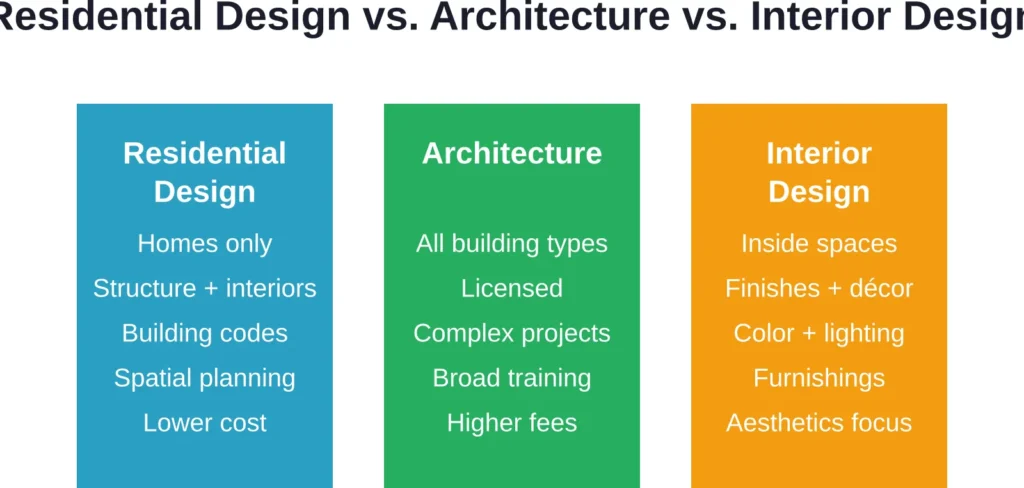
Residential Design vs. Architecture
Architects typically hold professional licenses requiring extensive education and examinations. They’re qualified to design buildings of any size and complexity, from homes to skyscrapers.
Residential designers (also called building designers or home designers) specialize specifically in homes. Many focus exclusively on residential projects and develop deep expertise in this niche. Depending on location, residential designers may or may not need licensing for certain project types.
The practical difference? For straightforward residential projects—a new single-family home or a room addition—a residential designer often provides everything needed. Their specialized focus means they understand residential building codes inside and out, stay current with home construction trends, and typically charge lower fees than architects.
Architects bring broader training and can handle complex projects requiring structural engineering integration, unusual sites, or commercial elements. But for many homeowners, a residential designer delivers exactly what’s needed without the added cost.
Residential Design vs. Interior Design
Interior design focuses on the spaces within the walls—finishes, furnishings, color schemes, lighting fixtures, and decorative elements. Interior designers create cohesive aesthetics and optimize how rooms function for daily life.
Residential design encompasses interior considerations but starts earlier in the process. It determines where those walls go in the first place, how big rooms should be, where windows and doors make sense, and how the building envelope performs.
The two disciplines frequently overlap. A comprehensive residential design includes interior layout planning. And interior designers often influence architectural decisions about built-ins, ceiling heights, or window placement during new construction or renovations.
Both focus on improving living spaces—residential design just starts from the ground (literally) up.
Why Residential Design Matters
Good residential design profoundly impacts quality of life. It’s not just about aesthetics—though beauty certainly matters. The way homes are designed affects health, safety, sustainability, comfort, and even social equity.
Health and Well-Being
According to the AIA Framework for Design Excellence, good design supports health and well-being for all people, considering physical, mental, and emotional effects on building occupants and the surrounding community.
Residential design decisions directly influence occupant health:
- Natural light exposure affects circadian rhythms and mental health
- Indoor air quality depends on ventilation design and material choices
- Acoustic design impacts sleep quality and stress levels
- Accessible design allows people to age in place safely
- Connection to outdoor spaces encourages physical activity
Design that prioritizes well-being includes operable windows, natural ventilation systems, and spaces utilizing outside air rather than recirculated air from other rooms. It means integrating no-smoking signage at entrances and creating layouts that encourage healthy lifestyles.
Environmental Sustainability
Here’s a stark fact: buildings are responsible for approximately 40% of all global greenhouse gas emissions through operations and construction.
Residential projects represent one of the most consistent opportunities for architects and designers to reduce this impact. While large commercial projects often garner sustainability honors, the sheer volume of residential construction means sustainable home design has massive leverage for environmental benefit.
Sustainable residential design incorporates:
- Energy-efficient building envelopes that reduce heating and cooling needs
- Passive solar design that harnesses natural heating and cooling
- High-performance windows and insulation
- Water conservation through efficient fixtures and rainwater harvesting
- Renewable energy integration like solar panels
- Durable, locally-sourced, and low-embodied-carbon materials
The AIA Framework for Design Excellence challenges designers toward a zero-carbon, healthy, just, resilient, and equitable built environment. Residential design sits at the heart of achieving these goals.
Safety and Building Standards
Residential design ensures homes meet safety standards that protect occupants. Building codes exist for good reason—they prevent fires, structural failures, electrical hazards, and countless other dangers.
HUD’s Minimum Property Standards establish certain minimum standards for buildings constructed under housing programs, covering new single-family homes, multi-family housing, and even healthcare facilities. These standards work alongside model building codes to ensure basic safety and habitability.
Professional residential designers navigate these requirements, ensuring homes aren’t just beautiful but fundamentally safe and code-compliant.
Social Equity and Changing Demographics
American households have become increasingly diverse in structure and composition. Good residential design responds to this diversity, creating flexible spaces that adapt to different family structures, work-from-home needs, multi-generational living, and accessibility requirements.
Design also impacts social equity at a community level. Thoughtful residential planning considers how housing choices affect neighborhood resilience, access to resources, and environmental justice. The example of New Orleans’ Lower Ninth Ward—98% African American at the time of Hurricane Katrina and, more than 15 years later, the area has yet to fully recover—illustrates how design decisions intersect with social and environmental vulnerability.
The Residential Design Process
Residential design unfolds in phases, each building on the previous work. Understanding this process helps homeowners and designers collaborate effectively.
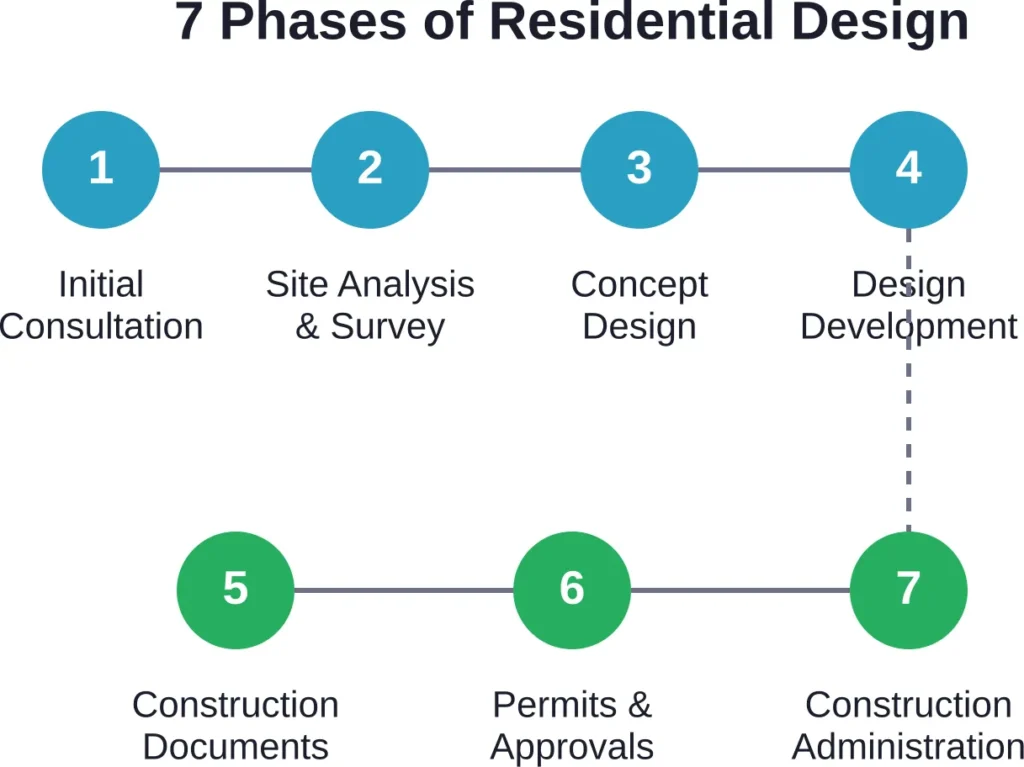
Phase 1: Initial Consultation and Programming
Everything starts with understanding client needs. What’s the budget? How many bedrooms? Any must-have features? How will the home be used daily?
Designers gather information about lifestyle, aesthetic preferences, functional requirements, and constraints. This programming phase establishes the foundation for all subsequent work.
Phase 2: Site Analysis and Survey
Every site has unique characteristics—topography, sun orientation, views, access points, utilities, soil conditions, and local zoning restrictions.
Thorough site analysis determines how the home should sit on the land, which way it should face, where drainage needs consideration, and what site challenges require creative solutions.
Phase 3: Concept Design
Now the creative work begins. Designers develop initial concepts showing overall layout, room arrangement, exterior style, and how the building responds to the site.
Concept designs are often rough sketches or simple 3D models. They explore different approaches before committing to details. Client feedback at this stage shapes the direction.
Phase 4: Design Development
Once a concept gets approval, designers refine it. Dimensions become precise. Materials get specified. Building systems are integrated. Details emerge.
Design development produces more accurate drawings showing exactly what will be built, though not yet at construction-document detail level.
Phase 5: Construction Documents
These are the detailed plans builders use to construct the home. Construction documents include:
- Floor plans with all dimensions and room labels
- Elevations showing exterior views
- Sections cutting through the building to show vertical relationships
- Foundation and framing plans
- Electrical, plumbing, and HVAC layouts
- Material and finish specifications
- Construction details for complex connections
Thorough construction documents prevent confusion, reduce change orders, and ensure the design vision becomes reality.
Phase 6: Permits and Approvals
Before construction begins, plans must receive approval from local building departments. Designers typically manage permit submission, responding to reviewer comments and making necessary revisions to achieve approval.
Phase 7: Construction Administration
Even with perfect plans, questions arise during construction. Designers often provide construction administration services—answering contractor questions, reviewing submittals, visiting the site, and ensuring the built result matches the design intent.
Get BIM Support for Residential Design Projects
Residential design projects require coordination between architecture, structure, MEP systems, and construction documentation. Powerkh supports residential project delivery with BIM modelling, coordination, and technical documentation services.
Need Residential Design Support?
Talk with Powerkh to:
- develop BIM models for residential projects
- support coordination across disciplines
- prepare technical drawings and documentation
- improve project delivery workflows
Talk with Powerkh about BIM support for residential developments.
Key Principles of Good Residential Design
What separates good residential design from mediocre? Several core principles consistently appear in successful projects.
Balance and Proportion
Good residential design achieves visual and functional balance. Room sizes should feel appropriate to their purpose. Exterior proportions should create harmony. Elements shouldn’t overwhelm or underwhelm.
Balance isn’t about symmetry—though symmetry can create balance. It’s about visual weight feeling distributed properly, so nothing looks awkward or out of place.
Flow and Circulation
How people move through a home matters immensely. Good circulation means:
- Clear paths from entry to main living areas
- Logical progression through spaces
- Private areas separated from public areas
- Minimal wasted hallway space
- Easy access to outdoor areas
Awkward circulation creates daily frustration. Thoughtful circulation makes homes feel intuitive and comfortable.
Natural Light and Views
Daylight transforms spaces. Strategic window placement brings light deep into the home, reduces energy needs, and connects occupants with the outdoors.
Good designers consider sun angles, privacy needs, and how light changes throughout the day and across seasons.
Flexibility and Adaptability
Life changes. Kids grow up. Work arrangements shift. Aging brings new mobility needs.
Residential design that accommodates change serves homeowners better over time. This might mean bedrooms sized to function as home offices, main-floor layouts that work for aging in place, or bonus spaces with flexible purposes.
Context and Climate Response
Homes don’t exist in isolation. Good residential design responds to its climate, neighborhood character, and regional building traditions while still feeling fresh and personal.
Climate-responsive design positions homes to harness or block sun exposure as needed, uses materials appropriate to local weather, and incorporates strategies like natural ventilation where climate allows.
Residential Design Trends in 2026
While core design principles remain constant, residential design trends evolve with technology, environmental awareness, and changing lifestyles.
| Trend | Description | Impact |
|---|---|---|
| Net-zero homes | Designs that produce as much energy as they consume through efficiency and renewables | Dramatically reduced operating costs and environmental footprint |
| Universal design | Spaces usable by people of all ages and abilities without specialized adaptation | Homes that support aging in place and accommodate diverse needs |
| Biophilic design | Integration of natural elements, materials, and connections to nature throughout the home | Improved mental health, reduced stress, enhanced well-being |
| Multi-generational layouts | Flexible spaces that accommodate extended family while maintaining privacy | Supports diverse family structures and caregiving arrangements |
| Smart home integration | Technology infrastructure planned from the design phase for automation and efficiency | Enhanced comfort, security, and energy management |
These trends reflect broader societal shifts toward sustainability, inclusivity, and adaptability—principles embedded in frameworks like AIA’s Design Excellence standards.
Choosing Between a Residential Designer and an Architect
So when does a project need an architect versus a residential designer?
Generally speaking, residential designers work well for:
- New single-family homes of typical size and complexity
- Additions and renovations to existing homes
- Projects with straightforward structural requirements
- Budgets where professional fees are a significant concern
Architects make more sense for:
- Unusual or challenging sites requiring creative structural solutions
- Projects mixing residential and commercial uses
- Historically significant properties needing specialized expertise
- Complex, high-end custom homes with unique requirements
- Projects requiring licensed professional stamps (varies by jurisdiction)
That said, many residential designers produce exceptional work for sophisticated clients. And plenty of architects happily take on simple projects.
The best approach? Interview professionals from both backgrounds. Evaluate their portfolios, ask about their experience with similar projects, and assess whether their process and communication style fits your needs.
The Cost of Residential Design
Design fees vary widely based on project complexity, location, professional experience, and scope of services.
Residential designers typically charge using various fee structures based on project type and scope.
Fee arrangements might include hourly rates for specific services, flat fees for defined projects, or percentage-based pricing tied to construction budgets. Architects generally charge at the higher end of these ranges or slightly above, particularly for custom work.
The investment in good residential design typically pays for itself through fewer construction problems, better material choices, more efficient building systems, and higher resale value. Not to mention the intangible value of living in a space that genuinely works well.
Frequently Asked Questions
A residential designer creates comprehensive plans for homes, including floor plans, elevations, structural layouts, and construction details. They work with clients to understand needs, develop design concepts, produce construction documents, and often help navigate the permitting process. Many also provide construction administration to ensure designs are built correctly.
For most single-family home projects, a residential designer can provide all necessary services, often at lower cost than an architect. Architects are typically needed for complex projects, mixed-use buildings, historically significant properties, or when local regulations require a licensed architect’s stamp. Evaluate your specific project needs and interview professionals from both backgrounds.
The timeline varies based on project complexity and client decision-making speed. A typical new home design might take 3-6 months from initial consultation through construction documents. Simple renovations might take 4-8 weeks. Complex custom homes can require 6-12 months or more. Factor in additional time for permit approvals, which varies by jurisdiction.
Residential design encompasses the entire building—structure, envelope, room layouts, and how the building sits on the site. Interior design focuses on finishes, furnishings, color schemes, lighting, and decorative elements within existing or planned spaces. Residential design determines where walls go; interior design determines what those walls look like and what furniture goes in front of them.
Design costs vary significantly based on project complexity and location. Fee structures typically include hourly rates, flat-fee arrangements for standard projects, or percentage-based pricing. Different fee models offer cost predictability and flexibility depending on the project scope.
The International Residential Code (IRC) provides the most widely adopted model code for one- and two-family dwellings and townhouses up to three stories. Many jurisdictions adopt the IRC with local amendments. HUD’s Minimum Property Standards apply to federally-backed housing programs. State and local codes may impose additional requirements. Professional residential designers stay current with applicable codes in their practice areas.
Sustainable residential design reduces environmental impact through energy-efficient building envelopes, passive solar strategies, renewable energy integration, water conservation, durable and low-embodied-carbon materials, and site planning that preserves natural features. Given that buildings account for approximately 40% of global greenhouse gas emissions, sustainable home design offers significant leverage for environmental benefit.
Conclusion
Residential design shapes the places we call home—and by extension, shapes our daily lives.
From structural fundamentals to aesthetic flourishes, from building code compliance to sustainability goals, residential design balances countless factors. Done well, it creates homes that are safe, comfortable, beautiful, efficient, and adaptable.
The field encompasses specialized knowledge of residential construction, deep understanding of how people live, and creative problem-solving that turns constraints into opportunities.
Whether you’re planning a new home, considering a major renovation, or simply curious about the built environment, understanding residential design reveals how intentional decisions—about room proportions, window placement, material selection, and spatial flow—profoundly impact the human experience.
The best residential design goes beyond shelter. It creates places where life unfolds comfortably, where families grow, where work and rest both find their space, and where the daily routines of living feel somehow better than they might elsewhere.
That’s the power of thoughtful residential design. And that’s why it matters.
Ready to start your own residential design project? Connect with experienced residential designers or architects in your area who can help transform your vision into a well-designed reality.