

Quick Summary: The best structural steel detailing companies provide precision shop and erection drawings, BIM coordination, and fabrication-ready deliverables. Top agencies include specialized firms across the U.S. offering services from Tekla modeling to CNC files, serving fabricators, contractors, and erectors with accurate, code-compliant documentation that streamlines construction workflows.
Structural steel detailing serves as the critical bridge between engineering design and fabrication. Without precise shop drawings and erection plans, steel fabricators would struggle to translate architectural visions into buildable frameworks.
The right detailing partner transforms structural plans into fabrication-ready documentation. But with dozens of companies offering steel detailing services, how do project teams identify the best fit?
This guide profiles ten leading structural steel detailing companies, examining their core services, technical capabilities, and what sets them apart in a competitive market.
What Steel Detailing Companies Actually Do
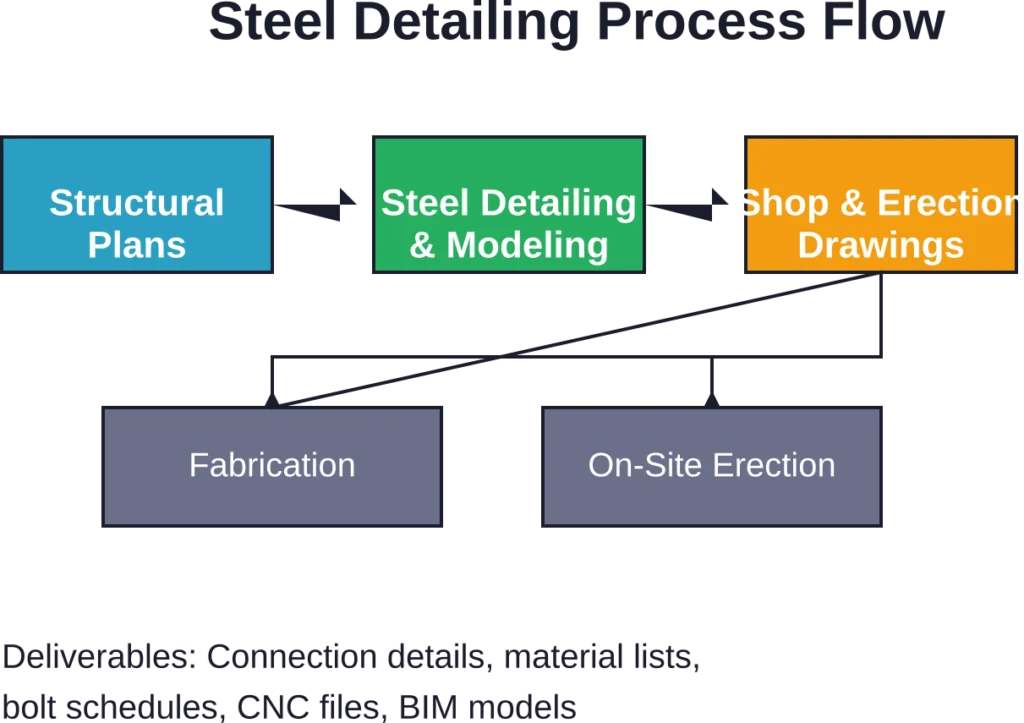
Steel detailing is like a shop drawing, but specifically for steel fabricators. The main purpose of steel detailing is to produce the drawing that the steel fabricator will use to cut, weld, and build the steel framework for a construction project.
Think of it as layout instructions guiding fabricators on exactly how to install the steel framework. A steel detailer uses construction plans produced by architects and structural engineers as the foundation, then develops comprehensive fabrication and erection drawings.
These drawings include precise dimensions, connection details, bolt specifications, weld symbols, and material callouts. Fabricators rely on this documentation to manufacture individual steel components and assemble them correctly on-site.
The Top 11 Structural Steel Detailing Companies
Here’s a detailed look at ten leading companies providing structural steel detailing services across the United States and internationally.

1. Powerkh
Powerkh is a UK-based BIM and VDC consultancy with offices in the USA and Ukraine, providing structural steel detailing services for contractors, fabricators, and engineering teams. The company works on commercial, industrial, and mixed-use projects, supporting project teams with fabrication-ready steel models, shop drawings, and BIM coordination during design and construction stages.
Their services include structural steel detailing, connection detailing, clash detection, constructability review, and coordination between structural, architectural, and MEP systems. Powerkh works with Autodesk Revit, Tekla, and Navisworks to develop detailed steel models and support fabrication and installation workflows.
The company also provides Scan to BIM, point cloud modelling, and support for renovation and existing structure projects. Their approach is focused on accurate detailing, coordination between disciplines, and reducing issues before fabrication and on-site installation begin.
Contact Information:
- Website: www.powerkh.com
- Email: [email protected]
- Facebook: www.facebook.com/100064039650167
- LinkedIn: www.linkedin.com/company/powerkh
- Instagram: www.instagram.com/powerkh_com
- Address: 3, Lavinia Walk, Taw Hill, Swindon SN25 1AP
- Phone: +44 7490 426678
2. Adept Engineering
Based in both Namakkal, India and Schaumburg, USA, Adept Engineering is recognized among the top structural steel detailing companies in USA. The company delivers precision-driven fabrication-ready shop and erection drawings, BIM coordination, quantity take-offs, and CNC files tailored to U.S. fabricators since 2013.
Chicago fabricators and contractors across the country choose Adept for their Tekla expertise and understanding of American Institute of Steel Construction standards. Their dual-location model combines offshore efficiency with U.S.-based project management.
Services include structural and miscellaneous steel detailing, connection design support, and 3D modeling for clash detection. The team works with commercial buildings, industrial facilities, and infrastructure projects.

3. JMT Consultants Inc.
JMT Consultants Inc. provides structural and miscellaneous steel detailing in Houston, serving projects throughout Texas and beyond. The company helps clients bring structures to life through expert steel detailing backed by decades of experience.
Their shop drawings simplify fabrication with accurate dimensions, clear connection details, and comprehensive material specifications. The team serves projects throughout Texas and understands regional building codes and local fabricator requirements.
JMT focuses on creating documentation that saves time during fabrication and erection phases. Their services span structural steel frameworks, miscellaneous metals, stairs, railings, and architectural steel elements.

4. DraftingServices.com
Operating out of NYC since 2007, DraftingServices.com provides steel shop drawing services to contractors, fabricators, and erectors across the United States. The company emphasizes fast replies, reliable turnaround times, and accurate shop drawings.
Every week the team creates erection and fabrication shop drawings for diverse project types. Their New York City base gives them extensive experience with complex urban construction requirements and tight site constraints.
The company handles both structural and miscellaneous steel detailing, producing drawings that translate construction plans into buildable instructions. Their client base includes general contractors and specialty steel fabricators.

5. Matrix Steel Solutions
Matrix Steel Solutions is a structural steel detailing company in USA offering structural steel design and drafting services with BIM and Tekla detailing. The firm positions itself as delivering precision engineering for fabrication excellence.
Their service portfolio covers the full spectrum from initial modeling through final CNC output files. Matrix works with fabricators who need detailed connection designs, bolt lists, and material tracking throughout project lifecycles.
The company emphasizes technology adoption, utilizing advanced software platforms to coordinate complex assemblies and identify potential issues before fabrication begins. Their deliverables support lean manufacturing workflows.

6. CAD Crowd Network
CAD Crowd operates as a platform connecting clients with steel detailing professionals rather than functioning as a traditional single-office firm. The network includes numerous detailers specializing in CAD drafting and steel shop drawings.
This model provides flexibility for clients who need to scale resources up or down based on project demands. The platform vets detailers and manages quality control across distributed teams.
Services available through the network include structural steel detailing, miscellaneous metals, connection design, and 3D modeling. Clients can access specialists with particular industry experience or software expertise.

7. Industrial Services Enterprises (ISE)
While primarily known as a steel fabricator in New Jersey and Pennsylvania, Industrial Services Enterprises maintains in-house detailing capabilities that serve both internal fabrication needs and external clients.
Their detailing team understands fabrication from the shop floor perspective, producing drawings optimized for efficient manufacturing. This fabricator-detailer integration reduces coordination issues and speeds project delivery.
ISE’s detailing services cover structural steel frameworks for commercial and industrial buildings throughout the Mid-Atlantic region. Their knowledge of local fabrication practices and regional suppliers adds practical value.
8. Powerkh Engineering
Powerkh positions itself among the best structural steel detailing companies in the USA, offering comprehensive documentation services for fabricators and contractors. The company handles projects ranging from small commercial buildings to large industrial complexes.
Their deliverables include detailed shop drawings, erection plans, connection designs, and material reports. Powerkh emphasizes accuracy and compliance with AISC standards and client-specific requirements.
The team works across multiple software platforms, adapting to client preferences and project specifications. Their quality control process includes internal reviews before submitting drawings for approval.

9. Offshore Outsourcing India
Offshore Outsourcing India provides structural steel detailing services to U.S. clients seeking cost-effective offshore partnerships. The company employs Tekla-certified detailers familiar with American construction standards.
Their service model appeals to fabricators and contractors who need to supplement in-house detailing capacity during peak periods. Time zone differences enable round-the-clock project progress.
Deliverables include 3D models, shop drawings, erection drawings, and CNC files. The firm maintains quality assurance protocols designed to meet U.S. fabricator expectations and submittal requirements.
10. Detail Engineering Services
Detail Engineering Services specializes in structural and miscellaneous steel detailing for commercial construction, focusing on accuracy and constructability. The company serves general contractors, steel fabricators, and erectors.
Their process begins with thorough plan review and continues through detailed modeling, connection design, and drawing production. The team coordinates with structural engineers when design clarifications are needed.
Services extend beyond basic detailing to include material optimization, erection sequencing input, and field support. Their experience spans office buildings, retail centers, parking structures, and industrial facilities.
11. Steel Detailing America
Steel Detailing America offers nationwide coverage with a focus on mid-size fabricators and regional contractors. The company provides both structural steel and miscellaneous metals detailing.
Their team produces shop drawings, erection plans, and anchor bolt plans using industry-standard software. They emphasize communication throughout the project lifecycle, from kickoff meetings through final revisions.
The firm’s client base includes fabricators working on educational buildings, healthcare facilities, and light industrial projects. Their understanding of various steel connection types and regional construction practices supports diverse project requirements.

Key Services Offered by Steel Detailing Companies
Understanding what services different companies provide helps match the right detailer to specific project needs.
Shop Drawing Production
Shop drawings form the core deliverable for all steel detailing companies. These detailed fabrication drawings show individual piece marks, dimensions, hole locations, weld specifications, and material grades.
Fabricators use shop drawings to manufacture each steel component. The drawings must be accurate enough that shop workers can produce parts without needing additional clarification or field measurements.
Erection Drawings
Erection drawings provide the roadmap for assembling fabricated steel on-site. These drawings show how individual pieces connect, the erection sequence, and temporary bracing requirements.
Steel erectors depend on clear erection plans to safely and efficiently build the structural framework. Good erection drawings anticipate site logistics and crane placement.
BIM and 3D Modeling
Building Information Modeling represents the modern standard for steel detailing. Companies create 3D models in software like Tekla Structures, which automatically generates shop drawings from the model.
3D modeling enables clash detection with other building systems before fabrication begins. Coordination meetings use the model to resolve conflicts between steel, mechanical, electrical, and architectural elements.
Connection Design
Some steel detailing companies offer connection design services, going beyond documentation to provide engineering calculations. This service determines connection capacity, bolt sizes, weld requirements, and plate thicknesses.
Not all detailers are qualified for connection design—it requires engineering expertise and proper licensure. When detailers provide this service, it can streamline projects by eliminating back-and-forth with separate engineers.
Material Takeoffs and Reports
Accurate material lists help fabricators order correct quantities and grades of steel. Detailing companies generate bills of material from their models, broken down by piece marks and assembly locations.
These reports support purchasing, inventory management, and shipping logistics. Some detailers also provide weight reports for crane planning and structural load tracking.
What to Look for When Choosing a Steel Detailing Company
Several factors influence which detailing company best fits a particular project or long-term partnership.
Software Capabilities
Most fabricators have preferred detailing software. Tekla Structures dominates the U.S. market, but some shops use SDS/2, Advance Steel, or other platforms.
Compatibility matters—if a fabricator runs their shop from Tekla models, hiring a detailer who works in incompatible software creates conversion hassles. Confirm software alignment before engaging a detailing company.
Industry Experience
Steel detailing requirements vary significantly across building types. Commercial office structures have different connection standards than industrial plants or bridge projects.
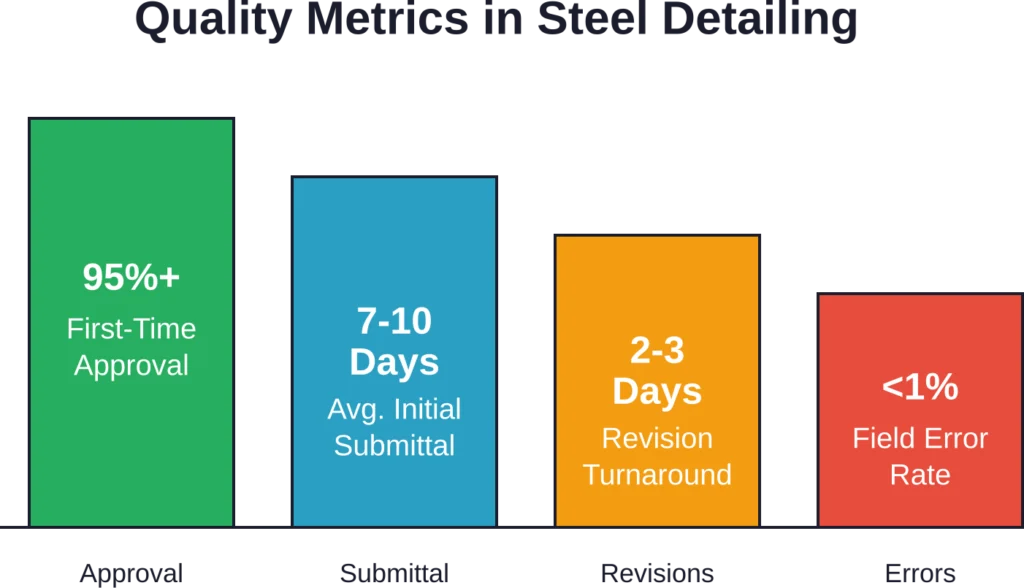
Detailers with relevant industry experience understand typical details, applicable codes, and common fabrication practices for specific project types. This knowledge reduces errors and revision cycles.
Turnaround Time and Communication
Construction schedules often demand quick detailing turnarounds. Companies that respond promptly to questions and deliver on schedule keep projects moving forward.
Communication patterns matter as much as speed. Detailers who proactively flag potential issues or suggest constructability improvements add value beyond basic documentation.
Quality Control Processes
Internal review procedures catch errors before drawings reach the fabricator. Companies with multi-level checking systems produce more accurate deliverables.
Ask potential detailing partners about their QA protocols. How many people review drawings before submission? What checklists do they follow? How do they track and resolve markups?
| Evaluation Criteria | Why It Matters | Questions to Ask |
|---|---|---|
| Software Platform | Ensures file compatibility with fabrication systems | Which platforms do you support? Can you provide native model files? |
| AISC Knowledge | Guarantees code-compliant connection details | How do you stay current with AISC specifications? Who reviews for code compliance? |
| Project Experience | Reduces learning curve for project-specific requirements | How many similar projects have you detailed? Can you provide references? |
| Response Times | Prevents schedule delays from coordination questions | What is your typical RFI response time? How do you handle urgent requests? |
| Revision Process | Streamlines markup incorporation and resubmittals | How do you track and implement markup comments? What is your revision turnaround? |
Regional Considerations for U.S. Projects
Steel construction practices vary somewhat by region due to local codes, seismic requirements, and fabricator preferences.
Seismic Design Zones
West Coast projects in California, Oregon, and Washington have stringent seismic detailing requirements. Connection details must accommodate movement and meet special inspection standards.
Detailers working in high-seismic zones need familiarity with special moment frames, braced frame requirements, and AISC 341 provisions. This specialization isn’t necessary for projects in low-seismic regions.
Building Code Variations
While most jurisdictions adopt the International Building Code, local amendments create variations. Some cities have additional requirements for high-rise construction, fire ratings, or inspection procedures.
Detailing companies with regional experience understand these local quirks. Houston detailers know Texas practices; New York detailers understand NYC building department expectations.
Fabricator Networks
Regional fabricator networks develop preferred connection standards and detailing conventions. Detailers who regularly work with fabricators in a region learn their shops’ capabilities and preferences.
This familiarity leads to more efficient fabrication. Detailers design connections that match available equipment and avoid details requiring specialized capabilities the fabricator doesn’t have.
Technology Trends Shaping Steel Detailing
The steel detailing industry continues evolving as new technologies enable more efficient workflows.
Advanced BIM Coordination
Multi-trade coordination through federated BIM models has become standard on complex projects. Steel detailers participate in virtual design coordination meetings alongside MEP trades and other specialties.
This process identifies clashes earlier than traditional 2D drawing coordination. Resolving conflicts in the model prevents costly field rework when incompatibilities surface during construction.
Automated Drawing Production
Modern detailing software automates much of the drawing production process. Once the 3D model is complete, software generates shop drawings, material reports, and even CNC files with minimal manual drafting.
This automation improves consistency and reduces production time. Detailers spend more effort on modeling accuracy and connection design rather than manual drafting tasks.
Cloud Collaboration Platforms
Cloud-based project management tools enable real-time collaboration between detailers, fabricators, engineers, and contractors. Teams access current drawings, track RFIs, and manage submittals through shared platforms.
These systems create audit trails documenting when drawings were revised and who approved changes. The transparency reduces coordination confusion on fast-track projects.
Common Challenges and How Top Companies Address Them
Every steel detailing project encounters obstacles. How companies handle these challenges separates adequate detailers from exceptional ones.
Incomplete Structural Drawings
Detailers often receive structural plans with missing dimensions, unspecified connection types, or conflicting information between drawings and calculations.
Top detailing companies don’t just highlight problems—they propose solutions. They submit detailed RFIs with suggested resolutions based on standard practices, helping engineers quickly address issues.
Fast-Track Schedules
Compressed construction timelines pressure detailers to produce drawings before all design information is available. Changes during detailing create rework and coordination headaches.
Experienced detailers manage this through phased releases, detailing portions of the project as information becomes firm while flagging areas awaiting final design decisions. Clear communication about what’s ready and what’s pending prevents fabrication false starts.
Fabricator-Specific Requirements
Each fabricator has unique capabilities, preferred connection types, and shop standards. Details that work for one fabricator might be inefficient or impossible for another.
Smart detailing companies learn their clients’ shop capabilities and detail accordingly. They design connections using standard angles and plates the fabricator stocks, avoid welds requiring specialized qualifications, and sequence assemblies to match the shop’s workflow.
Frequently Asked Questions
Structural engineers design the steel framework, determining member sizes, load paths, and connection requirements. Steel detailers take those engineering designs and create fabrication drawings showing exactly how to build each component. Engineering focuses on structural adequacy; detailing focuses on constructability.
Detailing timelines vary based on project complexity and size. Small commercial buildings might require 2-4 weeks for initial submittals. Large or complex structures can take 8-12 weeks or more. Phased detailing on fast-track projects releases portions of the structure as design information becomes available.
Steel detailers don’t require engineering licenses to produce shop drawings based on sealed engineering plans. However, if a company provides connection design or engineering analysis, those services must be performed by or under the supervision of a licensed professional engineer.
Standard deliverables include PDF shop drawings and erection plans. Many companies also provide native model files in formats like Tekla, SDS/2, or IFC for coordination. CNC fabrication files come in DXF, DWG, or machine-specific formats. Material reports are typically delivered as Excel spreadsheets or CSVs.
Many U.S. fabricators and contractors successfully work with offshore detailing companies. The key is ensuring the offshore team understands American Institute of Steel Construction standards, U.S. building codes, and imperial measurement systems. Time zone differences can be managed through overlapping work hours and clear communication protocols.
While specific rates vary, detailing companies structure fees in several ways: per ton of steel detailed, per drawing sheet, hourly rates, or lump sum for the entire project. Complexity, schedule, and scope of services affect total costs. Some companies offer different rates for initial detailing versus revision work.
The most important software is whatever platform your fabrication shop uses. Tekla Structures is the dominant platform in the U.S., but SDS/2 and Advance Steel also have significant market share. Beyond the primary detailing software, look for companies proficient in Navisworks or similar tools for BIM coordination, and AutoCAD for 2D work when needed.
Making the Right Choice for Your Steel Projects
Selecting a steel detailing company comes down to finding the right match between project requirements and company capabilities.
Start by clarifying what services the project needs. Basic shop drawings? Full BIM coordination? Connection design support? Material optimization? Different companies excel in different areas.
Check references and review sample drawings. Past performance with similar projects indicates how a detailer will handle current challenges. Talk to fabricators who’ve worked with the company—they’ll share insights about accuracy, responsiveness, and constructability.
Consider the working relationship beyond just technical capabilities. Steel detailing requires ongoing coordination throughout the project. Companies that communicate clearly, respond quickly to questions, and proactively solve problems make better long-term partners than those with slightly lower rates but poor responsiveness.
The ten companies profiled here represent strong options across different project types and service models. Adept Engineering and Matrix Steel Solutions bring offshore cost advantages with U.S. standards compliance. Regional specialists like JMT Consultants and DraftingServices.com offer local market knowledge. Platform networks like CAD Crowd provide flexibility for variable workloads.
Take time to evaluate which company aligns with project priorities. The right steel detailing partner doesn’t just produce drawings—they become an extension of the project team, contributing to successful fabrication and construction outcomes.