

Quick Summary: Using the wrong engine oil can lead to reduced lubrication, increased friction, overheating, and long-term engine damage. Symptoms include unusual noises, oil leaks, poor performance, and decreased fuel efficiency. If the wrong oil is detected early, draining and replacing it can prevent serious damage, but prolonged use may require professional inspection or costly repairs.
Most drivers have experienced that sinking feeling at the auto parts store: staring at rows of motor oil bottles, wondering if the one in hand is actually the right one. And sometimes, mistakes happen. The wrong oil gets poured into the engine.
But what actually happens when the wrong engine oil ends up in your car?
The consequences range from minor performance issues to catastrophic engine failure, depending on what type of oil was used and how long the vehicle runs with it. Understanding these risks can save thousands in repair costs.
Why Engine Oil Type Matters So Much
Engine oil isn’t just a generic lubricant. It’s a carefully engineered fluid designed to match specific engine requirements.
According to Purdue Agriculture research, conventional engine oils consist of approximately 80 percent refined crude oil (called base oil), with the remaining 20 percent being additives that serve numerous purposes that serve numerous purposes. These additives control viscosity, prevent corrosion, clean engine components, and manage thermal stability.
Different engines operate under different conditions. A high-performance sports car generates more heat and friction than a standard commuter sedan. A diesel engine has completely different lubrication needs than a gasoline engine.
Manufacturers specify oil types for good reason. The wrong viscosity, additive package, or oil formulation disrupts the delicate balance the engine requires.
What Viscosity Actually Means
Viscosity is oil thickness. That 5W-30 or 10W-40 rating on the bottle? It indicates how the oil flows at different temperatures.
The first number (with the W for winter) shows cold-temperature flow characteristics. The second number represents viscosity at operating temperature. Oil that’s too thick won’t flow properly when cold. Oil that’s too thin won’t protect adequately when hot.
Using oil with incorrect viscosity is one of the most common mistakes. And it creates immediate problems.
What Happens When You Put the Wrong Oil in Your Car
The consequences depend on how different the wrong oil is from what the engine needs. Here’s what occurs inside the engine.
Inadequate Lubrication and Increased Friction
Engine components move at incredible speeds, with metal surfaces constantly sliding against each other. Proper oil creates a protective film that prevents metal-to-metal contact.
Wrong oil viscosity disrupts this protection. If the oil is too thin, it breaks down under pressure and heat, allowing components to grind together. If it’s too thick, it doesn’t flow quickly enough to reach critical areas.
The result? Accelerated wear on bearings, camshafts, pistons, and cylinder walls. This wear happens silently at first, then progressively worsens.
Overheating Issues
Oil doesn’t just lubricate—it cools. As it circulates, it carries heat away from combustion chambers and friction points.
Wrong oil formulations manage heat differently. Some break down faster under thermal stress. Others don’t transfer heat as efficiently. When cooling capacity drops, engine temperatures climb.
Sustained overheating warps metal components, damages gaskets, and accelerates oil degradation. It creates a destructive feedback loop.
Engine Seal and Gasket Damage
Modern engines use synthetic seals and gaskets engineered for specific oil formulations. These seals maintain proper compression and prevent leaks.
Some oil types contain additives that cause seals to swell or shrink. Using oil with incompatible additives can make seals brittle, causing them to crack. Or they expand beyond proper tolerances, creating compression loss.
Oil leaks follow. And with leaks come low oil levels, which compound the damage.
Sludge and Deposit Formation
When oil breaks down prematurely—which wrong oil often does—it oxidizes and forms sludge. This thick, tar-like substance clogs oil passages, restricts flow, and coats components.
Sludge buildup chokes the engine. Oil can’t reach where it’s needed. Moving parts starve for lubrication. Performance drops dramatically.
Research on engine oil deterioration shows that after extended use (more than 10,000 km), oil properties such as viscosity at cold ignition, 40 °C and 100 °C dropped 22.92%, 23.61% and 26.13% respectively, affecting engine performance. Using the wrong oil accelerates this deterioration process.
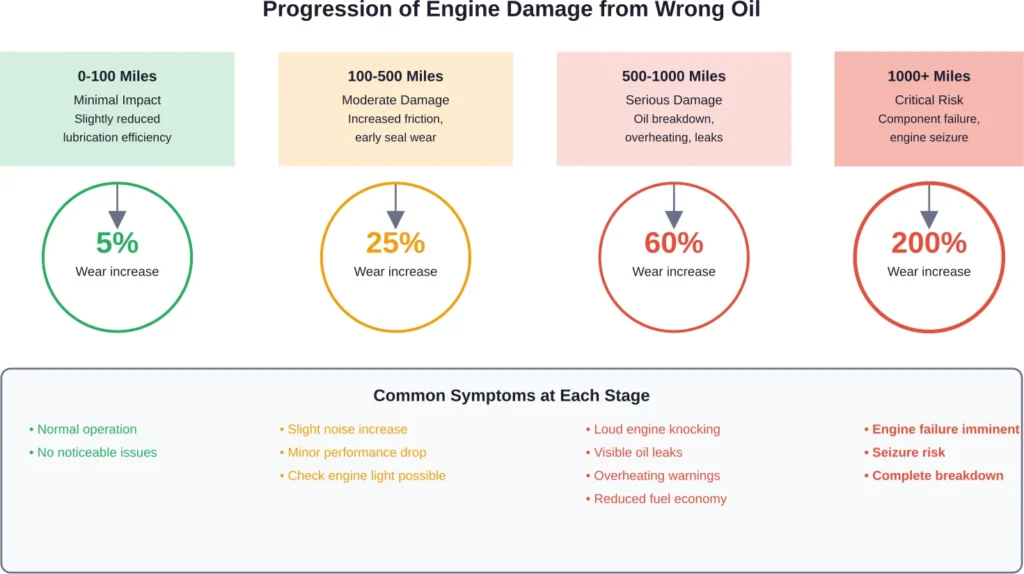
Common Symptoms of Using the Wrong Engine Oil
How does someone know if the wrong oil is in the engine? Several warning signs appear, though their severity varies based on the oil mismatch.
Unusual Engine Noises
Properly lubricated engines run relatively quietly. When lubrication fails, metal components make contact, creating distinct sounds.
Knocking, ticking, or grinding noises indicate insufficient oil protection. These sounds often intensify during cold starts or under acceleration when oil pressure matters most.
Drivers frequently report hearing unusual noises as an early indicator something’s wrong with the oil.
Oil Pressure Warning Lights
Modern vehicles monitor oil pressure continuously. When pressure drops below safe thresholds, warning lights illuminate.
Wrong oil viscosity commonly triggers these warnings. Oil that’s too thin can’t maintain proper pressure. Oil that’s too thick restricts flow, creating pressure fluctuations.
Never ignore oil pressure warnings. They indicate immediate risk of engine damage.
Visible Oil Leaks
Finding puddles under the vehicle or noticing oil spots on the driveway signals leaking seals or gaskets.
As mentioned earlier, incompatible oil formulations damage seals. Once seals fail, oil escapes. Leaks not only create mess—they reduce oil levels, compounding lubrication problems.
Reduced Engine Performance
Engines running on wrong oil feel sluggish. Acceleration lags. Power output drops noticeably.
This happens because increased friction forces the engine to work harder for the same output. More energy goes toward overcoming resistance rather than generating power.
Drivers often describe the vehicle feeling “heavy” or “tired.”
Decreased Fuel Efficiency
Increased friction means the engine burns more fuel to produce equivalent power. Fuel economy suffers as a direct result.
Tracking fuel consumption provides an early warning system. Sudden drops in miles per gallon, without changes in driving habits, suggest underlying problems—potentially oil-related.
Engine Overheating
Temperature gauge readings climbing higher than normal indicate cooling problems. Wrong oil loses its heat-transfer capability faster.
Overheating compounds rapidly. Higher temperatures accelerate oil breakdown, which further reduces cooling, creating a destructive spiral.
Check Engine Light Activation
Modern engine management systems detect abnormalities in combustion, emissions, and sensor readings. Wrong oil can trigger various fault codes.
While a check engine light doesn’t definitively indicate oil problems, it warrants immediate diagnostic attention—especially if recent oil service occurred.
| Symptom | Severity Level | Typical Onset Time | Action Required |
|---|---|---|---|
| Unusual engine noises | High | Immediate to 100 miles | Stop driving, drain oil |
| Oil pressure warning | Critical | Immediate | Stop engine immediately |
| Visible oil leaks | Moderate to High | 100-500 miles | Inspect seals, replace oil |
| Reduced performance | Moderate | 50-200 miles | Schedule oil change |
| Decreased fuel economy | Low to Moderate | 100-300 miles | Monitor and replace oil |
| Engine overheating | High | Variable | Stop driving, inspect cooling system |
| Check engine light | Variable | Variable | Run diagnostics immediately |
Types of Oil Mistakes and Their Specific Consequences
Not all wrong oil scenarios create equal damage. The type of mistake determines the severity.
Wrong Viscosity Grade
Using 10W-40 instead of 5W-30, for example, changes flow characteristics significantly.
Thicker oil (higher numbers) creates more resistance, particularly in cold weather. Engines designed for thinner oil struggle to circulate thicker formulations, starving components during crucial startup moments.
Thinner oil than specified doesn’t maintain protective film thickness under operating temperatures and pressures. Metal-to-metal contact increases.
Conventional Oil in Synthetic-Required Engines
High-performance engines often require synthetic oil because of tighter tolerances and higher operating temperatures.
Conventional oil breaks down faster under these extreme conditions. It can’t handle the thermal stress. Using conventional oil in synthetic-specified engines accelerates wear dramatically and creates sludge buildup.
Diesel Oil in Gasoline Engines (or Vice Versa)
Diesel and gasoline engines have fundamentally different combustion characteristics. Their oils contain different additive packages.
Diesel oil contains higher levels of detergents and anti-wear additives. Using it in gasoline engines can damage catalytic converters and oxygen sensors.
Gasoline engine oil in diesel engines lacks the protection diesel combustion requires, leading to rapid component wear.
Mixing Different Oil Types
Topping off synthetic oil with conventional (or vice versa) dilutes the superior oil’s properties.
While not immediately catastrophic, mixing reduces the benefits of premium oil. Additives may interact unpredictably. The blend’s performance characteristics fall somewhere between the two—often closer to the inferior option.
Using Oil Beyond Its Specification
Oil technology evolves. Modern oils meet specific API (American Petroleum Institute) or ILSAC (International Lubricant Standardization and Approval Committee) standards.
Using outdated oil formulations in newer engines means missing crucial advancements in friction reduction, deposit control, and emissions compatibility. Older oil specifications simply don’t protect modern engines adequately.
Can the Wrong Oil Cause Permanent Damage?
The question everyone asks: is the damage reversible?
It depends entirely on how long the wrong oil remained in the engine and how severe the mismatch was.
Short-Term Exposure
If wrong oil is identified quickly—within the first few miles or before the vehicle is driven extensively—damage is often minimal or nonexistent.
Draining the incorrect oil and replacing it with the proper specification typically resolves the issue. A few miles of operation with moderately wrong oil rarely causes permanent harm to modern engines.
Extended Use
Once the vehicle runs hundreds or thousands of miles on wrong oil, wear accumulates. This wear is permanent.
Bearings develop grooves. Cylinder walls show scoring. Piston rings lose sealing capability. These aren’t reversible with an oil change—they require mechanical repair or replacement.
Catastrophic Failures
In worst-case scenarios, wrong oil leads to complete engine failure: seized bearings, broken connecting rods, destroyed camshafts.
These failures necessitate engine rebuilding or replacement. Repair costs easily reach thousands of dollars, often exceeding the vehicle’s value in older cars.
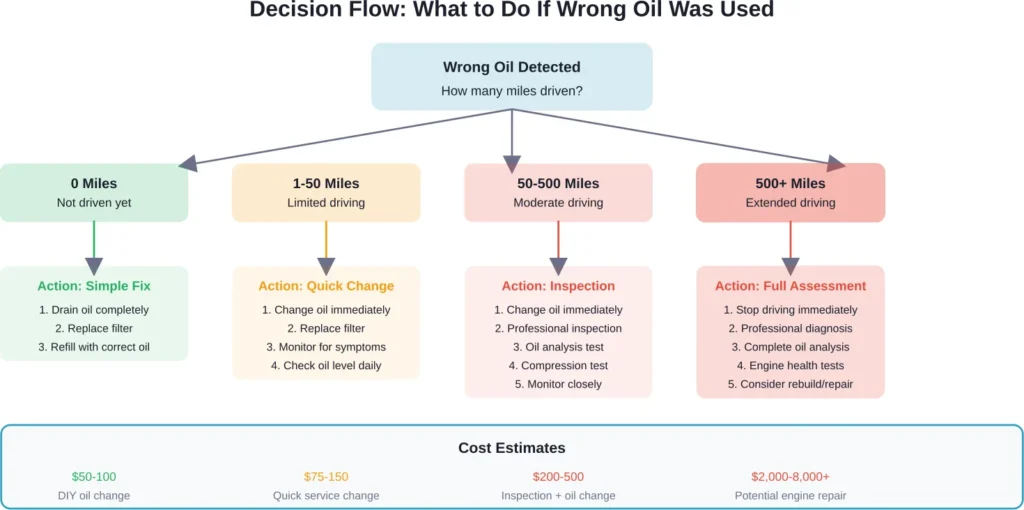
What to Do If Wrong Oil Was Used
Discovering wrong oil in the engine prompts immediate questions about next steps. Here’s the recommended approach.
If Discovered Before Driving
The best scenario: realizing the mistake before starting the engine.
Drain the incorrect oil completely. Replace the oil filter (it absorbed some of the wrong oil). Fill with the correct oil type and grade according to the owner’s manual specifications.
Check for any obvious leaks or issues, then proceed with normal operation.
If Discovered After Limited Driving
After driving 10-50 miles with wrong oil, damage risk exists but likely remains limited.
Schedule an immediate oil change—don’t wait until the next regular service interval. Drain the wrong oil, replace the filter, and refill with correct oil.
Monitor the engine closely over the next several hundred miles. Listen for unusual noises. Watch for warning lights. Check oil level and condition regularly.
If symptoms appear, seek professional inspection.
If Discovered After Extended Driving
After hundreds of miles, professional assessment becomes necessary.
Change the oil immediately, but don’t assume that solves underlying damage. Request a comprehensive engine inspection checking for:
- Bearing wear through oil analysis
- Compression loss indicating ring or valve damage
- Abnormal noises suggesting component wear
- Oil consumption rates
- Seal and gasket integrity
Mechanics can perform oil analysis to detect metal particles, which indicate internal wear. They can also conduct compression tests and leak-down tests to assess engine health.
Professional Oil Analysis
Many service centers offer oil analysis services. A sample of used oil is tested for:
- Metal particles (iron, copper, aluminum indicating component wear)
- Viscosity breakdown
- Additive depletion
- Contamination levels
- Fuel dilution
This analysis reveals whether significant damage occurred and whether the engine can continue operating safely.
How to Avoid Putting Wrong Oil in Your Car
Prevention beats repair every time. These strategies help ensure the correct oil goes into the engine.
Always Check the Owner’s Manual
Vehicle manufacturers specify exact oil requirements in the owner’s manual. This specification isn’t a suggestion—it’s an engineering requirement.
The manual lists viscosity grade, performance specifications (API, ILSAC ratings), and sometimes brand recommendations. Following these specifications exactly prevents most oil mistakes.
Owner’s manuals for most vehicles are available online through manufacturer websites like Ford and Toyota if the physical copy is unavailable.
Understand Oil Specifications
Learning to read oil bottle labels prevents confusion. Key information includes:
- Viscosity grade (5W-30, 10W-40, etc.)
- Oil type (conventional, synthetic blend, full synthetic)
- API service rating (SN, SP for gasoline; CJ-4, CK-4 for diesel)
- ILSAC certification mark
Matching these specifications to manual requirements ensures compatibility.
Keep Records
Maintaining service records helps track what oil type was used previously. This creates consistency and flags deviations.
Many drivers photograph the oil bottle after each change or keep receipts showing the specific product used.
Use Professional Service When Uncertain
When doubt exists about proper oil selection, professional service centers eliminate guesswork. They access databases listing exact specifications for every vehicle make and model.
The small service fee often costs less than fixing mistakes from using wrong oil.
Buy Oil in Advance
Purchasing the correct oil ahead of time—when there’s no time pressure—reduces rushed decisions that lead to mistakes.
Storing the right oil means it’s always available for changes, eliminating last-minute store trips where errors happen.
Special Considerations for Different Vehicles
Certain vehicle types have unique oil requirements that demand extra attention.
High-Performance and Sports Cars
Performance vehicles operate at higher RPMs and temperatures than standard cars. They typically require full synthetic oil with specific viscosity grades.
Using conventional oil—even briefly—in these engines causes accelerated wear. The performance demands exceed what conventional oil can handle.
Hybrid Vehicles
Hybrids present unique challenges. Their engines cycle on and off frequently, experiencing more cold starts than conventional vehicles.
Many hybrids require low-viscosity synthetic oils (0W-20, 0W-16) to reduce friction during these frequent startups. Using thicker oil significantly impacts the hybrid system’s efficiency and fuel economy.
Diesel Engines
Diesel engines absolutely require diesel-specific oil. The additive packages differ fundamentally from gasoline engine oils.
Diesel oil contains higher levels of detergents to handle soot from diesel combustion. It also has different anti-wear additives suited to diesel engine pressures and temperatures.
Turbocharged Engines
Turbochargers operate at extremely high temperatures and speeds. They demand synthetic oil with excellent thermal stability.
Wrong oil in turbocharged engines can cause turbo bearing failure, which requires expensive turbocharger replacement.
Older Vehicles
Classic cars and older vehicles sometimes need different oil than modern specifications suggest.
Older engines with looser tolerances may perform better with slightly higher viscosity oils. Additionally, some vintage engines require oils with ZDDP (zinc dialkyldithiophosphate) additives that have been reduced in modern formulations due to catalytic converter concerns.
Frequently Asked Questions
Damage timing varies dramatically based on how different the wrong oil is from specifications. Minor viscosity differences might allow hundreds of miles without serious harm, while severely mismatched oil (like diesel oil in a gasoline engine) can cause damage within miles. Generally speaking, even short exposure creates some accelerated wear. The safest approach: change oil immediately upon discovering the mistake, regardless of mileage.
Mixing brands with identical specifications (same viscosity, same API rating, same oil type) rarely causes problems. Modern oils from reputable manufacturers are compatible. However, mixing conventional with synthetic or different viscosity grades creates a blend with unpredictable properties. While not immediately catastrophic, the mixture won’t perform as well as the superior oil would alone. Best practice: stick with one oil type and specification rather than mixing.
Using higher-quality oil than specified typically doesn’t cause harm. Synthetic oil in an engine designed for conventional oil usually works fine—it’s over-engineering the solution. The exception: very old engines with worn seals might develop leaks with low-viscosity synthetics because the thinner oil seeps through gaps that thicker conventional oil sealed. For most vehicles built after 2000, upgrading to synthetic is safe and often beneficial.
This is a common one-grade viscosity difference. At operating temperature, 5W-30 is slightly thicker than 5W-20. The consequences are usually minor: marginally reduced fuel economy and possibly slight performance decrease. Engines designed for 5W-20 have tighter tolerances optimized for thinner oil, so thicker oil increases friction slightly. It won’t cause immediate damage, but long-term use may accelerate wear. Change to the correct 5W-20 at the next service interval.
Brand matters less than specifications. Any oil meeting the viscosity grade and API/ILSAC certifications required by the vehicle will function adequately. That said, oil quality does vary between manufacturers. Premium brands often include better additive packages, superior base stocks, and more consistent quality control. The specification certifications ensure minimum performance standards, but some brands exceed those minimums. Sticking with recognized brands provides reliability.
Yes, potentially. Manufacturer warranties typically require following specified maintenance procedures, including using correct oil specifications. If engine damage occurs and investigation reveals wrong oil was used, warranty claims may be denied. Dealerships and warranty administrators can check service records and analyze used oil to determine if specifications were met. Always keep receipts showing compliant oil was used for warranty protection.
Engine flushing after wrong oil is rarely necessary unless severe contamination or sludge formation occurred. In most cases, simply draining the incorrect oil, replacing the filter, and refilling with correct oil suffices. The new oil will gradually clean residual contaminants. However, if wrong oil created visible sludge or if symptoms persist after changing oil, a professional flush might help. Mechanics can assess whether flushing benefits the specific situation.
Protect Your Engine by Using the Right Oil
Engine oil seems simple—just a fluid that goes in the engine. But as this examination shows, using the wrong type creates consequences ranging from minor inefficiency to catastrophic failure.
The key takeaway? Oil specifications exist for engineering reasons, not marketing. Manufacturers determine requirements based on extensive testing of engine tolerances, operating temperatures, and performance characteristics.
When wrong oil ends up in an engine, time matters most. Early detection and correction prevent permanent damage. Extended use allows accelerated wear to accumulate, eventually requiring expensive repairs that far exceed oil change costs.
Prevention strategies are straightforward: consult the owner’s manual, understand oil specifications, keep records, and seek professional help when uncertain. These simple steps eliminate most oil mistakes.
For those who’ve already used wrong oil, immediate action offers the best outcome. Drain the incorrect oil, replace the filter, refill with proper specifications, and monitor the engine closely. Professional inspection provides peace of mind and catches developing problems before they become catastrophic.
The engine is the heart of the vehicle. Proper lubrication keeps that heart beating strong. Don’t risk thousands in repair costs by cutting corners on oil selection. Invest the small amount of time required to verify specifications—it’s the cheapest engine insurance available.