
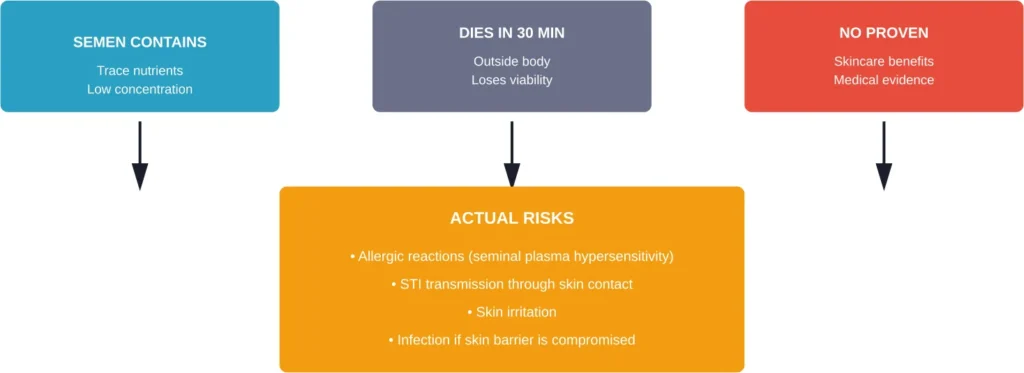
Quick Summary: Leaving sperm on skin poses minimal health risks for most people, though it offers no scientifically proven skincare benefits. While semen contains trace nutrients, the concentrations are too low to provide therapeutic effects. The primary concerns are potential allergic reactions (seminal plasma hypersensitivity) and STI transmission risk. Medical evidence shows sperm dies within 30 minutes outside the body, making any prolonged topical application ineffective for purported beauty benefits.
Social media influencers and beauty bloggers have made bold claims about semen’s skincare benefits. But what does medical science actually say about leaving sperm on skin?
The reality is far less exciting than viral TikTok videos suggest. While semen contains various proteins and nutrients, research doesn’t support the idea that topical application provides meaningful benefits. More importantly, there are legitimate health considerations worth understanding.
This article examines what actually happens when semen contacts skin, separating medical evidence from beauty industry hype.
The Biological Reality of Sperm on Skin
Outside the human body, sperm has a remarkably short lifespan. According to medical research, sperm begins to die and lose functionality after approximately 30 minutes of exposure to air.
Inside the female reproductive tract, sperm can survive up to 5 days in optimal conditions. But once exposed to environmental factors—air, temperature changes, pH variations—that viability plummets dramatically.
So what does this mean for skincare applications? Once semen dries on skin, the active components have already begun degrading. Any purported therapeutic benefit would need to occur within that narrow window, which makes sustained treatment claims questionable at best.
What Semen Actually Contains
Semen composition includes:
- Water (approximately 90% of volume)
- Proteins and enzymes
- Zinc and other trace minerals
- Fructose (energy source for sperm)
- Urea
- Small amounts of vitamins
- Spermidine and spermine (polyamines)
Here’s the thing though—the concentration of these nutrients is extremely low. The small quantities present in typical semen volume make any meaningful nutritional or therapeutic impact highly unlikely when applied topically.
The Skincare Claims Under Medical Scrutiny
Beauty influencers have promoted semen facials for various supposed benefits. But do these claims hold up to scientific examination?
Does Semen Help With Acne?
No credible medical evidence supports semen as an acne treatment.
While zinc has established benefits for acne management, semen contains only trace amounts—far less than over-the-counter acne products or dietary sources. A study published in the American Journal of Epidemiology found that a diet rich in plant-based protein, fruits, vegetables, and whole grains can promote healthy cellular aging.
Real talk: If zinc were the answer, dermatologists would recommend zinc supplements or topical treatments, not semen application.
Anti-Aging Properties: Fact or Fiction?
The anti-aging claims center on spermidine, a polyamine compound found in semen.
Research demonstrated that spermidine can accelerate skin wound healing. A 2021 study published in Cell Communication and Signaling (Cell Commun Signal. 2021 Mar 22;19:36) showed that systemic and topical spermidine administration promoted wound healing through urokinase-type plasminogen activator pathways.
But wait. These studies used concentrated, purified spermidine—not raw semen. The concentration in semen is nowhere near therapeutic levels used in clinical research.
Commercial skincare products containing synthesized spermine do exist. These formulations use concentrated, lab-created compounds in controlled doses, which is fundamentally different from applying bodily fluids to skin.
Protein Content and Skin Health
Some claim semen’s protein content nourishes skin. This misunderstands how skin absorbs nutrients.
Skin acts as a barrier, not a digestive system. Most protein molecules are too large to penetrate the epidermis effectively. The proteins in semen don’t magically bypass this biological reality.
For protein to benefit skin health, dietary intake matters far more than topical application. Nutrients reach skin cells through the bloodstream after digestion and metabolization—not through surface contact.
Potential Health Risks to Consider
While semen contact with intact skin poses minimal risk for most people, certain complications deserve attention.
Seminal Plasma Hypersensitivity: A Real Allergy
Seminal plasma hypersensitivity (SPH) is an allergic reaction to proteins in semen. Though likely underdiagnosed, it affects some individuals with varying severity.
Symptoms can include:
- Localized skin redness and irritation
- Burning or stinging sensations
- Hives or welts at contact sites
- Systemic reactions in severe cases
Medical literature documents cases of severe systemic reactions to seminal fluid with significant skin prick test responses. Diagnosis relies on thorough patient history and confirmatory skin prick testing. Anyone experiencing consistent irritation after semen contact should consult a dermatologist or allergist.
Sexually Transmitted Infection Risks
This is where things get serious. Semen can transmit various infections through skin contact, particularly if skin integrity is compromised.
According to the CDC, multiple pathogens can be present in semen:
- Zika virus persists longer in semen than other bodily fluids. Research shows that at >90 days after illness onset, less than 7% of participants had detectable Zika virus RNA in semen, with an estimated mean time to clearance of 54 days.
- Schistosoma haematobium eggs have been found in up to 43% of semen samples and in 33.3% of cervix biopsies obtained from endemic area populations.
- Syphilis-causing bacteria (Treponema pallidum) can be present at concentrations high enough to transmit disease
- Various other STI pathogens
Research led by the University of Washington School of Medicine suggests syphilis transmission may occur through semen contact, not just genital sores as traditionally believed.
Even micro-abrasions in skin—invisible to the naked eye—can provide pathogen entry points. Facial skin, often thinner and more sensitive than other areas, may be particularly vulnerable.
| Risk Factor | Concern Level | Notes |
|---|---|---|
| STI transmission | High | Especially with compromised skin barrier |
| Allergic reaction | Moderate | Affects susceptible individuals |
| Skin irritation | Low to Moderate | Depends on skin sensitivity |
| Proven skincare benefit | None | No scientific evidence supports claims |
General Skin Irritation
Beyond allergies and infections, semen can simply irritate skin, particularly sensitive facial skin.
Some individuals report redness, itching, or burning sensations after semen contact, though experiences vary. Skin sensitivity varies dramatically between individuals, making reactions unpredictable.
Why the Beauty Industry Promotes Semen Facials
If medical evidence doesn’t support the practice, why do spas and beauty influencers promote it?
Marketing, frankly. The novelty factor generates attention and clicks. Controversial or shocking beauty treatments create buzz, driving social media engagement and salon bookings.
Some establishments offer treatments using animal-derived spermine (often from salmon DNA, not actual sperm). These products—like Rejuran—use purified compounds in controlled formulations, which is entirely different from DIY applications of human semen.
That said, even commercial products containing spermine derivatives lack robust clinical evidence for dramatic skincare benefits. The concentration and delivery method matter enormously.
What Medical Experts Actually Recommend
Dermatologists consistently emphasize evidence-based skincare approaches. For concerns like acne, aging, or skin health, proven treatments include:
- Retinoids for cell turnover and collagen production
- Vitamin C serums for antioxidant protection
- Hyaluronic acid for hydration
- Sunscreen for preventing UV damage
- Niacinamide for inflammation and pore appearance
- Chemical exfoliants (AHAs, BHAs) for texture
These ingredients have extensive research backing their efficacy. They’re formulated at therapeutic concentrations, tested for safety, and designed for optimal skin absorption.
For overall skin health, lifestyle factors matter more than any topical treatment:
- Adequate hydration
- Balanced nutrition rich in antioxidants
- Quality sleep
- Stress management
- Sun protection
- Avoiding smoking
A study published in the American Journal of Epidemiology found that a diet rich in plant-based protein, fruits, vegetables, and whole grains can promote healthy cellular aging.
The Bottom Line on Semen and Skin Contact
Medical evidence doesn’t support using semen as a skincare treatment. The nutrient concentrations are too low to provide meaningful benefits, and sperm viability outside the body is extremely limited.
More importantly, legitimate health risks exist—from allergic reactions to potential STI transmission—that far outweigh any unproven cosmetic benefits.
Sound familiar? Another beauty trend that promised miracles without scientific backing. The skincare industry constantly cycles through novel ingredients and shocking treatments designed more for viral marketing than actual efficacy.
For anyone concerned about skin health, aging, or acne, evidence-based treatments recommended by dermatologists offer safer, more effective alternatives. Proper nutrition, sun protection, and clinically proven ingredients deliver results without unnecessary health risks.
If contact with semen occurs during sexual activity, simple washing with mild soap and water is sufficient for most people. Those experiencing consistent irritation should consult healthcare providers rather than assuming it’s normal.
Frequently Asked Questions
No. Pregnancy requires sperm to reach and fertilize an egg inside the reproductive tract. Sperm on external skin cannot cause pregnancy, as it cannot travel through intact skin to reach reproductive organs. Sperm also dies quickly when exposed to air and environmental conditions outside the body.
Sperm begins dying within approximately 30 minutes after exposure to air and environmental factors. Once semen dries on skin, sperm cells are no longer viable. This is drastically different from the 5-day survival time possible inside the female reproductive tract under optimal conditions.
No scientific evidence supports semen as an effective acne treatment or skincare product. While semen contains trace amounts of zinc and other nutrients, the concentrations are far too low to provide therapeutic benefits. Dermatologists recommend evidence-based treatments like retinoids, benzoyl peroxide, or salicylic acid for acne instead.
Yes. Seminal plasma hypersensitivity is a real allergic condition affecting some individuals. Symptoms range from localized redness and burning to more severe systemic reactions. Diagnosis typically involves patient history and skin prick testing. Anyone experiencing consistent irritation after semen contact should consult an allergist or dermatologist.
According to the CDC, various pathogens can be present in semen including Zika virus, syphilis bacteria, and others. Transmission risk increases if skin has cuts, abrasions, or compromised barrier function. Research from the University of Washington suggests syphilis may transmit through semen contact, not just genital sores as previously thought.
Washing with mild soap and water after contact is advisable, particularly if concerned about STI transmission or if experiencing any irritation. This simple hygiene practice removes potential pathogens and allergens. For most people with intact skin and known partners, immediate washing isn’t medically urgent but is generally recommended.
Commercial treatments using compounds like spermine typically use synthesized or animal-derived ingredients, not human semen. Even these products lack robust clinical evidence for dramatic skincare benefits. The concentrations and formulations differ significantly from raw semen, but medical support for efficacy remains limited regardless of the source.