

Quick Summary: Failing a drug test can result in consequences ranging from job offer withdrawal to immediate termination, depending on whether it’s pre-employment or workplace testing. Federal and state laws, company policies, and the specific circumstances all influence outcomes. Understanding your rights, potential for retesting, and available support resources helps navigate this challenging situation effectively.
Drug testing has become standard practice across industries. Employers use these screenings to maintain workplace safety, comply with regulations, and reduce liability risks.
But what happens when the results come back positive?
The consequences depend on multiple factors: the type of test, your employment status, industry regulations, and applicable laws. The outcome for a job applicant differs significantly from that of a current employee. Federal workers face different protocols than private sector employees.
Understanding these distinctions helps you navigate this challenging situation more effectively.
Types of Drug Tests and When They Happen
Employers conduct drug testing at various stages of employment. Each type serves a different purpose and carries distinct implications.
Pre-employment drug testing occurs after a conditional job offer. According to the U.S. Department of Labor, these tests must follow specific procedural safeguards, particularly for federal positions. The DHHS Mandatory Guidelines for Federal Workplace Drug-Testing Programs establish stringent collection requirements for urine samples.
Random workplace testing happens without advance notice. Industries with safety-sensitive positions—transportation, healthcare, construction—implement these programs most frequently.
For-cause testing occurs when an employer suspects impairment or after workplace incidents. A 2023 study of Swedish workplaces analyzing 23,900 urine and oral fluid drug test results found that 4.6% tested positive for one or more controlled substances.
Return-to-duty testing applies after policy violations or rehabilitation completion.
Common Testing Methods
Urine testing remains the most common method. Detection periods vary by substance but typically range from several days to weeks for frequent users.
Saliva testing detects recent use within five to 48 hours. While less expensive, these tests show slightly lower accuracy compared to urine analysis.
Hair follicle testing provides the longest detection window—up to 90 days. However, this method costs more and takes longer to process.
Blood testing offers precise current impairment measurement but rarely appears in employment contexts due to invasiveness and expense.
What Happens After a Failed Pre-Employment Drug Test
Failing a pre-employment screening typically results in immediate consequences.
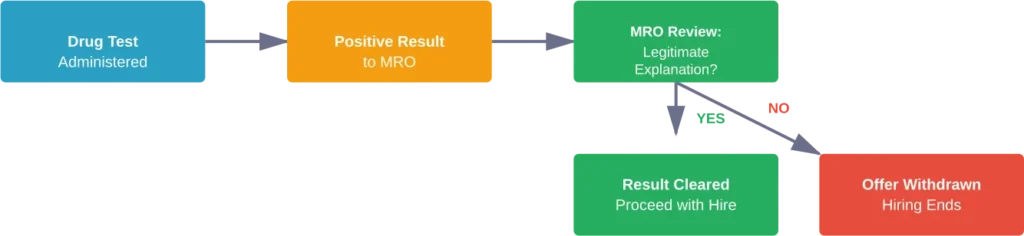
The employer withdraws the conditional job offer. Most companies maintain strict policies requiring negative results before finalizing employment. No legal obligation exists to provide a second chance or retest opportunity, though some employers may allow it.
The testing facility notifies the Medical Review Officer (MRO) first. This physician reviews positive results to rule out legitimate medical explanations. You’ll receive an opportunity to explain prescription medications or other valid reasons for the positive result.
If the MRO confirms the positive test as accurate, the employer receives notification. At this point, the hiring process ends for that position.
Does It Show on Background Checks?
Failed drug tests don’t typically appear on standard background checks. These screenings aren’t part of criminal records or employment verification databases.
However, some industries maintain internal databases. Healthcare facilities and transportation companies sometimes share information about failed tests within their sectors.
The result stays with the testing company and the employer who ordered it. Future employers won’t discover this information unless you disclose it or they contact that specific previous employer.
Consequences for Current Employees
Workplace drug test failures carry different implications than pre-employment situations.
Company policy determines the immediate response. Some organizations terminate employment immediately upon a confirmed positive result. Others offer rehabilitation programs or second chances, particularly for valued long-term employees.
Safety-sensitive positions face stricter consequences. According to FMCSA regulations, commercial drivers who test positive for drugs or register 0.04 or greater alcohol content must be immediately removed from safety-sensitive functions. They cannot return to driving commercial vehicles until successful completion of the return-to-duty process with a DOT-qualified substance abuse professional.
Federal employees and contractors follow protocols established under the Drug-Free Workplace Act. These workers typically face mandatory referral to Employee Assistance Programs before potential termination.
Legal Protections and Limitations
The Americans with Disabilities Act (ADA) provides limited protections. According to the Equal Employment Opportunity Commission, employers cannot revoke job offers solely because legally-prescribed medications caused a positive drug test result. The EEOC filed suit against The Princess Martha LLC and TJM Properties Inc. in 2022 for disability discrimination after they revoked an applicant’s offer when her legally-prescribed medications prevented her from passing the required screening.
Current illegal drug users receive no ADA protection. The law only protects individuals who have completed rehabilitation or are currently participating in supervised programs.
State laws create additional complexity. Some states with legal marijuana programs prohibit employment discrimination based on off-duty cannabis use. Others provide no such protections, allowing employers to maintain zero-tolerance policies regardless of state legalization status.
Recent research from the Journal of Cannabis Research explored perceptions among healthcare workers regarding cannabis use and employment. The study highlighted ongoing tensions between changing legal landscapes and employer drug policies.
Industry-Specific Consequences
Different sectors enforce varying standards based on regulatory requirements and safety concerns.
| Industry | Testing Frequency | Typical Consequences | Regulatory Oversight |
|---|---|---|---|
| Transportation (DOT) | Pre-employment, random, post-accident | Immediate removal, mandatory SAP evaluation | Federal Motor Carrier Safety Administration |
| Healthcare | Pre-employment, for-cause | Termination or license reporting | State medical boards |
| Construction | Pre-employment, random, post-accident | Immediate termination common | OSHA guidelines |
| Office/Corporate | Pre-employment primarily | Varies by company policy | Minimal federal oversight |
| Federal Employment | Pre-employment, random | EAP referral, potential termination | Department of Health and Human Services |
Transportation workers face the strictest protocols. The Department of Labor’s guidelines require comprehensive testing programs with specific procedures for collection, testing, and reporting.
Healthcare professionals risk license implications. State medical boards may receive notifications of positive results, potentially triggering investigations or disciplinary actions.
Can You Dispute or Retake a Failed Test?
Several options exist for challenging results, though success rates vary.
The MRO interview provides the first opportunity. During this conversation, you can explain legitimate prescription medications, medical conditions, or other factors that might cause false positives.
Laboratory errors do occur. Research indicates that laboratory performance varies significantly in drug testing reliability. Technical complications can affect accuracy, particularly with immunoassay screening tests that show higher false-positive rates than confirmatory testing methods.
Requesting a retest of the same sample sometimes helps. Labs typically split samples and store the second portion for exactly this purpose. The retest uses the more accurate gas chromatography-mass spectrometry (GC-MS) method.
Some employers allow complete retesting after a waiting period. This varies significantly by company policy and industry regulations.
Common False Positive Causes
Certain medications and substances trigger false positives. Poppy seeds can cause opiate detection. Some cold medications contain compounds that mimic amphetamines in initial screening tests.
Cross-reactivity affects immunoassay tests. These screening methods sometimes identify legal substances as illicit drugs, which is why confirmatory testing using GC-MS is critical for accuracy.
Medical review officers exist specifically to identify these situations. Providing documentation of legitimate prescriptions or medical conditions during the MRO interview often resolves false positives.
What to Do Immediately After Failing
Taking prompt action improves your options and protects your interests.
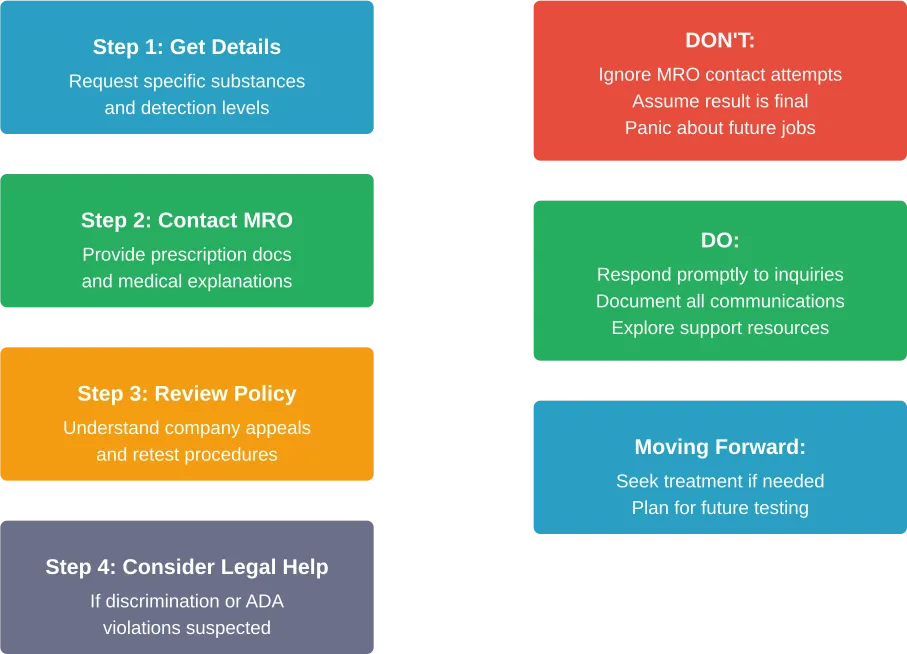
Request detailed information about the test result. Ask which substances were detected and at what levels. This information helps you understand whether prescription medications or other factors contributed.
Contact the MRO if you haven’t already. Explain any legitimate medical reasons for the positive result. Provide prescription documentation promptly.
Review the company’s drug testing policy carefully. Understanding the specific protocols and appeal processes helps you navigate the situation more effectively.
Consider legal consultation if circumstances suggest discrimination or policy violations. Employment attorneys can evaluate whether your rights were violated, particularly regarding ADA protections or state-specific laws.
Don’t panic about future employment. While the immediate situation feels overwhelming, failed tests don’t follow you indefinitely through background checks or public records.
Probation and Legal System Implications
Failing a drug test while on probation creates serious legal consequences.
Probation violations can result in jail time. Courts view drug test failures as direct violations of probation terms. Judges may revoke probation and impose the original suspended sentence.
The severity depends on several factors: the substance detected, whether it’s a first violation, your overall compliance history, and the specific probation terms.
Some judges order increased testing frequency or extended probation. Others mandate treatment programs or community service. The worst-case scenario involves immediate incarceration.
Honesty with your probation officer helps. Immediately disclosing the failed test and demonstrating willingness to address the issue sometimes reduces consequences. Attempting to hide or explain away results typically worsens outcomes.
Support and Treatment Resources
Substance use challenges require professional support. Multiple resources exist for individuals facing drug-related employment issues.
Employee Assistance Programs provide confidential counseling and referral services. Many employers offer these programs at no cost to workers. They help with substance abuse, mental health, and related issues.
Substance Abuse Professional (SAP) evaluations are mandatory for DOT-regulated workers. These qualified professionals assess the situation and recommend appropriate treatment or education programs.
Community treatment centers offer outpatient and inpatient programs. Many accept insurance or provide sliding-scale fees based on income.
Support groups provide peer assistance. Organizations like Narcotics Anonymous and SMART Recovery offer free, ongoing support for individuals working toward recovery.
State unemployment insurance programs have specific provisions regarding drug testing. According to Department of Labor guidance, certain unemployment compensation applicants may face permissible drug testing requirements under the Middle Class Tax Relief and Job Creation Act.
How Long Do Results Stay on Record?
Failed drug tests don’t appear in centralized databases accessible to all employers.
The testing laboratory maintains records according to regulatory requirements. For DOT testing, records are kept for specific periods as mandated by federal regulations.
Individual employers retain results in personnel files. How long they keep this information depends on company policy and applicable record retention laws.
Industry-specific databases exist in some fields. Healthcare and transportation sectors sometimes maintain shared information systems, though access is typically restricted to employers within those industries.
For practical purposes, the failed test affects primarily the relationship with that specific employer. Moving to a new company typically means starting fresh, assuming the new employer doesn’t contact the previous one for detailed references.
Preventing Future Issues
Understanding detection windows helps individuals prepare for testing situations.
Detection windows for marijuana vary based on usage frequency and individual factors including metabolism and body composition.
Different controlled substances have varying detection windows based on individual factors including metabolism, body composition, and usage patterns.
These timeframes aren’t guarantees. Individual metabolism, body composition, hydration levels, and usage patterns all affect detection periods.
For prescribed medications, maintaining current documentation proves critical. Keep prescription bottles and doctor’s notes readily available if you’re subject to drug testing.
Frequently Asked Questions
Yes, in most circumstances. Employers can terminate employment based on positive drug test results unless doing so violates specific legal protections. The ADA protects individuals using legally prescribed medications, but current illegal drug users receive no protection. State laws vary, with some providing additional protections for legal marijuana use outside work hours.
No, failed drug tests don’t typically show on standard background checks. These results aren’t part of criminal records or centralized employment databases. However, if you provide the specific employer as a reference, they may disclose the failed test when contacted. Industry-specific databases in healthcare and transportation sometimes share this information within their sectors.
Initial immunoassay screening tests show higher false-positive rates than confirmatory testing. Research indicates that laboratory performance varies significantly, which is why the MRO review process exists. Confirmatory testing using gas chromatography-mass spectrometry provides much higher accuracy. False positives can result from legitimate medications, foods, or cross-reactivity with legal substances.
This depends on employer policy and applicable regulations. Many testing protocols involve split samples specifically for retesting purposes. The lab retests using more accurate methods to confirm initial positive results. Some employers allow complete retesting after a waiting period, though this isn’t guaranteed. DOT regulations have specific retest protocols for regulated workers.
Refusing a drug test typically carries the same consequences as failing one. For DOT-regulated positions, refusal requires immediate removal from safety-sensitive functions. Employers generally treat refusal as admission of drug use and proceed with termination or offer withdrawal. Probationers who refuse testing face potential probation violations and legal consequences.
Prescription medications can trigger positive results on initial screening tests. This is exactly why the MRO review process exists. When contacted by the MRO, provide documentation of legitimate prescriptions. The MRO can then verify the medication explains the positive result and clear you. The EEOC protects workers using legally prescribed medications from discrimination based on test results.
Detection windows for marijuana vary significantly based on usage patterns. Occasional users typically test positive for 3-7 days after last use. Regular users may show positive results for 2-3 weeks. Heavy daily users can test positive for 30 days or longer. Hair follicle tests detect marijuana use for up to 90 days. Individual metabolism and body composition also affect detection timeframes.
Moving Forward After a Failed Test
Failing a drug test feels overwhelming. The immediate consequences—whether job loss, offer withdrawal, or legal complications—create significant stress and uncertainty.
But this situation doesn’t define your future.
Understanding your rights, available appeals processes, and support resources provides a path forward. Whether you’re dealing with substance use challenges or a legitimate false positive, taking informed action makes the difference.
For those facing genuine substance use issues, treatment works. Employers increasingly recognize addiction as a treatable condition rather than simply a firing offense. Employee assistance programs, rehabilitation facilities, and community support groups help thousands of individuals rebuild their careers and lives.
If discrimination or policy violations occurred, legal protections exist. The ADA, state employment laws, and federal regulations establish boundaries that employers must respect. Employment attorneys can evaluate whether your specific situation warrants legal action.
The key lies in addressing the situation directly rather than avoiding it. Respond to MRO contacts, understand the specific test results, review applicable policies, and explore available options. Each situation differs based on employment status, industry regulations, and individual circumstances.
Failed drug tests don’t appear on background checks, aren’t shared across industries (in most cases), and don’t prevent future employment opportunities. Learning from the experience, addressing any underlying issues, and moving forward with better preparation for potential future testing situations puts you back in control.
Whether seeking treatment resources, legal guidance, or simply understanding what happens next, taking that first step today changes tomorrow’s outcome.