
Quick Summary: Violating probation can result in severe consequences including arrest, revocation hearings, and incarceration for the original sentence. The outcome depends on the violation type—technical violations (like missing appointments) versus substantive violations (new crimes)—and the court’s assessment of your case. Working with an attorney and understanding your probation terms is essential to avoid or minimize penalties.
Probation seems like freedom. It’s not incarceration, after all. But here’s the thing—it’s conditional freedom, and that changes everything.
According to the Legal Information Institute at Cornell Law, probation is a criminal sentence that allows convicted defendants to remain in the community under supervision instead of serving time in jail or prison. A court imposes specific conditions during the probation period, which may include reporting to a probation officer, avoiding further offenses, staying away from victims, and completing community service.
The numbers tell a stark story. In Illinois, there are over 470,000 people on probation compared to just over 27,000 incarcerated in prison. That’s nearly triple the number of people on community supervision than incarcerated. And when probation conditions are violated, that alternative to incarceration can collapse quickly.
So what actually happens when someone violates probation? The answer isn’t simple, but understanding the process can make all the difference between maintaining freedom and facing serious jail time.
Understanding Probation and Its Terms
Before diving into violations, it’s worth understanding what probation actually entails. Formal probation is granted by the court as an alternative to prison, providing offenders with the benefit of supervision in the community by a probation officer. Offenders are given court ordered terms and conditions of probation to follow for three to five years.
These conditions vary based on the offense, jurisdiction, and individual circumstances. Common terms include:
- Regular reporting to a probation officer
- Maintaining employment or actively seeking work
- Avoiding contact with victims or certain individuals
- Abstaining from alcohol and drugs
- Submitting to random drug testing
- Completing community service hours
- Paying fines, fees, or restitution
- Staying within specified geographic boundaries
- Not committing new crimes
Here’s where it gets tricky. Some requirements sound straightforward but create significant challenges in practice. For homeless individuals, requirements like maintaining a stable address, reporting to probation officers, or avoiding interactions with law enforcement present unique problems.
Studies from various areas show that people facing housing insecurity are 36% more likely to unsuccessfully complete probation. That’s not a small margin—it’s a massive barrier that transforms probation from an alternative to incarceration into a stepping stone toward it.
Two Types of Probation Violations
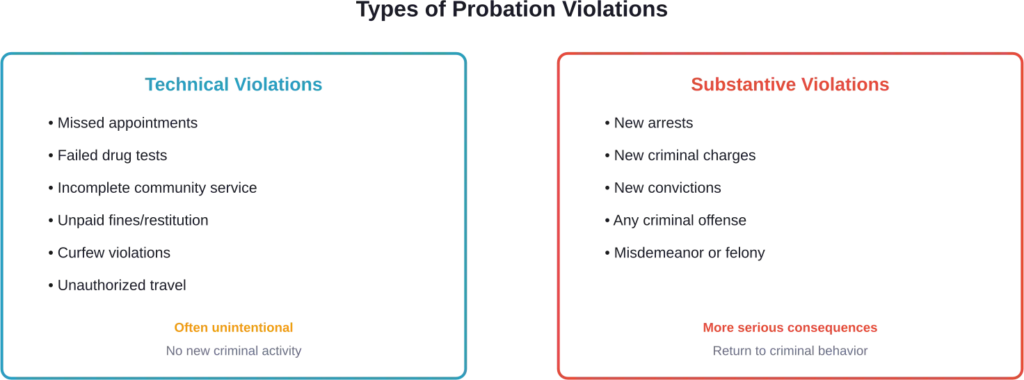
Not all violations are created equal. Understanding the difference between technical and substantive violations is critical because courts treat them very differently.
Technical Violations
Technical violations occur when probationers fail to comply with the conditions of probation without committing a new crime. These are administrative breaches that don’t involve criminal behavior.
Common technical violations include:
- Missing scheduled appointments with a probation officer
- Failing to complete community service hours
- Not attending required counseling or treatment programs
- Testing positive for alcohol or drugs (when abstinence is required)
- Traveling outside permitted areas without permission
- Failing to pay fines or restitution on schedule
- Not maintaining employment
- Violating curfew requirements
The thing about technical violations? They’re often unintentional. Someone loses their job and can’t afford the probation fees. Transportation breaks down, causing missed appointments. Life happens, but courts don’t always see it that way.
Substantive Violations
Substantive violations are straightforward—they involve committing a new criminal offense while on probation. This is the more serious category because it demonstrates a return to criminal behavior.
These violations include any new arrest or conviction, from minor misdemeanors to serious felonies. The severity of the new offense heavily influences the court’s response.
Courts view substantive violations as fundamental failures to comply with the basic expectation of lawful behavior. The consequences tend to be harsher because the person violated the core condition of probation: don’t commit crimes.
What Happens When Probation Is Violated
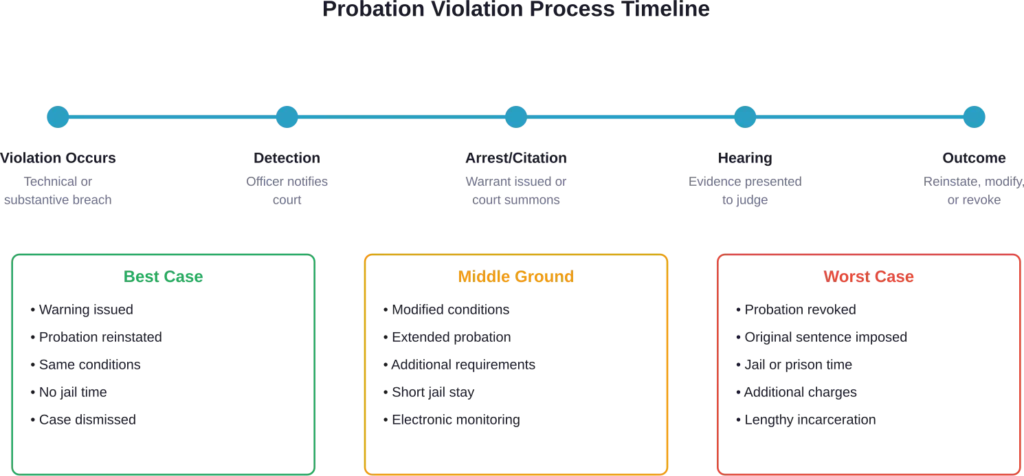
The process following a probation violation follows a predictable sequence, though the outcome can vary significantly based on circumstances.
Detection and Reporting
Violations come to light in several ways. Probation officers monitor compliance through scheduled check-ins, drug tests, and case file reviews. Law enforcement may notify probation departments of new arrests. Sometimes third parties—employers, treatment providers, or even victims—report violations.
Once a violation is detected or reported, the probation officer documents it and notifies the court. This isn’t automatic incarceration, but it starts the formal process.
Arrest and Detention
For serious violations, particularly substantive ones involving new crimes, the court may issue a warrant for arrest. The probationer can be taken into custody immediately and held without bail pending a probation violation hearing.
For less serious technical violations, the probation officer might issue a warning or citation requiring a court appearance without immediate arrest. But that’s discretionary—not guaranteed.
The Probation Violation Hearing
This is where things get decided. Unlike criminal trials, probation violation hearings operate under different rules. The burden of proof is lower—prosecutors need only prove the violation by a “preponderance of the evidence” rather than “beyond a reasonable doubt.”
That’s a massive difference. Preponderance means “more likely than not”—basically a 51% threshold rather than the near-certainty required in criminal trials.
During the hearing, the prosecution presents evidence of the violation. The probationer can present defenses, call witnesses, and testify. However, some constitutional protections from criminal trials don’t apply—there’s no automatic right to a jury trial in probation violation hearings.
Possible Outcomes
Judges have broad discretion in probation violation cases. Possible outcomes include:
- Reinstatement: The judge may reinstate probation with the same conditions, essentially giving a warning
- Modified probation: Probation continues but with additional or stricter conditions (more frequent reporting, electronic monitoring, treatment programs)
- Extended probation: The probation period gets extended beyond the original term
- Jail time with probation continuation: Short jail sentence followed by continued probation
- Probation revocation: Probation is terminated and the original suspended sentence is imposed—meaning jail or prison time
The most severe outcome is complete revocation, which sends the person to jail or prison to serve the original sentence that was suspended when probation was granted. For felony probation, this can mean years behind bars.
Factors That Influence Consequences
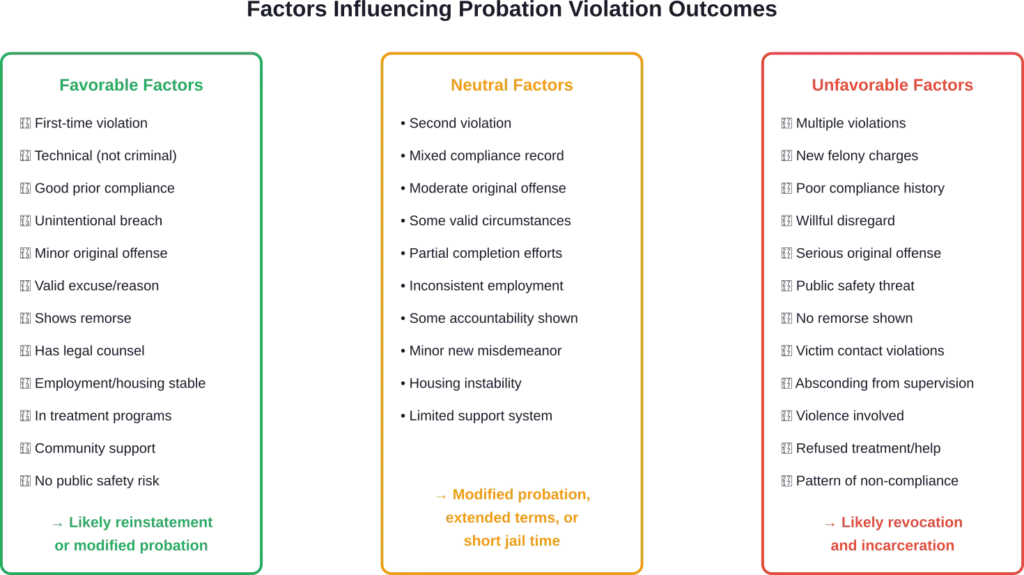
Courts don’t apply one-size-fits-all responses to violations. Several factors influence the outcome:
Violation severity: A failed drug test is treated differently than a new violent felony. Substantive violations almost always result in harsher penalties than technical violations.
Violation history: First-time violations, especially technical ones, often receive leniency. Multiple violations demonstrate a pattern of non-compliance that courts view seriously.
Original offense: Someone on probation for a serious violent felony faces stricter scrutiny than someone convicted of a minor offense. The underlying conviction matters.
Compliance history: Probationers who’ve otherwise complied with terms—attended meetings, completed programs, paid restitution—are viewed more favorably than those with spotty compliance records.
Circumstances of the violation: Was it willful disregard or circumstances beyond control? Someone who missed appointments due to documented medical emergencies has a better case than someone who simply ignored requirements.
Risk to public safety: Courts prioritize community safety. Violations suggesting danger to others result in swift, severe responses.
Remorse and accountability: Taking responsibility and demonstrating genuine efforts to comply can influence judicial discretion favorably.
Can Probation Violations Be Dismissed
Yes, but it’s not common. Dismissal requires strong legal arguments and often skilled representation.
Several defenses can lead to dismissal:
Insufficient evidence: If the prosecution can’t prove the violation occurred, even by the lower preponderance standard, the allegation must be dismissed.
Impossibility of compliance: If circumstances made compliance genuinely impossible—not just difficult—that can constitute a defense. This is where homelessness, medical emergencies, or similar situations come into play.
Violation of probationer’s rights: If evidence was obtained through illegal searches, coerced statements, or other rights violations, it may be excluded.
Technical errors: Procedural mistakes in how the violation was charged or the hearing conducted can result in dismissal.
Mistaken identity: Sometimes violations are attributed to the wrong person, particularly in cases of failed drug tests or reported sightings.
Legal representation significantly increases dismissal chances. Attorneys understand the procedural requirements, evidentiary standards, and effective defense strategies that self-represented individuals often miss.
First Probation Violation: Will You Go to Jail
This is the question everyone asks, and the answer frustrates most people: it depends.
For first-time technical violations, incarceration is less likely but not impossible. Judges often exercise leniency, particularly when:
- The violation was minor and unintentional
- The probationer has otherwise complied with terms
- There’s no threat to public safety
- The probationer demonstrates accountability and plans for compliance
Many first technical violations result in warnings, modified conditions, or short jail stays rather than full revocation.
But for substantive violations involving new crimes, even first violations often result in jail time. Courts view new criminal activity as a fundamental breach that justifies incarceration, regardless of whether it’s the first violation.
The reality? There’s no guarantee of leniency for first violations. Some judges are more lenient than others. Some jurisdictions prioritize incarceration; others emphasize rehabilitation. The specific circumstances matter enormously.
Common Mistakes That Lead to Violations
Understanding how violations happen helps prevent them. Certain mistakes appear repeatedly in probation violation cases.
Missing Appointments or Deadlines
This is the most common technical violation. Life gets busy, transportation fails, work schedules conflict—but probation appointments aren’t optional. Missing even one can trigger violation proceedings.
The fix is straightforward but requires diligence: calendar every appointment, set multiple reminders, and if something prevents attendance, contact the probation officer immediately—preferably before the missed appointment.
Failing Drug or Alcohol Tests
For probationers with substance-related conditions, failed tests are violation triggers. Some try to game the system with detox drinks or substitution. That rarely works and creates additional violations when caught.
The only reliable strategy is actual abstinence. For those struggling with addiction, requesting additional treatment support is better than risking violations through continued use.
Associating With Prohibited Individuals
Probation often prohibits contact with co-defendants, gang members, or other convicted felons. In tight-knit communities or neighborhoods, this can be challenging.
The violation happens even if the contact is coincidental. Probationers need strategies to avoid these individuals—different routes, different establishments, different social circles.
Traveling Without Permission
Many probationers don’t realize they can’t just leave the jurisdiction for weekend trips. Crossing county or state lines typically requires advance permission from the probation officer.
Always request permission in writing before traveling, even for family emergencies. Documentation protects against violation claims.
Incomplete Community Service or Programs
Community service hours and program completion aren’t suggestions—they’re requirements with deadlines. Procrastination creates violations.
Start early, track progress meticulously, and keep documentation of every hour completed or session attended. If legitimate obstacles arise, communicate with the probation officer and request extensions before deadlines pass.
Failing to Pay Fines or Restitution
Financial obligations continue regardless of employment status or economic hardship. Non-payment is a technical violation that can lead to incarceration.
When financial difficulties arise, probationers should immediately petition the court for modified payment plans rather than simply stopping payments. Courts can adjust amounts or schedules but need formal requests to do so.
How to Avoid Probation Violations
Prevention is infinitely better than defense. Practical strategies significantly reduce violation risks.
Know your exact conditions: Get a written copy of all probation terms. Review them regularly. If anything is unclear, ask the probation officer for clarification.
Treat appointments like court dates: Because they essentially are. Never miss scheduled meetings. Arrive early. Bring required documentation.
Maintain documentation: Keep records of everything—community service hours, program attendance, payment receipts, employment verification, residence information. Documentation is defense against false violation claims.
Communicate proactively: If problems arise that might affect compliance, contact the probation officer immediately. Proactive communication demonstrates good faith and often results in accommodations rather than violations.
Stay employed and housed: Stable employment and housing make probation compliance significantly easier. Many violations stem from the chaos of unemployment or homelessness.
Avoid situations that create risk: Don’t go to places where probation violations are likely—bars if alcohol is prohibited, neighborhoods where prohibited individuals congregate, situations where law enforcement contact is probable.
Get help for underlying issues: Addiction, mental health problems, anger management issues—whatever contributed to the original offense likely threatens probation compliance. Treatment isn’t just rehabilitation; it’s violation prevention.
Understand that ignorance isn’t a defense: “I didn’t know that was a violation” rarely works. The responsibility for understanding and following probation terms falls entirely on the probationer.
| Probation Requirement | Common Compliance Challenge | Prevention Strategy |
|---|---|---|
| Regular officer meetings | Transportation, work conflicts | Schedule appointments around work, arrange reliable transportation, request schedule changes in advance |
| Drug/alcohol abstinence | Addiction, social pressure | Engage in treatment programs, build sober support network, avoid triggering situations |
| Community service | Finding placement, time management | Start early, document all hours, maintain regular completion schedule |
| Financial obligations | Unemployment, expenses | Request payment plan modifications immediately when financial hardship occurs |
| Geographic restrictions | Family visits, job opportunities | Request travel permission in writing well in advance, keep approval documentation |
| No new offenses | High-crime neighborhoods, prior associations | Avoid risky situations, change social circles, relocate if possible |
What to Do If You’ve Already Violated Probation
Real talk: it happens. When it does, the response matters enormously.
Don’t Ignore It
The worst possible response is pretending the violation didn’t happen or won’t be discovered. Probation systems eventually catch violations, and discovery after attempted concealment results in harsher penalties than immediate disclosure.
Contact an Attorney Immediately
Before speaking with the probation officer or anyone else about the violation, consult an attorney. Legal counsel can advise on the best approach, protect rights during hearings, and present the strongest possible defense.
Probation violation cases operate under different rules than criminal trials. Specialized knowledge makes a significant difference in outcomes.
Be Prepared to Demonstrate Accountability
Courts respond more favorably to probationers who take responsibility, explain circumstances without making excuses, and present concrete plans for future compliance.
This might include documentation of steps already taken—enrollment in treatment, completion of missed requirements, proof of good faith efforts to comply.
Gather Evidence and Witnesses
If the violation accusation is false or circumstances explain the breach, gather supporting evidence immediately. Witnesses, documents, medical records, employment verification—anything that supports the defense.
Consider the Prosecutor’s Recommendation
Sometimes negotiating with prosecutors before the hearing can result in recommendations for lighter penalties rather than full revocation. Attorneys handle these negotiations more effectively than self-represented individuals.
The Role of Legal Representation
Legal representation in probation violation cases isn’t just helpful—it often determines the outcome.
Attorneys understand the procedural requirements, evidentiary standards, and effective defense strategies. They know which arguments judges find persuasive and which fall flat.
Beyond courtroom advocacy, attorneys negotiate with prosecutors and probation officers to reach favorable resolutions without full hearings. Many violations are resolved through negotiations that result in modified probation rather than revocation.
For those concerned about cost, many jurisdictions provide public defenders for probation violation hearings when defendants can’t afford private counsel. The right to appointed counsel in violation hearings varies by jurisdiction, but it’s worth requesting.
Special Considerations for Specific Populations
Homeless Probationers
Homelessness and probation create a particularly difficult combination. Requirements that assume stable housing—maintaining an address, reporting regularly, attending programs—become nearly impossible without shelter.
Studies from various areas show that people facing housing insecurity are 36% more likely to unsuccessfully complete probation. That’s not because they’re less committed to compliance—it’s because the system creates barriers that homelessness makes insurmountable.
Some jurisdictions are recognizing this problem. Recommendations for improvement include creating dedicated homeless programs within probation offices, improving inter-agency collaboration for homeless services, and ending automatic incarceration for technical violations that stem from housing instability.
For homeless probationers, connecting with social services, shelters, and advocacy organizations can provide support for both housing and probation compliance.
Those With Substance Abuse Issues
Addiction doesn’t pause for probation. Probationers struggling with substance abuse face particular challenges with testing requirements and staying clean.
Many jurisdictions now recognize addiction as a medical condition requiring treatment rather than punishment. Drug courts, treatment-focused probation programs, and graduated sanctions rather than immediate revocation are becoming more common.
For probationers with substance abuse issues, requesting treatment as a probation condition rather than viewing it as an additional burden can be transformative. Treatment provides support for staying compliant rather than fighting addiction alone.
Those With Mental Health Conditions
Mental health conditions can interfere with probation compliance in ways that aren’t immediately obvious. Disorganization, memory problems, difficulty with appointments, and impulsive behavior can all stem from mental health issues rather than willful non-compliance.
Documenting mental health conditions and their impact on compliance ability can provide important context in violation hearings. Mental health treatment, when incorporated into probation conditions, can support compliance while addressing underlying issues.
Understanding Your Rights During Violation Proceedings
Probation violation hearings differ from criminal trials, but probationers still have important rights.
Right to notice: Probationers must receive written notice of the alleged violation and the scheduled hearing date. This notice should specify what violation is alleged and when it occurred.
Right to a hearing: Probationers have the right to appear before a judge and contest the violation allegation.
Right to present evidence: This includes calling witnesses, submitting documents, and testifying on one’s own behalf.
Right to confront evidence: Probationers can challenge the prosecution’s evidence and cross-examine witnesses.
Right to counsel: In many jurisdictions, probationers have the right to an attorney. When facing felony probation revocation, this right is stronger. When financial barriers exist, requesting appointed counsel is appropriate.
What probationers typically don’t have in violation hearings:
- Right to a jury trial (judges decide violation cases)
- Proof beyond reasonable doubt (only preponderance of evidence required)
- All exclusionary rules that apply in criminal trials
Understanding these distinctions helps probationers and their attorneys prepare appropriate strategies for violation hearings.
Long-Term Consequences Beyond Immediate Penalties
Probation violations create ripple effects beyond immediate court penalties.
Criminal record impacts: Violations appear on criminal records and can affect future sentencing if new offenses occur. Multiple violations suggest non-compliance patterns that judges consider in future cases.
Employment consequences: Incarceration resulting from violations means job loss. Even without incarceration, violations can affect employment requiring clean probation records or security clearances.
Housing implications: Violations can trigger eviction from certain housing programs or disqualify individuals from future housing assistance.
Immigration consequences: For non-citizens, probation violations—especially substantive violations involving new crimes—can trigger deportation proceedings or affect immigration status.
Family impacts: Incarceration from violations affects custody arrangements, child support obligations, and family relationships.
Financial burdens: Violations often result in additional fines, extended probation supervision fees, and legal costs that compound existing financial obligations.
These long-term consequences make preventing violations—and effectively defending against allegations when they occur—critically important.
Frequently Asked Questions
Yes, though it’s less likely than for substantive violations or repeat offenses. Judges have discretion to impose jail time even for first technical violations, particularly if the violation demonstrates disregard for probation terms or creates public safety concerns. However, many jurisdictions favor graduated sanctions for first technical violations—warnings, modified conditions, or short jail stays rather than full revocation. Having legal representation and demonstrating accountability significantly improves outcomes for first-time technical violations.
Violation hearings typically last 30 minutes to several hours, depending on complexity. Simple technical violations with admitted facts may resolve quickly. Contested violations requiring witness testimony and evidence presentation take longer. The hearing itself is usually faster than a criminal trial because there’s no jury and evidentiary rules are more relaxed. However, scheduling delays mean weeks or months may pass between the violation allegation and the actual hearing date.
Felony probation violations carry serious consequences even for first offenses. Technical violations may result in modified probation with stricter conditions, extended supervision periods, or short jail sentences. Substantive violations involving new crimes often result in probation revocation and imposition of the original felony sentence—potentially years in prison. The severity of the original felony, nature of the violation, and prior compliance history all influence the outcome. Legal representation is particularly important for felony probation violations given the substantial prison time at stake.
Generally, no. Once probation is formally revoked and the original sentence imposed, reinstatement is rare. Courts view revocation as the final determination that community supervision failed. However, if revocation resulted from procedural errors, rights violations, or insufficient evidence, appeals may overturn the revocation. Additionally, some jurisdictions allow motions to modify sentences after revocation, though success rates are low. The best strategy is aggressively defending against revocation rather than hoping for reinstatement afterward.
Probation violations typically appear on criminal background checks because they become part of court records associated with the original conviction. If the violation resulted in revocation and incarceration, that additional sentence appears on records. The violation itself may not be listed as a separate criminal charge unless new charges were filed, but the court proceedings and outcomes are generally accessible through background checks. This can affect employment, housing, and other opportunities requiring background screening.
Several strategies can help avoid incarceration: hire experienced legal counsel immediately; demonstrate proactive accountability by addressing the violation cause before the hearing; gather evidence supporting compliance efforts or explaining the violation; present concrete plans for future compliance including treatment enrollment or program participation; emphasize positive compliance history if applicable; and negotiate with prosecutors for recommendations of modified probation rather than revocation. For technical violations, showing that circumstances rather than willful disregard caused the breach improves outcomes significantly.
Probation violation is the alleged breach of probation conditions—the accusation that terms weren’t followed. Probation revocation is the court’s decision to terminate probation and impose the original suspended sentence as a result of proven violations. Not all violations result in revocation. Courts may respond to violations by continuing probation with warnings, modifications, or additional conditions. Revocation is the most serious outcome, ending probation supervision and imposing incarceration. Understanding this distinction is important because defending against violation allegations aims to prevent revocation.
Conclusion
Probation violations carry consequences that range from warnings to years of incarceration. The outcome depends on violation type, compliance history, circumstances, and legal representation quality.
Technical violations—missed appointments, failed tests, incomplete requirements—differ fundamentally from substantive violations involving new crimes. Courts treat them differently, though neither should be taken lightly.
The probation violation process follows a predictable path: detection, arrest or citation, hearing, and outcome. Understanding this process and the rights involved helps probationers and their attorneys mount effective defenses.
Prevention remains the best strategy. Understanding probation terms, maintaining meticulous compliance, documenting everything, and communicating proactively with probation officers significantly reduces violation risks.
When violations occur, immediate legal consultation and proactive accountability make substantial differences in outcomes. Ignoring violations or attempting to conceal them invariably worsens consequences.
The system isn’t perfect. For homeless individuals, those struggling with addiction or mental health issues, and others facing systemic barriers, probation compliance presents challenges that go beyond individual effort. Advocacy for system improvements continues, but individuals navigating probation today need practical strategies for their current circumstances.
If you’re facing probation violation allegations, don’t navigate the system alone. The stakes—freedom versus incarceration—are too high. Consult with an attorney who understands probation violation defense in your jurisdiction. The investment in legal representation often determines whether probation continues or ends in a jail cell.
Probation offers a second chance. Protecting that opportunity requires understanding the rules, following them diligently, and responding appropriately when problems arise. The consequences of violations are real, but so are the strategies for prevention and defense.