

Quick Summary: MerchantWords alternatives for 2026 include WisePPC, Helium 10 (largest Amazon keyword database, from $29/mo), Jungle Scout (beginner-friendly all-in-one toolkit, from $49/mo), SellerSprite (international markets focus), and AMZScout (budget option). Free options like Helium 10’s Magnet demo and Sonar offer basic keyword research without upfront cost. The right tool depends on your budget, platform focus, and feature needs—most serious sellers choose Helium 10 for data accuracy and comprehensive features.
Amazon keyword research isn’t optional anymore. With over 2.5 million active sellers competing for attention and billions of product searches happening every month, visibility depends entirely on using the right keywords.
MerchantWords has been a go-to for real shopper search data. Pricing information should be verified on the official MerchantWords website as current rates were not found in available source material. But it’s not the only player in town.
Here’s the thing though—several competitors now offer deeper databases, more accurate search volume data, and features that extend far beyond basic keyword lookup. Some cost less. Others offer free tiers that MerchantWords doesn’t.
This guide covers the most powerful MerchantWords alternatives available in 2026, what makes each one different, and which sellers they’re actually built for.
Why Sellers Look Beyond MerchantWords
MerchantWords built its reputation on one core strength: real shopper search data pulled directly from Amazon’s search bar. For years, that was enough.
But Amazon selling has evolved. Sellers now need tools that do more than just surface keywords.
They need accurate search volume estimates. Competitor analysis. PPC bid suggestions. Listing optimization scoring. Product research capabilities. Backend keyword management.
MerchantWords provides keyword discovery. That’s valuable. But modern Amazon tools have layered on product databases, profitability calculators, inventory trackers, and automated advertising management.
So when sellers ask “what’s better than MerchantWords,” they’re often asking: what tool gives me keyword research plus the other capabilities that actually move sales?
The other consideration is cost. At typical mid-range pricing, MerchantWords sits alongside several alternatives. Several alternatives offer more features at similar or lower price points. Others cost more but justify it with dramatically larger databases and better accuracy.
Real talk: most serious FBA sellers and KDP publishers have migrated to all-in-one platforms that treat keyword research as one component of a complete seller toolkit rather than the only feature.
WisePPC: The PPC Powerhouse for Data-Driven Amazon Sellers

According to the official WisePPC website, the platform is an advanced Amazon PPC optimization tool and analytics suite designed specifically for maximizing ad efficiency, ROI, and long-term campaign performance. As an Amazon Ads Verified Partner, it focuses on deep advertising insights, bulk management, and historical data that Amazon itself doesn’t provide.
WisePPC currently offers free access during beta (no credit card required). This makes it an attractive and low-risk option compared to MerchantWords while delivering specialized PPC depth.
What Makes WisePPC’s PPC Management Different
The official site highlights WisePPC’s ability to store years of historical ad data (versus Amazon’s 60–90 days limit), combined with granular hourly insights and powerful optimization tools. For Amazon advertisers tired of limited native reporting, it has become a go-to solution for scaling campaigns smarter.
Here’s what that means in practice:
- Bulk edit thousands of campaigns, ad groups, and targets in one go
- Analyze performance with up to 6 metrics simultaneously on custom charts
- Use gradient-based highlighting to instantly spot winning/losing keywords and placements
- Access long-term historical trends, seasonality, and placement-level data
- Edit bids, budgets, and statuses directly in tables without leaving the view
- Segment data by campaign type, match type, bid strategy, and more
But WisePPC doesn’t stop at analytics. It layers powerful PPC management into a broader workflow that includes real-time optimization, multi-account support, sales + ad unified reporting, and upcoming AI bid automation + dynamic repricing.
WisePPC vs MerchantWords: The Data & Action Difference
MerchantWords excels at keyword discovery. WisePPC takes those keywords and turns them into profitable, scalable ad campaigns.
According to the official WisePPC site, the platform keeps years of granular data (30+ metrics, 250K+ hourly insights) while giving users direct control through bulk actions and inline editing. This goes far beyond static keyword research — it delivers actionable, long-term visibility and campaign execution tools that MerchantWords simply doesn’t offer.
The official materials emphasize that WisePPC helps sellers improve campaign efficiency and cut wasted ad spend by replacing guesswork with clear, visual, data-backed decisions.
Who Should Choose WisePPC
This tool makes sense for:
- Amazon sellers running large or multiple PPC campaigns who need deep performance insights and bulk control
- Advertisers frustrated with Amazon’s short data retention and limited reporting
- Agencies or multi-account managers looking for centralized ad + sales analytics
- Sellers focused on optimizing ROAS, TACOS, and placement performance at scale
- Anyone who already has keywords and now wants to execute and refine campaigns efficiently
The interface is built for power users, but the official site and beta provide intuitive tools and support to get started quickly. Early beta access lets you test the full feature set before any paid commitment.
Contact Information
- Website: wiseppc.com
- Facebook: www.facebook.com/people/Wise-PPC/61573154427547
- LinkedIn: www.linkedin.com/company/wiseppc
- Instagram: www.instagram.com/wiseppc
Helium 10: The Gold Standard for Serious Sellers

According to the official Helium 10 website, the platform offers the most comprehensive Amazon seller tools in the industry, supporting Amazon, Walmart, and TikTok Shop sellers. The keyword research tool—called Magnet—sits at the center of a complete seller suite.
Helium 10’s free plan exists, with paid plans starting from $29/mo according to the official Helium 10 website. That positions it competitively against MerchantWords while delivering significantly more capability.
What Makes Helium 10’s Keyword Research Different
The official website describes Magnet 2.0 as having the largest Amazon keyword database and the most accurate volume data. For serious FBA sellers and KDP publishers, it’s become the gold standard.
Here’s what that means in practice:
- Input a seed term or ASIN to uncover thousands of related terms
- See search volume estimates backed by Amazon’s actual data
- Filter by competition level, word count, and search volume thresholds
- Identify long-tail keyword opportunities with lower competition
- Export keyword lists directly to PPC campaigns
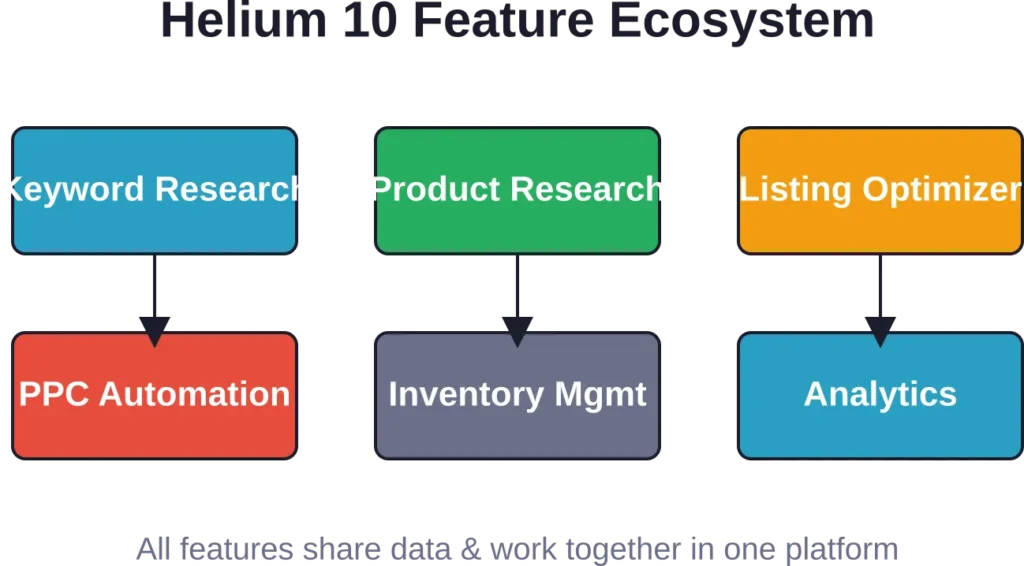
But Magnet doesn’t exist in isolation. Helium 10 layers keyword research into a broader workflow that includes product research (Black Box), listing optimization (Scribbles), inventory management, and profitability tracking.
As stated on the official site, the platform now offers “AI-powered listing builder” and “conversion-ready listings” with “automated ads” and “real-time data.”
Helium 10 vs MerchantWords: The Data Difference
MerchantWords pulls real shopper searches. So does Helium 10. The difference is scale and freshness.
Helium 10 updates its database continuously and covers billions of keyword combinations across all major Amazon marketplaces—not just .com but also Canada, Mexico, Germany, Spain, Italy, France, UK, India, and the Netherlands according to the official tool interface.
The official Helium 10 comparison page notes that data accuracy is where the platform “outshines” competitors. While specific accuracy percentages aren’t disclosed, the company emphasizes that “exceptional value provided by Helium 10’s comprehensive feature set” justifies the investment for serious sellers.
Sound familiar? That’s the core issue with MerchantWords. It does one thing. Helium 10 does that one thing plus product validation, supplier sourcing, listing optimization scoring, review management, and PPC automation.
Who Should Choose Helium 10
This tool makes sense for:
- FBA sellers managing multiple ASINs who need keyword research integrated with inventory and profitability tracking
- KDP publishers optimizing book listings and backend keywords
- Agencies managing Amazon accounts for multiple clients
- Sellers expanding into international Amazon marketplaces
- Anyone who needs PPC campaign management alongside organic keyword optimization
The learning curve is steeper than simpler tools. But the official site offers extensive training resources, and the free plan allows testing core features before committing to paid tiers.
Jungle Scout: Best All-in-One for Beginners

Jungle Scout entered the market as a product research tool and expanded into keyword research, supplier databases, and sales analytics. It’s often recommended for beginners because the interface prioritizes simplicity over advanced customization.
Jungle Scout pricing starts at $49/mo according to available sources. That’s higher than Helium 10’s entry tier but still competitive with MerchantWords when factoring in the additional features.
Jungle Scout’s Keyword Scout Tool
Keyword Scout is Jungle Scout’s answer to Magnet and MerchantWords. It provides:
- Search volume estimates for seed keywords
- Related keyword suggestions with competition scores
- PPC bid recommendations
- Exact and broad match data
- Reverse ASIN lookup to see what keywords competitors rank for
The data comes from Amazon’s search suggest API combined with Jungle Scout’s proprietary sales estimates. According to the official Helium 10 comparison page published September 6, 2024, data accuracy is an area where “Helium 10 outshines Jungle Scout,” though both tools provide useful directional insights.
Where Jungle Scout Excels
The real strength isn’t the keyword tool in isolation—it’s how Keyword Scout integrates with Jungle Scout’s product database and opportunity finder.
New sellers can:
- Use the Product Database to filter by category, price, and estimated sales
- Identify product opportunities with favorable demand and manageable competition
- Run Keyword Scout on top products to reverse-engineer their keyword strategies
- Validate demand by checking search volume for primary keywords
- Build listings using the keywords with the best volume-to-competition ratio
That workflow is more beginner-friendly than Helium 10’s sprawling feature set. The trade-off is less granular control and a smaller keyword database.
Jungle Scout vs MerchantWords
MerchantWords gives more raw keyword data. Jungle Scout gives less keyword data but packages it with product research, supplier contacts, sales estimates, and listing builders.
For someone only doing keyword research on existing products, MerchantWords might edge ahead. For someone launching new products and needing the full toolkit, Jungle Scout delivers better value.
The interface is also cleaner. MerchantWords can feel overwhelming with wall-to-wall data tables. Jungle Scout uses visual dashboards and color-coded opportunity scores that make decision-making faster.
AMZScout: Budget-Conscious Seller’s Choice

AMZScout positions itself as the budget alternative to premium tools. It offers keyword research, product databases, and a popular Chrome extension at price points below Helium 10 and Jungle Scout.
The keyword features aren’t as deep. The database isn’t as large. But for sellers managing tight budgets or testing Amazon selling before fully committing, AMZScout provides enough capability to make informed decisions.
What AMZScout’s Keyword Explorer Offers
The Keyword Explorer provides:
- Search volume estimates for Amazon.com and international marketplaces
- Related keyword suggestions
- Search trend graphs showing seasonality
- Niche score calculation based on search volume and competition
It’s simpler than Magnet or Keyword Scout. The dataset is smaller. But the core functionality—finding keywords, estimating volume, assessing competition—works.
The Chrome Extension Advantage
AMZScout’s Chrome extension (called PRO Extension) provides on-page insights while browsing Amazon. Sellers can see estimated sales, revenue, review velocity, and top keywords for any product without leaving the browser.
That makes competitive keyword research faster. Instead of manually copying ASINs into a separate tool, the extension surfaces keyword data directly on product pages.
MerchantWords doesn’t offer an equivalent browser extension. Neither does the free tier of most competitors.
Limitations to Know
AMZScout’s keyword database is noticeably smaller than Helium 10’s. Long-tail keywords and niche terms often don’t appear. Search volume estimates can be less precise, particularly for newer or seasonal keywords.
The tool also lacks advanced filtering options. Power users accustomed to Helium 10’s ability to filter by word count, exact phrase, competing products, and CPR (Cerebro’s proprietary metric) will find AMZScout’s options limited.
But for sellers prioritizing cost over comprehensiveness, it delivers functional keyword research at a fraction of the price.
SellerSprite: International Market Specialist

SellerSprite built its reputation serving Chinese sellers expanding into Western Amazon marketplaces. The tool now supports sellers worldwide, with particular strength in multi-marketplace keyword research and competitor tracking.
Multi-Marketplace Keyword Research
SellerSprite covers Amazon US, UK, Germany, France, Italy, Spain, Canada, Mexico, Japan, India, and Australia. The keyword database pulls from all these marketplaces simultaneously.
For sellers running international expansion strategies, this matters. Rather than subscribing to separate tools for each marketplace (or paying premium tiers of other tools to unlock international data), SellerSprite provides multi-region coverage in base plans.
Keyword Research Features
The keyword mining tool provides:
- Search volume across multiple marketplaces
- Keyword tracking with daily rank updates
- Reverse ASIN lookup showing competitor keywords
- Keyword trend analysis with historical data
- PPC keyword suggestions with estimated CPC
One standout feature: SellerSprite’s “Keyword Miner” can analyze entire categories to surface trending search terms before they become saturated. That’s valuable for product research—identifying emerging demand signals before competition intensifies.
SellerSprite vs MerchantWords
MerchantWords offers international marketplace data in higher-priced tiers. SellerSprite includes it as standard.
SellerSprite also layers in competitor monitoring. Sellers can track up to hundreds of competitor ASINs, receive alerts when competitors change prices or run promotions, and see which new keywords competitors start ranking for.
MerchantWords focuses purely on keyword discovery. SellerSprite treats keyword research as part of a competitive intelligence workflow.
Free Alternatives: Sonar and Helium 10’s Free Plan
Not every seller needs a paid subscription. Free tools can handle basic keyword research, particularly for hobbyists, low-volume sellers, or those validating product ideas before investing in premium software.
Sonar by Sellics

Sonar is a 100% free Amazon keyword research tool. No trial period. No credit card. Just open the site and start searching.
It provides:
- Keyword suggestions based on Amazon’s search suggest API
- Search volume estimates (though less precise than paid tools)
- Support for Amazon US, UK, Germany, France, Italy, Spain, Canada, Mexico, India
The database is smaller. Volume estimates are directional rather than precise. Advanced filtering doesn’t exist. But for quick validation—”Does this keyword actually get searched?”—Sonar works.
Helium 10 Free Plan
According to the official Helium 10 website, free Amazon seller tools are available without paying anything. The free plan includes limited access to Magnet, the Chrome extension, and several other tools.
Limitations apply—typically capped daily searches and restricted feature access. But sellers can:
- Test Magnet’s keyword database before upgrading
- Use the Chrome extension (X-Ray) to analyze competitor listings
- Access the FBA calculator and URL builder
The official site states: “Access powerful keyword research, advertising, and marketing tools without paying a cent.”
That makes Helium 10’s free tier more useful than most “free trials” that expire after 7-14 days. The free plan persists indefinitely, just with usage caps.
When Free Tools Are Enough
Free keyword research works for:
- Validating single product ideas before launch
- Hobbyist sellers with one or two ASINs
- Reverse-engineering a handful of competitor keywords
- Learning Amazon SEO concepts without financial commitment
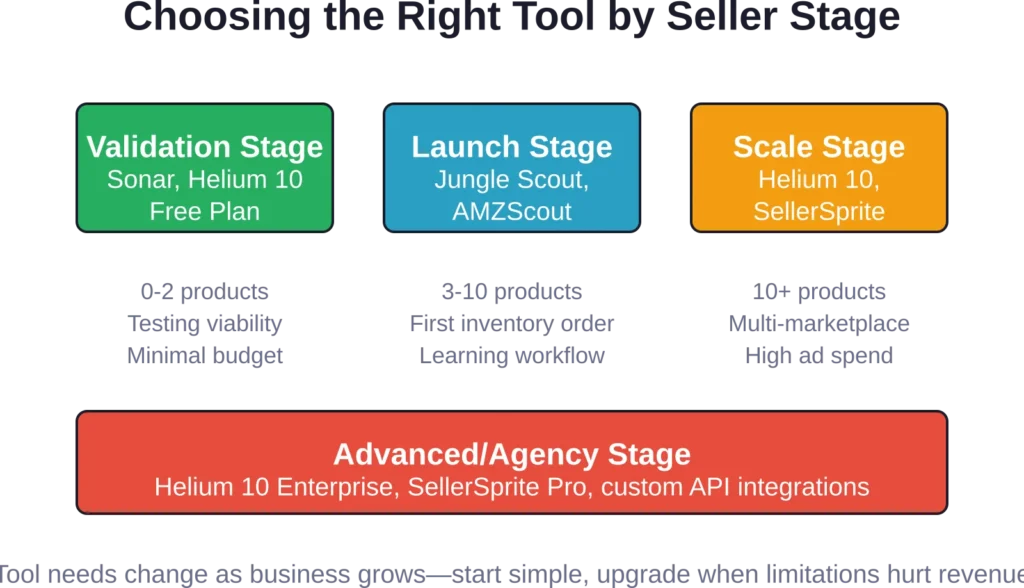
Once catalog size exceeds 5-10 products, or when scaling advertising spend into four figures monthly, paid tools provide ROI through better targeting, automated bid management, and profitability tracking that free tools can’t match.
Specialized Tools Worth Considering
Beyond the major platforms, several specialized tools solve specific keyword research problems that general-purpose tools don’t address well.
ZonGuru: Conversion Optimization Focus

ZonGuru offers keyword research alongside tools specifically designed to improve conversion rates: review automation, photo enhancers, and sales funnel tracking.
The keyword tool (called Keywords on Fire) provides standard search volume and competition metrics. Where ZonGuru differentiates is connecting keyword data to actual conversion performance.
Sellers can see which keywords drive traffic and convert, versus keywords that bring clicks but no sales. That’s valuable for PPC optimization—cutting spend on high-traffic, low-conversion terms and doubling down on keywords that actually generate orders.
Viral Launch: Market Intelligence Platform

Viral Launch started as a product launch service and evolved into a full market intelligence platform. The keyword research tool (Keyword Research and Keyword Manager) integrates with launch services, review management, and kinetic PPC.
The standout feature is the Market Intelligence database—essentially a searchable repository of every Amazon product with estimated sales, revenue, review velocity, and trend data. Keyword research ties directly into this database, showing not just search volume but actual sales performance of products ranking for specific keywords.
DataHawk: Analytics and Competitive Intelligence

DataHawk focuses on competitive analysis and analytics. The keyword tracking tool monitors rank positions daily across unlimited keywords and ASINs.
For brands managing large catalogs or agencies tracking dozens of clients, DataHawk’s strength is visualization—dashboards that show keyword rank movement, share of voice by category, and competitor activity over time.
It’s less useful for initial keyword discovery (the database is smaller than Helium 10 or Jungle Scout). But for ongoing rank tracking and competitive monitoring, DataHawk excels.
How to Actually Choose Your MerchantWords Alternative
Comparing feature lists doesn’t answer the real question: which tool should this specific business invest in?
Here’s a decision framework that cuts through the noise:
Start With Budget Reality
Tools range from free (Sonar, Helium 10 Free) to $29-$49/mo (Helium 10, Jungle Scout, SellerSprite) to $100+ for advanced tiers.
The question isn’t “what’s the best tool in absolute terms?” It’s “what’s the best tool that this business can afford and will actually use?”
A $200/mo tool that goes unused delivers zero value. A $29/mo tool used daily to optimize listings and PPC delivers immediate ROI.
Match Features to Actual Workflow
List the tasks the business actually performs:
- Finding new product opportunities? Need product research + keyword research (Jungle Scout, Helium 10).
- Optimizing existing listings? Need keyword research + listing grader (Helium 10, ZonGuru).
- Managing PPC campaigns? Need keyword research + bid automation (Helium 10, Viral Launch).
- Tracking competitor activity? Need reverse ASIN lookup + rank tracking (SellerSprite, DataHawk).
- Expanding internationally? Need multi-marketplace data (SellerSprite, Helium 10).
MerchantWords does keyword discovery. Period. If the business needs only that, it’s still viable. But most sellers need integrated workflows where keyword data feeds directly into listing optimization, PPC campaigns, and competitive analysis.
Test Before Committing
Most tools offer free trials or limited free plans. Use them.
Run the same search across three tools. Compare results. Which interface feels intuitive? Which data seems most accurate? Which export formats integrate with existing workflow?
The “best” tool on paper often isn’t the best tool for a specific team’s habits and technical comfort level.
Consider Growth Trajectory
A tool that works perfectly for 5 ASINs might collapse under 50. Conversely, enterprise platforms can feel like overkill (and wasted budget) for small catalogs.
Think 6-12 months ahead. If the plan is aggressive expansion—new products, new marketplaces, scaling ad spend—choose a tool with room to grow. Migrating tools mid-scale is painful.
If the plan is maintaining a small, profitable niche catalog, simpler tools with lower costs make more sense.
Integration and Workflow Considerations
Keyword research doesn’t happen in isolation. The best tools connect to the rest of the seller’s tech stack.
Amazon Seller Central Integration
Some tools (particularly Helium 10 and Jungle Scout) offer direct integration with Seller Central. That allows:
- Automatic ASIN sync
- Sales data import for performance tracking
- One-click listing updates
- Automated rank tracking
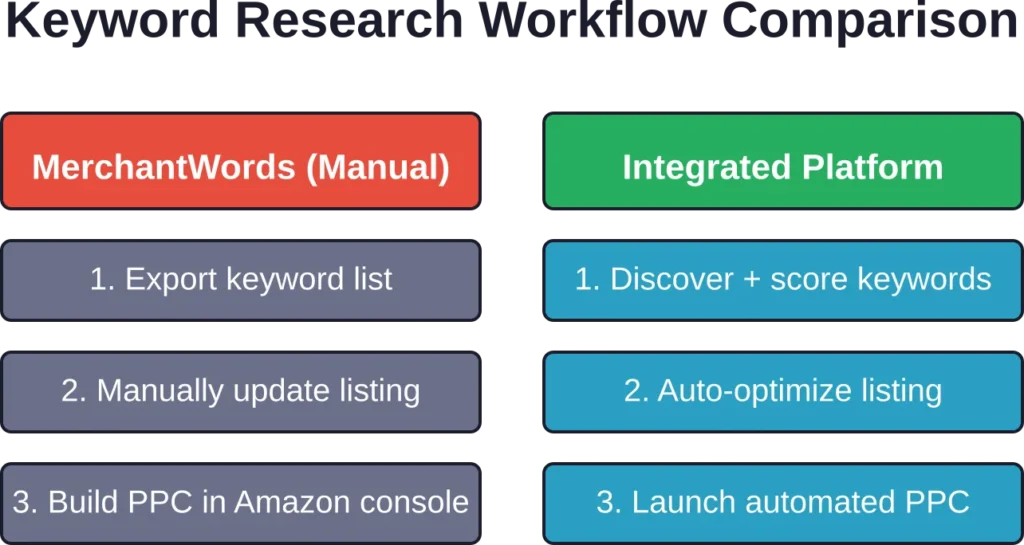
Manual workflow—export keywords from one tool, copy into a spreadsheet, manually update Seller Central—introduces friction and errors. Direct integration eliminates that.
PPC Platform Compatibility
Tools like Helium 10 Ads (as mentioned on the official site under automated advertising features) and Jungle Scout’s PPC tools manage Amazon Advertising campaigns directly.
The workflow becomes: discover keywords → filter by profitability → launch PPC campaign → track performance → optimize bids → measure ROI. All in one platform.
MerchantWords provides keyword data. Then sellers manually build campaigns in Amazon Advertising console. That extra step slows iteration.
Export and Reporting
Check export formats: CSV, Excel, API access.
Agencies managing multiple clients need bulk export and white-label reporting. Solo sellers might prefer visual dashboards over raw data exports.
Advanced users running custom analytics (combining keyword data with external traffic sources, for example) need API access or at minimum comprehensive CSV exports with all data fields.
Common Mistakes When Switching Tools
Migrating from MerchantWords (or any established tool) to an alternative introduces risk. Here’s what typically goes wrong:
Assuming Data Matches 1:1
Different tools use different data sources and estimation models. A keyword showing 10,000 monthly searches in MerchantWords might show 8,500 in Helium 10 and 12,000 in Jungle Scout.
That’s not necessarily inaccuracy—it’s methodology differences. What matters is relative ranking (is Keyword A bigger than Keyword B?) and directional trends, not absolute precision on any single number.
Don’t panic when numbers differ. Look for consistency in patterns and rankings.
Ignoring the Learning Curve
Even “user-friendly” tools require 5-10 hours to learn properly. Rushing through setup, skipping tutorials, and immediately running campaigns based on half-understood data causes expensive mistakes.
Block learning time. Watch official training videos. Run test searches on familiar products to understand how the tool interprets data.
Over-Relying on Automation
Advanced tools offer automated bid management, auto-generated listing copy, and AI-powered keyword suggestions. That’s powerful but not foolproof.
Automation works best when guided by strategy. Blindly accepting every AI suggestion or letting automated bidding run unsupervised can waste budget fast.
Use automation for execution speed, but maintain strategic oversight.
Forgetting About Backend Keywords
Amazon allows up to 500 bytes of backend search terms (also called “Search Terms”)—hidden keywords that don’t appear in titles or bullets but still help products rank.
MerchantWords users typically export keyword lists and manually fill backend fields. Better tools (Helium 10’s Scribbles, for instance) automate this, suggesting backend keywords that complement front-end listing copy without duplication.
When switching tools, verify the new platform handles backend keyword optimization. Otherwise, valuable ranking opportunities get missed.
Frequently Asked Questions
Helium 10’s free plan provides the most capability among truly free options. It includes limited daily searches in Magnet (the keyword research tool), Chrome extension access, and several other tools without cost. Sonar is another completely free option with no restrictions, though the database is smaller and volume estimates less precise. For validation and small-scale research, both work well.
For most sellers, yes. According to the official Helium 10 website, the platform offers the largest Amazon keyword database and most accurate volume data. Beyond raw keyword discovery, Helium 10 integrates keyword research with product research, listing optimization, PPC management, and profitability tracking. MerchantWords focuses exclusively on keyword data. Paid plans for Helium 10 start from $29/mo versus MerchantWords at $39/mo, making Helium 10 both more comprehensive and more affordable at entry tiers.
Absolutely. Many experienced sellers cross-reference data from 2-3 tools to validate keyword opportunities. A common approach: use Helium 10 or Jungle Scout as the primary platform, then spot-check high-value keywords in Sonar or MerchantWords to confirm search volume estimates. Different tools use different data sources, so cross-validation reduces the risk of optimizing for inaccurate metrics.
Most do, but coverage varies. According to the official Helium 10 website, Magnet supports Amazon.com, Canada, Mexico, Germany, Spain, Italy, France, UK, India, and the Netherlands. Jungle Scout covers major marketplaces. SellerSprite specializes in international markets with support for US, UK, Germany, France, Italy, Spain, Canada, Mexico, Japan, India, and Australia. Always verify which specific marketplaces a tool supports before subscribing if international selling is part of the strategy.
No tool has perfect accuracy because Amazon doesn’t publish official search volume data. Tools estimate volume using search suggest API data, clickstream data, and proprietary algorithms. Expect variance of ±20-30% between tools on any given keyword. What matters more than absolute accuracy is relative ranking (which keywords are bigger than others) and trend direction (is search volume growing or declining). Use volume estimates as directional guides, not precise measurements.
Start free. Use Sonar and Helium 10’s free plan to learn keyword research fundamentals and validate initial product ideas. Once generating consistent sales (or preparing to launch with serious inventory investment), upgrade to paid tools. The improved data accuracy, automation, and integrated features deliver ROI quickly once operations reach scale. But free tools provide enough capability to learn and validate without financial risk.
Keyword research tools find search terms shoppers use and estimate search volume. Product research tools analyze entire product categories to identify opportunities—filtering by sales estimates, competition levels, price points, and trends. Many platforms (Helium 10, Jungle Scout) combine both. The workflow typically starts with product research to find opportunities, then uses keyword research to optimize listings and PPC for those products. Standalone keyword tools like MerchantWords or Sonar don’t include product opportunity analysis.
Making the Switch: Implementation Checklist
Transitioning from MerchantWords to an alternative requires systematic implementation to avoid disruption:
Before Canceling Current Subscription
- Export all saved keyword lists, searches, and historical data from MerchantWords
- Document current workflow: which features get used daily, weekly, monthly
- Identify must-have features the replacement tool needs to support
- Sign up for free trials of 2-3 alternatives
During Trial Period
- Run identical searches across old and new tools to compare results
- Test integration with existing workflow (Seller Central, PPC platforms, spreadsheets)
- Verify all team members can access and understand the new interface
- Check export formats match reporting needs
- Confirm marketplace coverage matches business requirements
After Selecting Replacement
- Migrate saved keyword lists and tracking configurations
- Update SOPs and training documentation
- Run parallel (old and new tool) for 2-4 weeks to ensure nothing breaks
- Only then cancel the old subscription
Rushing the switch causes data gaps and workflow interruptions that hurt sales. Methodical migration prevents that.
The Bigger Picture: Keywords Are Just One Piece
Here’s what often gets missed in tool comparisons: keyword research alone doesn’t drive sales.
The complete optimization chain looks like this:
- Keyword research identifies what shoppers search for
- Listing optimization incorporates those keywords into titles, bullets, descriptions, and backend fields
- PPC campaigns drive initial traffic and sales velocity
- Organic ranking improves as sales accumulate
- Conversion rate optimization (images, A+ content, pricing) turns traffic into purchases
- Review management and customer service maintain ranking and Buy Box eligibility
Tools that handle only step one leave sellers manually managing steps two through six. Integrated platforms automate or streamline the entire chain.
That’s why most sellers eventually migrate from single-purpose keyword tools to comprehensive platforms. The question becomes less “which keyword tool is cheapest?” and more “which complete platform delivers the best ROI across the entire optimization workflow?”
Looking Ahead: Tool Selection in 2026 and Beyond
The Amazon tools market continues evolving. AI-powered features, voice search optimization, and multi-channel selling (Amazon + Walmart + TikTok Shop) are reshaping what sellers need.
According to the official Helium 10 website, the platform now supports not just Amazon but also Walmart and TikTok Shop sellers. That multi-channel capability matters as brands diversify beyond Amazon to reduce platform dependency.
Keyword research increasingly incorporates AI search optimization. With tools like Alexa and voice shopping growing, backend keyword strategies that worked for typed searches need adaptation for conversational queries.
The tools adapting fastest to these shifts—adding AI features, voice search optimization, multi-platform support—will capture market share. Those stuck in 2020-era feature sets will lose ground.
When evaluating MerchantWords alternatives, consider not just current needs but where Amazon selling (and e-commerce broadly) is headed over the next 24-36 months.
Final Recommendations: Which Tool for Which Seller
Cutting through all the comparison data, here’s the simple breakdown:
For serious FBA sellers managing 10+ ASINs and spending $1,000+/month on PPC: Helium 10. The comprehensive feature set, largest database, and automation capabilities justify the investment. Start with the $29/mo tier and scale up as needed.
For beginners launching their first 1-3 products: Jungle Scout. The simplified interface, integrated product research, and beginner-focused training resources reduce the learning curve. Worth the $49/mo during the critical launch phase.
For budget-conscious sellers testing Amazon as a side business: AMZScout or Helium 10’s free plan. Both provide enough functionality to validate ideas and optimize initial listings without monthly subscription costs.
For sellers expanding into international marketplaces: SellerSprite. Multi-marketplace coverage as standard, competitive intelligence features, and international seller-focused support make it the best choice for cross-border operations.
For sellers who only need keyword discovery (already have listing optimization, PPC management, etc. handled): Stick with MerchantWords or try Sonar. If the workflow already works and keyword research is the only missing piece, single-purpose tools make sense.
For agencies managing multiple client accounts: Helium 10 or DataHawk. API access, white-label reporting, bulk ASIN management, and client permission controls are essential at agency scale. Both platforms support these workflows.
Conclusion: Better Tools Enable Better Selling
MerchantWords pioneered accessible Amazon keyword research. It’s still a solid tool. But the market has evolved.
Modern Amazon selling demands integration—keyword research feeding directly into listing optimization, PPC automation, inventory planning, and profitability tracking. Standalone tools create friction. Comprehensive platforms create flow.
The right alternative depends on business stage, budget, and feature requirements. Most sellers will find better value in platforms like Helium 10 or Jungle Scout that treat keyword research as one component of complete seller operations rather than an isolated function.
Start with free trials. Test workflows. Compare actual results on products the business already sells. The best tool isn’t the one with the longest feature list—it’s the one that fits naturally into daily operations and demonstrably improves results.
Ready to move beyond basic keyword research? Pick one alternative from this guide, sign up for the free trial or free tier, and run it against current listings this week. The data will show whether it’s time to switch.