

Quick Summary: Amazon repricing tools automate price adjustments to help sellers win the Buy Box and maximize profits. The best repricers in 2026 include Aura, Seller Snap, BQool, Informed Repricer, and ChannelMax, each offering unique AI-driven or rule-based strategies. Choosing the right tool depends on your business size, catalog complexity, and whether you prioritize speed, control, or advanced analytics.
Lost the Buy Box overnight because a competitor dropped their price by three cents at 2 AM?
That’s the reality of selling on Amazon. Prices shift constantly—Amazon reassesses Buy Box eligibility frequently—and manual repricing just can’t keep up. The competition is relentless, margins are razor-thin, and every hour without the Buy Box means lost revenue.
Amazon repricing tools solve this by automating price changes in real time. But here’s the thing—not all repricers are created equal. Some use simple rule-based logic, others deploy advanced AI and game theory to avoid price wars while protecting margins. Some excel at Buy Box velocity, others at profitability optimization.
This guide compares the best Amazon repricing tools for 2026, breaking down features, strategies, pricing, and which tool fits which type of seller. Whether running a fast-growth FBA operation or managing thousands of SKUs across multiple marketplaces, the right repricer can transform how the business scales.
Optimize Your Advertising and Pricing Strategy with WisePPC

Effective repricing requires more than just reacting to competitor changes; it demands deep visibility into how those adjustments impact your overall advertising efficiency and profit margins. WisePPC provides a unified analytics environment that bridges the gap between sales performance and campaign management.
By centralizing data from Amazon and other marketplaces, the platform enables sellers to:
- Align Bidding with Pricing: Monitor how price shifts influence Return on Advertising Spend (ROAS) and Average Selling Price (ASP).
- Access Long-Term Data: Retain historical performance insights beyond Amazon’s 60-90 day window to better understand seasonal trends.
- Identify Growth Drivers: Distinguish between organic sales and revenue generated by paid placements.
- Streamline Operations: Execute bulk updates across campaigns and targets to react quickly to market conditions.
To start optimizing your marketplace business with data-driven insights, head over to WisePPC and register for an account.
What Is an Amazon Repricer and Why Sellers Need One
An Amazon repricer is software that automatically adjusts product prices based on market conditions, competitor activity, and seller-defined rules. Instead of manually checking prices and updating listings throughout the day, the repricer monitors the marketplace 24/7 and reacts instantly to changes.
The goal isn’t just winning the Buy Box—it’s maximizing profitability while maintaining competitive positioning. Amazon’s Buy Box algorithm considers price, fulfillment method, seller metrics, and availability. A repricer helps optimize the price variable without sacrificing margin.
Here’s why automation matters: Amazon’s marketplace moves fast. Competitors adjust prices continuously. Manual repricing means reacting hours or even days late, missing sales opportunities and losing revenue. Automated repricing responds in seconds, capturing the Buy Box when conditions favor it and pulling back when they don’t.
The best repricing tools don’t just match or beat competitor prices. They analyze market dynamics, predict competitor behavior, and adjust strategically to avoid destructive price wars. That’s the difference between racing to the bottom and building a sustainable, profitable Amazon business.
How Amazon Repricers Actually Work
Repricing tools connect to Amazon Seller Central via API, pulling real-time data on competitor prices, Buy Box status, inventory levels, and sales velocity. The software then applies pricing logic—either rule-based or AI-driven—to calculate optimal price points.
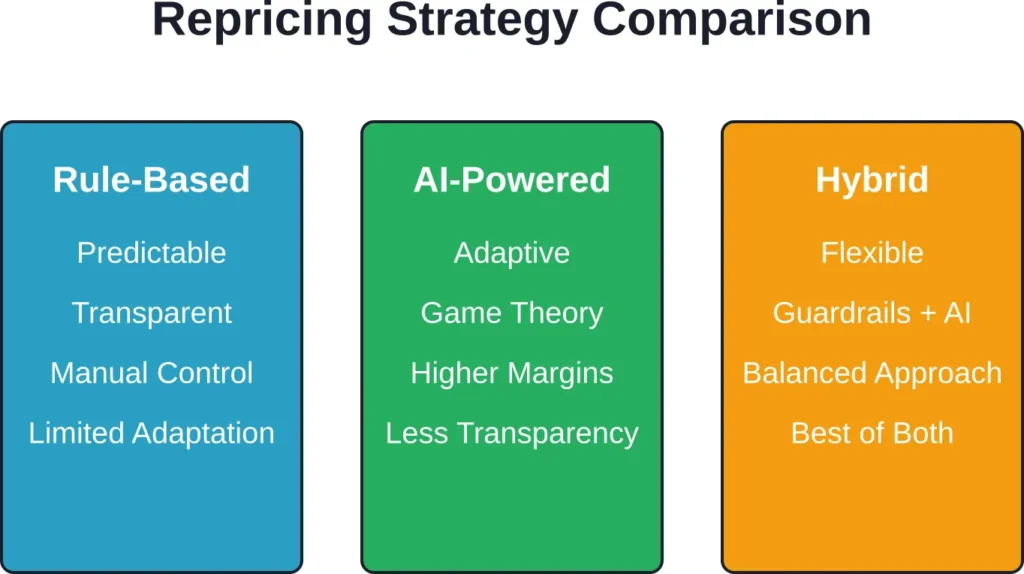
Rule-Based Repricing
Rule-based repricers let sellers set specific pricing decisions manually. Common rules include “beat the lowest FBA price by $0.05” or “match the Buy Box price.” Sellers control exactly how the tool behaves under different conditions.
This approach offers predictability and transparency. The logic is straightforward: if X happens, do Y. It works well for sellers with stable catalogs and clear competitive positioning. But rule-based systems can’t adapt to complex market dynamics or predict competitor reactions, which sometimes leads to price wars.
AI-Based Repricing
AI-powered repricers use machine learning and algorithmic pricing to analyze competitor behavior, market trends, and historical performance. Instead of following rigid if-then rules, the AI makes probabilistic decisions designed to maximize Buy Box win rate and total profit.
Advanced repricers employ game theory to anticipate competitor moves and avoid mutually destructive pricing spirals. The software learns which competitors respond aggressively and which don’t, adjusting strategy accordingly. This approach typically delivers higher margins but requires trust in the algorithm and may feel less transparent to sellers who prefer granular control.
Hybrid Strategies
Many modern repricers blend both approaches. Sellers set guardrails—minimum and maximum prices, margin floors, competitor filters—while the AI operates within those boundaries. This balances control with intelligent automation, giving sellers safety nets while leveraging algorithmic optimization.
The Best Amazon Repricing Tools for 2026
The following tools represent the top tier of Amazon repricing software available today. Each has distinct strengths, ideal use cases, and pricing models. The rankings consider feature depth, AI sophistication, user feedback, marketplace support, and real-world performance data.
1. Aura

Aura positions itself as a complete seller operations platform, with repricing as one component of a broader toolkit. The platform integrates inventory management, analytics, multi-channel support, and AI-driven repricing into a unified interface.
The repricing engine uses algorithmic pricing designed to maximize total profit rather than just Buy Box percentage. Aura analyzes not only current competitor prices but also sales velocity, inventory turnover, and historical performance to set optimal price points.
Standout features include built-in analytics tracking ACOS and ROAS, multichannel support covering 21 Amazon marketplaces plus Walmart, and inventory optimization insights. The AI avoids race-to-the-bottom scenarios by factoring in profit margins and long-term business health.
Best for: Sellers managing large catalogs across multiple channels who want an all-in-one platform rather than separate point solutions. The unified approach reduces tool sprawl and simplifies operations.
Pricing varies based on scale and features. Consult the official Aura website for current plans and tiers.
2. Seller Snap

Seller Snap delivers AI-powered repricing with a focus on game theory and competitive intelligence. The platform doesn’t just react to price changes—it predicts competitor behavior and adjusts preemptively to maintain Buy Box position without triggering price wars.
The algorithm learns from millions of pricing interactions across the marketplace, identifying patterns in how different competitors respond to price changes. This intelligence informs smarter repricing decisions that protect margins while maximizing sales velocity.
Key capabilities include customizable repricing strategies, detailed performance dashboards, and support for both FBA and FBM listings. Seller Snap also offers inventory-aware repricing, adjusting strategy based on stock levels to optimize turnover and prevent stockouts.
Best for: Mid-to-large sellers doing significant monthly volume who need sophisticated AI repricing and are willing to trust algorithmic decision-making. Community discussions frequently highlight Seller Snap’s effectiveness for high-velocity operations.
Pricing typically starts around the industry baseline—consult the official site for up-to-date subscription tiers and volume-based pricing.
3. BQool

BQool has been a staple in the Amazon seller community for years, known for reliable rule-based repricing and straightforward setup. The platform offers both Central and BigCentral plans, scaling from small sellers to enterprise operations.
The repricing logic emphasizes transparency and control. Sellers configure detailed rules specifying exactly how prices should adjust based on competitor conditions, fulfillment method, feedback ratings, and other factors. This granular control appeals to sellers who want to understand and dictate every aspect of their pricing strategy.
BQool also includes features beyond repricing: listing optimization, review management, and automated customer emails. The all-in-one approach makes it attractive for sellers who prefer consolidated tools.
Best for: Sellers who prioritize control and transparency, prefer rule-based logic over AI black boxes, and appreciate bundled seller tools. BQool works well for established sellers with clear pricing strategies they want to automate without surprises.
Check the official BQool website for current pricing on Central and BigCentral plans.
4. Informed Repricer

Informed Repricer focuses squarely on intelligent repricing without the feature bloat. The tool uses algorithmic repricing designed to win the Buy Box profitably, avoiding unnecessary price drops when market conditions don’t require them.
The platform analyzes competitor pricing patterns, Buy Box eligibility, and seller metrics to determine the minimum competitive price needed. Instead of blindly undercutting, Informed Repricer tests price points algorithmically to find the sweet spot between competitiveness and profitability.
Informed Repricer supports advanced features like competitor exclusions (ignore certain sellers when repricing), velocity-based pricing (adjust based on sales speed), and margin protection rules. The interface is clean and focused, making setup and monitoring straightforward.
Best for: Sellers who want a dedicated, purpose-built repricing tool without extra features they won’t use. Informed Repricer appeals to those who value simplicity, algorithmic intelligence, and a no-nonsense approach to automated pricing.
Pricing information is available on the Informed Repricer official site, with plans typically structured by SKU count or monthly volume.
5. ChannelMax

ChannelMax delivers multichannel inventory and repricing management, supporting Amazon, eBay, Walmart, and other marketplaces from a single dashboard. The repricing component integrates tightly with inventory sync, order management, and listing distribution.
The repricing engine offers both rule-based and automated strategies. Sellers can define custom rules per SKU or category, set floor and ceiling prices, and filter which competitors to track. ChannelMax also provides real-time alerts when competitors change prices or when Buy Box status shifts.
For sellers operating across multiple channels, ChannelMax synchronizes pricing strategy across platforms, ensuring consistency and preventing channel conflict. The unified inventory view helps avoid overselling and stockouts.
Best for: Multichannel sellers who need coordinated repricing and inventory management across Amazon, eBay, Walmart, and other platforms. ChannelMax simplifies complexity for sellers juggling multiple storefronts.
See the ChannelMax website for current subscription pricing and feature tiers.
Other Amazon Repricers Worth Considering
The following tools didn’t make the top five but offer unique capabilities or cater to specific seller segments.
RepricerExpress

RepricerExpress provides fast, flexible repricing with support for Amazon and eBay. The platform emphasizes speed—repricing cycles execute in minutes—and ease of use. Setup is straightforward, and the interface is beginner-friendly.
Best for: Smaller sellers or those new to automated repricing who want an affordable entry point without overwhelming complexity.
Appeagle

Appeagle offers AI-driven repricing with a focus on Buy Box analytics and competitive intelligence. The dashboard provides detailed insights into Buy Box share, competitor behavior, and repricing performance.
Best for: Data-driven sellers who want deep analytics alongside automated repricing and don’t mind a steeper learning curve.
Feedvisor

Feedvisor targets enterprise sellers with advanced AI, dedicated account management, and strategic consulting. The platform combines repricing with advertising optimization and demand forecasting.
Best for: Large brands and enterprise operations seeking white-glove service, strategic guidance, and integration with broader e-commerce operations.
Teikametrics

Teikametrics integrates repricing with Amazon advertising optimization, offering a unified platform for pricing and ad spend management. The AI optimizes both simultaneously to maximize ROI.
Best for: Sellers running significant ad campaigns who want coordinated optimization of pricing and advertising spend.
Xsellco Repricer

Xsellco offers multichannel repricing and customer support tools. The platform connects Amazon, eBay, and other marketplaces, with repricing rules that sync across channels.
Best for: Multichannel sellers who also need integrated helpdesk and customer communication features.
| Repricer | Best For | Strategy Type | Key Strength |
|---|---|---|---|
| Aura | Multi-channel, large catalogs | AI-driven | All-in-one platform with analytics |
| Seller Snap | High-volume FBA sellers | AI with game theory | Predictive competitor intelligence |
| BQool | Control-focused sellers | Rule-based | Granular control and transparency |
| Informed Repricer | Focused repricing without bloat | Algorithmic | Simplicity and algorithmic efficiency |
| ChannelMax | Multichannel operations | Hybrid | Unified multichannel management |
| RepricerExpress | Small sellers, beginners | Rule-based | Affordable and user-friendly |
Critical Factors When Choosing an Amazon Repricer
Selecting the right repricing tool requires evaluating several dimensions beyond feature lists and marketing claims. The wrong choice can erode margins, create operational headaches, or fail to deliver expected ROI.
Business Size and Catalog Complexity
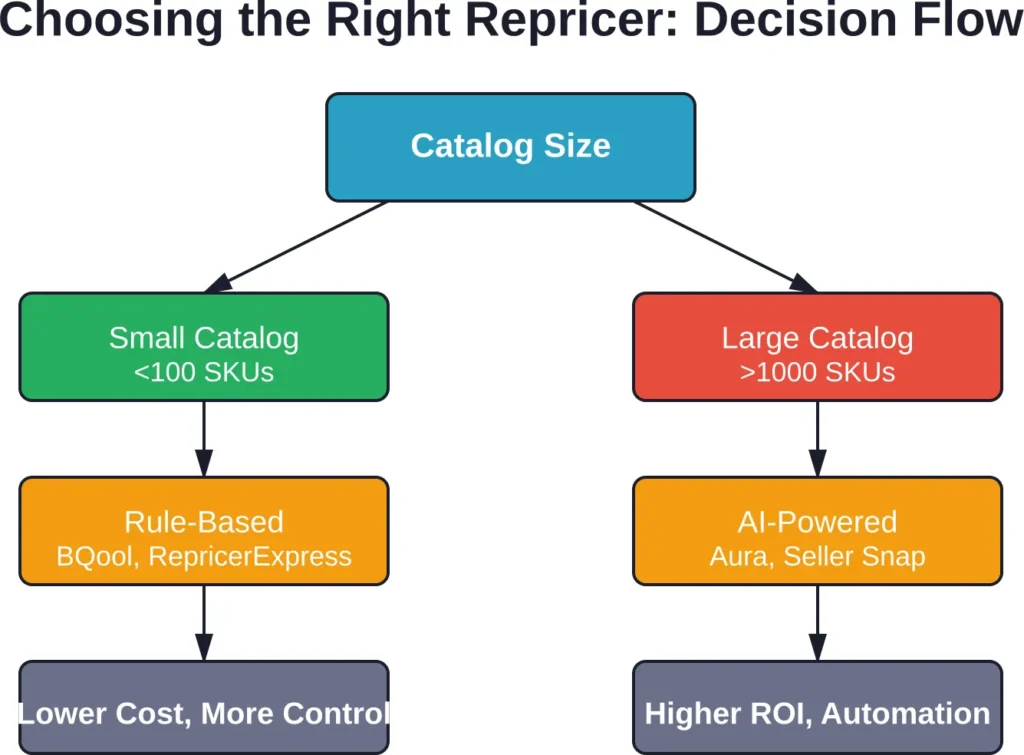
Sellers with fewer than 100 SKUs have different needs than those managing thousands of listings. Small catalogs benefit from straightforward rule-based repricers with affordable pricing tiers. Large, complex catalogs require sophisticated AI, bulk management tools, and robust filtering capabilities.
Consider SKU count, product variation, and category diversity when evaluating tools. Some repricers charge per SKU, others per monthly sales volume. Understand the pricing structure and how costs scale as the business grows.
Control vs. Automation
Some sellers want total control over every pricing decision. Others prefer to set guardrails and let AI handle tactical execution. Neither approach is wrong—it depends on business philosophy and risk tolerance.
Rule-based systems offer transparency and predictability but require more manual strategy work. AI-driven systems automate optimization but operate as black boxes, making it harder to understand why specific price changes occurred. Hybrid systems attempt to balance both, offering flexibility at the cost of added complexity.
Marketplace Coverage
Most repricers support Amazon.com and major North American/European marketplaces. But if selling on Amazon Japan, Australia, or emerging markets, verify coverage before committing. Multichannel sellers need tools that handle eBay, Walmart, and other platforms in addition to Amazon.
Integration and API Limits
Repricing tools connect to Amazon via API, which imposes rate limits and throttling. Some repricers optimize API usage better than others, enabling faster repricing cycles without hitting limits.
Check how the tool integrates with existing systems: inventory management software, accounting platforms, analytics dashboards. Seamless integration reduces manual data entry and improves operational efficiency.
Support and Onboarding
Repricing strategy can get complex. Access to knowledgeable support—via chat, email, or phone—matters, especially during setup and when troubleshooting unexpected behavior.
Some tools offer dedicated onboarding, training resources, and strategic consultation. Others provide basic documentation and expect sellers to figure it out. Factor in the learning curve and available support when comparing options.
Pricing and ROI
Repricing tools range from budget-friendly options under $100/month to enterprise platforms costing thousands. Pricing models vary: flat monthly fees, per-SKU charges, percentage of sales, or tiered plans based on volume.
Calculate expected ROI. A repricer that costs $500/month but increases Buy Box percentage by 15% and improves margins by 3% easily pays for itself. Conversely, a cheap tool that underperforms may cost more in lost revenue than it saves in subscription fees.
Most repricers offer free trials—use them. Test the tool with real inventory and real competitors. Monitor performance for at least two weeks before committing to an annual plan.
Common Repricing Mistakes to Avoid
Even the best repricing tool can underperform if configured poorly or used without strategy. These mistakes frequently derail repricing efforts.
Setting No Minimum Price Floor
Failing to establish a hard minimum price is a recipe for disaster. Without a floor, aggressive competitors or algorithmic errors can drive prices below cost, generating losses on every sale. Always set minimum prices based on landed cost plus a baseline margin.
Ignoring Competitor Quality
Not all competitors are equal. Repricing against sellers with poor metrics, MF fulfillment, or low feedback scores can lead to unnecessary price cuts. Configure the repricer to ignore low-quality competitors or weight them differently.
Over-Optimizing for Buy Box Percentage
Winning 100% Buy Box share at razor-thin margins destroys profitability. The goal is maximizing total profit, not Buy Box percentage. Sometimes accepting 70% Buy Box at higher margins generates more revenue than 95% at lower margins.
Neglecting Inventory Levels
Repricing strategy should adjust based on inventory. Slow-moving stock with high inventory may benefit from aggressive pricing to boost turnover. Fast-moving items with low stock should prioritize margin over velocity. Many repricers offer inventory-aware pricing—use it.
Setting and Forgetting
Repricing isn’t fire-and-forget. Market conditions shift, competitors enter and exit, and product lifecycles change. Review repricing performance weekly, adjust rules or AI parameters monthly, and recalibrate strategy quarterly. Continuous optimization is essential.
How to Test and Evaluate Repricing Performance
Implementing a repricer is just the beginning. Measuring performance and iterating strategy determines whether the tool delivers ROI.
Key Metrics to Track
Monitor these metrics to evaluate repricing effectiveness:
- Buy Box Percentage: Share of time the listing owns the Buy Box. Track overall and per-SKU.
- Average Sale Price: Mean price at which units sell. Compare before and after implementing repricing.
- Total Revenue: Overall sales volume. Repricing should increase revenue, not just Buy Box share.
- Margin Percentage: Gross margin per sale. Ensure repricing doesn’t erode profitability.
- Inventory Turnover: How quickly stock moves. Effective repricing accelerates turnover without sacrificing margin.
- Competitor Response Rate: How often competitors react to price changes. High response rates may indicate price war risk.
A/B Testing Strategies
Test different repricing strategies on similar products to identify what works best. For example, run AI-based repricing on half the catalog and rule-based on the other half, then compare performance after 30 days.
Test different floor prices, competitor filters, and repricing speed settings. Small adjustments can yield significant performance differences. Document tests and results to build institutional knowledge.
Analyzing Outliers
Review SKUs with unusually high or low performance. What’s different about top performers? Are they in less competitive categories, priced uniquely, or benefiting from specific repricing logic? Replicate successful patterns across similar products.
Similarly, investigate underperformers. Are competitors more aggressive? Is the minimum price too high? Does the product have quality issues affecting Buy Box eligibility? Address root causes rather than just tweaking repricing settings.
Transitioning Between Repricing Tools
Switching repricers can feel risky, but the process is straightforward with proper planning.
Export Historical Data
Before disconnecting the current repricer, export performance data, pricing history, and rule configurations. This data informs setup on the new platform and provides a performance baseline for comparison.
Parallel Testing
If possible, run the new repricer on a subset of SKUs while the old tool manages the rest. Monitor performance for 1-2 weeks to verify the new tool meets expectations before full migration.
Reconfigure Rules and Guardrails
Don’t assume the new repricer uses identical logic or terminology. Carefully reconfigure minimum and maximum prices, competitor filters, repricing speed, and other parameters. Test thoroughly before activating at scale.
Monitor Closely Post-Migration
Watch performance closely for the first two weeks after switching. Check for unexpected price changes, Buy Box loss, or margin erosion. Be prepared to adjust settings or revert if issues arise.
The Future of Amazon Repricing in 2026 and Beyond
Amazon repricing continues evolving as AI, machine learning, and marketplace dynamics advance. Several trends are reshaping the landscape.
Deeper AI Integration
AI-driven repricers are getting smarter, incorporating broader data sets—advertising performance, seasonal trends, external market signals—to make more nuanced pricing decisions. The best tools predict not just competitor behavior but demand fluctuations and market shifts.
Unified Commerce Platforms
Repricing is increasingly bundled into all-in-one seller platforms that manage inventory, advertising, analytics, and operations. This consolidation reduces tool sprawl and improves data integration, enabling more holistic optimization.
Real-Time Market Intelligence
Advanced repricers now monitor broader market signals: competitor stock levels, review sentiment, listing quality, and external pricing trends. This intelligence informs smarter repricing that considers context beyond simple price matching.
Multichannel Complexity
As sellers expand beyond Amazon to Walmart, eBay, Shopify, and other channels, repricers must coordinate pricing across platforms while respecting channel-specific rules and competitive dynamics. Multichannel repricing is becoming table stakes, not a premium feature.
Regulatory and Algorithmic Changes
Amazon continuously updates its Buy Box algorithm, seller policies, and marketplace rules. Repricing tools must adapt quickly to these changes. Sellers should choose tools with active development teams that respond rapidly to platform shifts.
Which Amazon Repricer Is Right for Your Business?
There’s no universal “best” repricer—the right choice depends on business size, strategic priorities, risk tolerance, and operational complexity.
Choose Aura if: Managing large catalogs across multiple marketplaces and want an all-in-one platform with AI repricing, analytics, and inventory management integrated.
Choose Seller Snap if: Running high-volume FBA operations and need sophisticated AI with game theory to maximize Buy Box share and margins simultaneously.
Choose BQool if: Preferring granular control over pricing decisions, want transparent rule-based logic, and appreciate bundled seller tools like review management.
Choose Informed Repricer if: Seeking a focused, purpose-built repricing tool without feature bloat, with algorithmic intelligence but no unnecessary complexity.
Choose ChannelMax if: Operating across Amazon, eBay, Walmart, and other platforms and need unified multichannel repricing and inventory sync.
Choose RepricerExpress if: Just starting with automated repricing, managing a small catalog, and want an affordable, user-friendly entry point.
The decision ultimately comes down to testing. Most repricers offer free trials—use them. Run the tool on real inventory, monitor results, and evaluate whether it delivers the promised ROI. Trust the data, not the marketing.
| Priority | Recommended Tool | Why |
|---|---|---|
| Maximum Control | BQool | Granular rule-based configuration |
| AI Sophistication | Seller Snap | Game theory and predictive intelligence |
| Multichannel Operations | ChannelMax / Aura | Unified cross-platform management |
| Simplicity | Informed Repricer | Focused, no-bloat repricing |
| All-in-One Platform | Aura | Repricing + analytics + inventory |
| Budget-Friendly | RepricerExpress | Affordable entry point |
Frequently Asked Questions About Amazon Repricing Tools
Repricing tools range from under $100/month for basic plans to several thousand dollars monthly for enterprise solutions. Pricing models vary: flat monthly fees, per-SKU charges, percentage of sales, or tiered plans based on volume. Many tools offer free trials—test before committing. Check official websites for current pricing, as subscription tiers and costs change frequently.
Yes, poorly configured repricers can trigger destructive price wars where competing sellers race to the bottom. Rule-based repricers that blindly undercut competitors are particularly vulnerable. AI-driven tools using game theory are designed to avoid this by predicting competitor behavior and adjusting strategically. Always set minimum price floors and configure competitor filters to prevent runaway price drops.
It depends. Sellers with fewer than 50 SKUs in low-competition niches may manage manual repricing effectively. But even small catalogs benefit from automation if competition is intense or if products are in fast-moving categories. Repricing tools save time, capture Buy Box opportunities 24/7, and often pay for themselves through improved margins and sales velocity. Many affordable options cater specifically to small sellers.
Repricing speed varies by tool and plan tier. Some repricers update prices every few minutes, others every 15-30 minutes. Amazon reassesses prices frequently, so faster repricing cycles capture more Buy Box opportunities. However, extremely aggressive repricing can trigger price wars. Balance speed with strategic caution.
Most repricers support both FBA and FBM (Merchant Fulfilled) listings. However, repricing strategy should differ: FBA listings typically compete primarily against other FBA sellers, while FBM competes across fulfillment methods. Configure the repricer to filter competitors by fulfillment type and adjust strategy accordingly. Some tools offer separate rule sets for FBA vs. FBM.
Many modern repricers support multiple Amazon marketplaces—North America (US, Canada, Mexico), Europe (UK, Germany, France, Italy, Spain), and others like Japan and Australia. Multichannel tools like Aura and ChannelMax manage repricing across 20+ marketplaces from a single dashboard. Verify marketplace coverage before selecting a tool, especially if selling internationally.
Repricing errors—such as setting prices too low or too high—can happen due to misconfigurations, data glitches, or algorithm bugs. Protect against this by setting hard minimum and maximum price limits, enabling alerts for unusual price changes, and monitoring performance regularly. Most repricers include safeguards and allow manual overrides. If an error occurs, disable repricing for affected SKUs immediately and adjust settings to prevent recurrence.
Conclusion
Amazon repricing tools are no longer optional for serious sellers. The marketplace moves too fast, competition is too intense, and margins are too thin to rely on manual pricing. The right repricer automates tactical execution, frees up time for strategic work, and optimizes profitability while maintaining Buy Box competitiveness.
But not all repricers are equal. The best tool for a small private-label seller differs from what works for a large reseller managing thousands of SKUs across multiple channels. Success depends on matching tool capabilities to business needs, configuring settings thoughtfully, and iterating strategy based on performance data.
Aura, Seller Snap, BQool, Informed Repricer, and ChannelMax lead the 2026 market, each excelling in different areas. AI-driven tools like Seller Snap and Aura deliver sophisticated optimization for high-volume operations. Rule-based tools like BQool offer transparency and control for sellers who prefer hands-on management. Focused solutions like Informed Repricer provide algorithmic pricing without feature bloat.
The key is testing. Take advantage of free trials, run tools on real inventory, and measure results rigorously. Monitor Buy Box percentage, average sale price, margin, and revenue. Adjust settings, iterate strategy, and don’t settle for mediocre performance.
Ready to stop losing the Buy Box at 2 AM? Choose a repricer, configure it strategically, and let automation work while focusing on growing the business. The right tool pays for itself many times over—in recovered sales, protected margins, and reclaimed time.