

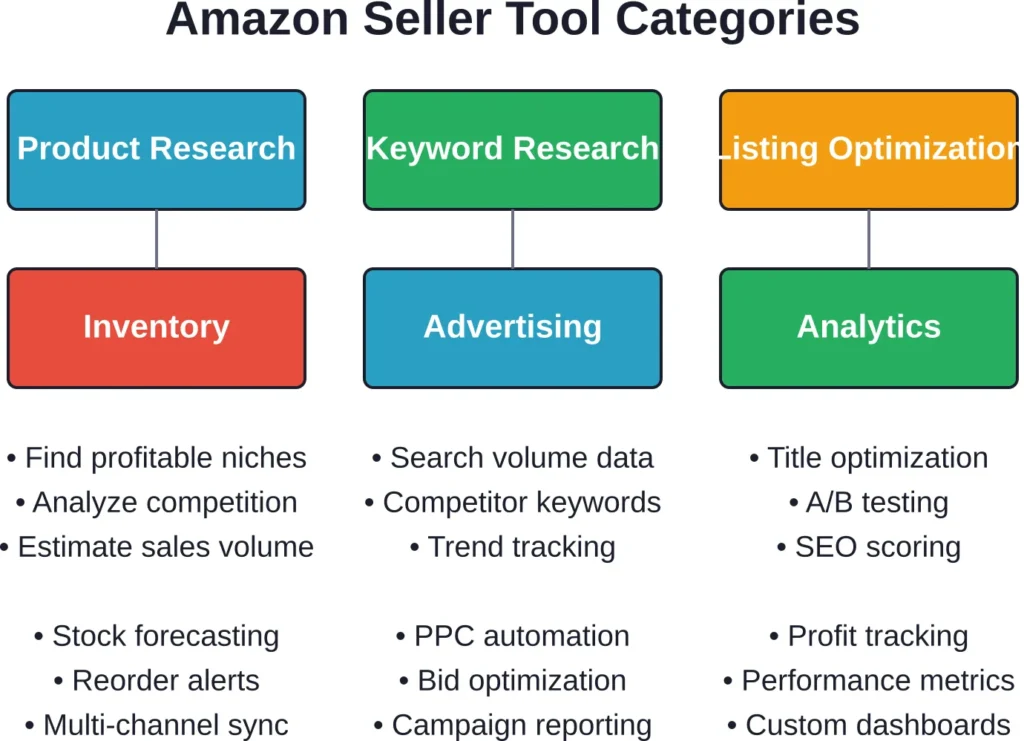
Quick Summary: Amazon sellers need specialized tools to compete effectively in 2026. The most essential tools cover product research, keyword optimization, inventory management, listing optimization, advertising automation, and analytics. While Amazon provides native tools through Seller Central, third-party solutions like WisePPC, Helium 10, Jungle Scout, and Keepa offer advanced features that can significantly improve profitability and reduce workload.
The Amazon marketplace has become increasingly competitive. According to the U.S. Small Business Administration, about 72 percent of U.S. adults use at least one social media platform, and e-commerce continues its explosive growth trajectory.
But here’s the thing—success on Amazon doesn’t happen by accident. The sellers who consistently rank at the top and generate substantial revenue use specialized tools to automate research, optimize listings, and track performance.
This comprehensive list covers the essential tools Amazon sellers need in 2026, from free native options to premium third-party platforms. Each category serves a specific purpose in the selling workflow, and understanding which tools match your business stage makes the difference between spinning your wheels and scaling profitably.
Why Amazon Sellers Need Specialized Tools
Selling on Amazon involves dozens of moving parts. Product research, keyword optimization, inventory forecasting, advertising management, competitor tracking, and financial reporting all demand attention.
Trying to manage everything manually through spreadsheets and guesswork creates bottlenecks. More importantly, it puts sellers at a disadvantage against competitors who leverage automation and data-driven decision-making.
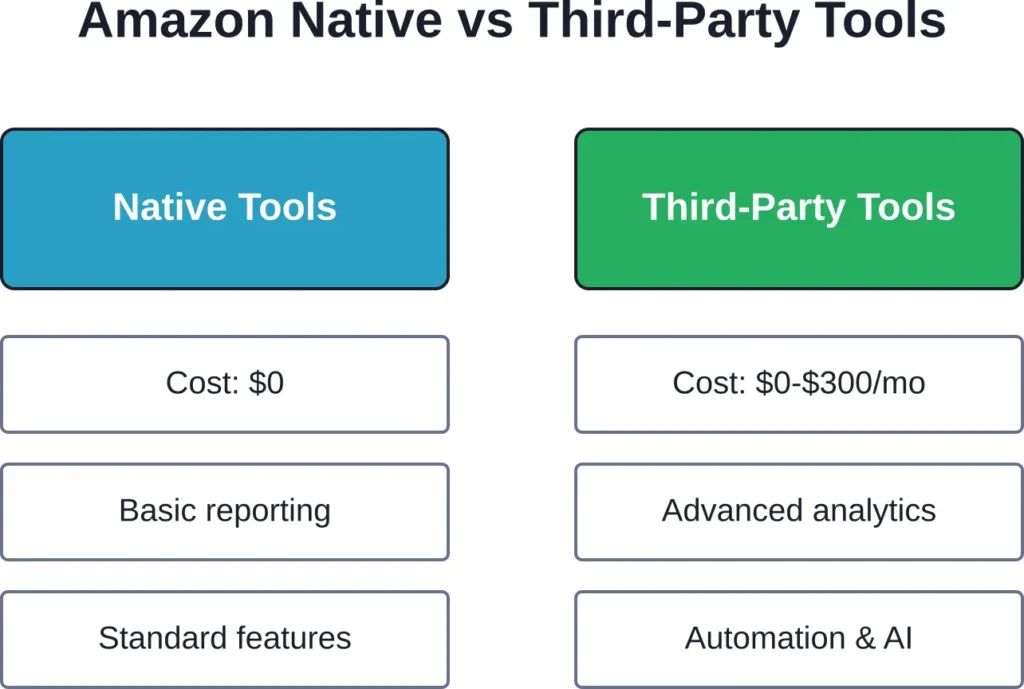
Third-party Amazon seller tools fill the gaps that Amazon’s native Seller Central interface doesn’t address. While Seller Central provides basic reporting and campaign management, it lacks advanced features for keyword research, competitive analysis, and predictive analytics.
According to Amazon Ads data, approximately 36% of sales are driven through surveyed shoppers discovering products via Amazon advertising. The sellers who understand how to optimize their ad spend using specialized tools capture a disproportionate share of that revenue.
Amazon Native Tools (Free with Seller Account)
Amazon provides a solid foundation of tools through Seller Central. These native features don’t require additional subscriptions and cover the basics of managing an Amazon business.
Seller Central Dashboard
Seller Central serves as the command center for Amazon businesses. The dashboard provides access to inventory management, order processing, advertising campaigns, and performance metrics.
The interface includes payment summaries, customer feedback, and health metrics that track account standing. Sellers can manage multiple marketplaces from a single login, which proves valuable for international expansion.
While functional, Seller Central’s reporting capabilities remain somewhat limited. The data is there, but extracting actionable insights requires manual work or integration with external analytics platforms.
Amazon Sponsored Ads Manager
Amazon’s native advertising platform allows sellers to create Sponsored Products, Sponsored Brands, and Sponsored Display campaigns. The minimum starting budget sits at just $10, making it accessible for new sellers testing the waters.
The Campaign Manager interface includes automatic and manual targeting options. Automatic campaigns let Amazon’s algorithm handle keyword selection, while manual campaigns give sellers granular control over bid adjustments and targeting strategies.
According to Amazon’s own data, Surveyed shoppers report being more likely to make purchases from ads seen on Amazon, with significant reach across owned-and-operated inventory.. The cross-channel impact extends beyond the Amazon marketplace itself.
Brand Registry Tools
Sellers who register their trademarks gain access to enhanced content tools, A+ Content, and stronger intellectual property protections. Brand Registry unlocks features that non-branded sellers can’t access.
A+ Content allows for rich media product descriptions with comparison charts, enhanced images, and storytelling elements. These enhanced listings typically convert at higher rates than standard text-only descriptions.
Brand Analytics within Brand Registry provides search term data, market basket analysis, and demographic insights that inform both product development and marketing strategy.
Amazon Currency Converter
For sellers operating in multiple Amazon marketplaces, the Currency Converter automates disbursement management. It handles currency conversion and routing payments to the appropriate bank accounts.
This tool eliminates the hassle of managing separate bank accounts in each country and reduces currency exchange fees compared to traditional bank transfers.
Advertising and PPC Tools
Amazon advertising represents one of the largest expenses for most sellers. PPC management tools optimize campaigns, reduce wasted spend, and improve return on ad spend.
WisePPC

WisePPC is a comprehensive Amazon PPC optimization platform designed for sellers seeking to maximize advertising efficiency, reduce wasted spend, and gain deep visibility into campaign performance. As an official Amazon Ads Verified Partner, it combines powerful bulk operations, long-term historical data storage, and advanced analytics to help businesses of all sizes scale smarter across Sponsored Products, Sponsored Brands, and Sponsored Display campaigns.
Contact Information:
- Website: wiseppc.com
- Facebook: www.facebook.com/people/Wise-PPC/61573154427547
- LinkedIn: www.linkedin.com/company/wiseppc
- Instagram: www.instagram.com/wiseppc
Product Research Tools
Finding profitable products separates successful sellers from those who struggle. Product research tools analyze sales data, competition levels, and market trends to identify opportunities.
Helium 10

Helium 10 offers over 30 powerful Amazon FBA tools covering product research, keyword optimization, and listing management.
Black Box, Helium 10’s product research database, allows filtering by revenue, review count, price point, and competition metrics. Sellers can identify niches with strong demand and manageable competition.
The Chrome Extension provides real-time data overlays on Amazon search results and product pages. This on-the-fly analysis speeds up the research process significantly.
Helium 10 offers a free tier for sellers just starting out, with paid plans scaling based on usage limits and feature access. Amazon tools can range anywhere from $0-$300 dollars depending on the functionality of the tool you’re looking for.
Jungle Scout

Jungle Scout pioneered the Amazon product research category and remains a top choice for both new and experienced sellers. The platform’s database tracks millions of products across Amazon’s global marketplaces.
The Opportunity Finder tool surfaces trending products and emerging niches based on search volume growth and competitive gaps. This forward-looking analysis helps sellers get ahead of market shifts.
Jungle Scout’s accuracy in estimating sales volumes has improved consistently. While no estimation tool achieves perfect accuracy, Jungle Scout’s algorithms account for seasonal variations and category-specific patterns.
Keepa

Keepa tracks historical price and sales rank data for every Amazon product. The browser extension displays price history charts directly on product pages.
This historical perspective reveals pricing patterns, seasonal trends, and stock-out incidents. Sellers use Keepa data to validate product ideas and identify when competitors might be vulnerable.
Keepa’s alert system notifies users when products hit specific price points or availability changes. This feature proves valuable for both product sourcing and competitive monitoring.
Keyword Research and Optimization Tools
Amazon’s search algorithm determines which products appear for which queries. Keyword research tools help sellers understand search behavior and optimize listings accordingly.
Helium 10 Cerebro and Magnet
Cerebro reverse-engineers competitor keywords by showing which search terms drive traffic to any ASIN. This competitive intelligence reveals keyword opportunities that sellers might otherwise miss.
Magnet generates keyword ideas based on seed terms, showing search volume, competition levels, and relevance scores. The tool helps build comprehensive keyword lists for both listing optimization and advertising campaigns.
Together, these tools provide a complete keyword research workflow from discovery through prioritization.
MerchantWords

MerchantWords maintains one of the largest databases of Amazon search terms. The platform tracks real customer searches rather than relying solely on Amazon’s limited keyword suggestions.
The tool provides search volume estimates and trend data that inform both product selection and listing optimization decisions. Understanding which terms customers actually use prevents optimization for the wrong keywords.
Amazon Ads API

For sellers managing large advertising portfolios, the Amazon Ads API enables programmatic campaign management at scale. According to Amazon’s official documentation, there are no minimum additional fees for API use beyond standard account costs.
The API provides direct access to campaign creation, bid adjustments, and reporting data. Developers can build custom workflows that automate repetitive tasks and implement sophisticated bidding strategies.
While the API requires technical knowledge to implement, it unlocks capabilities that aren’t available through the standard advertising interface. Large sellers and agencies typically use the API to manage hundreds of campaigns efficiently.
Listing Optimization Tools
Even great products fail without optimized listings. These tools help sellers craft titles, bullet points, and descriptions that both convert customers and rank in search results.
Listing Analyzers
Several platforms offer listing quality scoring that evaluates keyword usage, readability, and best practice compliance. These analyzers identify weaknesses in existing listings and suggest specific improvements.
The scoring algorithms consider factors like title length, keyword placement, bullet point structure, and backend search term utilization. Sellers receive actionable recommendations rather than vague advice.
A/B Testing Platforms
Amazon’s own A/B testing tool (Manage Your Experiments) allows Brand Registry sellers to test different titles, images, and A+ Content variations. The platform splits traffic and tracks conversion rate differences.
Third-party A/B testing tools extend these capabilities with more sophisticated analytics and broader testing parameters. Some platforms test multiple variations simultaneously rather than simple A/B splits.
Inventory Management Tools
Running out of stock tanks rankings and loses sales. Overstocking ties up capital and risks long-term storage fees. Inventory management tools balance these competing pressures.
Inventory Forecasting Software
Advanced inventory tools use historical sales data, seasonality patterns, and lead times to predict future demand. The forecasting algorithms account for promotional spikes and market trends.
Reorder alerts notify sellers when stock levels approach critical thresholds. The timing considers supplier lead times and shipping duration to prevent stock-outs.
Multi-Channel Inventory Sync
Sellers operating on multiple platforms need synchronized inventory counts. When a product sells on Shopify, the Amazon quantity should update automatically.
Multi-channel tools maintain real-time inventory accuracy across platforms, preventing overselling and the account health issues that follow.
Analytics and Reporting Tools
Data without analysis doesn’t improve decision-making. Analytics platforms transform raw numbers into actionable insights.
Profit Dashboards
Profit tracking tools calculate actual margins after accounting for all Amazon fees, advertising costs, cost of goods, and shipping expenses. The real-time calculations show profitability at the product and order level.
Many sellers are surprised to discover which products actually drive profit versus which just generate revenue. This visibility enables data-driven decisions about inventory investment and advertising budget allocation.
Performance Benchmarking
Some analytics platforms provide industry benchmarks that show how a seller’s metrics compare to category averages. Understanding whether conversion rates and advertising costs are competitive identifies improvement opportunities.
The benchmarking data helps set realistic targets and prioritize optimization efforts on the metrics that matter most.
Review and Feedback Management Tools
Reviews influence conversion rates dramatically. Feedback management tools help sellers monitor reviews, respond appropriately, and request feedback within Amazon’s terms of service.
Review Monitoring
Review alert systems notify sellers immediately when new reviews appear. Fast response to negative reviews can sometimes mitigate damage by demonstrating customer service commitment.
Some tools aggregate reviews across multiple marketplaces into a single dashboard, streamlining monitoring for international sellers.
Automated Feedback Requests
Amazon allows sellers to request reviews through the Request a Review button. Some tools automate this process while staying within Amazon’s communication policies.
The automation ensures consistent follow-up without requiring manual effort for every order. Timing matters—sending requests at the optimal window after delivery improves response rates.
Financial and Accounting Tools
Managing Amazon finances requires tracking sales across marketplaces, reconciling payments, calculating fees, and organizing data for tax preparation.
Accounting Integration
Specialized Amazon accounting software integrates with platforms like QuickBooks and Xero. The integration automatically categorizes transactions and reconciles payouts.
This automation eliminates manual data entry and reduces accounting errors. The categorization properly handles Amazon’s complex fee structure and various transaction types.
Tax Compliance Tools
Sales tax obligations vary by state and product category. Tax compliance platforms track nexus requirements, calculate tax liability, and generate reports for filing.
For international sellers, VAT compliance adds another layer of complexity. The right tools ensure compliance without requiring deep tax expertise.
Repricing Tools
The Buy Box algorithm considers price as a major factor. Repricing tools automatically adjust prices based on competition and margin rules.
Algorithmic Repricing
Repricing algorithms monitor competitor prices and adjust listings to remain competitive while maintaining minimum margins. The rules can account for seller rating, fulfillment method, and inventory levels.
Some repricing tools use machine learning to identify optimal price points that balance competitiveness with profitability. The algorithms learn from historical data which price changes drive the most profitable outcomes.
Strategy Templates
Rather than setting individual rules for every product, repricing platforms offer strategy templates. Sellers can apply consistent logic across product categories and adjust parameters based on goals.
| Tool Category | Primary Function | Typical Cost Range | Best For |
|---|---|---|---|
| Product Research | Find profitable products | $0-$100/month | New sellers and expanding catalogs |
| Keyword Research | Optimize search visibility | $0-$200/month | All sellers focused on organic rank |
| Listing Optimization | Improve conversion rates | $0-$100/month | Sellers with existing products |
| Inventory Management | Prevent stock-outs | $50-$300/month | High-volume sellers |
| PPC Management | Optimize ad spend | $100-$750/month | Sellers spending $1000+ on ads |
| Analytics | Track profitability | $50-$200/month | Data-driven sellers |
How to Choose the Right Tools
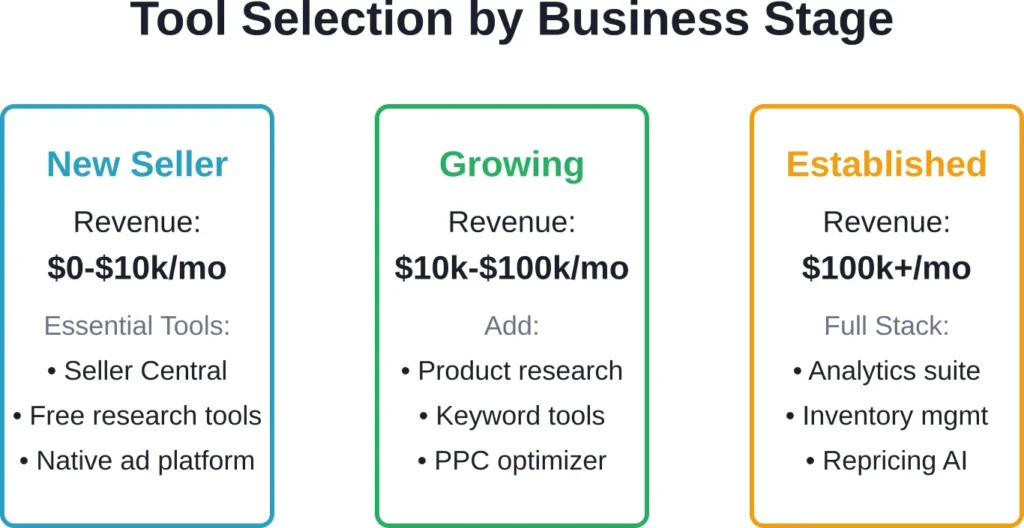
Not every seller needs every tool. The right toolkit depends on business stage, budget, and specific challenges.
For New Sellers
New sellers should start with free tools and Amazon’s native features. Seller Central provides everything needed to launch and test initial products.
As revenue grows, add a product research tool first. Finding the right products matters more than optimizing mediocre ones.
For Growing Sellers
Once monthly revenue crosses $10,000, investing in keyword research and PPC management tools pays dividends. The improved efficiency and optimization typically more than cover the tool costs.
Inventory management becomes critical when carrying multiple products with different velocity patterns. The forecasting prevents both stock-outs and overstock situations.
For Established Sellers
Sellers doing six figures and beyond benefit from comprehensive analytics platforms and advanced automation. At this scale, small percentage improvements translate to meaningful revenue gains.
The focus shifts to efficiency—managing larger catalogs and advertising budgets without proportionally increasing workload. Automation and sophisticated analytics enable scaling without scaling headcount.
Budget Considerations
Tool costs add up quickly. A full software stack can easily run $300-$500 monthly or more. Sellers should evaluate return on investment rather than just upfront cost.
A $100/month tool that improves advertising efficiency by 10% pays for itself many times over for sellers spending $5,000 monthly on ads. The same tool might not justify the cost for someone spending $500 on ads.
Integration and Workflow
Tools that don’t integrate create data silos and duplicate work. When evaluating options, consider how well different tools work together.
Some all-in-one platforms cover multiple categories but may not excel at each individual function. Others specialize deeply in one area but require cobbling together multiple subscriptions.
Free Tools Worth Considering
Budget-conscious sellers can accomplish a lot with free tools. While paid platforms offer more features and automation, free options provide solid functionality for those just starting out.
Amazon’s Seller Central mobile app allows managing inventory and responding to customer messages on the go. The convenience factor helps sellers stay on top of urgent issues without being chained to a desktop.
Google Trends shows search interest over time for potential products. While not Amazon-specific, it provides directional insight into market demand and seasonality.
Keepa offers a free browser extension with price history data. The free tier covers most use cases for product research and competitive monitoring.
Many premium platforms offer limited free tiers that work for sellers managing small catalogs. These freemium models allow testing the platform before committing to a paid subscription.
Common Mistakes When Choosing Tools
Sellers often make predictable mistakes when building their tool stack. Avoiding these pitfalls saves both money and frustration.
Buying Too Many Tools Too Soon
Tool overload creates confusion and wasted subscriptions. New sellers sometimes subscribe to five platforms at once before understanding which features they actually need.
Start minimal and add tools as specific needs emerge. The discipline prevents paying for unused features and maintains focus on core activities.
Ignoring Learning Curves
Powerful tools require time to master. The most feature-rich platform delivers zero value if the seller never learns to use it properly.
When evaluating options, consider the available training resources and support quality. A slightly less powerful tool with excellent documentation might deliver better results than a sophisticated platform with poor onboarding.
Focusing Only on Price
The cheapest option rarely provides the best value. A $50 tool that delivers $500 in improved efficiency beats a free tool that delivers $100 in benefits.
Calculate the potential return rather than just the upfront cost. Time saved and revenue improved often justify premium pricing.
Not Testing Before Committing
Most platforms offer free trials. Sellers who skip testing and commit to annual subscriptions sometimes discover the tool doesn’t fit their workflow.
Use trial periods to evaluate real functionality with actual data. Generic demos don’t reveal whether the platform suits specific needs.
AI and Automation in Amazon Tools
Artificial intelligence has transformed Amazon selling tools over the past few years. According to Amazon’s November 4, 2024 announcement at unBoxed, new AI features like AI Creative Studio and Audio Generator help sellers create high-quality advertising content from minimal input.
AI Creative Studio allows conceptualizing, creating, and refreshing ad content across formats. Sellers can research, generate, refine, and publish various ad creatives from a single product image.
The Audio Generator produces ad copy and a high-quality 30-second audio ad within minutes of submitting a product at no additional cost. This democratizes audio advertising for sellers who previously lacked the resources for professional audio production.
These Amazon-native AI tools complement third-party platforms that use machine learning for bid optimization, inventory forecasting, and pricing strategies. The AI arms race among tool providers benefits sellers through continuously improving capabilities.
Frequently Asked Questions
No, Amazon’s native tools through Seller Central provide everything needed to launch and operate a business. Paid tools accelerate research, optimize operations, and improve efficiency, but aren’t strictly required. Many successful sellers started with free tools and added paid subscriptions as revenue grew and specific needs emerged. The key is understanding which problems paid tools solve and whether those solutions justify the investment for your specific business stage.
Product research tools deliver the highest impact for new sellers. Finding profitable products with reasonable competition matters more than optimizing listings or advertising for mediocre products. A solid product research platform helps avoid common mistakes like entering oversaturated niches or choosing products with thin margins. Once product selection is solid, keyword research tools become the next priority for optimizing visibility.
Tool budgets scale with business size. New sellers can operate effectively with $0-$50 monthly using free tiers and single-subscription platforms. Growing sellers doing $10,000-$50,000 monthly typically invest $100-$300 in tools. Established sellers above $100,000 monthly often spend $300-$1,000 or more on comprehensive tool stacks. The guideline is spending 1-2% of revenue on tools and software, adjusting based on return on investment.
It depends on needs and preferences. All-in-one platforms like Helium 10 offer convenience through unified interfaces and bundled pricing. Specialized tools often provide deeper functionality in their specific category but require managing multiple subscriptions. All-in-one solutions work well for sellers who need baseline functionality across categories. Specialized tools suit sellers with specific advanced needs or those who’ve outgrown all-in-one platform capabilities in certain areas.
No tool guarantees success. Tools provide data, automation, and insights, but sellers still need to make good decisions, source quality products, and provide excellent customer service. Tools amplify capabilities and reduce manual work, but they don’t replace business fundamentals. The most expensive tool stack won’t save a poorly conceived product or fix fundamental business model problems. Think of tools as force multipliers rather than silver bullets.
Calculate potential return on investment. A PPC tool costing $150 monthly that reduces wasted ad spend by 15% pays for itself if monthly ad budget exceeds $1,000. A product research tool that helps identify one additional profitable product per year justifies its annual cost many times over. Track metrics before and after implementing tools to measure actual impact. If you can’t identify specific improvements or time savings, reconsider whether that subscription makes sense.
The Amazon Ads API suits sellers managing large campaigns programmatically or developing custom workflows. It requires technical expertise to implement and maintain. For most sellers, third-party tools built on top of Amazon’s APIs provide better value through user-friendly interfaces and pre-built automation. The API makes sense for large sellers with development resources or agencies managing many client accounts. Individual sellers typically benefit more from polished third-party platforms.
Building Your Tool Stack Strategically
The right approach to building an Amazon tool stack involves starting minimal, validating each addition, and scaling systematically.
Begin with Amazon’s free native tools and free tiers of third-party platforms. Master these basics before adding paid subscriptions. This foundation prevents paying for features that duplicate free functionality.
Add tools one at a time, allowing weeks to fully implement and measure impact before subscribing to another platform. The staged approach prevents overwhelm and enables clear attribution of which tools drive results.
Regularly audit existing subscriptions. Tools that seemed essential six months ago might no longer provide proportional value as the business evolves. Cutting unused subscriptions frees budget for more impactful investments.
Connect with other sellers through forums and communities to learn which tools work well for businesses similar to yours. Real-world experiences from sellers at your stage provide more relevant guidance than generic reviews.
Conclusion
The Amazon seller tool landscape offers solutions for every challenge and budget. From free native tools through Seller Central to sophisticated third-party platforms costing hundreds monthly, sellers can assemble capabilities matching their needs.
Success doesn’t require using every available tool. Strategic selection based on business stage, specific challenges, and return on investment delivers better results than accumulating subscriptions.
Start with Amazon’s native features and free tools. Add paid platforms systematically as revenue grows and specific needs emerge. Focus on tools that solve actual problems rather than accumulating features that sound impressive but deliver little practical value.
The competitive Amazon marketplace rewards sellers who leverage data and automation effectively. The right tool stack amplifies capabilities without requiring proportionally larger teams. That leverage transforms selling on Amazon from a demanding full-time job into a scalable business.
Ready to optimize your Amazon business? Start by auditing your current processes to identify bottlenecks and inefficiencies. Then research tools specifically designed to address those challenges. Test before you buy, measure results carefully, and build your stack methodically. The investment in the right tools pays dividends through increased efficiency, better decisions, and ultimately, higher profitability.