

Quick Summary: Amazon research tools help sellers analyze products, keywords, competitors, and pricing to make data-driven decisions. Leading platforms include Helium 10, Jungle Scout, SmartScout, SellerSprite, and specialized analytics suites that offer features ranging from product discovery to profit tracking. Most tools start from $29–$49/month, with free tiers available for basic research.
The Amazon marketplace moves fast. Every day, thousands of sellers launch new products, shift pricing strategies, and chase keyword rankings. Manual research breaks at scale.
The sellers who win in 2026 aren’t browsing spreadsheets and guessing. They’re using specialized research tools that surface demand trends, validate niches, and track competition in real time.
This guide covers the leading Amazon research tools across product discovery, keyword tracking, analytics, and pricing optimization. The focus is on repeatable workflows—tools that help sellers make consistent, data-backed decisions rather than one-off guesses.
Leverage Advanced Data for Amazon Market Research

Integrating specialized research and management tools is essential for maintaining a competitive edge on Amazon. Rather than relying solely on default reporting, high-growth sellers utilize platforms like WisePPC to gain deeper visibility into campaign performance and historical search trends. By centralizing data from Amazon and other marketplaces, users can move beyond standard metrics to identify high-value keywords and implement data-driven optimizations that directly impact profitability.
Key capabilities provided by this platform include:
- Long-Term Data Retention: Accesses performance insights that exceed Amazon’s standard 60-90 day window, enabling multi-year trend and seasonality analysis.
- Bulk Campaign Management: Executes rapid budget and bid adjustments across thousands of targets, significantly reducing manual administrative tasks.
- Granular Performance Segmentation: Segments data by match type, campaign type, and placement level to identify winning strategies versus underperforming spend.
- Unified Analytics Dashboard: Tracks 30+ core metrics—including TACOS, ACOS, and profit margins—in real-time to facilitate faster, more accurate decision-making.
Sign up for a trial at WisePPC to begin analyzing your data and automating your advertising strategy today.
Why Amazon Sellers Need Third-Party Research Tools
Amazon provides basic analytics through Seller Central. But those native dashboards have limitations. The data comes after the fact, competitor intelligence is minimal, and product opportunity signals are virtually nonexistent.
Third-party tools fill the gaps with features that Amazon doesn’t offer sellers directly.
Here’s what specialized research platforms bring to the table:
- Product discovery filters that surface profitable niches based on demand, competition, and review velocity
- Historical sales estimates that show seasonal trends and trajectory, not just current snapshots
- Reverse-ASIN keyword tools that reveal exactly which search terms drive traffic to competitor listings
- Supplier databases that connect product ideas to verified manufacturers
- Pricing trackers that monitor Buy Box shifts and competitor pricing moves in real time
- AI-assisted insights that flag optimization opportunities across listings, ads, and inventory
The difference between manual work and tool-assisted research isn’t just speed. It’s consistency. A repeatable research workflow lets sellers shortlist products the same way each week, build keyword strategies with the same filters, and track profitability with the same metrics.
That consistency compounds. Over months, it becomes the gap between sellers who scale predictably and those stuck guessing.
Types of Amazon Research Tools
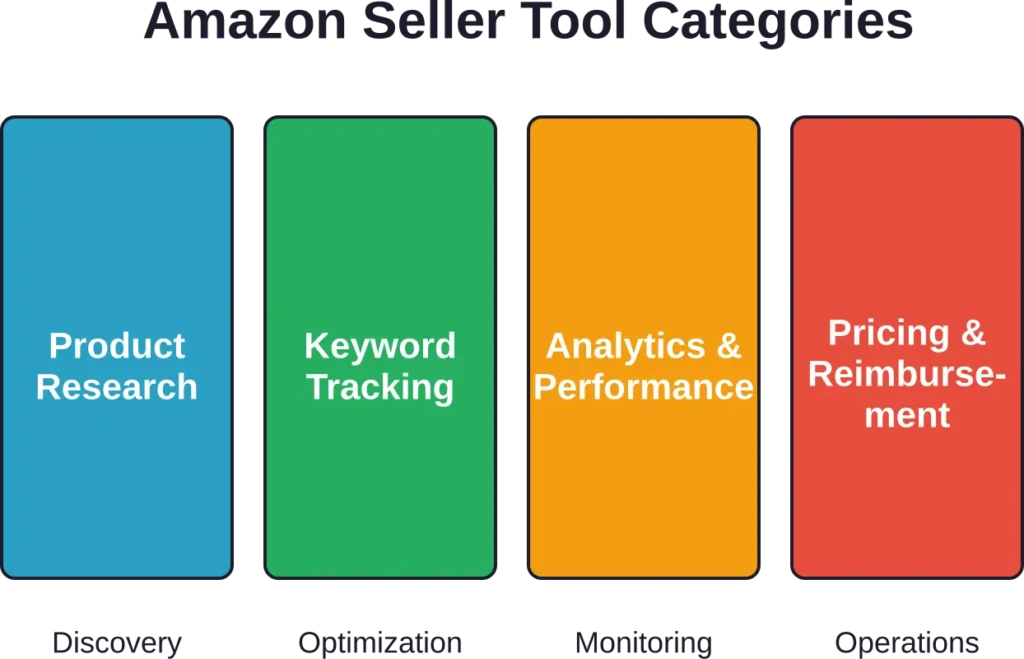
Not all research tools solve the same problem. The Amazon seller toolkit typically breaks into five categories, each addressing a different stage of the workflow.
Product Research Tools
These platforms help sellers discover what to sell. Product research tools aggregate Amazon catalog data, apply filters for revenue estimates, competition intensity, and review counts, then surface opportunities that meet specific criteria.
Common features include product databases with search filters, demand trend graphs, profitability calculators, and niche scorecards. The goal is to validate product ideas before committing inventory capital.
Keyword Research and Tracking Tools
Keyword tools reveal which search terms Amazon shoppers use, how much traffic those terms generate, and where a listing currently ranks. These platforms pull data from Amazon’s autocomplete, reverse-engineer competitor keyword strategies via ASIN lookups, and track ranking position over time.
Effective keyword research drives both listing optimization and PPC campaign structure. Without accurate search volume data, sellers either chase low-traffic terms or burn budget on hyper-competitive keywords.
Analytics and Performance Tools
Analytics platforms centralize sales data, profit margins, ad spend, and inventory turnover into unified dashboards. Many integrate directly with Seller Central and advertising consoles to pull first-party data, then layer on third-party benchmarks and forecasting models.
These tools answer questions like: which SKUs drive the most profit, which ad campaigns waste budget, and when inventory will run out based on current velocity.
Pricing and Repricing Tools
Repricing software monitors Buy Box eligibility and adjusts listing prices automatically based on competitor moves, inventory levels, and profitability thresholds. Advanced platforms use rule-based logic or AI to react in real time without constant manual oversight.
For sellers with catalog depth or frequent price competition, automated repricing protects margins while maintaining Buy Box share.
Reimbursement and Refund Tools
Amazon’s FBA system occasionally loses or damages inventory. Reimbursement tools audit Seller Central transaction logs, identify discrepancies, and file claims on behalf of sellers. Many sellers potentially miss reimbursements because manual auditing of FBA discrepancies is time-intensive.
Leading Amazon Product Research Tools
Product research is where most sellers start. The right tool shortens the gap between browsing Amazon and launching a validated product.
Jungle Scout

Jungle Scout built its reputation on the Product Database, a searchable index of millions of Amazon listings with filters for estimated monthly revenue, review count, seller type, and category. The platform combines browser extensions for on-page analysis with standalone web tools for deeper research.
Key features include demand trend graphs, supplier databases that connect products to verified manufacturers, and profitability calculators that estimate landed costs and FBA fees. The Opportunity Finder tool surfaces niche keywords with high demand and low competition.
Pricing starts from $49/month for basic plans. Some community members note that Jungle Scout’s sales estimates may tend to run conservative, which some sellers prefer for safer forecasting.
Helium 10

Helium 10 operates as an end-to-end suite covering product research, keyword tracking, listing optimization, and inventory management. The Black Box tool filters products by revenue, price range, review velocity, and competition metrics. Xray, the Chrome extension, overlays sales estimates and profitability data directly on Amazon search results.
The platform’s strength is breadth. Sellers get research tools, PPC analytics, keyword trackers, and listing builders under one subscription. Entry-level plans start from $39/month, though access to the full feature set requires higher tiers.
User feedback highlights the learning curve—Helium 10 packs dozens of tools, and new sellers sometimes struggle with which module to use when.
SmartScout

SmartScout approaches research from a category-first perspective. The platform maps entire Amazon categories, shows market share distribution among brands, and tracks traffic trends over time. TrafficGraph visualizes search volume patterns, while SellerMap reveals which brands dominate specific subcategories.
In 2026, SmartScout added AI-powered features including an AI Visibility Monitor that tracks how Amazon’s own AI search tools surface listings, and an AI Scorecard that evaluates listing readiness for voice and visual search.
Pricing starts from $29/month, making it one of the more accessible platforms for sellers focused on category intelligence rather than SKU-level granularity.
SellerSprite

SellerSprite originated in the Chinese seller market and has expanded globally. The Product Research module applies filters for sales estimates, keyword concentration, and seasonal trends. The platform’s keyword tools pull data across multiple Amazon marketplaces, which is valuable for sellers operating internationally.
SellerSprite also includes a Market Tracker that monitors specific niches over time, surfacing new entrants and ranking shifts. Pricing varies by plan and marketplace coverage—check the official site for current rates.
AMZScout

AMZScout offers a PRO Extension for Chrome that displays sales estimates, revenue projections, and niche scores on Amazon search and product pages. The web app includes a Product Database similar to Jungle Scout’s, with filters for profitability, competition, and trend direction.
The platform markets itself toward beginner sellers with simplified interfaces and lower price points. Some advanced sellers find the feature set limiting as they scale, but for early-stage product validation AMZScout delivers core functionality without overwhelming complexity.
| Tool | Starting Price | Core Strength | Best For |
|---|---|---|---|
| Jungle Scout | From $49/mo | Product Database, supplier connections | Product validation, sourcing |
| Helium 10 | From $39/mo | End-to-end suite, listing optimization | Sellers wanting all-in-one platform |
| SmartScout | From $29/mo | Category intelligence, market share | Competitive analysis, category research |
| SellerSprite | Varies | Multi-marketplace keyword data | International sellers |
| AMZScout | Check official site | Beginner-friendly interface | New sellers, simple validation |
Keyword Research and Tracking Tools
Keyword data drives listing copy and PPC campaigns. Without accurate search volume and competition metrics, optimization becomes guesswork.
Helium 10 Cerebro and Magnet

Cerebro is Helium 10’s reverse-ASIN tool. Enter a competitor ASIN, and Cerebro returns every keyword that listing ranks for, along with search volume, competing product count, and estimated PPC cost. Magnet generates keyword ideas from seed terms, filtering by volume, competition, and trend direction.
Both tools integrate with Helium 10’s listing builder, allowing sellers to move from keyword research directly into optimized copy without switching platforms.
Jungle Scout Keyword Scout
Keyword Scout provides search volume estimates, PPC bid ranges, and trend data for Amazon keywords. The tool tracks how search volume shifts seasonally, which helps sellers time launches and adjust ad budgets around demand peaks.
The Rank Tracker module monitors where a listing appears for target keywords over time, surfacing ranking drops that might signal algorithm changes or new competition.
SellerSprite Keyword Research
SellerSprite’s keyword module covers multiple Amazon marketplaces across regions. The tool pulls autocomplete data, reverse-ASIN keywords, and related search terms. Trend graphs show historical search volume, and the platform flags seasonal spikes based on prior-year data.
For sellers managing listings across multiple regions, SellerSprite’s multi-marketplace coverage simplifies international keyword strategy.
Sonar (Free Tool)

Sonar is a free Amazon keyword research tool. It generates keyword suggestions from seed terms and provides basic volume estimates. The tool doesn’t offer reverse-ASIN lookups or advanced filtering, but for budget-conscious sellers it covers foundational keyword discovery.
Sonar works well for initial brainstorming before investing in paid platforms.
Analytics and Performance Tracking Tools
Analytics tools centralize sales data, profit calculations, and ad performance into unified dashboards. These platforms answer the question: which products and campaigns actually make money?
Native Amazon Tools: Seller Central and Brand Analytics

Amazon provides first-party analytics at no extra cost. Seller Central includes Business Reports showing sessions, conversion rates, and units sold. Brand Analytics (available to Brand Registry participants) adds Search Query Performance data and Market Basket Analysis.
The data is accurate—it comes directly from Amazon—but the interface is fragmented across multiple dashboards. Integration with external tools requires manual exports or API connections.
Seller Central provides reports that can help sellers understand customer behavior and retention metrics.
Helium 10 Profits and Analytics
Helium 10 Profits tracks revenue, costs, and net profit at the SKU level. The tool imports Amazon payouts, deducts product costs and FBA fees, and factors in ad spend to calculate true profitability. Inventory dashboards forecast stockouts based on current velocity.
The analytics module integrates with Helium 10’s PPC tool, Adtomic, to show which campaigns drive profitable sales versus which burn budget on low-margin conversions.
SellerLabs (Scope and Ignite)

SellerLabs operates two main platforms: Scope for keyword research and Ignite for PPC management. Ignite’s analytics dashboard pulls Amazon Advertising data, calculates ACoS and TACoS, and flags keywords with high spend but low conversion.
The platform uses rule-based automation to adjust bids based on performance thresholds, reducing manual campaign maintenance.
DataHawk

DataHawk focuses on analytics for brands managing multiple marketplaces. The platform aggregates sales, traffic, and ad data across Amazon regions, then layers on competitive benchmarks and share-of-voice metrics.
Advanced dashboards track product launch velocity, review acquisition rates, and ranking progression. For brands with international catalogs, DataHawk simplifies cross-marketplace reporting.
Perpetua

Perpetua is an AI-driven advertising and analytics platform. The tool optimizes PPC campaigns using machine learning models that adjust bids, budgets, and targeting based on conversion patterns. Analytics dashboards show contribution margin, not just revenue, accounting for ad spend and product costs.
Perpetua is designed for sellers managing significant ad budgets, with pricing typically custom-quoted.
Pricing and Repricing Tools
Buy Box eligibility and pricing strategy directly impact sales velocity. Repricing tools automate price adjustments based on competitor moves, inventory levels, and profitability rules.
RepricerExpress

RepricerExpress monitors competitor prices and adjusts listings automatically to maintain Buy Box competitiveness while respecting minimum profit margins. The platform supports rule-based strategies—sellers define conditions like “stay $0.50 below the lowest FBA offer” or “never drop below $15 net profit.”
Real-time repricing reacts within minutes of competitor changes, which matters in categories with frequent price shifts.
Informed.co (formerly Appeagle)

Informed.co uses machine learning to optimize pricing decisions. The platform considers competitor pricing, stock levels, sales velocity, and external factors like seasonality. AI models predict the optimal price point to maximize revenue or profit, depending on seller goals.
Advanced features include competitor group targeting—repricing against specific sellers rather than the entire market—and velocity-based rules that adjust pricing to move excess inventory.
Seller Snap

Seller Snap combines repricing with game-theory algorithms that anticipate competitor behavior. The platform tracks patterns in how specific sellers react to price changes, then adjusts strategy to avoid race-to-the-bottom scenarios.
The tool also includes FBA fee calculators and profitability dashboards, centralizing pricing intelligence with margin tracking.
AI Integration in Amazon Research Tools (2026 Trends)
In 2026, AI features are moving beyond keyword suggestions and basic automation. Leading platforms now integrate machine learning into product discovery, listing optimization, and ad management.
Here’s where AI adds measurable value:
Demand Forecasting
AI models analyze historical sales data, seasonal patterns, and external signals (like social media trends) to predict future demand. Advanced forecasting helps sellers time launches, plan inventory orders, and adjust ad spend ahead of demand peaks.
Platforms like Helium 10 and Jungle Scout now include predictive trend graphs that flag products entering growth phases before they hit mainstream saturation.
Listing Optimization
AI listing builders analyze top-ranking competitors, extract common keyword patterns, and generate optimized titles, bullet points, and descriptions. SmartScout’s AI Listing Architect, for example, evaluates how well a listing performs in Amazon’s voice and visual search systems, then recommends adjustments.
These tools don’t replace human copywriting but they accelerate the process of keyword placement and readability optimization.
PPC Bid Optimization
Machine learning algorithms in platforms like Perpetua and Helium 10 Adtomic adjust PPC bids based on conversion probability, time-of-day performance, and inventory levels. The models learn which keywords convert at specific price points and shift budgets accordingly.
For sellers managing dozens of campaigns, AI-driven bid management reduces manual work and often improves ACoS by identifying inefficiencies humans miss.
Competitive Intelligence
AI monitors competitor listings for changes in pricing, keywords, images, and A+ content. When a top competitor updates their listing or launches a new product, alerts flag the change so sellers can react quickly.
SmartScout’s AI Visibility Monitor tracks how Amazon’s own AI features (like Rufus, Amazon’s conversational shopping assistant) surface specific listings, giving sellers insight into algorithmic favorability.
How to Choose the Right Amazon Research Tools
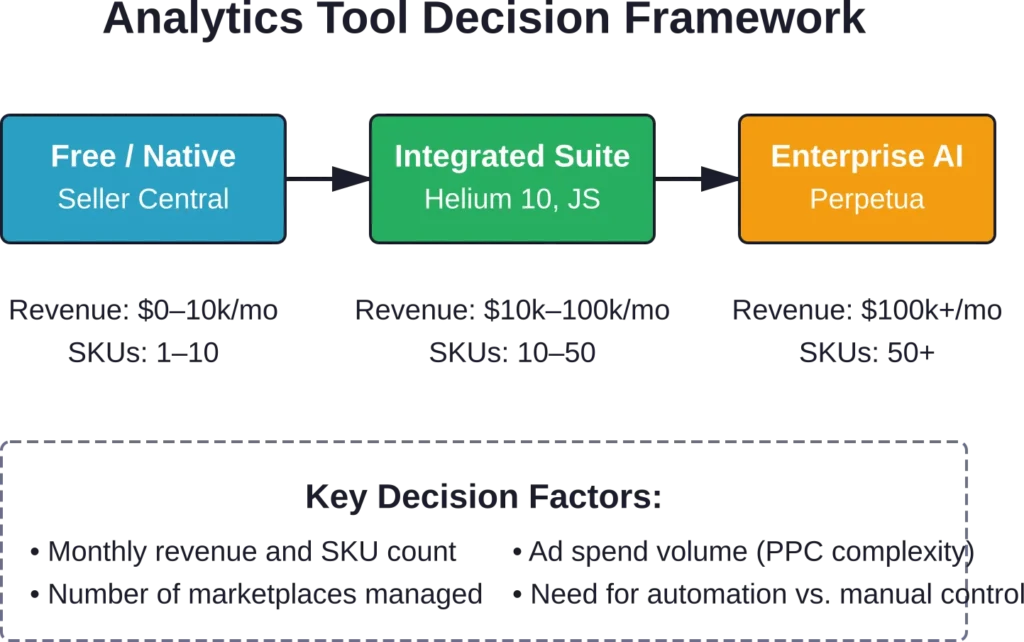
Tool selection depends on seller stage, budget, and workflow complexity. There’s no universal “best” platform—only the right fit for specific needs.
For New Sellers (First Product Launch)
Beginners benefit from simplified interfaces and lower price points. Start with one integrated suite rather than assembling multiple specialized tools.
Recommended approach:
- Use Helium 10’s free tier or AMZScout for initial product validation
- Leverage Amazon’s native Seller Central reports for sales tracking
- Add Sonar (free) for keyword discovery
- Upgrade to a paid plan only after validating product-market fit
At this stage, the goal is validating product-market fit while learning research workflows without overwhelming complexity.
For Growing Sellers ($10k–$100k Monthly Revenue)
Scaling sellers need tools that handle multiple SKUs, automate repetitive tasks, and provide deeper competitive intelligence.
Recommended stack:
- Jungle Scout or Helium 10 for product research and keyword tracking (from $39–$49/month)
- Repricing software like RepricerExpress for Buy Box management
- Analytics dashboard (Helium 10 Profits or SellerLabs Ignite) to track profitability by SKU
This tier balances feature depth with manageable subscription costs. The focus shifts from validation to optimization and efficiency.
For Established Brands ($100k+ Monthly Revenue)
Large sellers and brands need enterprise-grade analytics, multi-marketplace support, and advanced automation.
Recommended stack:
- SmartScout for category intelligence and market share tracking (from $29/month)
- Perpetua or Helium 10 Adtomic for AI-driven PPC management
- DataHawk or similar for multi-marketplace analytics
- Reimbursement tool (GetIDA, Refunds Manager) to recover lost FBA inventory value
At scale, tool ROI justifies higher monthly costs. The emphasis is on data-driven decision-making and freeing team bandwidth from manual work.
| Seller Stage | Monthly Revenue | Tool Priority | Budget Range |
|---|---|---|---|
| New Seller | $0–$10k | Product validation, keyword basics | $0–$50/mo |
| Growing Seller | $10k–$100k | Multi-SKU tracking, repricing, PPC | $100–$300/mo |
| Established Brand | $100k+ | AI automation, multi-marketplace, analytics depth | $500+/mo |
Building a Repeatable Research Workflow
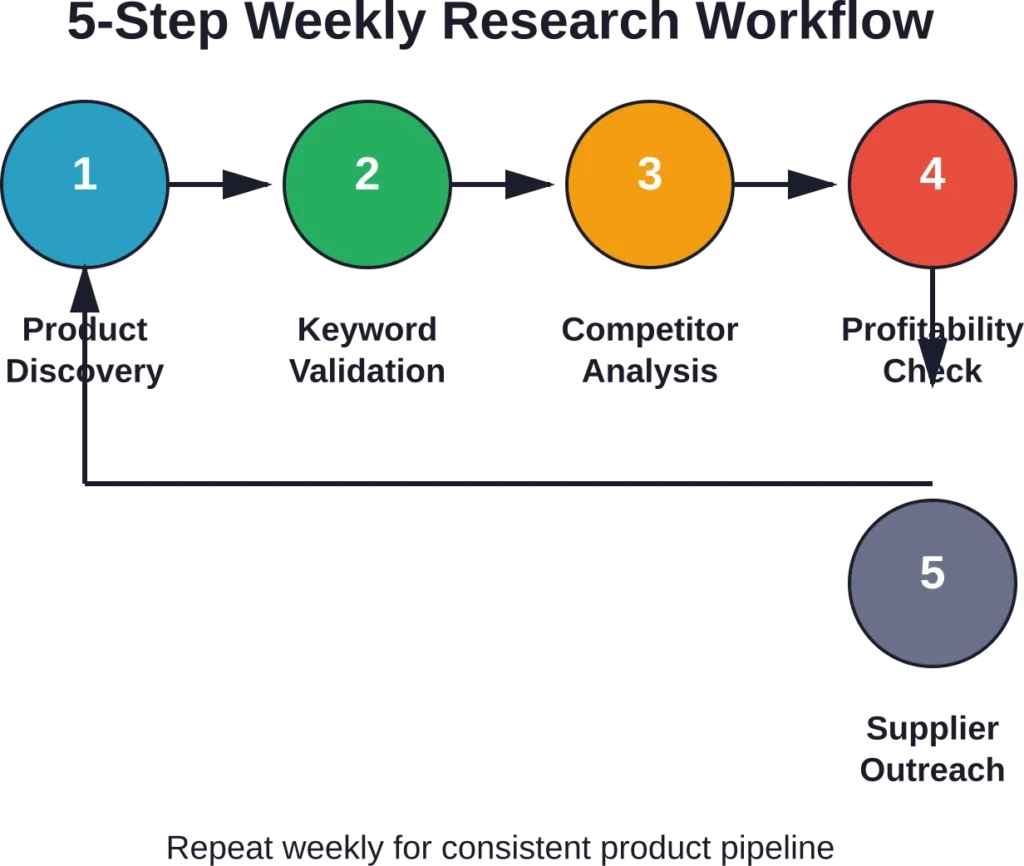
Tools deliver value when integrated into consistent workflows. Here’s a practical research process that sellers can repeat weekly.
Step 1: Product Discovery (Weekly)
Run product database searches with filters for:
- Monthly revenue: $5k–$30k (high enough to matter, not saturated)
- Review count: fewer than 200 (indicates newer niches)
- Price range: $15–$50 (healthy margins after FBA fees)
- Trend direction: upward or stable (avoid declining categories)
Export 10–20 candidate products. Review listings manually to check for quality issues, branding opportunities, or obvious differentiation angles.
Step 2: Keyword Validation
For shortlisted products, run reverse-ASIN lookups on top competitors. Identify:
- Primary keywords (high volume, high relevance)
- Long-tail variations (lower volume, easier to rank)
- Seasonal patterns (does demand spike at certain times?)
Build a target keyword list with 15–25 terms spanning high-volume core terms and long-tail modifiers.
Step 3: Competitor Analysis
Analyze the top 5 listings for target keywords:
- What price points dominate?
- What features appear in titles and bullets?
- How many reviews do competitors have, and what’s the acquisition rate?
- Are listings using A+ content, video, or other enhanced features?
Look for gaps—features customers mention in reviews that competitors don’t highlight, or price tiers with fewer strong offerings.
Step 4: Profitability Calculation
Estimate landed costs (product + shipping + import fees) and calculate net profit after Amazon fees. Most research tools include profitability calculators that factor in FBA fees, referral fees, and storage costs.
Set minimum thresholds—many sellers target 30%+ net margin to account for PPC spend and returns.
Step 5: Supplier Outreach
If a product passes validation, use supplier databases (Jungle Scout Supplier Database, Alibaba, or direct manufacturer contacts) to request quotes. Compare MOQs, unit costs, and lead times.
This workflow, repeated weekly, generates a consistent pipeline of validated product ideas without relying on gut instinct.
Common Mistakes When Using Amazon Research Tools
Even powerful tools produce poor results when used incorrectly. Here are the most common pitfalls.
Over-Reliance on Sales Estimates
Third-party tools estimate sales based on Best Seller Rank algorithms. Those estimates are directional, not exact. Community discussions on Reddit frequently mention discrepancies between tool estimates and actual sales after launch.
Use estimates to compare relative opportunity (Product A likely outsells Product B), not as precise revenue forecasts.
Ignoring Seasonal Trends
A product showing strong current sales might be riding a seasonal peak. Tools with historical trend graphs reveal whether demand is year-round or concentrated in specific months.
Launching a seasonal product in the off-season means waiting months to validate demand, tying up capital in slow-moving inventory.
Chasing Saturated Niches
High revenue attracts competition. Products with thousands of monthly sales often have dozens of near-identical listings fighting for share. New sellers entering saturated niches face uphill battles on ranking and differentiation.
Better approach: target mid-tier revenue ($5k–$20k/month) with fewer than 100 reviews on top listings. There’s enough demand to build a business, but less entrenched competition.
Tool Hopping Without Mastery
Switching between platforms every few months prevents deep familiarity. Most tools have learning curves—features that seem basic on the surface reveal advanced functionality after weeks of use.
Pick one integrated suite, learn it thoroughly, then add specialized tools only when specific gaps appear.
Free vs. Paid Amazon Research Tools
Budget-conscious sellers often ask: can free tools deliver enough value, or are paid platforms necessary?
What Free Tools Offer
Free options include Amazon’s native Seller Central reports, Sonar keyword tool, and limited-access tiers of platforms like Helium 10. These tools cover basic keyword discovery, sales tracking, and category browsing.
For sellers validating their first product or operating on razor-thin budgets, free tools provide enough data to avoid obvious mistakes.
Where Free Tools Fall Short
Free platforms typically lack historical data, competitor tracking, and advanced filters. Sales estimates are often unavailable, and keyword volume data is limited or outdated.
Scaling beyond a single product demands features like reverse-ASIN lookups, profitability dashboards, and inventory forecasting—none of which free tools provide reliably.
ROI Calculation for Paid Tools
A $49/month tool that helps a seller avoid one bad product decision (saving $2,000+ in inventory costs) pays for itself many times over. The question isn’t whether paid tools cost money—it’s whether they deliver returns that exceed the subscription.
For sellers doing $10k+/month, tool costs represent 0.5–1% of revenue. That’s a reasonable trade for data that improves product selection, keyword targeting, and profitability.
Integrating Tools with Existing Amazon Workflows
Research tools work best when integrated into existing seller operations, not bolted on as separate processes.
Product Launch Workflow
When launching a new SKU:
- Use product research tools to validate demand and competition
- Run reverse-ASIN keyword analysis on top 5 competitors
- Build listing copy using keyword lists from research tools
- Set up rank tracking for target keywords before launch
- Monitor early sales velocity and adjust PPC bids based on analytics dashboards
This sequence ensures research data informs every launch decision, from positioning to ad spend allocation.
Ongoing Optimization Workflow
For existing products:
- Review weekly analytics for profitability by SKU
- Check keyword rank trackers for drops or new opportunities
- Monitor competitor pricing and adjust via repricing tools
- Audit PPC campaigns monthly using AI-driven bid recommendations
- Quarterly review: compare category market share and adjust product roadmap
Regular touchpoints prevent drift—where listings slowly lose ranking or profitability erodes without immediate visibility.
The Role of Community and User Reviews
Online communities, particularly Reddit’s AmazonFBA and SellerCentral subreddits, provide real-world feedback on tool performance. Sellers share which platforms deliver accurate estimates, which customer support teams respond quickly, and which features justify premium pricing.
Before committing to a platform, search for recent discussions. Tool quality shifts over time—a platform praised two years ago might have stagnated while competitors innovated.
Look for patterns in feedback:
- Do multiple users report the same data accuracy issues?
- Are there consistent complaints about specific features or integrations?
- How does the company respond to criticism and feature requests?
Community consensus won’t replace direct testing, but it surfaces red flags and highlights strengths that marketing materials gloss over.
Future Trends in Amazon Research Tools
The research tool landscape continues evolving. Here’s where the category is heading in late 2026 and beyond.
Deeper AI Integration
AI will move beyond keyword suggestions into predictive analytics—forecasting which products will trend in 60–90 days based on external signals like social media mentions, search trends outside Amazon, and seasonal buying patterns from prior years.
Expect tools that automatically generate A/B test hypotheses for listings, then track results and iterate without manual intervention.
Multi-Marketplace Unification
As sellers expand beyond Amazon.com to international marketplaces, tools that aggregate data across regions become more valuable. Platforms like DataHawk and SellerSprite already offer multi-marketplace dashboards; this will become table stakes rather than a premium feature.
Voice and Visual Search Optimization
Amazon’s voice shopping (Alexa) and visual search features change how customers discover products. Research tools are adding scoring systems that evaluate listings for voice search compatibility and image optimization.
SmartScout’s AI Scorecard, introduced in 2026, is an early example. Tools that help sellers optimize for these emerging discovery channels will gain adoption as voice and visual commerce grow.
Sustainability and Social Metrics
Customer interest in sustainability and ethical sourcing is rising. Future research tools may integrate supplier certifications, carbon footprint data, and social impact metrics into product evaluation workflows.
Brands that align with these values early will differentiate as platforms surface sustainability data more prominently.
Frequently Asked Questions
Helium 10 and Jungle Scout are both beginner-friendly, with entry-level plans starting from $39–$49/month. Helium 10 offers a broader feature set, while Jungle Scout focuses on simplicity and ease of use. Both provide tutorials and support materials for new sellers. For those on tight budgets, starting with free tools like Amazon Seller Central reports and Sonar can provide basic validation before upgrading to paid platforms.
Sales estimates are directional rather than exact. Tools use Best Seller Rank algorithms to reverse-engineer sales volume, but actual sales can vary by 20–40% from estimates depending on category, seasonality, and listing optimization. Use estimates to compare relative opportunity between products, not as precise revenue forecasts. Always validate with small test orders before committing to large inventory purchases.
Most sellers start with one integrated suite (Helium 10, Jungle Scout, or SmartScout) that covers product research, keywords, and basic analytics. As businesses scale, adding specialized tools for specific needs—like repricing software, advanced PPC management, or reimbursement auditing—becomes valuable. The key is mastering one core platform before adding complexity.
Free tools can support initial validation but have significant limitations. They typically lack historical trend data, accurate sales estimates, and advanced competitor analysis. Sellers launching their first product can start with free options, but scaling beyond one SKU generally requires paid platforms with deeper data and automation features. The ROI on paid tools usually justifies the cost once monthly revenue exceeds $5k–$10k.
Product research tools help identify what to sell by analyzing demand, competition, profitability, and trends across Amazon’s catalog. Keyword research tools focus on how customers search for products—revealing search terms, volume, competition, and ranking data. Many platforms combine both functionalities, but some sellers use specialized keyword tools for deeper search term analysis when building listings and PPC campaigns.
Workflows vary by seller stage. Product research typically happens weekly or bi-weekly when actively sourcing new SKUs. Keyword rank tracking and analytics reviews should occur weekly to catch ranking drops or profitability issues early. PPC campaign audits benefit from monthly reviews using AI-driven recommendations. Competitive intelligence and category analysis work well on a quarterly cycle to inform broader strategy adjustments.
No tool guarantees success. Research platforms surface data and insights, but execution—product quality, listing optimization, customer service, and marketing—determines outcomes. Tools reduce guesswork and improve decision quality, but they can’t compensate for poor product selection, weak differentiation, or operational failures. Think of research tools as navigation systems: they show the route, but sellers still need to drive.
Conclusion: Choosing Tools That Match Your Workflow
The Amazon research tool market offers dozens of platforms, each with overlapping features and distinct strengths. The right choice depends less on which tool ranks “best” in generic comparisons and more on which platform aligns with specific seller needs, budget, and workflow.
New sellers benefit from integrated suites like Helium 10 or Jungle Scout that combine product research, keyword tracking, and basic analytics under one subscription. These platforms minimize tool sprawl while covering essential functions.
Growing sellers with multiple SKUs and rising ad spend gain value from specialized tools—repricing software to protect Buy Box share, analytics dashboards that calculate true profitability, and PPC platforms with AI-driven bid optimization.
Established brands managing international marketplaces and large catalogs need enterprise-grade solutions with multi-marketplace support, advanced forecasting, and team collaboration features.
Regardless of scale, the most successful sellers build repeatable research workflows. They use tools consistently—running the same filters weekly, tracking the same metrics, and reviewing performance on predictable cycles. That consistency turns data into compounding advantage.
The Amazon marketplace rewards sellers who make faster, more informed decisions than their competition. Research tools are the infrastructure that makes speed and accuracy compatible.
Start with one core platform. Master its features. Add specialized tools only when specific gaps become clear. And remember: tools provide leverage, but strategy and execution determine results.
Ready to streamline your Amazon research workflow? Evaluate your current process, identify the biggest data gaps, and test one platform with a free trial or entry-tier subscription. The right tool, used consistently, pays for itself many times over.