

Quick Summary: Amazon advertising tools automate campaign management, optimize bids, and improve profitability beyond Seller Central’s native capabilities. The best platforms in 2026 range from affordable rule-based solutions for small sellers to enterprise AI-powered tools managing millions in ad spend. Choosing the right software depends on monthly ad budget, team size, and whether you need autonomous optimization or hands-on control.
Amazon’s native Seller Central campaign manager wasn’t built for serious advertisers. The manual bid adjustments, limited bulk editing, and delayed reporting create bottlenecks that cost sellers thousands in wasted spend.
That’s where specialized Amazon PPC software comes in. These tools connect to Amazon’s API to analyze ad performance, adjust bids, and optimize keywords automatically — replacing messy spreadsheets and daily login checks.
The advertising landscape shifted dramatically between 2024 and 2026. According to IAB’s 2026 State of Data report, 60 to 75 percent of advertisers say widely adopted measurement solutions, incrementality, attribution, MMMs, still miss on rigor, speed, and efficiency. This gap pushed serious Amazon sellers toward dedicated automation platforms.
Here’s the thing though — not all Amazon advertising tools are created equal. Some use black-box AI that removes control, while others offer surgical precision with hybrid automation. Pricing ranges from $39/month starter plans to enterprise contracts exceeding $10,000 monthly.
This guide breaks down 15+ tools based on actual features, verified pricing, and real-world use cases. No fluff.
What Amazon PPC Software Actually Does
Amazon PPC software automates the management of advertising campaigns on Amazon. It connects to Amazon’s API to analyze ad performance, adjust bids, and optimize keywords 24/7.
These platforms handle the repetitive, data-heavy tasks that Amazon’s native Seller Central and vendor console weren’t built for: automatic bid adjustments based on performance metrics, keyword harvesting from search terms, budget pacing across multiple campaigns, and consolidated reporting across Sponsored Products, Brands, and Display.
Most tools operate in one of two modes: rule-based automation or AI-powered autonomous optimization. Rule-based systems execute actions when specific conditions trigger — for example, “If ACOS exceeds 30%, lower bid by 10%.” AI-powered platforms use machine learning models to predict performance and make continuous adjustments without predefined rules.
The practical difference? Rule-based tools give advertisers full transparency and control. AI platforms promise better performance but operate as black boxes where you can’t always see why a decision was made.
The Real Performance Gap
Timing matters in Amazon advertising. Analysis of bid optimization cycles shows that hourly or daily bid adjustments miss 60% of optimization opportunities compared to 15-minute refresh cycles.
That matters when you’re competing in auctions that refresh constantly. By the time a human checks Seller Central and adjusts a bid manually, the campaign has already spent on underperforming placements and missed high-converting traffic windows.
Top Amazon Advertising Tools Compared
The software market split into clear tiers based on budget, sophistication, and control philosophy. Here’s how the leading platforms stack up.
WisePPC: Deep Analytics Meets Actionable Control

WisePPC positions itself as a powerful Amazon Ads analytics and optimization platform that reveals the data Amazon hides while giving advertisers full control through bulk actions and smart automation. As an official Amazon Ads Verified Partner, it connects directly via the Ads API and stores long-term historical data far beyond Amazon’s standard 60-90 day limit.
The platform excels at granular, multi-dimensional analysis: placement-level performance, hourly trends, match-type breakdowns, product targeting insights, and combined ad + organic metrics. Advertisers get bulk editing for campaigns, ad groups, and keywords, advanced filtering, customizable dashboards, and automated bid/budget rules with dayparting capabilities.
WisePPC works best for Amazon sellers and agencies who want deeper visibility and faster execution than native tools provide, especially those managing multiple campaigns or needing long-term trend analysis. Currently in open beta with very attractive early-user offers; full pricing is usage-based and available upon request (starting mentions around custom/enterprise tiers).
Contact Information:
- Website: wiseppc.com
- Facebook: www.facebook.com/people/Wise-PPC/61573154427547
- LinkedIn: www.linkedin.com/company/wiseppc
- Instagram: www.instagram.com/wiseppc
AdLabs: Precision Control With Smart Automation

AdLabs positions itself against black-box automation tools by giving advertisers surgical precision backed by smart workflows and hybrid automation features.
The platform’s interface prioritizes speed: bulk bid editing, campaign actions, and smart dayparting with real-time ACoS insights. Custom dashboards display hourly performance data, and the system supports advanced segmentation that most competitors don’t offer at this level.
AdLabs works best for advertisers managing substantial budgets who need granular control but want automation to handle the repetitive optimization work. The pricing structure isn’t publicly listed — enterprise model with custom quotes.
Perpetua: AI That Learns Your Business Goals
Perpetua runs autonomous AI optimization across Sponsored Products, Brands, Display, and DSP campaigns. The system adjusts bids continuously based on goals you set: maximize revenue, hit target ACoS, or optimize for profit margins.
The platform’s strength is its goal-based approach. Instead of setting rules manually, advertisers define business objectives and let the AI determine the tactical execution. This works well for brands that trust algorithmic decision-making and don’t want to micromanage campaign settings.
Perpetua appears frequently in discussions about mid-market and enterprise Amazon advertising. Pricing requires direct contact with their sales team.
Helium 10 Adtomic: Integrated Keyword Intelligence
Adtomic ships as part of Helium 10’s broader suite of Amazon seller tools. It’s less of a standalone advertising platform and more of an integrated workflow for sellers already using Helium 10 for product research and listing optimization.
The advertising features include rule-based automation, bid optimization, and analytics. The real value comes from the integration with Helium 10’s keyword research tools — discovering high-intent search terms and moving them directly into campaigns without manual export/import.
Adtomic is included in higher-tier Helium 10 plans starting at $279/month. For sellers already paying for Helium 10, it’s an add-on feature rather than a separate expense. For advertisers who don’t need the full Helium 10 suite, the pricing becomes less attractive compared to dedicated advertising platforms.
BidX: Profit-First Optimization

BidX differentiates on profit margin optimization rather than ACoS or sales volume targeting. The platform factors in Amazon fees, cost of goods sold, and other expenses to optimize for actual profit — not just advertising efficiency.
This matters for sellers with complex cost structures or products where small margin differences multiply across volume. Community discussions indicate BidX performs well for sellers spending $10K+ monthly on Amazon ads who’ve already optimized basic ACoS but want to maximize bottom-line profit.
The platform uses AI-driven bid automation with margin targets as the primary optimization goal. Pricing isn’t publicly disclosed.
Rule-Based vs. AI Automation: Which Actually Works?
The automation debate split the Amazon advertising community into two camps. Rule-based advocates argue for transparency and control. AI proponents promise superior performance through machine learning.
Here’s what the data shows: both approaches work, but for different seller profiles.
Rule-Based Automation Strengths
Rule-based systems execute predefined logic: “If ACOS exceeds 30%, lower bid by 20%.” They’re transparent, predictable, and give advertisers full visibility into why each action happened.
This approach works well for sellers who understand their unit economics, have clear target metrics, and want to maintain strategic control while automating tactical execution. Rule-based tools typically cost less and don’t require large data sets to function effectively.
The limitation? Rules can’t adapt to patterns they weren’t programmed to recognize. If market conditions shift in unexpected ways, rule-based automation continues executing the old logic until a human updates the rules.
AI-Powered Autonomous Optimization
AI platforms use machine learning models to predict which bids, keywords, and budget allocations will drive the best outcomes. They continuously test, learn, and adjust without predefined rules.
According to marketing data, AI tools are now used by 34% of Amazon sellers. The technology matured significantly between 2024 and 2026, with platforms like Perpetua and Teikametrics reported to demonstrate measurable performance improvements over manual management.
The trade-off? Less transparency. AI systems make thousands of micro-adjustments based on patterns in historical data. Advertisers can see the outcomes but can’t always trace the specific logic behind each decision.
AI automation works best for advertisers managing large budgets across many campaigns where the volume of optimization opportunities exceeds human capacity. For small accounts with limited data, AI models struggle to train effectively and rule-based systems often perform better.
Budget-Tier Breakdown: What To Expect
Amazon advertising tools cluster into distinct price bands that correlate with features, sophistication, and target customer size.
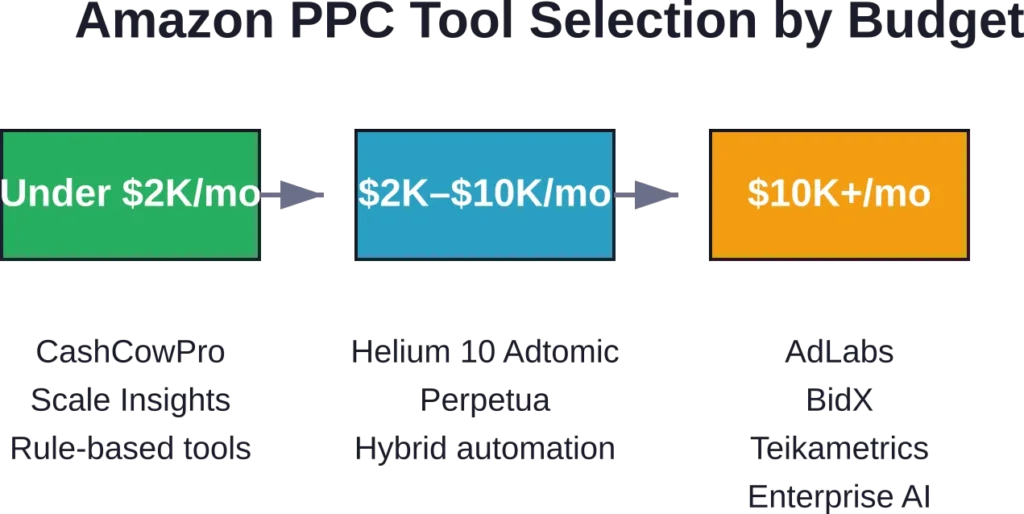
Entry Level: $39–$99/Month
Tools in this range offer basic rule-based automation, campaign analytics, and keyword management. Examples include CashCowPro starting at $49/month and similar platforms targeting sellers with modest ad budgets.
These platforms work for advertisers spending under $2,000 monthly on Amazon ads. They automate the most repetitive tasks — bid adjustments, negative keyword additions, budget pacing — without the advanced features that enterprise sellers need.
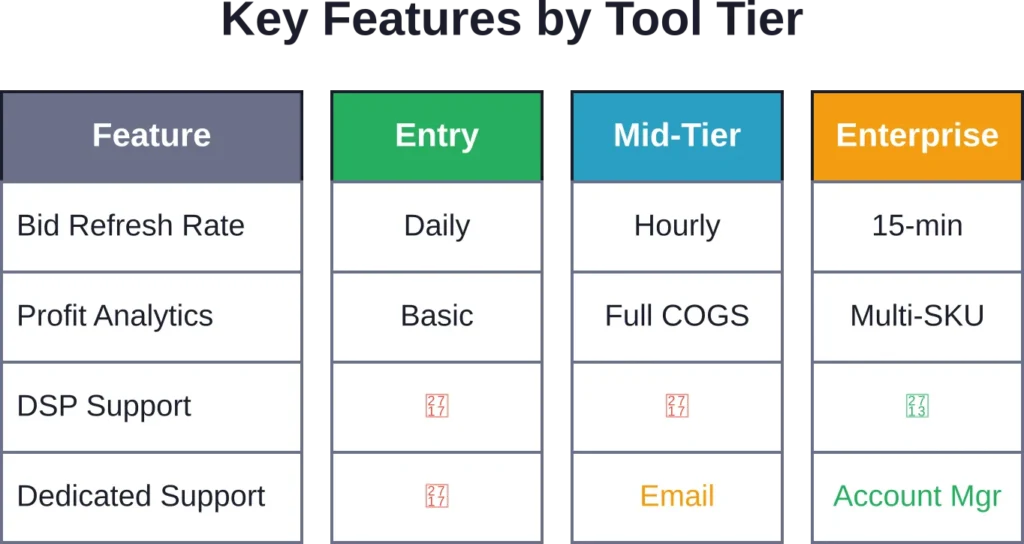
Limitations include slower refresh cycles (hourly or daily instead of 15-minute intervals), basic reporting, and limited campaign types supported. But for sellers just graduating from manual Seller Central management, the productivity gain justifies the cost.
Mid-Market: $99–$500/Month
The mid-tier delivers faster automation cycles, multi-campaign management, profit analytics, and integration with broader seller tool suites. Helium 10’s Adtomic falls here at $279/month as part of the complete platform.
This tier targets sellers spending $2,000–$10,000 monthly on ads. The tools handle Sponsored Products, Sponsored Brands, and basic Sponsored Display campaigns with hybrid automation that combines rules and algorithmic optimization.
Reporting becomes more sophisticated with custom dashboards, hourly performance tracking, and profit calculation that factors in Amazon fees and COGS.
Enterprise: Custom Pricing Above $500/Month
Enterprise platforms like AdLabs, Perpetua, BidX, and Teikametrics don’t publish pricing. Community discussions suggest monthly fees ranging from several hundred to several thousand dollars depending on ad spend volume.
These tools justify the cost through advanced features: 15-minute bid refresh cycles, full DSP campaign management, multi-channel advertising across Amazon and other platforms, dedicated account management, and proprietary AI models trained on billions of dollars in ad spend data.
For sellers spending $10K+ monthly on Amazon ads, the performance improvement from reduced wasted spend and improved campaign efficiency typically exceeds the software cost within the first month.
Essential Features To Evaluate
Not all Amazon advertising platforms prioritize the same capabilities. When comparing tools, focus on these core feature categories.
Bid Optimization Speed and Logic
The most critical differentiator is how frequently the tool refreshes bid decisions and what logic drives those changes. Platforms with 15-minute refresh cycles capture optimization opportunities that hourly or daily systems miss.
Evaluate whether the platform uses rules, AI, or hybrid approaches. Ask vendors to explain their bid logic in plain language — if they can’t or won’t, that’s a red flag.
Keyword Management and Search Term Harvesting
Effective tools automatically harvest high-performing search terms from campaign reports and add them as exact-match keywords while simultaneously adding non-converting terms to negative keyword lists.
This automation eliminates hours of weekly manual work and prevents wasted spend on irrelevant traffic. Check whether the tool supports bulk negative keyword operations and portfolio-level negative lists.
Profit Calculation Accuracy
Basic tools report ACoS and ROAS. Better platforms calculate true profit by factoring in Amazon referral fees, FBA fees, cost of goods sold, and other expenses.
For sellers with complex fee structures or products with tight margins, profit-based optimization delivers materially different results than ACoS targeting. Verify whether the platform allows custom COGS input and whether it updates automatically when Amazon changes fee structures.
Multi-Campaign and Portfolio Support
Managing dozens or hundreds of campaigns manually becomes impossible. Effective tools allow bulk operations across campaigns, portfolio-level budget pacing, and consolidated reporting that rolls up performance across product lines or brands.
Dayparting and Schedule-Based Optimization
Conversion rates vary by hour and day of week. Smart dayparting adjusts bids higher during high-converting time windows and lowers them during low-performance periods.
Real-time dayparting based on actual performance data outperforms generic schedule templates. AdLabs and several enterprise platforms offer this; budget tools typically don’t.
Amazon Ads Software vs. Hiring an Agency
Software and agencies solve related but different problems. Understanding when each makes sense prevents expensive mismatches.
When Software Makes Sense
Amazon advertising software works best when advertisers have in-house expertise to set strategy and interpret data. The software handles execution — bid adjustments, keyword management, budget pacing — while humans make strategic decisions about product targeting, creative testing, and budget allocation across campaigns.
For sellers spending $2,000–$50,000 monthly on ads with at least one knowledgeable team member, software typically delivers better ROI than agencies. The cost runs lower, response time is instant, and the advertiser maintains full control.
When Agencies Add Value
Agencies make sense when businesses lack internal Amazon advertising expertise or need strategic guidance beyond tactical execution. Good agencies bring category knowledge, creative capabilities, and strategic planning that software can’t replicate.
The challenge? Agency economics require minimum monthly retainers (typically $2,500–$10,000+) that only make sense for larger ad budgets. Agencies also introduce communication overhead and slower decision cycles compared to direct software access.
Some sellers use hybrid models: software for automation and agencies for strategy and creative development. This works well for brands scaling past $100K monthly ad spend who need both sophisticated execution and strategic depth.
Emerging Trends in Amazon Advertising Tools
The Amazon ads software market evolved rapidly between 2024 and 2026. Several trends shape current platform development.
AI-Enhanced Measurement and Attribution
According to IAB’s 2026 research, measurement gaps cost advertisers massive optimization opportunities. The report estimates $26 billion in potential unlocked media investment over two years through AI-driven measurement improvements.
Amazon advertising platforms responded by building better attribution models that connect advertising exposure to downstream conversions. Tools now track view-through conversions, brand halo effects, and cross-ASIN attribution more accurately than legacy point-of-sale measurement.
Retail Media Network Integration
Amazon commands the largest share of retail media spend, but Walmart, Target, and other retailers built substantial advertising platforms. Several tools expanded beyond Amazon-only to manage campaigns across multiple retail media networks from one dashboard.
Teikametrics and Pacvue lead this multi-channel approach. For brands selling across multiple retailers, unified campaign management reduces operational overhead.
Privacy-Enhanced Collaboration Features
Data privacy regulations and platform policy changes pushed Amazon advertising tools toward privacy-enhanced data collaboration capabilities. These features allow brands to activate first-party data for targeting without exposing raw customer information.
AWS’s advertising platform services reflect this trend at the infrastructure level. Amazon advertising tools built on AWS can leverage these privacy-preserving collaboration frameworks.
How To Choose the Right Amazon Ads Tool
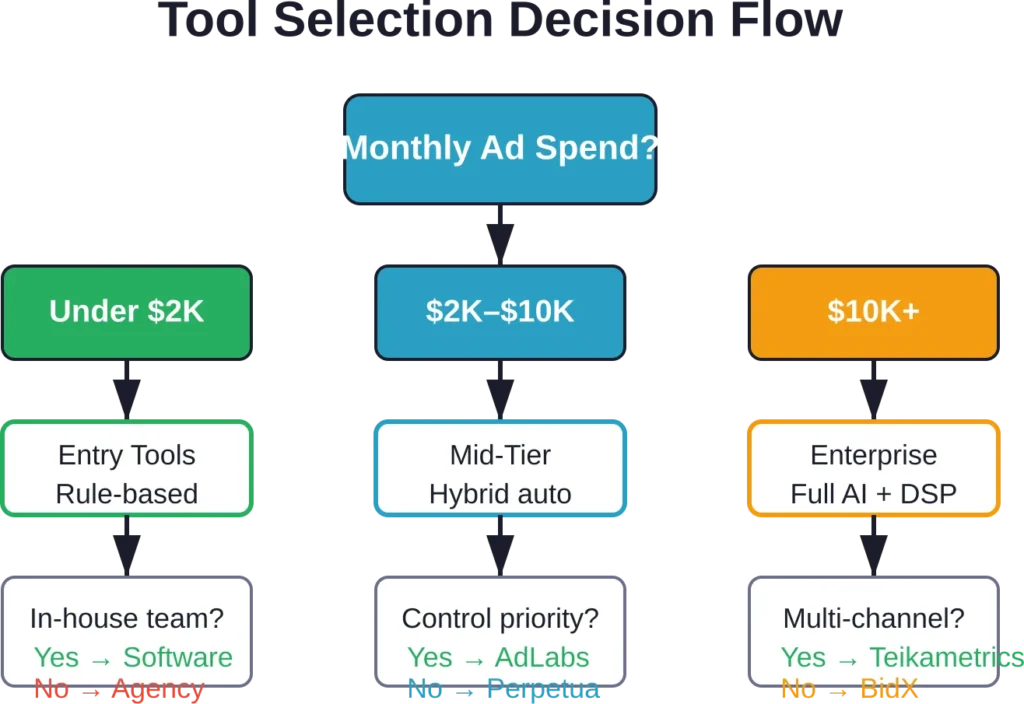
Selection criteria vary based on business stage, budget, and internal capabilities. Here’s a decision framework.
Start With Monthly Ad Spend
Your current and projected monthly Amazon advertising budget determines which tier makes economic sense. As a general guideline, software costs should represent 5–10% of monthly ad spend.
Spending under $2,000/month? Look at entry-level tools like CashCowPro or basic rule-based platforms. The feature limitations won’t constrain performance at this spend level.
Spending $2,000–$10,000/month? Mid-tier platforms deliver the automation sophistication and reporting depth that justify their cost. Helium 10 Adtomic works well if you already use the broader suite.
Spending $10,000+/month? Enterprise platforms with 15-minute bid cycles, dedicated support, and advanced AI optimization become worth the investment. The performance improvement from reduced wasted spend typically exceeds software costs.
Evaluate Team Expertise
Software amplifies team capabilities but doesn’t replace expertise. If your team understands Amazon advertising mechanics, conversion funnel optimization, and unit economics, sophisticated tools multiply their effectiveness.
If your team lacks deep advertising knowledge, either invest in training first or consider an agency relationship instead of just buying software.
Test Before Committing
Most Amazon advertising platforms offer trials or initial setup periods. Use them to evaluate interface usability, automation logic transparency, and reporting clarity.
Run the tool alongside manual management for 2–4 weeks. Compare performance metrics: wasted spend reduction, conversion rate changes, and time saved on campaign management. The data clarifies whether the tool delivers enough value to justify ongoing cost.
Check Integration Requirements
Some platforms require specific Amazon account types (Seller Central vs. Vendor Central), minimum ad spend history, or API access permissions. Verify compatibility before committing.
Common Mistakes When Adopting Amazon Ads Software
Implementation failures waste money and create frustration. Avoid these common errors.
Expecting Instant Results
Amazon advertising tools need time to learn account patterns and optimize effectively. AI platforms require 2–4 weeks of data collection before algorithms stabilize.
Sellers who judge performance after three days and immediately abandon tools miss the actual optimization curve. Set realistic expectations: meaningful performance improvements typically appear after 30–60 days.
Setting Unrealistic ACoS Targets
Software can’t violate economic reality. If your product margins, pricing, and conversion rates produce a 35% break-even ACoS, no tool will sustainably deliver 15% ACoS at meaningful volume.
Set targets based on actual unit economics and competitive dynamics in your category. Tools optimize toward the goals you set — but they can’t create profit where market conditions don’t support it.
Ignoring Negative Keywords
Even the best automation can’t overcome fundamentally irrelevant traffic. If your campaigns accumulate thousands of non-converting search terms and you never add negative keywords, automation tools will struggle.
Most platforms automate negative keyword management, but verify that the feature works properly and review negative lists periodically to catch edge cases.
Over-Relying on Automation Without Strategy
Software handles tactical execution brilliantly but doesn’t replace strategic thinking. Advertisers still need to make decisions about product positioning, creative messaging, seasonal budget allocation, and competitive response.
The most effective users combine software automation for bid management and optimization with human strategic oversight for campaign structure and business decisions.
Frequently Asked Questions
Amazon PPC software automates the management of advertising campaigns on Amazon by connecting to Amazon’s API to analyze ad performance, adjust bids, and optimize keywords continuously. Sellers need it because manual management through Seller Central becomes impractical at scale — the tools handle repetitive tasks like bid adjustments, keyword harvesting, and budget pacing that would otherwise require hours of daily work and still miss optimization opportunities that happen between manual check-ins.
Pricing varies widely based on features and target customer size. Entry-level tools start around $39–$99/month and offer basic rule-based automation suitable for sellers spending under $2,000 monthly on ads. Mid-tier platforms range from $99–$500/month with features like Helium 10’s Adtomic at $279/month included in higher plan tiers. Enterprise tools use custom pricing models typically starting above $500/month, with actual costs scaling based on ad spend volume managed.
Rule-based software works well for sellers who want full transparency and control over optimization logic and those with smaller ad budgets where AI models struggle to train effectively. AI-powered platforms deliver superior performance for advertisers managing large budgets across many campaigns where the volume of optimization opportunities exceeds human capacity — but they operate as black boxes with less visibility into specific decision logic. Many sellers with $10K+ monthly ad spend prefer hybrid approaches that combine rules for strategic guardrails with AI for tactical execution.
Software replaces agencies for tactical execution when businesses have in-house Amazon advertising expertise to set strategy and interpret data. For sellers spending $2,000–$50,000 monthly with at least one knowledgeable team member, software typically delivers better ROI than agencies at lower cost with faster response times. Agencies add value when businesses lack internal expertise or need strategic guidance and creative capabilities beyond tactical bid management — though agency economics require minimum retainers of $2,500–$10,000+ monthly that only make sense for larger budgets.
Initial setup and API integration typically complete within 24–48 hours, but meaningful performance improvements appear after 30–60 days. AI platforms specifically need 2–4 weeks of data collection before algorithms stabilize and begin delivering optimized results. Sellers who evaluate performance after only a few days miss the actual optimization curve — tools need time to learn account patterns, test bid adjustments, and identify the keyword and placement combinations that drive profitable conversions.
Bid optimization speed matters most — platforms with 15-minute refresh cycles capture opportunities that hourly or daily systems miss. Other critical features include automated keyword harvesting from search terms, profit calculation that factors in Amazon fees and COGS beyond basic ACoS reporting, multi-campaign and portfolio-level management capabilities, and smart dayparting that adjusts bids based on actual hour-by-hour conversion patterns. Verify whether the platform supports all campaign types you run including Sponsored Products, Brands, Display, and DSP if applicable.
Most Amazon advertising platforms support both Seller Central and Vendor Central accounts, but feature availability sometimes differs between account types. Vendor Central accounts access additional advertising products like DSP that require enterprise-tier software with specific integrations. Always verify compatibility with your specific account type before committing to a platform, and check whether the tool requires minimum ad spend history or special API permissions that may not be available to all account levels.
Conclusion
Amazon advertising tools evolved from simple bid automation utilities into sophisticated platforms that manage complex multi-campaign strategies across Sponsored Products, Brands, Display, and DSP.
The right tool depends on monthly ad spend, team expertise, and strategic priorities. Sellers spending under $2,000 monthly perform well with entry-level rule-based platforms. Mid-market advertisers at $2,000–$10,000 monthly benefit from hybrid automation with profit analytics. Enterprise sellers above $10,000 monthly justify advanced AI platforms with 15-minute bid cycles and dedicated support.
Don’t chase the newest AI features or the lowest price. Match tool capabilities to actual business needs. Test platforms during trial periods with real campaigns to verify performance claims before committing to annual contracts.
The Amazon advertising landscape will continue evolving. Measurement improvements promise to unlock significant additional performance according to IAB research. Privacy-enhanced collaboration features will enable better targeting without compromising customer data protection. Multi-channel retail media management will consolidate more platforms into unified dashboards.
Start with clear objectives based on your unit economics and competitive position. Choose software that amplifies your team’s capabilities rather than replacing strategic thinking. Monitor performance against quantifiable metrics — wasted spend reduction, time savings, and profit improvement — not vanity metrics like impressions or clicks.
Ready to optimize your Amazon advertising? Check current pricing and feature availability on official platform websites, start free trials where available, and test rigorously before committing.