

Quick Summary: AI ad cloning solutions allow marketers to analyze, replicate, and optimize high-performing competitor ads at scale. These platforms combine automated creative research, generative AI, and performance data to accelerate testing cycles and reduce production costs, with some implementations showing measurable improvements in ROI and campaign efficiency when deployed responsibly.
Running profitable ad campaigns often comes down to understanding what already works. Studying competitor creatives, dissecting hooks and formats, then building variations used to take hours of manual research. Not anymore.
AI ad cloning tools now automate the entire workflow—from discovering winning ads in platforms like Meta Ad Library to generating production-ready variants with one click. But here’s the thing: not all cloning software delivers the same results.
Some platforms excel at creative research but fall short on generation quality. Others produce gorgeous visuals but lack the analytics layer to tell you why an ad performed well. And a few integrate so tightly with ad accounts that launch becomes nearly automatic.
This guide breaks down the best AI solutions for cloning ads in 2026, covering what each tool does best, who should use it, and how pricing stacks up. Real talk: the right tool depends on whether creative discovery, copy generation, or full-stack automation matters most for the workflow.
Why AI Ad Cloning Matters Now
Digital advertising has become a game of speed and iteration. Brands that test more creatives win more auctions. According to Brookings Institution research, more than 30% of all workers could see at least 50% of their occupation’s tasks disrupted by generative AI, with creative and clerical roles among the most impacted.
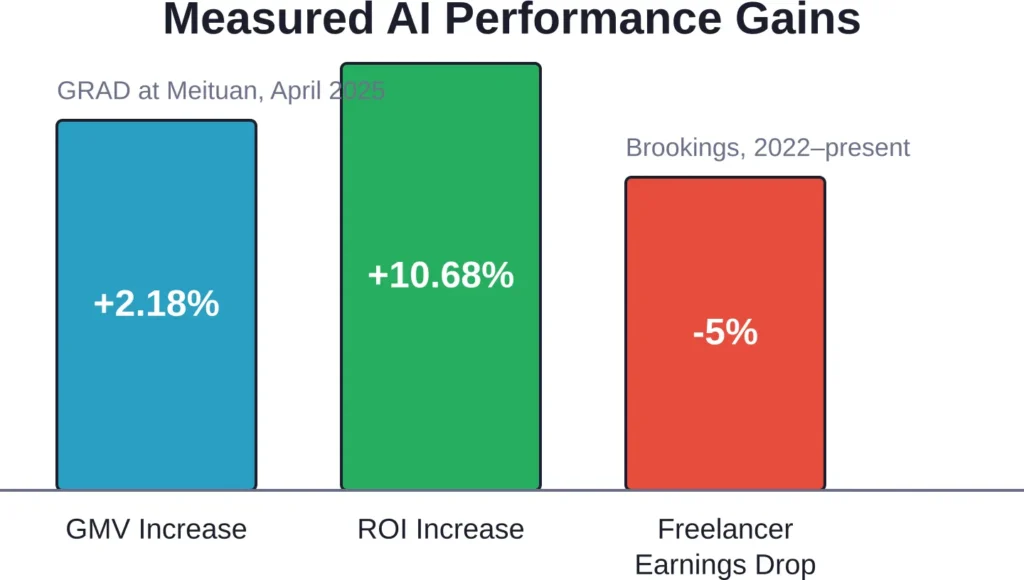
That disruption cuts both ways. Freelancers in AI-exposed occupations have experienced a 2% decline in the number of contracts and a 5% drop in earnings following the release of new AI software in 2022, per Brookings data. Meanwhile, brands adopting AI-powered ad workflows early are scaling output without proportionally scaling headcount.
The shift isn’t just about efficiency. It’s about competitive intelligence. Ad cloning tools let marketers see exactly what messaging, offers, and formats competitors are running—and how long they’ve been running them. If a competitor’s ad has been live for six months, that’s a signal it’s profitable.
Cloning doesn’t mean copying verbatim. It means learning from proven patterns, then adapting them with brand-specific positioning, creative twists, and fresh hooks. Done right, it shortens the path from hypothesis to validated winner.
Top AI Ad Cloning Tools in 2026
Here’s what the best platforms bring to the table. Each excels in different areas, so the right choice depends on team size, budget, and whether the priority is research or production.
1. Extuitive
Extuitive specializes in predictive AI cloning and validation for Shopify brands. It connects directly to your store, analyzes winning products and historical signals, then generates adapted ad variants (copy, visuals, videos, reels, pricing) while simulating real buyer reactions through 150,000+ AI consumer agents.
The platform goes beyond basic generation by forecasting CTR, ROAS, and purchase intent before any spend. It clones high-performers intelligently, preserving what works while optimizing for new audiences or channels, then ranks variants so you launch only the strongest ones.
Pricing starts at $1,000/month (Starter) for brands spending >$10K on ads, with Professional at $2,500/month and Enterprise custom. All plans include a demo-first approach rather than a simple free trial. Ideal for scaling D2C teams that want data-backed cloning instead of guesswork.
Contact Information:
- Website: extuitive.com
- Email: [email protected]
- LinkedIn: www.linkedin.com/company/extuitive
- Twitter: x.com/Extuitive_Inc
- Instagram: www.instagram.com/extuitiveinc
2. AdStellar
AdStellar combines competitor research with one-click creative generation. The platform pulls ads from Meta Ad Library, identifies winning patterns, and lets users generate variants directly from saved creatives.
The Winners Hub feature automatically surfaces ads that have been running for extended periods—a strong proxy for profitability. Bulk launch tools push multiple variants to Meta Ads Manager in one workflow, which is particularly valuable for agencies managing multiple clients and scaling output without scaling headcount.
Pricing sits at $49/month for the Hobby plan, $129/month for Pro, and $499/month for Ultra. A 7-day free trial covers all plans, so testing the workflow before committing is straightforward.
3. Foreplay

Foreplay focuses heavily on creative discovery and organization. The swipe file system lets teams save, tag, and categorize competitor ads by theme, format, or campaign type. It’s built for inspiration rather than direct cloning.
The platform doesn’t generate creatives natively, but it integrates with external generation tools. For teams that prioritize curation and collaborative briefing over automated production, Foreplay delivers a clean research experience.
4. AdCreative.ai

AdCreative.ai leans into generative AI for display ads, social creatives, and landing page visuals. Users input product details and brand assets, and the platform outputs dozens of design variants optimized for different placements.
It doesn’t clone competitor ads directly, but it applies learnings from high-performing ad structures across its training data. The output quality is high, especially for e-commerce brands needing volume without hiring designers.
5. Minea

Minea specializes in dropshipping and e-commerce ad discovery. The tool tracks winning products and their associated ad creatives across Meta, TikTok, and Pinterest. Filters for engagement, ad duration, and niche make it easy to find proven winners in specific verticals.
Minea doesn’t generate creatives, but it provides detailed analytics on why ads work—hooks, pain points, objection handling. For direct-response marketers, that context is often more valuable than automated generation.
6. AdSpy
AdSpy maintains one of the largest databases of social ads, with filters for demographics, landing pages, affiliate networks, and more. It’s a research-first tool with deep data but no native generation features.
The landing page tracking is particularly useful. Seeing how a competitor’s ad connects to their funnel—offer structure, upsells, email capture—provides strategic context beyond the creative itself.
7. Pencil (by Brandtech)
Pencil combines AI generation with performance prediction. The platform analyzes historical ad data to forecast which creative variants will perform best, then generates those variants automatically.
It integrates with ad accounts to pull real performance data, feeding that back into the prediction model. Over time, the tool learns what works for a specific brand, making recommendations increasingly accurate.
8. MagicBrief
MagicBrief is built for video ad analysis. The tool breaks down competitor video ads frame-by-frame, highlighting hooks, transitions, CTAs, and pacing. Annotations make it easy to brief video editors or agencies.
For brands where video is the primary format, MagicBrief’s granular analysis beats generic cloning tools. It bridges the gap between competitive research and production-ready briefs.
9. BigSpy
BigSpy offers broad coverage across multiple ad networks—Meta, Google, YouTube, Twitter, Yahoo. The free tier provides basic search and filtering, while paid plans unlock advanced analytics and bulk export.
It’s a solid budget option for small teams that need breadth over depth. The interface is less polished than premium alternatives, but the data coverage is extensive.
AI Ad Copy Generation Beyond Cloning
Not every marketer needs full creative cloning. Sometimes the bottleneck is just copy—headlines, body text, CTAs. AI copywriting tools solve that problem without requiring competitor research workflows.
Jasper
Jasper (formerly Jarvis) is one of the most mature AI copywriting platforms. Templates for Meta ads, Google Ads, and landing pages make it fast to generate variants. The tone-of-voice training lets brands maintain consistency across outputs.
Integration with Surfer SEO adds optimization for landing page copy, making Jasper a good fit for teams running integrated search and social campaigns.
Copy.ai
Copy.ai focuses on speed and simplicity. The ad copy templates require minimal input—product name, benefit, audience—and generate dozens of options in seconds. Quality can be hit-or-miss, so expect to edit, but it accelerates the first draft.
The free tier is generous, making it accessible for solopreneurs and small teams testing AI-assisted workflows.
Anyword

Anyword adds a predictive scoring layer. Each generated copy variant gets a performance score based on historical ad data. The tool claims that a score of 60 means the copy is better than 60% of comparable texts.
For marketers drowning in options, that scoring mechanism provides a decision-making shortcut. Testing shows scores correlate loosely with real performance, but they’re not foolproof—treat them as a guide, not gospel.
Writesonic
Writesonic offers similar functionality to Copy.ai and Jasper but at lower price points. The tool generates ad copy, blog posts, landing pages, and more. A limited free tier is capped at 10,000 words per month, and paid plans start around $9/month.
Writesonic offers solid value at lower price points.
Real-World Performance Data
The Federal Trade Commission has cracked down on exaggerated AI marketing claims. In June 2024, the FTC filed suit against FBA Machine and Bratislav Rozenfeld (also known as Steven Rozenfeld and Steven Rozen) alleging that, in a business opportunity scheme, they falsely guaranteed that consumers could make money operating online storefronts using AI-powered software, defrauding consumers out of over $[amount unspecified in provided material]. By July 2025, a settlement permanently banned the defendants from business opportunity sales.
That enforcement pattern continues. In April 2025, the FTC ordered Workado to back up its claim that its AI Content Detector was 98% accurate, citing lack of competent evidence. The message is clear: unsubstantiated performance claims invite regulatory scrutiny.
Real performance benchmarks are harder to come by, but academic research provides some validated data points. A study published on arXiv documented GRAD, a generative large-scale pre-trained model for automated ad bidding, implemented at Meituan. Extensive offline and online experiments demonstrated that GRAD increased platform revenue. The GRAD system demonstrated a 2.18% increase in Gross Merchandise [value/GMV] and the paper indicates improvements in platform revenue and ROI for advertisers.
That’s not ad cloning specifically, but it illustrates the scale of improvement possible when AI optimizes campaign mechanics. Cloning tools operate one layer up—optimizing creative rather than bidding—but the principle holds: systematic AI-assisted optimization compounds over time.
Ethical and Legal Considerations
Cloning competitor ads sits in a gray area. Ad libraries are public, so viewing and learning from competitor creatives is legal. But directly copying assets—images, logos, trademarks—can trigger intellectual property violations.
The FTC’s 2024 final rule banning fake reviews and testimonials also applies to AI-generated content. If cloned ads include fabricated testimonials or AI-generated reviews, they violate federal law. The rule explicitly targets AI-generated fake reviews, giving the agency authority to seek civil penalties.
Voice cloning introduces additional risks. Research on voice cloning documented risks of fraudulent wire transfers and identity impersonation using synthesized voices. While ad cloning rarely involves voice synthesis, the principle applies: using AI to impersonate individuals or fabricate endorsements is both unethical and illegal.
The FTC proposed additional protections in February 2024 to combat AI impersonation of individuals, later finalizing rules banning government and business impersonation fraud. Marketers using AI tools must ensure outputs don’t misrepresent identity, affiliation, or endorsement.
Practically, this means:
- Clone structure and strategy, not verbatim copy or branded assets
- Generate original images or use licensed stock, never scraped competitor photos
- Avoid AI-generated testimonials or reviews unless clearly disclosed
- Run outputs through plagiarism and trademark checks before launch
Workflow Integration and Team Structure
The best cloning tools don’t operate in isolation. They plug into existing creative workflows, feeding insights to copywriters, designers, and media buyers.
One common setup pairs a discovery tool like Foreplay or Minea with a generation tool like Jasper or AdCreative.ai. The discovery phase identifies patterns—hooks that work, offers that convert, formats that scale. The generation phase adapts those patterns to the brand’s positioning and product.
Agencies managing multiple clients benefit from platforms that support bulk operations and team collaboration. AdStellar’s bulk launch feature, for example, lets an agency push 50 ad variants across 10 client accounts in one session. That level of automation makes scaling viable.
For in-house teams, the priority shifts to deep integration with brand assets and performance data. Pencil’s approach—learning from actual campaign results to improve predictions—works well here, because the feedback loop tightens with each campaign cycle.
Measuring ROI on AI Ad Tools
How do you know if an AI cloning tool pays for itself? Track three metrics: time saved, creative output volume, and campaign performance lift.
Time Saved
Measure how long manual research and creative production took before adopting AI, then compare. If a cloning tool cuts research time from 10 hours per week to 2 hours, that’s 8 hours freed for strategy, optimization, or additional campaigns.
Output Volume
AI tools enable higher testing velocity. If you ran 5 creative variants per campaign before and now run 20, you’re testing 4x more hypotheses. More tests mean faster convergence on winners.
Performance Lift
The hardest metric to isolate, but the most important. Compare CPAs, CTRs, or ROAS before and after adopting AI-assisted creative workflows. Control for seasonality, budget changes, and external factors.
According to Brookings research on generative AI and the freelance market, freelancers in AI-exposed occupations saw a 2% decline in the number of contracts and 5% drop in earnings following the release of new AI software in 2022. That suggests AI tools create efficiency but also deflate labor markets. For brands, that means lower costs—for freelancers, it means tougher competition.
Common Pitfalls and How to Avoid Them
AI ad cloning isn’t foolproof. Here’s where teams typically stumble.
Over-Reliance on Automation
Tools generate dozens of variants, but not all are good. Without human review, low-quality outputs slip through. Establish a QA layer—one person reviewing AI outputs before launch prevents embarrassing mistakes.
Ignoring Brand Voice
Cloning competitor ads can dilute brand identity. If every output sounds like a generic direct-response ad, the brand becomes forgettable. Use AI to accelerate production, but layer in distinctive voice, humor, or values that competitors can’t replicate.
Chasing Trends Too Late
By the time an ad shows up in a cloning tool, it’s already weeks or months old. Early movers captured the arbitrage. Cloning tools work best for evergreen formats and proven structures, not chasing viral trends.
Legal Exposure
Scraping competitor assets—logos, product photos, influencer likenesses—creates IP risk. Always regenerate visuals or use licensed stock. When in doubt, consult legal before launching cloned creatives.
Future Trends in AI Ad Cloning
AI ad tools are evolving quickly. Here’s what’s emerging.
Real-Time Personalization
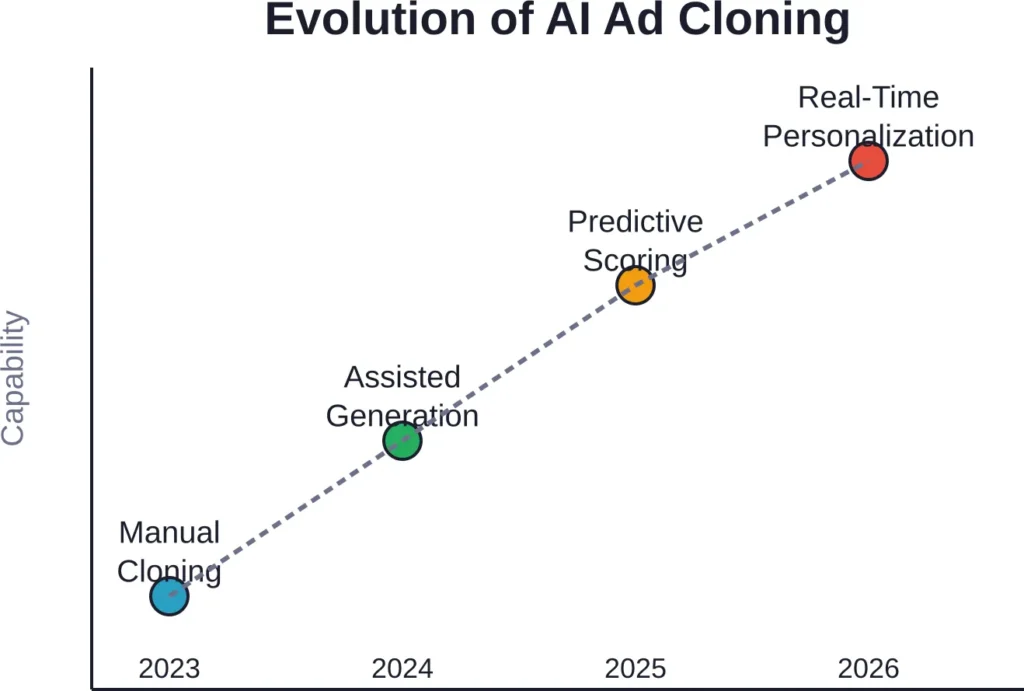
Next-generation tools will generate ad variants dynamically based on viewer context—location, weather, time of day, browsing history. Coca-Cola’s “Open Like Never Before” campaign used contextual creatives triggered by live footfall and temperature data, yielding 18% higher ad recall, as reported by WARC.
That level of dynamic generation is moving from one-off campaigns to platform-level features.
Multimodal Generation
Current tools handle text, static images, or video independently. Emerging platforms generate cohesive campaigns across formats—Meta carousel, Google responsive search ads, TikTok video, and email—from a single brief.
Performance Feedback Loops
Tools like Pencil already learn from campaign data, but the feedback loop is manual. Fully automated systems will adjust creative generation rules in real time based on live performance, iterating toward optimal formats without human intervention.
Regulatory Pressure
Expect more FTC scrutiny. The agency’s crackdown on deceptive AI claims, announced in September 2024 via Operation AI Comply, signals that regulators are watching how AI tools are marketed and deployed. Platforms making unsubstantiated performance guarantees will face enforcement actions.
Choosing the Right Tool for Your Needs
No single platform dominates every use case. The right choice depends on team structure, budget, and workflow priorities.
For agencies managing multiple clients, tools with bulk operations and scalable pricing make sense. AdStellar’s tiered plans and bulk launch features fit that profile.
For in-house performance marketers focused on direct-response, platforms combining discovery and analytics—like Minea or AdSpy—provide the strategic layer that justifies budget.
For creative teams prioritizing inspiration and collaboration, swipe file tools like Foreplay or MagicBrief streamline briefing and ideation without pushing automated generation.
For e-commerce brands needing high-volume output, generative platforms like AdCreative.ai or Jasper accelerate production cycles and reduce dependency on freelance designers.
Start with a clear diagnosis: is the bottleneck research, production, or both? That determines whether a discovery tool, generation tool, or integrated platform solves the problem.
| Team Type | Primary Need | Recommended Tool Category |
|---|---|---|
| Agency (multi-client) | Scale and bulk operations | Integrated platforms with automation |
| In-house performance team | Competitive intelligence | Discovery + analytics tools |
| Creative team | Inspiration and briefing | Swipe file and annotation tools |
| E-commerce brand | High-volume creative output | Generative AI platforms |
| Solopreneur | Low cost and simplicity | Freemium copywriting tools |
Frequently Asked Questions
Viewing and learning from competitor ads in public ad libraries is legal. Directly copying trademarked assets, logos, or proprietary images violates intellectual property law. Best practice: replicate strategy and structure, but generate original copy and visuals. Always run outputs through plagiarism checks before launching.
Some platforms offer direct integration with Meta Ads Manager and Google Ads, allowing bulk upload and campaign launch from within the tool. Others generate assets for manual upload. Check integration capabilities before committing—direct API access significantly streamlines workflows for teams running high volumes of campaigns.
Pricing varies widely. Entry-level tools start around $9-$49/month for limited features and users. Mid-tier platforms range from $129-$299/month with expanded libraries and generation capabilities. Enterprise solutions with custom integrations and dedicated support often require custom pricing, typically starting at $500+/month. Many platforms offer free trials—test before committing.
Both. Many modern platforms analyze and generate video creatives, though video generation quality still lags static images. Tools like MagicBrief specialize in video ad breakdowns, while platforms like AdCreative.ai focus on display and social static formats. For video-heavy campaigns, look for tools with frame-by-frame analysis and script generation features.
It can, if used carelessly. AI outputs tend toward generic direct-response patterns. To maintain brand identity, establish clear voice guidelines, train custom models where possible, and always review outputs before launch. Use AI to accelerate production, but layer in distinctive brand elements—humor, values, storytelling—that competitors can’t replicate at scale.
Ad spying typically refers to competitive intelligence—monitoring what competitors are running, for how long, and with what messaging. Ad cloning takes it a step further by generating creative variants inspired by competitor ads. Spying is research; cloning is production. Some tools do both, others specialize in one.
Run all AI outputs through policy checks before launch. Avoid fabricated testimonials, misleading claims, prohibited content, and trademarked assets. Meta and Google use automated systems to flag policy violations—AI-generated content isn’t exempt. When in doubt, consult platform policies or legal counsel. The FTC’s crackdown on deceptive AI claims means regulatory risk is real.
Conclusion
AI ad cloning tools have moved from experimental to essential. They compress research cycles, scale creative production, and provide competitive intelligence that used to require manual hours. But they’re not magic.
The best outcomes come from pairing AI efficiency with human judgment—using tools to accelerate the first 80% of work, then adding strategic polish that makes ads distinctly on-brand. Platforms like AdStellar, Foreplay, and Pencil each solve different parts of the puzzle. The right choice depends on whether discovery, generation, or integration matters most.
As generative AI adoption accelerates, expect regulatory scrutiny to increase. The FTC has made clear that unsubstantiated performance claims and deceptive practices invite enforcement. Use AI responsibly—clone structure and strategy, not verbatim assets. Run outputs through legal and policy checks before launch.
The competitive advantage goes to teams that adopt AI early enough to build workflows around it but thoughtfully enough to avoid the pitfalls. Test tools with free trials, measure ROI rigorously, and iterate based on real campaign data. The landscape is still evolving—what works today may be table stakes tomorrow.
Ready to start? Pick one tool from the list above, commit to a 30-day test, and track time saved, output volume, and campaign performance. That data will tell you whether AI ad cloning is hype or genuine leverage for the workflow.