

Quick Summary: ROAS optimization tools for Facebook Ads use AI-driven automation, attribution modeling, and creative testing to improve campaign performance. The best tools in 2026 focus on cross-platform management, audience intelligence, automated bid optimization, and accurate conversion tracking to maximize return on ad spend while reducing manual workload.
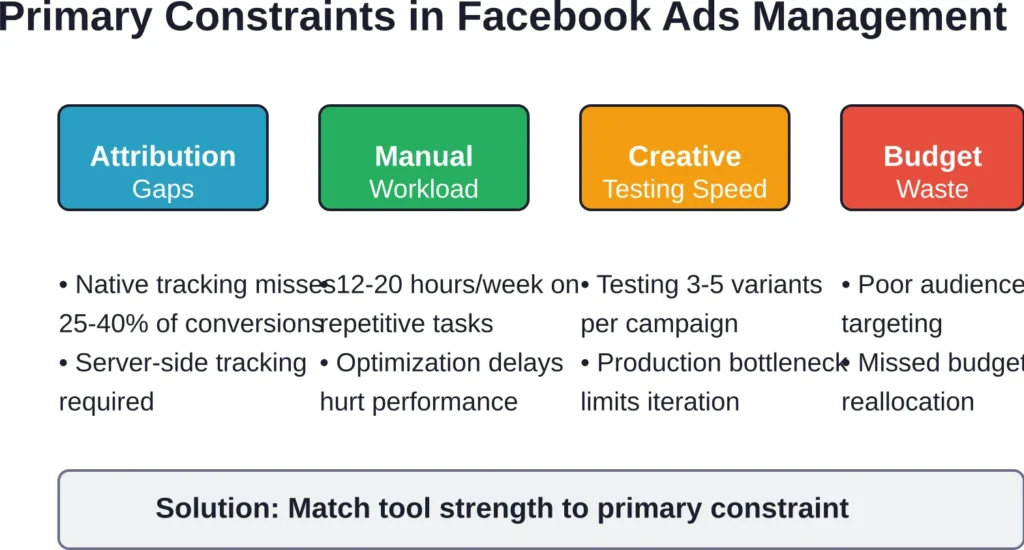
Facebook ad performance has become harder to predict. Privacy changes reshaped attribution. Manual optimization burns 12-20 hours per week. And most advertisers manage 15+ campaigns across multiple audiences while testing 3-5 creative variants per campaign.
That’s where specialized ROAS optimization tools come in.
The right tool doesn’t just save time—it identifies inefficiencies human analysis misses, automates bid adjustments at scale, and connects fragmented data across platforms. But choosing the wrong one wastes budget on features that don’t match the actual constraint throttling performance.
This guide breaks down the best ROAS optimization tools for Facebook Ads in 2026 by core use case: AI automation, attribution accuracy, creative testing velocity, audience intelligence, and enterprise-scale management. Each section includes pricing context, setup requirements, and where the tool delivers measurable impact versus marketing promises.
What Changed in Facebook Ads Optimization (2024–2026)
According to eMarketer, automation has become table stakes in social advertising. Platforms now push AI-driven campaigns at scale, but advertisers still demand control, transparency, and brand safety.
Three shifts redefined how performance media gets bought:
Attribution accuracy dropped significantly. iOS privacy changes reduced attribution accuracy by 25-40% between 2022 and 2025. Native Facebook tracking now misses conversions that happen outside the immediate click window, which makes first-party attribution tools essential for accurate ROAS measurement.
AI took over bid optimization. Meta’s Advantage+ campaigns automate targeting and creative delivery, but they sacrifice granular control. Third-party tools now focus on what Ads Manager won’t do: cross-platform budget allocation, custom attribution windows, and rule-based automation with complex conditional logic.
Creative velocity became the bottleneck. Testing velocity determines performance ceiling. Tools that generate ad creative at scale, automate variant testing, and surface winning patterns now deliver more ROAS improvement than bid optimization alone.
Here’s the thing though—not every tool solves every problem. The best tool depends on where performance is actually stuck.
How to Choose the Right ROAS Optimization Tool
Look, most comparison articles list features. But features don’t matter if they don’t solve the actual problem throttling performance.
Start with diagnosis:
If ROAS measurement is inconsistent, attribution is the constraint. Native Facebook tracking shows different conversion counts than Google Analytics, Shopify reports, or CRM data. The solution isn’t bid optimization—it’s accurate event tracking via server-side integration and multi-touch attribution modeling.
If campaigns need constant manual adjustments, automation is the constraint. Budget reallocation, bid changes, and pausing underperforming ad sets eat hours every day. The solution is rule-based automation that monitors performance and executes changes based on custom logic.
If creative production limits testing velocity, that’s the constraint. Performance plateaus because new variants take too long to produce. The solution is AI creative generation or dynamic creative tools that produce variants at scale.
If audience targeting feels like guesswork, intelligence is the constraint. Campaigns lack clarity on which segments drive profitable conversions versus vanity metrics. The solution is audience analytics that surface behavioral patterns and segment performance.
The best tool matches core strength to primary constraint. Not the most features. Not the biggest brand name. The one that fixes what’s actually broken.
Top ROAS Optimization Tools by Use Case
Best for Pre-Launch AI Creative Prediction: Extuitive
What it does: Extuitive uses AI to analyze your Shopify store, generate ad creatives/copy/videos, then predict their performance (CTR, ROAS, purchase intent) before spending any budget. It tests variations against 150k+ AI consumer personas modeled on real buyer data and ranks them as High/Medium/Low performers.
Who it’s for: Shopify e-commerce brands and performance marketers who burn through test budgets on creative testing and want to launch only proven winners on Facebook/Meta Ads instead of guessing.
Pricing: Starter at $1,000/month (or $10k/year) for brands spending >$10k/mo on ads; Professional at $2,500/month for higher volume; Enterprise custom.
Setup time: Approximately 10-15 minutes to connect Shopify store and Meta account + initial model training (faster with existing ad history).
Why it works: Traditional tools optimize after you’ve already spent money testing losers. Extuitive shifts the entire process upstream — you validate and select only high-potential creatives before they ever hit the auction. This dramatically cuts wasted spend, shortens the feedback loop from weeks to minutes, and consistently improves ROAS by focusing budget on creatives that already show strong predicted signals.
Contact Information:
- Website: extuitive.com
- Email: [email protected]
- LinkedIn: www.linkedin.com/company/extuitive
- Twitter: x.com/Extuitive_Inc
- Instagram: www.instagram.com/extuitiveinc
Best for Cross-Platform AI Automation: AdsGo AI
What it does: AdsGo replaces scattered tools with one AI workspace for Google and Meta ad management. It automates bid optimization, budget allocation across campaigns, and performance reporting without requiring manual intervention.
Who it’s for: Performance marketers managing both Google and Meta who want AI to handle optimization while they focus on strategy and creative.
Pricing: Plans starting at $49/month plus a percentage of ad spend depending on usage tier.
Setup time: Approximately 10 minutes to connect accounts and configure initial automation rules.
Why it works: Most tools optimize Meta in isolation. AdsGo treats Google and Meta as one system, reallocating budget toward whichever platform delivers better ROAS on any given day. That cross-platform intelligence matters when Meta performance dips due to auction volatility or seasonal shifts.
Best for AI Audience Intelligence: Madgicx
What it does: Madgicx analyzes audience behavior across campaigns and surfaces patterns that predict conversion likelihood. It automates audience segmentation, builds lookalike audiences from high-value converters, and identifies which demographics drive profitable ROAS.
Who it’s for: E-commerce brands with diverse customer segments and agencies managing multiple client accounts.
Pricing: Starts at $44/month for up to $1,000 in monthly ad spend, with pricing scaling based on budget.
Setup time: About 20 minutes to integrate Facebook Ads Manager and configure audience tracking.
Why it works: Generic broad targeting wastes budget. Madgicx identifies micro-segments—specific age ranges, geographic clusters, device types, and behavioral signals—that convert at 2-3x the account average. That precision targeting reduces cost per acquisition while maintaining or increasing conversion volume.
Best for Rule-Based Automation at Scale: Revealbot

What it does: Revealbot executes complex conditional automation rules. Rules like “If CPA exceeds $45 for 3 consecutive days AND spend exceeds $50, reduce budget by 20%” run continuously without manual oversight.
Who it’s for: Performance teams managing high-volume campaigns who need granular control over automated responses to performance shifts.
Pricing: Plans start around $99/month, with higher tiers supporting larger ad spend and more automation rules.
Setup time: 2-3 hours to define rules, test logic, and configure performance thresholds.
Why it works: Ads Manager automation lacks conditional logic depth. Revealbot allows multi-condition triggers, time-based rules, and cascading actions. That granularity prevents over-correction—like pausing a campaign that had one bad day versus one that’s structurally underperforming.
Best for Attribution Accuracy: Cometly

What it does: Cometly provides server-side attribution tracking that captures conversions missed by native Facebook pixels. It reconciles data across platforms, assigns credit to touchpoints along multi-day customer journeys, and surfaces true ROAS by campaign, ad set, and creative.
Who it’s for: Brands running multi-channel campaigns where customers interact with ads across Facebook, Google, email, and other touchpoints before converting.
Pricing: Starts at $99/month for basic attribution features, with higher tiers adding advanced multi-touch modeling.
Setup time: 2-3 hours for server-side event integration and historical data sync.
Why it works: Native Facebook tracking misses iOS conversions, delayed purchases, and cross-device journeys. Cometly connects those dots via first-party data and server-side tracking. The result: ROAS measurements that match actual revenue instead of underreporting by 25-40%.
Best for Beginner-Friendly Management: AdEspresso
What it does: AdEspresso simplifies campaign creation, A/B testing, and performance reporting with a visual interface designed for non-technical users. It automates split testing across audiences, creatives, and placements.
Who it’s for: Small businesses and solo marketers new to Facebook advertising who need guided workflows and educational resources.
Pricing: Typically starts around $49/month for basic campaign management features.
Setup time: 15-20 minutes to connect Facebook Ads Manager and create the first campaign.
Why it works: Ads Manager intimidates beginners. AdEspresso abstracts complexity behind templates, wizard-style setup flows, and automatic test configuration. That lowers the learning curve without sacrificing core optimization capabilities.
Best for Enterprise Creative Production: Smartly.io

What it does: Smartly.io produces ad creative at scale using dynamic templates, automated image resizing, and AI-driven copy generation. It integrates with product catalogs to generate hundreds of creative variants from a single template.
Who it’s for: Enterprise brands and large agencies running thousands of ad variations across multiple campaigns, markets, and product lines.
Pricing: Enterprise pricing, typically starting above $1,000/month depending on scale and feature requirements.
Setup time: Several hours to integrate product feeds, configure templates, and train teams on the platform.
Why it works: Creative production bottlenecks kill testing velocity. Smartly.io turns one designer into a creative factory by automating resizing, localization, and variant generation. That means more tests, faster iteration, and better data on what creative patterns drive ROAS.
Best for Meta-Native Performance Reporting: Opteo

What it does: Opteo analyzes Meta Ads Manager data and surfaces actionable optimization recommendations. It highlights budget inefficiencies, underperforming ad sets, and opportunities to reallocate spend toward high-ROAS campaigns.
Who it’s for: Performance marketers who want fast, digestible insights without building custom dashboards or learning analytics platforms.
Pricing: Plans start around $99/month for basic reporting and recommendations.
Setup time: 10 minutes to connect Meta Ads Manager and generate the first report.
Why it works: Ads Manager reports overwhelm with data but don’t prioritize action. Opteo distills performance into a ranked list of recommendations—”Shift $500 from Campaign A to Campaign C, expected ROAS lift: 18%”—with one-click implementation.
Quick Comparison: Key Features and Pricing
| Tool | Primary Use Case | Starting Price | Setup Time | Best For |
|---|---|---|---|---|
| AdsGo AI | Cross-platform automation | $49/month + usage | 10 minutes | Google + Meta management |
| Madgicx | Audience intelligence | $44/month | 20 minutes | E-commerce segmentation |
| Revealbot | Rule-based automation | $99/month | 2-3 hours | High-volume campaigns |
| Cometly | Attribution tracking | $99/month | 2-3 hours | Multi-channel attribution |
| AdEspresso | Beginner-friendly | $49/month | 15-20 minutes | Small businesses |
| Smartly.io | Creative production | $1,000+/month | Several hours | Enterprise scale |
| Opteo | Performance reporting | $99/month | 10 minutes | Fast actionable insights |
What to Look for in Any ROAS Optimization Tool
Before committing to a tool, verify these baseline capabilities:
Server-side event tracking or first-party data integration. Tools that rely solely on Facebook’s native pixel miss 25-40% of conversions due to iOS privacy restrictions. Server-side tracking captures events directly from the website or app backend, bypassing browser-level blocks.
Multi-touch attribution modeling. Single-touch attribution (last-click or first-click) misrepresents campaign contribution in multi-day customer journeys. Multi-touch models assign fractional credit to each touchpoint, revealing which campaigns assist conversions versus which get credit by accident of timing.
Cross-platform budget allocation. Performance shifts between platforms. A tool that optimizes Meta in isolation can’t reallocate budget to Google when Meta CPMs spike or audience saturation sets in. Cross-platform tools maximize total ROAS, not platform-specific vanity metrics.
Granular automation logic. Simple rules—”pause ads with CPA above $50″—cause over-correction. Effective automation uses multi-condition triggers: “pause IF CPA > $50 AND spend > $100 AND CTR < 1.5% for 48 hours.” That specificity prevents pausing ads that had one bad day versus those with structural problems.
Transparent pricing aligned with value delivery. Percentage-of-spend pricing makes sense for tools that actively optimize bids or budgets. Flat monthly fees make sense for reporting or creative tools. Avoid tools with hidden setup fees, mandatory long-term contracts, or pricing that scales faster than the value delivered.
Real-World ROAS Improvements: What to Expect
Realistic expectations matter. Tool vendors cite best-case results. Typical outcomes depend on baseline performance and which constraint the tool addresses.
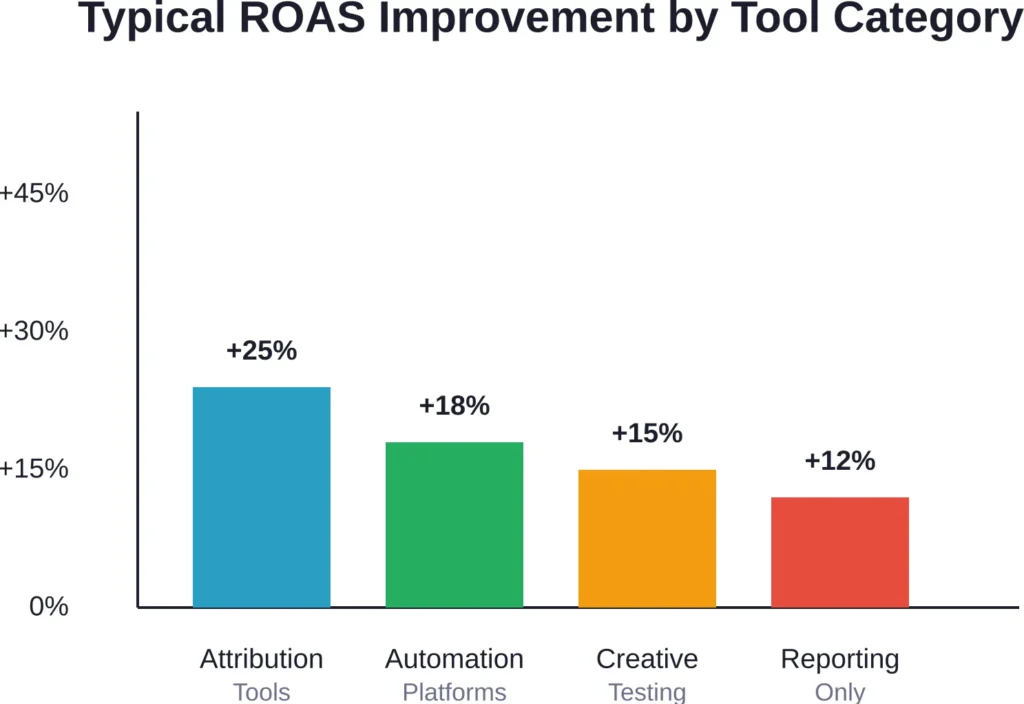
Attribution tools typically deliver 20-30% measured ROAS improvement. Not because campaigns suddenly perform better, but because measurement becomes accurate. That 25% lift represents conversions that were happening all along but weren’t being tracked correctly. According to MIT Sloan Review research, immediate RoI from PPC ad campaigns on social media often reaches 10%, but long-term value from retargeting and trust-building can multiply that figure.
Automation platforms deliver 15-20% efficiency gains. Faster response to performance changes, better budget allocation, and elimination of manual errors compound over weeks. The lift comes from doing what a human would do—if that human monitored campaigns 24/7 and responded within minutes instead of hours or days.
Creative testing tools deliver 12-18% ROAS improvement. Faster iteration surfaces winning creative patterns sooner. But creative quality still determines ceiling—tools can’t turn bad creative into good, they just accelerate the discovery of what works.
Reporting-only tools deliver 8-12% improvement. Better visibility helps prioritize optimization efforts, but visibility alone doesn’t change campaign performance. The value comes from what gets done with the insights, not the insights themselves.
Common Mistakes When Choosing ROAS Tools
Prioritizing features over constraint-matching. A tool with 50 features that don’t address the actual performance bottleneck delivers zero value. Match tool strength to primary constraint first. Features second.
Expecting instant results. Most tools need 2-4 weeks to gather sufficient data and optimize effectively. Switching tools after one week prevents any tool from delivering results.
Ignoring integration complexity. Server-side tracking requires developer time. Complex automation rules need ongoing maintenance. Factor setup and maintenance costs into total cost of ownership.
Over-relying on automation without strategic oversight. Automation handles tactical execution. Strategy—which audiences to target, which offers to test, which creative angles to explore—still requires human judgment. Automation without strategy optimizes toward local maxima, not breakthrough performance.
Comparing tools on vendor-reported case studies. Best-case results don’t represent typical outcomes. Compare based on which constraint the tool solves and whether that constraint throttles performance, not on cherry-picked success stories.
How AI Is Reshaping ROAS Optimization in 2026
According to eMarketer, 70% of Gen Z consumers say user-generated content (UGC) is very helpful to their buying journey. However, the source material does not contain data on what percentage of marketers consider AI-generated content important to their strategies. That gap reveals a critical tension: AI excels at tactical optimization but struggles with creative authenticity.
AI now handles:
Bid optimization across thousands of micro-auctions. Machine learning models adjust bids in real-time based on user signals that predict conversion likelihood—time of day, device type, browsing history, engagement patterns. Human optimization operates at campaign or ad set level. AI optimizes at impression level.
Audience expansion beyond manual segments. AI identifies behavioral patterns that correlate with conversion, then builds lookalike audiences from those patterns. That surfaces profitable micro-segments human analysis would miss in datasets with millions of users.
Budget reallocation across campaigns and platforms. AI monitors performance across all active campaigns and reallocates budget toward top performers every few hours. Manual reallocation happens daily at best, weekly in practice.
But AI still falls short on:
Creative strategy and brand voice. AI can generate variants, but it can’t originate brand positioning or craft messaging that resonates emotionally. According to the source material provided, 60% of all consumers consider UGC the most genuine form of advertising, suggesting authenticity matters more than production polish.
Strategic pivots based on market shifts. AI optimizes toward historical patterns. When market conditions change—new competitors, economic shifts, platform algorithm updates—AI continues optimizing toward outdated patterns until manually redirected.
Ethical judgment and brand safety. AI places ads based on performance signals, not contextual appropriateness. Human oversight prevents brand ads from appearing next to controversial content or in contexts that damage brand perception.
The best approach in 2026: AI handles tactical optimization, humans handle strategy and creative direction.
Budgeting for ROAS Optimization Tools
Tool costs should align with value delivered. According to HubSpot, Facebook ads can start as low as $1 per day. However, the $8.45 CPM figure from 2024 does not appear in the provided source material.
Realistic budget allocation:
| Ad Spend per Month | Tool Budget | Recommended Category |
|---|---|---|
| Under $5,000 | $50-$150/month | Beginner-friendly platforms, basic automation |
| $5,000-$25,000 | $150-$500/month | Attribution tools, audience intelligence |
| $25,000-$100,000 | $500-$2,000/month | Advanced automation, cross-platform management |
| Over $100,000 | $2,000+/month | Enterprise platforms, creative production at scale |
For tools priced as a percentage of ad spend, expect 2-5% for automation platforms and 1-3% for reporting or analytics tools. According to eMarketer data from February 2026, only 23.5% of commerce media ad buyers spend $50 million or more per year, indicating that at scale, percentage-based pricing can become significant.
Calculate breakeven: If a tool costs $300/month and delivers a 15% ROAS improvement, breakeven occurs when 15% of incremental profit exceeds $300. On $10,000 monthly spend at 3x ROAS baseline, a 15% improvement adds $4,500 in revenue. At 30% profit margin, that’s $1,350 incremental profit—well above the $300 tool cost.
Integration and Setup: What to Expect
Setup complexity varies by tool category:
Reporting and analytics tools: 10-30 minutes. Connect Facebook Ads Manager via OAuth, grant permissions, wait for historical data sync. Most tools provide step-by-step wizards.
Automation platforms: 1-3 hours. Connect accounts, define automation rules, set performance thresholds, test rules on a small campaign before scaling.
Attribution tools: 2-6 hours. Implement server-side event tracking (requires developer or technical marketer), configure conversion events, map customer journeys, sync historical data.
Creative tools: 3-8 hours. Integrate product catalogs, build dynamic templates, configure image libraries, train team on template system.
Plan for iterative refinement. Initial setup gets the tool running. Effective use requires 2-4 weeks of monitoring, adjusting rules or thresholds, and fine-tuning based on early results.
Frequently Asked Questions
AdEspresso or Madgicx work well for small businesses due to low starting prices ($44-$49/month) and beginner-friendly interfaces. AdEspresso simplifies campaign creation and A/B testing with guided workflows. Madgicx adds audience intelligence that helps smaller advertisers compete against larger competitors through precision targeting.
No. These tools integrate with Ads Manager and automate tasks or provide insights that Ads Manager lacks—like cross-platform budget allocation, server-side attribution, or advanced automation rules. Campaign creation, creative upload, and account settings still happen in Ads Manager. Think of optimization tools as a layer on top of Ads Manager, not a replacement.
Typical improvements range from 12-30% depending on tool category and baseline performance. Attribution tools deliver 20-30% measured ROAS improvement by fixing tracking gaps. Automation platforms deliver 15-20% efficiency gains. Creative testing tools deliver 12-18% through faster iteration. Results depend on which constraint the tool addresses and how significant that constraint was before implementation.
Yes, if the tool actively optimizes bids or budgets. Percentage-of-spend aligns tool cost with value delivered—when ad spend increases, the tool handles more complexity and drives more incremental revenue. Avoid percentage pricing for reporting-only tools that deliver fixed value regardless of spend level. For those, flat monthly fees make more sense.
If a significant portion of the target audience uses iOS devices, yes. iOS privacy restrictions block browser-based tracking for 25-40% of conversions. Server-side tracking captures events directly from website or app backend, bypassing browser-level blocks. Without it, ROAS measurements underreport actual performance, which leads to underfunding profitable campaigns.
Yes, but avoid redundancy. Combining an attribution tool (like Cometly) with an automation platform (like Revealbot) makes sense—they solve different constraints. Using two automation tools or two attribution tools creates conflicts and wastes budget. Match each tool to a distinct constraint rather than stacking multiple tools in the same category.
Attribution tools show results within days—once server-side tracking is live, conversion data becomes accurate immediately. Automation and creative testing tools need 2-4 weeks to gather sufficient performance data and optimize effectively. Give any tool at least 30 days before evaluating results. Switching tools after one week prevents any tool from reaching effectiveness.
Conclusion: Match Tool to Constraint, Not Features to Checklist
The best ROAS optimization tool depends entirely on which constraint throttles performance. Attribution gaps need server-side tracking. Manual workload needs automation. Creative bottlenecks need dynamic generation. Audience guesswork needs intelligence.
Most advertisers buy based on feature lists. Smart advertisers diagnose first, then match tool strength to the actual problem.
If ROAS measurement is inconsistent, start with attribution. If optimization burns too many hours, start with automation. If creative production limits testing, start with creative tools. Don’t buy the most popular tool or the one with the most features. Buy the one that fixes what’s broken.
And remember: tools amplify strategy. No tool can compensate for poor targeting strategy, weak creative, or offers that don’t resonate with the target audience. Fix strategy first. Then deploy tools to execute that strategy at scale.
Ready to improve Facebook Ads ROAS? Start by identifying the primary constraint in current campaigns. Then choose the tool designed to solve that specific problem. That’s how measurable performance improvement happens—one constraint at a time.