

Quick Summary: AI tools have revolutionized Meta ads management in 2026, with platforms using machine learning to automate creative rotation, bid optimization, and audience targeting. According to eMarketer, AI-powered ad spend will reach $57 billion in 2026 as marketers prioritize speed and measurable returns. Meta’s Advantage+ Sales Campaigns deliver an average 22% ROAS boost, while third-party tools like Ryze AI, Madgicx, and Revealbot offer autonomous management, creative analytics, and fatigue prediction to maximize performance.
Meta ads have become the battleground where creative fatigue, bid fragmentation, and audience saturation collide. The creative landscape has shifted dramatically, with creative fatigue now occurring much more quickly than in 2023. AI tools detect fatigue signals and swap creatives automatically to prevent CPM spikes.
AI tools exist to close that gap.
According to McKinsey’s 2025 report on the state of AI, 88% of companies use AI in at least one function, but only around 40% are able to see a positive impact on the bottom line. The gap between adoption and results comes down to choosing tools that fit the specific decisions marketers need to make.
This guide reviews the best AI tools for improving ROAS on Meta ads in 2026, comparing pricing, features, and real-world performance across autonomous management, creative analytics, reporting, and campaign optimization platforms.
Why AI Tools Matter for Meta Ads ROAS in 2026
The advertising landscape changed dramatically between 2024 and 2026. Three forces drive the shift toward AI-powered management.
First, creative velocity. Audiences scroll faster, algorithms prioritize fresh content, and ad fatigue happens earlier. AI tools detect fatigue signals—rising CPMs, declining CTRs, frequency caps—and swap creatives automatically before performance drops.
Second, bid complexity. Meta’s auction system evaluates thousands of signals per impression: device type, time of day, user behavior, competitor activity, seasonal trends. Manual bid adjustments can’t keep pace. AI models analyze bid landscapes in real time and adjust bids within milliseconds to capture high-intent impressions at optimal prices.
Third, attribution fragmentation. iOS privacy changes, cookie deprecation, and cross-device journeys broke traditional tracking. AI attribution models use probabilistic matching, incrementality testing, and server-side tracking to reconstruct customer journeys and allocate budget to channels that drive real revenue.
According to eMarketer, at Cannes Lions 2025, Meta introduced new generative AI ad features including dynamic image-to-video tools and brand-safe creative automation. According to eMarketer, Meta’s Advantage+ Sales Campaigns deliver an average 22% ROAS boost.
But Meta’s native tools come with limitations. Advantage+ campaigns sacrifice control for automation. Advertisers lose granular targeting options, creative rotation control, and budget pacing flexibility. That’s where third-party AI tools fill the gap.
Stop Testing Losers: Predict Winning Ads with Extuitive
Extuitive is an AI-first technology platform designed to eliminate the guesswork from Meta Ads performance. By utilizing an engine powered by 150,000+ AI-modeled consumer personas, it simulates real-world behavior to forecast which creatives will convert before any budget is spent.
- Pre-Launch Performance Scoring: Predicts click-through rates (CTR) and ROAS by ranking ad variants before they go live.
- AI Consumer Simulations: Validates images, reels, and copy against proprietary behavioral models to identify high-intent microsegments.
- Automated Creative Generation: Produces optimized assets and product concepts specifically tailored to a brand’s historical performance data.
- Rapid Scaling: Reduces creative testing cycles from weeks to minutes, allowing teams to skip low-performing “losers” and scale winners immediately.
Predict your next winning campaign and increase your ROAS by booking a demo with Extuitive.
The 10 Best AI Tools for Meta Ads Management
The tools below were evaluated based on autonomous management capabilities, creative analytics depth, pricing transparency, platform integrations, and verified user feedback across SERP sources and community discussions.
1. Ryze AI – Full Autonomous Management

Ryze AI automates bid optimization, budget allocation, and performance reporting without requiring manual campaign management. The platform is used by 2,000+ marketers across 23 countries managing over $500M in ad spend.
Ryze handles the three core ROAS drivers: bid adjustments based on conversion probability, budget reallocation toward high-performing ad sets, and automatic creative rotation before fatigue sets in.
Best For: Teams that want to remove daily campaign management entirely while maintaining performance standards.
Key Features:
- Autonomous bid optimization across Meta and Google Ads
- Budget reallocation based on real-time performance
- Creative fatigue detection and automatic swaps
- Cross-platform performance dashboards
- Flat-rate pricing independent of ad spend
Pricing: ~$40/mo flat (flat-rate pricing independent of ad spend).
Rating: 4.9/5 based on aggregated user reviews.
Pros: Fully autonomous, transparent flat pricing, cross-platform support.
Cons: Less granular creative analytics compared to specialized tools like Hawky or Madgicx.
2. Revealbot – Automation Rules at Scale

Revealbot excels at rule-based automation. Marketers set conditional triggers—if CPA exceeds $50, pause the ad set; if ROAS drops below 2.5x, reduce budget by 20%—and Revealbot executes changes automatically.
The platform supports bulk actions, A/B testing workflows, and Slack/email notifications when thresholds are breached.
Best For: Performance marketers who want precise control over automation logic without writing code.
Key Features:
- Custom automation rules with multi-condition triggers
- Bulk campaign editing and duplication
- A/B testing with statistical significance tracking
- Integrations with Slack, Google Sheets, and Zapier
- Multi-account management
Pricing: $99/mo (starting price).
Rating: 4.5/5 based on aggregated user reviews.
Pros: Highly flexible automation rules, transparent pricing, strong integrations.
Cons: Requires manual rule setup; not fully autonomous like Ryze AI.
3. Madgicx – Creative Analytics + AI Audiences
Madgicx combines creative intelligence with audience targeting. The platform analyzes which creative elements—headlines, images, CTAs, video hooks—drive conversions, then builds lookalike audiences based on high-intent behaviors.
Madgicx offers element-level creative analytics to identify which creative components drive conversions.
Best For: Brands running high-volume creative testing and need granular performance breakdowns.
Key Features:
- Element-level creative analytics
- AI-powered audience targeting
- Automated campaign launch and optimization
- Cross-channel reporting (Meta, Google, TikTok)
- Predictive budget recommendations
Pricing: Starting at approximately $44/month, scaling with ad spend.
Rating: 4.4/5 based on aggregated user reviews.
Pros: Deep creative analytics, AI audience builder, multi-platform support.
Cons: Pricing scales with ad spend; can become expensive for high-budget accounts.
4. Hawky – Creative Intelligence + Competitor Monitoring
Hawky focuses on the analysis-to-production loop: analyzing creative performance, predicting fatigue, monitoring competitor tactics, and generating new creatives based on what works.
The platform tracks creative effectiveness across Meta, Google, and TikTok, offering element-level breakdowns and fatigue prediction models that alert teams before CPMs rise.
Best For: Full-stack creative intelligence teams that want analysis, prediction, and production in one platform.
Key Features:
- Element-level creative analysis
- Fatigue prediction with early warning alerts
- Competitor ad monitoring and intelligence
- AI creative generation based on top performers
- Cross-platform performance tracking
Pricing: Custom pricing based on ad spend and feature requirements.
Rating: Not widely reported; check official site for current reviews.
Pros: Comprehensive creative intelligence, competitor insights, fatigue prediction.
Cons: Custom pricing lacks transparency; higher learning curve for small teams.
5. Juma (Formerly Team-GPT) – AI-Powered Reporting

Juma transforms raw ad data into actionable insights using prompt-based AI reporting. Instead of building dashboards manually, marketers describe what they need—”Show me ROAS by creative format for the last 30 days”—and Juma generates the report.
The platform supports cross-model AI access, collaborative workspaces, and multi-brand reporting folders.
Best For: Teams managing multiple clients or brands who need fast, flexible reporting without manual dashboard setup.
Key Features:
- Prompt-based report generation
- Cross-model AI access (GPT, Claude, etc.)
- Collaborative workspaces and client folders
- Multi-platform data integration
- Custom report templates
Pricing: Check official website for current pricing tiers and feature availability.
Rating: Not widely reported; user feedback suggests strong flexibility and ease of use.
Pros: Flexible AI-driven reporting, collaborative features, multi-brand support.
Cons: Focused on reporting, not campaign automation or creative analytics.
6. Cometly – Attribution-First Optimization

Cometly specializes in attribution modeling, tracking customer journeys across devices, platforms, and touchpoints. The platform uses first-party data, server-side tracking, and probabilistic matching to connect ad impressions to revenue.
By accurately attributing conversions, Cometly enables better budget allocation and bid optimization based on true customer acquisition costs.
Best For: Brands with complex customer journeys spanning multiple channels and devices.
Key Features:
- Multi-touch attribution modeling
- Server-side tracking and first-party data integration
- Cross-device journey reconstruction
- Real-time performance dashboards
- Integration with Meta, Google, TikTok, and Shopify
Pricing: Custom pricing based on tracking volume and feature requirements.
Rating: Not widely reported; check official site for current reviews.
Pros: Robust attribution modeling, server-side tracking, cross-platform support.
Cons: Custom pricing; attribution setup requires technical implementation.
7. AdEspresso – A/B Testing Simplified
AdEspresso (owned by Hootsuite) focuses on streamlined A/B testing for Facebook and Instagram ads. The platform allows marketers to test multiple variables—headlines, images, audiences, placements—without manually creating dozens of ad variants.
AdEspresso automatically splits budgets across test cells and highlights winning combinations based on statistical significance.
Best For: Small to mid-sized teams that prioritize testing velocity over advanced automation.
Key Features:
- Multi-variable A/B testing
- Automatic budget distribution across test cells
- Statistical significance tracking
- Campaign templates and quick duplication
- Reporting dashboards with performance breakdowns
Pricing: Check Hootsuite’s official site for current AdEspresso pricing tiers.
Rating: Historically strong user reviews; current ratings vary by source.
Pros: Simple A/B testing interface, fast campaign setup, statistical tracking.
Cons: Limited automation beyond testing; less feature-rich than Madgicx or Revealbot.
8. AdAmigo – AI Creative Generation

AdAmigo uses generative AI to create ad copy, images, and video variants based on product URLs or existing brand assets. The platform analyzes top-performing ads in the same vertical and generates new creatives that follow proven patterns.
AdAmigo integrates directly with Meta Ads Manager, allowing one-click launches from generated assets.
Best For: Teams that need high-volume creative production without hiring designers or copywriters.
Key Features:
- AI-generated ad copy and images
- Video variant creation from static assets
- Competitor ad analysis and pattern recognition
- Direct integration with Meta Ads Manager
- Brand voice customization
Pricing: Check official website for current pricing tiers and feature availability.
Rating: Not widely reported; user feedback suggests strong creative output quality.
Pros: Fast creative generation, competitor insights, direct Meta integration.
Cons: AI-generated content may lack brand-specific nuance; requires human review.
9. AdStellar – AI-Driven Campaign Strategy
AdStellar positions itself as an AI strategist, recommending campaign structures, audience segments, and bidding strategies based on account history and industry benchmarks.
The platform analyzes past campaign performance and suggests optimizations—restructure ad sets, consolidate audiences, shift budgets—backed by predictive ROAS models.
Best For: Marketers who want strategic recommendations alongside execution tools.
Key Features:
- AI-driven campaign structure recommendations
- Predictive ROAS modeling
- Audience segmentation and consolidation suggestions
- Automated budget optimization
- Performance benchmarking by industry
Pricing: Custom pricing based on ad spend and feature requirements.
Rating: Not widely reported; check official site for current reviews.
Pros: Strategic insights, predictive modeling, industry benchmarks.
Cons: Custom pricing; recommendations require manual implementation.
10. Meta Advantage+ – Native AI Automation
Meta’s own Advantage+ suite includes Advantage+ Shopping Campaigns and Advantage+ Sales Campaigns, which use machine learning to automate targeting, creative delivery, and bidding.
According to eMarketer, Advantage+ Sales Campaigns deliver an average 22% ROAS boost.
Advantage+ campaigns consolidate audiences, creatives, and placements into a single campaign structure. Meta’s algorithm decides which combinations perform best and allocates budget accordingly.
Best For: Brands willing to trade manual control for Meta’s algorithmic optimization.
Key Features:
- Automated targeting across broad audiences
- Dynamic creative optimization
- Consolidated campaign structures
- Real-time bid adjustments
- Integration with Meta’s GEM recommendation model
Pricing: No additional cost; standard Meta ad pricing applies.
Rating: Performance varies; some brands report strong ROAS gains, others see diminished control and inconsistent results.
Pros: No extra cost, native integration, proven ROAS improvements for many advertisers.
Cons: Limited control over targeting, creative rotation, and budget pacing.
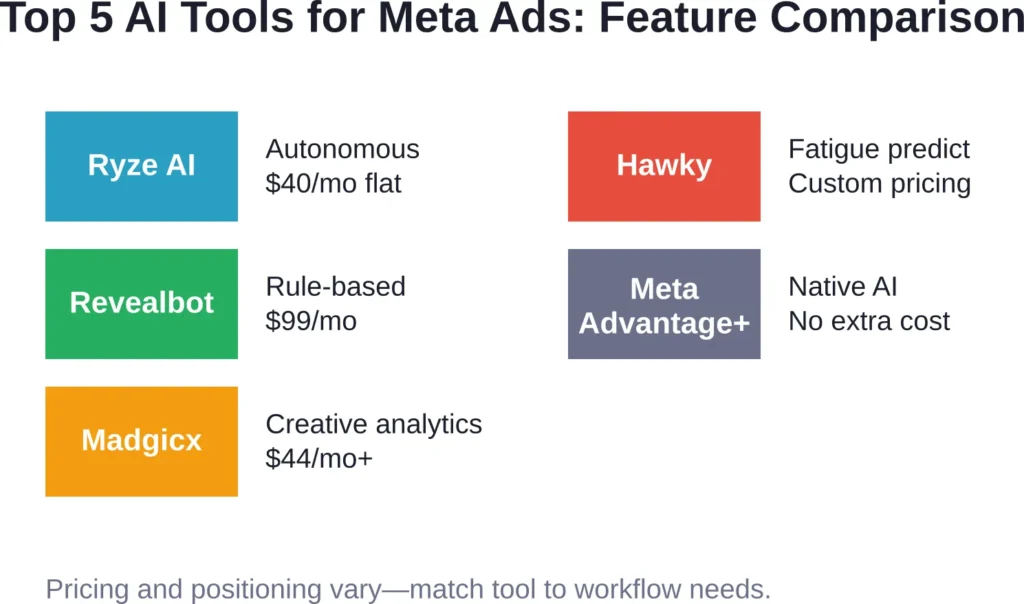
Feature Comparison: How the Best Tools Stack Up
The table below compares key features across the top AI tools for Meta ads management. Not every tool excels at every task—choosing the right platform depends on whether the priority is autonomous management, creative analytics, or strategic reporting.
| Tool | Autonomous Management | Creative Analytics | Fatigue Prediction | Multi-Platform | Pricing Model |
|---|---|---|---|---|---|
| Ryze AI | Yes | Basic | Yes | Meta, Google | Flat rate (~$40/mo) |
| Revealbot | Rule-based | Basic | No | Meta, Google, TikTok | $99/mo+ |
| Madgicx | Partial | Advanced | Yes | Meta, Google, TikTok | $44/mo+ (scales with spend) |
| Hawky | No | Advanced | Yes | Meta, Google, TikTok | Custom |
| Juma | No | No | No | Meta, Google, LinkedIn | Custom |
| Cometly | No | No | No | Meta, Google, TikTok | Custom |
| Meta Advantage+ | Yes | Limited | Yes | Meta only | No extra cost |
The analysis-to-production loop matters more than any single tool. Teams that analyze creative performance, predict fatigue, generate new assets, and launch campaigns quickly outperform teams that excel at only one stage.
For example, Hawky excels at analysis and prediction but requires integration with creative production tools. AdAmigo generates creatives but lacks deep performance analytics. Ryze AI handles autonomous management but offers limited creative insights compared to Madgicx.
The strongest workflows combine tools: use Madgicx or Hawky for creative analytics, AdAmigo for rapid asset generation, and Ryze AI or Revealbot for autonomous campaign management.
How to Choose the Right AI Tool for Meta Ads
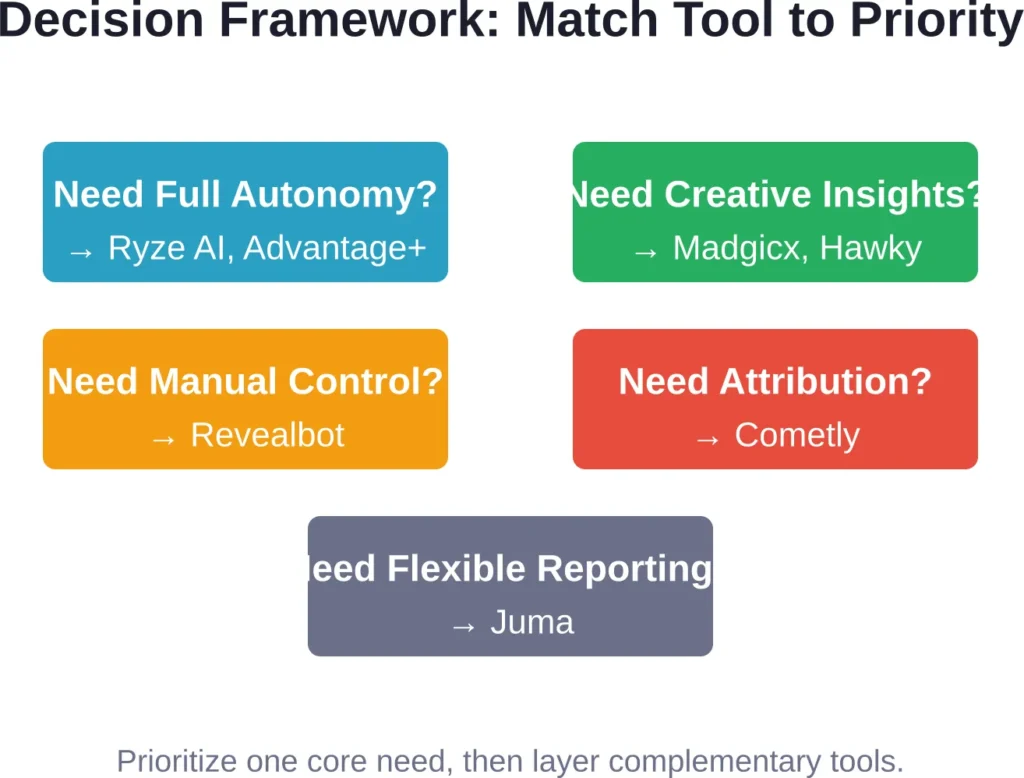
Choosing the right AI tool depends on five factors: team size, campaign complexity, budget flexibility, technical capability, and control preferences.
Team Size and Workload
Small teams (1–3 people) benefit most from autonomous platforms like Ryze AI or Meta Advantage+ that eliminate daily management tasks. Larger teams with dedicated creative, analytics, and optimization roles gain more value from specialized tools like Madgicx for creative intelligence and Cometly for attribution.
Campaign Complexity
Brands running 5–10 campaigns with consistent product catalogs perform well with Advantage+ or Ryze AI. Brands running 50+ campaigns across multiple product lines, regions, and audiences need rule-based automation (Revealbot) or advanced segmentation (Madgicx).
Budget Flexibility
Flat-rate pricing (Ryze AI at ~$40/month) works well for high-spend accounts. Percentage-of-spend pricing (common with Madgicx and AdStellar) scales costs with budget but can become expensive. Custom pricing (Hawky, Cometly, AdStellar) offers flexibility but lacks transparency.
Technical Capability
Attribution tools like Cometly require server-side tracking setup and first-party data integration. Creative intelligence platforms like Hawky require ongoing analysis and interpretation. Autonomous platforms like Ryze AI and Meta Advantage+ require minimal technical setup.
Control vs. Automation
Marketers who prioritize control prefer Revealbot’s rule-based system, where every automation logic is explicitly defined. Marketers who prioritize speed and scale prefer Ryze AI or Advantage+, where algorithms make decisions autonomously.
According to eMarketer citing CivicScience, 30% of US adults say AI in ads makes them less likely to choose a brand. That tension—between automation efficiency and audience perception—shapes how brands deploy AI tools. Transparency matters. According to eMarketer citing a PhotoShelter survey, 78% of marketers worldwide say user-generated content is important to social media strategies, while only 28% say AI-generated content is important.
The takeaway: AI tools work best when they enhance human creativity and judgment, not replace it.
The Role of Meta’s Native AI Tools
Meta’s Advantage+ suite represents the platform’s push toward algorithmic control. At Cannes Lions 2025, Meta introduced new generative AI ad features including dynamic image-to-video tools and brand-safe creative automation, backed by Meta’s significant AI infrastructure investments.
Advantage+ campaigns consolidate targeting, creative, and placement decisions into a single structure. The algorithm tests combinations and allocates budget toward winners. According to eMarketer, Advantage+ Sales Campaigns deliver an average 22% ROAS boost.
But the trade-off is control. Advertisers lose the ability to exclude specific audiences, control creative rotation timing, or enforce strict budget caps per ad set. For brands with tight compliance requirements—financial services, healthcare, legal—that loss of control creates risk.
Third-party tools offer a middle path: automation with transparency. Ryze AI automates bid adjustments but allows manual overrides. Revealbot executes rules but sends notifications before taking action. Madgicx recommends audience segments but lets marketers approve or reject them.
The question isn’t whether to use AI—it’s how much control to retain.
Measuring Success: ROAS Benchmarks and KPIs
ROAS improvements depend on baseline performance, industry vertical, and campaign maturity. According to eMarketer, LinkedIn achieves 121% ROAS in B2B paid social. But B2B benchmarks differ dramatically from e-commerce or DTC brands.
For Meta ads, typical ROAS benchmarks in 2026 fall between 2.5x and 4x for mature campaigns. Brands using AI tools report 15–30% improvements over manual management, depending on the tool and implementation quality.
Key performance indicators beyond ROAS include:
- Creative Fatigue Rate: How quickly CPMs rise and CTRs decline for the same creative. AI tools should keep fatigue rates below 10% week-over-week.
- Bid Efficiency: Cost per conversion relative to target CPA. AI bidding should maintain CPAs within 10% of target without sacrificing volume.
- Budget Utilization: Percentage of allocated budget spent efficiently. AI tools should achieve 95%+ utilization without overspending.
- Creative Velocity: Number of new creatives launched per week. AI-assisted workflows should enable 2–3x more creative tests than manual workflows.
- Attribution Accuracy: Percentage of conversions correctly attributed to source campaigns. AI attribution models should reduce “unknown” conversions by 30–50%.
According to McKinsey’s 2025 report, 88% of companies use AI in at least one function, but only around 40% are able to see a positive impact on the bottom line. The gap comes from choosing the wrong tools, poor implementation, or lack of clear success metrics.
Common Pitfalls When Using AI Tools for Meta Ads
AI tools promise efficiency and performance, but several common mistakes undermine results.
Over-Reliance on Automation
Letting AI run campaigns without oversight leads to wasted spend when market conditions shift. Seasonal trends, competitor actions, and platform algorithm changes require human judgment. Set weekly review cycles to audit AI decisions and adjust strategies.
Ignoring Creative Fatigue Signals
Even tools with fatigue prediction require fresh creative assets. If the creative library runs dry, AI can only rotate existing ads—it can’t invent new angles. Maintain a pipeline of new creatives to feed AI optimization.
Misaligned Attribution Windows
AI tools optimize toward the attribution window configured in the platform. If the tool uses a 1-day click window but the business relies on 7-day view-through conversions, optimization will misallocate budget. Align attribution settings with actual customer journey length.
Insufficient Data for AI Models
AI tools require minimum data volumes to generate reliable predictions. Campaigns with fewer than 50 conversions per week struggle to benefit from advanced optimization. Consolidate small campaigns or use manual management until volume scales.
Ignoring Platform Policy Changes
Meta’s ad policies evolve frequently. AI tools automate execution but don’t guarantee compliance. Regularly review campaign content, targeting parameters, and landing pages to avoid policy violations that trigger account restrictions.
The Future of AI in Meta Ads: What’s Coming in 2027
According to eMarketer, AI-powered ad spend will reach $57 billion in 2026 as brands prioritize speed and measurable returns. That figure is expected to grow by 20–25% annually through 2028.
Three trends shape the next phase of AI adoption in Meta ads.
Generative Creative at Scale
Generative AI will move beyond copywriting and static images to produce full video ads, interactive formats, and personalized landing pages. Meta’s investment in Scale AI and generative recommendation models signals the platform’s commitment to automated creative production.
Real-Time Competitive Intelligence
AI tools will increasingly monitor competitor ad activity in real time, alerting brands when rivals launch new campaigns, shift messaging, or increase spend. Platforms like Hawky already offer competitor tracking; expect broader adoption across all major tools.
Cross-Platform Campaign Orchestration
AI tools will manage campaigns across Meta, Google, TikTok, and emerging platforms simultaneously, optimizing budget allocation based on cross-platform performance. Multi-platform AI management will become the standard for brands spending $50K+ per month.
But challenges remain. According to eMarketer citing CivicScience, 30% of US adults say AI in ads makes them less likely to choose a brand. Transparency, authenticity, and user-generated content remain critical to maintaining audience trust while leveraging AI efficiency.
Frequently Asked Questions
The best tool depends on campaign needs. For full autonomous management, Ryze AI offers flat-rate pricing and hands-free optimization. For creative analytics and audience targeting, Madgicx provides element-level insights and AI audience building. For rule-based control, Revealbot allows custom automation logic. Meta’s Advantage+ delivers strong ROAS improvements at no extra cost but sacrifices manual control.
Pricing varies widely. Ryze AI charges approximately $40/month flat rate. Revealbot starts at $99/month. Madgicx begins at $44/month but scales with ad spend. Hawky, Cometly, and AdStellar use custom pricing based on spend and feature requirements. Meta Advantage+ incurs no additional cost beyond standard ad spend.
AI tools can automate bid optimization, budget allocation, and creative rotation, but strategic decisions—campaign structure, messaging strategy, audience segmentation—still require human judgment. Tools like Ryze AI and Advantage+ offer near-autonomous management, but weekly oversight ensures alignment with business goals and market conditions.
AI tools track performance metrics—CPM trends, CTR decay, frequency increases—and compare current patterns to historical data. When metrics deviate from expected ranges, the tool flags potential fatigue. Advanced platforms like Hawky and Madgicx predict fatigue 3–5 days before performance drops, allowing teams to swap creatives proactively.
Yes, but effectiveness depends on data volume. Campaigns with fewer than 50 conversions per week may not generate sufficient data for AI optimization. Small-budget advertisers benefit most from flat-rate tools like Ryze AI (which don’t charge based on spend) and should focus on consolidating campaigns to increase conversion volume per ad set.
Meta Advantage+ offers native integration, no extra cost, and proven ROAS improvements (22% average boost according to eMarketer), but limits manual control over targeting, creative rotation, and budget pacing. Third-party tools like Ryze AI, Madgicx, and Revealbot provide automation with transparency, custom rules, and advanced analytics, but add subscription costs.
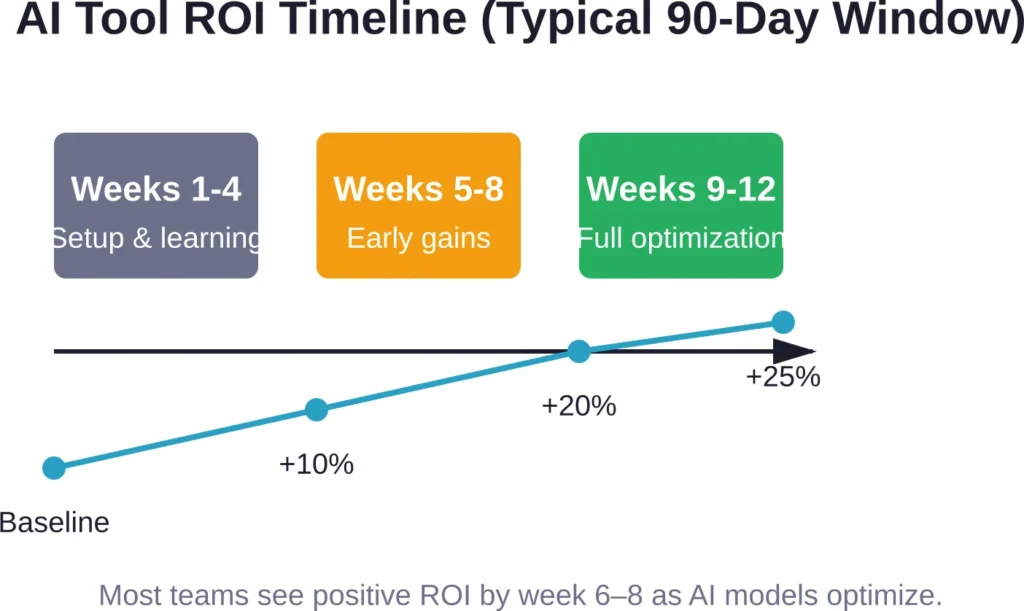
Compare ROAS, CPA, and total conversions before and after implementation. Track time savings (hours per week saved on manual management) and creative velocity (number of tests launched per week). Calculate total cost (subscription fee + ad spend) against revenue generated. Most teams see positive ROI within 4–8 weeks if the tool matches their workflow needs.
Final Verdict: Which AI Tool Should You Choose?
Choosing the best AI tool for improving ROAS on Meta ads comes down to workflow priorities.
For teams that want to eliminate daily campaign management entirely, Ryze AI offers the best combination of autonomy, pricing transparency, and cross-platform support. The flat-rate model (~$40/month) makes it cost-effective for high-spend accounts.
For teams focused on creative performance and audience targeting, Madgicx delivers the deepest analytics and AI-powered audience building. The element-level creative insights help identify which specific components drive conversions.
For teams that prioritize control and custom automation logic, Revealbot remains the strongest option. The rule-based system allows precise configuration without sacrificing automation efficiency.
For teams managing complex attribution across devices and platforms, Cometly provides the most robust tracking and journey reconstruction, though implementation requires technical setup.
For teams willing to trade control for native integration and proven ROAS improvements, Meta Advantage+ delivers strong results at no extra cost, particularly for brands with straightforward product catalogs and broad target audiences.
The strongest approach combines multiple tools: use Madgicx or Hawky for creative intelligence, AdAmigo for rapid asset generation, and Ryze AI or Advantage+ for autonomous execution. That integrated workflow—analysis, production, optimization—outperforms any single tool in isolation.
Real talk: AI won’t fix broken fundamentals. If the offer doesn’t resonate, the creative doesn’t hook, or the landing page doesn’t convert, no tool will salvage performance. AI amplifies what already works—it doesn’t create strategy from scratch.
According to eMarketer citing a PhotoShelter survey, 78% of marketers worldwide say user-generated content is important to social media strategies, while only 28% say AI-generated content is important. The takeaway: AI tools work best when they enhance human creativity, not replace it.
Start with one tool that matches the biggest workflow bottleneck—whether that’s manual bid adjustments, slow creative testing, or fragmented reporting—and expand from there.
Take Action: Start Improving Your Meta Ads ROAS Today
The difference between stagnant campaigns and profitable growth often comes down to execution speed. AI tools handle the repetitive work—bid adjustments, budget shifts, creative swaps—so teams can focus on strategy, messaging, and audience insights.
Evaluate the tools above based on current workflow gaps. Sign up for free trials where available. Test one tool for 30 days and measure ROAS, CPA, and time savings against baseline performance.
The question isn’t whether AI will reshape Meta ads management—it already has. The question is whether teams adopt the right tools fast enough to stay competitive.