

Quick Summary: Marketing automation AI tools combine artificial intelligence with automated workflows to handle repetitive marketing tasks like email campaigns, lead scoring, content personalization, and analytics. As of 2026, leading platforms include HubSpot, Salesforce Marketing Cloud, and specialized AI tools like Jasper and Copy.ai, with the global martech market projected at $148 billion. Most organizations achieve less than 50% ROI on AI investments without proper implementation strategy.
Marketing teams face an overwhelming challenge: doing more with less while maintaining personalization at scale.
That’s where AI-powered marketing automation steps in. These platforms analyze thousands of customer interactions, predict behavior patterns, and execute campaigns without constant human oversight.
The global martech market is projected to reach $148 billion (per Forrester data referenced in source materials), with AI capabilities becoming the deciding factor for platform selection. But here’s the thing—not all automation tools deliver equal value.
This guide covers the most effective marketing automation AI tools available in 2026, backed by industry research from Forrester, Gartner, and real implementation data.
What Makes Marketing Automation AI Different
Traditional marketing automation follows IF-THEN rules. Someone downloads an ebook, they get a nurture sequence. Simple enough.
AI marketing automation goes several steps further. These systems learn from behavioral patterns across thousands of contacts, adjusting send times, subject lines, and content recommendations without manual programming.
The distinction matters. According to data from Ryze AI, According to Ryze AI implementation data, companies implementing AI marketing automation see a 14.5% increase in sales productivity and a 12.2% reduction in marketing overhead within the first year.
Real talk: most organizations still struggle to extract value from these investments. Industry reports indicate that most orgs get less than 50% ROI on AI investments, primarily due to poor data preparation and misaligned implementation strategies.
Core Capabilities of AI Marketing Automation
Modern platforms combine several AI-powered functions:
- Predictive lead scoring — algorithms evaluate prospect behavior to prioritize sales-ready contacts
- Dynamic content personalization — real-time adaptation of messaging based on individual user profiles
- Send-time optimization — machine learning determines optimal engagement windows for each contact
- Campaign performance forecasting — predictive analytics estimate results before launch
- Automated A/B testing — systems continuously test variables and implement winning variations
- Natural language generation — AI creates email copy, social posts, and ad variations
These capabilities work together to create marketing systems that improve over time, learning from every interaction to refine future outreach.
Mid-Market Marketing Automation Solutions
Growing companies need robust automation without enterprise complexity and cost.
Extuitive
Extuitive — AI-powered predictive platform for paid media automation, specialized in Shopify and D2C brands.
Pricing is custom, with dedicated Enterprise plans for brands spending $100K+/month on ads.
The platform uses custom-trained AI models on your store data + 150k+ simulated consumers to predict CTR, ROAS, and conversions before campaign launch. Key features include automatic store analysis, large-scale creative generation & scoring, pre-launch validation, and autopilot optimization for Meta and TikTok.
Best for growing eCommerce brands that want to reduce wasted ad spend through predictive intelligence. Has full API, custom model refresh, and white-glove support in higher tiers.
Contact Information:
- Website: extuitive.com
- Email: [email protected]
- LinkedIn: www.linkedin.com/company/extuitive
- Twitter: x.com/Extuitive_Inc
- Instagram: www.instagram.com/extuitiveinc
ActiveCampaign

ActiveCampaign combines email marketing, automation, and CRM in a platform designed for scaling businesses.
Pricing starts at $39/month for up to 2,500 subscribers, making it accessible for smaller teams. Plans scale with contact volume and feature requirements.
The platform includes predictive sending, win probability scoring, and automated split testing. Integration ecosystem connects to most common business tools.
Interface learning curve exists, but significantly less steep than enterprise platforms. Support resources include extensive documentation and community forums.
Brevo (formerly Sendinblue)

Brevo offers an affordable entry point with free plans available and paid tiers starting at $15 per seat/month.
AI features include send-time optimization, subject line recommendations, and predictive contact scoring. Platform handles email, SMS, and chat from a unified interface.
Best for teams prioritizing multi-channel communication without complex workflow requirements. Advanced automation capabilities lag behind specialized competitors.
Klaviyo

Klaviyo dominates eCommerce marketing automation with deep integrations into Shopify, WooCommerce, and major commerce platforms.
Predictive analytics estimate customer lifetime value, churn risk, and optimal next purchase timing. Automated flows trigger based on browsing behavior, purchase history, and predicted intent.
Pricing scales with contact count and email volume—check official site for current rates as pricing structure updates frequently.
The eCommerce focus means limited functionality for non-retail businesses. Service providers and SaaS companies will find better fits elsewhere.
Enterprise Marketing Automation Platforms
Large organizations need platforms that can handle complex workflows, multiple business units, and integration with extensive tech stacks.
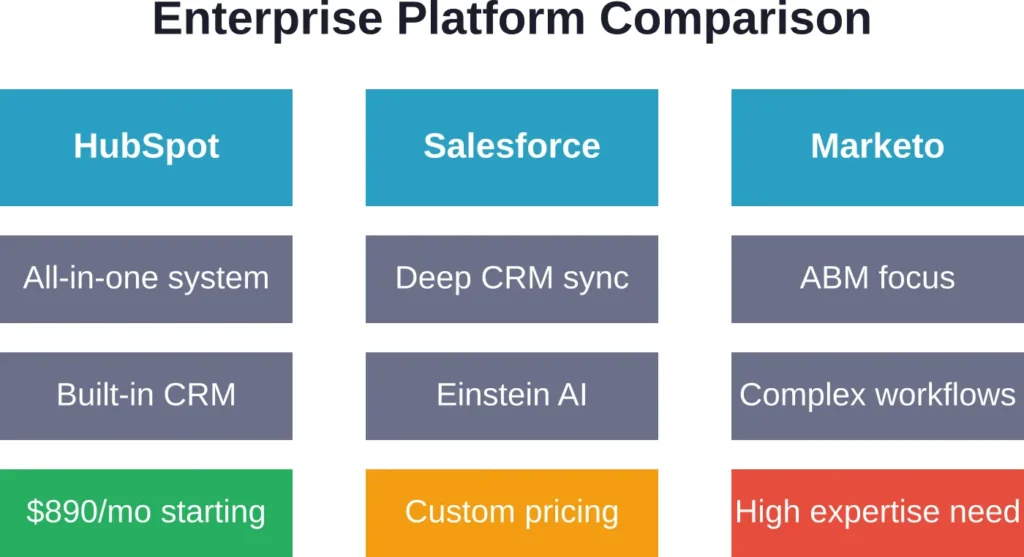
HubSpot Marketing Hub
HubSpot was recognized as a Leader in the Gartner Magic Quadrant for B2B Marketing Automation Platforms for the fifth consecutive year, according to their 2025 report, according to their 2025 report.
The platform combines CRM, marketing automation, and AI tools in a unified system. Notable AI features include content assistant for generating blog posts and emails, predictive lead scoring, and smart send-time optimization.
Pricing for HubSpot Marketing Hub Professional scales with contact volume; verify current rates on official HubSpot pricing page. Enterprise plans scale based on contact volume and required features.
The all-in-one approach reduces integration complexity but creates vendor lock-in. Teams already using separate best-of-breed tools may find the transition disruptive.
Salesforce Marketing Cloud Account Engagement

Salesforce Marketing Cloud Account Engagement has been recognized as a Leader in the Gartner Magic Quadrant for B2B Marketing Automation Platforms for the seventh consecutive year as of October 2024.
The platform excels at connecting marketing automation with sales processes through native Salesforce CRM integration. AI capabilities include Einstein predictive scoring, automated campaign optimization, and natural language insights.
Best suited for organizations already committed to the Salesforce ecosystem. Standalone implementation requires significant configuration and often professional services support.
Pricing varies based on edition and user count—contact Salesforce for current enterprise pricing as rates change frequently based on negotiated contracts.
Adobe Marketo Engage

Marketo remains a major player in enterprise marketing automation with sophisticated journey orchestration and account-based marketing capabilities.
AI features include predictive content, audience segmentation, and automated program optimization. The platform handles complex multi-touch attribution and cross-channel campaign management.
Implementation requires technical expertise. Organizations should budget for onboarding, training, and often dedicated Marketo administrators.
AI Workflow Automation Platforms
These tools orchestrate complex automation across multiple marketing tools and data sources.
Zapier

Zapier connects over 8,000 apps, enabling marketers to build automated workflows without coding.
Recent AI additions include automated workflow suggestions, data transformation tools, and intelligent error handling. The platform serves as the integration layer connecting disparate marketing tools.
Pricing starts at $19.99/month with free plans available for basic automation. Usage-based pricing scales with task volume and complexity.
Not a complete marketing automation solution on its own—functions best as the connective tissue between specialized tools.
Make (formerly Integromat)
Make provides visual workflow automation with more complex logic handling than Zapier.
The interface uses flowcharts to map data movement between systems. Advanced features include routers, aggregators, and conditional branching for sophisticated automation sequences.
Pricing starts with a free tier, then scales based on operations performed monthly. Check official documentation for current tier structures as they evolve.
Gumloop

Gumloop focuses specifically on marketing automation with AI-powered workflow creation.
Free plan includes 2,000 credits per month with 1 seat and 1 active trigger. Solo plan starts at $37/month with 10,000+ credits, unlimited seats, and advanced features.
A 20% discount code (MARKETERMILK) has been mentioned in community discussions for Gumloop, though promotional availability varies.
AI Content Generation Tools
Content creation represents one of the most time-consuming marketing activities. AI tools accelerate production while maintaining quality.
Jasper AI

Jasper generates marketing copy using large language models trained on high-performing content.
The platform creates blog posts, email sequences, social media content, and ad copy. Brand voice training ensures consistency across outputs.
Pricing varies by plan—contact Jasper for current rates as subscription structures change based on usage needs and team size.
Output quality depends heavily on prompt engineering and human editing. Raw AI output rarely works as final copy without refinement.
Copy.ai

Copy.ai specializes in shorter-form content like social posts, email subject lines, and ad variations.
The tool generates multiple alternatives quickly, useful for A/B testing and creative exploration. Workflow features help organize projects and maintain brand consistency.
Free tier provides limited generations monthly. Paid plans remove restrictions—see official pricing page for current subscription costs.
Writesonic

Writesonic combines content generation with SEO optimization features.
AI analyzes competitor content and search intent to guide article creation. The platform includes fact-checking capabilities and citation suggestions.
Pricing tiers vary by word count allocation and feature access. Check official site for up-to-date plan details.
Email Marketing AI Tools
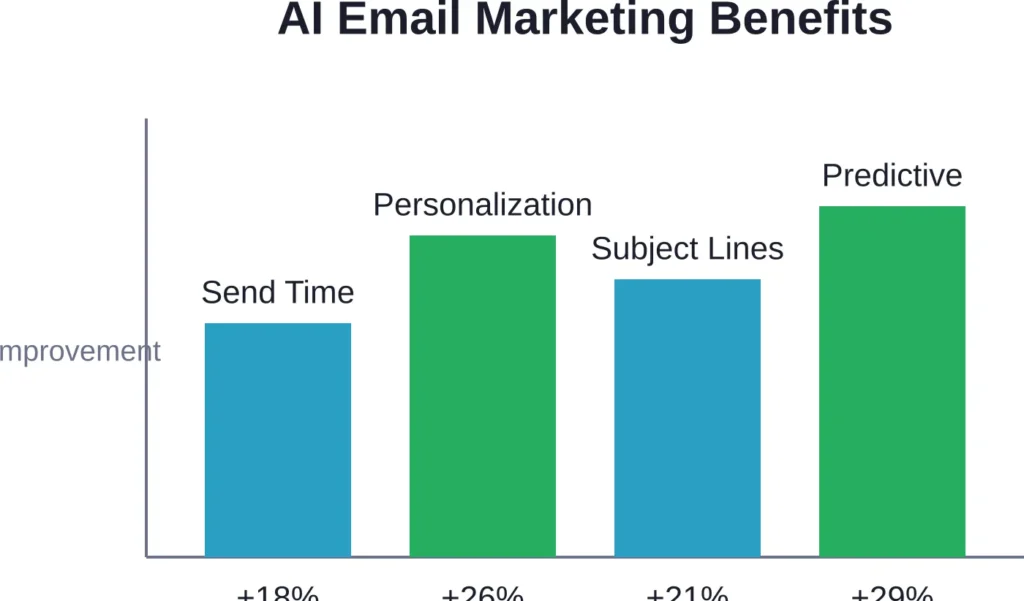
Email remains the highest-ROI marketing channel. AI makes campaigns more effective through personalization and optimization.
Customer.io

Customer.io focuses on behavioral email automation for SaaS and digital products.
The platform tracks user actions and triggers relevant messages based on feature usage, engagement patterns, and lifecycle stage. Predictive features include optimal send time and churn risk scoring.
Best suited for product-led businesses where usage data drives marketing strategy. Traditional lead-based marketing teams may find the approach misaligned.
Loops

Loops provides developer-friendly email automation with API-first architecture.
Technical teams appreciate the programmatic control and event-based triggering. AI features include send-time optimization and subject line testing.
Pricing starts with a free tier for basic usage. Paid plans scale with contact volume and sending frequency.
Seventh Sense
Seventh Sense adds AI-powered send-time optimization to existing email platforms.
The tool analyzes individual engagement patterns to determine optimal delivery timing for each contact. Integrates with HubSpot, Marketo, and Eloqua.
Pricing varies based on contact database size and platform integration. Contact vendor for current rates as pricing evolves.
Social Media Automation With AI
Managing multiple social channels demands consistent content creation and engagement monitoring. AI tools handle the repetitive work.
Buffer

Buffer automates social media scheduling with AI-powered optimal posting times.
The platform analyzes historical engagement to recommend when to publish for maximum reach. Content suggestions help identify trending topics relevant to target audiences.
Free plan covers basic scheduling. Paid tiers add team collaboration, analytics, and advanced automation features. Check current pricing as plans evolve.
Hootsuite

Hootsuite provides enterprise social media management with AI content recommendations and sentiment analysis.
Bulk scheduling, approval workflows, and unified inbox management help teams coordinate complex social strategies. Integration ecosystem connects to major social networks and business tools.
Pricing scales with user count and feature requirements. Enterprise plans include custom integrations and dedicated support.
Lately

Lately uses AI to analyze long-form content and generate dozens of social media posts automatically.
The platform identifies key quotes, statistics, and concepts from blog posts, videos, and podcasts, then creates platform-optimized variations.
Pricing varies by plan—contact vendor for current rates. Most valuable for content-heavy brands repurposing existing assets.
Analytics and Reporting AI Tools
Data analysis separates effective marketing from wasted effort. AI tools identify patterns humans miss.
Google Analytics 4 with AI Insights

GA4 includes predictive metrics like purchase probability, churn probability, and revenue forecasting.
Anomaly detection automatically flags unusual traffic patterns or conversion changes. Natural language queries let marketers ask questions in plain English.
Free for most businesses. Google Analytics 360 provides enterprise features at custom pricing.
Tableau with Einstein Analytics

Tableau combines data visualization with Salesforce Einstein AI for predictive insights.
The platform connects to multiple data sources, creating unified dashboards that forecast trends and recommend actions.
Best for organizations with complex data environments requiring custom reporting. Pricing varies by deployment and user licensing.
Domo

Domo provides business intelligence with AI-powered anomaly detection and predictive analytics.
Real-time data connections update dashboards automatically. Natural language queries make complex analysis accessible to non-technical users.
Pricing structure varies by organization size and feature needs. Contact vendor for current enterprise rates.
Conversation and Chatbot AI
Conversational marketing captures leads and answers questions 24/7 without human agents.
Drift

Drift pioneered conversational marketing with AI-powered chatbots that qualify leads through natural dialogue.
The platform routes qualified prospects to sales reps in real-time while handling common questions automatically. Integration with CRM systems ensures conversation data flows to contact records.
Pricing varies by plan and conversation volume. Check official site for current subscription tiers.
Intercom

Intercom combines live chat, chatbots, and customer support in a unified platform.
AI features include intent detection, automated responses, and conversation routing. The system learns from past interactions to improve answer accuracy.
Pricing scales with contact volume and feature requirements. Multiple tiers accommodate different business sizes.
ManyChat

ManyChat specializes in social media messaging automation, particularly Facebook Messenger and Instagram.
Visual flow builder creates conversation paths without coding. AI features include keyword detection and sentiment analysis.
Free plan covers basic automation. Pro plans add advanced features and remove branding. See official pricing for current costs.
Implementation Strategy for Marketing AI
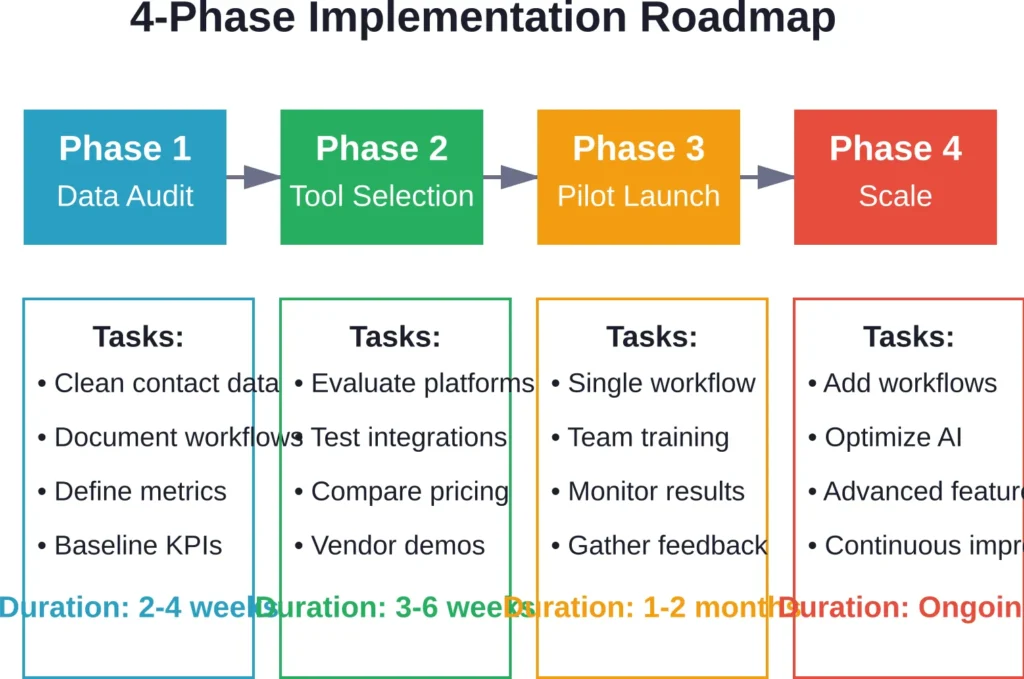
Tools only deliver value with proper implementation. Here’s how to avoid becoming part of the less-than-50% ROI statistic.
Start With Data Foundation
AI systems require clean, organized data to function effectively.
Audit current data quality before implementing new tools. Identify gaps in customer information, fix inconsistent formatting, and establish data governance policies.
Organizations with poor data hygiene see minimal AI value regardless of tool sophistication.
Define Clear Success Metrics
Vague goals produce mediocre results.
Establish specific KPIs before implementation: email open rates, conversion percentages, revenue per contact, or customer acquisition cost. Baseline current performance to measure improvement accurately.
According to Ryze AI implementation data, teams implementing AI marketing automation typically see a 14.5% increase in sales productivity within the first year., but only when tracking specific metrics.
Implement Incrementally
Attempting to automate everything simultaneously overwhelms teams and systems.
Start with one high-impact workflow. Master that process, then expand to additional use cases. Incremental implementation allows learning and adjustment without catastrophic failure.
Common starting points include email welcome sequences, lead scoring, or basic content personalization.
Maintain Human Oversight
AI automation doesn’t mean eliminating human judgment.
Review AI-generated content before publication. Monitor automated campaigns for errors or tone problems. Establish approval workflows for high-stakes communications.
The most effective implementations combine AI efficiency with human creativity and strategic thinking.
Platform Comparison Table
Choosing the right platform depends on business size, technical capability, and marketing complexity.
| Platform | Best For | Starting Price | Key AI Features | Integration Complexity |
|---|---|---|---|---|
| HubSpot | All-in-one solution | $890/month | Predictive scoring, content assistant, send optimization | Low (unified system) |
| Salesforce Marketing Cloud | Enterprise with Salesforce CRM | Custom pricing | Einstein predictive analytics, automated insights | Medium (Salesforce ecosystem) |
| ActiveCampaign | Growing businesses | $39/month | Predictive sending, win probability, split testing | Low to medium |
| Klaviyo | eCommerce brands | Varies by contacts | CLV prediction, churn risk, timing optimization | Low (eCommerce platforms) |
| Zapier | Workflow orchestration | $19.99/month | Workflow suggestions, data transformation, error handling | High (connects multiple tools) |
| Jasper AI | Content generation | Custom pricing | Brand voice training, multi-format content creation | Low (standalone tool) |
Common Implementation Challenges
Understanding where others fail helps avoid repeating mistakes.
Data Quality Problems
Garbage in, garbage out remains true for AI systems.
Duplicate contacts, missing fields, and inconsistent formatting sabotage automation effectiveness. Lead scoring algorithms trained on poor data produce unreliable predictions.
Solution: Dedicate resources to data cleaning before automation implementation. Establish ongoing data maintenance processes.
Over-Automation
Automating every interaction removes human authenticity.
Contacts notice when they’re receiving robotic communications. Over-automated sequences feel impersonal and decrease engagement over time.
Solution: Reserve automation for appropriate touchpoints. High-value opportunities still warrant personal outreach.
Insufficient Testing
Launching automation workflows without thorough testing creates public failures.
Broken merge tags, incorrect conditional logic, or timing errors damage brand reputation and waste leads.
Solution: Test all workflows with internal contacts first. Review output quality before exposing to prospects.
Lack of Team Training
Sophisticated tools deliver no value when teams don’t understand them.
Marketing automation platforms include extensive capabilities most organizations never utilize due to training gaps.
Solution: Budget for ongoing education. Platforms evolve constantly—quarterly training refreshers keep skills current.
Future Trends in Marketing Automation AI
The landscape continues evolving rapidly. Here’s where the industry heads next.
Revenue Marketing Platforms
According to Forrester, traditional marketing automation platforms and account-based marketing systems are converging into Revenue Marketing Platforms.
These unified systems connect marketing activities directly to revenue outcomes, eliminating the gap between lead generation and sales results.
The shift reflects growing executive pressure for marketing to demonstrate measurable business impact beyond vanity metrics.
Autonomous Campaign Management
Platforms like Ryze AI represent a new category: autonomous marketing systems that manage campaigns with minimal human intervention.
These tools automatically adjust bids, reallocate budgets, and optimize creative without manual campaign management. Used by over 2,000 marketers managing more than $500M in ad spend across 23 countries as of May 2026.
The autonomous approach works best for performance marketing with clear conversion goals. Brand building and complex messaging still require human oversight.
Predictive Content Personalization
Beyond email send times, AI now personalizes entire content experiences based on predicted preferences.
Website visitors see different headlines, images, and calls-to-action based on behavioral predictions. Email content dynamically adjusts based on individual engagement patterns.
Privacy regulations complicate this approach—balancing personalization with compliance remains challenging.
Voice and Conversation AI
Natural language processing enables more sophisticated chatbot interactions.
Modern systems understand context, handle multi-turn conversations, and escalate appropriately when human intervention becomes necessary.
Voice-activated marketing represents the next frontier, though adoption remains early stage.
Selecting the Right Tools
No single platform fits every organization. Consider these factors when evaluating options.
Business Model Alignment
B2B companies need lead nurturing and sales handoff capabilities. eCommerce brands require behavioral triggers and purchase pattern analysis. SaaS businesses benefit from usage-based automation.
Choose platforms designed for similar business models. General-purpose tools force workarounds that create friction.
Technical Capability
Enterprise platforms require dedicated administrators and often external consultants. Mid-market solutions balance capability with usability. Entry-level tools prioritize simplicity over sophistication.
Honest assessment of internal technical resources prevents buying tools teams can’t implement effectively.
Integration Requirements
Marketing automation connects to CRM systems, analytics platforms, advertising networks, and content management systems.
Evaluate existing tech stack before selecting new tools. Native integrations reduce implementation complexity significantly.
Budget Reality
Listed starting prices rarely reflect actual costs. Factor in implementation, training, ongoing support, and scaling expenses.
Organizations implementing AI marketing automation see a 12.2% reduction in marketing overhead within the first year, but only after initial investment recovers.
Measuring Marketing Automation Success
Effective measurement requires tracking both efficiency and effectiveness metrics.
Efficiency Metrics
These measure resource utilization:
- Time saved per campaign — hours recovered through automation
- Cost per lead — acquisition cost reduction from automated nurturing
- Marketing overhead percentage — staff costs as proportion of revenue
- Campaign velocity — time from planning to execution
Effectiveness Metrics
These measure business impact:
- Conversion rate improvement — lead-to-opportunity and opportunity-to-customer percentages
- Revenue per contact — total value generated per database contact
- Customer lifetime value — long-term revenue from automated nurturing
- Attribution accuracy — confidence in revenue source identification
Balanced measurement prevents optimizing for efficiency while effectiveness suffers, or vice versa.
Frequently Asked Questions
Traditional marketing automation follows preset rules—if someone downloads an ebook, send email sequence A. AI marketing automation adapts based on data, learning which emails, send times, and content work best for each individual contact without manual rule creation.
Costs vary dramatically by platform and business size. Entry-level tools start around $39/month for small contact databases. Mid-market solutions like HubSpot begin at $890/month. Enterprise platforms use custom pricing often exceeding several thousand monthly. Check current pricing directly as rates change frequently.
Yes, when implemented appropriately. Small teams gain disproportionate leverage from automation since they have fewer resources. Start with simple workflows like welcome sequences and abandoned cart recovery before advancing to complex predictive features. Free and low-cost tiers make experimentation accessible.
Simple implementations take 4-8 weeks. Complex enterprise deployments span 3-6 months. Incremental approaches work best—launch one workflow successfully, then expand. Organizations rushing full implementation often encounter data quality issues and team adoption problems that delay value realization.
No. AI handles repetitive execution tasks—scheduling emails, adjusting bids, scoring leads. Strategic thinking, creative direction, and complex decision-making still require human expertise. The most effective implementations combine AI efficiency with human creativity and judgment.
Clean contact data including email addresses, engagement history, and behavioral information provides the foundation. More sophisticated features require purchase history, website activity, demographic details, and firmographic data for B2B. Data quality matters more than quantity—accurate information about 10,000 contacts outperforms messy data on 100,000.
eCommerce, SaaS, financial services, healthcare, and B2B technology see strong results due to high transaction volumes and clear conversion paths. Traditional service businesses and complex B2B sales benefit but require more customization. Any business with repeatable marketing processes gains value from appropriate automation.
Taking Action With Marketing Automation AI
The marketing automation landscape in 2026 offers unprecedented capability for organizations willing to implement thoughtfully.
Success requires more than tool selection. Data quality, incremental implementation, clear metrics, and team training separate effective automation from wasted investment.
Start with a single high-impact workflow. Master that process before expanding to additional use cases. Organizations implementing AI marketing automation see a 14.5% increase in sales productivity within the first year when following structured approaches.
The global martech market projected at $148 billion reflects massive investment in these capabilities. But most organizations achieve less than 50% ROI on AI investments due to poor execution.
Focus on fundamentals: clean data, defined goals, appropriate tool selection, and ongoing optimization. The competitive advantage comes not from having AI tools but from using them effectively.
Evaluate current marketing processes. Identify repetitive tasks consuming team time. Research platforms aligned with business model and technical capability. Test with pilot programs before full commitment.
Marketing automation AI delivers measurable results when implemented strategically. Organizations that invest time in proper foundation-building realize the productivity gains and cost reductions the technology promises.