

Quick Summary: AI tools are transforming digital marketing by automating content creation, optimizing campaigns, and personalizing customer experiences at scale. The best AI marketing tools in 2026 include ChatGPT for content generation, Jasper for copywriting, Surfer SEO for optimization, Canva for design, and specialized platforms for email, social media, and analytics. According to a Salesforce report, 51% of marketing leaders currently use AI, with adoption accelerating. 84% of companies investing in AI are seeing positive ROI.
Artificial intelligence has moved from novelty to necessity in digital marketing. What started as experimental automation has become the backbone of how modern marketing teams operate.
The numbers tell the story. A March 2025 survey found that 28% of U.S. employed adults used ChatGPT for work. Among marketers specifically, adoption has accelerated even faster—according to a Salesforce report, 51% of marketing leaders currently use AI, with adoption accelerating. And they’re not just experimenting. 84% of companies investing in AI are seeing positive ROI.
But here’s the challenge: the AI marketing landscape has exploded. Tools promise everything from instant content creation to predictive analytics that reads customer minds. Some deliver. Many don’t.
This guide cuts through the noise. It focuses on AI marketing tools that solve real problems—the ones marketing teams at major brands actually use to grow. No fluff, no theoretical benefits. Just practical tools that work.
What AI Marketing Tools Actually Do
AI marketing tools leverage machine learning, natural language processing, and predictive analytics to handle tasks that traditionally required hours of manual work or specialized expertise.
They fall into several categories. Content creation tools generate copy, images, and video. Optimization platforms improve SEO and campaign performance. Analytics tools uncover insights from customer data. Automation platforms orchestrate workflows across multiple channels.
The real power comes from how these tools handle scale. A marketer can personalize email subject lines for 10 customers manually. For 10,000 customers? That requires AI.
According to the American Marketing Association, AI serves as customer-facing agents through chatbots and service robots, as core attributes of interactive products like voice assistants, and as integral components of marketing automation systems.
Traditional marketing playbooks no longer work. AI hasn’t just sped marketing up—it’s collapsed the distance between strategy and execution. Marketing leaders who win aren’t the ones with the best frameworks. They’re the ones who’ve learned to train systems, meet modern buyers where they actually are, and build experiments that produce measurable outcomes in 30-60 days.
Ad Campaign Optimization
Paid advertising costs too much for guesswork. AI optimization ensures budget goes to what actually works.
Extuitiveї
Extuitive is an AI platform that predicts the performance of ad creatives before launching any campaign. It analyzes images, videos, copy, and pricing, then forecasts key metrics such as CTR, ROAS, and CPC with high accuracy.
The platform uses over 150,000 AI consumer agents that simulate real human behavior, allowing marketers to test dozens or hundreds of creative variations in minutes. It integrates natively with Shopify and is particularly strong for e-commerce brands that need fast, data-driven creative decisions.
Contact Information:
- Website: extuitive.com
- Email: [email protected]
- LinkedIn: www.linkedin.com/company/extuitive
- Twitter: x.com/Extuitive_Inc
- Instagram: www.instagram.com/extuitiveinc
Adext AI

Adext manages Google Ads and Facebook Ads campaigns with AI that continuously tests audience segments. It automatically shifts budget to the best-performing audiences.
The platform runs hundreds of audience experiments simultaneously—something no human could manage manually. Results typically show 20-30% improvement in cost per acquisition.
Pattern89
Pattern89 analyzes creative elements in ads to predict performance before spending budget. It identifies which images, copy, colors, and calls-to-action work best for specific audiences.
The system learns from millions of ads across industries, bringing that collective knowledge to each campaign.
Albert AI

Albert runs autonomous digital advertising campaigns across channels. It tests creatives, adjusts bids, allocates budget, and personalizes messaging—all without human intervention.
Enterprise brands use Albert for complex, multi-channel campaigns where the volume of optimization decisions exceeds human capacity.
Content Creation and Copywriting Tools
Content remains the foundation of digital marketing. AI tools have transformed how teams produce it.
ChatGPT by OpenAI

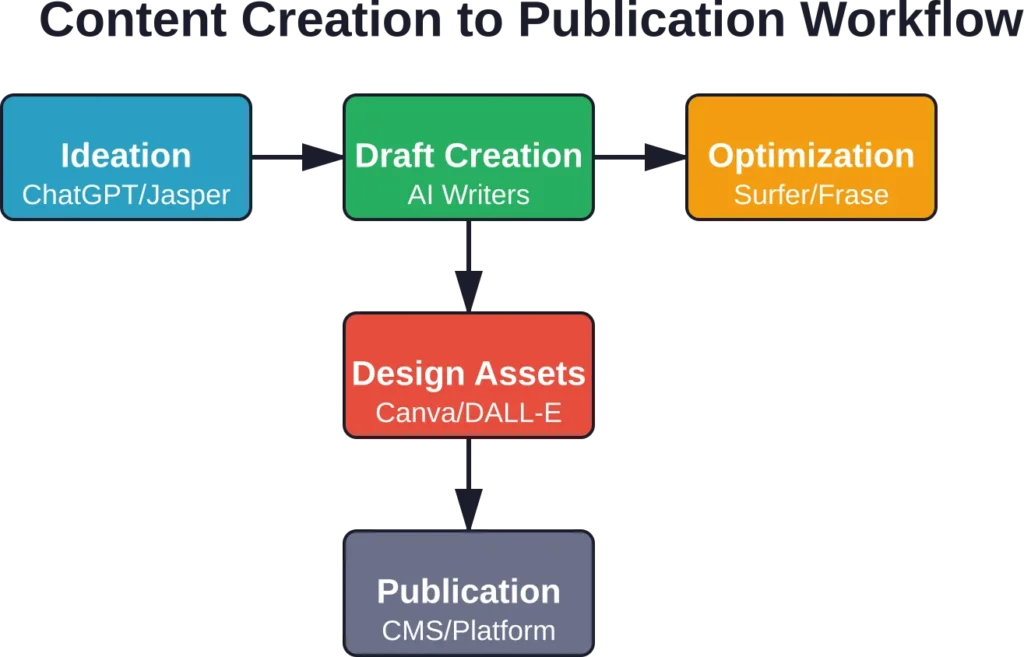
ChatGPT has become synonymous with AI content creation. It’s the most recognized generative AI tool for marketing—and for good reason.
The platform handles blog outlines, social media posts, email copy, product descriptions, and conversational content. Its natural language understanding makes it particularly effective for brainstorming and first drafts.
Marketers use ChatGPT for customer support conversations, content ideation, repurposing long-form content into multiple formats, and even basic market research through prompt engineering.
The tool offers a free tier with GPT-3.5 and a $20/month plan for GPT-4 access with higher usage limits. For marketing teams, the paid tier usually pays for itself within the first week.
Limitations exist. ChatGPT requires careful prompting to produce brand-specific content. It sometimes generates generic copy that needs significant editing. And it has no built-in SEO optimization.
Jasper AI

Jasper takes content generation a step further with marketing-specific templates and brand voice customization. Where ChatGPT offers a blank canvas, Jasper provides structure.
The platform includes templates for ad copy, landing pages, email sequences, blog posts, and social media content. It learns brand voice from sample content and maintains consistency across outputs.
Teams appreciate Jasper’s collaboration features. Multiple users can work within the same brand guidelines. The platform integrates with Surfer SEO for content optimization directly in the workflow.
Pricing varies—check Jasper’s official website for current plans. The platform targets serious content operations rather than occasional users.
Copy.ai

Copy.ai focuses on speed. It generates marketing copy in seconds through specialized tools for different formats.
The platform handles blog ideas, social media captions, product descriptions, email subject lines, ad copy, and sales copy. Its interface emphasizes quick iteration—generate five variations, pick the best, refine.
Copy.ai works particularly well for teams that need volume. E-commerce brands use it for product descriptions at scale. Social media managers generate weeks of post ideas in minutes.
The tool offers a free tier for testing and paid plans for higher limits. Check the official site for current pricing.
SEO and Content Optimization Platforms
Creating content matters little if nobody finds it. AI-powered SEO tools have changed how marketers approach search optimization.
Surfer SEO

Surfer SEO analyzes top-ranking pages and provides data-driven recommendations for content optimization. It takes the guesswork out of SEO.
The platform examines keyword density, content structure, word count, headings, images, and semantic keywords from pages that already rank. Then it provides a content editor with real-time scoring.
Writers see exactly what to adjust as they work. The score increases when content matches optimization targets. This approach consistently produces content that ranks.
Surfer integrates with Google Docs, WordPress, and Jasper. Teams can optimize without switching between platforms.
Pricing varies by plan—see the official website for current options. Most content teams find it pays for itself through improved rankings.
Clearscope

Clearscope takes a similar approach with a focus on content relevance. It identifies the topics, terms, and questions top-ranking content covers.
The platform generates content briefs that outline exactly what a piece should include to compete. Writers and editors can track optimization in real-time through browser extensions.
Clearscope particularly excels at semantic SEO—understanding the concepts related to a topic rather than just keyword matching.
Frase

Frase combines content research, optimization, and generation in one platform. It analyzes search results, generates content briefs, and helps writers create optimized content.
The tool’s question-answering feature identifies common queries around a topic. This helps marketers structure content to capture featured snippets and answer-box rankings.
Frase also generates content outlines based on top-ranking pages and provides an AI writer for producing optimized drafts.
Visual Content Creation Tools
Visual content drives engagement. AI has democratized design, making professional-quality visuals accessible to non-designers.
Canva with Magic Design
Canva’s AI features have transformed it from a template library into an intelligent design assistant. Magic Design generates complete designs from simple text prompts.
Marketers describe what they need—”Instagram post for product launch, modern tech aesthetic”—and receive multiple design options. The AI understands brand colors, fonts, and style preferences from previous work.
The platform also includes background removal, image enhancement, video editing, and presentation creation. All with AI assistance.
Canva offers a free tier with basic AI features and paid plans for teams. Check the official site for current pricing tiers.
DALL-E 3

OpenAI’s DALL-E 3 generates images from text descriptions. The latest version produces remarkably detailed, contextually accurate images.
Marketing teams use it for concept visualization, social media graphics, blog post illustrations, and ad creative ideation. The image quality now rivals stock photography for many use cases.
DALL-E 3 integrates with ChatGPT Plus subscriptions. Users can generate images directly within conversations, making iteration fast.
Because of integration capabilities, teams connect DALL-E to automation platforms like Zapier to automatically generate images from form submissions or database entries.
Adobe Firefly

Adobe’s generative AI, Firefly, integrates directly into Photoshop, Illustrator, and Express. This puts AI image generation in the hands of designers already working in Adobe’s ecosystem.
Firefly excels at generative fill—adding or removing elements from existing images with AI. It also handles text effects, style transfer, and template generation.
For teams already paying for Adobe Creative Cloud, Firefly adds powerful AI capabilities without additional subscriptions.
Runway ML

Runway focuses on AI video creation and editing. It generates video from text prompts, extends existing footage, removes backgrounds in video, and applies motion tracking effects.
The platform has become popular for creating social media video content quickly. Marketers generate product demo videos, explainer content, and video ads without traditional video production.
Social Media Management and Automation
Social media demands constant content production and engagement. AI tools help teams maintain presence without burning out.
Lately

Lately uses AI to transform long-form content into dozens of social media posts. It analyzes what content performs best for a specific audience and generates posts that match those patterns.
The platform learns brand voice from past high-performing posts. Then it automatically pulls key quotes, stats, and ideas from blog posts, videos, or podcasts and formats them for each social platform.
Marketing teams save hours on content repurposing. One webinar becomes weeks of social content.
Buffer with AI Assistant

Buffer’s AI Assistant helps write social media posts, suggest optimal posting times, and repurpose content across platforms. It understands character limits and platform-specific best practices.
The tool also provides engagement analytics and suggests which types of content to create more of based on performance data.
Buffer remains popular because it combines AI content help with robust scheduling and team collaboration features.
Hootsuite Insights

Hootsuite’s AI-powered social listening tracks brand mentions, sentiment, and trending topics. It identifies opportunities for engagement and potential PR issues before they escalate.
The platform’s AI categorizes conversations, identifies influencers, and suggests optimal response strategies based on sentiment analysis.
Email Marketing Optimization
Email remains one of the highest-ROI marketing channels. AI optimization makes campaigns significantly more effective.
Seventh Sense
Seventh Sense uses AI to optimize email send times for each individual recipient. Rather than blasting everyone at 10 AM Tuesday, it determines when each person is most likely to engage.
The system analyzes historical engagement patterns and adjusts send times continuously. Results typically show 7-14% increases in open rates and significantly better click-through rates.
It integrates with HubSpot and Marketo, working as an optimization layer on top of existing email platforms.
Phrasee
Phrasee generates and tests email subject lines, preview text, and call-to-action copy using natural language generation. Its AI understands brand voice and writes in that style.
The platform runs multivariate testing automatically, learning what language drives opens and clicks for specific audiences. Over time, performance consistently improves.
Major retailers and e-commerce brands use Phrasee to personalize email at scale—generating unique subject lines for different customer segments without manual work.
Persado

Persado takes AI-powered copywriting specifically for marketing campaigns. It generates emotional language that drives action, backed by extensive testing data.
The platform analyzes how different emotional approaches—urgency, gratitude, achievement—perform with different audiences. Then it generates copy optimized for specific campaign goals.
While enterprise-focused and premium-priced, Persado delivers measurable lift in conversion rates across email, ads, and landing pages.
Analytics and Customer Insights
Data without insights wastes time. AI analytics tools transform raw data into actionable intelligence.
Google Analytics 4 with AI Insights

Google Analytics 4 uses machine learning to surface insights automatically. It identifies significant changes in traffic, predicts future behavior, and suggests opportunities.
The platform’s predictive metrics estimate purchase probability and churn likelihood for user segments. Marketers can target campaigns to high-probability converters or re-engage at-risk customers.
GA4’s AI-powered search answers questions in natural language. Teams ask “why did conversion rate drop last week?” and receive data-backed explanations.
Tableau with Einstein AI

Tableau’s Einstein AI helps non-technical marketers discover insights through natural language queries and automated analysis.
The platform explains outliers in data, predicts trends, and suggests which segments to investigate. This removes the bottleneck of waiting for data analysts to pull reports.
Modern AI analytics tools evolve beyond one-off queries. Multiple specialized AI agents collaborate in agentic workflows, continuously uncovering insights. One agent might monitor campaign metrics and notice a 15% drop in sign-ups this week. It could then autonomously trigger another agent to investigate causes—discovering a 10% overall conversion rate decline. A third agent might drill deeper, finding a 15% conversion decline specifically in Europe, tied to a 25% decline in organic search traffic from that region.
HubSpot Marketing Hub
HubSpot’s AI features span content optimization, lead scoring, chatbots, and predictive analytics. The platform uses machine learning to score leads based on behavior and attributes.
Its content strategy tool analyzes top-performing content and suggests topics likely to perform well. The AI assistant helps write blog posts, social updates, and email copy within the platform.
For teams wanting an integrated marketing platform with built-in AI throughout, HubSpot provides a comprehensive solution.
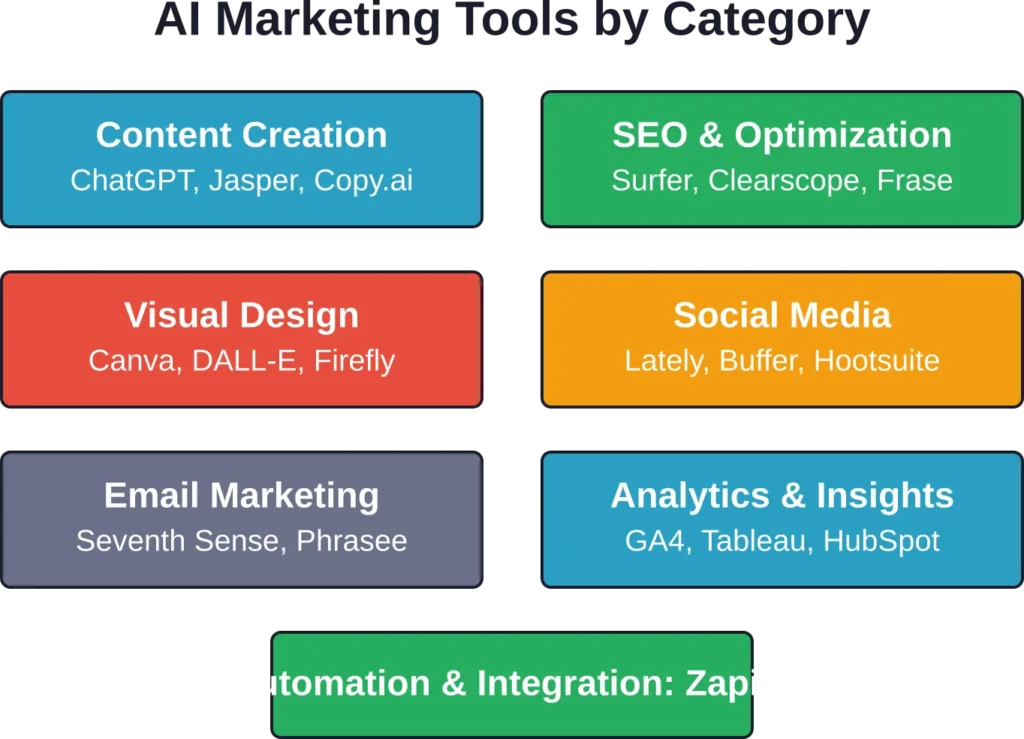
Automation and Integration Platforms
Individual AI tools deliver value. Connected AI tools multiply it. Automation platforms orchestrate workflows across tools.
Zapier

Zapier connects over 6,000 apps, enabling AI-powered workflows without coding. Marketing teams automate repetitive tasks by creating “Zaps” that trigger actions across platforms.
Common marketing automation examples include automatically generating images with DALL-E from Google Forms responses, posting new blog content to social media, adding leads from landing pages to email sequences, and creating personalized follow-up tasks.
The platform’s AI features help users build automations through natural language descriptions. Describe the workflow needed, and Zapier suggests the specific triggers and actions to create it.
Make (formerly Integromat)
Make provides similar automation capabilities with a visual interface that shows data flow between apps. It handles complex, multi-step workflows particularly well.
Marketing operations teams use Make for advanced scenarios like conditional logic, data transformation, error handling, and parallel processing.
Gumloop

Gumloop takes AI automation further by enabling users to build custom AI workflows for specific marketing tasks. It combines AI models with business logic.
Teams create workflows for research, content generation, data processing, and administrative tasks. The platform works particularly well for sales enablement, market research, and content operations.
Conversational AI and Chatbots
Conversational AI handles customer interactions at scale, providing instant responses and qualifying leads 24/7.
Drift

Drift pioneered conversational marketing with AI chatbots that qualify leads through natural conversation. The platform identifies high-intent visitors and routes them to sales instantly.
Its AI learns from conversation history to improve responses over time. The system handles common questions, books meetings, and personalizes interactions based on visitor data.
B2B companies particularly value Drift for converting website traffic into qualified sales opportunities.
Intercom

Intercom combines customer support and marketing automation with AI-powered conversation routing. Its chatbot handles support tickets, qualifies leads, and triggers personalized messages based on behavior.
The platform’s Fin AI answers customer questions by pulling information from help documentation. When it can’t help, it routes seamlessly to human agents with full context.
ManyChat

ManyChat focuses on conversational marketing through messaging apps—WhatsApp, Facebook Messenger, Instagram, and SMS. Its AI helps create conversation flows and automated responses.
E-commerce brands use ManyChat for abandoned cart recovery, product recommendations, order updates, and promotional campaigns through chat.
Specialized AI Marketing Tools Worth Knowing
Beyond the major categories, specialized tools solve specific marketing challenges exceptionally well.
Grammarly Business

Grammarly’s AI checks grammar, tone, clarity, and brand voice across all writing. Marketing teams use it to maintain quality and consistency in content at scale.
The business version learns company-specific terminology and preferred style, ensuring everyone writes on-brand.
Brandwatch

Brandwatch uses AI for social listening and brand monitoring across billions of online conversations. It identifies trends, measures brand health, and spots emerging issues.
The platform’s image recognition detects logos in photos even without text mentions—crucial for understanding real brand exposure.
Crimson Hexagon

Now part of Brandwatch, Crimson Hexagon specializes in AI-powered consumer insights from social media. It segments audiences by interest, identifies influencers, and maps conversation themes.
Optimizely

Optimizely uses AI to run website and app experiments. Its Stats Engine reduces the time needed to reach statistical significance in A/B tests.
The platform’s AI also suggests which elements to test based on potential impact and automatically allocates traffic to winning variations.
Crayon

Crayon tracks competitive intelligence with AI that monitors competitor websites, content, pricing, job postings, and digital presence. It alerts marketing teams to significant competitive moves.
Product marketers use it to stay informed without manual competitor checking. The AI identifies patterns and trends across competitive landscapes.
| Tool Category | Primary Use Case | Best For | Integration Strength |
|---|---|---|---|
| ChatGPT | Content generation | Ideation and drafting | API available |
| Jasper | Marketing copy | Brand-consistent content | Native integrations |
| Surfer SEO | Content optimization | Search rankings | Google Docs, WordPress |
| Canva | Visual design | Non-designers | Social platforms |
| HubSpot | All-in-one marketing | Integrated workflows | Extensive ecosystem |
| Zapier | Workflow automation | Connecting tools | 6,000+ apps |
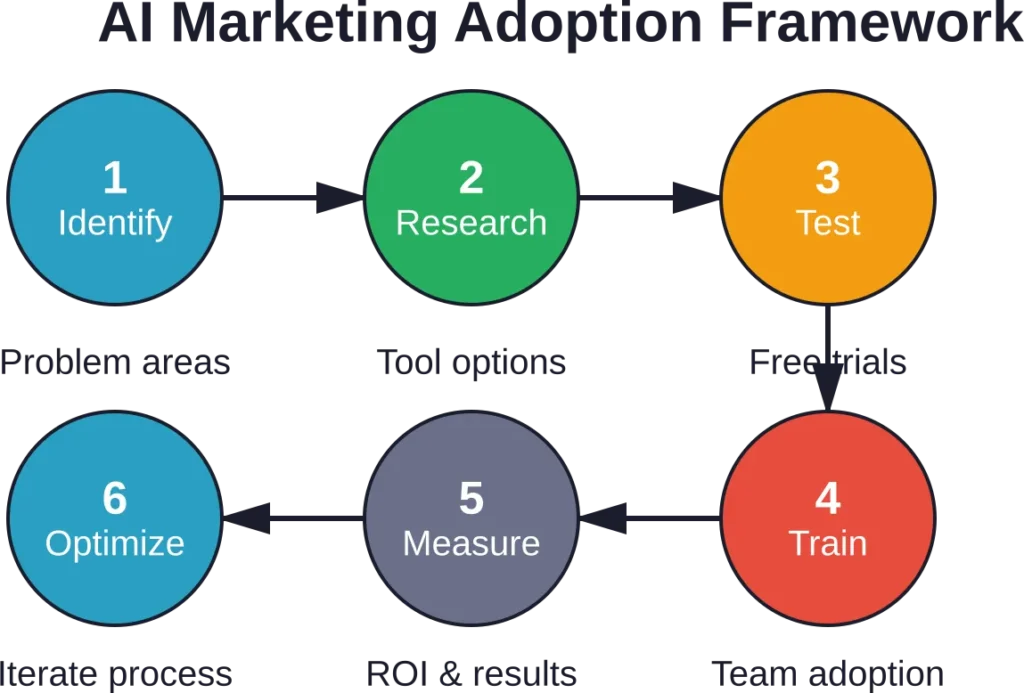
How to Choose the Right AI Marketing Tools
The abundance of AI tools creates decision paralysis. Here’s how to choose effectively.
Start With the Problem
Don’t start with tools. Start with the specific problem costing time or money. Is content production the bottleneck? Start with creation tools. Is organic traffic stagnant? Begin with SEO optimization.
Tools solve problems. Identify the problem first.
Consider Integration Requirements
Standalone tools create workflow friction. Check what platforms a tool connects with. Does it integrate with existing CRM, content management, or marketing automation systems?
Tools that require manual export/import quickly get abandoned.
Evaluate Learning Curve
Sophisticated AI tools deliver better results but require more training. Balance capability against adoption likelihood.
A simpler tool the team actually uses beats a powerful one that sits unused.
Test Before Committing
Most AI marketing tools offer free trials. Test with real work, not demo scenarios. Put the tool through actual workflows to see if it fits.
Pay attention to edge cases and limitations during testing. They become important at scale.
Calculate ROI
AI tools should save time or increase results measurably. Calculate the value of time saved or additional revenue generated versus tool cost.
For example, if a content tool saves 10 hours weekly at a $50/hour cost, that’s $500/week in value. A $200/month tool pays for itself easily.
Plan for Change Management
New tools require process changes. Plan training, create documentation, and give teams time to adapt. Rushing adoption leads to resistance.
According to the American Marketing Association, developing skills to work alongside AI has become essential. Marketers need to learn prompt engineering, output evaluation, and workflow design.
Common Mistakes With AI Marketing Tools
Knowing what to avoid matters as much as knowing what to do.
Expecting Magic
AI tools amplify marketing skills—they don’t replace them. ChatGPT won’t write brilliant copy without strategic prompts. Surfer won’t create compelling content without subject matter expertise.
Tools multiply human capability. They don’t eliminate the need for it.
Ignoring Brand Voice
AI-generated content often sounds generic without customization. Successful teams train tools on brand voice through examples, style guides, and iterative feedback.
Generic content performs generically. Brand-specific content performs better.
Over-Automation
Automating everything removes the human touch that builds relationships. Some interactions should remain personal—responding to complaints, high-value negotiations, relationship building.
Research from the American Marketing Association shows consumers react differently to AI than humans. Marketing AI as superior to humans can backfire. Balance efficiency with authenticity.
Skipping Human Review
AI makes mistakes. It hallucinates facts, misses context, and sometimes produces nonsense. Always review AI output before publishing.
The fastest path to brand damage is publishing unreviewed AI content.
Tool Hopping
New AI tools launch constantly. Chasing every new release prevents mastery of any tool. Pick solid options and learn them deeply rather than constantly switching.
Depth beats breadth with marketing tools.
The Future of AI in Digital Marketing
AI marketing tools continue evolving rapidly. Several trends shape what comes next.
Agentic AI Systems
Future marketing AI won’t wait for prompts. Autonomous agents will monitor performance, identify issues, test solutions, and implement fixes without human intervention.
Research from UC Berkeley’s California Management Review describes this shift from novelty to autopilot. Marketing’s future involves systems that continuously optimize rather than tools requiring constant direction.
Hyper-Personalization at Scale
AI enables one-to-one marketing for millions of customers. Future tools will generate unique content, offers, and experiences for each individual based on behavior, preferences, and context.
The American Marketing Association emphasizes that AI’s power lies in personalization capabilities that humans physically cannot match.
Multimodal AI
Tools increasingly combine text, image, video, and voice in integrated workflows. Create a product description and automatically generate matching images, videos, and audio versions.
Multimodal AI reduces the friction between content formats.
Predictive Marketing
AI moves from reactive to predictive. Rather than analyzing what happened, it forecasts what will happen and suggests preemptive actions.
Predictive churn modeling, lifetime value forecasting, and campaign performance prediction become standard.
Ethical AI and Transparency
As AI becomes more prevalent, transparency about its use matters. Consumers increasingly want to know when they’re interacting with AI versus humans.
Research from the American Marketing Association shows that marketing AI as superior to humans can backfire with consumers. Authenticity matters.
Building Your AI Marketing Stack
Rather than adopting every tool, build a focused stack that covers core needs.
Starter Stack
For teams just beginning with AI:
- ChatGPT for content ideation and drafting
- Canva for visual content
- Google Analytics 4 for insights
- Grammarly for quality control
Total monthly cost: Under $50. These tools provide immediate productivity gains without complex implementation.
Growth Stack
For established marketing teams scaling operations:
- Jasper for content production
- Surfer SEO for optimization
- HubSpot for integrated marketing
- Zapier for automation
- Seventh Sense for email optimization
This stack handles higher volume while maintaining quality and consistency.
Enterprise Stack
For large organizations with complex needs:
- Comprehensive platform like HubSpot or Marketo
- Specialized tools for each channel (content, SEO, social, email)
- Advanced analytics like Tableau with Einstein AI
- Conversation AI like Drift or Intercom
- Ad optimization like Albert or Adext
- Social listening like Brandwatch
Enterprise stacks prioritize integration, scalability, and advanced capabilities.
Skills Marketers Need for AI Tools
Tools alone don’t deliver results. Marketers need specific skills to use them effectively.
Prompt Engineering
Getting good output from AI requires writing effective prompts. This means being specific about context, format, tone, and desired outcomes.
Poor prompt: “Write about marketing.” Effective prompt: “Write a 300-word LinkedIn post for B2B marketers explaining why personalization increases conversion rates. Use a professional but conversational tone with one specific example.”
Critical Evaluation
AI produces confident-sounding content regardless of accuracy. Marketers must evaluate output for factual accuracy, brand alignment, and strategic fit.
This requires domain expertise that AI complements but doesn’t replace.
Workflow Design
Effective AI use requires reimagining workflows. Rather than plugging AI into existing processes, design new processes that leverage AI strengths.
This means thinking systematically about which tasks to automate, which to augment, and which to keep human.
Data Literacy
AI tools surface insights from data. Interpreting those insights requires understanding statistics, correlation versus causation, and experimental design.
Marketers increasingly need analytical skills previously reserved for data scientists.
Ethics and Responsibility
According to the American Marketing Association, marketers must consider how AI use affects customer relationships, privacy, and trust.
Skills in ethical AI use—transparency about automation, respecting privacy, avoiding bias—become competitive advantages.
| Use Case | Recommended Tools | Expected Time Savings | Key Benefit |
|---|---|---|---|
| Blog content production | Jasper + Surfer SEO | 40-50% | Optimized content faster |
| Social media management | Lately + Buffer | 60-70% | Consistent presence |
| Email campaigns | HubSpot + Seventh Sense | 30-40% | Higher engagement |
| Visual content creation | Canva + DALL-E | 50-60% | Professional quality |
| Campaign analytics | GA4 + Tableau | 20-30% | Faster insights |
| Lead qualification | Drift + HubSpot | 70-80% | 24/7 availability |
Measuring AI Marketing Tool Success
AI tool adoption without measurement wastes money. Track these metrics to evaluate success.
Time Savings
Track hours saved on specific tasks before and after AI implementation. Generative AI tools for marketing save users an average of 5.4% of work hours—more than two hours per week for full-time professionals.
Multiply time saved by hourly cost to calculate dollar value.
Quality Metrics
Measure quality of AI-assisted work versus manual work. For content, track engagement rates, time on page, conversion rates, and search rankings.
AI should maintain or improve quality, not just increase speed.
Adoption Rate
Track how many team members actually use new AI tools. Low adoption indicates training issues, workflow problems, or tool mismatch.
Aim for 80%+ adoption within 60 days.
ROI
Calculate total tool cost (subscription plus training time) versus value generated (time saved plus performance improvements).
Positive ROI should appear within 30-60 days for most AI marketing tools.
Output Volume
Track how much more work the team produces with AI assistance. This matters for content marketing, social media, and campaign production.
Volume increase without quality decrease indicates successful implementation.
Privacy and Compliance Considerations
AI tools process data. Marketing teams must ensure compliant usage.
Data Privacy
Don’t input sensitive customer data into AI tools without verification that the vendor handles it properly. Check data processing agreements, storage locations, and privacy policies.
Some AI tools train on user inputs. Understand what happens to data entered.
Copyright and Licensing
AI-generated content raises copyright questions. Some AI training includes copyrighted material. Understand the licensing terms of AI-generated outputs.
For commercial use, verify that generated content carries appropriate usage rights.
Disclosure Requirements
Some jurisdictions require disclosure when AI generates content or interacts with customers. Stay current on regulations in markets served.
Brand Safety
AI can generate brand-damaging content if not properly constrained. Implement review processes before publication.
One embarrassing AI output can undo months of brand building.
Frequently Asked Questions
There’s no single best AI marketing tool—the right choice depends on specific needs. ChatGPT excels for content ideation and drafting, Jasper for brand-consistent marketing copy, Surfer SEO for content optimization, HubSpot for integrated marketing automation, and Canva for visual design. Most successful marketing teams use multiple specialized tools rather than relying on one platform.
Research shows that generative AI tools for marketing save users an average of 5.4% of work hours, with results appearing within 30-60 days through time savings and improved results. Start with free trials to verify value before committing to paid plans.
Start with ChatGPT for content tasks and Canva for visuals—both offer free tiers and intuitive interfaces. Use them for actual work projects rather than just testing. Once comfortable, add Grammarly for quality control and Google Analytics 4 for insights. Master these basics before expanding to specialized tools. The key is consistent use rather than tool collection.
No. AI tools amplify marketing skills but don’t replace strategic thinking, creativity, emotional intelligence, or relationship building. Research from the American Marketing Association shows consumers respond differently to AI versus humans, and marketing AI as superior can backfire. The most effective approach combines AI efficiency with human judgment, creativity, and empathy.
Essential skills include prompt engineering to get quality AI outputs, critical evaluation to assess accuracy and brand fit, workflow design to integrate AI into processes, data literacy to interpret AI-generated insights, and ethics awareness to use AI responsibly. These skills matter more than technical knowledge—most modern AI tools require no coding.
Data handling varies significantly by tool. Check each vendor’s data processing agreements, storage locations, and whether inputs train AI models. Don’t input sensitive customer data without verification of proper handling. For commercial use in regulated industries, verify compliance with GDPR, CCPA, and relevant regulations. Reputable enterprise tools typically offer compliant data handling, but consumer-grade tools may not.
Free tiers typically limit usage volume, features, or output quality. They work well for testing and small-scale use. Paid plans offer higher usage limits, advanced features, priority support, team collaboration, integrations, and commercial usage rights. For professional marketing work, paid plans usually become necessary once past initial testing. Most tools offer a $20-50/month tier sufficient for individual marketers and $100-500/month for teams.
Conclusion
AI marketing tools have evolved from experimental technology to essential infrastructure. According to a Salesforce report, 51% of marketing leaders currently use AI, with adoption accelerating. 84% of companies investing in AI are seeing positive ROI.
But tools alone don’t create success. The marketing teams winning with AI share common patterns. They start with specific problems rather than chasing trends. They choose tools that integrate with existing workflows. They invest in training and change management. They measure results rigorously. And they maintain the human judgment that AI complements but can’t replace.
The AI marketing landscape will continue evolving. New tools launch constantly. Capabilities expand. What matters is building a foundation—a core stack of proven tools used effectively, combined with the skills to evaluate and adopt new capabilities when they genuinely add value.
Start small. Pick one or two tools that address current bottlenecks. Master them. Measure results. Then expand deliberately based on demonstrated ROI.
The competitive advantage goes to teams that integrate AI into daily practice, not those with the longest tool list. Focus on consistent execution over comprehensive coverage.
AI isn’t replacing marketing—it’s reshaping what marketers can accomplish. The question isn’t whether to use AI tools, but how quickly to build the skills and systems that turn AI capability into business results.
Ready to start? Begin with the starter stack—ChatGPT, Canva, Google Analytics 4, and Grammarly. Spend 30 days using them daily. Then evaluate what to add based on where bottlenecks remain. That practical approach beats analysis paralysis every time.