

Quick Summary: The best ads analytics tools for Facebook in 2026 include Extuitive, SegmentStream, Madgicx, Triple Whale, Northbeam, Funnel.io, Supermetrics, Whatagraph, Smartly, Hunch, and Superads.ai. These platforms offer advanced attribution, creative analytics, multi-channel reporting, and automated optimization that go beyond native Meta reporting. Tool selection depends on team size, attribution needs, budget, and whether multi-channel measurement is required.
Facebook Ads Manager gives numbers. Lots of them. Impressions, clicks, conversions, spend — all neatly displayed in rows and columns. But here’s the problem: those numbers don’t tell the full story.
When campaigns run across multiple platforms, when iOS privacy updates obscure conversion paths, when creative fatigue sets in gradually, native reporting falls short. Teams end up making decisions based on incomplete data, missing patterns that could save thousands in wasted spend.
That’s where dedicated Facebook ads analytics tools come in. These platforms pull together fragmented data, recover lost conversions, attribute revenue accurately across channels, and surface insights that Ads Manager simply can’t provide. The right tool transforms raw metrics into actionable intelligence.
This guide examines the top Facebook ads analytics tools for 2026, comparing their attribution capabilities, creative analysis features, reporting automation, and pricing. Each tool serves different needs — from small e-commerce brands to enterprise marketing teams running multi-channel campaigns.
Why Native Facebook Reporting Isn’t Enough
Facebook Ads Manager was built for one purpose: managing Facebook ads. That creates blind spots when campaigns span multiple channels or when attribution windows don’t capture the full customer journey.
Most social media networks offer built-in insights, but they don’t always show what’s needed. And when teams run multiple platforms, manually piecing together data from each network wastes time and introduces errors.
Native reporting also lacks cross-channel context. Ads Manager won’t reveal that the last $10K in Meta spend generated $800 in marginal revenue while shifting that budget to YouTube would’ve generated $4,500. These aren’t edge cases — they’re daily realities for performance marketers.
Another gap: creative intelligence. Meta shows which ad sets perform well, but not which specific creative elements — hooks, headlines, visual styles — drive results. Without tag-level creative analysis, teams repeat winners by accident rather than by design.
Attribution presents the biggest challenge. Meta’s 7-day click window misses conversions that happen later in the funnel. For higher-consideration purchases, this window captures only a fraction of Facebook’s true impact, undervaluing the channel and leading to budget misallocation.
Third-party analytics tools address these gaps with custom attribution models, incrementality testing, automated reporting across platforms, creative element tracking, and unified dashboards that show how all channels work together.
What to Look for in Facebook Ads Analytics Tools
Not all analytics platforms solve the same problems. Some excel at attribution modeling, others at creative analysis or multi-channel reporting. The best tool depends on what teams need most.
Here are the core evaluation criteria:
Attribution depth matters most for teams running campaigns across multiple touchpoints. Look for tools that support custom attribution models, incrementality testing, and conversion recovery beyond Meta’s native windows. Multi-touch attribution reveals which touchpoints actually contribute to conversions, not just which ones get last-click credit.
Creative analytics become critical once campaigns scale. Tag-level analysis — tracking specific hooks, opening scenes, headlines, or visual styles — helps identify which creative variables consistently drive results. Without this, teams know an ad performs well but don’t know why, making replication difficult.
Automated optimization ranges from basic alerting to AI-driven budget reallocation. Entry-level tools send notifications when metrics hit thresholds. Advanced platforms automatically shift spend toward high-ROAS audiences or pause underperforming ads based on statistical significance.
Multi-channel capabilities determine whether a tool works in isolation or integrates with the broader marketing stack. For brands running paid social alongside Google Ads, TikTok, email, and influencer campaigns, unified reporting becomes essential. Single-channel tools create data silos.
Data integration affects what sources feed into analysis. The best tools connect with measurement partners, e-commerce platforms like Shopify, CRMs, and data warehouses. This creates complete visibility into how ad spend translates to revenue, not just conversions.
Pricing structure varies widely. Some tools charge flat monthly fees, others use usage-based pricing tied to ad spend or data volume. For small teams, free tiers or low entry points matter. For enterprises, unlimited seats and custom pricing become relevant.
Teams should prioritize based on their biggest pain points. A DTC brand struggling with iOS attribution needs different tools than an agency managing dozens of client accounts with standardized reporting templates.
Top Facebook Ads Analytics Tools: Detailed Comparison
The following tools represent the strongest options for Facebook ads analytics in 2026, each with distinct strengths for different use cases.
1. Extuitive
Extuitive is a predictive AI platform that forecasts Facebook (Meta) and TikTok ad performance before you launch them. Instead of burning budget on test campaigns, it scores creatives for CTR, ROAS, and purchase intent using your historical data plus 150,000+ AI-modeled consumer agents.
The platform connects directly to your Shopify store, automatically analyzes products, generates or evaluates ad creatives (copy, images, videos, hooks), and delivers performance predictions validated against real campaign outcomes. This lets teams kill losers early and scale only the highest-potential ads.
Extuitive goes beyond simple scoring — it combines brand-specific ad history with behavioral simulations to predict how different audience segments will respond. It highlights which visual elements, messaging angles, and structures drive the best results, dramatically reducing creative fatigue and wasted testing spend.
Best for: Shopify e-commerce brands and performance marketers spending $10K+/month on Meta/TikTok ads who want to minimize risk, speed up creative iteration, and launch with higher confidence instead of relying on guesswork and live A/B tests.
Limitations: Higher entry price point (starting at $1,000/month) makes it less suitable for very small budgets or beginners. The strongest value appears for teams already running meaningful ad spend who can act on the predictions at scale.
Contact Information:
- Website: extuitive.com
- Email: [email protected]
- LinkedIn: www.linkedin.com/company/extuitive
- Twitter: x.com/Extuitive_Inc
- Instagram: www.instagram.com/extuitiveinc
2. SegmentStream

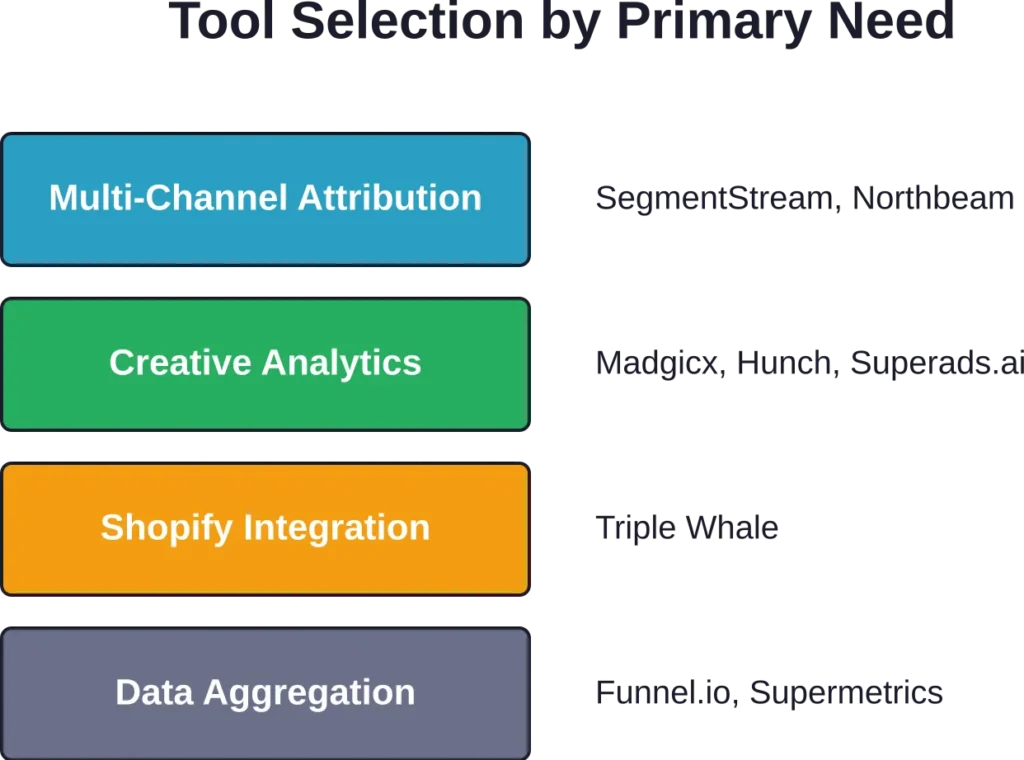
SegmentStream leads for teams running Facebook alongside other channels. The platform recovers conversions lost beyond Meta’s 7-day window, validates Facebook’s impact against other channels, and uses AI-native measurement to optimize across the entire marketing mix.
Core capabilities include custom attribution modeling with multi-model support and incrementality testing. Instead of relying on Meta’s attribution alone, SegmentStream builds models that reflect actual customer journeys, often revealing that Facebook drives 30-40% more conversions than Meta reports.
The platform integrates with measurement partners and data warehouses, pulling in complete revenue data rather than just pixel-tracked conversions. This matters for high-consideration purchases where the decision happens offline or significantly after the last click.
Automated optimization goes beyond Facebook. SegmentStream’s AI analyzes marginal ROAS across all channels, identifying diminishing returns and recommending budget shifts. Teams see exactly where the next $1,000 should go to maximize total revenue, not just Facebook revenue.
Best for: Performance marketing teams managing multi-channel campaigns with budgets above $50K/month who need attribution beyond platform-reported metrics.
Limitations: Pricing targets mid-market and enterprise teams. Smaller brands with simple single-channel setups may not need the sophistication SegmentStream provides.
3. Madgicx
Madgicx specializes in Meta ads management with built-in optimization. The platform analyzes Facebook campaigns and automatically adjusts targeting, budgets, and creative based on performance data.
Starting from $69/month, Madgicx offers accessible pricing for growing e-commerce brands. The tool connects directly to Meta’s API, pulling granular campaign data and applying AI-driven recommendations in real time.
Automated rules go beyond basic threshold alerts. Madgicx identifies audience segments with strong early performance and scales them before competitors saturate the same audiences. It also detects creative fatigue early, recommending refreshes before ROAS deteriorates significantly.
The platform includes audience insights that reveal which interest combinations and lookalike percentages perform best. For brands testing multiple audience hypotheses, this accelerates learning and reduces wasted spend on low-potential segments.
Best for: E-commerce brands and small agencies managing Meta ads with limited manual optimization time, seeking automation that improves efficiency without requiring extensive setup.
Limitations: Focuses exclusively on Meta platforms. Teams running campaigns across TikTok, Google, and other channels need separate tools for those networks.
4. Triple Whale

Triple Whale built its platform specifically for the Shopify ecosystem, integrating deeply with e-commerce data to connect ad spend directly to revenue and customer lifetime value.
The tool pulls data from Facebook ads, Shopify sales, email campaigns, and other marketing channels into a unified dashboard. This shows true ROAS including returning customer revenue, not just first-purchase attribution.
Attribution recovery addresses iOS 14+ tracking losses. Triple Whale uses server-side tracking and probabilistic modeling to recover conversions that Meta’s pixel misses. For Shopify brands, this often increases reported conversions by 20-30%.
Creative analytics within Triple Whale track which products, offers, and ad formats drive the highest lifetime value customers, not just the most conversions. This shifts focus from acquisition cost to customer quality.
Best for: Shopify brands running Facebook ads as a primary acquisition channel, especially those affected by iOS attribution loss and needing clearer revenue visibility.
Limitations: Deeply tied to Shopify. Brands on other e-commerce platforms or using custom storefronts may find integration limited.
5. Northbeam

Northbeam provides multi-touch attribution specifically designed for post-iOS digital marketing. The platform reconstructs customer journeys across paid social, paid search, email, and organic channels.
Attribution models go beyond last-click or even-touch defaults. Northbeam uses machine learning to weight each touchpoint based on its actual influence on conversion probability, creating custom models for each brand’s specific funnel.
Facebook performance gets evaluated in context. The platform shows which other touchpoints Facebook ads work alongside — for example, revealing that Facebook drives awareness while Google Brand Search closes conversions, or that email remarketing amplifies Facebook’s impact.
Reporting automation includes scheduled deliveries and customizable dashboards for stakeholders. Agencies use Northbeam to show clients complete attribution stories rather than fragmentary channel reports.
Best for: DTC brands and agencies managing six-figure monthly ad budgets across multiple paid and owned channels, needing sophisticated attribution that accounts for cross-channel effects.
Limitations: Pricing reflects enterprise positioning. Smaller brands may find the cost prohibitive relative to budget size, and setup requires technical integration with multiple data sources.
6. Funnel.io

Funnel.io functions as a marketing data hub, centralizing data from Facebook, Google, TikTok, affiliate networks, and 500+ other sources into a single warehouse or dashboard.
The platform doesn’t provide attribution modeling or optimization. Instead, it solves the data aggregation problem, ensuring clean, consistent data flows into whatever BI tools or dashboards teams already use.
Data transformation capabilities handle common issues like inconsistent naming conventions, currency conversions, and timezone standardization. This reduces manual cleanup that typically consumes hours each week.
For Facebook specifically, Funnel.io pulls data from Ads Manager, Facebook Page Insights, and Instagram Business accounts, combining them with Google Analytics, CRM data, and offline conversions for complete reporting.
Best for: Marketing operations teams and agencies managing reporting for multiple brands, needing reliable data pipelines rather than additional analysis layers.
Limitations: Requires separate BI or visualization tools. Funnel.io delivers clean data but doesn’t include built-in dashboards or automated insights — teams must build those downstream.
7. Supermetrics
Supermetrics pioneered automated marketing data transfer, connecting advertising platforms to Google Sheets, Excel, Data Studio, Power BI, and similar tools.
For Facebook analytics, Supermetrics pulls Ads Manager data into familiar spreadsheet and dashboard environments. Teams can schedule automatic refreshes, ensuring reports always show current data without manual exports.
Pricing starts at accessible levels for freelancers and small teams. The tool doesn’t require technical setup beyond connecting accounts and selecting metrics, making it approachable for non-technical marketers.
Template libraries include pre-built Facebook report templates for common use cases: campaign performance summaries, audience breakdowns, creative testing dashboards, and budget pacing trackers.
Best for: Solo marketers, freelancers, and small teams comfortable working in spreadsheets or lightweight BI tools, needing automated data transfer without advanced attribution or AI features.
Limitations: No built-in attribution modeling or optimization. Supermetrics delivers raw data; teams must build analysis and insights manually on top of that data.
8. Whatagraph

Whatagraph focuses on automated reporting and client-facing dashboards, designed primarily for marketing agencies managing multiple accounts.
The platform connects to Facebook Ads, Google Analytics, Instagram, and 40+ other data sources, generating visual reports automatically. Templates can be white-labeled with agency branding.
Report scheduling eliminates manual reporting cycles. Agencies set up templates once, then automatically deliver weekly or monthly performance summaries to clients without touching the reports again unless changes are needed.
Cross-channel reporting combines Facebook data with other paid and organic channels in unified dashboards. Clients see their entire digital presence rather than isolated channel reports.
Best for: Marketing agencies and consultants managing multiple client accounts, needing polished, automated client reporting without building custom dashboards for each account.
Limitations: Reporting-focused rather than analysis-focused. Whatagraph doesn’t provide deep attribution modeling, creative insights, or optimization recommendations — just clean, automated reports.
9. Smartly

Smartly operates at enterprise scale, managing creative production, campaign automation, and optimization across Facebook, Instagram, Snapchat, Pinterest, and TikTok.
Creative automation allows teams to generate thousands of ad variations from modular templates, automatically testing combinations of images, headlines, descriptions, and calls-to-action across audience segments.
Predictive budgeting uses historical performance data to allocate spend across campaigns dynamically. Instead of setting static daily budgets, Smartly shifts budget in real time toward high-performing segments and times of day.
The platform includes workflow management for large teams, with approval chains, asset libraries, and role-based permissions. This matters when multiple stakeholders need to review creative or when compliance requires formal sign-offs.
Best for: Enterprise brands and large agencies running high-volume Facebook campaigns with significant creative testing needs and complex approval workflows.
Limitations: Pricing and feature complexity target enterprise users. Small teams find the platform overpowered for their needs, and setup requires dedicated onboarding and training.
10. Hunch

Hunch specializes in creative analytics, using computer vision and AI to analyze which visual elements, messaging styles, and creative patterns drive performance.
The platform tags creative assets automatically — identifying hooks, product placements, color schemes, text overlays, and pacing. This eliminates manual tagging, which becomes impractical once campaigns scale beyond a few dozen variations.
Pattern detection reveals which creative variables correlate with high ROAS. Teams discover insights like “ads with product close-ups in the first 2 seconds generate 40% higher conversion rates” or “green color schemes underperform blue by 18% in this audience.”
These insights transform creative production from guesswork to systematic iteration. Instead of hoping new creative performs well, teams build on proven patterns and test specific hypotheses.
Best for: Performance creative teams running large-scale video ad testing on Facebook, needing systematic creative intelligence to improve win rates and reduce production waste.
Limitations: Focuses exclusively on creative analytics. Teams also need separate tools for attribution, reporting, or multi-channel management — Hunch doesn’t cover those use cases.
11. Superads.ai

Superads.ai applies AI to creative analysis, automatically scoring ad creative and predicting performance before campaigns launch.
Pre-launch scoring uses models trained on thousands of high-performing ads to evaluate new creative. This helps teams prioritize which assets to test first, reducing wasted spend on low-probability winners.
Creative element analysis breaks down which components — hooks, visual styles, messaging angles — contribute most to predicted performance. Teams understand not just whether an ad will perform, but why.
Pricing starts with a free tier, making AI-powered creative analytics accessible even to small teams. Paid tiers from $99/month add deeper analysis and higher usage limits.
Best for: Small to mid-size e-commerce brands and agencies testing Facebook video ads, seeking AI-powered creative guidance without enterprise-level tool complexity or cost.
Limitations: Creative-only focus. Superads.ai doesn’t handle attribution, cross-channel reporting, or budget optimization — it solves one specific problem well rather than attempting full-stack analytics.
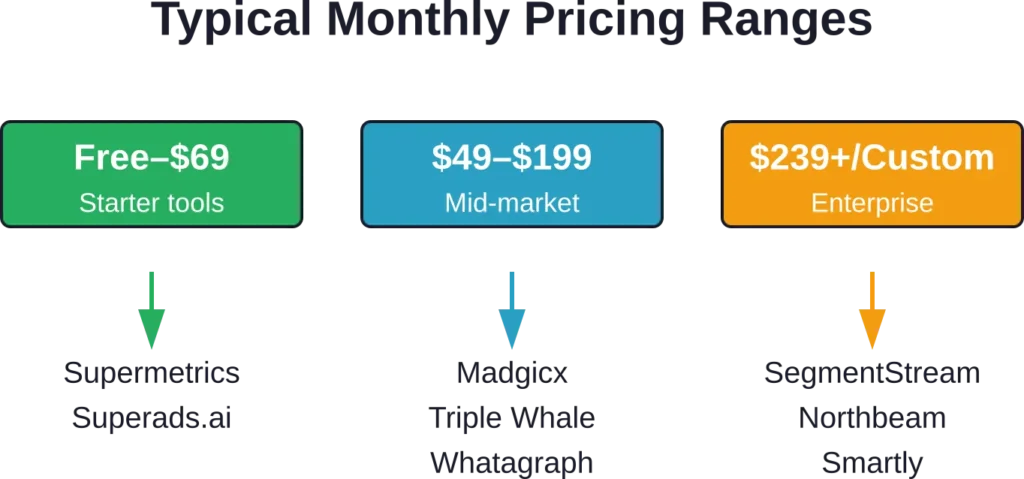
Pricing Comparison: What to Expect
Facebook ads analytics tools span a wide pricing range, from free tiers to enterprise contracts. Understanding typical costs helps teams budget appropriately and avoid sticker shock during tool evaluation.
| Tool | Starting Price | Mid-Tier Price | Best Pricing Fit |
|---|---|---|---|
| SegmentStream | Custom | Custom | Mid-market to enterprise |
| Madgicx | From $69/mo | ~$200+/mo | Small to mid-size brands |
| Triple Whale | From $69/mo | ~$150+/mo | Shopify DTC brands |
| Northbeam | Custom | Custom | Enterprise |
| Funnel.io | Custom | $49–$100/mo typical | Mid-market agencies |
| Supermetrics | Free tier available | $49–$100/mo | Freelancers to small teams |
| Whatagraph | ~$199/mo | ~$299+/mo | Agencies |
| Smartly | Custom | Custom | Enterprise only |
| Hunch | Custom | Custom | Mid-market to enterprise |
| Superads.ai | Free tier available | From $99/mo | Small to mid-size teams |
According to Buffer’s authoritative guide published in May 2026, prices range from free to $239+/month depending on capabilities. Free tiers are offered by Buffer, Social Status, Tailwind, and several other platforms for basic analytics. Mid-market tools typically cost $49–$100/month, while enterprise solutions like Rival IQ start at $239/month.
Tool pricing often correlates with sophistication. Data aggregation tools like Supermetrics offer accessible entry points because they transfer data without adding analysis layers. Attribution platforms and AI-powered optimization tools command higher prices due to the technical complexity and value they deliver.
Usage-based pricing appears in several platforms, scaling costs with ad spend, data volume, or number of connected accounts. This aligns costs with value for growing brands but can create unpredictable expenses as campaigns scale.
Teams should check official websites for current pricing, as subscription tiers and feature availability change frequently. Many vendors offer free trials or demos, allowing hands-on evaluation before committing to annual contracts.
How to Choose the Right Tool for Your Needs
With dozens of options available, tool selection comes down to matching capabilities to specific business requirements. The wrong choice wastes budget on unused features or forces manual workarounds for missing capabilities.
Start with Your Biggest Pain Point
Identify what’s broken or missing in current reporting. Is attribution the problem — do teams lack visibility into which touchpoints actually drive conversions? Is creative production operating blind, without systematic feedback on what works? Is multi-channel reporting consuming too much manual effort?
The primary pain point should drive tool selection. A team struggling with iOS attribution losses needs conversion recovery first, creative analytics second. An agency drowning in manual client reporting needs automation first, advanced attribution second.
Consider Team Size and Technical Capability
Enterprise platforms assume dedicated marketing operations staff and technical integrations. Small teams without data engineers find these tools overwhelming and difficult to implement.
Conversely, simple data transfer tools frustrate sophisticated teams that need custom attribution models or AI-driven optimization. Tool complexity should match team capability and available implementation resources.
Evaluate Single-Channel vs. Multi-Channel Needs
Brands running Facebook as a standalone channel can use Meta-specific tools like Madgicx effectively. But once campaigns span Google, TikTok, Pinterest, and other platforms, single-channel tools create fragmentation.
Multi-channel marketers benefit from unified attribution and reporting platforms that show how channels work together rather than treating each in isolation. This shifts measurement from channel-level ROAS to portfolio-level efficiency.
Match Budget to Value
Tools delivering 5-10% ROAS improvements on $100K monthly ad spend justify $1,000+ monthly software costs. The same tools become expensive overhead for brands spending $5K/month on ads.
Calculate potential value: if better attribution recovers 20% more conversions, and those conversions generate $10K additional monthly revenue, paying $500/month for the tool makes financial sense. If recovered conversions only add $2K monthly revenue, the math doesn’t work.
Check Integration Requirements
Some tools work standalone, others require integration with measurement partners, data warehouses, or specific e-commerce platforms. Verify compatibility with existing tech stacks before committing.
Teams using Shopify should prioritize tools with native Shopify connectors. Brands with custom tech stacks need flexible APIs and webhook support. Agencies managing client data across various platforms need multi-integration capabilities.
Test Before Committing
Most platforms offer free trials or pilot programs. Use them to validate that the tool solves the intended problem and fits into existing workflows.
During trials, evaluate actual implementation difficulty, data accuracy, and whether insights lead to actionable decisions. Impressive demos don’t always translate to useful daily tools.
Real Results: What Analytics Tools Enable
The value of Facebook ads analytics tools shows up in measurable outcomes when implemented effectively. Data from authoritative sources demonstrates the impact.
REMOVE – This specific statistic (101% increase in video views, 79% more impressions, 63% more engagements) does not appear in the Buffer source material provided.
These gains come from systematic optimization enabled by better data. When teams see which creative elements drive results, which audiences respond best, and where diminishing returns appear, they make sharper decisions.
Attribution recovery particularly impacts e-commerce brands affected by iOS privacy changes. Brands implementing server-side tracking and probabilistic modeling through tools like Triple Whale typically recover 20-30% of conversions that Meta’s pixel misses, revealing Facebook’s true contribution to revenue.
Multi-channel attribution shifts budget allocation by revealing cross-channel effects. Performance marketers using platforms like SegmentStream or Northbeam often discover that reallocating 10-15% of budget from saturated channels to underinvested channels improves overall ROAS by 15-25%.
Automated optimization reduces reaction time. Instead of reviewing campaigns weekly and making manual adjustments, AI-powered tools identify performance shifts daily and adjust automatically. This prevents prolonged periods of suboptimal spend and capitalizes on sudden opportunities faster than human review cycles allow.
Creative analytics accelerate learning curves. Teams using tag-level analysis produce winning creative more consistently because they understand which variables matter. This reduces the percentage of tests that fail and improves average creative performance across all campaigns.
The compounding effect matters: a 10% improvement in creative win rate, combined with 15% better attribution and 8% budget efficiency gains, doesn’t add to 33% better performance — it multiplies, often producing 40-50% total ROAS improvement over 6-12 months.
Common Implementation Mistakes to Avoid
Teams frequently encounter problems when implementing Facebook ads analytics tools, most of which are avoidable with proper planning.
Choosing Tools Before Defining Requirements
Selecting software based on feature lists rather than specific needs leads to expensive tools that don’t solve actual problems. Define what success looks like before evaluating options.
Ignoring Data Quality
Analytics tools only work when fed accurate data. Broken pixels, incorrect event tracking, and inconsistent naming conventions produce garbage-in-garbage-out results. Audit data quality before expecting meaningful insights.
Expecting Immediate Results
Most analytics platforms require learning periods to establish baselines, train models, or accumulate enough data for statistical significance. Teams often abandon tools after two weeks when meaningful patterns take 4-6 weeks to emerge.
Over-Relying on Automation
Automated optimization works well within guardrails, but shouldn’t replace strategic thinking. Tools optimize toward the metrics they’re given — if those metrics don’t align with business goals, automation drives the wrong outcomes.
Neglecting Team Training
Sophisticated tools require understanding to use effectively. Teams that skip onboarding and training use 20% of available features and miss insights that better-trained users spot immediately.
Tool Sprawl
Adding multiple overlapping tools creates confusion about which data source to trust. Three different attribution platforms reporting different conversion numbers make decision-making harder, not easier. Consolidate where possible.
The Role of Native Meta Analytics
Despite limitations, Facebook Ads Manager and Meta Business Suite remain essential components of the analytics stack. Third-party tools supplement native reporting rather than replace it entirely.
Ads Manager provides campaign management, real-time spend monitoring, and initial performance signals. Teams still use it daily for campaign setup, audience targeting, and basic optimization.
Meta Business Suite combines Facebook Page Insights, Instagram analytics, and basic cross-platform reporting for organic and paid content. Small businesses managing Meta properties benefit from the unified view without needing third-party tools.
The Ads Library offers transparency into competitor creative, showing what messaging and formats other brands test. This informs creative strategy in ways third-party tools can’t replicate.
Integration matters: the best third-party tools pull data from Meta’s APIs rather than requiring manual exports. This ensures data consistency and reduces administrative overhead.
Teams should use native tools for tactical campaign management and third-party platforms for strategic analysis, attribution, and cross-channel optimization. Each serves distinct purposes in the analytics workflow.
Future Trends in Facebook Ads Analytics
The analytics landscape continues evolving as privacy regulations tighten, AI capabilities advance, and measurement challenges grow more complex.
Privacy-first measurement becomes mandatory as third-party cookies disappear and platform tracking windows shrink further. Tools that rely on deterministic tracking struggle while those using incrementality testing, synthetic control groups, and privacy-preserving analytics gain adoption.
AI-driven optimization expands beyond budget allocation into creative generation, audience discovery, and predictive analytics. Future tools won’t just report what happened — they’ll predict outcomes and prescribe actions with increasing accuracy.
Cross-device and cross-platform attribution improves as measurement partners develop better identity resolution. Understanding how desktop browsing, mobile app engagement, and in-store visits connect to Facebook ads becomes clearer.
Real-time decision-making accelerates. Current tools operate on hourly or daily refresh cycles; emerging platforms process data continuously and adjust campaigns in real time based on streaming analytics.
Consolidation pressure grows. Managing separate tools for creative analytics, attribution, reporting, and optimization creates complexity. Platforms that deliver multiple capabilities within unified workflows gain competitive advantage.
The distinction between analytics and activation blurs. Future platforms won’t just measure performance — they’ll automatically create and launch new campaigns based on discovered patterns, closing the loop from insight to action without human intervention.
Frequently Asked Questions
Facebook Ads Manager shows performance data within Meta’s attribution window and across Meta properties only. Third-party tools provide custom attribution models, conversion recovery beyond Meta’s windows, creative analytics, multi-channel reporting, and automated optimization. Native reporting works for basic campaign management; third-party tools enable strategic measurement and optimization across the full marketing mix.
According to authoritative data from May 2026, Facebook ads analytics tools range from free tiers to $239+/month depending on capabilities. Mid-market tools typically cost $49–$100/month. Enterprise platforms use custom pricing based on ad spend volume, data volume, or number of connected accounts. Match tool cost to potential value — a tool that improves ROAS by 10% on $50K monthly spend justifies $500+ monthly cost.
Better tools implement server-side tracking, probabilistic modeling, and integration with measurement partners to recover conversions Meta’s pixel misses. E-commerce brands using platforms like Triple Whale or SegmentStream typically recover 20-30% of lost conversions. However, no tool recovers 100% of tracking losses — privacy limitations create inherent measurement gaps that estimation models partially address.
Specialized tools often deliver better results in their focus areas. Hunch and Superads.ai provide deeper creative intelligence than general-purpose platforms. SegmentStream and Northbeam offer more sophisticated attribution than creative-focused tools. Some teams use stacked solutions — one tool for attribution, another for creative analytics. Others prefer all-in-one platforms that handle multiple use cases adequately rather than any single use case exceptionally.
Initial setup typically takes 1-2 weeks for data connections and configuration. Meaningful baselines emerge after 2-4 weeks of data collection. Actionable insights usually surface within 4-6 weeks as patterns become statistically significant. Full value realization — when optimizations based on tool insights show measurable ROAS improvement — typically takes 2-3 months. Teams that expect immediate transformation after one week of implementation usually abandon tools prematurely.
The most important feature addresses the biggest performance gap. For brands losing visibility due to iOS tracking limitations, attribution recovery matters most. For teams struggling with creative production efficiency, tag-level creative analytics delivers highest impact. For agencies managing dozens of accounts, reporting automation saves the most time. Evaluate what’s currently broken or missing before prioritizing features — the best tool solves the most painful problem first.
Several tools offer free tiers or low-cost entry points accessible to small businesses. Supermetrics, Superads.ai, and others provide meaningful capabilities starting at $0-99/month. However, tool value correlates with ad spend volume. A business spending $2K monthly on Facebook ads may not see sufficient return from a $500/month analytics platform. Small businesses should start with free or low-cost options, then upgrade as ad spend scales and optimization opportunities justify higher software costs.
Final Recommendations
Choosing Facebook ads analytics tools comes down to matching capabilities with specific team needs, budget constraints, and strategic priorities.
For multi-channel performance marketers managing six-figure monthly budgets, platforms like SegmentStream or Northbeam deliver the attribution sophistication and cross-channel optimization that justify their enterprise pricing. These teams need to understand how Facebook fits within the complete marketing portfolio rather than optimizing it in isolation.
E-commerce brands running primarily Facebook and Instagram ads benefit from Meta-specific platforms like Madgicx or Shopify-integrated tools like Triple Whale. These provide the right depth for single-channel or dual-channel optimization without unnecessary complexity.
Agencies managing multiple client accounts prioritize reporting automation and white-label capabilities. Whatagraph addresses this need directly, while Funnel.io provides the data infrastructure for agencies building custom reporting solutions.
Creative-focused teams testing dozens or hundreds of ad variations gain disproportionate value from specialized creative analytics platforms like Hunch or Superads.ai. These tools transform creative production from art to science, systematically improving win rates.
Small teams and freelancers working within tight budgets should explore free tiers and entry-level options from Supermetrics, Superads.ai, and similar platforms. These deliver meaningful capabilities without requiring enterprise-level investment.
The best approach often involves starting narrow and expanding gradually. Solve the biggest pain point first with a focused tool, validate the value, then consider adding complementary capabilities as needs and budgets grow.
Most importantly, analytics tools only create value when insights drive action. The fanciest attribution model delivers zero return if teams don’t adjust budgets based on findings. The deepest creative intelligence wastes money if production teams don’t iterate based on learnings.
Choose tools that fit workflows, integrate with existing systems, and produce insights that lead to clear next actions. The goal isn’t comprehensive data — it’s better decisions that improve ROAS, reduce wasted spend, and accelerate learning.
Start by auditing current analytics gaps, defining success metrics, and evaluating 2-3 tools that address priority needs. Test thoroughly during trial periods, involve team members who’ll use the tools daily, and verify that implementation effort aligns with expected value.
The right Facebook ads analytics tool transforms scattered metrics into strategic intelligence, revealing opportunities that native reporting misses and enabling optimization that moves revenue meaningfully.