

Quick Summary: ROAS optimization tools for Meta Ads combine AI-powered automation, attribution tracking, creative testing, and budget management to improve campaign returns. Platforms like Extuitive, Madgicx, Revealbot, Triple Whale, and AdRoll offer specialized features ranging from autonomous bid optimization to multi-touch attribution, with pricing from $36 to $500+ monthly depending on ad spend and feature depth.
The average media buyer now manages 47 different campaign variables per Meta ad account. Between audience targeting, creative testing, budget allocation, and placement optimization, the manual workload has reached a breaking point.
What used to take an hour to set up now requires constant monitoring, adjustment, and analysis across multiple campaigns running simultaneously. Manual work that cost $200 per month in inefficiencies back in 2022 now runs advertisers $500+ monthly.
Here’s the thing though—automation isn’t just about saving time anymore. AI-powered ad spend will hit $57 billion in 2026 as brands go all in on automation, according to eMarketer. The platforms pushing hardest on automation are the social networks themselves, and Meta leads that charge.
But automation alone won’t fix poor attribution, creative fatigue, or budget waste. That’s where specialized ROAS optimization tools come in.
What Makes a Strong ROAS Optimization Tool
Not every Facebook ad software qualifies as a true ROAS optimizer. The best platforms share a few core capabilities that separate them from basic campaign managers.
First, they track attribution beyond Meta’s native reporting. With iOS privacy changes and multi-touch customer journeys spanning 7-14 days, accurate attribution has become the foundation of profitable scaling.
Second, they automate decision-making at scale. Rule-based automation lets advertisers create complex logic like “If CPA exceeds $50 for 3 hours, reduce budget by 30%” or “If ROAS is above 4.0 for 24 hours, increase budget by 50%.” These conditional triggers mirror how experienced media buyers think but execute faster than any human can.
Third, they integrate creative performance into optimization. According to eMarketer’s 2026 data: 70% of Gen Z consumers say user-generated content from everyday users is very helpful to their buying journey, and 60% of all consumers consider UGC the most genuine form of advertising. Tools that can test, rotate, and refresh creative based on fatigue signals prevent the performance drop that kills most campaigns.
Top ROAS Optimization Tools for Meta Ads
The market has consolidated around a few key players, each with distinct strengths. Some excel at attribution. Others dominate automation. A handful do both but at premium price points.
Extuitive
Extuitive built its reputation on pre-launch predictive validation for Meta ads using AI consumer simulations. The platform connects to your Shopify store, analyzes historical performance, and uses thousands of modeled consumer profiles (based on real buyer behavior) to forecast which creatives are likely to deliver strong ROAS before any ad spend occurs.
The predictive intelligence layer is where Extuitive stands out. It scores new ad creatives, copy, and concepts for expected CTR and ROAS, filtering out weak performers early. This eliminates most of the expensive “test and learn” phase that burns budget on losers while letting winners scale faster.
Extuitive works best for Shopify DTC brands that run frequent creative testing and want to cut wasted spend on low-potential ads. It’s especially powerful for teams launching 50–200+ creatives per week who need data-driven decisions at the idea stage rather than after days of live testing.
Pricing is custom (typically enterprise-oriented, contact for quote). The platform targets growing e-commerce brands looking for a serious edge in creative efficiency and ROAS predictability.
Contact Information:
- Website: extuitive.com
- Email: [email protected]
- LinkedIn: www.linkedin.com/company/extuitive
- Twitter: x.com/Extuitive_Inc
- Instagram: www.instagram.com/extuitiveinc
Madgicx
Madgicx built its reputation on AI-driven audience targeting and creative insights specifically for Meta ads. The platform analyzes which ad creatives drive the best ROAS across different audience segments, then automatically shifts budgets toward winning combinations.
The creative intelligence layer is where Madgicx shines. It tracks creative fatigue signals and suggests refresh timing before performance drops. For brands running high-volume creative testing, this prevents the common scenario where a winning ad quietly dies while budgets keep flowing.
Madgicx pricing typically starts around $149/month depending on ad spend volume. with tiers based on monthly ad spend. The platform works best for brands spending $10,000+ monthly who need granular creative performance data.
Revealbot

Revealbot focuses entirely on automation rules and bulk campaign management. The platform’s conditional logic system lets advertisers build decision trees that execute 24/7 without manual intervention.
The bulk editing features save hours when managing dozens of ad sets simultaneously. Changes that would take 45 minutes in Meta Ads Manager happen in under two minutes with Revealbot’s interface.
Where this tool shines: complex accounts with 15+ campaigns running simultaneously. The rule builder handles nested conditions like “If ROAS drops below 3.0 AND CPA exceeds $40 AND spend exceeds $200, pause the campaign and send Slack notification.”
Pricing begins at $99/month for accounts spending up to $10,000 monthly, with pricing scaling based on total ad spend.
Triple Whale

Triple Whale consolidates data from Meta, Google, TikTok, and Shopify into unified dashboards focused on profitability metrics. The platform calculates true ROAS by factoring in returns, refunds, and customer lifetime value—not just initial purchase attribution.
For ecommerce brands, this makes a massive difference. Standard Meta reporting shows gross ROAS but doesn’t account for the 15-20% of orders that get returned or the customers who buy once and never return versus those who become repeat purchasers.
Triple Whale’s attribution model tracks customers across devices using first-party data, which has become critical as third-party cookie deprecation expands.
Triple Whale pricing varies based on store revenue and scales with business size.
Hyros
Hyros specializes in multi-touch attribution for businesses running ads across multiple platforms. The system uses AI to assign conversion credit across touchpoints, which matters when customers interact with Meta ads, Google search, email campaigns, and organic content before converting.
Standard last-click attribution models give Meta full credit if someone clicks a Facebook ad right before purchasing, even if they discovered the brand through a Google search three days earlier. Hyros distributes credit proportionally, which reveals the true incremental value of each channel.
This becomes crucial when scaling budgets. Platforms that appear profitable under last-click attribution sometimes show diminishing returns under multi-touch models, preventing wasteful budget increases.
Hyros operates on premium pricing reflecting its enterprise attribution capabilities.
AdRoll

AdRoll combines retargeting capabilities with cross-channel campaign management spanning Meta, TikTok, Pinterest, and over 500 ad exchanges. The platform’s AI bidding engine, BidIQ, processes trillions of intent signals daily to predict the exact value of each impression.
The retargeting focus makes AdRoll particularly effective for ecommerce. About 70% of online shoppers abandon their shopping carts, according to AdRoll research., and AdRoll’s dynamic product ads automatically sync product catalogs to show abandoned items across multiple channels.
AdRoll provides 17 different campaign reports and six attribution models to analyze performance from multiple angles. The 30-day benchmark report covers over 20 industries, letting advertisers compare their ROAS against category averages.
AdRoll offers tiered pricing starting at $36/month for the Marketing & Ads Plus plan, with additional costs based on ad spend and CPM-based pricing for media delivery.
Cometly

Cometly focuses on attribution accuracy for paid social advertisers dealing with complex customer journeys. The platform captures server-side data that Meta’s pixel misses, which has become critical as browser-based tracking degrades.
Setup takes 2-3 hours for most accounts, and the platform provides multi-touch attribution models that adjust automatically as campaigns scale. Cometly pricing begins at $99/month for core attribution features.
Where Cometly differentiates: the platform tracks user behavior beyond conversion events. It monitors which ad interactions lead to newsletter signups, product page visits, and wishlist additions—micro-conversions that predict eventual purchases.
AdEspresso
AdEspresso simplifies A/B testing for Meta ads with visual campaign builders that don’t require technical setup. The platform lets advertisers test dozens of creative variations, audience combinations, and copy approaches simultaneously.
The visual interface appeals to small teams or solo marketers who find Meta Ads Manager overwhelming. AdEspresso abstracts the complexity while still providing granular performance data on what’s working.
Pricing starts at $49/month for basic testing features, with setup taking roughly 15 minutes for new accounts.
Northbeam
Northbeam provides marketing mix modeling alongside attribution tracking. The platform analyzes how different marketing channels interact and influence each other, revealing scenarios where Meta ads drive awareness that leads to Google search conversions days later.
This holistic view prevents the common mistake of cutting budgets from “underperforming” channels that actually drive top-of-funnel awareness measured elsewhere.
Northbeam works best for brands spending $50,000+ monthly across multiple channels. Pricing reflects that positioning, typically starting around $1,000/month.
How AI-Powered Automation Changes Meta Ad Management
Automation has moved from “nice to have” to mandatory infrastructure. The average Facebook advertiser manages 15+ campaigns across multiple audiences, tests 3-5 creative variants per campaign, and tracks attribution across customer journeys spanning 7-14 days.
Doing this manually burns 12-20 hours per week on repetitive tasks. But here’s where it gets interesting: AI automation can significantly reduce manual work while improving campaign performance, though specific improvements vary by platform and account structure.
The automation isn’t just about speed. AI bidding engines analyze patterns human buyers miss. They detect creative fatigue before ROAS drops. They identify audience overlap that wastes budget. They adjust bids based on time-of-day conversion patterns specific to each account.
That said, full automation has limits. Some US consumers express skepticism about AI-generated content in ads, with concerns about authenticity and brand preference. The tension between automation efficiency and human creative judgment hasn’t resolved—it’s just shifted.
Successful media buyers use automation for optimization and monitoring while maintaining creative control over messaging, brand positioning, and strategic direction.
Attribution Tracking Beyond Meta’s Native Reporting
Meta’s attribution window shortened significantly after iOS 14.5 privacy changes. The platform now struggles to track conversions that happen more than 7 days after ad interaction, and cross-device journeys often go unmeasured entirely.
Third-party attribution tools solve this by implementing server-side tracking that doesn’t rely on browser pixels. When someone clicks a Meta ad on their phone, browses the website on their laptop later, then converts on their tablet the next week, Meta’s pixel loses the connection. Server-side tools maintain that thread.
This matters more as purchase cycles lengthen. B2B campaigns regularly see 30-60 day consideration periods. Even ecommerce sees extended journeys for higher-priced items or new-to-brand customers.
Multi-touch attribution distributes conversion credit across touchpoints. According to eMarketer data, multi-touch attribution modeling can significantly improve reported ROAS compared to last-click attribution methods.—substantially higher than the last-click ROAS Meta reported natively.
Creative Performance and Fatigue Management
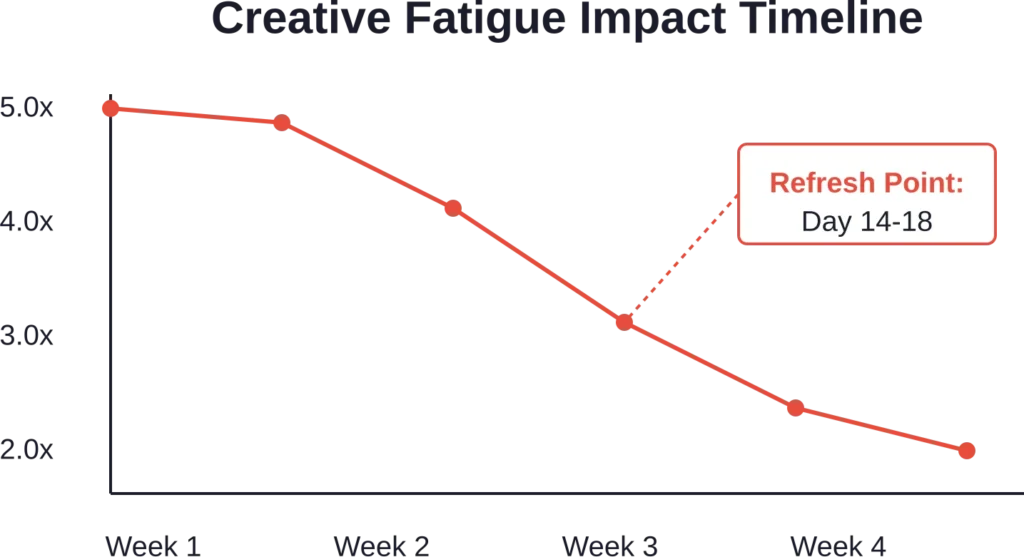
Creative fatigue kills more Meta campaigns than targeting or bidding issues. An ad that delivers 5x ROAS in week one often drops to 2x by week three as the same audiences see it repeatedly.
The best ROAS optimization tools monitor frequency metrics and performance decay, then trigger creative refreshes before the decline accelerates. Some platforms use AI to generate creative variations automatically, though effectiveness varies.
Many marketers worldwide prioritize user-generated content in social media strategies, with less emphasis on AI-generated content alternatives. The data suggests human-created content still outperforms synthetic alternatives for most brands.
Real talk: creative remains the variable most resistant to full automation. Tools can identify what’s working and suggest refresh timing, but generating scroll-stopping creative concepts still requires human insight.
Budget Allocation and Bid Optimization
Manual budget management breaks down once accounts exceed five to seven active campaigns. Advertisers face constant decisions about which campaigns deserve more budget, which need pausing, and which should scale aggressively.
Automated budget allocation tools make these decisions using real-time performance data. They shift spending toward campaigns exceeding ROAS targets while reducing budgets for underperformers.
The key is setting proper thresholds. A campaign that drops to 2.5x ROAS might need pausing if the target is 3.5x, or it might warrant a budget increase if the target is 2x and it’s trending upward.
Most optimization tools let advertisers set ROAS floors, CPA ceilings, and spend limits that govern automated decisions. The platform handles execution, but strategic parameters come from the advertiser.
Pricing Models and Cost Structures
ROAS optimization tools typically charge in one of three ways: flat monthly fees, percentage of ad spend, or hybrid models combining both.
Flat-fee platforms like AdEspresso ($49/month) work well for smaller advertisers testing optimization features. These plans usually cap monthly ad spend—once accounts exceed those limits, percentage-based pricing becomes more economical.
Percentage-of-spend models typically charge 1-5% of monthly media budgets. A brand spending $20,000 monthly might pay $400-1,000 for platform access, which scales proportionally as budgets grow.
Hybrid models combine smaller base fees with usage-based charges. AdRoll starts at $36/month plus CPM-based costs for ad delivery across its network.
The pricing structure matters less than the value equation. A tool that improves ROAS from 2.5x to 3.5x while charging 3% of spend delivers massive net value. The same tool would be overpriced for an advertiser seeing only marginal improvements.
| Tool | Starting Price | Best For | Key Strength |
|---|---|---|---|
| AdRoll | $36/month | Ecommerce retargeting | Cross-channel reach (500+ exchanges) |
| AdEspresso | $49/month | Small teams, A/B testing | Visual interface, fast setup |
| Cometly | $99/month | Attribution accuracy | Server-side tracking |
| Revealbot | $99/month | Automation at scale | Complex rule builder |
| Triple Whale | $129/month | Ecommerce profitability | Returns and LTV tracking |
| Madgicx | $149/month | Creative optimization | Fatigue detection and refresh timing |
| Hyros | $500/month | Multi-channel attribution | AI-powered credit distribution |
Integration Requirements and Technical Setup
Setup complexity varies dramatically across platforms. Some tools connect via OAuth in under 10 minutes. Others require custom pixel implementation, server-side tracking configuration, and data warehouse integration taking several hours or days.
Most ROAS optimization tools integrate with Meta’s Marketing API, which provides programmatic access to campaign data and management functions. This standard integration handles basic features like performance reporting, budget adjustments, and campaign creation.
Advanced features like cross-device attribution or custom conversion tracking require additional implementation. Server-side tracking needs developer involvement to send conversion events from the advertiser’s server rather than relying solely on browser pixels.
AdRoll offers 12 API integrations connecting with major marketing stack components. Semrush’s Ads Launch Assistant provides campaign reporting across both Google and Meta within a unified interface.
Technical requirements scale with feature sophistication. Basic automation and reporting work with simple integrations. Multi-touch attribution and cross-platform tracking need more infrastructure.
Data Privacy and Tracking Changes
Cookie deprecation and privacy regulations have fundamentally altered how attribution works. Third-party cookies that powered retargeting for years are disappearing. Browser tracking faces increasing restrictions. Users opt out of tracking at higher rates.
First-party data has become the foundation of sustainable attribution. Tools that help advertisers collect and activate their own customer data—email addresses, purchase histories, browsing behavior on owned properties—deliver more reliable results than those depending on third-party signals.
Server-side tracking bypasses many browser-level restrictions by sending conversion data directly from the advertiser’s server to ad platforms. This maintains attribution accuracy even when browser pixels fail.
The shift favors platforms with robust first-party data infrastructure. AdRoll maintains 4.5 billion cross-device identifiers built from first-party sources. Triple Whale connects directly to Shopify stores to track conversion data that never touches a browser.
Comparing Performance Across ROAS Tools
Direct performance comparisons are tricky because tools serve different functions. Attribution platforms, automation tools, and creative testing solutions optimize different parts of the funnel.
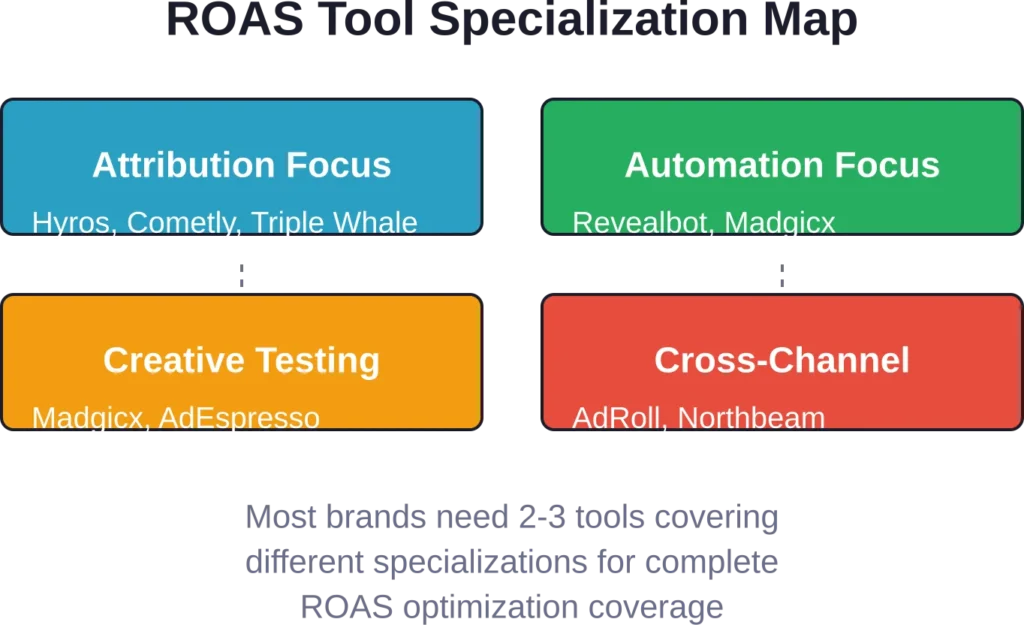
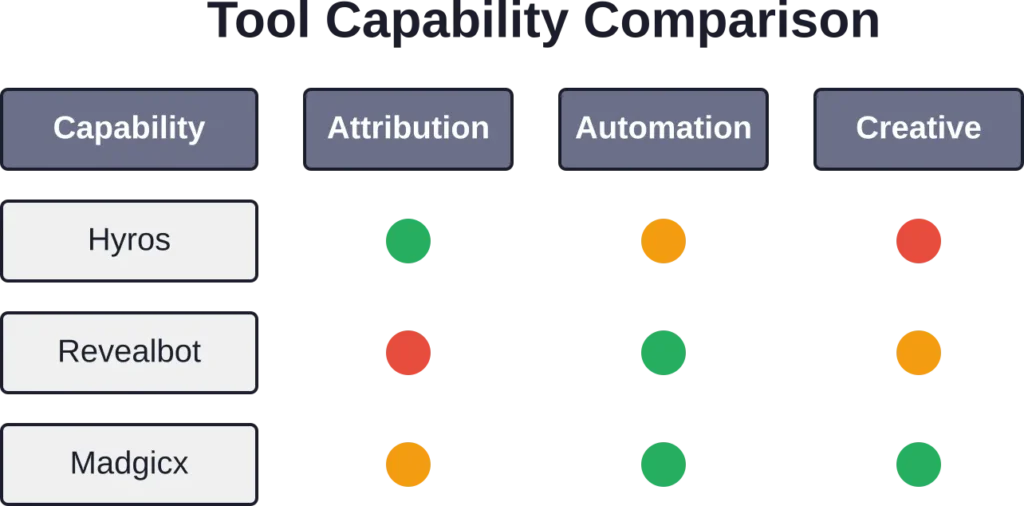
The strongest setups combine multiple tools. A typical high-performing stack might include:
- Attribution platform (Hyros or Cometly) for accurate conversion tracking
- Automation tool (Revealbot or Madgicx) for budget and bid management
- Creative testing platform (AdEspresso or Madgicx) for identifying winning ads
- Analytics dashboard (Triple Whale) for profitability analysis
Running multiple tools increases costs but delivers compound benefits. Accurate attribution from one platform feeds better automation decisions in another. Creative insights improve what gets tested. Budget optimization scales what works.
Solo tools work for focused needs. A brand struggling specifically with creative fatigue might only need Madgicx. An advertiser confident in creative but drowning in manual campaign management might only need Revealbot.
Choosing the Right Tool for Your Ad Account
The best ROAS optimization tool depends on current pain points, monthly ad spend, team size, and technical resources.
For accounts spending under $5,000 monthly, start with single-purpose tools addressing the biggest bottleneck. If attribution is the issue, Cometly at $99/month delivers strong value. If manual campaign management consumes too much time, AdEspresso’s testing automation costs $49/month.
Mid-market advertisers spending $10,000-50,000 monthly typically benefit from combining attribution and automation tools. The incremental cost pays for itself through improved ROAS and recovered time.
Enterprise accounts above $50,000 monthly should evaluate comprehensive platforms or multi-tool stacks. At this scale, a 0.5x ROAS improvement generates enough incremental revenue to justify premium tooling costs.
Technical capability matters. Server-side attribution requires developer support for proper implementation. Brands without technical resources should prioritize tools with simpler pixel-based tracking.
Team structure influences tool selection. Solo marketers need different features than five-person teams. Tools with strong collaboration features, role-based permissions, and approval workflows become valuable as team size grows.
Common Mistakes When Implementing ROAS Tools
The biggest mistake is expecting tools to fix strategic problems. Optimization platforms amplify what’s already working—they don’t create winning campaigns from failing ones.
A campaign with poor creative, misaligned targeting, and unappealing offers won’t suddenly succeed because an automation tool manages its budget. The tool will just pause it faster or waste less money determining it doesn’t work.
Over-automation is another common trap. Handing full control to AI without setting proper guardrails leads to budget waste when the system makes decisions that contradict business logic. Successful automation requires clear parameters: minimum ROAS targets, maximum CPA limits, daily spend caps, and strategic priorities the algorithm can’t determine independently.
Ignoring creative refresh kills long-term performance. Automation can’t save campaigns suffering from creative fatigue. The tools can detect the problem, but humans need to produce new creative assets.
Mismatched attribution windows create false insights. Comparing 7-day click attribution from Meta against 30-day multi-touch attribution from a third-party tool generates contradictory data that makes optimization decisions harder, not easier.
FAQ
Meta Ads Manager provides basic campaign creation, targeting, and reporting. ROAS optimization tools add advanced attribution tracking, automated bid and budget management, creative fatigue detection, cross-channel reporting, and rule-based optimization that executes decisions 24/7 without manual intervention. They essentially automate and enhance what experienced media buyers do manually in Ads Manager.
Pricing ranges from $36/month for basic features (AdRoll’s starter plan) to $500+/month for enterprise attribution platforms like Hyros. Most tools use tiered pricing based on monthly ad spend. For accounts spending $10,000-25,000 monthly, expect to budget $100-300/month for optimization tools. Larger accounts spending $50,000+ may invest $500-2,000 monthly across multiple specialized platforms.
Tools like AdEspresso ($49/month) and Cometly ($99/month) work for smaller budgets, though the relative cost percentage is higher. The question is whether the tool solves a specific problem costing more than the subscription fee. If manual campaign management burns 5+ hours weekly, a $50-100/month tool that recovers that time delivers positive ROI even at lower ad spend levels.
Basic implementations using OAuth connections and standard pixel tracking require no technical resources—most marketers handle setup independently in 10-30 minutes. Advanced features like server-side tracking, custom conversion events, and data warehouse integration typically need developer support. Check each tool’s documentation to understand technical requirements before committing.
Initial data collection typically takes 7-14 days as tools gather baseline performance data. Meaningful ROAS improvements usually appear within 21-45 days once the system has enough data to make confident optimization decisions. Attribution tools may show immediate differences in reported ROAS simply by tracking conversions Meta’s pixel missed, though actual campaign performance improvements take longer.
Absolutely. Many successful advertisers run 2-4 tools serving different functions: one for attribution, another for automation, a third for creative testing. The key is ensuring they don’t conflict—for example, running two automation tools that both adjust budgets simultaneously could create chaos. Use each tool for its specific strength rather than overlapping features.
Track net ROAS (revenue minus ad spend and tool costs divided by total costs), time saved on manual campaign management, attribution accuracy improvements, creative refresh frequency, and budget allocation efficiency. Compare performance in 30-day windows before and after implementation. Remember that seasonal factors and creative quality changes also impact results, so isolate the tool’s contribution carefully.
Conclusion
ROAS optimization for Meta ads has moved far beyond manual campaign management. The 47 variables that modern advertisers juggle require specialized tools that automate decisions, track attribution accurately, and prevent creative fatigue before it impacts performance.
No single tool dominates every category. Attribution specialists like Hyros and Cometly excel at tracking conversions Meta misses. Automation platforms like Revealbot and Madgicx handle the repetitive optimization decisions that burn hours weekly. Creative-focused tools identify fatigue and suggest refresh timing.
The strongest approach combines 2-3 specialized tools rather than searching for one platform that does everything adequately. Start with the biggest bottleneck—attribution confusion, manual management overload, or creative fatigue—and add capabilities from there.
Looking at the data, 78% of marketers consider UGC important to social strategies while AI ad spend hit $57 billion in 2026. The future clearly sits at the intersection of human creative insight and automated optimization execution.
Ready to improve your Meta ads performance? Identify your current biggest challenge—tracking, automation, or creative—then evaluate tools specialized in solving that specific problem