

Quick Summary: Several specialized tools scrape competitor Facebook ads from the Meta Ad Library, including dedicated platforms like BigSpy, Foreplay, and AdSpy that automate creative downloads and trend tracking. Most scraping tools operate in a legal gray area since they rely on browser automation rather than official APIs, though scraping publicly visible ad data itself isn’t inherently illegal. API-native alternatives like adlibrary.com avoid scraping risks entirely by using official Meta partnerships while still delivering competitive intelligence.
Running Facebook ads without checking what competitors already tested is like navigating with your eyes closed. The Meta Ad Library contains millions of active campaigns—but manually browsing through it wastes hours that could go toward actually launching ads.
That’s where Facebook ad scraping tools come in. They automate competitor research, pull creative at scale, and surface trends before manual research ever could.
But here’s the catch: not all scraping tools work the same way. Some break when Meta changes its layout. Others risk Terms of Service violations. A handful skip scraping entirely and use official APIs instead.
This guide breaks down the top tools available in 2026, how they work, what they cost, and which legal considerations matter before you commit to a platform.
Predictive Ad Intelligence with Extuitive
While scraping competitor data provides a look at what others have done, Extuitive offers a more direct approach by predicting how audiences will react to ads in real-time. The platform uses AI models to simulate the behavior of over one hundred thousand real consumers, allowing brands to skip manual competitive research and go straight to high-performing creatives. Instead of guessing which competitor strategies to copy, businesses can validate their own ads and target segments with data-backed accuracy.
- Eliminates the need for manual competitive analysis by simulating audience responses.
- Forecasts click-through rates and ROAS before launching campaigns.
- Identifies winning audience segments using behavioral AI models.
- Tests creative variations rapidly to find the most effective messaging.
- Connects with Shopify to instantly transform product data into validated ads.
Book a demo or start a subscription to scale Meta campaigns with precision using Extuitive.
What Facebook Ad Library Scraping Actually Means
The Meta Ad Library is a public transparency database. Anyone can visit it and see active ads from any advertiser across Facebook, Instagram, Messenger, and Audience Network. Meta built it to comply with political advertising regulations—but it’s equally useful for competitive intelligence.
Scraping refers to automated data extraction. Instead of manually clicking through pages, a scraper visits the library programmatically, collects ad creative URLs, headlines, descriptions, run dates, and targeting hints, then stores everything in a structured format for analysis.
Most tools rely on browser automation or API endpoints that Meta doesn’t officially support for third-party scraping. A few newer platforms use legitimate Meta partnerships instead, which eliminates the fragility and compliance gray area.
Legal Considerations Around Scraping Public Websites
Community discussions suggest scraping publicly visible data isn’t inherently illegal in most jurisdictions. The Ninth Circuit Court of Appeals ruled in hiQ v. LinkedIn that the Computer Fraud and Abuse Act likely does not bar scraping data from a public website against the wishes of the website owner, reiterating that ruling after the Supreme Court decided Van Buren v. United States.
That said, Terms of Service are a separate matter. Meta’s ToS restricts automated access that doesn’t use official APIs. Violating ToS isn’t typically a criminal matter, but it can lead to account bans or service termination if detected. Ethical competitive intelligence practices emphasize transparency and adherence to provider guidelines.
According to BYU Scholars Archive, competitive intelligence is systematic and ethical when it involves gathering information about competitor activities through legitimate means. Industrial espionage—wiretapping, office burglaries, stealing proprietary data—crosses into illegality. Scraping public ad data sits somewhere in between: legal in the data-access sense, but potentially against platform terms.
How Facebook Ad Scrapers Collect Competitor Data
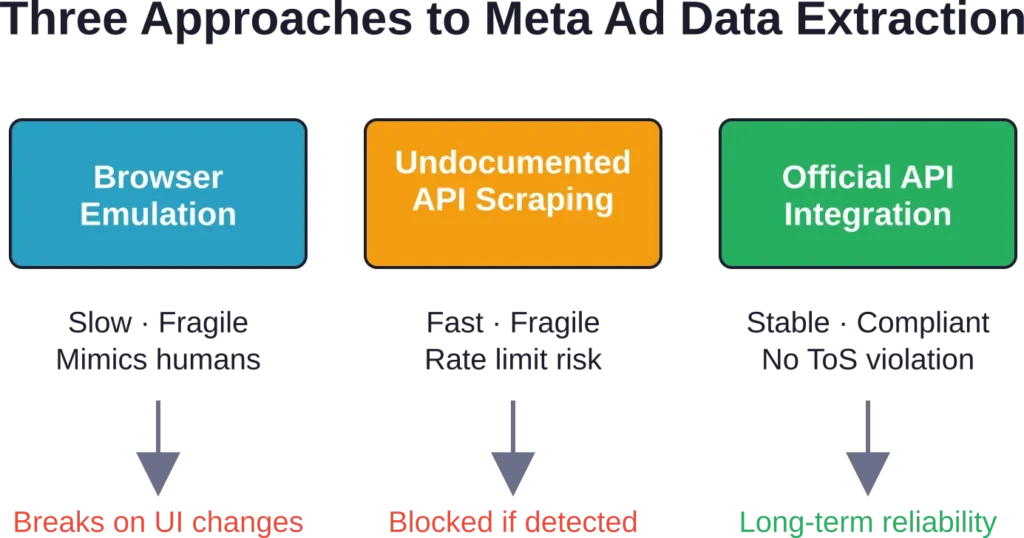
Tools use one of three approaches: browser emulation, direct scraping of undocumented endpoints, or official API integration.
Browser emulation tools like Apify run a headless Chrome instance that mimics human browsing. They load the Ad Library page, scroll, click filters, and capture the rendered HTML. This method works without reverse-engineering APIs, but it’s slow and breaks whenever Meta updates the DOM structure.
Undocumented API scraping involves tools sending HTTP requests directly to Meta’s internal endpoints—endpoints that power the Ad Library frontend but aren’t officially documented for third-party use. This is faster than browser emulation but equally fragile and more likely to trigger rate limits or blocks.
API-native platforms partner with Meta or use official Graph API endpoints where available. These tools don’t scrape at all. They request data through legitimate channels, which means better uptime, no ToS risk, and fewer maintenance headaches when Meta rolls out changes.
Top Facebook Ad Library Scraping Tools in 2026
The market splits into dedicated ad intelligence platforms and general-purpose scraping services. Below are the tools that consistently rank for performance, reliability, and feature depth.
BigSpy
BigSpy scrapes ads from Facebook, Instagram, Twitter, YouTube, and Pinterest. It claims to index over 100 million ads and refreshes data daily. The interface lets users filter by country, ad type, CTA, and engagement metrics.
One limitation: BigSpy doesn’t provide precise spend estimates, only rough engagement signals. The search can feel cluttered with older or inactive ads if filters aren’t tightened.
Pricing starts at a low entry tier. Higher tiers unlock historical data, bulk downloads, and advanced filters.
Foreplay

Foreplay targets performance marketers who need a swipe file of winning creatives. It combines scraping with manual curation—users can save ads to boards, tag them by hook or angle, and share collections with team members.
The tool excels at organizing creative inspiration rather than raw data analysis. Spend estimates and detailed targeting insights are minimal compared to more analytics-heavy platforms.
Pricing information suggests plans start around $49/month, with higher tiers adding collaborative features and larger storage quotas.
AdSpy
AdSpy built its reputation in the affiliate and e-commerce space. It indexes Facebook and Instagram ads with deep filtering: by affiliate network, landing page technology, ad copy keywords, even specific emojis in the headline.
The database is large but updates can lag by a few days. AdSpy also skews toward direct-response verticals—brand campaigns and B2B ads are less represented.
AdSpy offers paid plans without a free tier, but the platform offers a five-day trial for $1.
PowerAdSpy
PowerAdSpy covers Facebook, Instagram, YouTube, and Google Display Network. Its standout feature is demographic breakdown estimates—age, gender, device—pulled from public engagement patterns.
The interface is straightforward but dated compared to newer tools. Bulk export options exist, though CSV formatting sometimes requires cleanup before importing into other analytics tools.
PowerAdSpy offers tiered plans with annual discount options
Minea

Minea focuses on e-commerce and dropshipping. It scrapes product ads and connects them to supplier databases like AliExpress, showing estimated margins alongside creative performance.
If you’re running Shopify stores, Minea’s product-first approach saves time. For service businesses or lead gen, the tool offers less value since product-centric filters dominate the UI.
Minea offers tiered pricing plans, with Pro and higher tiers unlocking additional search volume and export limits.
Apify Facebook Ad Library Scraper

Apify is a general web scraping platform that offers a pre-built actor for the Meta Ad Library. It runs in the cloud, requires no local setup, and can be scheduled to run daily or weekly.
The trade-off: Apify is more technical. Users need to understand JSON output and how to configure selectors. When Meta updates the Ad Library DOM, the scraper breaks until Apify or the community updates the actor code.
Apify charges based on compute usage. Small scraping jobs cost a few dollars per month; large-scale daily scrapes can run $50+ depending on volume.
adlibrary (API-Native Alternative)
Unlike scraping tools, adlibrary.com integrates directly with Meta’s official systems. It provides estimated spend ranges, bulk creative downloads, and search filters without relying on browser automation or undocumented endpoints.
Because it’s API-native, adlibrary doesn’t face the fragility issues that plague scrapers. Updates to Meta’s public site don’t break functionality. There’s also no ToS risk since data access happens through legitimate channels.
The platform offers a free tier with limited searches. Paid plans scale based on usage volume, with transparent pricing published on the website.
| Tool | Data Method | Spend Signals | Starting Price | ToS Risk |
|---|---|---|---|---|
| BigSpy | Scraping | Estimated | $9/mo | Medium |
| Foreplay | Scraping + Curation | No | ~$49/mo | Medium |
| AdSpy | Scraping | No | $149/mo | Medium |
| PowerAdSpy | Scraping | Estimated | ~$49/mo | Medium |
| Minea | Scraping | Yes | ~$49/mo | Medium |
| Apify | Browser Emulation | No | Usage-based | Medium |
| adlibrary | API-native | Estimated range | Free tier + paid | None |
Key Features That Matter in an Ad Scraping Tool
Not all features carry equal weight. Here’s what actually moves the needle when evaluating platforms.
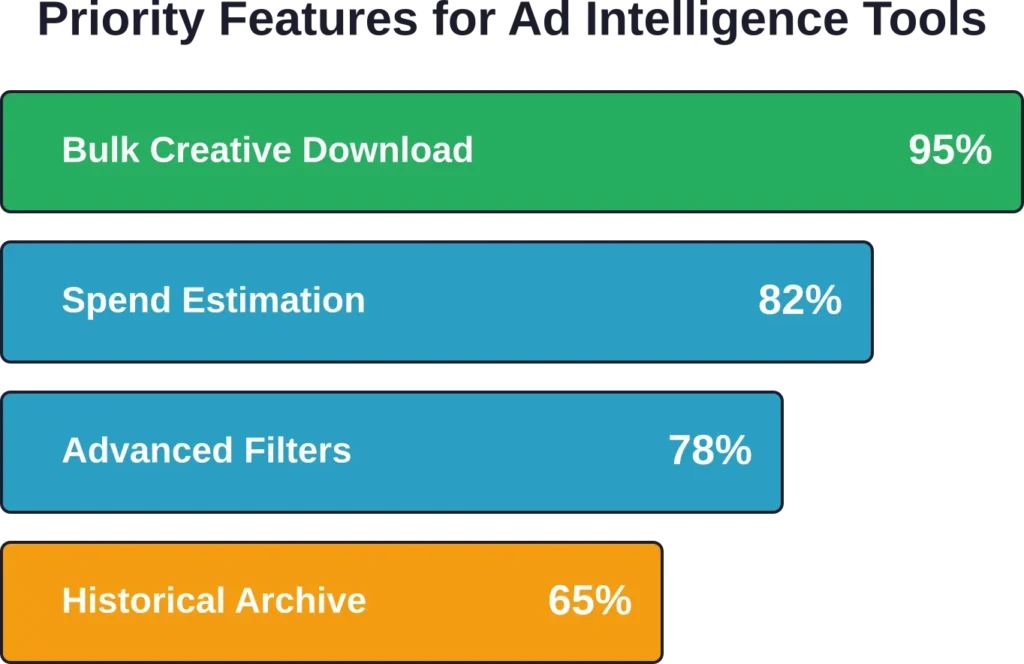
Creative Download and Organization
Manual right-clicking to save images gets old fast. Tools that offer bulk download—images, videos, carousels—save hours. Bonus points if they preserve metadata like upload date and format.
Organization matters too. Tagging, folders, and shareable boards make it easier to collaborate with designers and media buyers.
Spend Estimation and Performance Signals
Meta doesn’t publish exact ad spend in the public library. Tools infer estimates using signals like ad longevity, impression range disclosures (for political ads), and engagement velocity.
These estimates aren’t perfect, but they help separate experimental tests from proven winners. A campaign running for six months straight with multiple creatives likely performs better than a three-day test that vanished.
Search and Filter Flexibility
Generic keyword search is table stakes. Advanced filtering separates good tools from great ones: filter by CTA button, ad format (video vs. carousel vs. image), date range, geography, landing page domain, even specific text patterns in the headline.
The more granular the filters, the faster users find relevant examples without wading through noise.
Historical Data and Trend Tracking
Seeing what’s active today is useful. Seeing what ran last month, last quarter, or last year reveals seasonal patterns, creative fatigue, and long-term strategy shifts.
Some tools archive ads even after they stop running. Others only show active campaigns, which limits historical analysis.
API Access and Export Options
For teams with internal analytics workflows, API access or CSV/JSON exports are essential. Manually copying data from a web UI doesn’t scale.
Check export limits carefully. Some tools cap exports at 100 rows per day on lower-tier plans, which constrains larger research projects.
When to Use a Scraper vs. Manual Research
Scraping shines when research volume is high or when tracking dozens of competitors over time. Manual browsing works fine for one-off checks or small verticals with few advertisers.
Consider a scraper if any of these apply: monitoring more than five competitors regularly, needing creative archives for trend analysis, working with a team that needs shared access to ad libraries, or building internal dashboards that aggregate competitive data.
Stick with manual research if budgets are tight, ad volume in the niche is low, or if compliance and ToS concerns outweigh efficiency gains. The Meta Ad Library itself is free and reasonably functional for small-scale use.
Ethical and Compliance Considerations
Academic sources on competitive intelligence emphasize that ethical CI involves collecting information through legitimate, transparent means. According to research from Brigham Young University, responsible competitive intelligence is systematic, legal, and avoids industrial espionage tactics like wiretapping or stealing proprietary data.
Scraping public ad data sits in a gray zone. The data itself is public—Meta publishes it for transparency. The method of access is where questions arise. Using undocumented endpoints or automating access in ways that violate Terms of Service crosses into ethically questionable territory even if it’s not outright illegal.
The FTC has emphasized in recent guidance on AI and data practices that companies must uphold privacy and confidentiality commitments. While this guidance targets AI training data, the principle applies broadly: data collection methods should respect platform rules and user expectations.
For research development and institutional settings, as outlined by scholars at the University of South Florida and University of Wisconsin-Madison, competitive intelligence should be conducted transparently with clear policies on data use, storage, and sharing. This approach reduces legal risk and aligns with broader ethical standards in business intelligence.
Alternatives to Scraping: API-Native Competitive Intelligence
API-native platforms eliminate scraping risks by partnering directly with Meta or using officially supported data access methods. These tools request ad data through legitimate channels, which means no browser automation, no reverse-engineered endpoints, and no ToS violations.
The trade-off used to be limited data availability—official APIs historically provided less than what scraping could pull. That gap has narrowed. Modern API-native tools now offer bulk creative downloads, estimated spend ranges, and filtering options comparable to scrapers, all while maintaining long-term stability.
For agencies and enterprises where compliance matters, API-native tools reduce legal risk and eliminate the maintenance burden of fixing scrapers every time Meta updates its frontend.
Pricing and Budget Considerations
Tool costs vary widely. Entry-level plans vary by platform but often impose strict limits on searches, exports, or historical data access. Mid-tier plans vary by platform and unlock most core features suitable for solo practitioners or small teams.
Enterprise and agency tiers reach $149/month and higher, offering unlimited searches, API access, white-label options, and priority support. Usage-based platforms like Apify bill by compute time rather than fixed subscriptions, which can be more cost-effective for sporadic use or highly cost-prohibitive for continuous monitoring.
When evaluating cost, factor in hidden limits: export caps, user seat restrictions, storage quotas, and whether historical data costs extra. A cheaper plan with a 50-export-per-day cap may cost more in wasted time than a pricier unlimited plan.
How to Choose the Right Tool for Your Needs
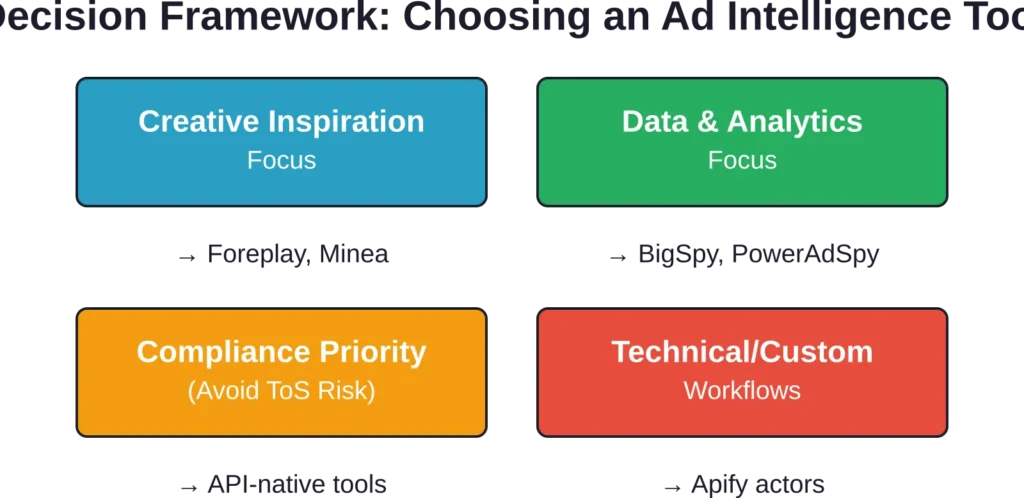
Start by defining use cases. Are you building a swipe file of creative inspiration, conducting quarterly competitive audits, or feeding data into internal BI dashboards?
Creative-focused teams benefit most from tools with strong organization features—boards, tagging, sharing. Minea, Foreplay, and similar platforms prioritize this workflow.
Data-heavy analysis requires robust export, filtering, and historical archives. BigSpy, PowerAdSpy, and API-native platforms fit here.
Compliance-sensitive organizations—agencies handling client data, publicly traded companies, or teams in regulated industries—should prioritize API-native tools to avoid ToS and legal gray areas.
Budget and team size matter too. Solo founders or bootstrapped startups can start with free tiers or low-cost plans. Agencies managing multiple clients need multi-user access, white-label options, and scalable pricing.
Implementing Competitor Ad Research Into Your Workflow
Tools only matter if insights actually inform campaign decisions. Here’s how to integrate competitive research into a repeatable workflow.
Set a weekly or biweekly cadence for ad audits. Pick five to ten direct competitors and review new ads, creative refreshes, and messaging shifts. Document patterns: Are competitors testing more video? Switching from product-focused to benefit-focused copy? Running seasonal promotions earlier than last year?
Create a shared swipe file or board where team members save standout examples. Tag ads by hook type, visual style, CTA, or offer structure. Over time this becomes a searchable library of proven concepts.
Feed insights into creative briefs. If three competitors are testing user-generated content styles and running those ads for months, that’s a signal worth exploring. If nobody in the space uses carousel ads, test one—it might be an untapped format.
Track spend patterns when tools provide estimates. Sudden increases suggest a winning campaign scaling. Budget cuts or ad pauses might indicate poor performance or seasonal pullback.
Pair ad research with landing page analysis. Many scraping tools show destination URLs. Visit those pages, screenshot them, and analyze offer structure, form length, and conversion elements. The full funnel matters—not just the ad creative.
Common Pitfalls and How to Avoid Them
Relying too heavily on one competitor’s strategy is risky. What works for a brand with 10x your budget or an established email list might flop when replicated at smaller scale. Use competitive research for inspiration and validation, not direct copying.
Ignoring your own data in favor of competitor signals is another mistake. Just because a competitor runs an ad for three months doesn’t guarantee it’s profitable. They might be testing, building awareness at a loss, or operating under different unit economics. Always validate externally sourced insights against internal performance data.
Scraper maintenance is a hidden cost. Browser-based tools break when platforms update. Budget time for troubleshooting or choose API-native alternatives that offload that burden.
Over-indexing on creative while ignoring targeting and offer structure skews analysis. An ad’s success depends on audience fit, offer strength, and funnel design—not just the visual or headline. Scraping tools show creative easily but rarely reveal full targeting parameters or backend funnel details.
Frequently Asked Questions
Scraping publicly visible data from the Meta Ad Library is not inherently illegal under U.S. law. The Ninth Circuit ruled in hiQ v. LinkedIn that accessing public website data doesn’t violate the Computer Fraud and Abuse Act. However, Meta’s Terms of Service restrict automated access that doesn’t use official APIs, so scraping may violate ToS even if it’s not a criminal matter. API-native tools avoid this issue by using legitimate data channels.
No. Meta does not publish exact spend figures in the public Ad Library except for certain political ads, which show spending ranges. Tools estimate spend using signals like ad longevity, engagement velocity, and impression disclosures when available. These estimates help identify high-performing campaigns but are not precise budget figures.
Meta can theoretically ban accounts or IP addresses that violate Terms of Service through aggressive automated access. In practice, most scraping tools operate by accessing the public Ad Library without requiring user login, which reduces direct account risk. API-native platforms eliminate this risk entirely since they use official data access methods that comply with Meta’s policies.
The native Meta Ad Library is free and publicly accessible but requires manual browsing and offers limited filtering, no bulk downloads, and no historical archives once ads stop running. Scraping tools automate data collection, provide advanced filters, organize results, estimate spend, and archive ads for long-term trend analysis. API-native tools offer similar automation and features but use official integrations instead of scraping.
Minea and Foreplay are popular among e-commerce brands because they focus on product ads and creative organization. Minea connects ads to supplier databases and shows estimated product margins, making it especially useful for dropshipping. BigSpy and PowerAdSpy also work well for e-commerce due to broad ad coverage and engagement filtering. API-native tools like adlibrary suit brands prioritizing compliance alongside competitive research.
Weekly or biweekly scraping is sufficient for most use cases. Daily scraping generates too much noise unless monitoring a highly dynamic vertical like political campaigns or flash-sale e-commerce. Monthly reviews miss short-term tests and creative iteration cycles. Set a cadence that matches campaign planning cycles—if creative gets refreshed every two weeks, audit competitors on the same schedule.
The native Meta Ad Library is the primary free option, though it requires manual effort and lacks automation. Some tools like adlibrary offer free tiers with limited search volume. Apify charges based on usage, so light scraping jobs cost only a few dollars per month. For ongoing research at scale, paid tools deliver better ROI by saving time and providing richer data, but casual users can start with free options and upgrade as needs grow.
Conclusion
Facebook ad scraping tools automate what would otherwise take hours of manual research, surfacing competitor creative, spend patterns, and messaging trends at scale. The right tool depends on priorities—creative inspiration, data analysis, compliance, or technical flexibility.
Scraping-based platforms dominate the market but carry fragility and ToS risks. API-native alternatives offer stability and compliance at the cost of slightly fewer historical archives or niche filtering options, though that gap continues to narrow in 2026.
Whichever approach fits your needs, integrate insights into a repeatable workflow. Competitive intelligence only delivers value when it informs creative briefs, media planning, and strategic decisions. Start with a tool that matches your budget and use case, track what competitors actually do rather than what they say, and validate external signals against internal performance data.
Ready to level up your Facebook ad strategy? Pick a tool from the list above, run your first competitor audit this week, and start building a swipe file of winning creative that your team can reference every time a new campaign launches.