

Quick Summary: The best AI content marketing software in 2026 includes Extuitive for ad, Semrush Content Toolkit for SEO-optimized content creation, ChatGPT for versatile writing assistance, Jasper for brand-aligned content at scale, and specialized tools like Grammarly for editing and Lumen5 for video content. These platforms combine generative AI capabilities with workflow automation, helping marketing teams produce high-quality content faster while maintaining brand voice and optimizing for both traditional search and emerging AI-powered discovery channels.
Content marketing teams face a fundamental challenge in 2026: produce more content, faster, without sacrificing quality or brand consistency. According to Duke’s Fuqua School of Business CMO Survey, marketing leaders reported integrating artificial intelligence into marketing, saying it has had a positive impact.
The numbers tell a compelling story. Research on generative AI adoption indicates that marketing teams are increasingly embedding AI into daily marketing practice, with practitioners reporting significant productivity gains from AI integration.
But here’s the thing—not all AI content marketing software delivers equal value. Some excel at long-form blog content but struggle with social posts. Others generate ideas brilliantly yet produce generic output that needs heavy editing.
This guide breaks down 16 AI content marketing platforms tested across real marketing workflows. The focus? Tools that actually improve content ROI, not just tools with “AI” slapped on the marketing page.
What Defines AI Content Marketing Software in 2026
AI content marketing software has evolved far beyond simple text generators. Modern platforms integrate multiple capabilities that address the full content lifecycle.
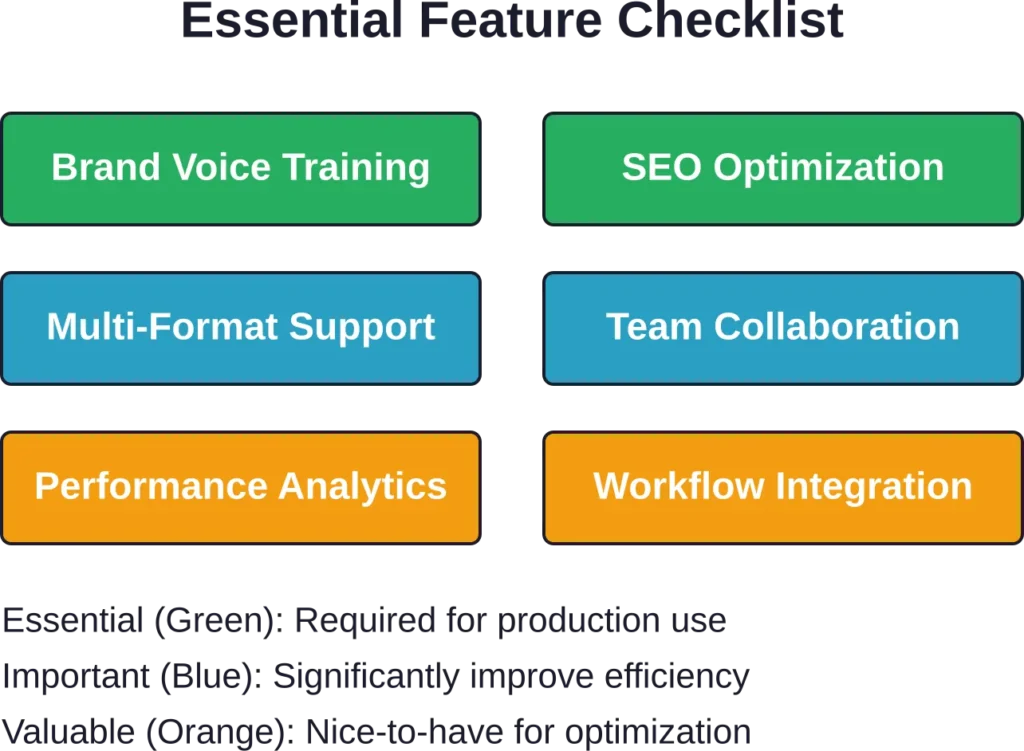
At minimum, effective AI content marketing software should handle content ideation, draft generation, optimization for search and discovery, and performance analytics. The best platforms add collaboration features, brand voice training, multi-format support, and integration with existing marketing stacks.
Real talk: the “AI” label gets thrown around loosely. Tools with basic templates or autocomplete don’t cut it anymore. Look for platforms that use large language models (LLMs) for generation, offer fine-tuning or brand training, and provide optimization features for both traditional SEO and emerging AI search platforms.
The shift toward conversational search built into Google and Bing changes content requirements. According to Gartner’s 2024 Magic Quadrant for Content Marketing Platforms, suite-based offerings now include database insights on content performance to drive asset optimization across multiple discovery channels.
The 16 Best AI Content Marketing Software Platforms
Each platform below has been evaluated based on core content creation capabilities, optimization features, ease of use, pricing transparency, and integration options. The rankings prioritize tools that deliver measurable content performance improvements.
1. Extuitive
Extuitive is an AI-powered creative engine that generates ad copy, images, videos, and full creative briefs while predicting real-world performance before launch. The platform connects directly to Shopify stores, analyzes products, and uses over 150,000 AI-modeled consumers to simulate audience reactions with high accuracy.
What sets Extuitive apart is its unique pre-launch validation system — it doesn’t just create content, but forecasts CTR, purchase intent, and ROAS by testing hundreds of variations against behavioral models trained on real consumer data. This eliminates guesswork and wasted ad spend that plagues most content marketing workflows.
Teams can generate dozens of high-potential creatives in minutes, see predicted performance scores, and launch only the strongest ones. It bridges generative AI with predictive intelligence in one seamless platform.
Best for: Shopify brands and ecommerce teams focused on high-ROI advertising content who want to create and validate marketing assets at scale without expensive testing cycles.
Pricing: Starter at $1,000/month (or $10k/year), Professional at $2,500/month (or $25k/year), Enterprise with custom billing.
Contact Information:
- Website: extuitive.com
- Email: [email protected]
- LinkedIn: www.linkedin.com/company/extuitive
- Twitter: x.com/Extuitive_Inc
- Instagram: www.instagram.com/extuitiveinc
2. Semrush Content Toolkit

Semrush Content Toolkit combines AI-powered writing assistance with comprehensive SEO optimization. The platform analyzes competitor content, identifies ranking opportunities, and guides writers toward search-optimized output.
What sets Semrush apart is the tight integration between content creation and competitive intelligence. Teams can identify content gaps, generate SEO briefs, draft articles with AI assistance, and track rankings—all within one platform.
The AI Visibility Toolkit, launched as an add-on, specifically addresses optimization for AI-powered search engines and citation sources. At $99/month, it tracks how content appears in AI-generated summaries and provides recommendations for improving visibility in these new discovery channels.
Best for: Organizations that prioritize search visibility and need integrated competitive research alongside content creation.
Pricing: Pro plan starts at $129.95/month, Business at $249.95/month. The AI Visibility Toolkit is an additional $99/month.
3. ChatGPT

ChatGPT remains the most versatile general-purpose AI writing tool available. The conversational interface handles everything from blog outlines to social media captions, email drafts to product descriptions.
The Plus and Pro tiers add meaningful capabilities. GPT-4 provides better reasoning and context retention for complex content briefs. Custom GPTs allow teams to create specialized assistants trained on brand guidelines, product information, or specific content formats.
But wait. ChatGPT’s flexibility is also its weakness for production content workflows. There’s no built-in SEO optimization, no content calendar integration, no version control. Teams serious about content marketing typically use ChatGPT for ideation and first drafts, then move to specialized tools for optimization and publishing.
Best for: Teams needing flexible AI writing assistance across multiple content formats without heavy workflow requirements.
Pricing: Plus at $20/month, Pro at $200/month, Business at $30/user/month, Enterprise with custom pricing.
4. Jasper

Jasper positions itself as the enterprise AI content platform, emphasizing brand voice consistency and team collaboration. The platform trains on company style guides, past content, and brand assets to generate output that matches existing content.
Teams can create brand-specific templates for recurring content types—product announcements, thought leadership articles, case studies. The collaboration features support content workflows with review stages, feedback loops, and approval processes.
Jasper’s browser extension brings AI writing assistance into existing tools. Draft LinkedIn posts, polish email copy, or generate ad variations without switching applications.
The downside? Jasper optimizes for brand consistency over search optimization. Teams focused on organic discovery typically pair Jasper with dedicated SEO tools.
Best for: Enterprise marketing teams that need brand-aligned content at scale with robust collaboration features.
Pricing: Creator plan starts at $39/month for individual users, Teams at $99/month, Business with custom pricing for larger organizations.
5. Lumen5

Lumen5 transforms text content into video automatically. The platform analyzes blog posts or scripts, identifies key points, matches relevant stock footage, adds text overlays, and generates social-ready video content.
Video content drives engagement, but production traditionally requires specialized skills and tools. Lumen5 democratizes video creation for marketing teams without video editors on staff.
The AI handles scene selection, timing, and basic editing. Teams customize brand colors, fonts, logos, and music. The output quality works well for social media, email newsletters, and blog embeds, though it won’t replace professionally produced video for high-stakes campaigns.
Best for: Marketing teams that need to repurpose written content into video format without dedicated video production resources.
Pricing: Basic at $29/month, Starter at $79/month, Pro at $199/month.
6. Copy.ai

Copy.ai specializes in short-form content generation—ad copy, social media posts, product descriptions, email subject lines. The platform offers templates for dozens of content formats, each optimized for specific marketing channels.
The workflow is straightforward: select a template, provide context about the product or campaign, and receive multiple variations. Teams can quickly generate dozens of headline options or ad variations for testing.
Copy.ai added long-form content features and a “Workflows” tool that chains multiple AI tasks together. Create a blog outline, expand each section, generate meta descriptions, and draft social promotion posts in a single automated sequence.
Best for: Marketing teams focused on high-volume short-form content creation and ad copy testing.
Pricing: Pro plan starts at $49/month, custom pricing for larger teams.
7. Writesonic

Writesonic combines content generation with built-in SEO analysis and competitive research. The platform analyzes top-ranking content for target keywords, identifies common elements, and guides content creation toward ranking factors.
The article writer generates full blog posts from keywords or outlines. The output includes suggested images, meta descriptions, and internal linking opportunities. Quality varies—some articles need substantial editing, while others require only light polish.
Writesonic’s newer features include an AI chatbot builder and image generation capabilities, expanding beyond pure content creation into broader marketing applications.
Best for: Small marketing teams that need integrated content creation and SEO guidance in a single affordable platform.
Pricing: Individual plans start around $15/month, with business tiers scaling based on word count needs.
8. Frase

Frase takes a research-first approach to content optimization. The platform analyzes search results for target keywords, extracts common topics and questions, and builds content briefs that guide writers toward comprehensive coverage.
The AI writing features generate sections based on the brief, though many teams use Frase primarily for research and optimization rather than generation. The outline builder and topic clustering features help identify content gaps and plan content strategy.
Frase integrates with Google Search Console and Google Docs, fitting into existing content workflows. The optimization score updates in real-time as writers add content, showing how well the draft covers important topics compared to ranking competitors.
Best for: Content teams that prioritize thorough topic coverage and SEO optimization over pure generation speed.
Pricing: Solo plan at $15/month, Basic at $45/month, Team at $115/month.
9. MarketMuse

MarketMuse uses AI to analyze content inventory and identify opportunities for improvement or expansion. The platform builds topic models showing how comprehensively existing content covers relevant subjects compared to competitors.
Rather than focusing on keyword rankings, MarketMuse emphasizes topical authority. The platform suggests new content to create, existing content to update, and topics to cover more thoroughly across the content portfolio.
The AI-generated content briefs are exceptionally detailed, often running several pages with specific subtopics, questions to answer, and related concepts to include. This depth makes MarketMuse valuable for complex, authoritative content but potentially overwhelming for straightforward blog posts.
Best for: Enterprise content teams building comprehensive topical authority in specific subject areas.
Pricing: Standard plan at $149/month, premium tiers with custom pricing based on content volume.
10. Surfer SEO

Surfer SEO combines content optimization with AI writing assistance. The platform analyzes ranking content for target keywords, providing specific recommendations on word count, keyword usage, headings, and structure.
The content editor shows real-time optimization scores as writers work. Green means well-optimized, red indicates areas needing attention. The specificity helps: rather than “use this keyword more,” Surfer suggests “add 2-3 more mentions of ‘content marketing software’ in H2 headings.”
Surfer’s AI writing feature generates content sections optimized for the target keyword, though output quality varies. Most teams use it for outlines and first drafts rather than final copy.
Best for: SEO-focused content teams that want detailed optimization guidance with integrated writing assistance.
Pricing: Essential at $89/month, Scale at $219/month, Enterprise with custom pricing.
11. Anyword

Anyword focuses on performance-driven copy, using AI trained on marketing data to predict which messages will resonate with specific audiences. The platform generates variations of ad copy, landing page headlines, and email subject lines, each with a predicted performance score.
The performance prediction model is trained on billions of marketing messages and their actual conversion data. While predictions aren’t perfect, they provide useful directional guidance for prioritizing which variations to test.
Anyword integrates with major ad platforms and email marketing tools, allowing performance data to feed back into the AI model. Over time, the system learns which messaging patterns work best for specific audiences and channels.
Best for: Performance marketers running paid campaigns who need high-volume copy testing and optimization.
Pricing: Starter at $49/month, Data-Driven at $99/month, Business with custom pricing.
12. Clearscope

Clearscope provides content optimization focused on comprehensive topic coverage. The platform analyzes top-ranking content, identifies important terms and concepts, and grades content based on how thoroughly it addresses the topic.
The interface is clean and focused. Paste in content, select a target keyword, and receive a list of relevant terms to include naturally throughout the piece. The grade updates in real-time as terms are added.
Clearscope doesn’t generate content—it optimizes what writers create. This makes it popular with teams that have strong writers but want to ensure content covers topics comprehensively enough to rank.
Best for: Content teams with skilled writers who need optimization guidance without AI generation.
Pricing: Essentials at $189/month, Business at $399/month, Enterprise with custom pricing.
13. Notion AI

Notion AI integrates writing assistance directly into Notion’s workspace platform. Teams already using Notion for content planning, project management, or knowledge bases get AI features without switching tools.
The AI can generate content, summarize notes, translate text, adjust tone, or continue writing from partial drafts. The integration with Notion databases means AI can reference existing content, meeting notes, or research stored in the workspace.
Notion AI works best for teams that already use Notion heavily. The writing features are less specialized than dedicated content marketing platforms, but the seamless integration with existing workflows creates real productivity gains.
Best for: Marketing teams that use Notion as their primary workspace and want integrated AI writing assistance.
Pricing: $10/member/month added to existing Notion plans.
14. Claude (Anthropic)

Claude offers an alternative to ChatGPT with some distinct advantages for content marketers. The context window—how much text Claude can process at once—is substantially larger, making it better suited for analyzing long documents or working with extensive brand guidelines.
Claude tends toward more nuanced, carefully reasoned output. For content requiring balanced analysis or handling of complex topics, Claude often produces more thoughtful first drafts than other AI writing tools.
The conversational interface is similar to ChatGPT. Teams use Claude for research, outlining, drafting, and editing tasks. Like ChatGPT, Claude lacks built-in SEO optimization or publishing workflow features.
Best for: Content teams working with complex topics that require nuanced analysis and large context windows.
Pricing: Free tier available, Pro at $20/month for priority access and higher usage limits.
15. Wordtune

Wordtune functions as an AI rewriting tool that offers alternative phrasings for sentences and paragraphs. Select text, click Wordtune, and receive multiple ways to express the same idea with different tones, lengths, or emphasis.
The tool excels at making content more concise, more casual, or more formal. It’s particularly useful for non-native English speakers or anyone who struggles with varied sentence structure.
Wordtune added generative features that create content from prompts, though its strength remains rewriting and editing. The browser extension works across email, documents, and web forms.
Best for: Writers who need help with phrasing variety, tone adjustment, and making content more concise or engaging.
Pricing: Free plan with limited features, Plus at $9.99/month, Unlimited at $14.99/month.
16. Grammarly

Grammarly has evolved from a grammar checker into a comprehensive AI writing assistant. The platform now offers tone adjustments, clarity improvements, engagement optimization, and generative writing features.
What makes Grammarly valuable for content marketing? It works everywhere. The browser extension, desktop apps, and integrations mean every piece of content—emails, social posts, blog drafts, ad copy—gets the same quality check.
The generative AI features added in 2024 handle common writing tasks: email replies, paragraph expansion, tone shifts. But Grammarly shines brightest as an editing layer on top of other content creation tools, catching errors and improving clarity before publication.
Best for: Teams that want consistent quality across all written content with minimal friction in existing workflows.
Pricing: Pro at $30/member/month, Enterprise with custom pricing and advanced security features.
Key Features That Matter in AI Content Marketing Software
Not all features deliver equal value. Based on testing across marketing workflows, these capabilities consistently drive better content outcomes.
Content Quality and Brand Voice
Generic AI output stands out—and not in a good way. The best platforms offer brand training, style customization, or fine-tuning that makes generated content sound like it came from a human team member.
Look for tools that allow uploading existing content samples, defining tone guidelines, or creating custom templates. The investment in setup pays off through content that needs less editing before publication.
SEO and Discovery Optimization
Content that doesn’t get found doesn’t generate results. Platforms with built-in keyword research, competitor analysis, and optimization guidance help content rank in search results.
The emerging requirement? Optimization for AI-powered search and citation sources. Tools like Semrush’s AI Visibility Toolkit specifically track and optimize for how content appears in AI-generated summaries and recommendations.
Multi-Format Support
Modern content marketing spans blog posts, social media, email, video scripts, ad copy, and more. Tools that handle multiple formats reduce context switching and maintain consistent messaging across channels.
Some platforms specialize deeply in one format—and that’s fine if it matches workflow needs. Teams producing primarily blog content don’t need robust video features. But most marketing operations benefit from at least some multi-format flexibility.
Collaboration and Workflow
Content rarely flows from draft to publication without reviews, edits, and approvals. Platforms with built-in collaboration features—comments, version history, approval workflows—reduce friction in team processes.
Integration with existing tools matters too. If the team uses Google Docs for drafting, Slack for communication, and WordPress for publishing, smooth integrations prevent manual copy-paste steps that waste time and introduce errors.
Analytics and Performance Tracking
Creating content is one thing. Understanding what works is another. Tools that track content performance—rankings, traffic, engagement, conversions—enable data-driven optimization.
The best platforms close the loop between creation and performance. Generate content, publish, track results, feed performance data back into the AI to improve future output.
How Marketers Are Actually Using AI for Content
Theory is one thing. Real-world application is another. Data from Duke’s Fuqua School of Business shows that 50% of marketing leaders use AI for content personalization and creation, with another 50% applying it to blogs, websites, social media, and email content.
The adoption pattern reveals how teams integrate AI into workflows rather than replacing human marketers entirely.
Content Ideation and Research
AI excels at generating ideas quickly. Teams use tools like ChatGPT or Claude to brainstorm blog topics, identify content angles, research competitor approaches, and outline article structures.
The time savings are substantial. What once took hours of research and whiteboard sessions now happens in minutes. Quality still matters—AI-generated ideas need evaluation and filtering—but the volume of options accelerates planning.
First Draft Generation
Most teams use AI to create first drafts rather than final copy. The AI handles the blank page problem, generating content that covers key points and follows basic structure.
Human editors then refine the output: adding unique insights, adjusting tone, incorporating brand voice, updating with current data, and ensuring accuracy. This collaborative approach produces better results than either AI or humans working alone.
Content Optimization and Repurposing
Existing content represents substantial investment. AI tools help maximize that investment by optimizing content for search, updating outdated information, and repurposing content across formats.
Turn blog posts into social media threads. Convert webinar transcripts into articles. Generate email sequences from whitepapers. The AI handles format transformation while humans ensure key messages stay intact.
Personalization at Scale
Generic content underperforms. But creating personalized versions manually doesn’t scale. AI bridges this gap by generating content variations for different audience segments, industries, or use cases.
The same core message adapts to speak directly to enterprise buyers versus small business owners, technical users versus business stakeholders, different geographic markets with cultural nuances.
Performance Analysis and Iteration
AI analytics tools track content performance across metrics—rankings, traffic, engagement, conversions. More sophisticated platforms identify patterns: which topics resonate, what formats drive action, which distribution channels deliver results.
Research on generative AI adoption highlights how agentic AI workflows operate continuously, with specialized agents monitoring metrics autonomously. One example described an agent noticing a 15% drop in sign-ups, triggering analysis and recommendations without human prompting.
Pricing Models and Budget Planning
AI content marketing software pricing varies widely based on features, scale, and business model. Understanding common pricing structures helps teams budget appropriately.
Subscription Tiers
Most platforms offer tiered monthly subscriptions. Entry-level plans typically range from $15 to $50/month for individuals or small teams. Mid-tier plans run $100 to $250/month with expanded features and higher usage limits. Enterprise tiers start around $500/month with custom pricing based on team size and needs.
Common limitations on lower tiers include monthly word counts, number of users, available features, and integration options. Teams should calculate expected usage to avoid tier hopping or overage charges.
Usage-Based Pricing
Some platforms charge based on consumption—words generated, credits consumed, API calls made. This model offers flexibility for variable workloads but requires monitoring to prevent unexpected costs.
ChatGPT’s pricing illustrates this well: Plus at $20/month provides generous but capped usage, while Pro at $200/month removes most limitations for power users.
Add-On Features
Core platforms often offer specialized capabilities as paid add-ons. Semrush’s AI Visibility Toolkit at $99/month supplements the base Content Toolkit. These add-ons let teams customize their stack without paying for unnecessary features.
True Cost Considerations
Software subscription costs are obvious. Hidden costs matter too: implementation time, training requirements, integration development, workflow adjustments. Factor these into total cost of ownership.
The productivity gains from effective AI content marketing software typically justify costs quickly. Duke’s Fuqua School research found AI delivers a 7.2% reduction in marketing overhead costs alongside productivity improvements.
Integration and Technical Requirements
AI content marketing software doesn’t exist in isolation. Integration with existing marketing technology stacks determines real-world usability.
Content Management Systems
Direct integration with WordPress, HubSpot, Contentful, or other CMS platforms streamlines publishing. Create content in the AI tool, push directly to CMS with formatting intact, schedule publication—all without copy-paste steps.
Look for tools with native integrations or robust APIs that support custom connections. Browser extensions offer a middle ground, bringing AI features into existing interfaces.
SEO and Analytics Platforms
Integration with Google Search Console, Google Analytics, and SEO tools closes the feedback loop. Track how AI-generated content performs, identify successful patterns, adjust strategy based on data.
Platforms like Semrush bundle content creation with analytics. Standalone tools should integrate cleanly with existing analytics infrastructure.
Collaboration Tools
Teams use Slack, Microsoft Teams, Asana, Monday, or other collaboration platforms. AI tools that integrate with these systems fit naturally into existing workflows.
Notion AI exemplifies tight integration—AI features work directly in the workspace teams already use. Grammarly achieves similar results through browser extensions and app integrations.
Marketing Automation and CRM
For teams using marketing automation platforms or CRM systems, integration enables personalized content at scale. Generate email sequences, ad variations, or landing page copy that pulls data from CRM records.
Enterprise platforms typically offer more robust integration options, though they come with higher price tags and implementation complexity.
Potential Pitfalls and How to Avoid Them
AI content marketing software delivers substantial value when used effectively. But common mistakes undermine results.
Publishing Unedited AI Output
AI-generated content needs human review. Accuracy issues, generic phrasing, outdated information, and logical gaps appear regularly in AI output. Teams that publish without editing damage credibility and waste the investment in content creation.
Treat AI output as first drafts requiring editorial attention. Verify facts, add unique insights, inject brand personality, and ensure content delivers genuine value to readers.
Ignoring Brand Voice
Generic AI content sounds like generic AI content. Readers notice. Search engines increasingly detect and potentially downrank obviously AI-generated material.
Invest time in brand voice training for AI tools that offer it. Create detailed style guides. Generate custom templates. The setup effort pays dividends through content that sounds authentically human.
Neglecting SEO Fundamentals
AI writing tools don’t automatically produce SEO-optimized content. Strategic keyword targeting, proper heading structure, internal linking, and comprehensive topic coverage still require intentional effort.
Use AI tools that integrate SEO guidance, or pair generative AI with optimization platforms. The combination of AI generation speed and SEO best practices drives better organic visibility.
Overlooking Quality Checks
AI makes mistakes. It confidently states incorrect facts, misinterprets context, and occasionally generates nonsensical content. Speed gains disappear when errors slip through and require post-publication corrections.
Implement review processes. Use tools like Grammarly for grammar and clarity checks. Verify factual claims against authoritative sources. Test content with small audiences before broad distribution.
Tool Sprawl and Integration Gaps
Adding too many specialized tools creates integration nightmares and workflow friction. Every additional platform requires logins, learning curves, and context switching.
Start with one or two core platforms that handle primary needs. Add specialized tools only when clear gaps exist and integration paths are solid. A smaller, well-integrated stack outperforms a sprawling collection of disconnected tools.
The Future: Where AI Content Marketing Is Heading
The pace of AI advancement shows no signs of slowing. Several trends are reshaping content marketing further.
Agentic Workflows and Autonomous Optimization
Current AI tools require human direction for each task. Emerging agentic systems coordinate multiple AI agents that work together with minimal human intervention.
Research on generative AI adoption describes systems where one agent monitors campaign metrics, another analyzes audience behavior, and a third adjusts content strategy—all autonomously. The 15% sign-up drop example triggered automatic diagnosis and recommended fixes without waiting for human analysis.
AI-Powered Search and Discovery
Conversational search in Google, Bing, ChatGPT, and other platforms changes content optimization requirements. According to Gartner’s 2024 Magic Quadrant analysis, content platforms now need database insights on performance across AI-powered discovery channels, not just traditional search.
Content that appears in AI-generated summaries, gets cited by conversational assistants, or surfaces in AI-curated feeds reaches audiences differently than traditional search results. Optimization strategies must adapt.
Deeper Personalization
AI enables content personalization beyond basic segmentation. Future systems will generate unique content variations for individual users based on behavior patterns, preferences, and context.
The technical capability exists now. Adoption awaits better tools for managing personalization at scale without overwhelming content teams.
Multimodal Content Generation
Current AI tools largely specialize in text, images, or video separately. Emerging multimodal systems generate coordinated content across formats simultaneously—text with matching images, video scripts with visual storyboards, interactive content combining multiple media types.
This integration simplifies workflows and ensures consistency across formats, but requires substantially more computing resources than single-format generation.
Better Quality and Accuracy
AI models continue improving rapidly. GPT-4 outperforms GPT-3.5 noticeably. Future models will generate more accurate, nuanced, and contextually appropriate content with less hallucination and fewer factual errors.
But human oversight remains essential. The goal isn’t replacing human marketers—it’s augmenting capabilities to produce more content at higher quality than either humans or AI achieve alone.

Frequently Asked Questions
The best AI content marketing tool depends on specific needs. Semrush Content Toolkit excels for SEO-focused content with integrated competitive research. ChatGPT offers the most versatile writing assistance across formats. Jasper leads for brand consistency at enterprise scale. Teams should evaluate tools based on primary use cases, existing technology stack, and budget constraints rather than looking for a single “best” option.
Pricing ranges from $15/month for basic individual plans to $500+/month for enterprise platforms. Mid-range options like Semrush Pro start at $129.95/month, while versatile tools like ChatGPT Plus cost $20/month. Most platforms offer tiered pricing based on usage limits, team size, and feature access. Enterprise implementations with custom integrations and support typically require custom pricing negotiations.
AI-generated content can rank in Google search when it provides genuine value, demonstrates expertise, and follows SEO best practices. Google’s guidelines focus on content quality and user value rather than how content is created. However, generic AI output that lacks unique insights or merely rehashes existing information typically underperforms. Successful ranking requires human oversight, fact verification, optimization, and adding original analysis to AI-generated drafts.
Human writers remain essential even with AI content tools. AI handles initial drafts, ideation, research, and format transformation effectively, but humans add strategic thinking, unique insights, brand voice, fact verification, and quality control. The most effective approach combines AI speed and scale with human creativity and judgment. Research shows many marketers using generative AI report significant productivity improvements, suggesting AI augments rather than replaces human capabilities.
Start by identifying primary content needs: long-form blog posts, social media content, video scripts, ad copy, or multi-format coverage. Evaluate whether SEO optimization, brand voice training, or team collaboration features matter most. Test free trials or entry-level plans before committing to expensive tiers. Check integration capabilities with existing tools. Consider total cost including implementation time and training requirements, not just subscription fees.
AI writing assistants like ChatGPT or Claude focus on text generation with conversational interfaces but lack specialized marketing features. Content marketing platforms combine AI generation with SEO optimization, competitive research, content planning, collaboration tools, and performance analytics. Writing assistants work well for ideation and drafts; platforms support complete content workflows from planning through publication and measurement. Many teams use both: writing assistants for flexibility, platforms for production content.
AI-generated content accuracy varies by model, prompt quality, and topic complexity. Modern large language models produce generally accurate content but regularly include factual errors, outdated information, or logical inconsistencies. AI can confidently state incorrect information—a phenomenon called hallucination. Every piece of AI-generated content requires human fact-checking before publication. Tools trained on proprietary data or connected to current information sources tend toward higher accuracy than general-purpose models.
Making the Right Choice for Your Team
Selecting AI content marketing software requires matching platform capabilities to team needs, workflow realities, and budget constraints.
Teams focused primarily on organic search visibility benefit most from platforms with integrated SEO features—Semrush, Surfer SEO, Frase. Organizations prioritizing brand consistency across large content volumes should evaluate Jasper or similar enterprise-focused platforms with custom training capabilities.
Small teams or individual marketers often find the most value in versatile, affordable options like ChatGPT Plus combined with specialized tools for specific gaps. The $20/month base covers most writing needs, with targeted additions for SEO optimization or video creation as budgets allow.
Enterprise organizations typically need platforms with robust collaboration features, advanced integrations, and dedicated support. The higher costs justify themselves through efficiency gains across larger teams.
The implementation approach matters as much as platform selection. Start with clear use cases—which content types take the most time, where quality bottlenecks exist, what manual tasks consume resources. Pilot AI tools on specific content workflows before rolling out broadly. Measure results objectively: time saved, content volume produced, performance metrics, quality scores.
Training determines success. AI tools with shallow learning curves deliver value faster, but even simple platforms require team members to understand capabilities, limitations, and best practices. Invest in training upfront to avoid the frustration of powerful tools used ineffectively.
The AI content marketing landscape will continue evolving rapidly. Platforms add features constantly, new tools launch regularly, and best practices shift as models improve. Build flexibility into tooling decisions rather than committing rigidly to single platforms. Monitor emerging capabilities and be willing to adapt as better options appear.
Current data demonstrates the value proposition clearly: many marketers have integrated AI into processes, with practitioners reporting significant productivity improvements and widespread adoption of generative AI tools. The question isn’t whether to adopt AI content marketing software—it’s which platforms fit specific needs best and how to implement them effectively.
The platforms covered in this guide represent proven options with track records of delivering results. Test those aligned with primary content needs. Measure outcomes rigorously. Adjust based on data rather than assumptions. AI content marketing software delivers substantial value when matched appropriately to team workflows and used with clear processes for quality control and optimization.
Start with one or two core platforms. Master them thoroughly. Add specialized tools as specific gaps become clear. The goal isn’t building the largest tool collection—it’s creating a streamlined content engine that produces higher quality output at greater scale than previously possible.