

Quick Summary: AI email marketing tools use artificial intelligence to automate campaign creation, personalize content, optimize send times, and improve engagement metrics. These platforms help marketers save time, boost conversion rates, and deliver more relevant messages to subscribers through features like predictive analytics, automated copywriting, and intelligent segmentation.
Email marketing remains one of the most effective channels for reaching customers in 2026. But the pressure to deliver personalized, timely messages at scale has never been higher.
That’s where artificial intelligence comes in. AI email marketing tools handle the heavy lifting—from writing subject lines to predicting optimal send times—so marketing teams can focus on strategy rather than execution.
The numbers tell the story. According to HubSpot research, 54% of marketers report saving 1–5 hours a week thanks to AI in email marketing, while 31% save 6–10 hours.
Here’s the thing though—not all AI email marketing tools are created equal. Some excel at copywriting, others at analytics, and a few do it all. This guide breaks down the landscape so teams can find the right fit for their needs.
What AI Email Marketing Tools Actually Do
AI email marketing platforms use machine learning algorithms to automate and optimize various aspects of email campaigns. These tools analyze data patterns, customer behavior, and engagement metrics to make intelligent decisions that traditionally required manual effort.
The core capabilities fall into several categories. Content generation tools write subject lines, preview text, and email copy based on brand voice and campaign goals. Personalization engines tailor messages to individual subscribers using behavioral data and predictive analytics. Send-time optimization algorithms determine when each recipient is most likely to engage.
But wait—there’s more. Segmentation tools automatically group subscribers based on actions, preferences, and purchase history. A/B testing features run experiments and identify winning variants without manual intervention. Performance analytics predict future outcomes and recommend improvements.
Optimize Email Performance Before Sending
Extuitive provides a predictive environment for validating email marketing strategies before they reach a live audience. By simulating recipient behavior, the platform identifies which subject lines and content structures are most likely to drive engagement, reducing the need for costly and time-consuming manual A/B testing.
- Subject Line Validation: Forecasts open rates by analyzing the emotional and psychological impact of different headings.
- Content Resonance Testing: Evaluates body copy to ensure the messaging aligns with specific audience segments.
- Engagement Prediction: Uses AI models to estimate click-through rates and conversion potential based on historical performance data.
- Workflow Integration: Supports the development of custom digital solutions to embed predictive analytics into existing marketing platforms.
Schedule a subscription consultation to improve campaign outcomes with Extuitive.
Why Marketing Teams Are Adopting AI Email Tools
The shift toward AI-powered email marketing isn’t just hype. Real business outcomes are driving adoption across organizations of all sizes.
Time savings rank as the top benefit. What once required hours of copywriting, testing, and optimization now happens in minutes. Teams can launch campaigns faster and manage more sophisticated programs with the same headcount.
Performance improvements matter just as much. Email marketing already delivers impressive returns—according to industry research, the average ROI for email marketing is between $36–$38 for every $1 spent. Automated workflows generate 30x higher returns compared to one-off email campaigns. AI tools make it easier to build and scale these high-performing automated sequences.

Key Categories of AI Email Marketing Tools
The AI email marketing ecosystem includes platforms with different specializations and strengths. Understanding these categories helps match tools to specific needs.
All-in-One Marketing Platforms
Comprehensive platforms combine email marketing with broader marketing automation, CRM, and analytics capabilities. These tools work well for businesses that want unified customer data and cross-channel orchestration.
Klaviyo stands out in this category with its autonomous marketing features. The platform processes 2.5B average events daily. Its AI capabilities include automated campaign creation, predictive analytics, and personalization across email and SMS channels.
HubSpot offers another all-in-one option with AI features embedded throughout its marketing hub. The platform includes AI-powered content generation, smart send-time optimization, and predictive lead scoring. Integration with HubSpot’s CRM provides deep customer context for personalization.
Salesforce brings enterprise-scale capabilities with Einstein AI powering its Marketing Cloud. The platform excels at complex customer journeys, advanced segmentation, and predictive analytics for large organizations.
Specialized Email Marketing Tools
Dedicated email platforms focus exclusively on optimizing email campaigns and workflows. These tools often provide more advanced email-specific features than all-in-one platforms.
Mailchimp has evolved its platform with AI capabilities including content generation, subject line optimization, and send-time prediction. The tool remains accessible for small businesses while offering sophisticated automation for growing companies.
Customer.io takes a developer-friendly approach with powerful APIs and flexible event-based triggers. The platform’s AI features include behavioral segmentation, predictive engagement scoring, and automated message optimization.
AI Content Generation Tools
Some platforms specialize in using AI to create email content, from subject lines to full message bodies. These tools integrate with existing email platforms or work as standalone writing assistants.
Many marketing teams use general-purpose AI writing tools like ChatGPT for email content creation. According to a March 2025 survey, 28% of employed adults in the U.S. used ChatGPT to get work done.
Content creation statistics reveal widespread adoption. According to research from Ahrefs (2025), 87% of respondents reported using AI to create content, with 76% using AI to generate ideas and 73% using it to create outlines. An additional 63% use AI for editing and rewriting, while 53% rely on it for drafting headlines.
Analytics and Optimization Platforms
These tools focus on analyzing email performance data and recommending improvements. Advanced platforms use predictive analytics to forecast campaign outcomes and suggest optimizations.
Amplitude transforms product usage data into targeted email campaigns by identifying behavioral cohorts, conversion drivers, and retention patterns. This approach helps connect email marketing directly to product engagement.
| Category | Best For | Key Capabilities | Typical Users |
|---|---|---|---|
| All-in-One Platforms | Unified customer data and cross-channel marketing | Email, SMS, automation, CRM, analytics | Growing businesses, ecommerce brands |
| Specialized Email Tools | Advanced email-specific features and automation | Campaign creation, segmentation, A/B testing | Email-focused marketing teams |
| Content Generation | Fast content creation and copywriting | AI writing, subject lines, message bodies | Content-strapped teams, agencies |
| Analytics Platforms | Performance optimization and predictive insights | Behavioral analysis, forecasting, recommendations | Data-driven marketers, growth teams |
Top AI Email Marketing Tools to Consider
The following platforms represent some of the most capable AI-powered email marketing solutions available in 2026. Each brings unique strengths to different use cases.
Klaviyo

Klaviyo positions itself as an autonomous B2C CRM powered by AI agents. The platform’s Marketing Agent can build complete on-brand campaigns from a single prompt, analyzing a website to understand brand voice and product catalog.
The platform’s data foundation is substantial—processing 2.5B average events daily. This infrastructure enables sophisticated personalization and predictive analytics at scale.
Klaviyo’s AI features include automated flow creation, predictive product recommendations, send-time optimization, and intelligent audience segmentation. The platform works particularly well for ecommerce businesses that need to connect email marketing with product catalogs and purchase behavior.
Mailchimp

Mailchimp has evolved from a simple email service provider into a comprehensive marketing platform with AI capabilities throughout. The platform offers accessible AI features for businesses of all sizes.
Content creation tools help generate email copy, subject lines, and creative elements. Predictive segmentation automatically identifies high-value customers and those at risk of churning. Send-time optimization ensures messages arrive when recipients are most likely to engage.
The platform’s user-friendly interface makes advanced features accessible to teams without deep technical expertise. Integration with hundreds of other tools provides flexibility for diverse marketing stacks.
HubSpot Marketing Hub
HubSpot’s email marketing capabilities integrate tightly with its broader CRM and marketing automation platform. This integration provides rich customer context for personalization and segmentation.
AI features include smart content that adapts based on recipient attributes, predictive lead scoring to prioritize high-intent contacts, and automated A/B testing that identifies winning variants. The platform’s reporting connects email performance to revenue outcomes.
For teams already using HubSpot’s CRM, the marketing hub provides natural workflow integration. The platform scales from small businesses to large enterprises with complex needs.
Customer.io

Customer.io takes a developer-first approach to AI-powered email marketing. The platform excels at sophisticated behavioral triggers and event-based automation.
Behavioral cohorts automatically segment users based on product actions and engagement patterns. Liquid syntax templating enables advanced personalization without requiring separate versions of each message. Performance analytics identify conversion drivers and optimization opportunities.
The platform works best for product-led companies and SaaS businesses that need to trigger emails based on in-app behavior. Strong API support allows custom integrations and workflows.
Salesforce Marketing Cloud
Salesforce brings enterprise-grade capabilities with Einstein AI powering predictive analytics and automation. The platform handles complex, multi-step customer journeys across email and other channels.
Einstein features include send-time optimization, engagement scoring, content selection, and predictive audiences. Journey Builder visualizes and automates sophisticated cross-channel campaigns. Integration with Salesforce CRM provides complete customer context.
Real talk: Marketing Cloud is overkill for small businesses. But for enterprises with complex needs, large customer databases, and dedicated marketing operations teams, it delivers powerful capabilities.
What to Look for When Choosing an AI Email Marketing Tool
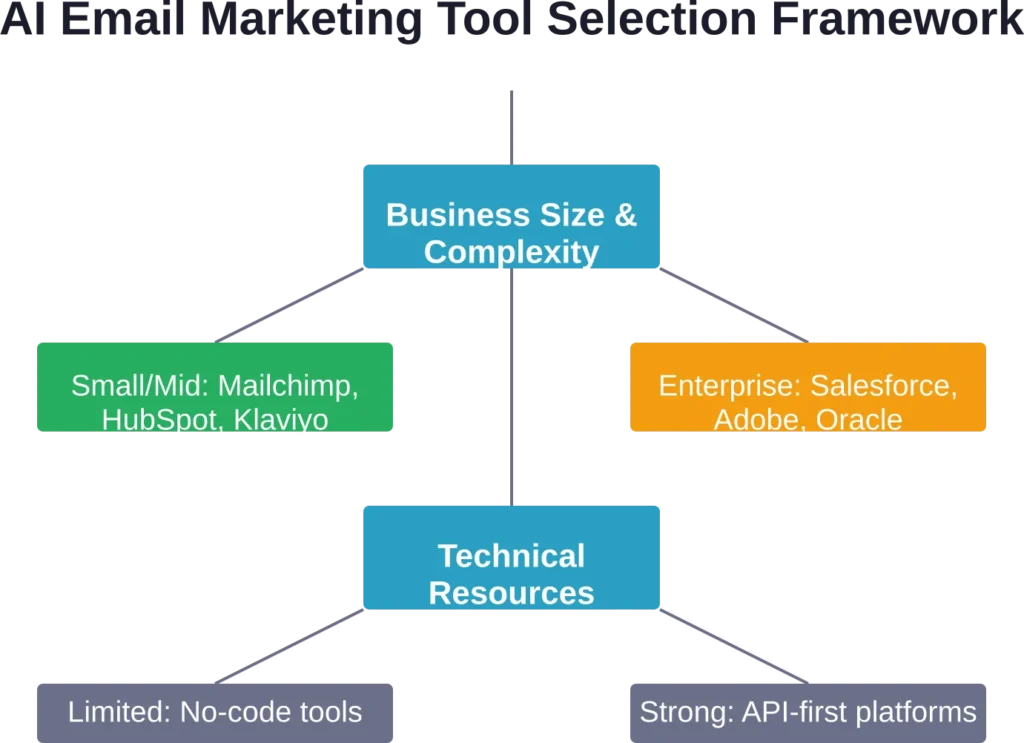
Several factors determine whether a platform will actually deliver value for a specific organization. Technical features matter, but so do practical considerations around implementation and ongoing use.
Integration Capabilities
An email marketing tool needs to connect with existing systems to access customer data and trigger campaigns. Look for platforms that integrate easily with current CRM, ecommerce, and analytics tools.
API quality matters for custom integrations. Platforms with robust, well-documented APIs provide more flexibility for unique workflows and data connections. Pre-built integrations with popular platforms reduce implementation time.
Data Quality and Unification
AI features only work as well as the data they analyze. Platforms that unify behavioral, transactional, and engagement data in real-time enable more accurate predictions and personalization.
Customer data platforms (CDPs) built into email tools eliminate the need for separate data infrastructure. This unified approach ensures consistent customer profiles across all marketing touchpoints.
Ease of Use vs. Sophistication
There’s a natural tension between powerful features and usability. Teams without dedicated developers need intuitive interfaces and visual workflow builders. Technical teams may prefer code-based control and flexibility.
The best fit depends on team composition. Mixed teams benefit from platforms that offer both visual interfaces for marketers and API access for developers.
Automation Capabilities
Look beyond basic autoresponders. Advanced platforms support complex, multi-step workflows triggered by specific behaviors and attributes. Branching logic enables different paths based on recipient actions.
The sophistication of segmentation and personalization features varies widely. Some tools offer simple merge tags, while others provide dynamic content blocks that adapt based on dozens of attributes.
Analytics and Reporting
Basic open and click metrics tell only part of the story. Advanced platforms connect email performance to downstream conversions and revenue. Attribution reporting shows which campaigns drive actual business outcomes.
Predictive analytics separate good platforms from great ones. Tools that forecast future engagement, predict churn risk, and recommend next-best actions enable proactive optimization.
Deliverability Support
Even the best campaigns fail if messages don’t reach inboxes. Look for platforms with strong sender reputation, authentication support (SPF, DKIM, DMARC), and deliverability monitoring.
Some platforms offer dedicated IP addresses for high-volume senders. Others provide deliverability consulting and monitoring services. These features matter more as send volume increases.
| Feature | Why It Matters | Questions to Ask |
|---|---|---|
| Integrations | Access to customer data and seamless workflows | Does it connect with our existing stack? Are APIs available? |
| Data Unification | Accurate AI predictions and personalization | Does it unify behavioral, transactional, and engagement data? |
| Automation | Scale personalized campaigns without manual work | How complex can workflows get? What triggers are supported? |
| Analytics | Measure true business impact, not just vanity metrics | Does it track conversions and revenue? Are predictions available? |
| Deliverability | Actually reach customer inboxes | What’s the sender reputation? What authentication is supported? |
Real-World Results from AI Email Marketing
Case studies and published results demonstrate the tangible impact of AI-powered email marketing when implemented effectively.
Delta Air Lines used Nvidia’s neural networks to create digital twins—virtual replicas of customers—to model reactions to their 2024 Paris Olympics sponsorship. This AI-driven approach helped attribute $30 million in ticket sales to the campaign.
These examples share common patterns. Organizations that invest in quality customer data, test AI features systematically, and optimize based on results see measurable improvements. Success doesn’t happen automatically—it requires intentional implementation and ongoing refinement.
Common Challenges and How to Address Them
Adopting AI email marketing tools isn’t without obstacles. Awareness of common challenges helps teams prepare and respond effectively.
Data Quality Issues
AI algorithms depend on clean, consistent data. Duplicate records, incomplete profiles, and outdated information lead to poor predictions and irrelevant personalization.
The solution starts with data hygiene. Regular deduplication, validation rules, and enrichment processes improve the foundation. Many platforms include data quality tools, but dedicated CDPs provide more comprehensive solutions.
Over-Automation Risks
Fully automated campaigns can feel impersonal or miss important context that human oversight would catch. Balance is essential.
Smart teams use AI to handle repetitive tasks and surface insights while keeping humans in the loop for strategy and quality control. Review AI-generated content before sending. Monitor automated workflows regularly. Adjust based on performance data.
Privacy and Compliance
AI personalization requires customer data, but privacy regulations limit how that data can be collected and used. GDPR, CCPA, and other laws impose strict requirements.
Choose platforms with built-in compliance features like consent management, data retention controls, and regional data storage. Maintain clear privacy policies and honor customer preferences. The best personalization respects boundaries.
Integration Complexity
Connecting a new email platform to existing systems takes time and technical effort. Data mapping, field synchronization, and workflow testing all require resources.
Plan for adequate implementation time. Start with core integrations before adding nice-to-have connections. Work with vendors’ implementation teams when available—their experience accelerates deployment.
The Future of AI in Email Marketing
AI capabilities in email marketing continue evolving rapidly. Several trends are shaping the next phase of development.
Autonomous agents represent the frontier. Platforms like Klaviyo’s Composer create complete campaigns from simple prompts, handling copywriting, design, and workflow setup automatically. This approach shifts the marketer’s role from execution to oversight and strategy.
Multimodal AI will connect email with other channels more seamlessly. Unified customer profiles will enable consistent experiences whether customers engage via email, SMS, web, or in-app messages. The lines between channels will blur.
Privacy-preserving personalization will advance as regulations tighten. Techniques like federated learning and differential privacy will enable sophisticated personalization while protecting individual privacy.
So where does this leave marketing teams? The organizations that thrive will combine AI efficiency with human creativity and strategic thinking. Technology handles repetitive work and surfaces insights. Humans define strategy, maintain brand voice, and ensure campaigns align with business goals.

Getting Started with AI Email Marketing
For teams new to AI-powered email marketing, a phased approach reduces risk and accelerates learning.
Phase 1: Assessment and Planning
Start by evaluating current email marketing performance and identifying specific pain points. Are campaigns taking too long to create? Is personalization limited? Are engagement rates plateauing?
Document existing tools, integrations, and workflows. Map out customer data sources and assess data quality. This groundwork clarifies requirements and reveals potential obstacles.
Phase 2: Tool Selection and Testing
Based on requirements, shortlist 2-3 platforms that match business size, technical capabilities, and budget. Most vendors offer trials or demos—take advantage of them.
Test core workflows during trials. Import a segment of customer data. Create sample campaigns using AI features. Evaluate ease of use, integration quality, and actual results.
Phase 3: Phased Implementation
Rather than migrating everything at once, start with one campaign type or audience segment. Learn the platform’s capabilities on a manageable scale before expanding.
Begin with AI features that offer quick wins—subject line optimization, send-time prediction, or basic personalization. Build confidence and expertise before tackling complex automation.
Phase 4: Measurement and Optimization
Track performance against clear benchmarks. Compare AI-powered campaigns to previous results using the same audiences and goals. Look beyond open rates to measure conversions and revenue impact.
Refine based on data. Adjust segmentation logic, test new personalization variables, and experiment with different automation triggers. AI tools improve as they learn from more campaigns.
Frequently Asked Questions
Pricing varies widely based on features, contact volume, and send limits. Entry-level plans for small businesses often start around $20-50 per month for basic automation and AI features. Mid-market solutions typically range from $200-1,000 monthly depending on list size and feature requirements. Enterprise platforms can cost several thousand dollars per month. Many vendors base pricing on contact count or email volume, so costs scale with business growth. Check each platform’s official website for current pricing tiers and feature availability.
Absolutely. Many platforms offer accessible plans with AI features that help small teams compete with larger organizations. Subject line optimization, send-time prediction, and basic personalization don’t require large lists or budgets to deliver value. Small businesses often see proportionally larger gains because they’re moving from manual processes to automation. Start with user-friendly platforms like Mailchimp or Klaviyo that offer strong features without requiring dedicated technical resources.
Marketing automation executes predefined workflows based on triggers and rules that marketers create manually. AI email marketing uses machine learning to make decisions, generate content, and optimize campaigns automatically based on data patterns. Traditional automation might send an email three days after signup; AI determines the optimal send time for each recipient individually. Both approaches have value—AI builds on automation foundations by adding intelligence and adaptation.
Initial improvements often appear within weeks as AI features optimize send times and subject lines based on existing data. More sophisticated benefits—advanced personalization, predictive analytics, complex automation—typically emerge over 2-3 months as algorithms accumulate sufficient data and campaigns undergo iterative refinement. Organizations with clean customer data and clear performance benchmarks see results faster. The learning curve for teams also affects timeline—plan for a few months to fully leverage advanced capabilities.
Not necessarily. Many modern platforms offer visual interfaces and no-code automation builders designed for marketers without programming backgrounds. Mailchimp, HubSpot, and Klaviyo all prioritize usability. However, more advanced features—complex API integrations, custom data transformations, sophisticated segmentation logic—benefit from technical expertise. Teams with developers can leverage platforms like Customer.io for deeper customization. Match tool sophistication to available technical resources.
No. AI handles repetitive tasks and surfaces insights, but human judgment remains essential for strategy, brand voice, and creative direction. The marketer’s role is evolving from execution to oversight—defining goals, reviewing AI outputs, making strategic decisions, and ensuring campaigns align with brand values. Research shows that marketers are saving hours per week with AI, but they’re redirecting that time to higher-level work rather than being replaced. The most effective approach combines AI efficiency with human creativity and strategic thinking.
Reputable platforms build compliance features into their infrastructure, including consent management, data retention controls, regional data storage options, and tools to honor deletion requests. However, platform capabilities don’t eliminate organizational responsibility for compliance with GDPR, CCPA, and other regulations. Maintain clear privacy policies, obtain proper consent, respect customer preferences, and work with platforms that prioritize security. When evaluating tools, ask specifically about compliance certifications, data handling practices, and available controls.
Making the Move to AI-Powered Email Marketing
Email marketing continues delivering exceptional returns in 2026, and AI tools amplify those results. Teams that adopt these platforms save significant time—54% report saving 1-5 hours weekly, with another 31% saving 6-10 hours. Performance improves through better send-time optimization, content personalization, and automated workflows.
But technology alone doesn’t guarantee success. The winning formula combines capable tools with clean data, clear strategy, and ongoing optimization. Start by identifying specific pain points in current email programs. Choose platforms that match business size and technical capabilities. Implement in phases, measure rigorously, and refine based on results.
The organizations gaining the most from AI email marketing aren’t necessarily the ones with the biggest budgets or the latest tools. They’re the ones that thoughtfully integrate AI capabilities into well-designed marketing programs and maintain the human elements that build authentic customer relationships.
Ready to explore AI email marketing tools for your business? Start with trials from 2-3 platforms that match your needs. Test core features with real campaigns. Measure results against clear benchmarks. The investment in finding the right fit pays dividends in time saved and performance gained.