

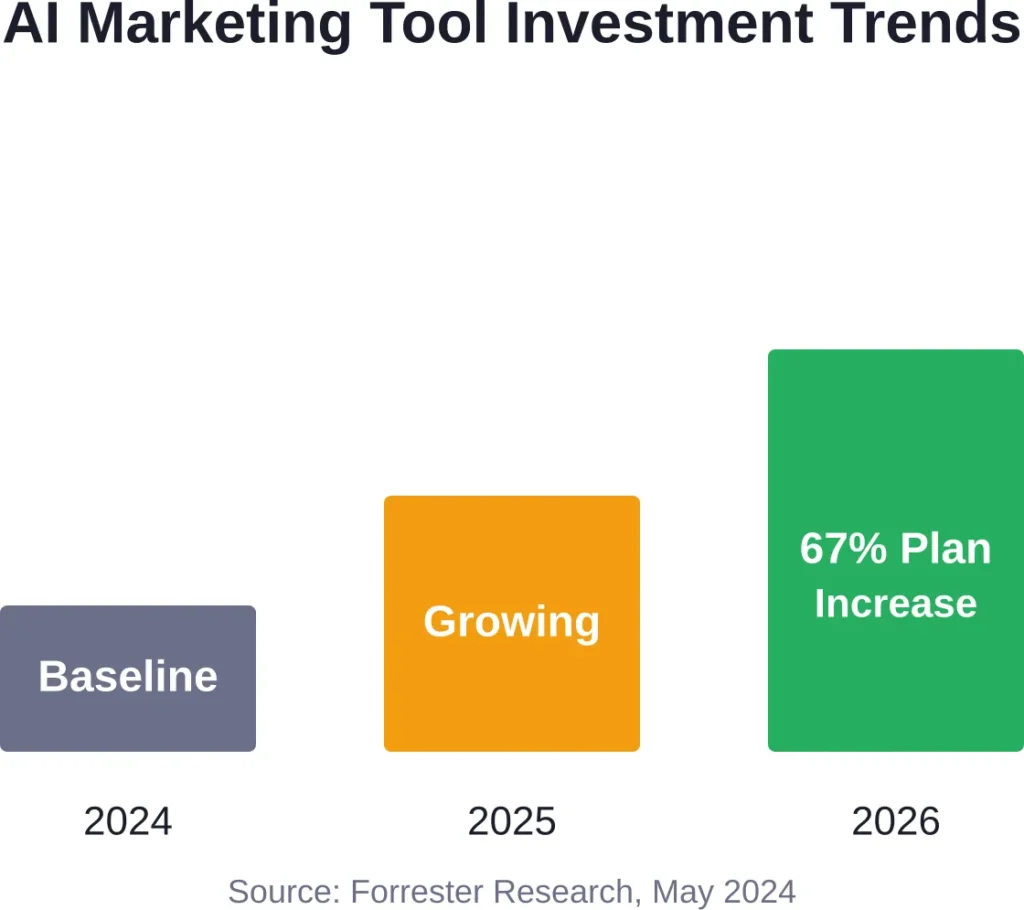
Quick Summary: AI marketing tools have evolved from experimental tech to essential business systems in 2026, with 67% of decision-makers increasing generative AI investment. The most effective tools now span chatbot platforms like ChatGPT (used by 62% of marketers), specialized content generators, automation systems, and analytics platforms—but adoption requires careful vetting for data governance, as 45% of consumers demand transparency about how brands use their information.
Marketing teams faced a reckoning in 2025. The AI hype cycle peaked, budgets tightened, and the question shifted from “Can AI do this?” to “Should we actually use AI for this?”
By 2026, the answer is nuanced. Some AI marketing tools deliver measurable ROI. Others waste time and money.
According to Forrester research from May 2024, 67% of AI decision-makers plan to increase investment in generative AI within the next year. But here’s the thing—29% cite trust as the biggest barrier to adoption. That gap between enthusiasm and execution defines the current landscape.
Real talk: not every tool deserves a spot in your stack. This guide focuses on what actually works, backed by adoption data from the American Marketing Association, Forrester research, and verified usage patterns.
What Makes an AI Marketing Tool Worth Using in 2026
The market shifted. Early AI tools promised magic but delivered mediocrity.
Now, the best platforms solve specific problems rather than claiming to do everything. They integrate with existing workflows instead of requiring complete process overhauls.
Three criteria separate useful tools from vendor hype:
Measurable impact on core metrics. Deployment should improve conversion rates, reduce production time, or cut costs within 90 days. Forrester’s Total Economic Impact study of Microsoft Copilot Studio showed a baseline ROI of 106%, with upside potential ranging from 216% to 314%. That’s the benchmark—tools should demonstrate quantifiable value, not vague productivity gains.
Data governance controls. Consumer expectations changed. According to Adobe’s 2025 AI and Digital Trends report cited by the American Marketing Association, 45% of consumers say visibility and control over their data is a top priority when engaging with brands. Tools without transparent data handling create liability.
Integration capability. Stand-alone systems create silos. The American Marketing Association notes that 95% of organizations struggle with disconnected or incomplete customer data. Tools must connect to existing CRM, analytics, and content platforms—or they compound the problem.
Visual Content Creation: Image and Video AI
Text generation grabbed headlines first, but visual AI tools matured faster than expected.
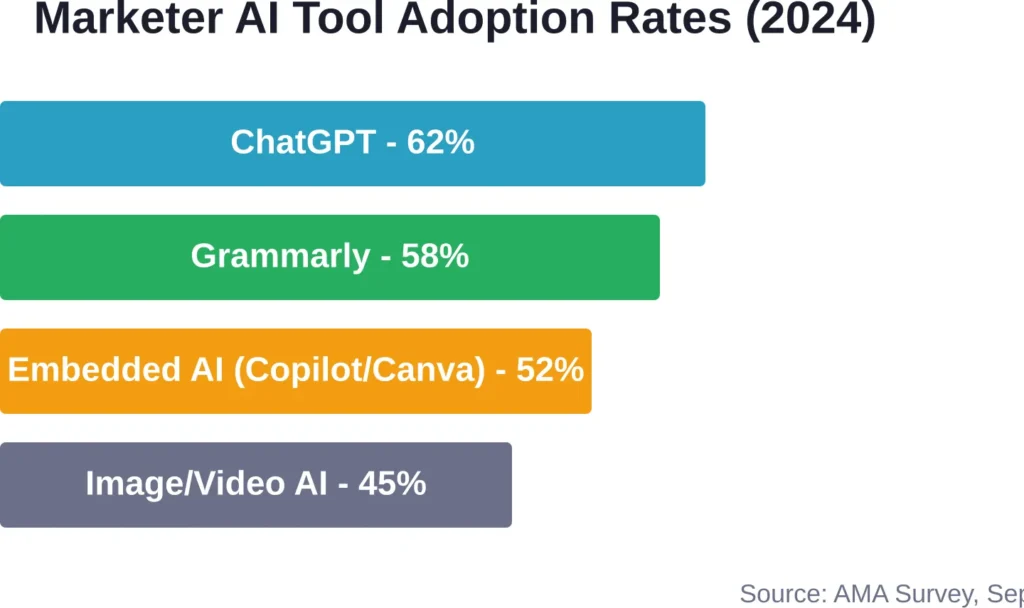
The American Marketing Association found that 45% of marketers use specialized image and video generators like Midjourney. That’s substantial penetration for tools that barely existed three years ago.
Extuitive and Predictive Ad Testing Platforms
Extuitive predicts the performance of ads before they go live. The platform analyzes creatives and forecasts CTR, ROAS, CPM and other key metrics with high accuracy using real campaign data.
Marketers use Extuitive to test dozens or hundreds of ad variations without burning test budgets. It is especially popular among Shopify and D2C brands that need to quickly validate new product creatives, headlines, and audience targeting.
The speed advantage is massive: instead of spending weeks and thousands of dollars on Meta or TikTok testing, you get reliable predictions in minutes.
However, like most predictive AI tools, Extuitive sometimes struggles with completely novel creative directions or highly emotional/brand-new product categories where historical patterns are weak.
The sweet spot? Using Extuitive to rapidly filter and rank large volumes of concepts, then letting human strategists refine the top performers. This hybrid approach combines AI scale with human taste and brand understanding.
Extuitive integrates directly with Shopify (auto-pulls products and store data) and connects via API/Zapier to ad accounts and creative generation tools, enabling fully automated creative testing workflows.
Contact Information:
- Website: extuitive.com
- Email: [email protected]
- LinkedIn: www.linkedin.com/company/extuitive
- Twitter: x.com/Extuitive_Inc
- Instagram: www.instagram.com/extuitiveinc
DALL·E and Image Generation Platforms

DALL·E 3 creates usable marketing images from text prompts. The quality improved dramatically—generated images now pass as stock photography in many contexts.
Teams use DALL·E for social media graphics, blog header images, and ad creative testing. The speed advantage is obvious: generate twenty variations in minutes rather than waiting days for designer availability.
However, NYU Stern research from November 2025 revealed what they called the “AI Advertising Paradox.” Professor Anindya Ghose and co-authors found that fully AI-generated advertisements sometimes underperform human expert-crafted visuals, particularly for campaigns requiring emotional resonance.
The sweet spot? Human-crafted concepts modified by generative AI. That hybrid approach captured AI efficiency without sacrificing strategic quality.
DALL·E integrates with automation tools. As noted in competitor research, connecting DALL·E to platforms like Zapier enables automatic image generation from form responses or CRM data.
Adobe Photoshop AI Features

Adobe embedded generative fill and expansion directly into Photoshop. This matters because professional designers already use Photoshop—the AI features augment existing skills rather than replacing workflows.
Generative fill removes objects, extends backgrounds, and creates elements that match surrounding image context. For marketers, this means faster asset customization without outsourcing every edit.
Video Generation and Editing
Runway and similar platforms generate short video clips from text or image inputs. The technology still has limitations—generated clips rarely exceed 10 seconds of usable footage—but iterative improvements happen monthly.
More practical today: AI video editing tools. Descript allows editing video by editing the transcript. Delete a sentence in the text, and the corresponding video segment disappears. For content teams producing interview content or webinar recordings, this cuts editing time substantially.
AI Chatbots and Text Generation Platforms
Chatbots dominate adoption. The American Marketing Association’s September 2024 survey found that 62% of marketers use chatbots like ChatGPT for content generation at work.
That penetration rate isn’t accidental. These platforms handle repetitive writing tasks—email drafts, social media captions, blog outlines—faster than humans can type.
ChatGPT and GPT-4-Based Tools

ChatGPT became the category standard. Most marketers encounter generative AI through OpenAI’s platform first.
The tool excels at brainstorming, first-draft content, and format conversion. Need ten subject line variations? ChatGPT generates them in seconds. Want to turn a blog post into social snippets? It handles the reformatting.
But there are limits. The output requires editing—always. GPT models hallucinate facts, miss brand voice nuances, and produce generic phrasing without careful prompting.
Based on community discussions, ChatGPT Plus costs $20 per month and provides enough query volume for most individual marketers. Teams need enterprise agreements for compliance features and API access.
Specialized Writing Assistants
Grammarly evolved beyond spell-check. According to the American Marketing Association survey, 58% of marketers use AI-powered tools like Grammarly.
The platform now offers tone adjustment, clarity scoring, and context-aware suggestions. For teams that produce customer-facing content, the business tier provides brand tone consistency checks across documents.
Jasper targets long-form marketing content specifically. The tool includes templates for blog posts, product descriptions, and ad copy—though templates often produce formulaic output without customization.
Tools with Embedded AI Capabilities
Many marketers don’t install dedicated AI apps. Instead, 52% use tools with embedded AI like Microsoft Copilot or Canva, according to the American Marketing Association data.
This approach reduces friction. Copilot sits inside Office apps, suggesting email replies and summarizing Teams meetings. Canva’s AI generates design variations without leaving the design workspace.
The trade-off? Less power than specialized tools, but significantly better adoption rates. People use features that appear in their existing workflow.
Marketing Analytics and Data Intelligence Tools
Data analysis represents AI’s strongest marketing use case right now. Machines parse datasets faster and spot patterns humans miss.
But there’s a catch—95% of organizations struggle with disconnected or incomplete customer data, according to the American Marketing Association. AI analytics tools only work when fed clean, integrated data.
Julius AI for Data Visualization

Julius AI specializes in turning raw data into visual insights. Upload a spreadsheet, describe what you want to see, and the tool generates charts, graphs, and statistical summaries.
This democratizes data analysis. Marketing coordinators without statistics backgrounds can now explore campaign performance data independently, rather than waiting for analyst availability.
The interface accepts natural language queries: “Show me conversion rate trends by traffic source over the last quarter” produces the relevant visualization without manual pivot table construction.
Improvado and Marketing Data Integration

Improvado tackles the disconnected data problem directly. The platform aggregates data from advertising platforms, CRM systems, analytics tools, and other marketing tech into unified dashboards.
AI features automate data transformation and anomaly detection. When campaign performance deviates from expected patterns, the system flags it for review.
For enterprise marketing teams running campaigns across multiple channels, this type of integration becomes essential. Manual data consolidation doesn’t scale.
Predictive Analytics Platforms
Northwestern University’s research highlights how AI-driven predictive analytics forecast customer behavior with increasing accuracy. Tools analyze historical patterns to predict churn risk, lifetime value, and purchase propensity.
Account-based marketing particularly benefits from predictive scoring. The American Marketing Association notes that 45% of ABM users see at least double ROI compared to other marketing methods. AI-powered account scoring helps concentrate resources on highest-probability targets.
| Analytics Tool Category | Primary Use Case | Integration Complexity | Typical Team Size |
|---|---|---|---|
| Data Visualization | Turning spreadsheets into insights | Low | Small to medium |
| Marketing Data Integration | Aggregating cross-platform campaign data | Medium to high | Medium to enterprise |
| Predictive Analytics | Lead scoring and churn prediction | High | Enterprise |
| Attribution Modeling | Understanding conversion paths | Medium | Medium to enterprise |
Social Media Management and Content Optimization
Social media tools incorporated AI features years ago, but capabilities accelerated recently. Modern platforms don’t just schedule posts—they optimize timing, suggest content variations, and analyze engagement patterns.
AI-Powered Scheduling and Optimization
Tools like Buffer and Hootsuite added AI scheduling that analyzes when audience engagement peaks for specific account types. Rather than posting at arbitrary times, the system identifies optimal windows based on historical performance.
Content optimization features suggest hashtags, predict engagement likelihood, and recommend post edits before publishing. These aren’t revolutionary individually, but compound efficiency gains add up across hundreds of monthly posts.
Social Listening and Sentiment Analysis
AI-driven social listening monitors brand mentions across platforms, categorizes sentiment, and identifies emerging conversation themes.
This matters for crisis management. Automated sentiment tracking flags potential PR issues before they escalate, giving teams time to respond strategically rather than reactively.
The technology also surfaces customer feedback patterns. When complaints cluster around specific product features or service issues, AI analysis aggregates and prioritizes the signal from noise.
Automated Response Systems
Chatbots handle routine customer service inquiries on social platforms. For brands receiving hundreds of repetitive questions, automated initial responses improve response time and free human agents for complex issues.
But implementation requires care. Poorly configured bots frustrate customers. The system must gracefully hand off to humans when queries exceed its capability—and that threshold needs constant adjustment.
Email Marketing Automation with AI
Email remains a core marketing channel, and AI features now permeate major email platforms.
Subject Line Optimization and Send Time Prediction
AI models analyze thousands of past campaigns to predict which subject lines will achieve higher open rates for specific audience segments.
Send time optimization determines when individual subscribers are most likely to engage. Rather than sending all emails simultaneously, the system staggers delivery to hit each recipient’s optimal window.
These features typically increase open rates by 5-15%, according to platform vendors—modest but meaningful improvements for mature email programs.
Content Personalization at Scale
Dynamic content blocks adjust email content based on recipient attributes, behavior history, and predicted preferences.
AI takes this further by generating personalized product recommendations, content suggestions, and offer variations without manual segmentation setup.
The practical limit? Data quality. Personalization requires accurate customer data. When records are incomplete or outdated, AI-generated personalization fails—sometimes spectacularly.
List Cleaning and Engagement Prediction
AI identifies subscribers unlikely to engage before sending, allowing strategic list pruning or re-engagement campaign targeting.
This protects sender reputation. Email providers penalize senders with high inactive subscriber counts, so removing disengaged contacts preemptively maintains deliverability for engaged audiences.
Marketing Automation and Workflow Tools
Automation platforms evolved from simple trigger-action systems to sophisticated AI-driven workflow orchestrators.
Zapier and No-Code Automation

Zapier connects disparate marketing tools without custom development. The platform added AI capabilities that enable more intelligent automation triggers and data transformation.
For example: automatically generating social media images from blog post content, transcribing podcast episodes and creating promotional snippets, or extracting key themes from customer support tickets for content teams.
The no-code interface means marketers build these workflows without engineering resources—though complex automations still require technical thinking to structure effectively.
CRM Integration and Lead Nurturing
Modern CRM platforms like HubSpot and Salesforce embedded AI throughout their feature sets. Lead scoring, opportunity prediction, and automated task creation now rely on machine learning models analyzing customer interaction patterns.
According to the American Marketing Association, account-based marketing now accounts for 28% of total user marketing budgets. AI-enhanced CRM systems support ABM strategies by identifying buying committee members, tracking account engagement across touchpoints, and recommending next-best actions.
Microsoft Copilot Studio
Copilot Studio represents Microsoft’s enterprise AI automation platform. The tool creates custom copilots that automate business processes, integrate with Microsoft 365 apps, and handle complex multi-step workflows.
Forrester’s Total Economic Impact study commissioned by Microsoft in September 2025 projected that Copilot Studio deployment achieves a baseline ROI of 106%, with upside potential ranging from 216% to 314% depending on use case sophistication and organizational readiness.
That ROI comes primarily from time savings in repetitive tasks—data entry, report generation, meeting summarization, and cross-system information retrieval.
Content Research and Competitive Intelligence
Research tools accelerated content strategy work by automating competitor monitoring, trend identification, and keyword opportunity discovery.
AI-Powered SEO and Content Research
Tools like SEMrush and Ahrefs incorporated AI features that suggest content topics based on search demand, competitive gaps, and keyword difficulty analysis.
The systems analyze top-ranking content for target keywords, identify common elements, and recommend content structure adjustments to improve ranking potential.
This shifts SEO from purely technical optimization to strategic content planning. Teams identify opportunities before creating content rather than optimizing after publication.
Competitive Monitoring and Alert Systems
AI-driven monitoring tracks competitor website changes, new content publication, pricing adjustments, and advertising campaigns.
Rather than manual competitor checks, automated systems surface significant changes immediately. When a competitor launches a new product, adjusts messaging, or increases ad spend, alerts trigger strategic review.
Trend Identification and Market Intelligence
Platforms analyze search trends, social conversations, news coverage, and industry publications to identify emerging topics before they reach mainstream awareness.
Early trend detection allows content teams to publish authoritative coverage while search competition remains low—capturing traffic as interest grows.
The Reality Check: What Forrester Enterprise Data Shows
Hype doesn’t match reality in many organizations. While AI tool vendors tout revolutionary capabilities, Forrester’s February 2026 analysis revealed “a measured — even cautious — approach to Copilot adoption that contrasts sharply with the AI infrastructure stampede dominating headlines.”
Enterprise IT organizations move slower than AI infrastructure buildout suggests. Hyperscalers race to build data centers and GPU manufacturers struggle to meet demand, but inside companies, adoption follows careful evaluation cycles.
Trust Remains the Biggest Barrier
Forrester identified trust as the top barrier—29% of AI decision-makers cite this concern. Trust encompasses data privacy, output accuracy, regulatory compliance, and ethical use questions.
The Federal Trade Commission increased scrutiny of AI marketing claims. In September 2024, the FTC announced Operation AI Comply, taking enforcement action against five operations making deceptive AI claims or selling AI technology usable in deceptive ways.
In June 2024, the FTC filed suit against FBA Machine and Bratislav Rozenfeld alleging they falsely guaranteed consumers could make money operating online storefronts using AI-powered software, with allegations of defrauding consumers out of over a significant sum.
Marketers deploying AI tools must verify vendor claims independently. Inflated capability promises create legal liability and damage brand credibility when tools underperform.
Job Impact and Workforce Concerns
Forrester’s 2023 survey found that 36% of employees fear losing jobs to AI. These concerns affect adoption—resistance from teams worried about displacement slows implementation.
The marketing agency sector shows what workforce disruption looks like. Forrester’s October 2025 predictions indicated marketing agencies are shifting business models, with implications for agency employment.
Agencies transform from pure service providers to hybrid models—vendors executing programs, merchants reselling software and media, affiliates contributing to larger organizations. This shift stems directly from AI tools reducing labor requirements for production work, as agencies adapt to changing market dynamics.
The Agency Relationship Review Wave
According to Forrester, 85% of US B2C marketing executives plan to review their media agencies in 2026. This represents a significant increase from typical three-to-five-year master service agreement cycles.
AI capability drives these reviews. Brands want agencies that effectively deploy AI tools to improve efficiency and performance. Agencies without clear AI strategies risk losing accounts.
| Adoption Challenge | Percentage Affected | Primary Concern | Mitigation Strategy |
|---|---|---|---|
| Trust and accuracy concerns | 29% | Output reliability and data privacy | Human verification protocols |
| Employee job security fears | 36% | Workforce displacement | Reskilling programs |
| Data disconnection issues | 95% | Incomplete customer data | Integration platforms |
| Consumer data transparency demands | 45% | Brand trust and compliance | Clear privacy policies |
Implementation Strategy: Getting AI Tools Right
Successful deployment requires more than purchasing licenses. Harvard Professional Development research notes that AI presents opportunities to personalize customer experiences and build technological skills—but only when implemented thoughtfully.
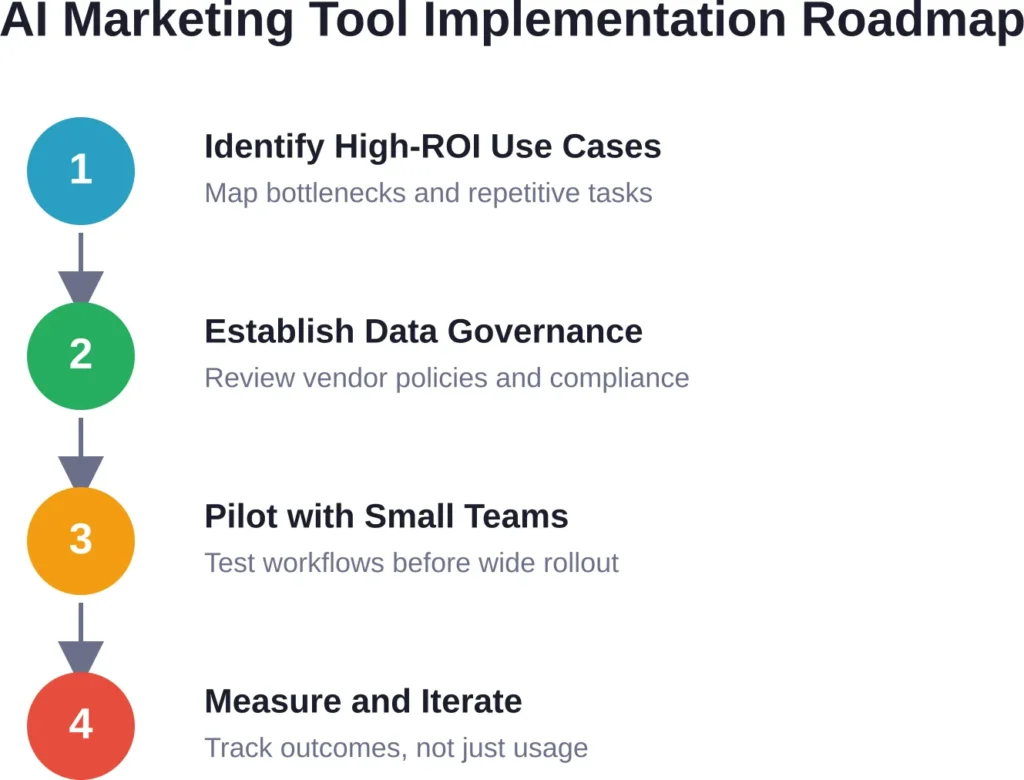
Start with High-ROI, Low-Risk Use Cases
Don’t try to AI-transform everything simultaneously. Identify specific bottlenecks where AI demonstrably improves speed or quality.
Good first targets include:
- Generating first drafts of repetitive content (product descriptions, routine social posts)
- Summarizing research or meeting notes
- Creating image variations for A/B testing
- Automating data report generation
These tasks produce measurable time savings without requiring organizational transformation.
Establish Clear Data Governance
The FTC explicitly warned AI companies to uphold privacy and confidentiality commitments in January 2024. Data is at the heart of AI development, and mishandling creates legal exposure.
Before deploying tools that process customer data:
- Review vendor data handling policies
- Verify compliance with relevant regulations (GDPR, CCPA, industry-specific requirements)
- Document what data gets processed and where it goes
- Train teams on acceptable use policies
The 45% of consumers who prioritize data transparency won’t tolerate brands that treat their information carelessly.
Build Human Verification into Workflows
AI output requires review. Always. Systems hallucinate facts, miss context, and produce occasionally nonsensical results.
Establish review protocols appropriate to risk level. Customer-facing content needs thorough human editing. Internal summaries might need spot-checking only.
The NYU Stern research on AI advertising effectiveness reinforces this—hybrid approaches combining human creativity with AI execution outperform purely automated solutions.
Measure Actual Impact, Not Activity
Track whether AI tools improve outcomes, not just whether teams use them.
Useful metrics include:
- Time to complete specific tasks before and after AI deployment
- Quality scores or approval rates for AI-assisted content
- Conversion rate changes for AI-optimized campaigns
- Cost per output unit (cost per email sent, per blog post published, per campaign launched)
If metrics don’t improve within a quarter, either the tool doesn’t fit the use case or implementation needs adjustment.
What to Avoid: Common AI Tool Mistakes
Some patterns consistently produce poor results.
Buying Tools Before Defining Problems
The biggest mistake? Purchasing AI platforms because competitors use them, without identifying what problem needs solving.
Tools don’t create strategy. They execute it. Teams that adopt AI without clear objectives waste budgets on subscriptions that sit unused.
Assuming AI Output is Always Correct
Large language models confidently state incorrect information. Image generators create subtle distortions. Analytics tools miss context humans catch immediately.
Publishing AI-generated content without verification damages credibility. One fabricated statistic or nonsensical claim undermines trust earned over years.
Ignoring Integration Requirements
Stand-alone tools create workflow friction. If using an AI tool requires exporting data, switching apps, copying content between systems, or manual reformatting—adoption fails.
Evaluate how tools connect to existing marketing tech stacks before purchase. API availability, native integrations, and data export formats matter as much as features.
Neglecting Team Training
AI tools require skill development. Effective prompt engineering, understanding model limitations, and recognizing when to use (or not use) automation—these competencies don’t appear automatically.
Budget time for training when implementing new tools. Teams that learn proper use patterns extract significantly more value than those left to figure it out independently.
The 2026 AI Marketing Landscape
Where does this all net out?
AI marketing tools moved from experimental to essential for specific tasks. Text generation, data analysis, and content optimization show clear ROI when implemented properly.
But the technology isn’t magic. Tools amplify existing capabilities—they don’t replace strategy, creativity, or domain expertise. Northwestern University research emphasizes that AI serves as a collaborator, not a replacement for marketing judgment.
The American Marketing Association’s agentic AI research from January 2026 points to the next evolution: AI systems that don’t just respond to prompts but proactively suggest actions, identify opportunities, and orchestrate multi-step processes with minimal human direction.
That future is still emerging. For now, focus on tools that solve today’s problems measurably and reliably.
Industry-Specific Considerations
Not all tools work equally well across sectors.
B2B companies with long sales cycles benefit most from predictive lead scoring and account intelligence tools. The American Marketing Association notes that ABM now accounts for 28% of total marketing budgets, and AI-enhanced targeting drives much of that investment.
E-commerce brands get immediate value from product description generators, image variation tools, and email personalization engines. Speed and volume matter more than deep customization.
Content publishers need research automation, SEO optimization, and distribution tools that help smaller teams compete with larger operations.
Financial services and healthcare face stricter compliance requirements that limit some AI applications. Tools must meet industry-specific data handling standards.
Budget Realities
AI tool costs vary dramatically. ChatGPT Plus costs $20 per month. Enterprise platforms run tens of thousands annually.
For small teams, start with accessible tools like ChatGPT, Grammarly, and Canva’s AI features. These provide substantial capability at low cost.
Mid-market companies should prioritize integration platforms and specialized tools for high-impact use cases—marketing automation, analytics consolidation, or campaign optimization.
Enterprises justify custom AI development and premium platforms, but only when clear ROI projections exist. The Forrester Copilot Studio analysis showing 106% baseline ROI provides a benchmark—expect similar returns or don’t invest.
Frequently Asked Questions
According to the American Marketing Association’s September 2024 survey, 62% of marketers use chatbots like ChatGPT for content generation at work—the highest adoption rate among AI marketing tools. Grammarly follows at 58%, and tools with embedded AI features like Microsoft Copilot or Canva reached 52% adoption.
When implemented strategically, yes. Forrester’s Total Economic Impact study of Microsoft Copilot Studio showed a baseline ROI of 106%, with upside potential ranging from 216% to 314%. However, ROI depends heavily on proper implementation, team training, and choosing appropriate use cases. Tools deployed without clear objectives often produce minimal returns.
Three primary risks emerge: First, AI systems can generate inaccurate information that damages credibility if published without verification. Second, data privacy concerns—45% of consumers prioritize visibility and control over their data, and improper handling creates legal liability. Third, over-reliance on AI reduces strategic thinking and creativity, as NYU Stern research showed purely AI-generated advertising sometimes underperforms human-crafted campaigns.
Absolutely, but start selectively. ChatGPT Plus at $20 per month provides substantial capability for content drafting and research. Free tiers of tools like Grammarly, Canva, and platform-embedded AI features (Google Analytics insights, social media scheduling optimization) deliver value without significant budget commitment. Avoid enterprise platforms until specific bottlenecks justify the investment.
Dramatically. Forrester research found that 85% of US B2C marketing executives plan to review their media agencies in 2026—significantly higher than typical review cycles. AI tools reduce labor requirements for execution work. Agencies are transforming from pure service providers to hybrid models reselling software and contributing capabilities to larger matrixed organizations.
Traditional marketing automation executes predefined rules: “when contact downloads whitepaper, send follow-up email sequence.” Generative AI creates new content based on patterns learned from training data: “generate twenty subject line variations optimized for this audience segment.” Generative AI is probabilistic and creative; traditional automation is deterministic and executional. Both have roles in modern marketing stacks.
Check several factors: Does the vendor clearly explain how they handle your data? Have they published security and compliance documentation? Do independent reviews confirm advertised capabilities? Has the FTC or industry regulators cited them for deceptive practices? The FTC announced Operation AI Comply in September 2024, taking action against vendors making false AI claims—research whether prospective vendors have regulatory issues before purchasing.
Conclusion
AI marketing tools deliver real value when matched to genuine problems. The data shows widespread adoption—67% of decision-makers increasing investment, 62% of marketers using chatbots, and measurable ROI in properly implemented systems.
But the technology isn’t a shortcut to marketing success. Tools amplify existing capabilities, automate repetitive work, and surface insights from data. They don’t replace strategy, creativity, or the human judgment necessary to build brand value.
The winners in 2026 won’t be organizations that deploy the most AI tools. They’ll be teams that identify high-impact use cases, implement thoughtfully, maintain data governance standards, and keep humans in the loop for strategic decisions.
Start with one well-chosen tool addressing a clear bottleneck. Measure results. Expand what works. That approach beats chasing every new AI platform that launches.
The technology will keep evolving—agentic AI, better integration, improved accuracy. The fundamentals won’t change. Solve real problems. Verify outputs. Respect customer data. Build on solid strategy.
AI marketing tools work. When used right.