

Quick Summary: Enterprise web design companies specialize in creating scalable, secure, and high-performance websites for large organizations. The best agencies combine strategic thinking with technical excellence, offering services from UX/UX design to complex integrations. Top firms include Excited Agency, Clay, Huemor, Digital Silk, and others that have proven track records with enterprise clients and deliver measurable business results.
Finding the right enterprise web design company isn’t like picking a freelancer for a quick website refresh. Large organizations need agencies that understand complex stakeholder landscapes, legacy system integrations, and compliance requirements that would make most designers’ heads spin.
Statistics show that nearly three-quarters of businesses have a website—and a further 43% of small businesses plan to invest in their website performance. For enterprise organizations, that quality bar sits significantly higher. The website isn’t just a digital brochure—it’s a revenue engine, a customer service platform, and often the primary interface between the brand and millions of users.
But here’s the challenge: the enterprise web design market is crowded with agencies claiming expertise. Some excel at visual storytelling but fumble technical architecture. Others nail the engineering but deliver experiences that feel clinical and cold.
This guide cuts through the noise. The agencies featured here have demonstrated real capability with enterprise clients, backed by verifiable client reviews and portfolio work that speaks for itself.
What Makes an Enterprise Web Design Company Different
Enterprise web design operates in a different universe than small business or startup work. The stakes are higher, the systems more complex, and the consequences of failure more severe.
Scale matters. Enterprise sites often handle millions of visitors monthly, thousands of pages, and integration points with CRM systems, marketing automation platforms, and legacy databases that have been running since before smartphones existed.
Security and compliance requirements add layers of complexity. Healthcare organizations need HIPAA compliance. Financial services firms face strict regulatory oversight. Global enterprises must navigate GDPR, CCPA, and a maze of international data protection laws.
Then there’s the stakeholder challenge. Small projects might involve three decision-makers. Enterprise projects regularly juggle input from marketing, IT, legal, compliance, accessibility, brand, and multiple business unit leaders—each with their own priorities and concerns.
The best enterprise web design companies have developed processes to navigate this complexity. They bring strategic frameworks, proven methodologies, and teams structured to handle the unique demands of large-scale digital transformation.
How to Choose the Right Enterprise Web Design Agency
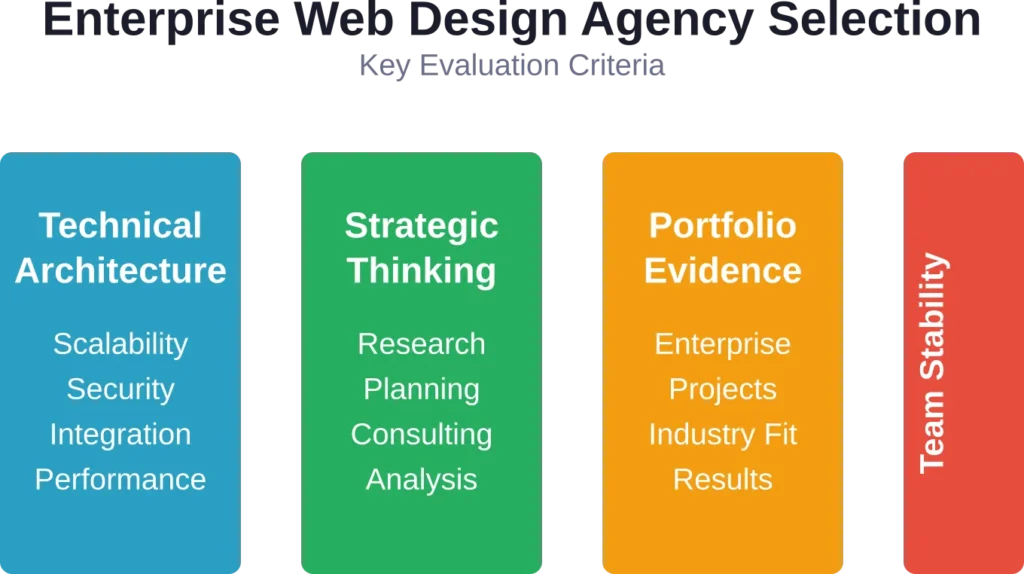
Selecting an enterprise web design partner requires a different evaluation framework than hiring for smaller projects. Here’s what actually matters.
Portfolio Depth and Relevance
Look beyond pretty screenshots. Examine whether agencies have tackled projects with similar complexity to yours. A firm that’s built gorgeous websites for boutique brands might struggle with the enterprise requirements you face.
Check for clients in your industry or adjacent sectors. Agencies familiar with your regulatory environment, customer base, and competitive landscape will hit the ground running faster.
Technical Architecture Capabilities
Enterprise sites demand robust technical foundations. The agency should demonstrate expertise in scalable architectures, whether that’s headless CMS implementations, microservices approaches, or hybrid solutions.
Ask about their development practices. Modern enterprises need agencies that follow DevOps principles, implement automated testing, and can integrate with existing tech stacks without creating technical debt.
Strategic Thinking vs. Order Taking
The best agencies challenge assumptions and push back when necessary. If an agency simply agrees with everything you say, that’s a red flag. Enterprise projects benefit from partners who bring strategic perspective, not just execution capability.
Look for evidence of strategic impact in their case studies. Did they just redesign an interface, or did they help reshape the client’s digital strategy?
Team Structure and Continuity
Enterprise projects span months or years. Ask about team stability. High turnover means you’ll constantly re-educate new people about your business context.
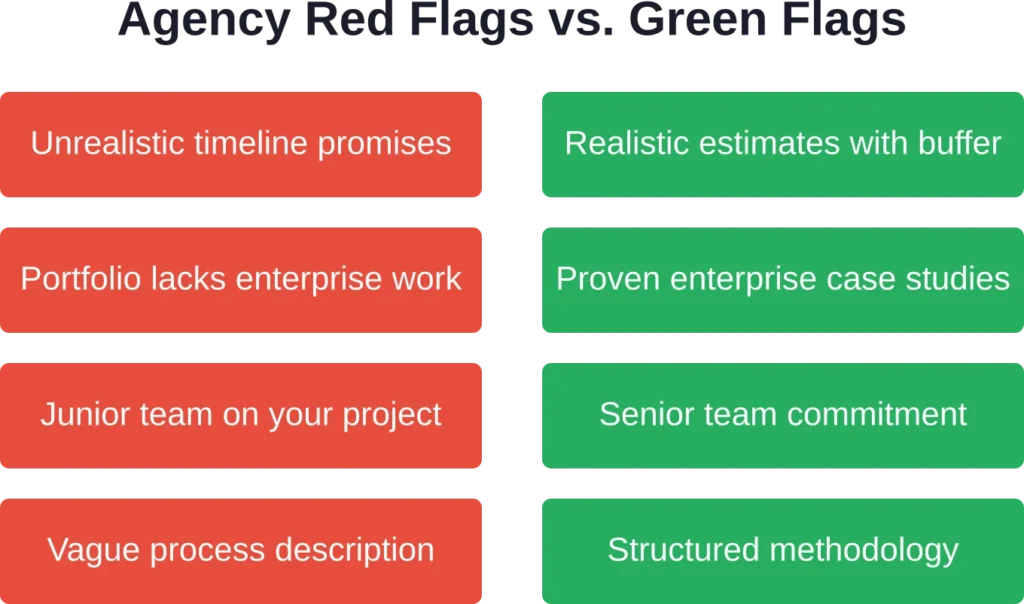
Understand who you’ll actually work with. Some agencies staff proposals with senior talent, then hand execution to junior teams. Others maintain consistent team composition throughout the engagement.
Top 15 Enterprise Web Design Companies in 2026
These agencies represent the strongest options for enterprise organizations seeking web design partners. Each brings distinct strengths, and the right choice depends on your specific requirements.
1. Lengreo

Lengreo approaches enterprise web solutions as a complete marketing and technology partner, focusing on websites that actively drive lead generation, conversions, and measurable business growth. Their philosophy centers on aligning digital presence with clear commercial objectives rather than purely visual execution.
The agency combines website development, B2B digital marketing strategy, conversion optimization, and lead generation tactics into integrated solutions. Their process begins with in-depth business analysis, discovery, and strategy development to ensure every website element supports revenue outcomes.
Lengreo has delivered strong results for technology companies, professional services providers, and international B2B organizations. Their work emphasizes performance-driven websites that support complex sales cycles and multi-channel customer acquisition.
The team excels at creating websites that function as powerful business development tools, incorporating data-informed design decisions and ongoing optimization to maximize qualified leads and client acquisition.
Best For: B2B enterprises and technology companies seeking websites that combine strong design with aggressive lead generation and measurable marketing performance.
Contact Information:
- Website: lengreo.com
- Phone: +31 686 147 566
- Email: [email protected]
- Address: Vrijstraat 9 C/D, 5611 AT Eindhoven, Netherlands
- LinkedIn: www.linkedin.com/company/lengreo
- Instagram: www.instagram.com/lengreo.agency
- Twitter: x.com/Lengreo
2. Mobian
Mobian builds high-performance web and digital solutions through dedicated engineering teams focused on speed, quality, and production readiness for demanding industries.
The agency combines full-stack web development, UI/UX design, scalable architecture, and modern technology implementation into complete digital products. Their process prioritizes clean architecture, clear documentation, and efficient delivery without compromising quality.
Mobian partners with companies in IT, healthcare, fintech, and logistics that need robust web platforms capable of supporting critical operations and future growth.
The team’s strength lies in delivering maintainable, scalable web systems with excellent user experiences that integrate seamlessly with business processes and existing technology stacks.
Best For: Enterprises and technology companies in regulated or high-stakes industries seeking dedicated teams for complex web and digital product development.
Contact Information:
- Website: mobian.studio
- Phone: [email protected]
- Address: Harju maakond, Tallinn, Kesklinnalinnaosa, Masina tn 22, 10113
- LinkedIn: www.linkedin.com/company/mobian-studio
3. Gilzor

Gilzor approaches web design and development through a product-oriented lens, creating digital solutions that balance user experience, functionality, and business scalability for ambitious companies.
The agency integrates UI/UX design, full-cycle web development, business analysis, and go-to-market strategy into cohesive digital products. Their process emphasizes idea validation, user-centric design, and technical excellence to reduce risk and accelerate time to value.
Gilzor builds high-quality web and mobile applications for startups, product studios, and small-to-medium businesses looking to establish or expand their digital presence. Their solutions focus on performance, conversion, and long-term maintainability.
The team’s strength lies in delivering clean, scalable architecture paired with intuitive interfaces that genuinely improve user engagement and business outcomes.
Best For: Startups and growing businesses needing custom web platforms that support product-market fit and sustainable digital growth.
Contact Information:
- Website: www.gilzor.com
- Email: [email protected]
- Address: Poland, Warsaw, Office 58, street Adama Mickiewicza 37, 01-625
- LinkedIn: www.linkedin.com/company/gilzor-softwaredevelopment
4. A-listware

A-listware specializes in enterprise web development and digital solutions, providing dedicated teams that deliver secure, responsive, and high-quality web platforms tailored to complex business requirements.
The agency offers end-to-end capabilities including software development, UX/UI design, cloud application development, and IT consulting. Their approach emphasizes seamless team integration and consistent delivery of enterprise-grade solutions.
A-listware supports enterprises, SMBs, and startups with custom web applications, modernizations, and digital transformation initiatives that enhance operational efficiency and customer engagement.
The team is particularly strong at building scalable enterprise applications and web systems that integrate smoothly with existing infrastructure while maintaining performance and security standards.
Best For: Enterprises requiring reliable web development partners capable of delivering complex, scalable digital solutions through dedicated or augmented teams.
Contact Information:
- Website: a-listware.com
- Phone: +1 (888) 337 93 73
- Email: [email protected]
- Address: North Bergen, NJ 07047, USA
- LinkedIn: www.linkedin.com/company/a-listware
- Facebook: www.facebook.com/alistware
5. Oski
Oski delivers enterprise-grade web solutions by combining deep technical expertise with thoughtful design to create powerful digital experiences for forward-thinking organizations.
The agency brings together frontend development, cloud architecture, UI/UX design, and AI-enhanced capabilities into robust web platforms. Their process focuses on engineering excellence, scalability, and seamless integration with existing business systems.
Oski serves tech-forward enterprises and ambitious startups across multiple industries, building solutions that support complex operational needs while maintaining excellent user experiences.
The team excels at creating high-performance websites and web applications that leverage modern technologies while remaining intuitive and reliable for both internal teams and external users.
Best For: Enterprises and growth-stage companies looking for sophisticated, scalable web solutions that combine technical strength with superior user experience.
Contact Information:
- Website: oski.site
- Phone: +48571282759
- Email: [email protected]
- Address: Kaupmehe tn 7, 10114 Tallinn, Estonia
- LinkedIn: www.linkedin.com/company/oski-solutions
6. Bop Design
Bop Design specializes in B2B web design and marketing, bringing focused expertise to enterprises selling to other businesses. Their deep understanding of B2B buyer behavior informs design decisions that support complex sales processes.
The agency’s approach emphasizes lead generation, sales enablement, and creating content architectures that serve buyers at different stages of their research and evaluation journey. They understand that B2B websites must educate, build credibility, and facilitate connection with sales teams.
Bop Design has particular strength working with professional services firms, technology companies, and industrial manufacturers. Their portfolio demonstrates experience creating websites that communicate complex value propositions clearly.
The team integrates closely with client marketing and sales organizations to ensure website strategy aligns with broader go-to-market approaches. This collaboration helps ensure digital investments drive measurable pipeline impact.
Best For: B2B enterprises in professional services, technology, or industrial sectors seeking websites optimized for lead generation and sales enablement.
7. Fantasy
Fantasy creates digital experiences that push creative boundaries while maintaining functional excellence. Their work is characterized by bold visual design, innovative interactions, and memorable user experiences.
The agency has collaborated with major brands across entertainment, technology, sports, and consumer goods. Their portfolio demonstrates capability handling high-profile launches where brand impact and user engagement are paramount.
Fantasy’s strength lies in balancing creativity with technical execution. They don’t just design beautiful interfaces—they build them to perform at scale with sophisticated animations, transitions, and interactive elements.
For enterprises launching new products, entering new markets, or seeking to differentiate through digital experience, Fantasy offers the creative firepower to make a splash.
Best For: Enterprises launching high-profile initiatives where creative differentiation and memorable user experiences justify premium design investment.
8. Instrument

Instrument describes itself as a digital product and brand experience agency. Their work spans strategy, design, and technology, with particular strength in creating cohesive experiences across digital touchpoints.
The agency brings a product mindset to web design, emphasizing user research, iterative development, and continuous optimization. This approach resonates with enterprises that view their websites as evolving products rather than static assets.
Instrument has worked with major brands including Google, Nike, and Sonos. Their portfolio demonstrates capability handling complex information architectures, e-commerce experiences, and brand storytelling at scale.
The team’s collaborative approach emphasizes embedding with client organizations to transfer knowledge and build internal capability alongside delivering solutions.
Best For: Enterprises seeking agencies that combine strategic thinking, design excellence, and product development methodologies for long-term digital initiatives.
9. Code and Theory
Code and Theory operates at the intersection of creativity and technology, serving enterprise clients who need agencies capable of handling complex technical requirements without sacrificing design quality.
The agency has grown to over 500 employees, providing the scale and specialized expertise required for large enterprise engagements. Their multidisciplinary teams include strategists, designers, engineers, and data scientists.
Code and Theory has worked with clients including JPMorgan Chase, Adidas, and Johnson & Johnson. Their portfolio spans websites, web applications, mobile experiences, and digital transformation initiatives.
The agency’s strength lies in managing complex, multi-year engagements that require coordination across multiple workstreams, technologies, and stakeholder groups.
Best For: Large enterprises undertaking significant digital transformation initiatives requiring both creative excellence and deep technical capabilities.
10. Basic Agency (DEPT)
Basic Agency, now part of DEPT, brings global scale combined with creative excellence. The merger has expanded capability while maintaining the design-forward approach that built Basic’s reputation.
The agency emphasizes creating digital experiences that drive business growth, combining brand strategy, web design, and digital marketing expertise. Their process includes extensive research to understand market dynamics and customer behavior.
Basic has worked with diverse clients across technology, fashion, hospitality, and consumer goods. Their portfolio demonstrates versatility across industries while maintaining consistently high design standards.
The DEPT network provides access to specialized capabilities across performance marketing, technology development, and international markets—valuable for enterprises with global operations or ambitious growth plans.
Best For: Global enterprises seeking agencies that combine creative firepower with international reach and diverse specialized capabilities.
11. Excited Agency
Excited Agency approaches web design through a product-first lens, focusing on clarity, structure, and conversion rather than surface-level aesthetics. This philosophy resonates with enterprise clients who need websites that actually drive business outcomes.
The agency combines UX research, web design, branding, and motion design into cohesive solutions. Their process emphasizes understanding user behavior patterns before committing to design directions—a research-driven approach that reduces risk for large-scale implementations.
Excited has built a reputation for creating websites that scale with the product and support long-term growth. Their portfolio includes work with technology companies, B2B enterprises, and fast-growth organizations that need design systems capable of evolving.
The team’s strength lies in balancing aesthetic quality with functional performance. They understand that enterprise sites must satisfy multiple stakeholders while maintaining consistency across hundreds of pages and templates.
Best For: Technology companies and B2B enterprises seeking product-focused design with strong emphasis on user research and conversion optimization.
12. Clay

Clay has established itself as a go-to partner for brands seeking design that makes a statement. Their work spans branding, digital products, and web experiences that prioritize visual impact and narrative storytelling.
The agency’s approach centers on understanding brand essence before diving into execution. This strategic foundation helps ensure that digital experiences reinforce broader brand positioning rather than existing in isolation.
Clay’s portfolio includes collaborations with well-known brands across technology, consumer goods, and media sectors. Their work demonstrates particular strength in creating cohesive visual systems that maintain consistency across digital touchpoints.
For enterprises undergoing brand evolution or launching new ventures, Clay offers the strategic depth to align digital experiences with transformational business initiatives.
Best For: Enterprises undergoing brand transformation or launching new digital products that require strong visual identity and narrative coherence.
13. Huemor

Huemor positions itself as a results-driven agency focused on creating websites that generate measurable business impact. Their approach emphasizes conversion optimization, user experience, and data-driven decision making.
The agency brings particular expertise in B2B web design, understanding the longer sales cycles and multiple decision-maker dynamics that characterize enterprise purchasing. Their process includes stakeholder interviews, competitive analysis, and user journey mapping.
Huemor’s portfolio demonstrates experience across industries including technology, manufacturing, professional services, and healthcare. They’ve developed expertise in creating websites that serve both marketing and sales enablement functions.
The team emphasizes transparency throughout engagements, providing regular reporting on project progress and performance metrics post-launch. This accountability resonates with enterprise clients accustomed to vendor management frameworks.
Best For: B2B enterprises needing websites that support complex sales processes and generate qualified leads through strategic user experience design.
14. Digital Silk

Digital Silk offers end-to-end digital solutions spanning strategy, branding, web design, and digital marketing. This comprehensive capability set appeals to enterprises seeking a single partner for multi-faceted initiatives.
The agency’s methodology begins with digital strategy development, ensuring that web design decisions align with broader business objectives. They emphasize creating cohesive brand experiences across all digital touchpoints.
Digital Silk has worked with enterprise clients across healthcare, financial services, technology, and consumer brands. Their portfolio demonstrates capability with both public-facing websites and complex web applications.
The team’s strength lies in managing large-scale projects with multiple workstreams. They’ve developed project management practices specifically designed for the complexity and stakeholder coordination requirements of enterprise engagements.
Best For: Enterprises seeking comprehensive digital transformation partners capable of handling strategy, design, and implementation across multiple initiatives.
15. Lounge Lizard
Lounge Lizard brings over two decades of experience to enterprise web design, combining creative excellence with technical expertise. Their longevity in the market speaks to sustained capability and client satisfaction.
The agency offers services spanning web design, mobile app development, digital marketing, and branding. This breadth allows them to support enterprises with diverse needs beyond initial website launches.
Lounge Lizard has worked with notable brands across entertainment, hospitality, healthcare, and professional services. Their portfolio demonstrates versatility across different industries and project types.
The team emphasizes building long-term partnerships rather than transactional project relationships. Many enterprise clients engage Lounge Lizard for ongoing optimization and evolution of their digital presence.
Best For: Enterprises seeking established agencies with proven track records and capability to support ongoing digital initiatives beyond initial launches.
Enterprise Web Design Service Categories
Enterprise web design encompasses multiple specialized service areas. Understanding these categories helps clarify what your organization actually needs.
Strategic Discovery and Planning
Top agencies begin engagements with discovery phases that map business objectives to digital strategies. This includes stakeholder interviews, competitive analysis, user research, and technical audits of existing systems.
The output typically includes strategic recommendations, user journey maps, content strategies, and technical architecture plans. This foundation prevents costly mid-project pivots when assumptions prove incorrect.
User Experience and Interface Design
UX/UI design for enterprise sites requires balancing diverse user needs while maintaining consistency across hundreds of page templates. Agencies create design systems that allow for flexibility without devolving into chaos.
The process includes wireframing, prototyping, usability testing, and iterative refinement. Mature agencies involve real users throughout rather than designing in isolation.
Content Strategy and Information Architecture
Enterprise sites often contain thousands of pages. Without thoughtful information architecture, users can’t find what they need and search engines struggle to understand site structure.
Strong agencies include content strategists who plan taxonomies, navigation systems, and content governance models. This work prevents the content sprawl that plagues many large websites.
Development and Technical Implementation
Modern enterprise sites require sophisticated technical implementations. Agencies must handle CMS configuration, API integrations, performance optimization, and security hardening.
The best firms follow contemporary development practices including version control, automated testing, and deployment pipelines. This engineering rigor reduces bugs and simplifies ongoing maintenance.
Testing, Quality Assurance, and Launch Support
Enterprise launches can’t afford embarrassing failures. Comprehensive testing across devices, browsers, and usage scenarios catches issues before users encounter them.
Agencies should provide launch support including monitoring, rapid issue resolution, and coordination with internal IT teams managing infrastructure and security.
Industry-Specific Considerations
Different industries bring unique requirements to enterprise web design. Here’s what matters most in key sectors.
Healthcare and Life Sciences
Healthcare organizations face strict HIPAA requirements for any patient data handling. Websites must implement appropriate security controls and maintain detailed compliance documentation.
Accessibility requirements are particularly important, as healthcare sites serve populations with diverse abilities. Section 508 compliance and WCAG 2.1 AA standards represent minimum expectations.
Financial Services
Financial institutions operate under intense regulatory scrutiny. Websites must include required disclosures, implement strong authentication, and maintain audit trails of content changes.
Security concerns extend beyond technical controls. Financial services firms need agencies familiar with security review processes and capable of documenting architecture decisions for compliance teams.
Manufacturing and Industrial
Manufacturing enterprises often need to present complex technical information accessibly. Product configurators, technical specification databases, and dealer locators require sophisticated functionality.
These organizations frequently serve both B2B and B2C audiences through single platforms, requiring thoughtful audience segmentation and content personalization.
Technology and Software
Technology companies need websites that reflect their innovation positioning. Agencies must balance cutting-edge design with practical performance and accessibility requirements.
Product-led growth strategies require tight integration between marketing sites and product experiences. APIs, webhooks, and sophisticated tracking implementations enable data-driven optimization.
Common Enterprise Web Design Challenges
Enterprise projects face recurring obstacles. Awareness helps organizations plan mitigation strategies.
Stakeholder Alignment and Decision-Making
Large organizations involve numerous stakeholders with competing priorities. Marketing wants engagement, IT prioritizes security, legal demands compliance language, and business units want their initiatives featured prominently.
The challenge intensifies when stakeholders have unclear decision-making authority. Projects stall when every decision requires consensus across a dozen people.
Strong agencies facilitate alignment through structured workshops, clear decision frameworks, and executive sponsorship. They help organizations clarify who decides what before projects begin.
Legacy System Integration
Enterprise organizations operate sophisticated technology ecosystems. New websites must integrate with CRM systems, marketing automation platforms, e-commerce engines, DAM systems, and countless other applications.
Some integrations involve legacy systems built decades ago with limited documentation. API quality varies wildly, and some systems require custom connector development.
The best agencies conduct thorough technical discovery to identify integration requirements early. They bring experience with common enterprise platforms and realistic assessments of integration complexity.
Content Migration and Governance
Enterprises often need to migrate thousands of pages from legacy systems. This content typically exists in inconsistent formats, varying quality levels, and duplicative structures.
Content migration provides opportunity to audit, consolidate, and improve information architecture. But it also introduces risk—broken links, missing assets, and formatting issues can plague launches.
Agencies should provide clear content governance frameworks that define ownership, approval workflows, and maintenance responsibilities post-launch.
Security Requirements and Approval Processes
Enterprise security teams rightfully scrutinize external vendors and new applications. Security reviews can extend timelines significantly if not planned proactively.
Agencies must provide detailed architecture documentation, security control evidence, and compliance certifications. They should expect penetration testing and remediation cycles before launches.
The smoothest projects involve security teams early in planning rather than treating security review as a late-stage gate.
Emerging Trends in Enterprise Web Design
The enterprise web design landscape continues evolving. Several trends are reshaping how organizations approach digital presence.
Headless and Composable Architectures
Enterprises are increasingly adopting headless CMS approaches that decouple content management from presentation layers. This architecture provides flexibility to publish content across websites, mobile apps, and emerging channels from a single source.
Composable approaches take this further, allowing organizations to assemble best-of-breed services rather than committing to monolithic platforms. This flexibility comes with increased complexity in integration and orchestration.
AI-Powered Personalization
According to MIT Sloan Management Review data, organizations have achieved 72% traditional AI adoption over the past eight years, with generative AI reaching 70% adoption in just three years. The review notes that 76% of respondents view agentic AI as more like a coworker than a tool, with rapid adoption underway.
Enterprise websites increasingly leverage AI for content personalization, chatbot interactions, and predictive recommendations. These capabilities require sophisticated data infrastructure and careful consideration of privacy implications.
Accessibility as Core Requirement
Accessibility has shifted from nice-to-have to essential requirement. Legal pressures, ethical considerations, and recognition that accessible design benefits all users are driving change.
Leading enterprises now require WCAG 2.1 AA compliance minimum, with many targeting AAA standards. This requires accessibility expertise throughout design and development, not just post-hoc remediation.
Performance and Core Web Vitals
Google’s Core Web Vitals have focused enterprise attention on performance optimization. Sites must deliver fast load times, stable layouts, and responsive interactions to rank well and satisfy users.
Performance optimization requires technical sophistication—image optimization, code splitting, caching strategies, and CDN configuration. Agencies must balance visual richness with performance constraints.
Questions to Ask Potential Agency Partners
The right questions during agency evaluation reveal capability and fit. Here are the most valuable inquiries.
About Their Process and Methodology
Ask agencies to walk through their typical project phases. What does discovery entail? How do they handle stakeholder input? What methodologies guide their work?
Look for structured approaches balanced with flexibility. Rigid processes break under enterprise complexity, but lack of methodology suggests inexperience.
About Team Composition and Availability
Who specifically will work on your project? What’s their experience level? How many other clients will they be serving simultaneously?
Request resumes or portfolios for key team members. Some agencies promise senior strategists but deliver junior execution—clarify roles upfront.
About Similar Client Experience
Which clients have they served with similar challenges to yours? Can they provide references from those engagements? What results did they achieve?
Specific examples matter more than vague claims. An agency claiming “enterprise experience” should easily provide detailed case studies demonstrating that expertise.
About Post-Launch Support
What happens after launch? Do they provide warranty periods? Is ongoing support available? How do they handle urgent issues?
Enterprise sites require ongoing optimization and evolution. Clarify whether the agency offers retainer relationships or if you’ll need to re-negotiate for every enhancement.
Red Flags to Watch For
Some warning signs suggest an agency may not be the right enterprise partner. Stay alert for these issues.
Overpromising on Timeline or Budget
Enterprise projects involve inherent complexity and stakeholder coordination challenges. Agencies promising unrealistic timelines or lowball budgets likely don’t understand what they’re committing to.
Experienced agencies provide realistic estimates and build contingency for inevitable scope refinements. If a proposal seems too good to be true, it probably is.
Limited Security or Compliance Understanding
If an agency seems unfamiliar with security review processes, compliance requirements, or regulatory frameworks relevant to your industry, proceed cautiously.
These topics should be natural parts of their scoping conversation, not awkward surprises when you bring them up.
Portfolio Mismatches
Some agencies claim enterprise capability but show portfolios dominated by small business work. The skills don’t translate directly.
Look for demonstrated experience managing the stakeholder complexity, technical sophistication, and scale requirements that characterize enterprise engagements.
Resistance to Process Alignment
Large organizations have procurement processes, security reviews, and legal requirements. Agencies unwilling to work within your frameworks create friction.
The best partners balance your process requirements with efficient project execution. Complete inflexibility on either side signals potential problems.
Making the Final Selection
After evaluating agencies, narrowing to a final choice requires synthesizing multiple factors.
Chemistry and Cultural Fit
Technical capability matters, but so does working relationship quality. Enterprise projects span months and involve intense collaboration. If the team chemistry feels wrong during sales conversations, it won’t improve under project pressure.
Look for agencies that communicate clearly, listen actively, and demonstrate genuine interest in understanding your business rather than just selling their services.
Value Beyond the Initial Project
The best agency relationships extend beyond single projects. Can this partner support ongoing optimization? Do they offer related services you’ll eventually need?
Building a productive working relationship takes time. Agencies familiar with your business, technical environment, and organizational dynamics deliver increasing value in subsequent engagements.
References and Due Diligence
Always contact references, and ask specific questions. How did the agency handle problems? Did they meet commitments? Would the client hire them again?
Listen for what references don’t say. Lukewarm endorsements or carefully worded responses may indicate issues the reference is diplomatically avoiding.
Proposal Quality and Detail
Proposals reveal how thoroughly agencies understand your requirements. Detailed, customized proposals demonstrate effort and insight. Generic templates suggest minimal preparation.
Strong proposals address your specific challenges, propose tailored solutions, and demonstrate understanding of your business context. They should feel like strategic documents, not boilerplate.
Frequently Asked Questions
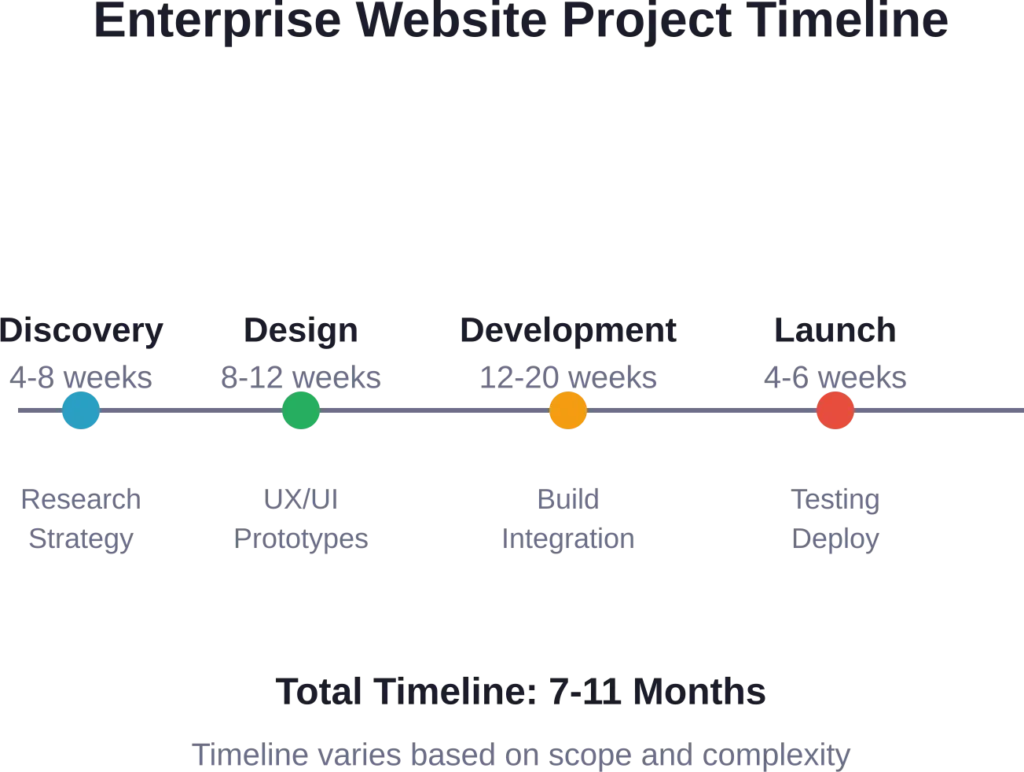
Enterprise web design projects typically span 7-11 months from initial kickoff to launch. This includes discovery and strategy (4-8 weeks), design and prototyping (8-12 weeks), development and integration (12-20 weeks), and testing and launch (4-6 weeks). Timeline varies significantly based on project scope, complexity of integrations, number of stakeholders, and organizational decision-making processes. Projects involving extensive custom functionality or complex migrations may extend beyond a year.
Enterprise web design involves substantially greater complexity across multiple dimensions. Scale differs dramatically—enterprise sites often contain thousands of pages versus dozens. Integration requirements multiply, connecting to CRM, marketing automation, legacy databases, and numerous other systems. Stakeholder coordination becomes exponentially more complex with multiple departments, compliance teams, and executive decision-makers. Security and compliance requirements are more stringent. Technical architecture must support high traffic volumes, global delivery, and sophisticated personalization. Development processes require more rigor with extensive testing, security reviews, and deployment protocols.
The choice depends on your specific needs and existing capabilities. Specialized web design agencies bring deep expertise in their focused area and often deliver higher quality work within that specialty. They’re ideal when you have strong internal marketing, development, or strategy teams that can handle adjacent needs. Full-service agencies offer convenience and integrated thinking across web design, digital marketing, branding, and technology. They suit organizations seeking a single partner for comprehensive digital initiatives. Consider whether you value best-in-class specialized expertise or prefer coordination simplicity with one partner managing multiple workstreams.
Enterprise website projects typically require significant investment reflecting their complexity and business impact. While specific numbers vary widely based on scope, projects generally start at substantial five-figure investments and can reach six or seven figures for large-scale initiatives. Budget should account for strategy and discovery, design and user experience work, development and technical implementation, content creation and migration, testing and quality assurance, and initial training and support. Rather than seeking a generic price range, define your specific requirements and obtain detailed proposals from qualified agencies. Investment should align with the strategic value the website provides to your business.
No single platform suits all enterprise needs. Popular options include enterprise CMS solutions like Adobe Experience Manager, Sitecore, and Drupal for organizations requiring sophisticated content management, workflow, and personalization. Headless CMS platforms like Contentful, Contentstack, and Strapi appeal to organizations seeking flexibility across multiple channels. WordPress with enterprise hosting and security can serve certain use cases. The best choice depends on your specific requirements around scalability, security, integration needs, internal technical capabilities, and budget. Strong agencies recommend platforms based on your requirements rather than pushing a single solution they prefer.
Success measurement should align with business objectives defined during project planning. Common metrics include conversion rate improvements for lead generation or e-commerce goals, engagement metrics like time on site, pages per session, and return visitor rates, performance indicators such as page load times and Core Web Vitals scores, SEO improvements including organic traffic growth and keyword rankings, and user satisfaction measured through surveys and usability testing. Track baseline metrics before launch to establish comparison points. Set specific, measurable targets during the strategy phase. Review performance data regularly post-launch to identify optimization opportunities. The most meaningful success measures connect website performance to broader business outcomes like pipeline growth, customer acquisition costs, or revenue impact.
Post-launch support varies by agency and engagement model but should include warranty periods covering bug fixes and critical issues, typically 30-90 days. Ongoing relationships might involve monitoring and optimization through retainer arrangements, technical support for updates, security patches, and platform upgrades, content and design updates as your business evolves, performance optimization based on usage data and analytics, and strategic consulting to align digital presence with changing business needs. Clarify post-launch support during agency selection. Some organizations prefer comprehensive retainer relationships. Others handle routine maintenance internally and engage agencies for major enhancements. Define expectations upfront to avoid misunderstandings.
Conclusion
Selecting an enterprise web design company represents a significant decision with lasting business impact. The right partner brings strategic thinking, technical excellence, and the project management sophistication required to navigate enterprise complexity.
The agencies highlighted here—Excited Agency, Clay, Huemor, Digital Silk, Lounge Lizard, Bop Design, Fantasy, Instrument, Code and Theory, and Basic Agency—have demonstrated capability serving enterprise clients across industries. Each brings distinct strengths suited to different organizational needs and project types.
But the best agency for your organization depends on your specific context. Industry requirements, technical environment, internal capabilities, budget parameters, and cultural fit all factor into the decision.
Invest time in thorough evaluation. Review portfolios critically. Contact references. Ask detailed questions about process, team composition, and technical approach. The upfront diligence pays dividends throughout the engagement.
Remember that your website isn’t a one-time project—it’s an evolving asset requiring ongoing investment and optimization. The ideal agency relationship extends beyond the initial launch, supporting your digital presence as your business grows and markets shift.
Ready to start your enterprise web design project? Begin by documenting your requirements, assembling your internal stakeholder team, and reaching out to agencies whose capabilities align with your needs. The right partner is out there—thorough evaluation helps ensure you find them.