

Quick Summary: This article reviews the 15 best roofing web design companies in 2026, covering agencies that specialize in lead-generating, SEO-optimized websites for roofing contractors. Each company is evaluated for design quality, technical capabilities, industry focus, and track record delivering measurable results for residential and commercial roofing businesses.
Here’s the uncomfortable truth: most roofing websites aren’t built to convert. They look nice in a portfolio screenshot, but they don’t answer the phone, don’t rank on Google Maps, and don’t turn visitors into booked estimates.
The gap between a brochure site and a lead-generation machine comes down to one thing—whether the agency building it actually understands the roofing business. Not just web design. Not just SEO. The full picture: how homeowners search after a storm, what objections stop them from calling, how to structure service pages so Google ranks them, and how to make the phone ring during slow months.
That’s what separates the agencies on this list from the thousands of generic web design shops. These 15 companies have proven track records building roofing websites that perform. Some focus on residential reroofing, others on commercial or restoration work. Some are full-service marketing agencies, others specialize exclusively in web design and development.
But they all share one trait: they’ve built websites that generate consistent, measurable results for roofing contractors.
What Makes a Great Roofing Web Design Company?
Before jumping into the list, it’s worth understanding what actually matters when evaluating a web design agency for your roofing business.
Design is subjective. Results aren’t.
A great roofing web design company delivers websites that accomplish specific business goals—more calls, more form fills, better Google rankings, higher close rates on estimates. They understand the roofing sales cycle, know how to structure content around high-intent search terms, and build sites that load fast on mobile devices.
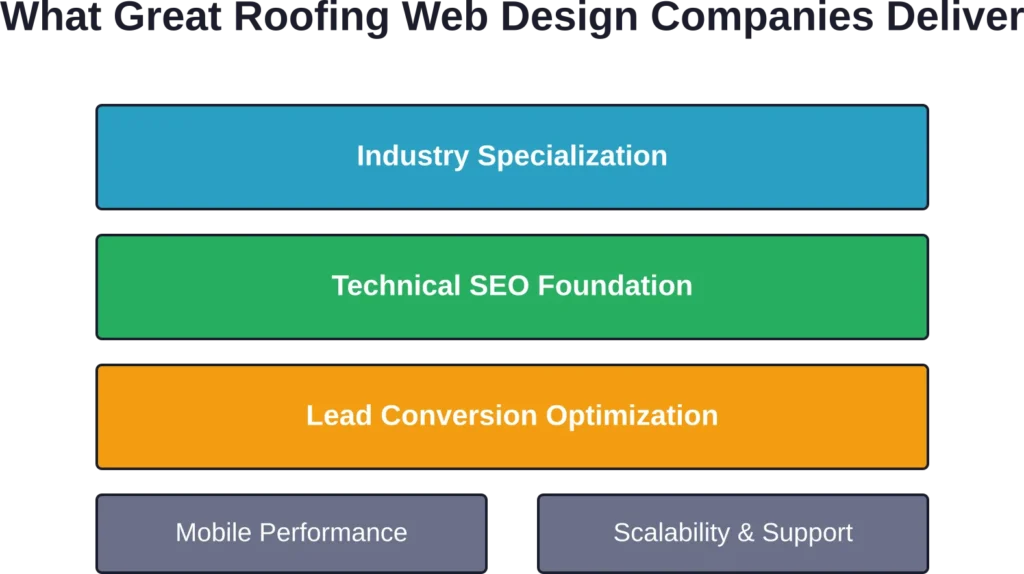
Here’s what separates the best from the rest:
Industry Specialization
Generic web designers build pretty sites. Roofing-focused agencies build sites that convert roofing leads. They know the terminology, understand seasonal demand cycles, and structure service pages around the way homeowners actually search—”roof repair near me,” “emergency roof leak,” “how much does a new roof cost.”
Agencies that work exclusively with contractors bring pre-built frameworks, proven page templates, and conversion strategies that have already been tested across hundreds of roofing companies. That means faster launches and better results out of the gate.
Technical SEO Foundation
A beautiful website that doesn’t rank might as well not exist. The best roofing web design companies build SEO into the foundation—proper heading structure, fast load times, mobile-responsive layouts, schema markup for local businesses, optimized images, and clean code that Google can crawl efficiently.
They also integrate with Google Business Profile, set up conversion tracking, and structure URLs and internal linking in ways that help individual service pages rank for local search terms.
Lead Capture and Conversion Optimization
Traffic without conversions is just expensive entertainment. Top roofing web design agencies obsess over conversion rate optimization: strategically placed call-to-action buttons, click-to-call functionality on mobile, short lead forms, trust signals like reviews and certifications, and fast-loading contact pages.
Many also include lead tracking systems so contractors can see exactly which pages, keywords, and campaigns generate actual phone calls and form submissions.
Speed and Mobile Performance
A significant portion of roofing searches happen on mobile devices, often during or immediately after a storm or leak discovery. If the site takes four seconds to load, the homeowner has already called your competitor.
The best agencies build on modern platforms (or optimize legacy ones) to deliver sub-two-second load times, mobile-first layouts, and one-tap calling from any page.
Scalability and Ongoing Support
Roofing businesses grow. Websites should grow with them. The right agency provides a platform that scales—whether that means adding new service pages, launching a new location, integrating CRM tools, or building out content marketing assets like blogs and guides.
Ongoing support matters too. Plugins break, forms stop working, hosting issues pop up. The best agencies offer maintenance packages or dedicated support so contractors don’t have to troubleshoot technical problems themselves.
The 15 Best Roofing Web Design Companies in 2026
This list includes agencies with documented track records building high-performance websites for roofing contractors. Some focus exclusively on web design, others offer full-service marketing. All have demonstrated measurable results—improved rankings, increased lead volume, and stronger conversion rates.
1. Mobian Studio
Mobian Studio is a European software development partner that builds dedicated engineering teams and production-ready digital products for companies in competitive industries. They help roofing contractors develop high-quality websites, mobile applications, and AI-enhanced tools that improve customer acquisition and service delivery.
What distinguishes Mobian is their focus on fast, reliable delivery through dedicated teams and full-stack execution. They create clean, scalable websites and digital systems with strong architecture, excellent user experience, and long-term support — ideal for roofing businesses that need dependable online platforms.
Mobian offers end-to-end product development, mobile and web solutions, AI & automation systems, scalable architecture, and legacy integration. They provide ongoing partnership with bug warranty and scaling support, helping roofing contractors maintain a competitive digital presence and streamline operations.
Contact Information:
- Website: mobian.studio
- Phone: [email protected]
- Address: Harju maakond, Tallinn, Kesklinnalinnaosa, Masina tn 22, 10113
- LinkedIn: www.linkedin.com/company/mobian-studio
2. A-Listware

A-Listware is a software development and IT consulting company that delivers custom digital solutions and dedicated teams for businesses across various sectors. They help roofing contractors build professional websites, modernize digital infrastructure, and implement tools that improve lead management and customer acquisition.
Their approach focuses on high-quality, secure, and responsive development with seamless team integration. A-Listware creates custom websites and supporting applications tailored to the needs of service contractors, emphasizing reliability and ease of use for both roofing businesses and their clients.
A-Listware provides software development, UX/UI design, testing & QA, IT consulting, dedicated development teams, data analytics, and cybersecurity services. They support roofing companies with custom web solutions, application services, and infrastructure management to strengthen their online marketing and operational efficiency.
Contact Information:
- Website: a-listware.com
- Phone: +1 (888) 337 93 73
- Email: [email protected]
- Address: North Bergen, NJ 07047, USA
- LinkedIn: www.linkedin.com/company/a-listware
- Facebook: www.facebook.com/alistware
3. Lengreo
Lengreo is a full-service B2B marketing and technology partner that builds high-converting websites and complete digital systems for service-based businesses, including roofing contractors. With a strong focus on lead generation and performance marketing, they help roofing companies attract more residential and commercial projects through targeted online strategies.
What sets Lengreo apart is their integrated approach combining website development with advanced lead-generation tactics. They create custom websites and landing pages optimized for conversion, paired with data-driven SEO, paid advertising, and hyper-personalized outreach campaigns. Their websites emphasize clear service presentation, fast-loading design, and strong calls-to-action tailored for roofing inquiries.
Lengreo offers a wide range of services including SEO (local and technical), PPC campaigns across Google and social platforms, LinkedIn outreach, email marketing, and appointment setting. They provide ongoing strategy optimization, conversion rate improvement, and detailed performance reporting to ensure roofing contractors see measurable growth in qualified leads and project bookings.
Contact Information:
- Website: Lengreo.com
- Phone: +31 686 147 566
- Email: [email protected]
- Address: Vrijstraat 9 C/D, 5611 AT Eindhoven, Netherlands
- LinkedIn: Lengreo
- Twitter: @Lengreo
- Instagram: @lengreo
4. Oski
Oski builds smart, well-engineered software solutions for tech-forward businesses and ambitious companies. They design, develop, and maintain robust websites and digital platforms that help roofing contractors deliver exceptional online experiences to homeowners and commercial clients.
What makes Oski stand out is their focus on performance, scalability, and modern technologies. Their websites feature clean architecture, fast loading times, strong frontend frameworks, and seamless integration with cloud services — all optimized for local service businesses like roofing.
Oski offers cloud solutions, frontend development (React, Next.js, etc.), artificial intelligence capabilities, CMS implementation, and full software delivery. They specialize in creating digital tools for industries including home services, helping roofing companies with booking systems, customer portals, and marketing websites that drive growth.
Contact Information:
- Website: oski.site
- Phone: +48571282759
- Email: [email protected]
- Address: Kaupmehe tn 7, 10114 Tallinn, Estonia
- LinkedIn: www.linkedin.com/company/oski-solutions
5. Gilzor

Gilzor specializes in custom software development and digital product creation for businesses looking to strengthen their online presence and streamline operations. They build modern, user-friendly websites and web applications that help roofing contractors improve customer experience, automate lead handling, and scale their digital marketing efforts.
Their strength lies in full-cycle development — from idea validation and UI/UX design to QA and go-to-market strategy. Gilzor creates responsive, high-performance websites and supporting tools (mobile apps, booking systems, or internal dashboards) that roofing companies can use to stand out in competitive local markets.
Gilzor provides mobile and web development, UI/UX design focused on conversion, quality assurance, go-to-market support, and post-launch maintenance. They help roofing businesses develop digital solutions that enhance customer engagement, support online project inquiries, and create additional sales channels.
Contact Information:
- Website: www.gilzor.com
- Email: [email protected]
- Address: Poland, Warsaw, Office 58, street Adama Mickiewicza 37, 01-625
- LinkedIn: www.linkedin.com/company/gilzor-softwaredevelopment
6. On The Map Marketing

On The Map Marketing is a digital agency specializing in home service contractors, with a strong focus on local SEO and lead generation. They build WordPress websites optimized for Google Business Profile rankings, local pack visibility, and organic search performance.
Their web design process starts with keyword research and competitive analysis, ensuring every service page, location page, and blog post is structured around high-intent search terms. They also implement advanced schema markup, optimize site speed, and build responsive layouts that work seamlessly on mobile devices.
On The Map offers ongoing SEO services, including monthly content creation, link building, and technical audits. Many of their roofing clients report significant increases in organic traffic and Google Maps impressions within the first few months of working with the agency.
7. Thrive Internet Marketing Agency
Thrive is a full-service digital marketing agency with a dedicated home services division. They build custom websites for roofing contractors using WordPress and proprietary themes designed for conversion and SEO performance.
Thrive’s approach emphasizes data-driven optimization. They use heat mapping, session recording, and A/B testing to refine website layouts, CTA placement, and form design. Their team also provides ongoing content marketing, Google Ads management, and social media services.
One area where Thrive excels is integrating new AI-driven search strategies, including optimization for Google AI Overviews and generative search engines. They’ve documented success helping clients maintain visibility as search behavior evolves beyond traditional blue-link results.
Thrive works with roofing companies across the revenue spectrum, from smaller local contractors to regional and national operations.
8. Contractor Gorilla

Contractor Gorilla is a marketing agency built specifically for residential contractors, with a large portfolio of roofing clients. They offer a complete web design and marketing platform that includes custom websites, Google Ads, Facebook Ads, SEO, and reputation management.
Their websites are built on a proprietary platform optimized for lead capture and conversion. Forms are short and strategically placed, CTAs are prominent on every page, and mobile layouts prioritize click-to-call functionality. They also include built-in review request tools, helping contractors generate a steady stream of fresh Google reviews.
Contractor Gorilla’s service model is all-inclusive—contractors get a dedicated account manager, monthly strategy calls, and proactive campaign adjustments based on performance data. Their team also handles creative assets, including ad graphics, landing pages, and email templates.
9. Estes Media
Estes Media is a boutique digital agency focused exclusively on home improvement contractors. They build custom WordPress websites with a strong emphasis on design quality, user experience, and technical SEO.
Estes takes a consultative approach, working closely with contractors to understand their brand, target customer, and competitive landscape. Their sites are visually polished, load quickly, and include advanced features like financing calculators, project cost estimators, and interactive service area maps.
They also offer ongoing SEO and content marketing services, producing long-form guides, project galleries, and educational blog posts that help roofing contractors rank for informational keywords and establish authority in their local markets.
10. CinchLocal

CinchLocal is a digital marketing platform designed for multi-location home service companies. While not exclusively focused on roofing, they have a significant number of roofing clients and offer robust web design and marketing tools for regional and national contractors.
CinchLocal’s platform includes a website builder, reputation management tools, social media scheduling, and multi-location SEO capabilities. Contractors can manage web content, Google Business Profiles, and customer reviews from a single dashboard.
Their websites are built for scalability—adding new locations, service pages, or team bios is straightforward, and the platform automatically generates location-specific landing pages optimized for local search.
CinchLocal is a good fit for roofing companies operating in multiple markets or planning to expand, as their technology and support infrastructure are designed to handle complexity.
11. Hook Agency

Hook Agency is a 55+ person marketing agency specializing in home service contractors, with a particularly strong reputation in the roofing vertical. Founded by Tim Brown, author of “How to Become a Hometown Hero,” the agency has built websites and marketing systems for roofing companies ranging from $1 million to $50 million in annual revenue.
What sets Hook apart is their integrated approach. They don’t just build websites—they build complete lead-generation systems that include custom web design, Google Ads management, local SEO, and proprietary lead tracking technology. Their websites are built on WordPress with custom themes optimized for roofing contractors, featuring fast load times, mobile-first design, and conversion-focused layouts.
Hook’s service plans are tiered based on company size and revenue goals, with monthly packages that bundle web design, hosting, ongoing optimization, and marketing services. Their client roster includes both residential reroofing companies and commercial roofing contractors, and they’ve documented case studies showing double-digit increases in lead volume after website launches.
The agency also provides extensive ongoing support, monthly reporting, and proactive optimization—adjusting headlines, testing new CTAs, and refining landing pages based on performance data.
12. Roofing Webmasters
As the name suggests, Roofing Webmasters focuses exclusively on the roofing industry. They’ve been building roofing contractor websites for over a decade and have developed proprietary templates, content frameworks, and SEO strategies specifically for residential and commercial roofing businesses.
Their websites come preloaded with roofing-specific content—service pages for shingle replacement, metal roofing, flat roofing, storm damage repair, and insurance claims assistance. They understand the local search landscape for roofing contractors and structure sites to rank for high-intent keywords in competitive markets.
Roofing Webmasters also offers content marketing services, including blog writing, video production, and reputation management. Many of their clients report improved Google Business Profile rankings and increased organic traffic within 60-90 days of launch.
Their platform includes built-in lead tracking, call recording, and CRM integration, giving contractors full visibility into which marketing channels and website pages generate actual revenue.
13. Contractor Dynamics
Contractor Dynamics is a digital agency focused on residential and commercial contractors, with a significant portion of their portfolio dedicated to roofing companies. They build custom WordPress websites with a strong emphasis on mobile performance and local SEO.
What makes Contractor Dynamics stand out is their technical expertise. Their sites consistently score 90+ on Google PageSpeed Insights, load in under two seconds on mobile, and are structured with clean schema markup that helps Google understand the business, services, and service areas.
They also integrate advanced conversion tracking, allowing contractors to see exactly which pages, keywords, and campaigns generate calls and form fills. Their monthly reporting includes detailed analytics, ranking updates, and actionable recommendations for ongoing optimization.
Contractor Dynamics works with roofing companies of all sizes, from single-crew operations to multi-location enterprises, and scales their service offerings based on business complexity.
14. Webrunner Media Group

Webrunner Media Group specializes in home improvement contractors, with deep expertise in roofing, siding, window replacement, and exterior remodeling. Their websites are built on custom platforms designed specifically for contractors, with pre-built modules for photo galleries, service area pages, financing options, and review displays.
One of their standout features is the visual quality of their designs. Webrunner sites use high-resolution imagery, professional layouts, and brand-consistent color schemes that help roofing contractors differentiate themselves from competitors. They also offer professional photography services for contractors who need on-site project photos.
Webrunner integrates with popular contractor CRMs, including JobNimbus, Jobber, and AccuLynx, streamlining lead management and follow-up workflows. They also provide ongoing SEO services, content writing, and Google Ads management as add-ons to their core web design packages.
15. Scorpion
Scorpion is a large-scale digital marketing agency that serves multiple industries, including legal, home services, and healthcare. Their home services division has built hundreds of websites for roofing contractors, and they bring enterprise-level technology and analytics to businesses of all sizes.
Scorpion’s platform includes proprietary lead tracking, call recording, AI-driven chat tools, and detailed attribution reporting. Contractors can see which ads, keywords, and website pages generate revenue, and Scorpion’s team uses that data to optimize campaigns and site content continuously.
Their websites are built on a proprietary CMS designed for speed and mobile performance. They also offer a full suite of marketing services, including social media management, reputation marketing, and video production.
Scorpion works with roofing companies at all stages—from startups to established multi-location operations—and structures service packages based on monthly marketing budget and business goals.
How to Choose the Right Roofing Web Design Company
With hundreds of agencies claiming to specialize in contractor marketing, narrowing down the right partner can feel overwhelming. Here’s a practical framework for evaluating options.
Start With Your Business Goals
Different agencies serve different needs. A $2 million residential reroofing company needs a different solution than a $15 million commercial contractor expanding into new markets.
Ask yourself: What does success look like six months from now? More phone calls? Better Google rankings? A website that converts at a higher rate? The ability to track ROI on every marketing dollar?
Match the agency’s core strengths to those specific goals. If lead volume is the priority, choose an agency with documented case studies showing increased conversions. If multi-location scalability matters, pick a platform built for growth.
Review Their Portfolio and Case Studies
Any agency can claim expertise. The best ones prove it with real examples. Look for portfolio sites in the roofing industry—preferably companies similar in size and market to yours.
Pay attention to design quality, mobile performance, and site speed. Open the sites on your phone. Try to find the phone number. Fill out a form. Does the experience feel smooth, or clunky?
Better yet, ask for case studies with measurable outcomes. Did traffic increase? Did leads go up? How long did it take to see results?
Understand What’s Included
Web design proposals vary wildly in scope. Some agencies charge a flat fee for design and launch, then hand over the keys. Others bundle ongoing hosting, maintenance, SEO, and optimization into monthly retainers.
Make sure the proposal covers: hosting, SSL certificates, backups, plugin updates, content creation, image sourcing, form setup, analytics integration, and basic SEO configuration. Hidden costs add up quickly if these aren’t included upfront.
Ask About Ownership and Portability
Some agencies build websites on proprietary platforms. That means if the relationship ends, the site doesn’t transfer—contractors have to start over.
Others build on WordPress or other open platforms, giving contractors full ownership and the ability to move to a different host or agency if needed.
Clarify ownership terms before signing. Who owns the design? The content? The domain? Can the site be exported if the partnership ends?
Evaluate Their Communication and Support
Web projects require collaboration. Contractors need to provide branding assets, approve designs, review content, and give feedback through multiple rounds of revisions.
Ask how the agency manages communication. Will there be a dedicated project manager? How often will there be check-ins? What happens if something breaks after launch?
Agencies with strong support infrastructure—dedicated account managers, ticketing systems, and proactive monitoring—tend to deliver smoother experiences and better long-term results.
Compare Monthly Investment Expectations
Though specific rates vary, typical monthly marketing budgets for roofing contractors range from $2,500 to $50,000 depending on market size, competition level, and service scope. Web design may be a one-time investment or bundled into ongoing monthly services.
Understand what the monthly commitment covers—just hosting and maintenance, or active SEO, content creation, and campaign management. Make sure the agency’s service model aligns with available budget and expected ROI.
Common Website Mistakes Roofing Contractors Make
Even with a professional agency, contractors sometimes make strategic mistakes that limit website performance. Here are the most common pitfalls.
Prioritizing Design Over Function
A visually stunning website that doesn’t convert is a waste of money. The goal isn’t to win design awards—it’s to generate leads and close jobs.
The best roofing websites balance aesthetics with functionality. They load fast, make it easy to request estimates, and guide visitors toward high-intent actions—calling, filling out forms, or viewing service area pages.
Ignoring Mobile Performance
More than half of all roofing searches happen on mobile devices, often in high-stress situations—during storms, after discovering leaks, or while comparing contractors.
If the mobile experience is slow, confusing, or hard to navigate, those leads go to competitors. Make sure the agency prioritizes mobile-first design and tests the site on actual devices before launch.
Weak or Missing Local SEO
Roofing is a local business. Rankings in Google’s local pack and Google Maps drive the majority of inbound leads for most contractors.
That means the website needs proper schema markup, optimized Google Business Profile integration, location-specific service pages, and embedded maps. Agencies that treat local SEO as an afterthought leave significant lead volume on the table.
Complicated Contact Forms
Long forms kill conversions. Homeowners searching for roofers don’t want to fill out ten fields before they can request an estimate.
The best forms ask for the bare minimum—name, phone number, zip code, and maybe a brief description of the project. Everything else can be collected during the follow-up call.
No Clear Calls to Action
Every page on a roofing website should guide visitors toward one clear action—call, request an estimate, or schedule an inspection.
If the CTA is buried at the bottom of the page, hidden in a menu, or mixed in with other links, conversion rates suffer. The best sites feature prominent, high-contrast CTA buttons on every page, often in the header, sidebar, and footer.
| Common Mistake | Why It Hurts Conversions | How to Fix It |
|---|---|---|
| Design over function | Slow load times, unclear navigation, weak CTAs | Prioritize speed, clarity, and lead capture |
| Poor mobile experience | Visitors leave before the page loads | Build mobile-first, test on real devices |
| Weak local SEO | Low rankings in Google Maps and local pack | Optimize schema, GBP, and location pages |
| Long contact forms | Homeowners abandon before submitting | Use short forms—name, phone, zip code only |
| No clear CTAs | Visitors don’t know what action to take | Add prominent buttons on every page |
What to Expect During the Web Design Process
Understanding the typical project timeline helps contractors set realistic expectations and plan accordingly.
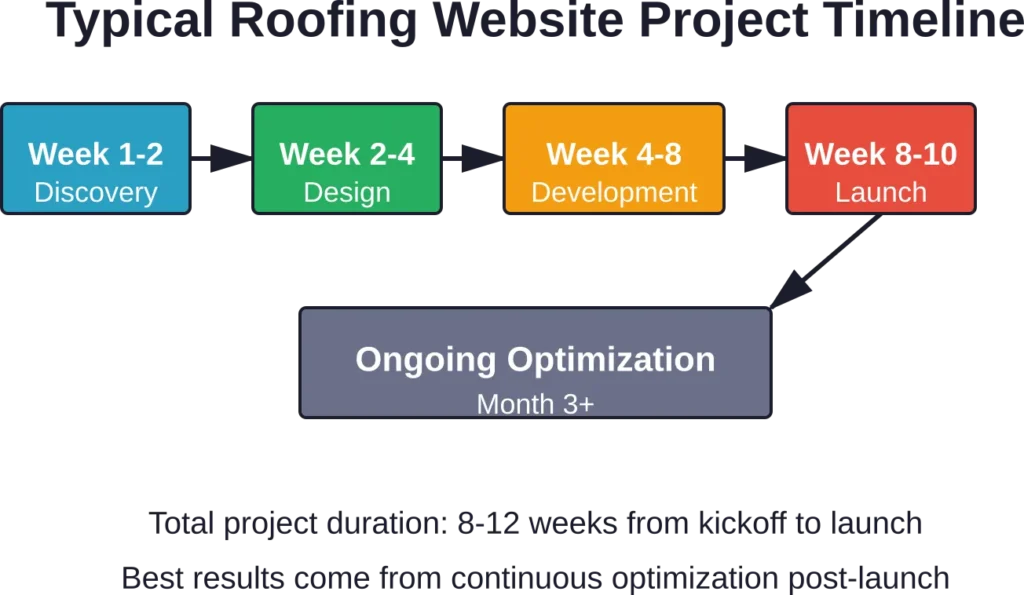
Discovery and Strategy (Week 1-2)
The process starts with discovery—understanding the business, target customer, competitive landscape, and goals. The agency will ask for branding assets (logos, colors, fonts), examples of sites the contractor likes, and details about services, service areas, and unique selling points.
This phase often includes keyword research, competitive analysis, and content strategy planning. The agency will identify which service pages, location pages, and content assets need to be built.
Design and Mockups (Week 2-4)
Next comes design. The agency will create mockups or wireframes showing the homepage, service pages, and key landing pages. Contractors review, provide feedback, and request revisions.
Most agencies allow 2-3 rounds of design revisions before locking in the final look. This phase is critical—once development starts, major design changes become expensive and time-consuming.
Development and Content (Week 4-8)
With the design approved, the agency builds the site—coding pages, integrating forms, setting up tracking, optimizing images, and writing or uploading content.
Contractors typically provide input on service descriptions, team bios, and company history. Many agencies offer content writing services to fill gaps.
Testing and Launch (Week 8-10)
Before going live, the agency tests the site across devices, browsers, and screen sizes. They check forms, call tracking, page speed, and SEO configuration.
Once everything is verified, the site goes live. Some agencies run the new site in parallel with the old one for a few days to catch any issues before redirecting the domain.
Optimization and Ongoing Support (Post-Launch)
Launch isn’t the finish line—it’s the starting line. The best agencies monitor performance, track conversions, and make iterative improvements based on real data.
That might mean tweaking headlines, adjusting CTA placement, adding new service pages, or refining SEO elements to improve rankings.
Key Features Every Roofing Website Needs
Regardless of which agency builds the site, certain features are non-negotiable for roofing contractors who want to generate consistent leads.
Mobile-Responsive Design
This should go without saying, but plenty of older roofing websites still fail basic mobile usability tests. Every element—navigation, images, forms, buttons—needs to work seamlessly on phones and tablets.
Click-to-Call Functionality
On mobile devices, phone numbers should be clickable. One tap should initiate a call. Forcing visitors to copy and paste or manually dial dramatically reduces conversion rates.
Service Area Pages
Roofing companies serve specific cities and neighborhoods. Each service area should have its own dedicated page optimized for local search terms—”roofer in [city],” “roof repair in [zip code],” etc.
These pages help contractors rank in multiple local markets and give Google clear signals about where the business operates.
High-Quality Project Photos
Homeowners want to see completed projects—before-and-after shots, roof replacements, storm damage repairs, and commercial installations. High-resolution photos build credibility and help visitors visualize the quality of work.
Customer Reviews and Testimonials
Social proof matters. Featuring Google reviews, video testimonials, or written case studies on the website reassures potential customers and increases trust.
Many agencies integrate review feeds that automatically pull fresh reviews from Google, keeping the site updated without manual work.
Clear Service Pages
Every roofing service—shingle replacement, metal roofing, flat roofing, gutter installation, storm damage repair—should have its own page. These pages should explain what the service includes, why it matters, and how to request an estimate.
Well-structured service pages also help the site rank for specific search queries and give Google more context about what the business offers.
Lead Capture Forms
Forms should be short, simple, and strategically placed. Best practice: name, phone, zip code, and a brief description field. Longer forms reduce completion rates.
Fast Load Times
Page speed directly impacts both user experience and SEO. Sites that load in under two seconds convert better and rank higher than slow sites.
Trust Signals
Certifications, manufacturer partnerships, insurance verification, and industry affiliations all build trust. Featuring logos from GAF, Owens Corning, CertainTeed, or industry associations signals professionalism and quality.
How Roofing Web Design Ties Into Overall Marketing
A great website doesn’t exist in isolation. It’s the hub of a larger marketing ecosystem that includes SEO, paid ads, reputation management, and content marketing.
SEO and Organic Traffic
Search engine optimization is the process of improving website visibility in Google search results. For roofing contractors, that means ranking for terms like “roofer near me,” “roof repair [city],” and “how much does a new roof cost.”
The best agencies build SEO into the site from day one—optimized page titles, headers, meta descriptions, schema markup, and internal linking. Ongoing SEO work includes content creation, link building, and technical optimization.
Google Ads and PPC
Pay-per-click advertising drives immediate traffic and leads while organic SEO takes time to build. Google Ads campaigns target high-intent keywords and send traffic to optimized landing pages.
The website needs to support PPC campaigns with fast-loading, conversion-focused landing pages that match ad messaging and include clear CTAs.
Google Business Profile and Local SEO
For roofing contractors, Google Business Profile (formerly Google My Business) is often the most valuable marketing asset. Optimizing the profile—accurate NAP (name, address, phone), photos, posts, and reviews—helps contractors appear in the local pack and Google Maps.
The website should link to and from the Google Business Profile, and the NAP information should be consistent across both.
Content Marketing
Blogging, guides, FAQs, and educational content help contractors rank for informational keywords, establish authority, and nurture leads. Homeowners researching roof replacement, storm damage, or roofing materials often read multiple articles before contacting contractors.
A steady stream of quality content increases organic traffic, improves domain authority, and supports long-term SEO performance.
Reputation Management
Reviews influence both search rankings and conversion rates. Contractors with more reviews and higher average ratings appear more frequently in local search results and convert more website visitors into calls.
Many web design agencies integrate review request automation, making it easy to collect fresh reviews after every completed job.
Frequently Asked Questions
Project costs vary widely depending on agency, scope, and complexity. Some contractors invest a few thousand dollars for template-based designs, while others spend significantly more for custom builds with advanced features, integrations, and ongoing support. Many agencies bundle web design into monthly marketing retainers rather than charging a separate upfront fee.
Typical timelines range from 8 to 12 weeks from kickoff to launch. Simpler template-based sites can go live faster, while fully custom builds with extensive content, integrations, and unique features take longer. Delays often happen during the review and approval stages—contractors who respond quickly to design mockups and content drafts keep projects on track.
Ownership terms vary by agency. Some build sites on proprietary platforms, meaning the contractor doesn’t fully own the site and can’t easily move it to another host. Others build on WordPress or open platforms, giving contractors full ownership of design, content, and code. Clarify ownership and portability terms before signing a contract.
Template sites use pre-built themes with limited customization options. They’re faster to launch and typically cost less, but every site built on the same template looks similar. Custom builds are designed from scratch, offering complete control over layout, features, and branding. Custom sites take longer and cost more but provide unique designs that better reflect brand identity.
That depends on the platform. WordPress sites with visual page builders allow contractors to make basic updates—changing text, adding photos, or publishing blog posts—without coding knowledge. Proprietary platforms may require agency assistance for any changes. Ask about content management capabilities and training during the proposal stage.
The best agencies integrate call tracking, form tracking, and analytics so contractors can see exactly which pages, keywords, and campaigns generate calls and submissions. Google Analytics, call recording tools, and CRM integrations provide detailed attribution data. If an agency doesn’t offer tracking and reporting, ask why—it’s a red flag.
It depends on current needs and budget. If the priority is getting a high-quality website live quickly, a web design specialist makes sense. If the goal is ongoing lead generation through SEO, PPC, and content marketing, a full-service agency that bundles web design with marketing services provides a more integrated solution. Many contractors start with web design and add marketing services once the site is live and performing.
Final Thoughts: Choosing the Right Partner
The roofing industry is more competitive than ever. Homeowners have dozens of contractors to choose from in every market, and most make decisions based on what they find online—Google search results, reviews, and websites.
A high-performing website isn’t just a digital brochure. It’s the most important lead-generation tool a roofing contractor owns. It works 24/7, answers questions, builds trust, and converts visitors into booked estimates.
The agencies on this list have proven track records building websites that deliver measurable results. Some focus exclusively on roofing, others serve a broader range of home service contractors. Some offer full-service marketing, others specialize in web design and development.
The right choice depends on business size, budget, growth goals, and current marketing needs. But regardless of which agency builds the site, the fundamentals remain the same: fast load times, mobile-first design, clear CTAs, strong local SEO, and ongoing optimization based on performance data.
Start by defining success—what does a winning website look like for the business? More calls? Higher conversion rates? Better Google rankings? Then evaluate agencies based on their ability to deliver those specific outcomes.
The best partnerships aren’t transactional. They’re collaborative, data-driven, and focused on long-term growth. Choose an agency that understands the roofing business, communicates clearly, and treats the website as the foundation of a larger marketing system—not just a one-time project.
Ready to build a website that actually generates leads? Review the agencies on this list, check their portfolios, and schedule consultations with the ones that align with business goals and budget. The right partner is out there—and the ROI on a high-performing roofing website is one of the best investments a contractor can make.