
Quick Summary: Dubai’s architectural excellence is driven by a diverse ecosystem of design firms specializing in luxury residential, commercial, and mixed-use developments. This guide profiles ten leading architectural design companies in Dubai—from award-winning international studios like Killa Design to innovative local practices such as Dabbagh Architects—each bringing unique expertise in sustainable design, cultural context, and cutting-edge innovation that continues to define the emirate’s iconic skyline.
Dubai’s skyline tells a story of ambition. Behind every iconic tower, luxury villa, and innovative mixed-use development stands an architectural firm that turned vision into concrete reality.
The emirate has become a global magnet for architectural talent—a place where international expertise meets local insight. These firms don’t just design buildings. They shape experiences, define neighborhoods, and push the boundaries of what’s technically and aesthetically possible.
But with dozens of studios claiming expertise, how do you identify the truly exceptional ones?
What Defines Excellence in Dubai Architecture
The best architecture firm in Dubai isn’t necessarily the largest or most famous. Excellence emerges from specific capabilities that matter in this unique context.
First, regulatory mastery. Dubai Municipality has increased construction oversight and field inspections in 2025, reflecting heightened scrutiny of compliance. Top firms navigate Dubai Building Code, DEWA regulations, and Estidama sustainability standards without friction.
Second, climate-responsive design. Passive cooling strategies, wind towers, and water features aren’t decorative—they’re functional responses to desert conditions. The 2024/25 House of the Future competition jury panel, including Ahmed Bukhash (Founder of Archidentity), specifically commended designs integrating these elements where technically feasible.
Third, cost efficiency without compromise. Dubai Municipality recently warned villa engineering firms for inflating construction costs through excessive material specifications. Leading practices strike the balance between quality and economic reality.
Architectural fees generally range from 3-6% of total construction cost in Dubai, depending on project complexity and scope. This transparency matters when budgeting residential or commercial developments.
The Top 11 Architectural Design Companies in Dubai
Here’s the thing though—Dubai’s architectural landscape is remarkably diverse. These ten firms represent different specializations, scales, and philosophies, but all share a track record of delivered excellence.

1. Powerkh
Powerkh is a UK-based company with offices in the USA and Ukraine, providing architectural visualization services for residential, commercial, hospitality, and mixed-use projects across Europe. The company creates BIM-based 3D models and architectural renderings that help architects, developers, and construction teams review projects before construction begins.
Their services include exterior and interior architectural visualization, BIM modelling from LOD 100 to LOD 500, Scan to BIM, and point cloud-based existing conditions modelling. Powerkh also supports coordination between architectural, structural, and MEP systems using Autodesk Revit and Navisworks workflows.
The company focuses on combining architectural rendering with technical BIM coordination, helping project teams keep visualizations aligned with project documentation, materials, dimensions, and construction data throughout different project stages.
Contact Information:
- Website: www.powerkh.com
- Email: [email protected]
- Facebook: www.facebook.com/100064039650167
- LinkedIn: www.linkedin.com/company/powerkh
- Instagram: www.instagram.com/powerkh_com
- Address: 3, Lavinia Walk, Taw Hill, Swindon SN25 1AP
- Phone: +44 7490 426678
2. Killa Design
Killa Design created Dubai’s most recognizable recent addition: the Museum of the Future. This award-winning practice combines parametric design with cultural narrative, producing buildings that function as landmarks.
The firm’s work on Marsa Al Arab in Jumeirah demonstrates their range—from iconic cultural institutions to luxury hospitality developments. Their approach integrates cutting-edge computational design with contextual sensitivity, creating structures that feel both futuristic and rooted in place.
Killa Design’s projects consistently feature environmental sustainability, with passive strategies and innovative material applications reducing operational energy demands.

3. Dabbagh Architects
Founded by Sumaya Dabbagh, this Emirati-owned practice brings deep regional understanding to contemporary design challenges. Dabbagh served on the House of the Future competition jury, evaluating designs for sustainable Emirati homes—a perfect illustration of the firm’s expertise in culturally grounded residential architecture.
The practice specializes in projects that balance modernity with Emirati identity, creating spaces that respect heritage while embracing innovation. Their residential work demonstrates particular sophistication in climate adaptation and community-oriented planning.

4. Archidentity
Ahmed Bukhash leads this UAE-based firm with a focus on architectural identity and sustainable urbanism. Archidentity’s portfolio spans residential, commercial, and mixed-use developments across the Gulf region.
The firm’s approach emphasizes strong street-facing frontages and cohesive community layouts—principles Bukhash advocated as a jury member on the House of the Future competition. Their work demonstrates how density and livability can coexist when thoughtfully planned.
5. Al Mujassam
With 48+ years of expertise, Al Mujassam represents institutional depth in Dubai’s architectural scene. This leading architecture company specializes in luxury villa design, custom residential homes, and apartment planning across Dubai and the wider UAE.
Their longevity reflects adaptability—the firm has evolved through multiple development cycles while maintaining design quality. Al Mujassam’s residential architecture in Dubai ranges from exclusive community villas to high-rise apartment towers, with particular strength in coordinating complex projects through Dubai’s regulatory environment.
The firm’s experience shows in execution: they understand that villas in exclusive communities often require more detailed coordination and higher specification levels than standard developments.

6. ODG Architects
ODG offers integrated design and build services for commercial, residential, and hospitality architecture projects in Dubai. This comprehensive approach—managing design through construction—appeals to clients seeking single-point accountability.
The firm’s architectural design service guides projects from initial sketch to final plan, with emphasis on spaces that suit lifestyle or business goals. ODG’s quality-driven approach has produced iconic projects across multiple typologies.

7. Spazio Interior Design
While primarily known for interior design, Spazio delivers comprehensive building architecture design in Dubai. The firm offers exclusive exterior architecture solutions for high-end and mid-range residential tower projects—creating facades that attract buyers and define skylines.
Their high-rise residential apartment tower expertise addresses a critical Dubai typology. Spazio understands that facade design directly impacts marketability in Dubai’s competitive residential sector.

8. La Firma
La Firma provides architecture services across Abu Dhabi, Dubai, and the broader UAE, with particular expertise in residential, commercial, and institutional projects. The firm demonstrates fluency in Emirates-specific requirements—from Abu Dhabi 2030 Vision standards to Dubai-specific DEWA regulations.
Their knowledge extends to technical details that trip up less experienced practices: ADDC utility connections in Abu Dhabi, Estidama sustainability standards, and Dubai Building Code nuances. This regulatory competence prevents costly delays and redesigns.
9. Memar Architects
Memar defines itself not by size or name recognition, but by designing spaces that reflect innovation, functionality, and cultural identity. The firm’s residential design philosophy emphasizes context-driven solutions rather than imported templates.
Their modern residential approach balances international design excellence with local cultural values—creating homes that feel contemporary without cultural dislocation. Memar’s work demonstrates that the best architecture firm in Dubai is measured by appropriateness, not just aesthetics.

10. Fajr Interiors
Fajr brings creativity and technical skill to architectural and interior design projects across Dubai. As an architect contractor in Dubai, the firm handles both design conception and practical execution.
Their integrated approach—combining architectural vision with construction coordination—suits clients who value seamless project delivery. Fajr’s work spans luxury residences, commercial spaces, and hospitality projects.

11. Studio Pheasant
Studio Pheasant completed the Gooder Store retail interior in Dubai—a 1,500 m² project completed in 2026 that showcases the firm’s contemporary approach to commercial architecture. The practice demonstrates particular strength in retail and hospitality interiors.
Their design philosophy emphasizes experiential qualities—how people move through and engage with space. This user-centered approach produces environments that function as brand experiences, not just physical containers.
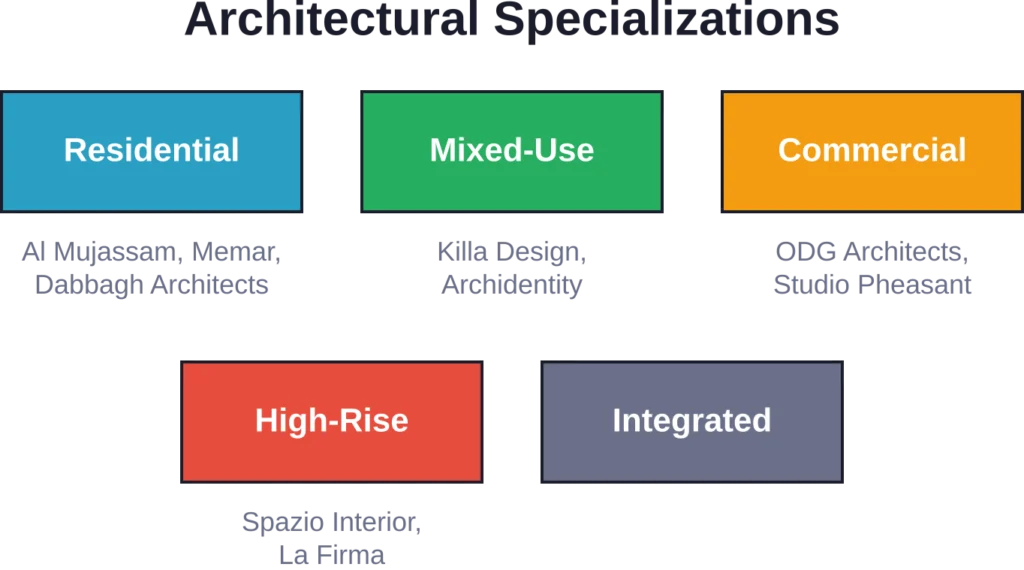
Key Selection Criteria for Architectural Partners
Choosing among Dubai’s architectural design companies requires evaluating capabilities against your specific project needs. Generic reputation matters less than relevant experience.
Start with typology expertise. A firm brilliant at luxury villas may lack the structural engineering coordination required for high-rise towers. Studio Pheasant excels at retail interiors—but that specialization differs from residential master planning.
Regulatory knowledge prevents delays. Engineering consultancy offices that breach Dubai Municipality regulations face six-month suspensions. Your architect’s fluency with approval processes directly impacts timeline and budget.
Portfolio scrutiny reveals patterns. Look for completed projects in similar contexts—not just pretty renderings. Al Mujassam’s 48+ years of delivered residential projects carries more weight than a newer firm’s ambitious proposals.
Sustainability integration separates forward-thinking practices from cosmetic green-washing. Killa Design’s Museum of the Future demonstrates environmental performance through form, not just specification sheets.
| Selection Factor | Why It Matters | How to Evaluate |
|---|---|---|
| Typology Experience | Each building type requires specific expertise | Review completed projects in your category |
| Regulatory Fluency | Prevents delays and redesign costs | Ask about approval timelines on recent projects |
| Climate Response | Impacts long-term operational costs | Request energy modeling data from past work |
| Cost Discipline | Protects budget without compromising quality | Examine value engineering examples |
| Cultural Context | Creates appropriate, meaningful design | Assess cultural sensitivity in portfolio |
Residential Architecture Trends in Dubai
Dubai’s residential architecture is shifting. The villa typology—long dominated by neo-classical pastiche—is evolving toward climate-responsive modernism.
The House of the Future competition results showcase this transition. Winning designs featured passive cooling, meaningful integration of traditional elements like wind towers, and strong street-facing frontages that build community rather than fortress compounds.
Cost efficiency has become a design priority, not an afterthought. Dubai Municipality’s crackdown on engineering offices that inflate costs through excessive steel specifications reflects market demand for value.
Sustainable design is moving from premium add-on to baseline expectation. Estidama standards in Abu Dhabi and growing environmental consciousness among Dubai buyers drive this shift. Firms like Dabbagh Architects integrate sustainability as fundamental design logic, not bolt-on features.
Community-oriented layouts are replacing inward-focused compounds. Archidentity’s emphasis on cohesive neighborhood design reflects recognition that residential quality extends beyond property lines.
Commercial and Mixed-Use Excellence
Dubai’s commercial architecture serves increasingly sophisticated users. Office buildings, retail environments, and hospitality projects demand more than aesthetic appeal—they must perform as business tools.
Killa Design’s work exemplifies this functional sophistication. The Museum of the Future operates as cultural institution, tourism attraction, and innovation hub simultaneously. That programmatic complexity requires architectural intelligence beyond form-making.
Retail architecture has evolved from container to experience. Studio Pheasant’s Gooder Store demonstrates how contemporary commercial interiors create brand environments that drive engagement and sales.
Mixed-use developments represent Dubai’s urban future. These projects integrate residential, commercial, and sometimes hospitality functions in cohesive environments. Success requires coordinating multiple regulatory frameworks, user groups, and operational systems—complexity that separates competent firms from exceptional ones.

Frequently Asked Questions
Architectural fees generally range from 3-6% of total construction cost in Dubai, depending on project size, complexity, and scope. Villas in exclusive communities often require more detailed coordination and higher specification levels, pushing fees toward the upper range. Some firms quote per-square-meter rates for specific typologies, but percentage-of-construction-cost remains the standard industry model.
Approval timelines vary by project complexity and emirate. Residential villas in Dubai typically require 8-16 weeks for Municipality approval after design completion. High-rise and mixed-use projects involve longer approval cycles due to additional structural, MEP, and life-safety reviews. Firms with strong regulatory expertise navigate this process more efficiently, avoiding resubmission delays.
Emirati-owned firms like Dabbagh Architects and Archidentity bring valuable cultural context and regional relationships. But firm ownership matters less than relevant project experience and design philosophy alignment. The best architectural design companies in Dubai include both local and international practices—evaluate based on portfolio quality, typology expertise, and cultural sensitivity rather than ownership structure alone.
Design-only firms like Killa Design focus exclusively on architectural services, with separate contractors handling construction. Design-build firms like ODG Architects integrate both functions, providing single-point accountability from concept through completion. Design-build can streamline coordination and potentially reduce costs, but design-only arrangements preserve stronger client control over contractor selection and construction quality.
Leading Dubai architecture firms integrate sustainability as core design logic, not optional add-on. This includes passive cooling strategies, material selection, water conservation, and energy modeling. Estidama standards govern Abu Dhabi projects, while Dubai increasingly emphasizes environmental performance. The House of the Future competition specifically commended passive cooling, wind towers, and water features where technically feasible—reflecting industry priorities toward climate-responsive design.
International architects regularly practice in Dubai, either through local office establishment or partnership with UAE-licensed firms. Projects require sign-off by locally registered consultants, but design leadership often comes from international studios. Killa Design represents this model—international design expertise operating within Dubai’s regulatory framework. The emirate’s architectural excellence stems partly from this global talent convergence.
Dubai architecture balances extreme climate challenges, rapid development timelines, cultural context, and ambitious aesthetic expectations. Successful designs respond to desert conditions through passive strategies while creating visually striking forms that function as economic and cultural assets. The best firms synthesize technical performance, regulatory compliance, cost discipline, and design excellence—a combination that defines Dubai’s architectural character.
Making the Right Choice
Dubai’s architectural landscape offers remarkable depth. From award-winning practices like Killa Design to experienced residential specialists like Al Mujassam, the ecosystem supports projects across every scale and typology.
But depth creates choice complexity. The firm perfect for one project may be wrong for another.
Start with clear project definition. Residential or commercial? What scale and budget? Which regulatory jurisdiction? What cultural and aesthetic priorities?
Then evaluate firms against those specific criteria. Portfolio relevance trumps general reputation. Regulatory fluency prevents costly delays. Cultural sensitivity creates appropriate solutions.
The best architecture firm in Dubai is the one whose expertise aligns precisely with your project’s unique requirements. Generic rankings matter less than specific fit.
These ten firms represent proven excellence across Dubai’s architectural spectrum. Each brings distinct strengths—study their work, understand their philosophies, and match capabilities to needs.
Dubai’s built environment continues evolving toward greater sustainability, cultural authenticity, and urban sophistication. The firms shaping that evolution combine technical mastery with design vision—transforming ambitious ideas into enduring reality.