

Quick Summary: As-built documentation records the final state of a completed construction project, capturing all changes, modifications, and deviations from original design plans. Unlike design documents that show intent, as-built records reflect reality—what was actually constructed, including field adjustments, unforeseen conditions, and contractor modifications. These documents serve as essential references for facility management, future renovations, compliance verification, and operational maintenance throughout a building’s lifecycle.
Construction projects rarely unfold exactly as designed. Field conditions change, materials get substituted, systems get rerouted, and contractors make countless adjustments during the building process. That gap between what was planned and what actually got built creates a documentation challenge that follows projects for decades.
As-built documentation bridges that gap. But it’s more than just updated drawings—it’s a comprehensive record of reality that becomes the single source of truth for everything that happens after construction wraps.
What As-Built Documentation Actually Means
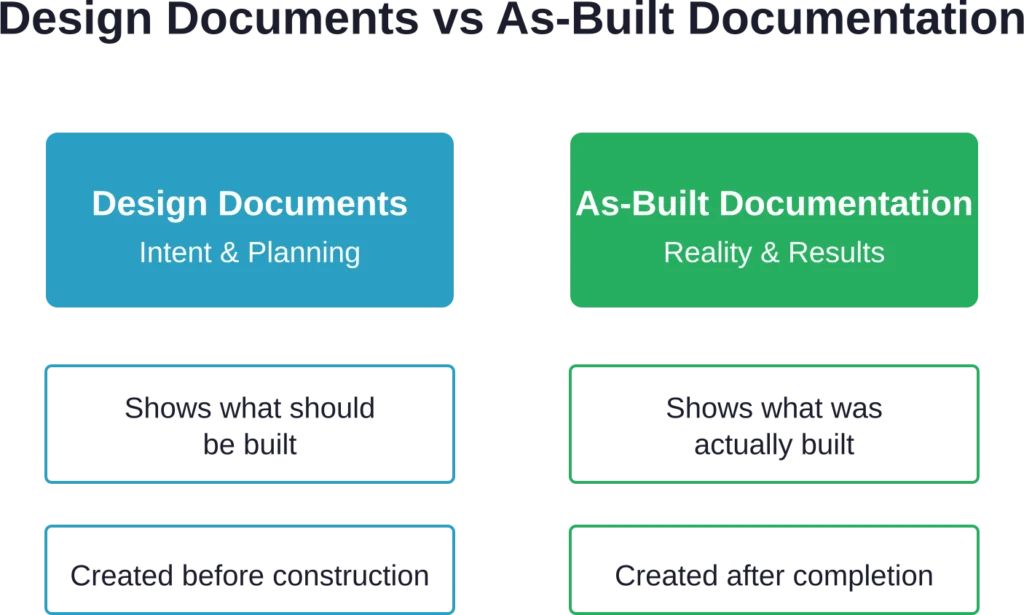
As-built documentation refers to the final, accurate record of a completed construction project. It captures the precise configuration of everything that was actually constructed, including all modifications, changes, and deviations from the original design plans.
The term encompasses detailed drawings, specifications, material lists, equipment data, and supporting records that document the exact state of the finished building or infrastructure. Unlike design documents that represent intentions and plans, as-built documentation reflects what exists in the physical world.
According to the American Institute of Architects, construction documents may not be complete when sent to bid, with incompleteness specifically noted. This reality makes as-built documentation even more critical—design cannot be perfected in advance of construction, and mid-course adjustment is always required.
Common Terms and Confusion
The construction industry uses several related terms that often get conflated. Record drawings typically refer to contractor-marked prints showing field changes. Conformed drawings incorporate bid clarifications issued as addendums, particularly in federal work, according to discussions on the AIA Community Hub.
As-built documentation goes further. It’s a comprehensive capture of the final project state, often incorporating survey data, material certifications, system test results, and operational parameters that didn’t exist when construction started.
Why Simply Updating Design Documents Doesn’t Work
Here’s where many projects go wrong. Teams treat as-built documentation as a simple revision task—mark up the original drawings with red ink, note a few changes, and call it done. That approach misses the point entirely.
Design documents serve a specific purpose: they communicate intent to contractors and establish a basis for bidding. They’re instruments of architectural service, as the AIA notes in its standard of care guidance—not products in themselves.
As-built documentation serves a completely different purpose. It’s a reference tool for facility operators, maintenance teams, renovation architects, and anyone who needs to understand the building as it exists. The information required for those use cases often doesn’t appear anywhere in the original design.
Information That Only Exists After Construction
Consider what gets determined during construction rather than design:
- Exact routing of utilities that shifted around discovered conditions
- Precise locations of concealed connections and access points
- Actual product models and serial numbers for installed equipment
- Field-verified dimensions that differ from nominal design measurements
- As-tested performance data for mechanical and electrical systems
- Substrate conditions that required structural reinforcement
- Approved substitutions and value engineering changes
None of this information exists when the design documents go out for bid. Marking up a design drawing with some revision clouds doesn’t capture the full picture of what happened in the field.
Who Actually Needs As-Built Documentation
The value of accurate as-built records extends far beyond the immediate project team. Multiple stakeholders rely on this documentation throughout a building’s operational life.
Facility managers use as-built drawings to plan maintenance schedules, order replacement parts, and troubleshoot system failures. When a pipe bursts or a circuit trips, they need to know exactly what’s behind that wall and where the shutoff valves actually are—not where they were supposed to be.
Renovation architects and engineers can’t design additions or upgrades without understanding existing conditions. As-built documentation provides the baseline for future work, reducing the need for expensive investigative demolition and field verification.
Building operators reference equipment specifications, control sequences, and system diagrams documented in as-built records. These details inform daily operations and emergency response procedures.
Regulatory inspectors and insurance auditors often require as-built documentation to verify code compliance and assess risk. The American Society of Civil Engineers emphasizes that careful documentation can reduce the impact of future claims against design teams.
| Stakeholder | Primary Use | Critical Information Needed |
|---|---|---|
| Facility Managers | Maintenance planning | Equipment locations, access points, shutoff locations |
| Renovation Teams | Design baseline | Structural elements, system capacities, available space |
| Building Operators | Daily operations | Control sequences, equipment specs, emergency procedures |
| Compliance Officers | Code verification | Fire-rated assemblies, egress paths, accessibility features |
| Asset Managers | Capital planning | System ages, warranty data, replacement schedules |
Get Accurate As-Built Documentation for Your Project
Powerkh works with project teams that need reliable as-built models, drawings, and verified site information during construction and project close-out. Its services include laser scanning, existing conditions modelling, deviation checks, and as-built verification.
Need Support with As-Built Documentation?
Talk with Powerkh to:
- verify installed work against design models
- prepare accurate as-built BIM models and drawings
- identify site deviations and undocumented changes
- support project handover with verified information
Contact Powerkh for a project review and consultation.
The Accuracy Challenge in As-Built Documentation
Creating truly accurate as-built documentation presents significant challenges. The process happens during the chaotic final stages of construction when teams are rushing toward substantial completion. Field crews are focused on finishing punch lists, not marking up drawings.
Contractors traditionally handle as-built documentation as a contractual obligation rather than a valued deliverable. The results often reflect that priority—hastily marked prints with incomplete notes, missing details, and questionable accuracy.
The ASCE notes that documenting decisions and field visits is crucial for claim reduction. But that documentation discipline needs to extend through project closeout, when attention typically shifts to the next job.
Traditional Methods Fall Short
The conventional approach relies on manual markups during construction. Superintendents and foremen are supposed to note changes on their field sets, which then get compiled into final as-built drawings. Several problems plague this method:
First, field markups happen inconsistently. When crews are under schedule pressure, documentation becomes an afterthought. Changes get made without corresponding drawing updates.
Second, manual compilation introduces errors. Someone has to interpret hastily scrawled notes and translate them into clean CAD revisions. Details get lost in translation or misunderstood entirely.
Third, timing creates gaps. Many changes happen early in construction but don’t get documented until months later during closeout, when memories have faded and original crew members may have moved to other projects.
Modern Approaches to As-Built Documentation
Digital tools are transforming how teams capture and maintain as-built records. The shift from paper-based markups to digital capture methods addresses many traditional accuracy challenges.
Laser scanning and photogrammetry technologies now enable precise 3D capture of completed construction. These methods produce point clouds and digital models that represent actual built conditions with millimeter-level accuracy. The data capture happens quickly—often in hours rather than days—and creates an objective record independent of manual interpretation.
Building Information Modeling (BIM) platforms support as-built documentation by providing a framework to integrate field data, equipment specifications, and system information into coordinated 3D models. Rather than scattered 2D drawings and separate equipment lists, BIM-based as-built documentation creates a single, queryable database of building information.
Mobile documentation apps allow field teams to capture changes in real-time using tablets and smartphones. Photos, notes, and markups get geotagged and timestamped, creating an audit trail that links documentation to specific construction activities.
According to Texas A&M University’s College of Architecture, construction management software tools increasingly incorporate AI features for automated documentation, change tracking, and information extraction from field photos and drawings.
The Digital Twin Concept
Digital twins represent the leading edge of as-built documentation. Rather than static drawings, a digital twin creates a dynamic virtual model linked to real-time building data. Sensors, control systems, and IoT devices feed operational information into the model, allowing facility teams to visualize performance alongside spatial configuration.
This approach transforms as-built documentation from a reference archive into an active management tool. The model evolves as the building changes, maintaining current information rather than becoming progressively outdated.
Creating Quality As-Built Documentation
Successful as-built documentation requires planning and process, not just technology. The best practices center on systematic capture rather than after-the-fact reconstruction.
Start with clear contract requirements. Specify exactly what as-built documentation the contractor must deliver, in what format, and with what level of detail. Vague language like “provide as-built drawings” leads to incomplete deliverables that don’t meet actual needs.
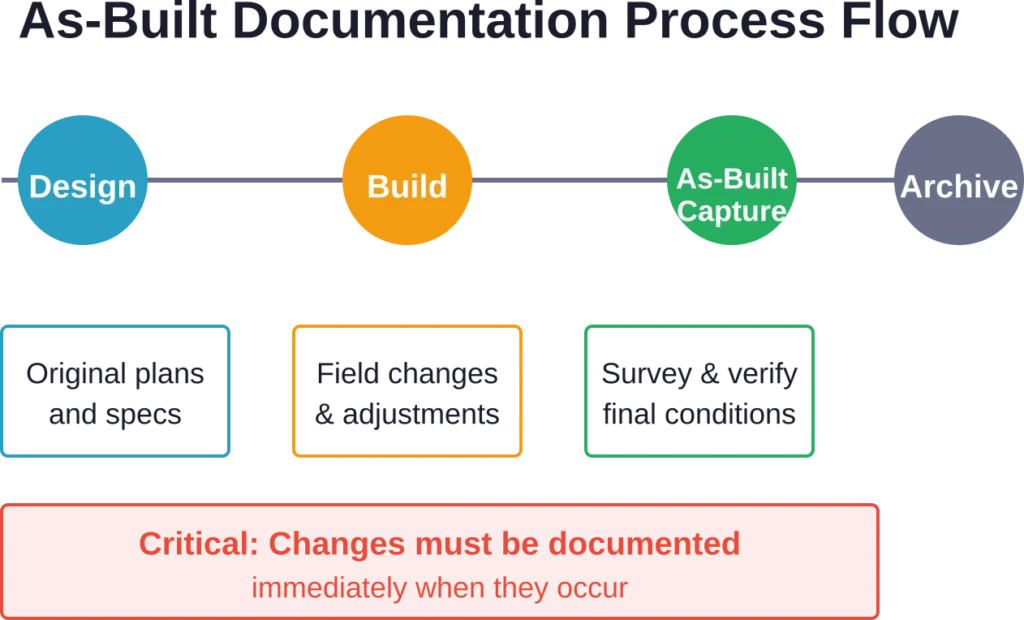
Establish documentation protocols during construction. Assign responsibility for capturing changes and set up regular review intervals to ensure markups stay current. Waiting until substantial completion creates an impossible catch-up task.
Use verification surveys to validate critical elements. For concealed systems and infrastructure, field verification before closeout catches discrepancies while correction is still practical.
Integrate equipment data systematically. Compile product literature, test reports, warranty information, and O&M manuals alongside spatial drawings. This supporting documentation becomes essential for facility management but often gets separated from the drawing set.
| Documentation Element | Timing | Responsible Party |
|---|---|---|
| Field markups | Continuous during construction | Contractor superintendent |
| Survey verification | Before concealment | Third-party surveyor or BIM coordinator |
| Equipment data compilation | As equipment is installed | Subcontractors and suppliers |
| System testing records | During commissioning | Commissioning agent or engineer |
| Final drawing coordination | Before substantial completion | Architect or design-build team |
Life After Provisional Acceptance
As-built documentation doesn’t end when the contractor hands over the keys. The real test comes during the building’s operational phase, when facility teams rely on that documentation daily.
Proper archiving ensures as-built records remain accessible. Physical drawing sets get damaged, lost, or buried in storage. Digital repositories with proper indexing and backup protocols keep information available when needed—potentially decades after project completion.
Version control becomes important as buildings evolve. Renovations, tenant improvements, and system upgrades require updating as-built documentation to maintain accuracy. Establishing a clear process for incorporating changes prevents the documentation from becoming obsolete.
Integration with facility management systems maximizes the value of as-built information. When equipment records link to maintenance schedules, space plans connect to occupancy management, and system documentation feeds into energy monitoring, as-built documentation becomes an active operational asset rather than a static archive.
Common Pitfalls to Avoid
Several mistakes consistently undermine as-built documentation efforts. Recognizing these patterns helps teams avoid repeating them.
Don’t assume contractors will deliver complete as-built documentation without specific requirements and ongoing oversight. The contractual obligation to provide as-builts doesn’t guarantee useful deliverables without clear specifications and accountability.
Don’t wait until closeout to start the documentation process. Changes captured six months after they happened are prone to errors and omissions. Real-time documentation may require more discipline, but it produces dramatically better results.
Don’t treat as-built documentation as a pure drafting exercise. The person updating drawings needs construction knowledge to interpret field conditions and understand what actually matters for future reference.
Don’t forget the supporting information. Drawings alone don’t tell the complete story. Equipment data, material certifications, test results, and operational parameters all contribute to comprehensive as-built documentation.
Industry Standards and Best Practices
Professional organizations provide guidance on as-built documentation requirements and standards. The AIA contract documents include provisions for contractor-provided record documents, though the specific requirements vary by project delivery method.
For federal projects, conformed drawings that incorporate bid clarifications and addendums serve as the baseline for as-built documentation, according to AIA Community Hub discussions among practitioners. This ensures the construction team works from a unified set of documents that reflects all pre-construction modifications.
Building owners increasingly specify BIM deliverables for as-built documentation, particularly on larger institutional and commercial projects. These specifications define model detail levels, required attributes, file formats, and coordination standards.
Some jurisdictions mandate as-built documentation for permit closeout, especially for structural, fire safety, and accessibility features. Local building departments may require stamped as-built drawings before issuing certificates of occupancy.
The Bottom Line on As-Built Documentation
As-built documentation represents more than a contractual deliverable or closeout formality. It’s the bridge between construction and operations, providing the information foundation for everything that happens to a building after the construction team leaves.
The gap between design intent and built reality exists on every project. Documenting that gap accurately requires systematic process, appropriate tools, and clear accountability. Organizations that treat as-built documentation as an afterthought pay for that decision repeatedly through maintenance inefficiencies, renovation surprises, and operational challenges.
The technology available today makes comprehensive, accurate as-built documentation more achievable than ever. But technology alone doesn’t solve the problem—it requires commitment to documentation discipline throughout the construction process and proper integration with facility management systems after turnover.
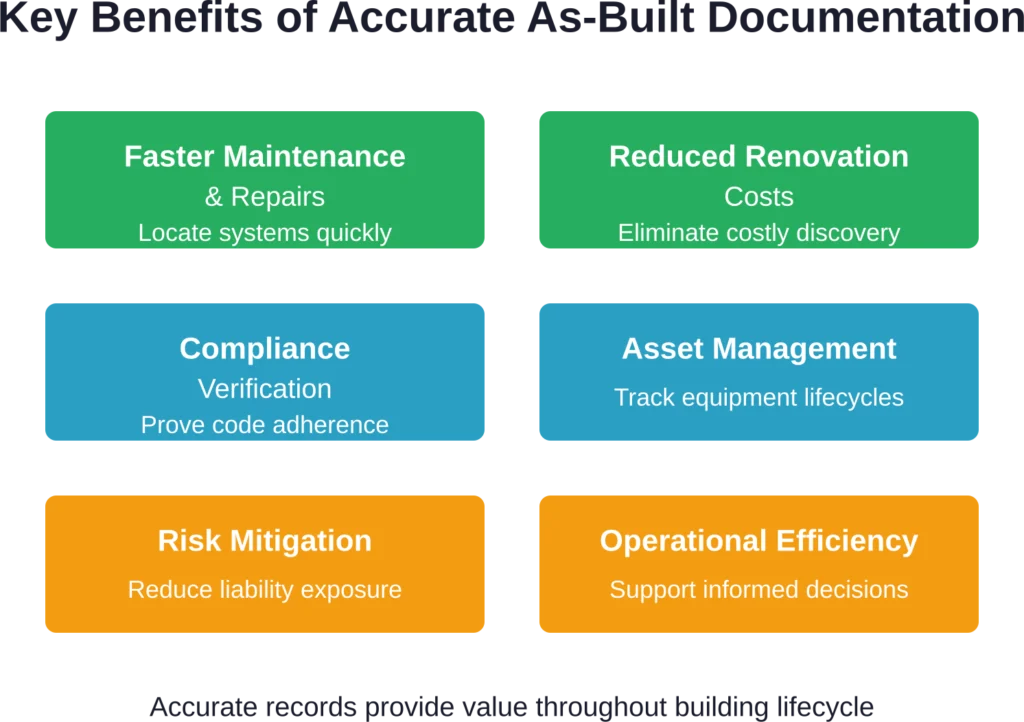
For building owners, the investment in quality as-built documentation returns dividends throughout the building lifecycle. For contractors and designers, delivering comprehensive as-built records demonstrates professionalism and reduces liability exposure. For facility teams, accurate as-built documentation makes the difference between reactive firefighting and proactive management.
Frequently Asked Questions
Record drawings typically refer to contractor-marked prints showing field changes made during construction. As-built drawings go further, incorporating survey verification, final system configurations, and coordinated updates across all disciplines. Record drawings are the contractor’s marked-up field documentation; as-built drawings are the architect’s or engineer’s final updated documents incorporating all changes.
As-built documentation should be captured continuously throughout construction, with final compilation and verification before substantial completion. Waiting until the end of the project to document changes results in incomplete and inaccurate records. Real-time capture during construction produces significantly better results than retrospective documentation.
Responsibility varies by contract type. In traditional design-bid-build, the contractor typically provides marked-up record drawings, which the architect then incorporates into final as-built documents. In design-build, the design-build entity handles the complete process. Contract documents should clearly specify who delivers what documentation, in what format, and by when.
As-built documentation should be retained for the life of the building. These records may be needed decades after construction for renovations, system upgrades, code compliance verification, or litigation. Digital archiving with proper backup protocols ensures long-term accessibility while reducing physical storage requirements.
Format requirements depend on the owner’s needs and contract specifications. Common deliverables include PDF drawing sets, native CAD files, BIM models with specified detail levels, and equipment databases. Digital formats should use industry-standard file types to ensure long-term accessibility as software versions change. Increasingly, owners specify BIM deliverables that integrate spatial, equipment, and operational information in coordinated 3D models.
As-built documentation can be created retroactively through field surveys and investigation, but this approach is significantly more expensive and less accurate than documentation during construction. Retroactive documentation requires accessing concealed systems, measuring existing conditions, and making assumptions about configurations that can’t be verified without destructive investigation. The cost and disruption typically far exceed what proper documentation during construction would have required.
Costs vary widely based on project size, complexity, documentation detail level, and capture methods used. As a rough guideline, comprehensive as-built documentation typically ranges from 0.5% to 2% of construction cost. Laser scanning adds specific costs based on building size and required accuracy. The investment should be weighed against the long-term value for facility management and the cost of inadequate documentation during future renovations.