

Quick Summary: BIM consulting costs typically range from $0.30 to $0.90 per square foot for standard 3D modeling, with small residential projects starting around $5,000 and larger commercial builds reaching $50,000 or more. Hourly rates for freelance BIM consultants average $50 to $150, while full-service firms may charge monthly retainers of $15,000 to $30,000 for ongoing projects. Cost drivers include project complexity, level of detail required, software licensing, and whether services are one-time or long-term engagements.
The global building information modeling market size reached USD 9.03 billion in 2025 and is projected to grow to USD 15.42 billion by 2030, according to MarketsandMarkets. That explosive 11.3% annual growth rate reflects one simple truth: construction firms can’t afford to skip BIM anymore.
But here’s the question every project manager, architect, and developer asks: what does BIM consulting actually cost?
The answer isn’t straightforward. Pricing varies wildly depending on project scope, complexity, delivery timeline, and whether you’re hiring a freelance BIM consultant or partnering with a full-service firm. Some projects get quoted per square foot, others by the hour, and many use hybrid models that bundle modeling, coordination, and clash detection.
This guide breaks down real-world BIM consulting costs, explains what drives pricing, and shows you how to budget smartly without overpaying or cutting corners that’ll haunt you during construction.
Understanding BIM Consulting Services
Before diving into numbers, it helps to clarify what BIM consulting actually covers. The term gets thrown around loosely, but professional BIM services typically fall into several distinct categories.
At the most basic level, you’ve got 3D modeling—creating digital representations of architectural, structural, and MEP (mechanical, electrical, plumbing) systems. Then there’s BIM coordination, where consultants identify clashes between different building systems before construction starts. Clash detection alone can save projects thousands by catching conflicts that would otherwise require expensive rework on-site.
Beyond modeling and coordination, many consultants offer 4D scheduling (linking models to construction timelines), 5D cost estimating (integrating budget data), facility management handover packages, and strategic BIM implementation planning for firms building internal capabilities.
Each service layer adds cost. A consultant who just delivers a clean Revit model charges differently than one who manages full coordination across five trades, attends weekly meetings, and produces construction documentation.
Typical BIM Consulting Pricing Models
BIM consultants price their work in several ways, and understanding these models helps you compare quotes accurately.
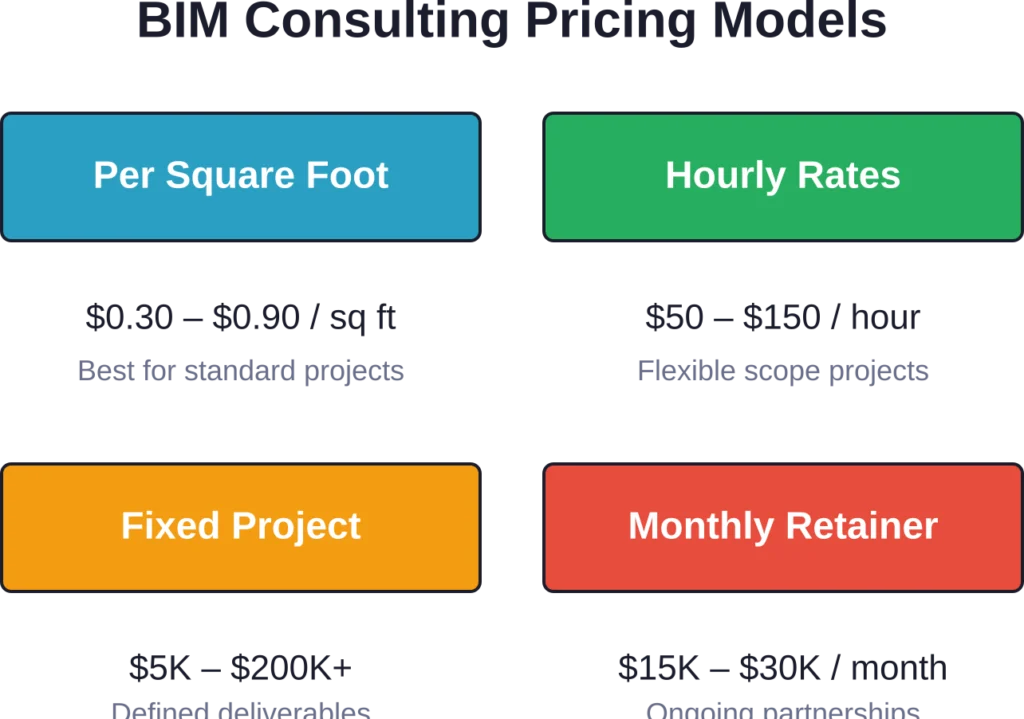
Per Square Foot Pricing
For standard 3D BIM modeling services, per square foot pricing is common. According to industry analysis, rates typically range from $0.30 to $0.90 per square foot depending on level of detail required.
A 10,000 square foot commercial office build at $0.50 per square foot would cost $5,000 for basic modeling. Bump that to LOD 400 (construction-level detail) for a complex healthcare facility, and you might hit $0.80 per square foot—$8,000 for the same footprint.
This model works well for straightforward projects where scope is clearly defined upfront. It’s less useful when projects involve heavy coordination, multiple design iterations, or ongoing consultant involvement beyond initial modeling.
Hourly Rates
Freelance BIM consultants and smaller firms often charge hourly. Based on 2026 market data, typical rates break down like this:
- Junior modelers: $40–$65 per hour
- Mid-level specialists: $65–$100 per hour
- Senior coordinators: $100–$150 per hour
- BIM managers/directors: $150–$200+ per hour
Hourly billing offers flexibility for projects with uncertain scope or where clients need on-demand expertise. The downside? Costs can balloon if the project hits complications or requires more coordination meetings than anticipated.
Fixed Project Fees
Many firms prefer fixed-fee agreements for predictable budgeting. Total project costs depend heavily on building type and complexity:
- Small residential: $5,000–$15,000
- Mid-size commercial: $15,000–$50,000
- Large mixed-use/industrial: $50,000–$200,000+
Fixed fees make sense when scope is well-defined and both parties understand deliverables. The consultant assumes risk for scope creep, which is why detailed contracts matter.
Monthly Retainers
For ongoing projects or firms needing dedicated BIM support, monthly retainers provide consistent service. According to BIM service operating cost analysis, professional firms running 20 full-time staff (including lead specialists and senior modelers) often structure retainers between $15,000 and $30,000 per month depending on service level.
Retainer arrangements work best for large projects spanning multiple phases, developments with rolling timelines, or organizations building internal BIM capabilities and needing mentorship alongside deliverables.
What Drives BIM Consulting Costs?
Understanding cost drivers helps you evaluate quotes and negotiate effectively. Several factors significantly impact final pricing.
Project Complexity and Building Type
A single-family home with straightforward geometry costs far less to model than a hospital with complex MEP systems, infection control zones, and specialty equipment integration. Healthcare, labs, data centers, and industrial facilities command premium rates because they require deeper technical knowledge and more detailed coordination.
Building size matters too, but not linearly. A 50,000 square foot warehouse might cost less per square foot than a 5,000 square foot high-end restaurant because the warehouse involves repetitive elements while the restaurant has custom everything.
Level of Detail (LOD)
BIM models range from conceptual massing (LOD 100) through construction documentation (LOD 400) to as-built records (LOD 500). Higher LOD means more time, more precision, and higher costs.
LOD 200 (schematic design) might suffice for early feasibility studies. LOD 350 (detailed design for coordination) is standard for most commercial projects. LOD 400 (fabrication and assembly detail) is required when models feed directly into shop drawings or prefabrication workflows.
Each LOD jump roughly doubles modeling time and cost. Be clear about what you actually need—paying for LOD 400 when LOD 300 serves your purpose wastes budget.
Disciplines Involved
Single-discipline modeling (architectural only) costs less than coordinated multi-discipline models (architectural + structural + MEP). Full coordination across five or six trades—adding fire protection, low voltage, and specialty systems—increases both modeling and coordination time substantially.
Clash detection between disciplines is where BIM delivers massive value, but it also adds cost. Expect coordination services to add 20–40% to base modeling fees depending on project complexity.
Software and Technology Requirements
Most BIM work happens in Autodesk Revit, but some clients require Archicad, Vectorworks, or open BIM formats. Software licensing isn’t trivial—core BIM software subscriptions run $2,500–$3,000 annually per seat, and specialized tools for energy analysis, structural calculations, or rendering add more.
According to SNS Insider, the software and solutions segment represented 57% of BIM market share in 2025, reflecting how central technology costs are to service delivery. Consultants factor these into pricing, though established firms spread costs across multiple projects.
Timeline and Delivery Speed
Rush jobs cost more. Period. If you need a coordinated model in three weeks instead of eight, expect to pay 25–50% premiums for consultants to prioritize your project and potentially bring in additional staff.
Conversely, flexible timelines sometimes earn discounts. Consultants with capacity gaps may offer better rates for projects that can slide into open calendar slots.
Geographic Location
BIM consulting rates vary by region. The U.S. BIM market was valued at approximately USD 3.90 billion in 2025 and is projected to reach USD 12.22 billion by 2035, growing at approximately 12.1% annually. That growth is uneven geographically.
Major metro markets (New York, San Francisco, Chicago) command higher rates than secondary cities. International outsourcing to skilled teams in India, Eastern Europe, or Southeast Asia can cut costs 40–60%, though communication and quality control require more attention.
Get BIM Consulting Support for Your Project
Powerkh works with project teams that need BIM and coordination support during design and construction stages. Its services include BIM modelling, coordination, constructability reviews, Scan to BIM, and technical delivery support for complex projects.
Need BIM Consulting Support?
Talk with Powerkh to:
- improve coordination across design and site teams
- support BIM delivery during design and construction
- prepare models and technical documentation
- resolve coordination and constructability issues early
Discuss BIM consulting and coordination requirements with Powerkh.
Freelance BIM Consultant vs. Full-Service Firm
Choosing between independent consultants and established firms affects both cost and project risk.
Freelance Consultants
Freelance BIM specialists typically charge $50–$150 per hour depending on experience. They offer flexibility, lower overhead costs, and often faster turnaround for smaller projects.
The trade-off? Limited capacity. A solo consultant juggling three projects might struggle if your timeline compresses unexpectedly. You also assume more coordination responsibility—freelancers rarely provide full-service project management.
Best for: small to mid-size projects, specific deliverables (clash detection, model cleanup, documentation), or supplementing internal teams during peak workload.
Full-Service Firms
Established BIM consultancies bring teams, redundancy, quality control processes, and project management infrastructure. They handle multi-discipline coordination, attend stakeholder meetings, integrate with general contractors, and deliver polished final packages.
You’ll pay more—often 30–50% premiums over freelance rates—but you’re buying reliability, accountability, and bandwidth. For projects exceeding $500K construction value, the risk mitigation usually justifies the cost difference.
Best for: complex commercial projects, healthcare/lab/industrial facilities, developer portfolios needing consistent standards, and projects requiring extensive coordination.
| Factor | Freelance Consultant | Full-Service Firm |
|---|---|---|
| Hourly Rate | $50–$150 | $100–$200+ |
| Project Management | Client-led | Included |
| Multi-Discipline Coordination | Limited | Full service |
| Capacity for Rush/Changes | Low | High |
| Best For | Small/mid projects, specific tasks | Complex/large projects, full coordination |
Hidden Costs and Budget Pitfalls
Quoted BIM consulting fees rarely tell the whole story. Several hidden costs catch clients off guard.
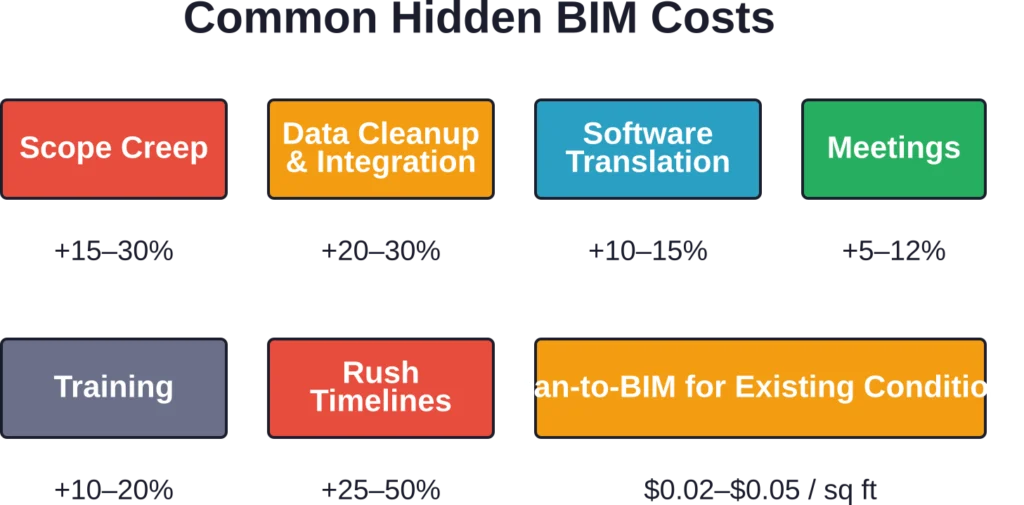
Scope Creep
Design changes mid-project trigger remodeling work. Each iteration costs money, especially if you’re paying hourly. Fixed-fee contracts should specify how many revision rounds are included and what additional changes cost.
One community discussion noted a consultant who experienced significant cost overruns because the client kept adding requirements without understanding ROI. The lesson? Define scope tightly upfront, and establish clear change-order processes.
Data Handoff and Integration
If your architect provides CAD files that need conversion to BIM, that’s extra work. If existing conditions require laser scanning, that’s additional cost (often $0.02–$0.05 per square foot for scan-to-BIM services).
Poor quality input files multiply consultant hours. One project requiring cleanup of messy legacy CAD drawings can cost 20–30% more than starting from clean architectural plans.
Software Compatibility
Not all software plays nicely together. If your structural engineer uses Tekla and your MEP contractor uses AutoCAD MEP while your architect is in Revit, someone needs to manage file translation and synchronization. That coordination time adds up.
Meeting and Communication Time
Weekly coordination meetings, RFI responses, and stakeholder presentations consume consultant time. Some firms include reasonable meeting time in fixed fees; others bill separately. Clarify this upfront to avoid surprise invoices.
Training and Knowledge Transfer
If you’re building internal BIM capabilities, you might need consultant training time for your team. That’s valuable but adds 10–20% to project costs depending on training depth.
How to Budget for BIM Consulting
Smart budgeting starts with clear requirements and realistic expectations.
Define Your Scope Precisely
Document exactly what you need: which disciplines, what LOD, how many design iterations, what file formats, what coordination meetings, and what final deliverables. The more specific your RFP, the more accurate quotes will be.
Get Multiple Quotes
Solicit proposals from at least three consultants or firms with relevant project experience. Compare not just bottom-line prices but what’s included, timelines, qualifications, and references.
Cheapest rarely wins. A consultant quoting 30% below competitors is either desperate for work (risky) or hasn’t understood your scope (leads to change orders later).
Build in Contingency
Add 15–20% contingency to your BIM consulting budget for scope adjustments, unforeseen coordination issues, or design changes. Projects rarely go exactly as planned.
Consider Total Project Impact
BIM consulting isn’t just an expense—it’s an investment that can reduce construction costs, minimize change orders, accelerate schedules, and improve building performance. Industry analyses suggest coordinated BIM models can significantly reduce field conflicts compared to traditional 2D workflows.
A $30,000 BIM investment on a $2 million project that prevents $80,000 in field rework and saves three weeks of schedule is objectively a bargain. Frame your budget decision around total value, not just consultant fees.
Phase the Work
For large projects, consider phasing BIM services. Start with schematic models and coordination, then layer in detail as design firms up. This spreads costs over project phases and allows you to adjust service levels based on value delivered.
Return on Investment: Does BIM Consulting Pay Off?
Here’s where budget objections fall apart.
Yes, BIM consulting costs money. But not using BIM costs more. According to industry commentary, a public client with prior BIM experience expressed concern that “BIM will only increase costs!” during a presentation. That client had experienced poor BIM consulting—specifically, consultants who pushed requirements without explaining value or ROI.
Good BIM consulting works differently. It’s teamwork with measurable outcomes: fewer RFIs, reduced change orders, faster approvals, better collaboration, and higher-quality construction. Industry analyses suggest coordinated BIM models can significantly reduce field conflicts compared to traditional 2D workflows.
The key is engaging consultants who tie BIM deliverables to project goals. Ask prospective consultants: “How will this specific requirement improve my project?” and “What’s the expected ROI?” If they can’t answer clearly, keep looking.
Finding the Right BIM Consultant
Cost matters, but capability matters more. Here’s how to evaluate consultants beyond price.
Verify Relevant Experience
Look for consultants with proven track records in your building type. A residential specialist won’t magically excel at hospital coordination. Ask for portfolio examples, references, and specific deliverable samples.
Check Technical Proficiency
Ensure consultants are fluent in required software platforms and understand industry standards (AIA protocols, LOD specifications, COBie data requirements for facility management). Certifications (Autodesk Certified Professional, buildingSMART credentials) provide some validation, though real-world experience trumps certificates.
Assess Communication Skills
BIM coordination requires constant communication with architects, engineers, contractors, and owners. Consultants who can’t explain technical issues clearly to non-technical stakeholders create friction. Test this during initial conversations—if they’re already confusing, imagine project meetings.
Evaluate Process and Tools
Ask about their coordination workflow, clash detection procedures, quality control steps, and collaboration platforms. Established processes indicate professionalism and reduce project risk.
Understand Their Workload
A consultant juggling eight projects simultaneously won’t give yours adequate attention. Ask about current commitments and who specifically will work on your project. Meeting the actual modelers, not just the sales rep, reveals a lot.
Regional Market Variations
BIM consulting rates and availability vary significantly by geography.
The North America BIM market is experiencing significant growth according to market research. Within North America, U.S. markets dominate, representing USD 3.90 billion in 2025 based on SNS Insider data.
Urban centers command premium rates but offer deeper talent pools. Secondary markets may have fewer options but lower costs. International outsourcing presents significant savings—skilled BIM teams in India or Eastern Europe charge 40–60% less than U.S. consultants—but requires careful management of time zones, communication, and quality control.
For projects requiring frequent face-to-face coordination or job site presence, local consultants provide value despite higher hourly rates. For modeling-heavy work with clear deliverables, offshore teams can deliver excellent results at lower cost.
Real-World Project Examples
Putting theory into practice, here’s how BIM consulting costs typically shake out for different project types.
Small Residential Project
A 3,500 square foot custom home requiring architectural and structural BIM models at LOD 300 for permit documentation and basic coordination.
Estimated cost: $5,000–$8,000 fixed fee, or 40–60 consultant hours at $75–$100 per hour. Timeline: 2–3 weeks.
Mid-Size Commercial Office
A 25,000 square foot, three-story office building with full architectural, structural, and MEP coordination, LOD 350 models, clash detection, and construction documentation.
Estimated cost: $20,000–$35,000 fixed fee. Timeline: 6–8 weeks.
Large Healthcare Facility
A 100,000 square foot hospital expansion with complex MEP, medical gas, infection control requirements, equipment coordination, LOD 400 models, 4D scheduling integration, and extensive coordination meetings.
Estimated cost: $80,000–$150,000, potentially structured as phased deliverables or monthly retainers. Timeline: 4–6 months.
Mixed-Use Development
A 200,000 square foot mixed-use project (retail, office, residential) requiring full multi-discipline coordination, multiple building systems, parking structure, and extensive stakeholder coordination.
Estimated cost: $120,000–$250,000 depending on complexity and duration. Often structured as monthly retainer throughout design and construction phases.
| Project Type | Size | Typical Cost Range | Timeline |
|---|---|---|---|
| Small Residential | 3,500 sq ft | $5,000–$8,000 | 2–3 weeks |
| Mid-Size Commercial | 25,000 sq ft | $20,000–$35,000 | 6–8 weeks |
| Large Healthcare | 100,000 sq ft | $80,000–$150,000 | 4–6 months |
| Mixed-Use Development | 200,000 sq ft | $120,000–$250,000 | 6–12 months |
BIM Training and Education Costs
Building internal BIM capabilities requires training investment. Bergen Community College and similar institutions offer construction and BIM-related courses that illustrate professional development costs:
- Applied Print Reading for Construction Professionals (60 hours): $600
- Construction Project Organization and Site Management (42 hours): $600
- Construction Cost Estimating and Control (30 hours): $750
- Practical Law and Documentation for Construction Managers (24 hours): $900
These represent foundational construction management training. Software-specific BIM training (Revit, Navisworks, BIM 360) typically costs $500–$2,000 per person for comprehensive courses. Many consultants offer on-the-job training as part of project delivery, which often provides better value than standalone courses by teaching skills in your actual project context.
Negotiating BIM Consulting Contracts
Once you’ve selected a consultant, contract negotiation determines whether the engagement succeeds or becomes a nightmare.
Define Deliverables Explicitly
List every deliverable: model files, PDF documentation, clash detection reports, coordination meeting notes, RFI responses. Specify file formats, naming conventions, and LOD for each discipline. Vague contracts breed disputes.
Establish Revision Limits
Fixed-fee contracts should specify how many design iterations are included. Common structures allow 2–3 rounds of revisions with additional changes billed hourly or as change orders at specified rates.
Clarify Ownership and Licensing
Who owns the BIM models? Can you reuse them for future renovations? What happens if you switch consultants mid-project? Address intellectual property upfront to avoid legal tangles later.
Set Payment Milestones
Tie payments to deliverable completion rather than calendar dates. Typical structures: 20% at contract signing, 30% at schematic design completion, 30% at design development, 20% at final documentation. This aligns incentives and protects both parties.
Include Performance Standards
What response time do you expect for questions? What clash detection tolerance is acceptable? How quickly must consultants address model errors? Setting standards prevents frustration when expectations don’t match reality.
Future Trends Affecting BIM Consulting Costs
The BIM consulting market is evolving rapidly, and several trends will impact pricing over the next few years.
AI and Automation
Artificial intelligence tools are beginning to automate routine modeling tasks, clash detection, and code compliance checking. This should reduce consultant hours for standard work while shifting value toward strategic coordination and problem-solving that still requires human expertise.
Cloud Collaboration
Cloud-based BIM platforms (Autodesk Construction Cloud, Trimble Connect, others) are making real-time collaboration easier and reducing file management overhead. This enables more efficient coordination but also requires consultants to maintain subscriptions to multiple platforms, affecting cost structures.
Government Mandates
Expanding BIM mandates for public projects in various jurisdictions are increasing demand for consultants, which may push rates higher in the short term until talent supply catches up. Regions implementing Level 2 or Level 3 BIM requirements (UK, Singapore, parts of the EU and Middle East) are seeing the most significant rate pressure.
Integrated Project Delivery
As integrated project delivery (IPD) and design-build models become more common, BIM consultants increasingly work as embedded team members rather than external vendors. This shifts compensation structures toward longer-term partnerships and risk-sharing arrangements.
Frequently Asked Questions
Standard 3D BIM modeling typically costs $0.30 to $0.90 per square foot depending on level of detail, building complexity, and disciplines involved. Simple residential projects trend toward the lower end, while complex commercial or institutional buildings with extensive MEP coordination hit the higher range.
Freelance BIM consultant hourly rates in 2026 typically range from $50 to $150 depending on experience level. Junior modelers charge $40–$65 per hour, mid-level specialists $65–$100, senior coordinators $100–$150, and BIM managers or directors $150–$200+ per hour for strategic consulting.
Freelance consultants typically charge 30–50% less than full-service firms but offer limited capacity and less project management infrastructure. For small projects or specific tasks, freelancers provide better value. For complex projects requiring multi-discipline coordination, extensive meetings, and quality assurance, firms justify their premium through reliability and bandwidth.
The biggest cost drivers are project complexity, required level of detail (LOD), number of disciplines being coordinated, timeline compression (rush work), and extent of client involvement requirements (meetings, training, documentation). Healthcare, laboratory, and industrial projects typically cost 40–60% more than standard commercial work due to technical complexity.
Clash detection is usually bundled into coordination services rather than priced separately. When itemized, expect clash detection to add 15–25% to base modeling costs. For a $20,000 modeling project, comprehensive clash detection across architectural, structural, and MEP disciplines might add $3,000–$5,000.
Yes. Provide clean input files to minimize data cleanup time, define scope tightly to avoid revisions, limit meeting frequency to essential coordination sessions, accept flexible timelines when possible, and specify appropriate LOD—don’t pay for LOD 400 detail if LOD 300 serves your needs. Also consider phasing work to spread costs across project stages.
Generally speaking, BIM consulting costs run 0.5% to 2% of total construction value depending on project size and complexity. A $5 million project might budget $25,000–$100,000 for BIM services. Larger projects achieve economies of scale and trend toward lower percentages, while smaller projects hit higher percentages due to base service minimums.
Final Thoughts
BIM consulting costs vary enormously based on project specifics, but typical ranges give you solid starting points for budgeting: $0.30–$0.90 per square foot for standard modeling, $50–$150 per hour for freelance work, $5,000–$200,000+ for complete project fees depending on scale and complexity.
The real question isn’t whether BIM consulting costs money—it’s whether it delivers value. When implemented thoughtfully with consultants who tie deliverables to project outcomes, BIM coordination typically returns 3–5 times its cost through reduced rework, faster schedules, and better construction quality.
Smart budgeting starts with clear scope definition, realistic expectations, and selecting consultants based on capability and fit rather than lowest price. Build in 15–20% contingency, compare multiple proposals carefully, and frame decisions around total project value rather than just consultant fees.
The building information modeling market is projected to reach USD 15.42 billion by 2030, growing at 11.3% annually. That growth reflects one undeniable reality: construction without BIM is becoming obsolete. The question facing project stakeholders isn’t whether to invest in BIM consulting but how to invest wisely to maximize return.
Ready to budget your BIM consulting needs? Start by documenting your project scope, desired LOD, coordination requirements, and timeline. Request detailed proposals from at least three qualified consultants or firms with relevant experience. Compare not just pricing but deliverables, processes, references, and communication style.
BIM consulting done right transforms projects. Done poorly, it wastes money and creates headaches. The difference lies in clear requirements, realistic budgets, and choosing partners who view BIM as collaborative problem-solving rather than just model production.
Get specific about what you need, compare options carefully, and invest in consultants who can articulate how their work will measurably improve your project. That’s how BIM consulting delivers value that far exceeds its cost.