

Quick Summary: The top 10 AngularJS web development companies in 2026 include Lengreo, Gilzor, OSKI Solutions, A-listware, Mobian Studio, Intellectsoft, ELEKS, Arosys, Designli, and Goji Labs. These agencies specialize in enterprise-grade Angular development, AngularJS migration, and scalable web application solutions. Each company brings unique strengths — from full-cycle product development to AI-powered Angular solutions — making them ideal partners for businesses seeking high-performance, maintainable web applications.
Finding the right Angular development partner can make or break a web application project. The wrong choice leads to technical debt, missed deadlines, and products that don’t scale. The right agency? That transforms an idea into a robust, enterprise-ready application.
Angular remains a powerhouse in the web development world. According to GitHub community discussions, Angular holds 17.1% popularity among JavaScript frameworks, though this represents a smaller share than React.js at 39.5%. Angular’s comprehensive tooling and TypeScript foundation make it the go-to choice for large-scale, maintainable web applications.
This guide cuts through the noise. The agencies listed here have proven track records with Angular, delivering everything from fintech platforms to healthcare SaaS applications. Real talk: not every company needs a full-service agency. Some projects need specialists. Others need generalists who can handle the entire stack.
What follows is a carefully researched list of 10 Angular development companies, each with distinct strengths, service offerings, and industry focus areas. No fluff. No invented claims. Just what these agencies actually deliver.
What Makes Angular Stand Out for Web Development
Angular isn’t just another JavaScript framework. It’s a complete platform for building client-side applications, maintained by Google and backed by a massive developer community.
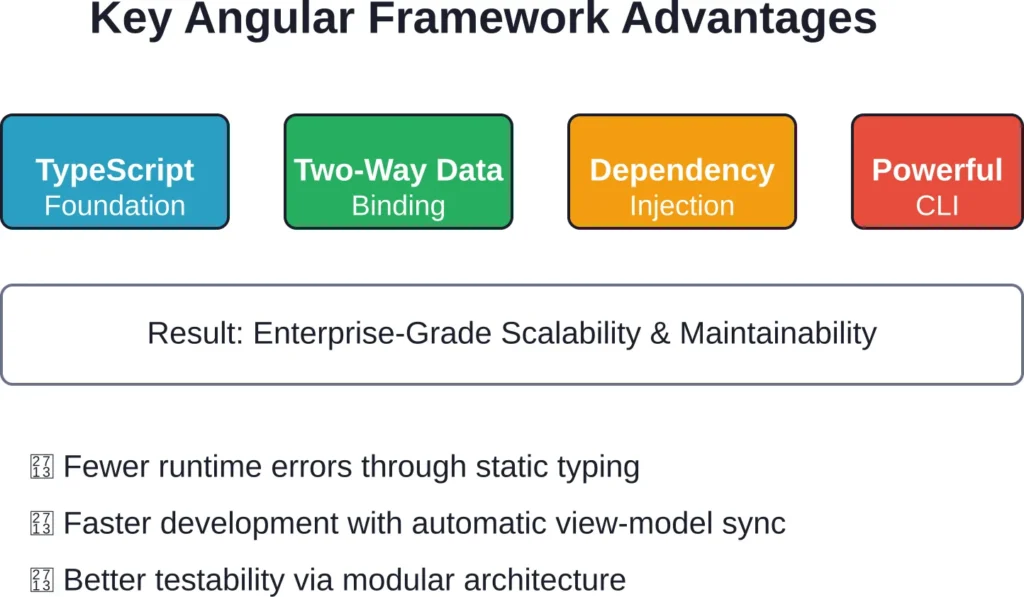
The framework’s TypeScript foundation brings static typing to JavaScript development. That means fewer runtime errors, better IDE support, and code that’s easier to maintain as projects scale. For enterprise teams managing codebases with hundreds of thousands of lines, this matters immensely.
Angular’s two-way data binding synchronizes the model and view automatically. When data changes in the model, the view reflects it instantly. When users interact with the view, the model updates. This reduces boilerplate code and speeds up development cycles.
The framework’s dependency injection system makes components modular and testable. Developers can inject services into components without tightly coupling them, which means better code reusability and easier unit testing. Industry reports suggest this architectural approach reduces debugging time by making components more isolated and predictable.
Angular’s CLI accelerates development with code scaffolding, build optimization, and testing setup. One command generates a component with all necessary files and boilerplate. Another command builds production-ready bundles with ahead-of-time compilation and tree shaking.
Top 10 AngularJS Web Development Companies
The following agencies represent the strongest Angular development partners available in 2026. Each brings distinct capabilities, industry focus, and service models to the table.
1. Oski
Oski builds smart, well-engineered web solutions with a strong focus on Angular and modern frontend technologies. They deliver complete software solutions — from architecture and development to deployment and long-term maintenance — for tech-forward enterprises and ambitious startups.
The company combines deep expertise in Angular with React, Vue, and other frontend frameworks, creating scalable, high-performance web applications. Their projects cover cloud-native solutions, complex enterprise systems, and digital products across industries such as fintech, logistics, e-commerce, education, insurance, and travel. Oski is known for accelerating development through AI-enhanced engineering while maintaining clean, maintainable codebases.
Oski emphasizes long-term partnerships. They work as an extension of the client’s team, providing ongoing support, optimization, and seamless scaling as the product evolves.
Best For: Tech-forward enterprises and startups that need reliable Angular development combined with full-stack capabilities and fast delivery for complex, scalable web applications.
Contact Information:
- Website: oski.site
- Phone: +48571282759
- Email: [email protected]
- Address: Kaupmehe tn 7, 10114 Tallinn, Estonia
- LinkedIn: www.linkedin.com/company/oski-solutions
2. Lengreo
Lengreo acts as a complete marketing and tech partner, delivering Angular-based web development integrated with powerful digital marketing strategies. They build high-converting websites, landing pages, and web applications that drive measurable business growth.
The company excels at full-cycle website and web application development, including discovery, prototyping, implementation, and ongoing support. Their Angular expertise helps clients create fast, SEO-optimized platforms combined with lead generation systems, resulting in significant increases in client acquisition and conversion rates for software companies, tech providers, and service businesses.
Lengreo focuses on personalized, results-driven partnerships rather than one-off projects. They combine technical development with B2B marketing tactics such as LinkedIn outreach, paid ads, and demand generation to ensure the developed web solutions actively generate qualified leads and opportunities.
Best For: B2B companies and tech providers seeking Angular web development tightly integrated with marketing and lead generation for rapid business growth.
Contact Information:
- Website: Lengreo.com
- Phone: +31 686 147 566
- Email: [email protected]
- Address: Vrijstraat 9 C/D, 5611 AT Eindhoven, Netherlands
- LinkedIn: Lengreo
- Twitter: @Lengreo
- Instagram: @lengreo
3. Gilzor

Gilzor specializes in custom web development with strong Angular capabilities, helping startups and small-to-medium businesses launch and scale digital products. They provide full-cycle development from idea validation to production-ready web applications.
Their team delivers complete web solutions including business analysis, UI/UX design, Angular development, quality assurance, and post-launch maintenance. Notable projects include web platforms for airlines, e-commerce grocery applications, and specialized tools that improved operational efficiency and user adoption.
Gilzor’s approach is built around reducing risk and delivering value quickly. They emphasize clear documentation, clean architecture, and close collaboration to ensure the final product meets both technical standards and business objectives.
Best For: Startups and SMBs that need reliable Angular web development with strong product thinking and end-to-end delivery.
Contact Information:
- Website: www.gilzor.com
- Email: [email protected]
- Address: Poland, Warsaw, Office 58, street Adama Mickiewicza 37, 01-625
- LinkedIn: www.linkedin.com/company/gilzor-softwaredevelopment
4. A-Listware
A-Listware provides dedicated Angular development teams and full software engineering services for enterprises, SMBs, and startups. With over 25 years of experience, they focus on building secure, responsive, and scalable web applications.
The company offers team augmentation, software development outsourcing, legacy modernization, and custom Angular solutions as part of broader IT services. They deliver enterprise applications, cloud solutions, and complex web systems across multiple industries while maintaining seamless integration with client teams.
A-Listware stands out for rapid team setup and long-term collaboration. Clients get 24/7 access to dedicated professionals who act as a natural extension of their own organization.
Best For: Companies looking for scalable Angular development capacity through dedicated or augmented teams with enterprise-grade quality and management.
Contact Information:
- Website: a-listware.com
- Phone: +1 (888) 337 93 73
- Email: [email protected]
- Address: North Bergen, NJ 07047, USA
- LinkedIn: www.linkedin.com/company/a-listware
- Facebook: www.facebook.com/alistware
5. Mobian
Mobian builds dedicated engineering teams specializing in Angular and modern web technologies for companies in healthcare, fintech, logistics, and IT. They deliver production-ready web and mobile solutions on time and within budget.
The studio offers both full outsourcing and outstaffing models, covering end-to-end product development, scalable architecture, legacy integration, and post-launch support. Their Angular expertise is combined with AI systems, cloud infrastructure, and domain-specific knowledge to create robust digital products.
Mobian focuses on senior-level execution and clean architecture. They provide documented, maintainable code and continue supporting clients after delivery through bug warranties and ongoing optimization.
Best For: European companies in regulated industries that need fast, reliable Angular development through dedicated teams or embedded engineers.
Contact Information:
- Website: mobian.studio
- Phone: [email protected]
- Address: Harju maakond, Tallinn, Kesklinnalinnaosa, Masina tn 22, 10113
- LinkedIn: www.linkedin.com/company/mobian-studio
6. Intellectsoft

Intellectsoft positions itself at the intersection of Angular development and emerging technologies. Based in Palo Alto, they integrate AI, blockchain, and IoT capabilities into Angular applications.
The company’s Angular work emphasizes modern architecture patterns. They build applications using micro-frontends, implement state management with NgRx, and use GraphQL for efficient data fetching. These aren’t just buzzwords — when applied correctly, they solve real scalability and performance challenges.
Intellectsoft’s client roster includes Fortune 500 companies across fintech, healthcare, retail, and logistics. Their case studies demonstrate experience with high-traffic applications processing millions of transactions.
The agency provides end-to-end services from initial consulting through post-launch optimization. Their consulting engagements help clients determine whether Angular fits their requirements or if alternative frameworks make more sense — honest advice that builds long-term relationships.
Best For: Companies building next-generation applications that combine Angular with AI, blockchain, or other advanced technologies.
7. ELEKS
ELEKS brings Eastern European development talent to Angular projects at competitive economics. Based in Princeton with delivery centers in Ukraine and other European locations, they’ve served clients for 30+ years.
The company’s Angular expertise extends across industries including automotive, logistics, finance, and healthcare. Their automotive projects demonstrate experience with real-time data visualization and complex state management — capabilities that transfer well to other domains requiring interactive interfaces.
ELEKS emphasizes product design alongside development. Their teams include UX researchers, UI designers, and business analysts who ensure Angular applications meet user needs, not just technical specifications. This holistic approach reduces the risk of building technically sound applications that users find confusing.
The agency’s quality management system is ISO 9001 certified, demonstrating mature, documented processes. For enterprises requiring vendor audits and compliance documentation, this certification streamlines procurement.
Best For: Businesses seeking strong Angular capabilities with competitive economics and mature development processes.
8. Arosys
Arosys focuses on product engineering services with Angular as a core competency. Based in Sunnyvale, they work primarily with startups and growth-stage companies building SaaS products.
The company’s Angular practice emphasizes rapid prototyping and iterative development. They help startups validate product ideas quickly, building MVPs that can evolve into full-featured applications as the business grows. This pragmatic approach balances speed with architectural foundations for future scaling.
Arosys’s team structure includes technical co-founders and CTOs from successful startups. This entrepreneurial experience means they understand not just software development, but product-market fit, user acquisition, and the resource constraints startups face.
The agency offers flexible engagement models including fixed-price projects, time-and-materials contracts, and dedicated team arrangements. For early-stage companies with uncertain scopes, this flexibility reduces risk.
Best For: Startups and growth-stage companies building Angular-based SaaS products that need to move fast while maintaining code quality.
9. Designli
Designli combines Angular development with exceptional design capabilities. Based in Greenville, South Carolina, they position themselves as a product studio rather than a development shop.
The company’s process begins with design sprints that define user experiences before development starts. This design-first approach ensures Angular applications feel intuitive and polished, not just functional. For consumer-facing applications where UX determines success, this emphasis matters.
Designli’s portfolio spans mobile apps, web applications, and progressive web apps. Their Angular work often integrates with mobile applications built using frameworks like React Native or native iOS/Android development, creating cohesive cross-platform experiences.
The agency maintains long-term relationships with clients, often serving as an outsourced product team for companies that don’t have internal development capabilities. They handle everything from strategy and design through development and launch.
Best For: Companies building consumer-facing Angular applications where design and user experience are as important as technical implementation.
10. Goji Labs

Goji Labs specializes in building digital products for startups and innovation teams within larger enterprises. Based in Los Angeles, they’ve launched over 150 products since founding.
The company’s Angular practice focuses on rapid development without sacrificing quality. They use standardized tech stacks, reusable component libraries, and battle-tested architecture patterns to accelerate timelines while maintaining code maintainability.
Goji Labs’s team includes product managers, designers, and developers who work collaboratively from day one. This integrated approach reduces the handoff friction that plagues projects where strategy, design, and development happen in silos.
The agency offers a unique validation approach for early-stage products. Before building full applications, they create clickable prototypes that simulate the user experience, allowing businesses to test concepts with real users before committing to full development.
Best For: Innovation teams and startups that need to validate product concepts quickly and launch MVPs without accumulating technical debt.
How to Choose the Right Angular Development Company
Selecting an Angular development partner requires more than browsing portfolios. Several factors determine whether an agency will deliver on promises or become a project liability.
Technical Expertise and Specialization
Look for companies with demonstrated Angular expertise. That means reviewing actual projects, not just marketing claims. Has the agency migrated legacy AngularJS applications to modern Angular? Have they built applications that handle thousands of concurrent users?
Check the team’s technology stack beyond Angular. Modern web applications rarely use a single framework in isolation. Strong agencies understand Node.js backends, cloud infrastructure, CI/CD pipelines, and testing frameworks like Jasmine and Karma.
Certifications and community involvement signal commitment. Developers who contribute to Angular’s ecosystem, speak at conferences, or maintain open-source Angular libraries bring deeper expertise than those who merely use the framework.
Industry Experience and Portfolio
Domain expertise matters more than most businesses realize. An agency that’s built healthcare applications understands HIPAA compliance, patient data security, and clinical workflows. One that’s developed fintech platforms knows payment processing, regulatory requirements, and transaction security.
Request case studies with measurable outcomes. “We built an Angular app” means nothing. “We migrated a healthcare SaaS platform from AngularJS to Angular, improving load times by 35% and enabling multi-tenant support for thousands of users” — that’s the specificity needed for informed decisions.
Portfolio diversity also matters. Companies that’ve worked across multiple industries bring cross-pollinated solutions. A feature that works brilliantly in e-commerce might solve a logistics challenge when adapted correctly.
Development Process and Communication
Understand how the agency manages projects. Do they use Agile methodologies with regular sprints and standups? How do they handle requirements changes mid-project? What’s their approach to code reviews and quality assurance?
Communication protocols determine project smoothness. Time zone differences can slow collaboration if not managed well. Ask about response times, meeting frequencies, and project management tools. Companies that use platforms like Jira, Slack, and GitHub Issues typically have mature development processes.
Cultural fit gets overlooked but affects everything. Some agencies operate with rigid hierarchies and formal processes. Others embrace flat structures and informal communication. Neither is inherently better, but misalignment causes friction.
Support and Maintenance
Application launch is the beginning, not the end. Angular releases major versions regularly. Dependencies need updates. Bugs emerge in production. Security patches require deployment.
Clarify post-launch support terms upfront. What’s included in initial delivery? What requires separate maintenance contracts? How quickly does the agency respond to production issues? Companies that disappear after launch leave clients scrambling when problems arise.
| Evaluation Criteria | What to Look For | Red Flags |
|---|---|---|
| Technical Expertise | Active Angular community involvement, modern tooling, TypeScript proficiency | Outdated portfolio with only AngularJS 1.x projects, no migration experience |
| Portfolio Quality | Measurable outcomes, diverse industries, complex applications | Vague case studies, no metrics, only simple projects |
| Communication | Defined processes, regular updates, responsive project managers | Slow email responses, unclear timelines, language barriers |
| Post-Launch Support | Clear maintenance terms, SLA agreements, dedicated support channels | No maintenance offerings, “we’ll figure it out later” responses |
Common Services Offered by Angular Development Companies
Angular development agencies provide a range of services beyond basic application development. Understanding these offerings helps businesses identify which capabilities their projects require.
Custom Angular Application Development
This core service involves building web applications from scratch using Angular. Agencies handle everything from requirements gathering and architecture design through coding, testing, and deployment.
Custom development projects typically follow Agile methodologies with iterative releases. Businesses see working software within weeks rather than waiting months for a complete product. This incremental approach allows course corrections based on user feedback and changing requirements.
Strong agencies don’t just code to specifications. They challenge assumptions, suggest improvements, and bring expertise from previous projects. The best ones function as strategic partners rather than order-takers.
AngularJS to Angular Migration
Many businesses still run applications built with AngularJS, the original version released in 2010. AngularJS reached end-of-life status, making migration to modern Angular essential for security and maintainability.
Migration projects involve more than updating syntax. Agencies must understand the existing application’s business logic, identify dependencies, refactor code to use modern patterns, and ensure no functionality breaks during transition.
One documented migration project improved load times by 35% while adding multi-tenant capabilities. That’s typical — migrations often become opportunities to fix technical debt and add features that were difficult with the old framework.
UI/UX Design and Angular Implementation
Some agencies combine design services with development. They conduct user research, create wireframes and prototypes, and then implement those designs using Angular with attention to performance and accessibility.
This integrated approach prevents the disconnect that happens when design and development teams work in silos. Designers understand Angular’s capabilities and constraints, creating interfaces that are both beautiful and technically feasible.
Progressive Web App Development
Progressive web apps use Angular with service workers, offline capabilities, and mobile-optimized interfaces to create experiences that feel like native mobile apps while running in browsers.
Agencies with PWA expertise understand caching strategies, push notifications, home screen installation, and the other features that blur the line between web and native applications. For businesses wanting mobile-like experiences without App Store submissions, PWAs offer compelling advantages.
Enterprise Application Modernization
Large enterprises often need to modernize legacy systems built on outdated technologies. Agencies help migrate these applications to modern Angular-based architectures, often implementing microservices and cloud deployment alongside frontend modernization.
These projects require deep understanding of enterprise systems, integration patterns, and change management. The technical challenge is only part of the equation — coordinating with IT departments, managing phased rollouts, and training end users determine success as much as code quality.
Maintenance and Support
Applications require ongoing work after launch. Dependencies need updates. Angular releases new versions with important features and security patches. Bugs emerge in production under real-world usage patterns.
Maintenance contracts typically include bug fixes, security updates, performance monitoring, and minor enhancements. Some agencies offer tiered support with different response times for critical production issues versus nice-to-have improvements.
| Service Type | Typical Duration | Key Deliverables |
|---|---|---|
| Custom App Development | 3-9 months | Full application, documentation, deployment pipeline, training |
| AngularJS Migration | 2-6 months | Modernized codebase, improved performance, maintained functionality |
| UI/UX + Development | 4-8 months | User research, design system, implemented application |
| PWA Development | 3-7 months | Offline-capable app, push notifications, mobile optimization |
| Ongoing Maintenance | Continuous | Updates, bug fixes, monitoring, minor enhancements |
Industry-Specific Angular Development Considerations
Different industries bring unique requirements to Angular development. Agencies with domain expertise deliver better outcomes by understanding these nuances.
Healthcare and Telemedicine
Healthcare applications must comply with HIPAA regulations governing patient data protection. Angular developers working in healthcare implement encryption, access controls, audit logging, and secure authentication that meet regulatory requirements.
Telemedicine platforms built with Angular need real-time video capabilities, often integrating with services like Twilio or Agora. They require offline functionality so providers can access patient records even when connectivity drops, then sync changes when connection restores.
Clinical workflows are complex and highly specific. Agencies that’ve built healthcare applications understand EMR integration, clinical terminology standards like HL7 FHIR, and the workflows that healthcare providers actually use.
Financial Services and Fintech
Financial applications demand enterprise-grade security. Angular developers working in fintech implement multi-factor authentication, transaction encryption, and security measures that protect against common vulnerabilities like XSS and CSRF attacks.
Real-time data visualization is common in fintech. Trading platforms, banking dashboards, and investment tools display constantly updating information. Angular’s change detection and reactive programming with RxJS handle this well when implemented correctly.
Compliance extends beyond security. Financial applications must maintain audit trails, implement role-based access controls, and often support SOC 2 or PCI DSS certification requirements. Agencies familiar with these standards build compliance in from the start rather than retrofitting it later.
E-commerce and Retail
E-commerce applications built with Angular need exceptional performance. Every 100ms of load time impacts conversion rates. Angular developers optimize bundle sizes, implement lazy loading, and use server-side rendering to deliver fast initial page loads.
Product catalogs with thousands of SKUs require efficient search, filtering, and pagination. Angular applications use strategies like virtual scrolling and smart caching to handle large datasets without degrading user experience.
Payment integration is critical and complex. Angular developers integrate with payment processors like Stripe, PayPal, and Square while maintaining PCI compliance by never handling raw card data directly in the frontend application.
Logistics and Supply Chain
Logistics applications often visualize complex data like shipment tracking, route optimization, and inventory levels across multiple locations. Angular’s component architecture makes building these interactive dashboards manageable.
Real-time updates matter in logistics. When truck locations change, warehouse inventory shifts, or delivery statuses update, applications need to reflect those changes immediately. WebSocket connections and Angular’s reactive patterns handle these requirements effectively.
Integration with IoT devices is increasingly common. Angular applications connect to GPS trackers, RFID readers, and warehouse automation systems. Agencies with logistics experience understand these integration patterns and the APIs involved.
Key Technologies Angular Development Companies Use
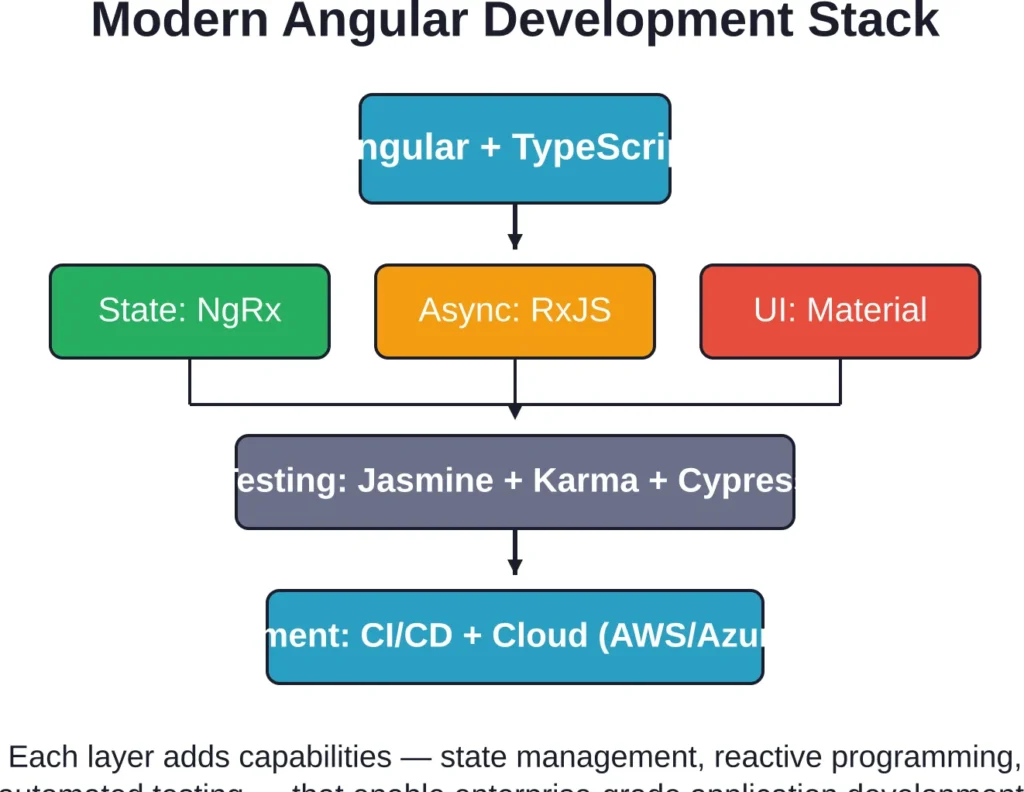
Modern Angular development involves an ecosystem of complementary technologies. Understanding this stack helps evaluate agency capabilities.
TypeScript
Angular is built with TypeScript, Microsoft’s typed superset of JavaScript. All serious Angular development uses TypeScript rather than plain JavaScript. The language’s static typing catches errors during development instead of at runtime.
RxJS and Reactive Programming
RxJS provides reactive extensions for JavaScript, handling asynchronous operations through observables. Angular uses RxJS extensively for HTTP requests, event handling, and state management. Developers who deeply understand RxJS write cleaner, more efficient Angular code.
NgRx for State Management
Complex applications need structured state management. NgRx implements Redux patterns in Angular applications, providing predictable state updates and time-travel debugging capabilities. Not every application needs NgRx, but for large applications with complex state, it’s invaluable.
Angular Material and Component Libraries
Angular Material provides pre-built UI components following Material Design principles. Component libraries accelerate development by providing tested, accessible components for common interface elements like date pickers, tables, and dialogs.
Some agencies build custom component libraries for clients with specific design systems. These reusable components ensure visual consistency and speed up future development.
Node.js Backend
Many Angular applications use Node.js backends. The JavaScript runtime allows full-stack developers to work across frontend and backend using the same language. Express and NestJS are popular Node.js frameworks that pair well with Angular.
Cloud Platforms
Modern Angular applications deploy to cloud platforms rather than traditional servers. Amazon Web Services, Google Cloud Platform, and Microsoft Azure provide hosting, databases, authentication services, and infrastructure that Angular applications consume through APIs.
Testing Frameworks
Quality Angular development includes comprehensive testing. Jasmine provides the testing framework, Karma runs tests in browsers, and Protractor or Cypress handle end-to-end testing. Strong agencies write tests alongside code rather than treating testing as an afterthought.
CI/CD Pipelines
Continuous integration and deployment automate building, testing, and releasing Angular applications. GitHub Actions, GitLab CI, CircleCI, and Jenkins run tests automatically when developers commit code and deploy to staging or production environments when tests pass.
Questions to Ask Angular Development Companies
The right questions reveal agency capabilities and fit better than marketing materials. These queries help evaluate potential partners.
About Technical Expertise
How many Angular developers are on your team? What’s the average experience level? Do developers specialize in Angular or work across multiple frameworks?
Can we review code samples from previous Angular projects? What coding standards and best practices do you follow? How do you handle code reviews?
What’s your experience with our specific industry? Can you share case studies from similar projects? What domain-specific challenges have you solved?
About Process and Communication
What development methodology do you use? How do sprints work? What meetings should we expect and how often?
How do you handle requirements changes during development? What’s your change management process? How are additional costs for scope changes calculated?
What project management tools do you use? How will we track progress? What visibility will we have into the development process?
About Team and Structure
Who will be on our project team? Can we interview key team members before starting? What happens if a critical team member leaves mid-project?
How do you handle time zone differences? What are your working hours? How quickly do you typically respond to questions or issues?
Will we have a dedicated project manager? Who’s our primary point of contact? How do we escalate issues if needed?
About Quality and Testing
What’s your testing approach? What types of testing do you perform? What test coverage percentages do you target?
How do you ensure code quality? What tools do you use for static analysis? Do you conduct security testing?
Can we see your typical test documentation? How do you handle bug reports? What’s your process for QA and user acceptance testing?
About Post-Launch Support
What support do you provide after launch? What’s included in the initial engagement versus what requires a maintenance contract?
What are your response times for production issues? Do you offer different support tiers? How do we report bugs or request enhancements?
How do you handle Angular version updates? Will you upgrade our application when new Angular releases come out? What’s that process like?
Angular Development Trends for 2026
The Angular ecosystem continues evolving. Several trends are shaping how development companies build applications in 2026.
Standalone Components
Angular introduced standalone components that don’t require NgModules. This simplified architecture reduces boilerplate and makes Angular more approachable for developers coming from other frameworks. Leading agencies are adopting standalone components for new projects while maintaining NgModule-based architectures for existing applications.
Improved Performance
Recent Angular versions have focused intensely on performance. Improvements to change detection, smaller bundle sizes, and better tree shaking make Angular applications faster. Agencies that stay current with these optimizations deliver snappier user experiences.
Enhanced Developer Experience
Angular CLI improvements, better error messages, and enhanced debugging tools make development more productive. The framework has acknowledged historical criticisms about developer experience and actively addresses them. Companies leveraging these improvements deliver projects faster with fewer frustrations.
Micro-Frontend Architecture
Large enterprises are adopting micro-frontends — breaking monolithic frontend applications into smaller, independently deployable pieces. Angular supports this pattern well, and agencies with micro-frontend expertise help enterprises modernize complex applications incrementally rather than requiring risky big-bang rewrites.
AI and Machine Learning Integration
Angular applications increasingly incorporate AI capabilities. That might mean integrating with APIs from OpenAI, Google’s Vertex AI, or AWS SageMaker. It could involve implementing natural language interfaces or intelligent automation. Agencies that understand both Angular and AI integration patterns deliver applications that leverage these emerging capabilities.
Accessibility Focus
Legal requirements and ethical considerations make accessibility non-negotiable. Angular Material components include strong accessibility support, and leading agencies ensure custom components meet WCAG standards. Keyboard navigation, screen reader support, and semantic HTML are standard practices for quality agencies.
Frequently Asked Questions
AngularJS refers to the original framework released in 2010, built with JavaScript. Angular (without the JS) refers to the complete rewrite released in 2016, built with TypeScript. They’re fundamentally different frameworks. AngularJS support ended in 2022, making migration to modern Angular necessary for applications still using the old version. Modern Angular offers better performance, mobile support, and long-term viability.
Project timelines vary dramatically based on complexity and scope. Simple applications might take 2-3 months from requirements to launch. Mid-complexity business applications typically require 4-6 months. Complex enterprise applications with extensive integrations can take 9-12 months or longer. Agencies using Agile methodologies deliver working software incrementally rather than waiting until the end, allowing businesses to see progress throughout development.
Specialized agencies bring deeper Angular expertise, which matters for complex applications, migrations, or when Angular-specific challenges arise. Full-stack agencies offer broader capabilities across technologies, which helps when projects involve significant backend work, mobile applications, or infrastructure setup. For projects where Angular is the primary challenge, specialists often deliver better outcomes. For projects requiring diverse technical capabilities, full-stack agencies make sense.
Yes, Angular supports progressive web app capabilities including offline functionality. Using service workers, Angular applications can cache resources and data, allowing them to function without internet connectivity. When connection restores, applications sync changes. This works well for field service applications, healthcare tools used in areas with spotty connectivity, and other scenarios where offline access matters. Implementing offline functionality requires specific architecture decisions, so discuss requirements with development partners early.
Quality agencies implement multiple security layers. Authentication systems verify user identities using standards like OAuth 2.0 or JWT tokens. Role-based access controls limit what different users can do. HTTPS encrypts data in transit. Input validation and sanitization prevent injection attacks. Angular’s built-in XSS protection helps when used correctly. For sensitive industries like healthcare or finance, agencies implement additional measures like encryption at rest, audit logging, and compliance with regulations like HIPAA or GDPR. Always discuss security requirements explicitly during agency evaluation.
This situation is challenging but manageable with proper planning. Ensure contracts address code ownership — typically the client should own all code and intellectual property. Maintain access to repositories, documentation, and deployment credentials throughout development. Use standard tools and frameworks rather than proprietary solutions. Good agencies document code thoroughly, making handoffs smoother. Requesting comprehensive documentation and knowledge transfer sessions before any transition reduces disruption. The best protection is thorough agency vetting upfront to minimize the need for mid-project changes.
Angular applications can work excellently on mobile when built with responsive design and performance optimization. Progressive web apps built with Angular provide mobile-like experiences in browsers. For native mobile applications, frameworks like Ionic or NativeScript use Angular to build apps that deploy to iOS and Android app stores. The right approach depends on requirements — PWAs work well when app store distribution isn’t necessary and web-based deployment offers advantages. Native mobile frameworks make sense when device-specific features or app store presence matters.
Making the Final Decision
Choosing an Angular development partner ranks among the most consequential decisions for web application projects. The right agency becomes a strategic partner that understands business goals and translates them into effective technical solutions. The wrong one creates technical debt, missed deadlines, and products that don’t meet needs.
Start by clarifying requirements. What problem does the application solve? Who are the users? What business outcomes define success? Technical capabilities matter, but agencies that understand business context deliver better solutions than those who merely follow specifications.
Request detailed proposals from multiple agencies. Compare not just capabilities but approach. How do they think about the problem? What questions do they ask? Do they challenge assumptions or just agree with everything? Agencies that push back constructively often deliver better outcomes than yes-men who blindly follow instructions.
Check references thoroughly. Don’t just contact the glowing testimonials on agency websites. Request contacts for projects similar to yours and ask specific questions about challenges, how the agency handled problems, and what the experience was really like.
Look beyond portfolios. Beautiful case studies matter, but dig deeper. Request access to actual code repositories if possible. Evaluate documentation quality. Check how well applications perform on mobile devices and with slow connections. These factors reveal more about capabilities than polished marketing materials.
Trust matters as much as technical skill. Development projects encounter unexpected challenges. Requirements change. Technical obstacles emerge. Market conditions shift. The relationship with the development partner determines whether these situations become catastrophes or merely bumps in the road.
Start small when possible. A discovery phase or small proof-of-concept project reveals how an agency works before committing to full development. This reduces risk and builds confidence on both sides.
But here’s the thing: perfect agencies don’t exist. Trade-offs are inevitable. The most technically skilled might lack design capabilities. The most creative might struggle with enterprise process requirements. The most affordable might not offer ongoing support. Clarity about priorities helps navigate these trade-offs.
The 10 companies listed here represent genuinely strong options, each with distinct strengths. House of Angular brings specialized expertise. BairesDev offers enterprise scale. Toptal provides flexible talent access. Andersen combines development with digital transformation. ScienceSoft brings industry-specific experience. Intellectsoft integrates emerging technologies. ELEKS offers competitive economics with quality. Arosys understands startup dynamics. Designli emphasizes design. Goji Labs accelerates time-to-market.
None is universally best. The right choice depends on specific project needs, budget constraints, timeline requirements, and organizational culture. Take the time to evaluate carefully. Ask hard questions. Trust but verify. The investment in thorough vetting pays dividends throughout the project and long after launch.
Angular development in 2026 offers tremendous opportunities. The framework’s maturity, Google’s ongoing investment, and the ecosystem’s depth create a solid foundation for building web applications that scale, perform, and remain maintainable for years. Partnering with the right development company turns those possibilities into reality.