

Quick Summary: Smartly.io is an enterprise-grade platform for social ad automation, but its complexity and budget requirements drive many teams to explore alternatives. Tools like Cropink ($39/mo), AdManage.ai, and Rocketium AI Studio offer specialized workflows for catalog automation, bulk campaign launching, and creative production — each targeting distinct pain points at different price points and team sizes.
Smartly.io bundles creative automation, media buying, and cross-platform intelligence into one platform. That’s powerful for enterprise teams managing millions in ad spend across Meta, TikTok, Pinterest, and Snapchat. But for smaller teams or those with focused workflows, the complexity and cost become friction points.
The platform works best when you need all three pillars: creative production at scale, automated media optimization, and unified reporting. If your team only needs one or two of those capabilities, specialized alternatives deliver faster onboarding and better cost efficiency.
Real timing data shows the stakes. Based on real timing data from bulk ad operations, launching 100 ads manually takes around 3,500 minutes — nearly 60 hours of repetitive clicking. At that rate, a single media buyer can manage approximately 20-50 ads per day before other responsibilities consume their time. Automation platforms cut that to minutes, but choosing the wrong tool means paying for features you won’t use.
This guide breaks down 10 alternatives across three categories: catalog automation for product-based campaigns, bulk media buying tools for high-volume launches, and creative production platforms for design-heavy workflows. Each entry includes transparent pricing, core strengths, and deal-breaker limitations so you can match tools to actual team needs.
Why Teams Move Beyond Smartly.io
Smartly.io positions itself as an all-in-one advertising platform. That consolidation appeals to large brands coordinating creative, media, and analytics teams across regions. But the same breadth creates specific friction points that push teams toward alternatives.
Here’s what drives the search for different tools.
Budget Constraints Hit Small-to-Midsize Teams
Smartly.io targets enterprise clients. Pricing structures reflect that focus. According to multiple sources, fees follow a tiered model: less than €100,000 in monthly spend carries a €5,000 flat fee (estimated monthly equivalent for annual plans starting at €100,000). Above that threshold, percentage-based fees apply — 5% for €100,001–€150,000, scaling down to 2% for spend above €1 million.
For teams spending €200,000 monthly, that’s an €8,000 monthly platform cost (4% fee). Agencies managing multiple mid-market clients or direct-to-consumer brands with $50,000–$150,000 monthly budgets find that pricing structure misaligned with their economics.
Alternatives like Cropink start at $39 per month for small catalogs, while tools such as AdManage.ai or Hunch offer entry points between €2,000–€5,000 monthly for teams that don’t need every module Smartly provides.
Onboarding Complexity and Learning Curves
Smartly.io’s feature set requires training. The platform combines three distinct products: Smartly Creative (asset production and versioning), Smartly Media (campaign automation and bidding), and Smartly Intelligence (reporting and forecasting). Each module has its own interface, workflows, and optimization logic.
Organizations typically require 4–8 weeks of onboarding before campaigns run efficiently. That’s acceptable for enterprises with dedicated ad ops teams. Smaller teams need tools they can deploy in days, not months.
Specialized alternatives trade breadth for speed. Catalog automation tools focus exclusively on product feed integration and template-based creative. Bulk launching platforms streamline campaign setup without creative or reporting layers. That narrower scope means faster time-to-value.
Over-Engineering for Specific Workflows
Not every team needs cross-platform orchestration. A Shopify merchant selling skincare products might only need catalog ads on Meta and Google Shopping. An agency scaling lead-gen campaigns for local clients might prioritize bulk ad creation over creative versioning.
Smartly.io’s architecture assumes you want unified control across platforms, creative production, and analytics. If your workflow centers on one pain point — say, launching 200 campaign variations weekly or producing 500 retailer-specific banners monthly — purpose-built tools deliver better ergonomics.
The platform’s intelligence layer exemplifies this. Smartly Intelligence offers forecasting, cross-platform attribution, and custom metric builders. That’s valuable for brand teams measuring incrementality across TV, digital, and retail media. Performance marketers optimizing Meta direct-response campaigns get more actionable insights from native platform reporting or lightweight BI connectors.
10 Best Smartly.io Alternatives for Different Use Cases
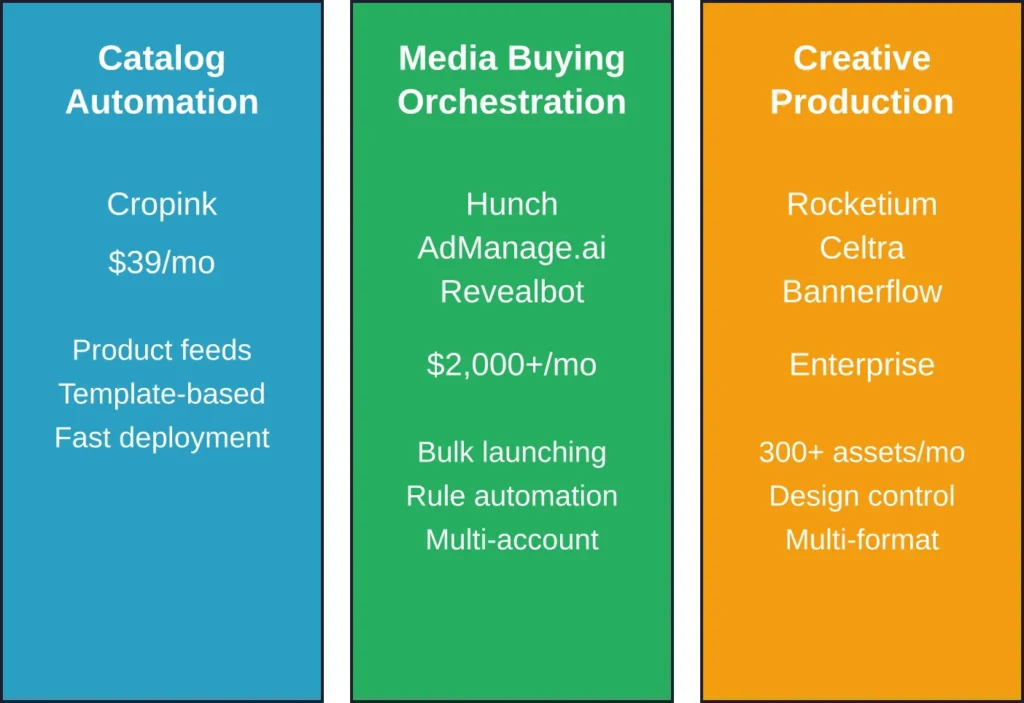
These alternatives split into three categories based on primary workflow: catalog automation, media buying orchestration, and creative production. Match your team’s bottleneck to the tool designed for it.
1. Extuitive – AI Ad Forecasting & Pre-Launch Validation
Extuitive is an AI-powered platform that predicts ad performance before you launch any campaigns. It connects to your Shopify (or similar) store, analyzes product data, and tests creatives against a behavioral model trained on over 150,000 real consumers. The tool forecasts key metrics like CTR, ROAS, CPA, and conversion probability with strong accuracy.
This allows brands to validate dozens of creatives in advance, eliminate weak performers, and scale only the strongest ones. It is particularly useful for reducing wasted spend during the creative testing phase.
Pricing starts with a free trial. Paid plans begin at $99/month and scale depending on the number of creatives and catalog size.
Where this tool shines:
Small to medium D2C and Shopify brands focused on creative testing efficiency. Teams launching new products or collections who want data-backed decisions before spending on ads. Performance marketers running Meta, TikTok, and Google campaigns who prioritize waste reduction.
Key limitations:
No media buying, campaign management, or optimization features — it is pre-launch only. Creative generation is helpful but not the strongest on the market. Requires a solid product catalog for best results. Platform is still relatively new compared to mature alternatives.
Contact Information:
- Website: extuitive.com
- Email: [email protected]
- LinkedIn: www.linkedin.com/company/extuitive
- Twitter: x.com/Extuitive_Inc
- Instagram: www.instagram.com/extuitiveinc
2. Hunch – Media Buying Automation for Agencies

Hunch automates media buying workflows across Meta, Google, and TikTok. The platform focuses on campaign structure, budget pacing, and rule-based optimizations rather than creative production. Think of it as the media layer of Smartly.io without the creative or intelligence modules.
The tool handles complex account structures well. Agencies managing 10+ client accounts with different naming conventions, UTM schemes, and budget allocations benefit from Hunch’s templatized campaign builders and bulk editing. The platform also offers automated budget shifting based on performance thresholds.
Pricing starts at approximately $2,000 per month with no free tier available. That’s positioned between mid-market tools and enterprise platforms, targeting agencies with established client rosters.
Where this tool shines: Agencies managing multiple client accounts. Teams with complex multi-country operations. Media buyers who need campaign structure automation without paying for creative or reporting layers.
Key limitations: No creative production features. Reporting is functional but not as deep as dedicated BI tools. Smaller teams might find the pricing steep if they’re only managing 2–3 accounts.
3. Rocketium AI Studio – Creative Production at Retail Scale

Rocketium AI Studio targets enterprise retail brands shipping creative across dozens of ad platforms and hundreds of format variations. The platform uses AI to generate on-brand assets from templates, product feeds, and campaign briefs, then versions those assets across formats and channels.
According to enterprise creative agency alternatives research, retail ad platforms added more than 100 new ad slots in recent years, with brands now shipping creative across 10+ platforms and 30+ formats. Traditional agency retainers built for 5-asset monthly calendars can’t match that operating rhythm. Rocketium compresses time-to-first-asset from weeks to 24–48 hours post-pilot.
The platform fits brands producing 300+ assets monthly, particularly those with retailer-heavy distribution (Amazon, Walmart, Target media networks). Creative automation here means feeding product data and brand guidelines into AI workflows that generate compliant, platform-specific assets at scale.
Where this tool shines: Enterprise retail brands managing 500+ assets per month. Teams coordinating creative across retail media networks. Creative operations teams replacing agency workflows with in-house automation.
Key limitations: Pricing is enterprise-level (contact sales). Overkill for teams producing fewer than 100 assets monthly. No media buying functionality — purely creative production and versioning.
4. AdManage.ai – Bulk Campaign Launching for Performance Marketers

AdManage.ai solves one specific problem: launching hundreds of campaign variations without manual clicking through Facebook Ads Manager. The platform offers spreadsheet-style bulk creation, preserved social proof when duplicating ads, and automated naming conventions.
Performance marketers testing 20+ audience combinations or 10+ creative variants across multiple campaigns hit Ads Manager’s limitations quickly. Inconsistent naming breaks reporting aggregation. Manual duplication loses social proof (likes, comments, shares). UTM parameters drift. AdManage.ai systematizes those repetitive tasks.
The tool integrates with Meta, Google, and TikTok. Workflows center on importing campaign structures from CSVs, applying naming templates, and launching in bulk. Think of it as a deployment layer on top of native ad platforms rather than a replacement.
Where this tool shines: Performance marketers launching 50+ ad variations weekly. Teams that need consistent campaign naming and UTM hygiene. Media buyers preserving social proof when scaling winning ads.
Key limitations: No creative production features. Reporting stays in native platforms or your existing BI stack. Focused exclusively on campaign setup, not ongoing optimization.
5. Celtra – Creative Automation for Brand Campaigns

Celtra is a creative management platform offering automation for brand-focused campaigns. The platform emphasizes design flexibility and collaboration over speed-to-market. Creative teams build modular templates with dynamic text, imagery, and video components, then version those templates across sizes and platforms.
This works well for brand campaigns requiring consistent messaging across display, social, and video formats. Celtra’s canvas gives designers granular control over layouts, animations, and responsive behavior. The trade-off is complexity — building reusable templates takes upfront investment.
The platform also offers creative analytics, tracking engagement metrics like video completion and interaction rates. That feedback loop helps creative teams refine concepts based on performance data rather than intuition.
Where this tool shines: Brand teams managing multi-channel campaigns with consistent creative messaging. Design-led workflows requiring layout control and animation. Teams needing creative performance analytics beyond platform-provided metrics.
Key limitations: Steeper learning curve than template-based tools. Pricing leans enterprise (contact sales). Not optimized for high-volume product catalog workflows.
6. Bannerflow – Display Advertising Creative Platform

Bannerflow is a display advertising creative production and management platform. The platform provides a drag-and-drop canvas for building HTML5 banners, then automates versioning across IAB standard sizes. Creative feeds integrate dynamic content like product pricing, event dates, or localized messaging.
The tool fits teams running programmatic display campaigns at scale. Instead of manually resizing and exporting 15 banner sizes per campaign, designers build one master creative and Bannerflow handles adaptation. The platform also manages ad serving and trafficking, bridging creative production and media deployment.
Analytics track creative performance at the banner level, surfacing which sizes and messaging variants drive engagement. That granularity helps optimize display campaigns beyond placement-level reporting.
Where this tool shines: Teams running large-scale programmatic display campaigns. Brands managing localized or event-based creative variations. Organizations consolidating creative production and ad serving in one platform.
Key limitations: Focused exclusively on display — not suited for social or video workflows. Requires design expertise to build effective templates. Pricing scales with ad volume and complexity.
7. Metadata.io – B2B Campaign Automation

Metadata.io focuses on campaign automation for B2B demand generation workflows. The platform integrates with LinkedIn, Google, and Facebook to launch, optimize, and report on campaigns targeting business audiences. Workflows emphasize lead quality over volume, with automated budget allocation favoring campaigns that drive pipeline.
The tool connects to CRM and marketing automation platforms (Salesforce, HubSpot, Marketo) to close the loop between ad spend and revenue outcomes. That integration lets marketers optimize toward SQLs or closed revenue rather than proxy metrics like clicks or form fills.
Metadata.io fits B2B teams running multi-channel demand gen programs where campaign performance ties directly to sales outcomes. The platform automates tactical execution so marketers focus on messaging, offers, and audience strategy.
Where this tool shines: B2B marketing teams optimizing toward pipeline and revenue. Demand gen programs spanning LinkedIn, Google, and Facebook. Teams needing tight integration between ad platforms and CRM systems.
Key limitations: Not designed for eCommerce, retail, or B2C direct response. Pricing reflects enterprise positioning. Requires mature attribution and CRM integration to extract full value.
8. Revealbot – Rule-Based Campaign Automation

Revealbot automates campaign management through customizable rules and alerts. The platform monitors metrics like CPA, ROAS, or frequency, then triggers actions like pausing ads, adjusting budgets, or sending Slack notifications when thresholds are crossed. This replaces manual performance monitoring with automated oversight.
The tool integrates with Meta, Google, Snapchat, and TikTok. Marketers build rule sets tailored to their KPIs — for example, pause any ad set with CPA above $50 after spending $200, or increase budget by 20% when ROAS exceeds 4x. Those rules run continuously, catching performance shifts faster than daily manual reviews.
Revealbot also offers bulk editing and automated reporting. The platform suits performance marketers managing dozens of active campaigns who need systematic optimization without hiring additional team members.
Where this tool shines: Performance marketers running high-volume campaigns across multiple platforms. Teams needing automated safeguards against budget waste. Media buyers who want rule-based optimization without building custom scripts.
Key limitations: Rules require thoughtful configuration — poorly designed thresholds can trigger premature pausing. No creative production features. Reporting is functional but not as robust as dedicated BI tools.
9. Smartly.io Lite (Hypothetical) – Simplified Entry Point

Some teams exploring alternatives actually need Smartly.io’s capabilities but can’t justify enterprise pricing. A hypothetical simplified tier stripping out advanced forecasting, multi-region orchestration, and white-glove support could capture mid-market teams currently choosing specialized alternatives.
This hypothetical tier would focus on core workflows: template-based creative automation, automated media buying for Meta and Google, and basic cross-platform reporting. Pricing around $2,000–$3,000 monthly would position it between tools like Hunch and full enterprise Smartly.io.
Such a product doesn’t currently exist, but the gap between $500/month specialized tools and $8,000+ enterprise platforms leaves room for a mid-tier offering.
Where this tool would shine: Mid-market brands needing multiple modules but not enterprise complexity. Agencies managing 3–10 client accounts. Teams graduating from point solutions but not ready for full Smartly.io pricing.
Key limitations: Hypothetical — not an existing product. Would require Smartly.io to adjust go-to-market strategy toward mid-market segments.
10. Cropink – Catalog Automation for eCommerce Teams
Cropink simplifies product-based ad creation. The platform connects directly to eCommerce catalogs (Shopify, WooCommerce, BigCommerce) and generates ad creatives using product data, pricing, and inventory status. Templates handle layout and text overlays while the feed integration keeps assets synchronized with your catalog.
This works especially well for teams running catalog campaigns across Meta and Google Shopping. Instead of manually updating 50 product ads when prices change, Cropink refreshes creative automatically. The workflow prioritizes speed over customization — you’re trading design control for operational efficiency.
Pricing starts free for up to 25 products, then $39 per month for paid plans. That cost structure makes sense for small-to-midsize eCommerce brands testing product ads without committing to enterprise tooling.
Where this tool shines: Small eCommerce teams that need catalog ads live quickly. Product-led marketers who prioritize launch speed over pixel-perfect design. Teams running seasonal promotions across hundreds of SKUs.
Key limitations: Creative customization is constrained by templates. Not designed for campaigns outside product catalogs (brand awareness, video ads, lead generation). No media buying or reporting features — this is purely a creative automation layer.
How to Choose the Right Smartly.io Alternative
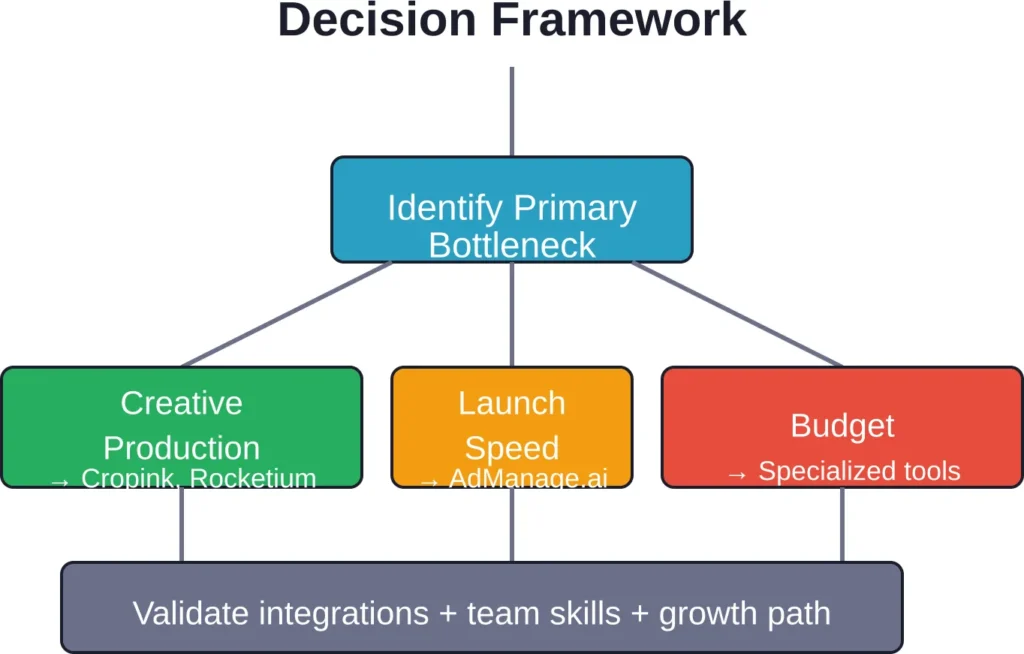
Match your primary bottleneck to the tool category designed to solve it. Here’s a framework for making that decision.
Start With Your Biggest Constraint
Three constraints typically drive teams toward automation: creative production capacity, campaign launch speed, or budget efficiency. Rank these by severity.
If creative production is the bottleneck — your team can’t produce enough asset variations to test effectively or keep campaigns fresh — prioritize creative automation tools. Cropink for product catalogs, Rocketium for high-volume retail creative, Celtra for brand campaigns requiring design control.
If campaign launch speed is the bottleneck — media buyers spend hours manually setting up campaign structures instead of analyzing performance — prioritize media buying tools. AdManage.ai for bulk launching, Hunch for multi-account orchestration, Revealbot for rule-based optimization.
If budget is the constraint — you need automation but can’t justify $5,000+ monthly platform costs — start with specialized tools that solve your most acute pain point. Scale into broader platforms as revenue grows.
Evaluate Integration Requirements
Some tools require tight integration with existing systems. Metadata.io needs CRM and marketing automation connections to optimize toward pipeline metrics. Cropink needs eCommerce catalog access to automate product ads. Rocketium works best with brand asset management systems feeding templates.
Map your current stack and identify integration dependencies. Tools that require extensive setup or IT support delay time-to-value, which matters more for small teams than enterprises with dedicated ad ops resources.
Consider Team Structure and Expertise
Creative-first tools like Celtra assume design expertise. Media buying platforms like Hunch assume familiarity with campaign structure and optimization logic. Product-feed tools like Cropink abstract away complexity, making them accessible to marketers without technical backgrounds.
Assess your team’s skill distribution. A designer-heavy team extracts more value from Celtra’s canvas than Cropink’s templates. A performance marketing team with no design resources benefits more from template-based automation than design-led platforms.
Project Growth Trajectory
Some tools scale gracefully, others hit ceilings. Cropink works well from 25 products to a few thousand, but teams managing 50,000+ SKUs across dozens of locales eventually need enterprise infrastructure. Revealbot’s rule-based approach scales to hundreds of campaigns but can’t replace strategic media planning.
Consider where your operation will be in 12–18 months. If you’re testing product ads today but plan to expand into video, display, and multi-platform campaigns, choosing a narrow tool creates future migration costs. If you’re confident your workflow stays focused on one channel or format, specialized tools deliver better ROI than paying for unused features.
Real-World Scenarios and Tool Fit
Abstract feature lists don’t clarify tool selection as effectively as concrete scenarios. Here are four common situations and the alternatives that fit best.
Scenario 1: Shopify Store Scaling Product Ads
A direct-to-consumer brand sells 400 SKUs across apparel and accessories. The marketing team runs catalog campaigns on Meta and Google Shopping. Current workflow involves manually exporting product images, adding text overlays in Canva, and uploading individual ads. Seasonal promotions require updating hundreds of ads with new pricing.
Best fit: Cropink. The Shopify integration automates catalog sync. Templates handle text overlays and promotional badges. When pricing changes, creative updates automatically. The $39/month cost scales with catalog size without enterprise complexity.
Why not Smartly.io: The team doesn’t need media buying automation or cross-platform intelligence. They’re optimizing within Meta and Google Shopping’s native interfaces. Paying for unused modules doesn’t improve outcomes.
Scenario 2: Performance Agency Managing 15 Client Accounts
A performance marketing agency runs lead-gen and eCommerce campaigns for 15 mid-market clients. Media buyers launch 50–100 new ad variations weekly across Meta, Google, and TikTok. Current pain points include inconsistent naming conventions across accounts, lost social proof when scaling ads, and time spent on repetitive campaign setup.
Best fit: AdManage.ai or Hunch. Both handle bulk launching and multi-account workflows. AdManage.ai preserves social proof when duplicating ads, which matters for scaling winning creative. Hunch offers deeper budget pacing and rule-based optimization if the team needs ongoing automated management beyond initial launch.
Why not Smartly.io: At $2,000–$5,000 monthly for mid-tier alternatives versus $8,000+ for Smartly.io, the agency’s client economics favor specialized tools. Creative production happens in-house or through freelancers, so the creative automation module adds cost without value.
Scenario 3: Enterprise Retail Brand Managing 1,000+ Assets Monthly
A national retail brand advertises across Amazon, Walmart, Target media networks, Meta, Google, Pinterest, and TikTok. The marketing team produces 1,000+ creative assets monthly, versioned across 30+ format specifications. Current workflow involves agency partners working on 2–3 week timelines, which delays campaign launches and limits testing velocity.
Best fit: Rocketium AI Studio. The platform’s AI-driven creative automation compresses production timelines from weeks to days. Template systems handle format adaptation across platforms. The brand internalizes creative production, reducing dependency on agency schedules and per-asset fees.
Why not Smartly.io: Smartly.io’s creative module could work, but Rocketium specializes in retail-scale production. The team might still use Smartly.io for media buying and intelligence, pairing it with Rocketium for creative. That hybrid approach optimizes each workflow component with best-in-class tools.
Scenario 4: B2B SaaS Company Running Multi-Channel Demand Gen
A B2B software company runs demand generation campaigns across LinkedIn, Google, and Facebook. The marketing team optimizes toward pipeline and revenue metrics, not clicks or impressions. Current challenges include disconnected reporting between ad platforms and Salesforce, and manual budget shifting based on which campaigns drive qualified opportunities.
Best fit: Metadata.io. The platform’s CRM integration closes the loop between ad spend and revenue outcomes. Automated budget allocation favors campaigns driving pipeline. The team shifts from optimizing toward vanity metrics to focusing on business impact.
Why not Smartly.io: Smartly.io optimizes toward platform-native metrics (CPA, ROAS, CTR) rather than CRM-based outcomes. Metadata.io’s B2B-specific workflows and integrations deliver better alignment with the company’s go-to-market motion.
Common Mistakes When Switching Platforms
Migrating from Smartly.io or choosing an alternative involves predictable pitfalls. Here’s what teams get wrong and how to avoid it.
Chasing Features Instead of Solving Workflows
Tool comparison spreadsheets listing features look rigorous but mislead. A platform with 50 features isn’t better than one with 10 if you only use 5. Teams accumulate unused capabilities while paying for complexity.
Start with workflow documentation instead. Map current processes: who does what, which steps take the most time, where errors occur. Then evaluate tools based on how directly they address documented bottlenecks. A tool that solves two critical pain points beats one that offers 20 features you’ll never configure.
Underestimating Migration Costs
Switching platforms involves technical migration (campaign structures, naming conventions, integrations) and organizational change (training, updated SOPs, new approval workflows). Teams budget for software costs but underestimate the labor required to transition smoothly.
Plan for 4–8 weeks of parallel operation. Run existing and new systems simultaneously while teams learn workflows and validate that reporting matches. Don’t shut down legacy tools until the new platform demonstrates equivalent or better outcomes across core KPIs.
Ignoring Integration Dependencies
Some tools work standalone, others require ecosystem integration to deliver value. Metadata.io needs CRM connections. Cropink needs catalog feeds. Rocketium benefits from brand asset management systems. Teams discover integration gaps after committing to contracts.
Audit integration requirements during evaluation. Identify which systems (eCommerce platforms, CRMs, asset management, BI tools) need to connect. Verify integration quality through demos or trials — documented API support doesn’t guarantee smooth workflows.
Optimizing for Current Scale Instead of Growth Trajectory
A tool perfect for current operations might not scale to next year’s needs. Teams choose based on today’s constraints, then hit platform limitations as volume grows. Migrating again creates compounding switching costs.
Stress-test tools against growth scenarios. If you’re managing 200 products today but plan to expand to 2,000, confirm the tool handles that scale without jumping to enterprise pricing tiers. If you’re running Meta campaigns now but plan to add TikTok and Pinterest, ensure platform coverage supports multi-channel expansion.
Pricing Structures Explained
Understanding how alternatives price their services clarifies total cost of ownership. Three models dominate this category.
Flat Monthly Subscriptions
Tools like Cropink charge fixed monthly fees based on catalog size or feature tier. Pricing is transparent and predictable. This model works well for teams with stable operations — you know exactly what you’ll pay each month.
The trade-off is lack of flexibility. If campaign volume drops, you still pay the full subscription. If you need occasional access to premium features, you’re locked into higher tiers. This structure favors consistent workflows over variable demand.
Percentage of Ad Spend
Enterprise platforms including Smartly.io often charge a percentage of managed ad spend. As budgets scale, platform costs scale proportionally. This aligns vendor revenue with client growth but can create sticker shock as campaigns expand.
Percentage-based pricing makes sense for platforms providing ongoing optimization that drives measurable performance lift. If the tool improves ROAS by 20%, paying 2–4% of spend is reasonable. But if the platform primarily handles workflow automation without performance impact, fixed-fee tools deliver better ROI at scale.
Tiered Usage-Based Pricing
Some tools price based on usage metrics: number of ads created, campaigns launched, or reports generated. This creates alignment between cost and value extracted, but introduces unpredictability. Heavy usage months cost more.
Usage-based pricing works for variable workflows. Seasonal eCommerce brands running heavy campaigns in Q4 pay more during peak periods, less in off-seasons. Agencies with fluctuating client rosters scale costs with active accounts.
| Pricing Model | Best For | Watch Out For |
|---|---|---|
| Flat subscription | Stable, predictable workflows | Paying for unused capacity in slow periods |
| Percentage of spend | High-budget campaigns where platform drives performance lift | Costs scaling faster than value at high spend levels |
| Usage-based | Variable workflows, seasonal campaigns | Unpredictable monthly costs, potential overages |
| Enterprise (custom) | Complex requirements, multi-team organizations | Lack of pricing transparency, long contract terms |
When Smartly.io Still Makes Sense
Specialized alternatives solve focused problems effectively, but some scenarios still favor Smartly.io’s integrated approach.
Multi-Team Enterprises Needing Unified Workflows
Large organizations with separate creative, media, and analytics teams benefit from shared platforms. Smartly.io’s modules communicate within one system, reducing handoff friction. Creative teams export assets directly to media buyers. Analytics teams pull performance data without stitching together separate tools.
Replicating that integration with multiple specialized tools requires custom development or accepting workflow gaps. For enterprises where coordination costs outweigh platform costs, all-in-one systems deliver operational value.
Brands Managing Massive Multi-Platform Spend
Organizations spending millions monthly across Meta, TikTok, Snapchat, Pinterest, and programmatic channels need centralized orchestration. Smartly.io’s media module handles cross-platform budget allocation, pacing, and optimization in one interface.
Specialized tools typically focus on 1–3 platforms. Managing six platforms across three tools introduces complexity and reporting inconsistency. At sufficient scale, paying for comprehensive coverage makes sense.
Teams Prioritizing Speed-to-Market Over Cost Efficiency
Smartly.io’s breadth enables rapid deployment across creative, media, and reporting simultaneously. Teams can launch new campaigns, creative tests, and measurement frameworks within the same platform, accelerating iteration cycles.
Specialized tools require coordinating across vendors. That coordination introduces delays — creative production finishes, then assets move to media tools, then reporting connects afterward. For teams where time-to-market drives competitive advantage, integrated platforms compress timelines.
Frequently Asked Questions
Cropink offers the lowest entry point at free for up to 25 products, with paid plans starting at $39 per month. That pricing applies specifically to catalog automation for eCommerce teams. For media buying workflows, tools like Revealbot or AdEspresso (not covered in depth here) start around $49–$99 monthly. The cheapest option depends on which workflow you’re automating — creative production, campaign launching, or ongoing optimization.
Enterprise platforms typically require minimum commitments and contract terms that don’t align with small team budgets or needs. Rocketium targets brands producing 300+ assets monthly, which exceeds most small team requirements. Tools like Cropink, Canva, or Bannersnack serve smaller creative production needs at accessible price points. Scale into enterprise platforms when asset volume and format complexity justify the investment.
Platform coverage varies by tool. AdManage.ai, Hunch, and Revealbot support Meta, Google, and TikTok. Metadata.io covers LinkedIn, Google, and Facebook. Cropink focuses on creative for catalog campaigns across Meta and Google Shopping. Always verify platform coverage during evaluation — some tools excel on specific channels but lack multi-platform support.
Plan for 4–8 weeks of parallel operation. Technical migration (campaign structures, naming conventions, integration setup) takes 1–2 weeks for specialized tools, longer for enterprise platforms. Organizational change (training, workflow documentation, performance validation) requires another 2–6 weeks depending on team size and campaign complexity. Don’t rush migration — operational disruption costs more than a few extra weeks of dual platform fees.
Creative automation platforms handle production and versioning efficiently but don’t replace strategic creative thinking. Tools excel at scaling concepts across formats and channels once the core creative is defined. Agencies still add value in brand strategy, campaign concepting, and producing hero assets. The shift is from agencies handling all production to agencies focusing on strategy while automation handles execution and versioning.
Historical performance data stays in ad platforms (Meta Ads Manager, Google Ads, etc.) or your BI tools — it doesn’t disappear when changing workflow tools. New platforms won’t backfill historical data from Smartly.io’s proprietary reporting. Export critical historical reports and performance benchmarks before migration. Most teams maintain access to legacy platforms in read-only mode for 3–6 months post-migration for reference.
Metadata.io specializes in B2B demand generation with CRM integrations and pipeline-focused optimization. Tools like HubSpot Ads and LinkedIn Campaign Manager native features also serve B2B workflows well. Many B2B teams find success combining general-purpose media buying tools (like Hunch or Revealbot) with strong BI/attribution layers rather than B2B-specific platforms, depending on their stack maturity.
Making the Final Decision
Choosing a Smartly.io alternative isn’t about finding the “best” tool — it’s about matching tool strengths to specific constraints and workflows. The platform perfect for a 500-person retail brand breaks budgets and over-engineers processes for a 5-person agency. The tool ideal for catalog automation doesn’t help teams focused on video creative or display campaigns.
Start by documenting current bottlenecks. Spend a week tracking where time goes: creative production, campaign setup, performance monitoring, reporting. Quantify the hours burned on repetitive tasks versus strategic work. That audit reveals which automation category delivers maximum leverage.
Then narrow candidates based on platform coverage, integration requirements, and team skills. A tool requiring design expertise won’t work for performance marketing teams without designers. A platform needing deep technical integration delays value for teams without engineering support.
Run focused trials. Instead of evaluating five tools across all features, test 2–3 finalists on your most painful workflow. Measure time savings, error reduction, and output quality. Compare trial results to current-state benchmarks, not competitor marketing claims.
Finally, stress-test pricing against growth scenarios. A tool that’s affordable today but triples in cost at moderate scale creates future migration headaches. Verify contract terms, especially around data portability, integration access, and exit processes.
Alternatives exist because no single platform optimally serves every workflow, team size, and budget. Smartly.io’s enterprise positioning created space for specialized tools solving focused problems more efficiently. The question isn’t whether alternatives are “better” — it’s whether their specific strengths align with your specific needs better than an all-in-one platform you’ll only partially use.