

Quick Summary: AI content marketing software helps businesses automate content creation, distribution, and optimization. The best tools in 2026 combine writing assistance, SEO optimization, social media management, and analytics capabilities. Leading platforms include Extuitive, Semrush ContentShake AI, Jasper, Canva, and specialized tools for different content types and channels.
Content marketing demands are growing exponentially. Teams face pressure to produce more content, faster, across more channels than ever before.
That’s where AI content marketing software enters the picture.
According to research from arXiv, AI-generated ads show competitive performance with human-created content, with participants showing strong preference in certain conditions. Even more telling: 29.4% of participants chose AI content even after correctly identifying its AI origin.
But here’s the thing—not all AI content tools deliver the same results.
This guide breaks down the most effective AI content marketing platforms available in 2026, based on verified testing data, G2 ratings, and real-world performance metrics.
What Is AI Content Marketing Software?
AI content marketing software uses machine learning and natural language processing to automate or assist with content creation, optimization, and distribution tasks.
These platforms handle everything from generating blog posts and social media captions to optimizing existing content for search engines and analyzing performance metrics.
The capabilities vary widely. Some tools focus exclusively on writing assistance. Others provide comprehensive suites covering content planning, creation, distribution, and analytics.
Modern AI content platforms typically include:
- Natural language generation for text content
- SEO optimization recommendations
- Content templates and workflows
- Multi-channel publishing capabilities
- Performance analytics and reporting
- Brand voice customization
Real talk: the technology has matured considerably. Research indicates humans can differentiate AI-generated text from human-written content approximately 53% of the time—barely above random guessing.
Top AI Content Marketing Software Platforms
The following platforms represent the most effective AI content marketing solutions based on verified testing, user ratings, and feature sets.
Extuitive
Extuitive is an AI-powered predictive advertising platform that helps brands create, validate, and launch high-performing content and ads before spending a single dollar on traffic. It combines AI generation with consumer behavior simulation to forecast real-world performance metrics like CTR, engagement, and ROAS.
The platform connects directly to Shopify stores (or takes a website URL), analyzes products, generates ad copy, images, videos, and pricing ideas, then pressure-tests them using 150,000+ AI-modeled consumer agents trained on real behavioral data. This allows teams to rank creatives, kill weak concepts early, and scale only the strongest ideas.
Pricing starts at enterprise-oriented plans (Starter from around $1,000/month). Contact sales for exact tiers and custom enterprise options.
The standout feature? Pre-launch performance prediction powered by AI consumer agents that simulate audience reactions with high accuracy, dramatically reducing wasted ad spend and guesswork.
Best for: Ecommerce brands and Shopify store owners focused on efficient content marketing and paid acquisition who want data-backed creative decisions instead of trial-and-error.
Contact Information:
- Website: extuitive.com
- Email: [email protected]
- LinkedIn: www.linkedin.com/company/extuitive
- Twitter: x.com/Extuitive_Inc
- Instagram: www.instagram.com/extuitiveinc
Semrush ContentShake AI

Semrush’s Content Toolkit provides organizations with tools specifically designed to publish search engine-optimized content at scale.
The platform analyzes top-ranking competitors, identifies content gaps, and generates SEO-optimized articles. For individual content creators, pricing starts from $60 per month, with the option to purchase an extra 10 SEO-boosted articles for $30.
The standout feature? Integration with Semrush’s broader SEO ecosystem. Writers get real-time keyword suggestions, readability scores, and competitive insights while drafting.
Best for: Organizations prioritizing search visibility and organic traffic growth.
Jasper

Jasper is listed among platforms with strong user ratings and recommendation likelihood.
The platform excels at brand-safe AI writing and team collaboration. Multiple team members can work within consistent brand guidelines, accessing templates optimized for various content types.
Pricing starts at $59 per month. The platform includes over 50 templates covering blog posts, social media content, email campaigns, and ad copy.
Jasper’s Boss Mode allows longer-form content generation with better context retention across paragraphs—addressing a common weakness in earlier AI writing tools.
Best for: Marketing teams requiring consistent brand voice across multiple content creators.
Canva

Canva is noted in G2 sources as having a 4.7/5 rating with high user recommendation rates.
While primarily known for design, Canva’s AI-powered features have evolved into a comprehensive visual content creation platform. The tool now includes AI writing assistance, background removal, video editing, and presentation creation.
Teams get access to brand kits, real-time collaboration, and thousands of templates. Pricing starts at $15 per month.
The platform particularly shines for social media content, where visual and text elements need tight integration.
Best for: Collaborative teams creating visual content across multiple channels.
Creatify AI

Creatify AI specializes in effortless video content creation.
The platform converts text descriptions into video content with minimal production investment. Pricing starts at $19 per month.
Users input product descriptions or marketing messages, and the AI generates video content with appropriate visuals, transitions, and text overlays.
Best for: E-commerce brands and marketers creating product videos at scale.
AKOOL

AKOOL focuses on realistic AI avatar videos and creative storytelling.
Starting at $21 per month, AKOOL enables teams to create presenter-style videos without filming. The AI avatars look increasingly realistic and support multiple languages.
The platform works particularly well for training content, product demonstrations, and social media videos where a human presenter adds credibility.
Best for: Teams producing presenter-led video content without access to on-camera talent.
SOCi

SOCi specializes in multi-location social media management.
For franchises and businesses with multiple locations, SOCi provides centralized control with local customization capabilities. Pricing starts at $19 per month.
The platform includes AI-powered content suggestions, unified messaging across locations, and location-specific performance analytics.
Best for: Multi-location businesses maintaining brand consistency while allowing local customization.
Creaitor

Creaitor targets lean teams scaling written content fast.
Starting at $19 per month, Creaitor emphasizes speed without sacrificing quality. The interface prioritizes quick content generation over extensive customization.
Teams can generate blog outlines, social posts, email copy, and product descriptions in minutes rather than hours.
Best for: Small teams with high content volume requirements and limited resources.
ChatGPT Plus

ChatGPT remains a versatile general-purpose AI writing tool. ChatGPT Plus costs $20 per month.
Unlike purpose-built content marketing platforms, ChatGPT requires more manual direction but offers unmatched flexibility. Users craft custom prompts for any content type imaginable.
The tool excels at brainstorming, outline creation, research summarization, and first-draft generation.
Best for: Content creators comfortable with prompt engineering who need maximum flexibility.
Grammarly

Grammarly has evolved beyond spell-checking into AI-powered writing refinement. The Pro tier costs $30 per member per month, with Enterprise offering custom pricing.
The platform now provides tone suggestions, clarity improvements, engagement optimization, and plagiarism detection. The AI analyzes context to recommend more effective phrasing.
Grammarly integrates directly into browsers, email clients, and document editors—catching issues wherever teams write.
Best for: Teams prioritizing clear, error-free communication across all written content.
AI Tools for Specific Content Marketing Functions
Different content marketing tasks require specialized capabilities. The following platforms excel in specific functional areas.
SEO Content Optimization
Hypotenuse AI specializes in SEO-ready blog content. The platform analyzes search intent, competitor content, and ranking factors to generate optimized articles.
The tool automatically incorporates target keywords at appropriate densities, suggests internal linking opportunities, and structures content with proper heading hierarchy.
Surfer SEO provides another approach—integrating directly into writing workflows with real-time optimization scores. Writers see immediate feedback on keyword usage, content structure, and readability.
Social Media Management
Buffer tailors posts for each channel through an AI Assistant that detects the target platform and adapts output accordingly. Buffer offers a free plan for up to three channels.
The platform recognizes that LinkedIn audiences expect different content than Instagram followers—and adjusts tone, length, and formatting automatically.
Predis.ai focuses specifically on creating all social media content with AI, including captions, images, and video content. Pricing starts from $19 per month, with topic tracking and sentiment signals.
Video Content Creation
Lumen5 transforms text content into video format automatically. Marketers paste blog posts or articles, and the platform identifies key points, sources relevant footage, and creates video content.
The platform works particularly well for repurposing existing written content into video format for social media distribution.
Email Marketing
AI-powered email tools focus on subject line optimization, send-time prediction, and content personalization.
Many email platforms now include AI features that analyze historical engagement data to predict optimal send times for individual subscribers. The technology also suggests subject line variations likely to improve open rates.
Content personalization goes beyond inserting names—AI analyzes behavioral data to recommend products, content, or offers matching individual preferences.
Key Features to Evaluate
When selecting AI content marketing software, specific capabilities determine real-world effectiveness.
Content Quality and Originality
Output quality varies dramatically across platforms. Testing multiple tools with identical prompts reveals significant differences in coherence, accuracy, and creativity.
Look for platforms that:
- Generate original content rather than recycling training data
- Maintain context across longer pieces
- Match specified tone and style consistently
- Produce factually accurate information
OpenAI’s tests indicate its classifier achieved only a 26% true positive rate (likely AI-written), while maintaining a 9% false positive rate for human content. This highlights both the sophistication of modern AI writing and the challenges of detection.
Integration Capabilities
Standalone tools create workflow bottlenecks. The most effective platforms integrate with existing marketing technology stacks.
Priority integrations include:
- Content management systems (WordPress, HubSpot, Webflow)
- Social media scheduling tools
- Email marketing platforms
- Analytics and reporting tools
- Project management software
Native integrations eliminate manual content transfers and reduce opportunities for errors.
Brand Voice Customization
Generic AI content lacks personality. Advanced platforms learn and replicate specific brand voices.
Jasper’s Brand Voice feature analyzes existing content to understand tone, vocabulary, and style preferences. Future content generation maintains these characteristics automatically.
Teams upload sample content representing the desired brand voice. The AI identifies patterns and applies them to new content creation.
Multi-Channel Support
Content rarely lives in a single channel. Effective platforms adapt content for different distribution channels without starting from scratch.
Look for tools that:
- Repurpose long-form content into social snippets
- Adjust tone and length for different platforms
- Generate channel-specific content formats
- Maintain message consistency across adaptations
Buffer’s channel-aware AI demonstrates this capability—automatically adjusting content based on destination platform requirements.
Collaboration Features
Content creation involves multiple stakeholders. Platforms supporting team collaboration prevent version control nightmares and approval bottlenecks.
Essential collaboration features:
- Role-based access controls
- Comment and feedback systems
- Version history and rollback
- Workflow approvals
- Shared content libraries
Canva particularly excels here, with real-time collaboration allowing multiple team members to edit simultaneously.
| Platform | Primary Function | Starting Price | G2 Rating | Best For |
|---|---|---|---|---|
| Semrush ContentShake | SEO-optimized content | $60/month | N/A | Organic traffic growth |
| Jasper | AI writing assistant | $59/month | 4.7/5 | Team collaboration |
| Canva | Visual content creation | $15/month | 4.7/5 | Social media visuals |
| ChatGPT Plus | General-purpose AI | $20/month | N/A | Maximum flexibility |
| Grammarly Pro | Writing refinement | $30/month | N/A | Error-free communication |
| Buffer | Social media management | Free tier available | N/A | Multi-channel posting |
AI Content Detection Considerations
As AI content becomes more prevalent, detection tools have emerged—though their effectiveness remains limited.
The Content Marketing Institute tested four AI detection tools with mixed results. OpenAI’s own classifier achieved only a 26% true positive rate when identifying likely AI-written content.
Detection tools show varying accuracy levels for AI content identification.
But here’s what matters more than detection: content quality and value. Search engines increasingly emphasize helpfulness and expertise over content origin.
Google’s guidance focuses on whether content demonstrates experience, expertise, authoritativeness, and trustworthiness—regardless of creation method.
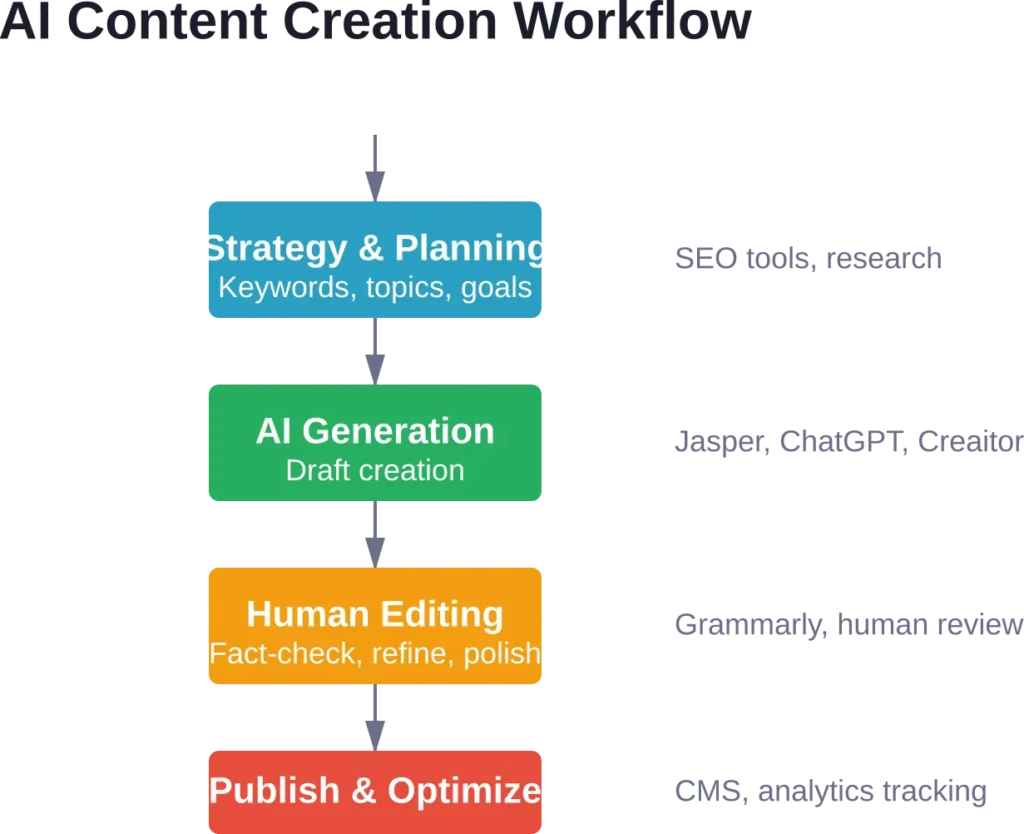
The practical takeaway? Focus on editing and enhancing AI-generated content rather than trying to make it undetectable. Add original insights, verify facts, and ensure the final product genuinely helps readers.
Pricing Models and ROI Considerations
AI content marketing software pricing varies widely based on features, usage limits, and target market.
Common Pricing Structures
Most platforms use subscription models with tiered pricing:
- Per-user pricing: Monthly fees per team member (common in collaboration-focused tools)
- Usage-based pricing: Charges based on content volume, API calls, or credits consumed
- Flat-rate pricing: Unlimited access within a tier for a fixed monthly fee
- Freemium models: Free basic access with paid upgrades for advanced features
Buffer offers a free plan for up to three channels. Canva starts at $15 per month. Enterprise platforms can reach $499 per month or more for comprehensive feature sets.
Calculating ROI
Content marketing ROI calculations should account for:
Time savings: Compare hours spent on manual content creation versus AI-assisted workflows. Many practitioners report significant time savings for routine content tasks.
Content volume increases: Track how much more content teams can produce with AI assistance while maintaining quality standards.
Performance improvements: Monitor whether AI-optimized content drives better engagement, traffic, or conversions compared to manual approaches.
Resource reallocation: Calculate the value of freeing skilled creators from routine tasks to focus on strategic work.
According to industry analyses, outsourcing a 1,500-word article to freelancers costs upwards of $175. AI writing assistant tools can reduce these outgoings significantly—though human editing and oversight remain essential.
Implementation Best Practices
Successfully deploying AI content marketing software requires more than subscription payments.
Start with Pilot Projects
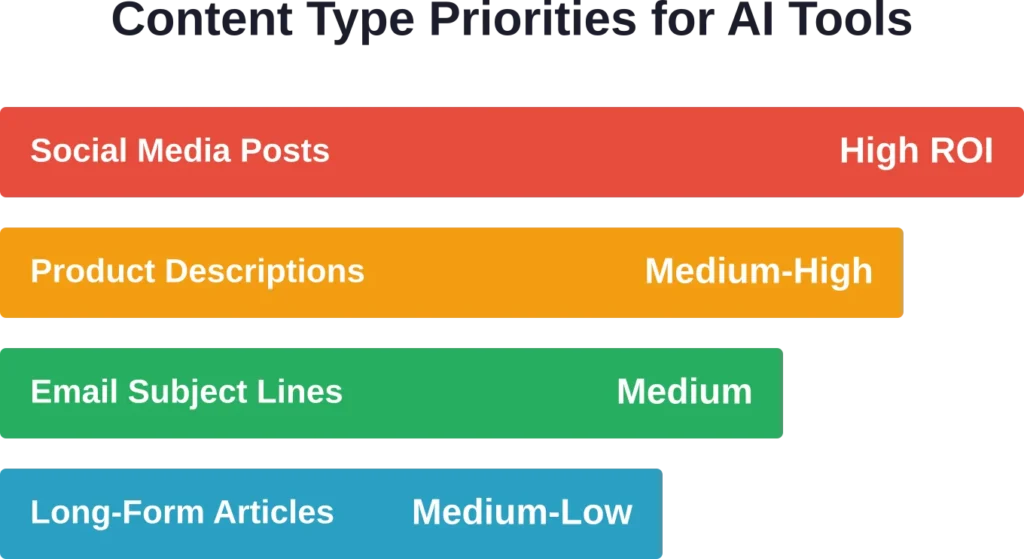
Test platforms on low-stakes content before committing to enterprise-wide rollouts. Create social media posts, email subject lines, or blog outlines—content types where imperfection won’t damage brand reputation.
Compare outputs from multiple tools using identical inputs. Evaluate quality, tone accuracy, and how much editing each requires.
Establish Clear Guidelines
Teams need explicit direction on:
- Which content types can use AI generation
- Required human review processes
- Brand voice parameters and examples
- Fact-checking and citation requirements
- Disclosure policies for AI-generated content
Documentation prevents inconsistent application and quality issues.
Invest in Training
AI tools deliver better results when users understand their capabilities and limitations. Effective training covers:
- Prompt engineering techniques
- Platform-specific features and workflows
- Quality assessment criteria
- Integration with existing tools
- Troubleshooting common issues
Most platforms offer documentation, video tutorials, and customer support. Allocate time for teams to complete training before expecting productivity gains.
Maintain Human Oversight
AI-generated content requires human review. Despite impressive capabilities, these tools still produce factual errors, logical inconsistencies, and off-brand messaging.
Implement review workflows where experienced team members verify accuracy, adjust tone, add original insights, and ensure content meets quality standards.
The goal isn’t eliminating human involvement—it’s focusing human effort on higher-value tasks while automating routine elements.
Emerging Trends in AI Content Marketing
The AI content landscape continues evolving rapidly. Several trends are reshaping how marketers approach these tools.
Multi-Modal Content Generation
Early AI tools focused exclusively on text. Modern platforms increasingly generate images, videos, audio, and interactive elements.
AKOOL and Creatify AI demonstrate this shift, creating video content from text descriptions. Canva integrates text and visual generation within a single workflow.
Future platforms will likely offer seamless multi-modal creation—generating coordinated text, images, and video for campaigns from single prompts.
Enhanced Personalization
AI enables personalization at scales previously impossible. Tools analyze audience segments and generate variations tailored to specific demographics, interests, or behaviors.
Research on LLM-generated ads shows AI’s advantage stems from crafting more sophisticated, aspirational messages and achieving superior visual-narrative coherence.
Marketers can create hundreds of ad variations, each optimized for narrow audience segments, without proportional increases in creative resources.
Real-Time Content Adaptation
Static content is giving way to dynamic, context-aware experiences. AI tools increasingly adjust content based on:
- Reader location and language
- Device type and screen size
- Time of day and weather conditions
- Previous interaction history
- Current events and trending topics
This shift requires moving beyond pre-generated content libraries toward systems that assemble and adapt content in real-time.
AI Search Optimization
Search behavior is changing as AI-powered answer engines gain adoption. Content marketing strategies must adapt to visibility in AI-generated search results.
Adobe Summit 2026 signals this new era for enterprise content. Marketers need to prepare for improving content scale, trust, and AI visibility.
Semrush offers AI-related visibility tools for marketers.
Optimization for AI search differs from traditional SEO. Content must directly answer questions, provide clear fact statements, and structure information for easy extraction by language models.
Common Implementation Challenges
Organizations encounter predictable obstacles when adopting AI content marketing software.
Quality Inconsistency
AI output quality varies based on prompt quality, topic complexity, and platform capabilities. The same tool might produce excellent content for one topic and poor results for another.
Solutions include:
- Developing prompt templates for common content types
- Creating quality checklists for review processes
- Maintaining example libraries of acceptable outputs
- Establishing clear rejection and revision criteria
Integration Difficulties
Many organizations struggle connecting AI tools to existing workflows and technology stacks. Data doesn’t flow smoothly between systems, creating manual transfer work.
Address this through:
- Prioritizing platforms with robust API access
- Using integration platforms like Zapier to connect tools
- Working with vendors to develop custom integrations
- Standardizing on platforms offering comprehensive ecosystems
Team Resistance
Content creators sometimes view AI tools as threats rather than assistants. Concerns about job security, creative control, and skill devaluation create adoption resistance.
Successful implementations frame AI as augmentation rather than replacement. Emphasize how automation handles routine tasks, freeing creators for strategic and creative work requiring human judgment.
Measurement Challenges
Quantifying AI tool impact proves difficult when multiple variables affect content performance. Attribution becomes murky.
Establish baseline metrics before implementation. Track not just content performance but also creation time, volume produced, and resource allocation shifts.
Compare AI-assisted content performance against manual creation controls when possible.
Frequently Asked Questions
No single platform dominates all use cases. Semrush ContentShake AI excels for SEO-focused content, earning recognition for search optimization capabilities. Jasper leads in team collaboration and brand consistency, with strong user ratings. Canva provides the best all-in-one solution for visual content creation at $15 per month. The most effective choice depends on specific content types, team size, and primary marketing channels.
Pricing varies dramatically based on features and target market. Entry-level tools start around $15 per month for platforms like Canva. Mid-tier solutions including Creatify AI, SOCi, and Creaitor range from $19 per month. Professional platforms such as Jasper begin at $59 per month. Enterprise solutions can exceed $199 per month. ChatGPT Plus offers general-purpose AI capabilities at $20 per month, while specialized tools command premium pricing for advanced features.
Search engines evaluate content based on helpfulness, expertise, and trustworthiness rather than creation method. Google’s guidance emphasizes demonstrating experience, expertise, authoritativeness, and trustworthiness regardless of whether humans or AI generated the content. AI-generated content can rank well when properly edited, fact-checked, and enhanced with original insights. The key lies in human oversight ensuring accuracy and value rather than publishing raw AI output. Platforms like Semrush ContentShake specifically optimize for search visibility.
AI tools augment rather than replace human creators. Research shows humans still struggle to distinguish AI-generated text approximately 53% of the time—barely above random guessing. However, AI-generated content requires human oversight for fact-checking, brand alignment, strategic thinking, and adding unique perspectives. The technology excels at automating routine tasks, generating first drafts, and scaling content volume. Human creators focus on strategy, editing, verification, and creative direction. Successful implementations combine AI efficiency with human judgment.
ROI measurement should track multiple dimensions. Time savings compare hours spent on manual creation versus AI-assisted workflows. Content volume increases demonstrate how much more teams produce while maintaining quality. Performance metrics evaluate whether AI-optimized content drives better engagement, traffic, or conversions. Resource reallocation calculates the value of freeing skilled creators from routine work for strategic tasks. Establish baseline metrics before implementation and compare AI-assisted content against manual creation controls when possible.
Primary risks include factual inaccuracies in AI-generated content requiring verification processes. Brand voice inconsistency occurs when platforms generate off-brand messaging without proper customization. Over-reliance on automation can reduce strategic thinking and creative innovation. Detection concerns arise as audiences and platforms develop AI content identification capabilities. Legal and ethical issues involve copyright questions, disclosure requirements, and transparency standards. Mitigate these risks through human oversight, clear guidelines, quality control processes, and treating AI as an assistant rather than autonomous creator.
Buffer excels at tailoring posts for each channel through an AI Assistant that detects the target platform and adapts output accordingly, with a free plan available for up to three channels. Predis.ai focuses on creating complete social media content including captions, images, and video content starting from $19 per month. Canva provides comprehensive visual content creation with social media templates and real-time collaboration at $15 per month with a 4.7 out of 5 G2 rating. SOCi specializes in multi-location social media management for franchises and businesses with multiple locations at $19 per month.
Conclusion
AI content marketing software has matured from experimental technology into essential marketing infrastructure.
The platforms covered here represent the most effective solutions based on verified testing, user ratings, and real-world performance data. Selection depends on specific needs—SEO optimization, social media management, video creation, or comprehensive content suites.
Start with clear objectives. Identify bottlenecks in current content workflows. Test platforms addressing those specific challenges before expanding to comprehensive solutions.
Remember that AI tools augment human creativity rather than replacing it. The most successful implementations combine AI efficiency with human oversight, strategic thinking, and quality control.
Ready to transform content marketing workflows? Evaluate platforms matching specific content types and channels. Start with pilot projects testing capabilities on low-stakes content. Establish quality guidelines and review processes before scaling adoption.
The competitive advantage goes to teams deploying AI thoughtfully—automating routine tasks while focusing human talent on strategy, creativity, and genuine audience connection.