

Quick Summary: Amazon sellers need different tools when operating in the USA versus European markets due to regulatory differences, marketplace structure, and VAT requirements. Key differences include ungating tools for Europe, VAT compliance software, multi-marketplace management platforms, and region-specific repricing systems. Understanding these distinctions helps sellers optimize operations and remain compliant across both markets.
Selling on Amazon isn’t a one-size-fits-all operation. The tools that work brilliantly for your US-based Amazon business might fall short—or become completely unnecessary—when you expand to European markets.
And that’s not just about language barriers or currency conversion. The regulatory landscape, marketplace structure, and buyer behavior across the Atlantic create fundamentally different operational needs.
European Amazon marketplaces operate under stricter regulatory frameworks. According to the International Trade Administration, in 2025, retail eCommerce sales are predicted to reach 38.1% of the UK’s total retail sales, with UK eCommerce sales increasing by nearly 30% in 2024-2025. Meanwhile, as of 2025, the Portuguese eCommerce market is valued at approximately $6.45 billion, with projections indicating the market could reach $11.03 billion by 2030, advancing at a CAGR of 11.33%.
But here’s the thing: these opportunities come with operational complexity that US-only sellers never encounter. VAT compliance, cross-border inventory management, multi-country customer service, and restrictive category gating require specialized tools.
This guide breaks down exactly which tools you need for each market, where they overlap, and where they diverge completely.
Understanding the Fundamental Marketplace Differences
Before diving into specific tools, it’s worth understanding why the tool requirements differ so dramatically between US and European Amazon operations.
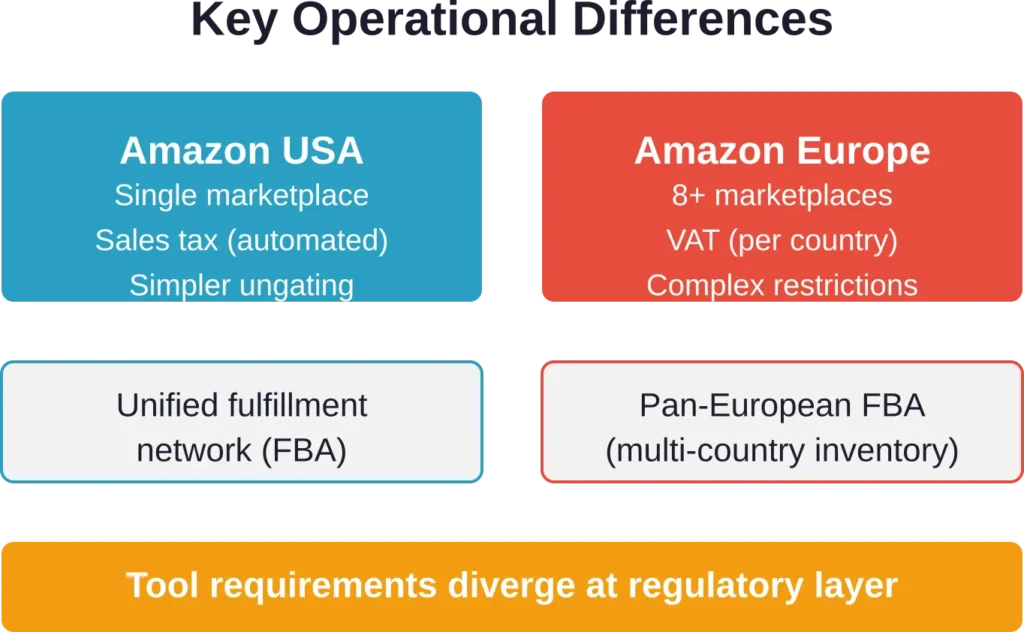
Amazon operates as a unified marketplace in the United States. One Seller Central account, one set of regulations, one tax authority to deal with (mostly), and one primary fulfillment network.
Europe? That’s a different story entirely.
European Amazon operations span multiple independent marketplaces—UK, Germany, France, Italy, Spain, Netherlands, Poland, Sweden, and more. Each has distinct regulatory requirements, tax systems, and consumer protection laws. While Amazon allows unified account management across European marketplaces, sellers still navigate country-specific compliance.
According to official Amazon documentation, Professional selling plan fees vary by region, but Amazon’s account linking feature can reduce total costs.
VAT Complexity Creates Tool Requirements
US sellers deal primarily with sales tax, which Amazon increasingly handles automatically through their tax calculation services. European sellers face Value Added Tax (VAT) requirements that vary by country, product category, and fulfillment method.
Dutch consumers spent about €36.0 billion online in 2024 with approximately 345 million purchases. Cross-border purchases reached 41 million transactions worth €4.4 billion. Each of these cross-border transactions potentially triggers different VAT obligations.
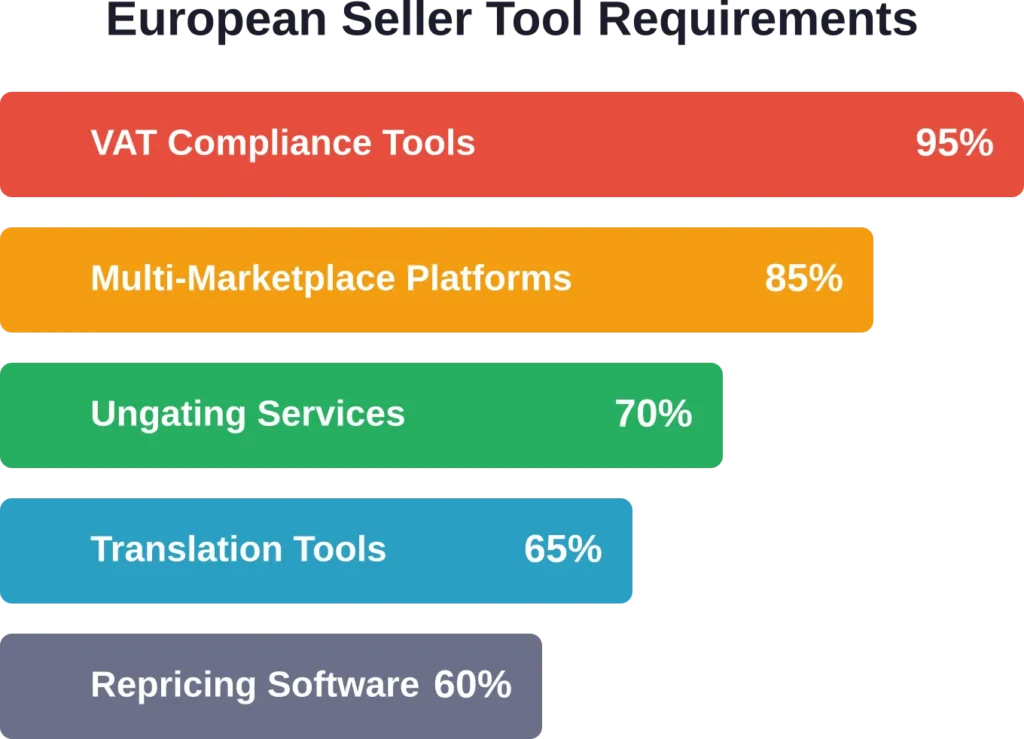
This complexity explains why VAT compliance tools dominate the European seller toolkit but remain largely absent from US-focused operations.
Gating and Ungating Requirements
Amazon USA maintains category restrictions, but the ungating process tends to be more straightforward and consistent. European marketplaces implement stricter brand and category restrictions that vary significantly by country.
According to seller community discussions, ungating on Amazon Europe requires navigating country-specific approval processes, documentation requirements, and compliance standards. Many profitable arbitrage opportunities in Europe remain locked behind these gates.
Tools That Work Across Both Markets
Some tools provide value regardless of geographic market. These cross-border platforms offer unified functionality with region-specific adaptations.
WisePPC (Amazon PPC Multi-Marketplace)

WisePPC is a specialized Amazon Ads management and analytics platform that connects directly via Amazon Ads API. It supports multiple Amazon marketplaces, including the US and various European countries (DE, UK, FR, IT, ES, etc.), allowing sellers to manage campaigns, analyze performance, and run bulk operations from a single unified dashboard.
The tool excels at long-term historical data storage (far beyond Amazon’s 60–90 days), advanced filtering, gradient performance highlighting, multi-metric charts, and on-the-fly campaign editing. It focuses purely on advertising optimization, ROAS/ACoS tracking, and cross-marketplace visibility rather than VAT, compliance, or regulatory requirements.
Contact Information:
- Website: wiseppc.com
- Facebook: www.facebook.com/people/Wise-PPC/61573154427547
- LinkedIn: www.linkedin.com/company/wiseppc
- Instagram: www.instagram.com/wiseppc
Helium 10 (with European Database)

Helium 10 maintains separate databases for US and European marketplaces. The European version includes marketplace-specific search volume data, competition metrics, and keyword suggestions for each country.
However, the tool doesn’t handle VAT compliance or multi-country regulatory requirements—it focuses purely on product research, keywords, and listing optimization.
Jungle Scout (Multi-Marketplace)

Jungle Scout similarly offers European marketplace support with country-specific product databases. Sellers can switch between Amazon.de, Amazon.co.uk, and other European marketplaces within the same platform.
The Chrome extension works across all Amazon domains, providing sales estimates and product data calibrated to each marketplace’s dynamics.
Keepa (Price Tracking Everywhere)

Keepa tracks price history, sales rank, and availability across all Amazon marketplaces globally. The tool provides identical functionality whether monitoring Amazon.com or Amazon.es.
For sellers operating in both markets, Keepa offers consistent data tracking without requiring separate subscriptions or accounts.
InventoryLab (with Multi-Marketplace Support)

InventoryLab connects to Professional selling accounts to help with inventory and order management. The platform supports both US and European marketplaces, though financial reporting must account for different tax systems.
FeedbackWhiz and Review Tools
Review management tools generally work across all Amazon marketplaces. The core functionality—automating review requests and monitoring feedback—remains consistent regardless of country.
However, European sellers must ensure their review solicitation practices comply with GDPR and country-specific consumer protection laws, which these tools typically support through configurable message templates.
Essential Tools for Amazon USA Sellers
US Amazon sellers benefit from a mature ecosystem of tools optimized for a single, large marketplace. These tools prioritize scale, competition analysis, and advertising efficiency.
Product Research and Sourcing Tools
Helium 10 is a comprehensive platform for US Amazon sellers. The tool provides product research, keyword analysis, listing optimization, and competitor tracking specifically calibrated for Amazon.com dynamics.
Jungle Scout offers similar capabilities with particularly strong product database features. The Chrome extension provides real-time sales estimates and revenue data directly on Amazon listing pages—critical for evaluating product opportunities in the competitive US market.
According to official Amazon resources, Veeqo is free multichannel shipping software that provides low shipping rates, smart automations, and powerful inventory tools. Sellers can earn up to 5% back on eligible shipments as of November 2024.
Keyword and SEO Optimization
Keyword research tools for Amazon USA focus heavily on search volume, competition intensity, and conversion potential. Tools like Cerebro (part of Helium 10) reverse-engineer competitor keyword strategies to identify ranking opportunities.
Keepa tracks price history and sales rank fluctuations, helping sellers identify seasonal trends and pricing opportunities. The browser extension integrates directly into Amazon product pages for real-time insights.
PPC and Advertising Management
US sellers typically invest heavily in Amazon PPC due to intense competition. Tools like Perpetua, Teikametrics, and Sellics automate bid management, budget allocation, and campaign optimization.
These platforms use machine learning to adjust bids based on performance data, time of day, and competitive dynamics—essential for maintaining profitability in the crowded US marketplace.
Inventory and Financial Management
InventoryLab connects to Professional selling accounts to help with inventory and order management. The tool streamlines bookkeeping, cost of goods tracking, and profit analysis specifically for US tax reporting requirements.
According to official Amazon documentation, sellers can download the free Amazon Seller app to manage business operations and receive alerts on the go. Seller Central serves as the hub for listing products, pricing, and fulfilling customer orders.
Review and Feedback Management
FeedbackWhiz and similar tools automate review requests, monitor seller feedback, and track product ratings. These platforms help US sellers maintain the high review velocity needed for competitive advantage.
Amazon’s Vine program helps trusted reviewers post opinions about new products, though this is an Amazon-native tool rather than third-party software.
| Tool Category | Primary Function | Why Critical for USA |
|---|---|---|
| Product Research | Identify profitable products | High competition requires data-driven decisions |
| Keyword Tools | SEO and PPC optimization | Search volume and conversion focus |
| PPC Automation | Ad campaign management | Advertising intensity demands automation |
| Inventory Management | Stock tracking and forecasting | Single fulfillment network simplifies operations |
| Review Management | Feedback automation | Review velocity impacts rankings significantly |
Critical Tool Gaps and Limitations
Understanding where tools fall short helps sellers anticipate challenges and plan workarounds.
Unified European Account Management
No single tool perfectly manages all aspects of European multi-marketplace operations. Sellers typically use 3-5 different platforms: one for VAT, one for inventory management, one for repricing, and one for translation.
This fragmentation creates data synchronization challenges and increases the learning curve for sellers expanding from US to Europe.
Real-Time VAT Rate Changes
VAT rates change periodically, and threshold rules shift as EU regulations evolve. Automated VAT tools generally keep pace, but sellers report occasional delays in rate updates—particularly for niche product categories or special tax classifications.
Country-Specific Compliance Monitoring
While ungating services help with initial category approval, ongoing compliance monitoring remains largely manual. Sellers must track regulatory changes, labeling requirements, and safety standards independently.
Few tools provide automated alerts when regulations change in specific European countries—unlike the US where federal regulations create more uniform compliance requirements.
Cross-Border Customer Service
Customer service tools that work well for English-only US operations often struggle with multilingual European support. While translation tools exist, cultural nuances in customer expectations vary significantly between countries.
German buyers expect different response times and communication styles than Italian buyers, yet few customer service platforms optimize for these variations automatically.
Essential Tools for Amazon Europe Sellers
European Amazon operations require specialized tools that address multi-marketplace complexity, regulatory compliance, and cross-border logistics.
VAT Compliance and Tax Management
VAT compliance represents the single biggest tool differentiator between US and European operations. Tools like Taxdoo, Avalara, and Lovat automate VAT registration, calculation, and filing across multiple EU countries.
These platforms track where inventory is stored, where sales occur, and which VAT rates apply—then generate country-specific tax reports. For sellers using Pan-European FBA, this becomes non-negotiable.
Greek e-commerce reached $31.9 billion in Gross Merchandise Value in 2024, growing at 8.2% annually. With 86% internet penetration and 58% online shoppers as of 2023, cross-border sales to Greece trigger specific VAT obligations that automated tools help manage.
Multi-Marketplace Management Platforms
While US sellers work primarily with Amazon.com, European sellers juggle Amazon.de, Amazon.co.uk, Amazon.fr, Amazon.it, Amazon.es, and others simultaneously.
Tools like ChannelEngine, Lengow, and Sellerboard provide unified dashboards for managing inventory, pricing, and orders across all European marketplaces. These platforms synchronize product data while respecting country-specific requirements.
According to official Amazon documentation, Professional selling plan fees vary by region, but Amazon’s account linking feature can reduce total costs. However, operational management still requires tools that handle multi-country complexity.
Ungating and Compliance Services
European category and brand restrictions vary significantly by country. Ungating tools and services help sellers navigate approval processes for restricted categories.
Platforms like Actorio specialize in European ungating strategies, providing documentation templates, approval process guidance, and category-specific compliance checklists. These tools don’t have direct US equivalents because US ungating is comparatively straightforward.
Pan-European Repricing Tools
European repricing tools must account for currency variations, country-specific competitive landscapes, and cross-border price perception.
RepricerExpress and similar platforms offer European-specific repricing algorithms that adjust prices based on each marketplace’s competitive dynamics while maintaining profitability across different VAT rates and currency fluctuations.
Translation and Localization Tools
Unlike the US market, European sellers must create and maintain product listings in multiple languages. Tools like Smartling, DeepL (integrated into some seller platforms), and Amazon’s own translation services help adapt content.
But translation alone isn’t sufficient—localization tools help adapt product descriptions, bullet points, and search terms to cultural preferences and search behavior in each country.
According to Finnish postal service data from 2024, Germany led with 42 percent of orders, followed by Sweden at 33 percent and China at 31 percent. UK orders represent 13% and US orders 12%. This cross-border shopping behavior requires localized content that resonates with each market.
Cost Comparison: Tool Expenses USA vs Europe
Tool costs represent a significant operational expense. European operations typically require higher tool investment due to complexity.
US sellers might operate effectively with 2-3 core tools: a product research platform (Helium 10 or Jungle Scout), a PPC automation tool, and basic inventory management. Total monthly costs typically range from $200-500 depending on business scale.
European sellers need those same tools plus VAT compliance software, multi-marketplace management platforms, and often translation services. Total monthly costs typically range from $400-900.
The higher European tool costs reflect regulatory compliance requirements rather than optional optimization features. VAT compliance isn’t negotiable—it’s legally mandated—making the associated tool costs unavoidable.
| Tool Category | USA Monthly Cost | Europe Monthly Cost | Difference Driver |
|---|---|---|---|
| Product Research | $99-199 | $99-199 | Comparable—same tools work both markets |
| VAT Compliance | $0 | $100-300 | EU legal requirement, not needed in USA |
| Multi-Marketplace | $0-50 | $100-200 | Single vs. multiple marketplace complexity |
| PPC Automation | $100-300 | $100-300 | Comparable—advertising exists both markets |
| Translation | $0 | $50-150 | Multi-language requirement in Europe |
| Ungating Services | $0-50 | $100-200 | More complex restrictions in Europe |
| Total Range | $200-500 | $400-900 | Regulatory and complexity premium |
Strategic Tool Selection Framework
Choosing the right tools starts with understanding your business model and expansion goals.
For US-Only Sellers
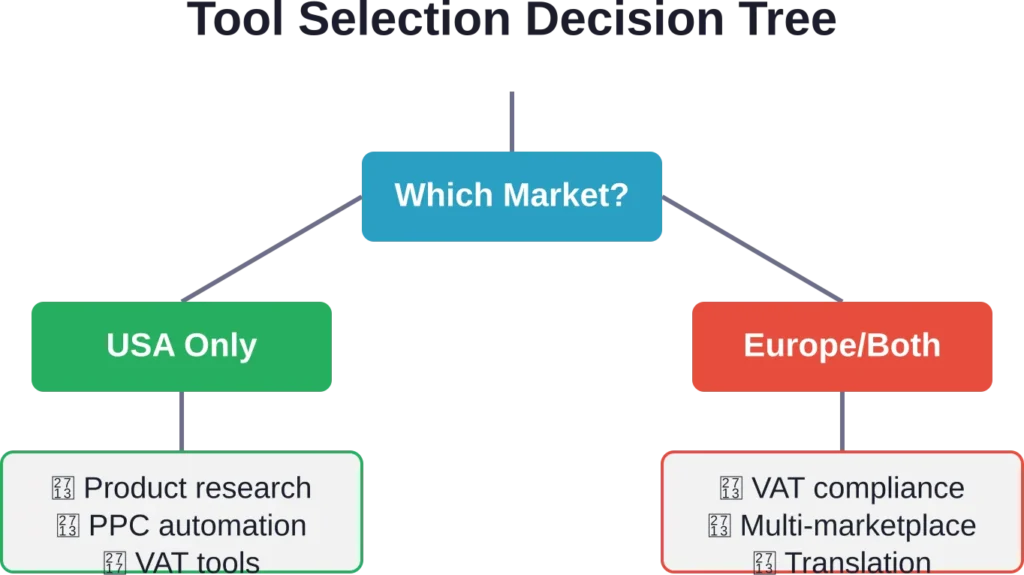
Focus on tools that maximize competitive advantage within a single marketplace. Prioritize product research depth, PPC sophistication, and review velocity optimization.
Key investments: comprehensive all-in-one platform (Helium 10 or Jungle Scout), PPC automation, and review management. Skip VAT tools entirely.
For Europe-Only Sellers
Prioritize regulatory compliance and multi-marketplace efficiency. VAT compliance tools become non-negotiable, and translation services determine market reach.
Key investments: VAT automation platform, multi-marketplace inventory system, ungating service for category expansion, and translation tools. Product research tools remain important but secondary to compliance infrastructure.
For Sellers Operating Both Markets
Seek tools that offer genuine multi-region support rather than maintaining separate tool stacks. Look for platforms that can segment data by marketplace while providing unified dashboards.
Key investments: Helium 10 or Jungle Scout with multi-marketplace databases, separate VAT compliance for Europe, unified inventory management that supports both regions, and PPC tools that handle currency and marketplace differences.
Consider total cost of ownership across both markets. Sometimes paying premium prices for truly unified tools costs less than maintaining separate subscriptions and dealing with data inconsistencies.
Growth Stage Considerations
New sellers in either market should start with essential tools only. For USA, that means product research and basic inventory tracking. For Europe, add VAT compliance from day one—don’t wait for tax problems to develop.
Established sellers benefit more from advanced automation. PPC optimization, dynamic repricing, and sophisticated analytics generate positive ROI only after achieving baseline sales volume.
Emerging Tools and Future Trends
The Amazon seller tool ecosystem continues evolving rapidly, particularly with AI integration.
Seller Assistant and Agentic AI
According to Amazon’s Seller Assistant upgrades announced in September 2025, the tool received major upgrades with agentic AI capabilities. The tool now learns seller preferences, reasons through problems, plans actions, and executes with permission.
This intelligent assistant handles routine operations and complex strategy, including monitoring Account Health, alerting about potential issues, and automating compliance management for both existing and new products.
These AI capabilities work across both US and European marketplaces, though the compliance automation features provide proportionally more value in Europe due to regulatory complexity.
Unified Listing Management
Amazon redesigned the Manage all inventory page (published October 9, 2025) to help sellers complete listing tasks more efficiently. The updated system groups related tasks under category labels: Complete Drafts, Activate Listings, and Optimize Listings.
This native Amazon tooling reduces reliance on third-party inventory management for basic operations, particularly beneficial for European sellers managing multiple marketplace listings simultaneously.
AI-Powered Listing Optimization
Machine learning tools increasingly analyze top-performing listings to suggest optimization opportunities. These tools identify missing attributes, recommend keyword additions, and predict conversion impact of listing changes.
For European sellers, AI tools that handle translation and localization simultaneously across multiple languages represent significant efficiency gains over manual or sequential translation approaches.
Integrated Analytics and Business Intelligence
Analytics platforms provide insights to make informed decisions, strengthen supplier strategies, and identify waste before it impacts performance. This represents a shift toward dynamic understanding rather than static reporting.
For sellers operating across US and European markets, unified analytics that segment performance by region, marketplace, and product category become increasingly valuable as businesses scale.
Common Mistakes When Selecting Tools
Sellers frequently make predictable errors when building their tool stack.
Buying Too Many Tools Too Soon
New sellers often subscribe to every recommended tool before understanding which capabilities they actually need. This creates unnecessary expenses and overwhelming complexity.
Start with one comprehensive platform (Helium 10 or Jungle Scout) and add specialized tools only after identifying specific operational bottlenecks.
Ignoring VAT Compliance Until It’s a Problem
European sellers sometimes delay VAT tool investment, assuming they’ll handle compliance manually or deal with it later. This invariably creates costly problems.
VAT tools should be implemented before the first European sale, not after receiving tax authority notices. Retroactive compliance costs far more than proactive tool investment.
Assuming US Tools Work in Europe
Many US tools claim “international support” but provide limited functionality outside Amazon.com. Sellers waste time and money discovering these limitations after subscribing.
Verify that European marketplace support includes localized data (search volumes, competition metrics, keyword suggestions) rather than just technical access to foreign Amazon domains.
Overlooking Translation Quality
Automated translation tools have improved dramatically, but they still produce listings that feel mechanical or miss cultural nuances. Poor translations hurt conversion rates and brand perception.
Budget for human review of machine-translated content, particularly for main product images, bullet points, and A+ content where quality matters most.
Not Planning for Tool Migration
Businesses outgrow tools as they scale. Sellers who don’t plan for data portability face painful migrations when switching platforms.
Before committing to any tool, understand how to export your data and whether the platform integrates with likely future tools.
Practical Implementation Roadmap
Here’s how to actually build your tool stack based on market and business stage.
Phase 1: Essential Foundation (Month 1)
USA: Subscribe to one all-in-one platform (Helium 10 or Jungle Scout). Set up free Amazon Seller app for mobile management. Install Keepa browser extension.
Europe: Subscribe to VAT compliance tool first. Add one all-in-one platform with European database support. Install Keepa browser extension.
Phase 2: Operational Efficiency (Months 2-3)
USA: Add PPC automation tool once advertising spend exceeds $1,000/month. Implement review management automation.
Europe: Add multi-marketplace inventory management. Implement translation tool for primary markets. Set up ungating service relationship.
Phase 3: Advanced Optimization (Months 4-6)
USA: Add inventory forecasting tool. Implement advanced analytics platform. Consider repricing automation for competitive categories.
Europe: Expand translation to all active marketplaces. Add repricing automation with multi-currency support. Implement advanced VAT reporting for tax optimization.
Phase 4: Strategic Tools (Months 6+)
Both Markets: Consider joining seller communities like Million Dollar Sellers (for businesses over $1 million annually). Invest in custom integrations between platforms. Develop automated reporting dashboards.
Regional Market Performance Data
Understanding actual market performance helps contextualize tool investment decisions.
According to International Trade Administration data, in 2025, retail eCommerce sales are predicted to reach 38.1% of the UK’s total retail sales, with UK eCommerce sales increasing by nearly 30% in 2024-2025. The UK has approximately 66.3 million internet users.
As of 2025, the Portuguese eCommerce market is valued at approximately $6.45 billion, with projections indicating the market could reach $11.03 billion by 2030, advancing at a CAGR of 11.33%. Active e-shoppers represent 56% of the population, with mobile commerce accounting for 36% of online sales.
Dutch consumers spent about €36.0 billion online in 2024 with approximately 345 million purchases. Cross-border purchases reached 41 million transactions worth €4.4 billion, demonstrating significant international shopping behavior.
Greek e-commerce market Gross Merchandise Value reached $31.9 billion in 2024, growing at 8.2% annually. Around 80% of businesses list digital transformation as a strategic priority.
These market sizes justify tool investment for European expansion. The combined European opportunity rivals or exceeds the US market, but only for sellers equipped to navigate the operational complexity.
Making the Build vs. Buy Decision
Some larger sellers consider building custom tools rather than subscribing to commercial platforms.
Custom development makes sense when: operations scale beyond standard tool capabilities, specific workflow requirements aren’t addressed by existing tools, or long-term costs of commercial subscriptions exceed development and maintenance costs.
Commercial tools remain superior for: rapidly changing features (Amazon updates policies frequently and commercial tools adapt faster than custom solutions), compliance-critical functions (VAT compliance tools have legal teams ensuring accuracy), and areas outside core competency (most sellers shouldn’t build their own PPC algorithms).
The hybrid approach works well for established businesses: use commercial tools for compliance, research, and advertising while building custom solutions for proprietary processes, unique competitive advantages, or internal workflow automation.
Frequently Asked Questions
Partially. Some tools like Helium 10 and Jungle Scout work across both markets with marketplace-specific databases included in one subscription. However, European sellers require additional tools that US sellers don’t need—specifically VAT compliance platforms, multi-marketplace inventory management, and translation services. Budget for 50-80% higher tool costs when operating in Europe compared to USA-only operations.
VAT compliance tools represent the single most critical difference. US sellers deal primarily with sales tax that Amazon increasingly handles automatically. European sellers face Value Added Tax requirements that vary by country, product category, and fulfillment method. VAT compliance isn’t optional—it’s legally mandated—and requires specialized software that doesn’t exist in most US tool stacks. Without proper VAT tools, European sellers face substantial fines and account suspension risks.
Not realistically. While you can start selling on Amazon USA with free or low-cost tools, European operations require minimum investment in VAT compliance from day one. Attempting to manage VAT manually creates overwhelming complexity and high error risk. The cheapest viable European tool stack costs approximately $200-300 monthly for VAT compliance plus basic marketplace management. This represents non-negotiable regulatory overhead rather than optional optimization.
US ungating processes tend to be more standardized and straightforward, typically requiring invoices from authorized suppliers and basic business verification. European ungating varies significantly by country and often requires additional documentation including VAT registration proof, country-specific business licenses, and brand authorization letters that meet local legal standards. Some categories restricted in European marketplaces remain open in the US, and vice versa. Specialized ungating services exist primarily for European markets because the complexity justifies professional assistance.
The core functionality remains identical, but the data differs substantially. European versions of these tools maintain separate databases for each marketplace—Amazon.de, Amazon.co.uk, Amazon.fr, etc.—with country-specific search volumes, competition metrics, and keyword suggestions. A product that shows high demand and low competition in the US market might show opposite metrics in Germany. Always research each target European marketplace independently rather than assuming US market dynamics transfer directly.
One multi-marketplace tool is strongly preferred. Managing separate tools for Germany, UK, France, Spain, and Italy creates data fragmentation, synchronization problems, and unnecessary complexity. Modern European seller tools provide unified dashboards that display all marketplaces while respecting country-specific requirements. The exception is VAT compliance, where you might use different providers depending on which countries you’re registered in, though most VAT tools also support multi-country management.
Yes, several valuable free tools work across all markets. The Amazon Seller app offers free mobile management. Keepa provides free price tracking with browser extensions for all Amazon domains. CamelCamelCamel offers free price history. However, these free tools don’t replace paid essentials like VAT compliance for Europe or comprehensive product research platforms.
Conclusion: Building Your Optimal Tool Stack
The fundamental difference between Amazon USA and European tool requirements comes down to regulatory complexity versus marketplace scale.
US sellers optimize for competition intensity within a unified marketplace. Tools focus on finding product opportunities, maximizing advertising efficiency, and accelerating review acquisition. The regulatory environment remains relatively straightforward, eliminating the need for specialized compliance software.
European sellers navigate multi-country operations where compliance becomes primary. VAT management, multi-marketplace coordination, translation, and country-specific ungating create tool requirements that simply don’t exist for US-only operations. Product research and advertising optimization remain important but secondary to building compliant operational infrastructure.
For sellers operating in both markets, the goal is finding tools that genuinely support multi-region operations rather than maintaining completely separate stacks. Look for platforms that segment data by marketplace while providing unified management interfaces.
Start with essential tools only. For USA, that means product research and basic inventory tracking. For Europe, VAT compliance becomes non-negotiable from day one. Add specialized tools only after identifying specific operational bottlenecks that justify the expense.
According to ECIPE research, the EU accumulated a cumulative R&D investment shortfall of approximately €740 billion by 2024 compared to the US, with €114 billion in annual gap in 2024 alone. This macro trend explains why many cutting-edge seller tools originate in the US market, then adapt for European operations with compliance layers added.
Real talk: European expansion requires higher tool investment and steeper learning curves. But the market opportunity justifies this complexity. Combined European marketplaces rival US opportunity for sellers who build appropriate operational infrastructure.
Ready to expand your Amazon business across markets? Start by auditing your current tool stack against the requirements outlined here. Identify gaps based on your target markets, then prioritize tools that address compliance and operational bottlenecks before optimization and nice-to-have features. Check the official Amazon Selling Partner Appstore for approved third-party software partners to automate, manage, and grow your business across all marketplaces.