

Quick Summary: Amazon sellers in 2026 need a strategic mix of marketing tools to compete effectively. Essential categories include product research platforms, keyword optimization software, PPC automation, and analytics dashboards. The right combination depends on business size, budget, and growth stage, with native Amazon tools like Sponsored Products and Campaign Manager forming the foundation, supplemented by third-party solutions like Helium 10, Jungle Scout, or SellerSprite for advanced insights.
Selling on Amazon in 2026 isn’t about listing products and waiting for sales anymore. The marketplace has matured into a performance-driven ecosystem where visibility, pricing strategy, and customer targeting determine winners. Marketing tools are the difference between manual guesswork and repeatable growth systems.
Here’s the thing though—most sellers either overpay for feature-bloated suites or piece together five different free trials that don’t talk to each other. Neither approach scales.
This guide breaks down the marketing tools Amazon sellers actually need in 2026, organized by function rather than brand hype. Some are native to Seller Central, others are third-party platforms with API access. The goal is clarity: which tools solve which problems, what they cost, and when to add them to the stack.
Why Amazon Sellers Need Dedicated Marketing Tools
Amazon provides Seller Central as the operational hub for orders, inventory, and basic advertising. But Seller Central wasn’t built for competitive intelligence, granular PPC optimization, or multichannel analytics. That gap creates opportunity for specialized software.
Marketing tools automate the repetitive work—keyword discovery, bid adjustments, competitor price tracking—so sellers can focus on strategy. They also surface data Amazon buries: true profitability after all fees, Buy Box win rate trends, and keyword rank movements over time.
Another factor: scale. Managing ten SKUs manually is feasible. Managing 200 SKUs across Sponsored Products, Sponsored Brands, and Display campaigns without automation is a recipe for wasted ad spend and missed opportunities.
Real talk: the sellers pulling six or seven figures aren’t using spreadsheets and intuition. They’re running systematic research, testing, and optimization loops powered by software that processes thousands of data points daily.
PPC Automation and Bid Management Tools
Third-party tools in this category help Amazon sellers automate bid adjustments, pause unprofitable keywords, and optimize budgets at scale — something that manual management cannot handle effectively.
WisePPC

WisePPC is one of the most powerful PPC automation and bid management platforms for Amazon sellers. It provides real-time bid optimization, bulk campaign editing, rule-based automation, and deep historical analytics across Sponsored Products, Sponsored Brands, and Sponsored Display.
The platform’s automation engine continuously monitors performance and adjusts bids using AI-powered strategies and custom rules. Sellers set criteria—say, “decrease bid by 20% if ACoS exceeds 35% for three consecutive days” or “pause keywords with zero conversions after $50 spend”—and WisePPC automatically executes thousands of adjustments daily while keeping full control in your hands.
WisePPC also includes a powerful bulk editor and real-time dashboard that overlays directly on your campaign data. Sellers can filter thousands of targets, make inline edits to bids and budgets, and instantly see performance trends, placement efficiency, and ad vs organic contribution for every keyword and ad group.
Contact Information:
- Website: wiseppc.com
- Facebook: www.facebook.com/people/Wise-PPC/61573154427547
- LinkedIn: www.linkedin.com/company/wiseppc
- Instagram: www.instagram.com/wiseppc
Analytics and Profitability Tracking
While Amazon Seller Central offers basic reports, it lacks true profitability insights. Dedicated analytics tools fill this gap by calculating real net profit after all expenses.
Data Dive
Data Dive is an analytics solution designed specifically for Amazon FBA sellers. It consolidates data from multiple sources into dashboards that highlight profitability drivers and risk factors.
According to case study analysis, a new seller using Data Dive identified high-potential keywords that larger competitors were overlooking, resulting in 35% increase in organic traffic within two months. Another seller identified product gaps through competitor analysis and generated $50,000 in revenue during the first quarter after filling those gaps.
While specific pricing and feature details aren’t available in the source material, the platform focuses on actionable insights rather than raw data dumps—surfacing underperforming SKUs, flagging margin erosion, and recommending inventory adjustments before stockouts occur.
Native Amazon Marketing Tools
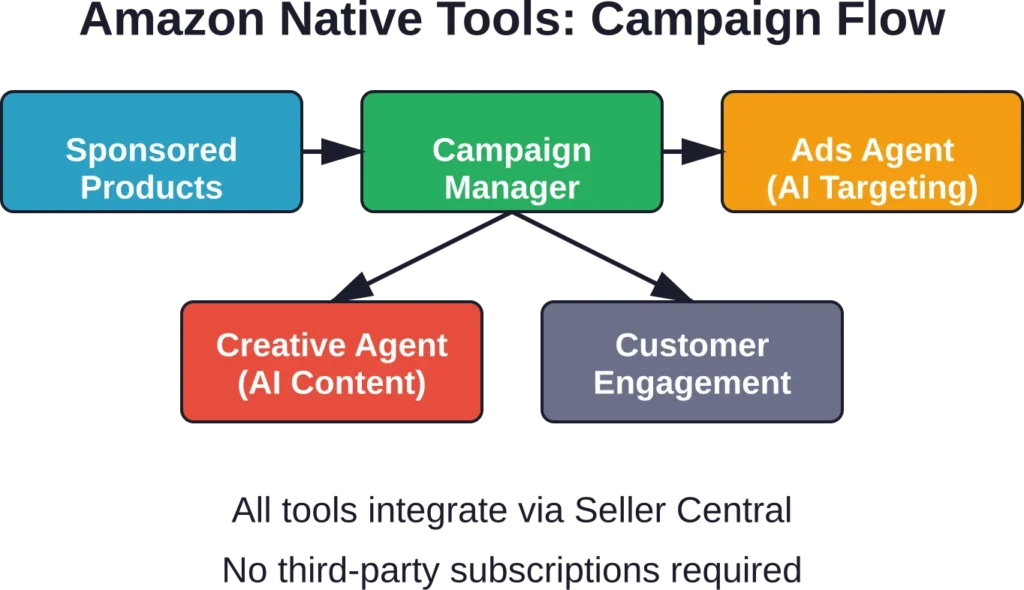
Before paying for third-party platforms, sellers should master the free tools Amazon provides. These integrate directly with Seller Central and require no API setup or monthly fees.
Sponsored Products
Sponsored Products are cost-per-click ads that appear in search results and on product pages. Sellers bid on keywords, and ads display when shoppers search those terms. This is the foundational advertising format for most Amazon sellers.
Campaign setup is straightforward: choose automatic targeting to let Amazon match your product to relevant searches, or manual targeting to bid on specific keywords. Automatic campaigns are useful for discovery—Amazon’s algorithm finds search terms sellers might miss—while manual campaigns allow precision control over spend and placement.
According to Amazon’s official seller resources, Sponsored Products ads can appear within relevant search results, the cart area, the highly-rated products section, and product detail pages. Placement flexibility matters because top-of-search placements convert differently than mid-page or sidebar slots.
Sponsored Products work best when paired with optimized product listings. The ad gets the click, but the listing copy, images, and reviews close the sale. Weak listings waste ad budget even when campaigns are structured correctly.
Sponsored Brands
Sponsored Brands allow sellers with registered brand names to promote multiple products in a single ad unit, usually displayed at the top of search results. These ads include a custom headline, brand logo, and up to three products.
As of Amazon Ads unBoxed 2025, Sponsored Brands reserve share of voice allows sellers to pre-purchase branded keywords, which will be placed at the top of search queries, at a fixed upfront cost. This shifts budgeting from auction-based bidding to predictable spend for critical terms.
Sponsored Products video is a new ad format that allows sellers to showcase multiple product features through interactive videos. Sellers can upload one to five product feature videos per product in addition to descriptive text for each feature.
Campaign Manager
Campaign Manager is Amazon’s unified interface for managing Sponsored Products, Sponsored Brands, and Sponsored Display campaigns from a single entry point. Announced at Amazon Ads unBoxed 2025, it simplifies cross-campaign workflows and speeds up ad buying.
Instead of toggling between separate dashboards for each ad type, sellers can now view performance across the full funnel—awareness, consideration, conversion—in one place. This matters for brands running integrated campaigns where Display ads build awareness at the top of the funnel and Sponsored Products close sales at the bottom.
Campaign Manager also surfaces AI-powered recommendations for budget allocation, bid adjustments, and audience expansion. It’s not a standalone AI agent—those are separate tools covered next—but it does nudge sellers toward data-backed optimizations they might otherwise overlook.
Ads Agent (AI-Powered Targeting)
Ads Agent is an agentic AI tool launched in 2025 to automate audience and keyword selection. It reviews thousands of data points—search volume, conversion history, competitor activity—and recommends the most relevant segments and keywords for each campaign.
The “agentic” label means the tool acts autonomously within guardrails: sellers set campaign goals and budget limits, then Ads Agent iterates on targeting without requiring daily manual input. This reduces the time sellers spend analyzing keyword reports and adjusting bids, especially for accounts managing dozens of active campaigns.
Ads Agent integrates with Campaign Manager and pulls data from all active ad types. Recommendations update dynamically as performance shifts, so targeting stays aligned with current search behavior rather than lagging weeks behind.
Creative Agent (AI-Powered Ad Creation)
Creative Agent generates ad content—including streaming TV ads—at no cost to sellers. It uses generative AI to produce video, display, and Sponsored Brands creative based on product images, descriptions, and brand guidelines.
This is significant because professionally produced video ads previously required agency budgets. Creative Agent democratizes access to high-quality content by automating scripting, editing, and formatting. Sellers provide raw assets, and the tool outputs polished ads ready for campaign deployment.
As of the 2025 unBoxed announcements, Creative Agent supports multiple ad formats and sizes, adjusting creative automatically for desktop, mobile, and streaming environments. Quality varies—AI-generated content can feel generic—but for budget-conscious sellers testing new formats, it’s a viable starting point.
Manage Your Customer Engagement
Manage Your Customer Engagement is a free tool for registered brands to send marketing emails to Amazon customers who follow the brand or have made repeat purchases. Launched in 2023, it addresses a long-standing seller frustration: limited direct communication with customers.
The tool identifies repeat customers—defined as those who’ve bought at least two products from the brand in the last 12 months—and provides weekly updates on newly qualified email recipients. Sellers can announce product launches, promote deals, or share brand stories without violating Amazon’s customer contact policies.
Access requires qualification: brands must have sent 10 or more customer engagement campaigns with at least 1,000 total emails sent over the last 10 campaigns, and maintain an average opt-out to click rate below 1%. These thresholds ensure only active, responsible senders use the tool.
Product Research and Market Intelligence Tools
Product research tools answer three questions: What should sellers sell? How much demand exists? Who are the competitors, and what are they doing? These platforms scrape Amazon data—search volume, sales estimates, review counts—and surface opportunities.
Jungle Scout

Jungle Scout is one of the most established product research platforms for Amazon sellers. It provides ASIN tracking, niche analysis, keyword search volume, and sales estimation for any product listing. Sellers use it to validate product ideas before sourcing inventory.
The platform’s Opportunity Finder scans Amazon for high-demand, low-competition niches based on filters like sales volume, review count, and price range. Sellers set criteria—say, products selling 300+ units per month with fewer than 100 reviews—and Jungle Scout returns a ranked list of candidates.
Jungle Scout also includes a Chrome extension that overlays data directly onto Amazon search results. Sellers can browse categories, click the extension, and instantly see monthly sales estimates, revenue, review velocity, and seller count for every product on the page.
Helium 10

Helium 10 is a comprehensive suite covering product research, keyword tracking, listing optimization, and inventory management. It’s often compared to Jungle Scout, but Helium 10 skews toward sellers who want deeper analytics and more granular control.
Helium 10 offers four pricing tiers. The Starter Plan begins at $39 per month and is suited for beginners with access to all tools and modules. The Platinum Plan costs $99 per month. Higher tiers are available for advanced users. Higher tiers unlock increased usage limits, advanced features, and one-on-one training.
Helium 10’s Black Box tool functions similarly to Jungle Scout’s Opportunity Finder: sellers filter by category, sales volume, price, and competition to discover product opportunities. Cerebro and Magnet handle keyword research, reverse-engineering competitor ASINs to reveal which keywords drive their traffic.
Frankenstein and Scribbles assist with listing optimization—Frankenstein cleans and deduplicates keyword lists, while Scribbles ensures all target keywords appear in titles, bullet points, and descriptions without redundancy.
SellerSprite

SellerSprite specializes in product and keyword research with an emphasis on workflow efficiency. The platform is structured around repeatable processes: discover products the same way each week, build keyword lists using consistent filters, track rankings with standardized reports.
SellerSprite’s Product Research module lets sellers discover product ideas with filters for sales estimates, competition levels, and trend momentum. Keyword Research identifies high-volume, low-competition keywords, while Keyword Tracker monitors daily rank positions for target terms.
The Listing Optimizer analyzes existing product pages and suggests improvements based on keyword density, competitor benchmarks, and conversion signals. Market Tracker provides niche-level analytics—total sales, average prices, review distributions—so sellers can gauge overall market health before committing to a product.
AmzScout

AmzScout offers two main products: the Pro Extension and the Amazon Seller Bundle. The Pro Extension costs $16.49 per month and provides product research data overlaid on Amazon pages. The Seller Bundle runs $29 per month and includes keyword tracking, competition analysis, and profitability calculators.
AmzScout’s Product Database works like other research tools—filter by category, sales volume, price, and review count to surface opportunities. The Stock Stats feature estimates inventory levels for competitor ASINs, which helps sellers predict how much capital competitors tie up in stock and how quickly products move.
Keyword Research and SEO Tools
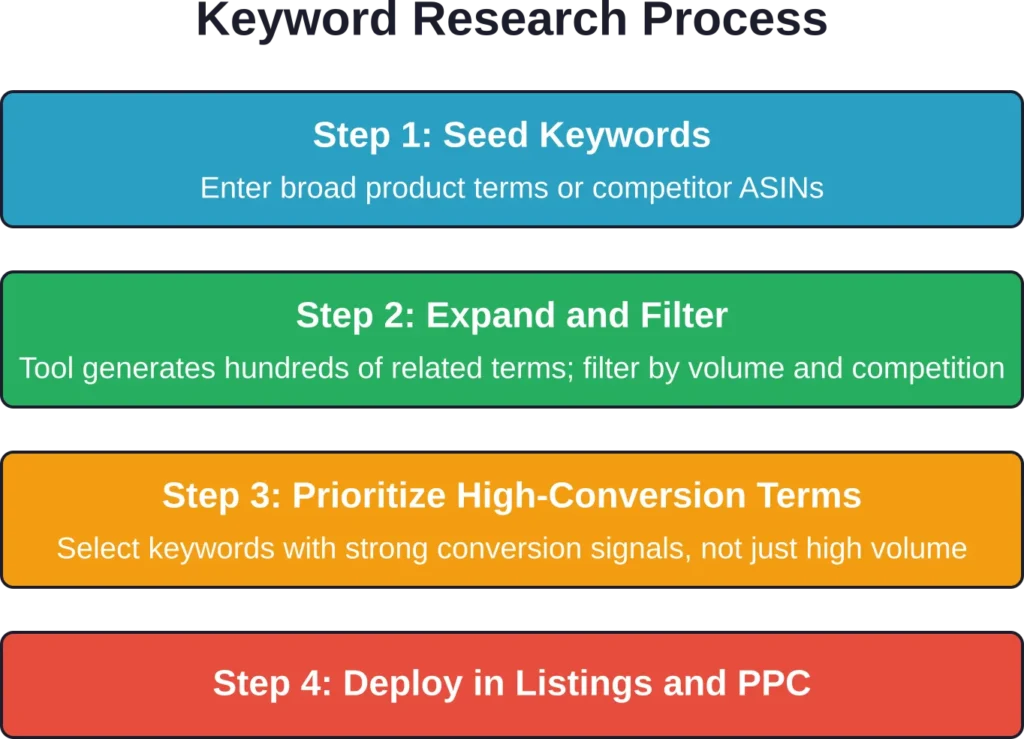
Keyword tools help sellers understand what shoppers type into Amazon’s search bar and which terms drive the most conversions. Amazon’s internal search algorithm—A9 (now evolving into A10)—prioritizes keyword relevance, sales velocity, and customer satisfaction signals. Ranking for the right keywords is the primary lever for organic visibility.
Helium 10 Cerebro and Magnet
Cerebro reverse-engineers competitor ASINs to show which keywords those products rank for, along with search volume and estimated monthly searches. Sellers input a competitor’s ASIN, and Cerebro returns hundreds or thousands of keywords, ranked by relevance and opportunity score.
Magnet generates keyword ideas from seed terms. Sellers enter a broad keyword like “yoga mat,” and Magnet returns related phrases—”eco yoga mat,” “thick yoga mat,” “travel yoga mat”—with search volume and competition metrics for each.
Jungle Scout Keyword Scout
Keyword Scout provides search volume, trend data, and PPC bid estimates for any keyword. Sellers can track keyword performance over time to identify seasonal spikes or declining interest before adjusting listings or ad campaigns.
The tool also highlights “highly relevant” keywords—terms with strong conversion rates relative to search volume—so sellers prioritize phrases that drive sales, not just traffic.
SellerSprite Keyword Research
SellerSprite’s keyword module surfaces opportunities with manageable competition, making it especially useful for newer sellers. The platform calculates a “keyword opportunity score” based on search volume, competition density, and conversion likelihood.
Sellers can filter by search volume thresholds, exclude branded terms, and export keyword lists for bulk upload into PPC campaigns or listing optimization tools.
Inventory and Shipping Tools
Inventory management directly impacts advertising effectiveness. Running PPC campaigns to drive traffic to out-of-stock products wastes ad spend and damages organic rank. Overstocking ties up capital and incurs long-term storage fees.
Veeqo

Veeqo is free multichannel shipping software that lets sellers pick, pack, and ship orders with the lowest shipping rates, smart automations, and powerful inventory tools. Sellers can earn up to 5% back on eligible shipments.
Veeqo integrates with Amazon and other sales channels, providing unified inventory visibility. When a product sells on Amazon, Veeqo automatically updates stock levels across all connected channels to prevent overselling.
InventoryLab

InventoryLab connects to Amazon Professional selling accounts to assist with inventory and order management. It’s designed for sellers who source products via retail arbitrage, wholesale, or private label, providing batch listing tools, cost tracking, and profitability reports.
InventoryLab’s “List” feature streamlines the process of creating new product listings or matching to existing ASINs. Sellers scan product barcodes, enter costs and quantities, and InventoryLab generates shipment labels and sends inventory data to Amazon.
Review and Feedback Tools
Customer reviews influence conversion rates, organic rankings, and Buy Box eligibility. More reviews and higher ratings generally lead to better performance across all metrics.
Amazon Vine

Enrollment in Vine requires Brand Registry, and there’s a fee per enrolled ASIN. Sellers can enroll up to 30 units per parent ASIN for review. Vine reviews carry a “Vine Customer Review of Free Product” badge to indicate the reviewer received the product for free.
The Vine program helps generate high-quality reviews for products by providing them to a trusted network of reviewers who try products free of charge and in return share their honest, unbiased opinions in reviews.
Feedback Genius and Similar Tools
Feedback request automation tools send follow-up emails to customers after purchase, asking for product reviews or seller feedback. These tools must comply with Amazon’s communication policies—no incentives for positive reviews, no excessive messaging, and customers must be able to opt out easily.
Effective feedback campaigns are timed strategically: send review requests after the customer has received the product and had time to use it, but before the purchase fades from memory. A/B testing subject lines, messaging tone, and send timing improves response rates.
A+ Content and Listing Enhancement

A+ Content (formerly Enhanced Brand Content) allows registered brands to add rich media—comparison charts, lifestyle images, detailed feature descriptions—to product detail pages below the bullet points.
Amazon provides A+ Content creation tools in Seller Central at no cost. Third-party tools like Listing Optimizer modules in Helium 10 or SellerSprite analyze existing A+ Content and suggest improvements based on competitor benchmarks and conversion best practices.
Good A+ Content doesn’t just look better; it reduces customer questions, lowers return rates, and improves conversion by answering objections before they arise. Sellers should test different layouts and messaging to find what resonates with their target audience.
How to Choose the Right Tools for Your Business
Not every seller needs every tool. A new seller with three SKUs and a $500 monthly ad budget has different requirements than a brand managing 200 SKUs and $20,000 in monthly PPC spend.
Start with Free Native Tools
Master Sponsored Products, Campaign Manager, and Seller Central reporting before paying for third-party software. Understand the data Amazon provides natively, identify gaps, and then fill those gaps with specialized tools.
Prioritize by Bottleneck
If product research is the constraint—struggling to find profitable niches—invest in Jungle Scout, Helium 10, or SellerSprite. If PPC management consumes hours daily, add bid automation. If inventory stockouts kill momentum, prioritize inventory forecasting and shipping tools.
Match Budget to Business Stage
Early-stage sellers should lean toward free or low-cost tools: Amazon’s native features, free trials, and entry-tier plans around $30-50 per month. Mid-stage sellers with consistent revenue can justify $100-300 per month on comprehensive suites. Established brands spending five figures monthly on ads benefit from enterprise-grade PPC platforms and custom analytics dashboards.
Evaluate Integration and Data Access
Tools that integrate directly with Amazon’s API and pull real-time data are more reliable than those relying on scraped data or manual uploads. Check whether the tool syncs automatically, how often data refreshes, and whether it supports all marketplaces where the business operates.
Test Before Committing
Most tools offer free trials or money-back guarantees. Test core workflows: run a product search, build a keyword list, set up a PPC rule. Does the tool deliver the insights needed? Is the interface intuitive? Does support respond quickly when issues arise?
| Tool Category | Primary Use Case | Best for Business Stage | Typical Monthly Cost |
|---|---|---|---|
| Native Amazon Tools | Basic advertising and customer engagement | All sellers | Free (ad spend separate) |
| Product Research | Finding profitable products and niches | New and scaling sellers | $30-$100 |
| Keyword Research | Optimizing listings and PPC targeting | All sellers | $30-$100 (often bundled) |
| PPC Automation | Managing campaigns at scale | Sellers with $2,000+ monthly ad spend | $100-$500+ |
| Analytics | Tracking true profitability per SKU | Scaling and established sellers | $50-$300 |
| Inventory Management | Preventing stockouts and overstock | Sellers moving 100+ units/month | Free-$200 |
Emerging Trends in Amazon Seller Tools (2026)
AI-powered automation is the dominant trend. Amazon’s launch of Ads Agent and Creative Agent signals a shift toward agentic systems that execute tasks autonomously within defined parameters. Third-party tools are following suit, embedding machine learning models that optimize bids, generate listings, and forecast demand without manual input.
Multichannel expansion is another focus. Sellers increasingly operate on Amazon, Shopify, Walmart, eBay, and social commerce platforms simultaneously. Tools that unify inventory, advertising, and analytics across channels are gaining traction because they reduce operational complexity.
Compliance and transparency features are expanding in response to regulatory pressure. The INFORM Consumers Act, effective as of June 27, 2023, requires online marketplaces to collect, verify, and disclose certain information about high-volume third party sellers. High-volume third party sellers covered under INFORM must meet certain disclosure and verification requirements.
Tools that automate compliance reporting, verify seller identity, and flag policy violations help sellers avoid penalties and account suspensions. As regulations evolve, expect more tools focused on risk management and policy adherence.
Common Mistakes Sellers Make with Marketing Tools
Over-tooling is expensive and distracting. Subscribing to five overlapping platforms because each has one unique feature creates redundancy and eats into margins. Better to master one comprehensive suite than dabble in many.
Ignoring data accuracy is another pitfall. Sales estimates, search volume, and competitor data from third-party tools are approximations, not ground truth. Cross-reference multiple sources and validate assumptions with real-world testing before making major inventory or advertising decisions.
Failing to integrate tools into workflows means they sit unused after the trial period. A tool is only valuable if it changes behavior—if keyword research leads to listing updates, if PPC insights trigger bid adjustments, if profitability reports inform product discontinuation decisions. Define the workflow first, then choose tools that support it.
Neglecting customer feedback in favor of metrics is a subtle error. Tools surface data—clicks, conversions, ACoS—but they don’t explain why customers choose competitors or what product improvements would increase satisfaction. Balance quantitative tool data with qualitative customer insights from reviews, messages, and return reasons.
Frequently Asked Questions
New sellers should start with Amazon’s native free tools: Sponsored Products for advertising, Seller Central reports for sales data, and Manage Your Customer Engagement for email marketing (once qualified). Veeqo offers free multichannel shipping software with discounted rates and up to 5% cashback on eligible shipments. These tools cover foundational needs without monthly subscriptions.
Budget depends on business stage and ad spend. Sellers just starting out can operate on free native tools plus $30-50 per month for basic product research. Mid-stage sellers typically spend $100-300 per month on comprehensive suites covering research, keywords, and repricing. Established brands with $10,000+ monthly PPC budgets often allocate $500-1,000 per month on advanced automation and analytics platforms.
Campaign Manager simplifies campaign management but lacks advanced automation rules, dayparting, portfolio-level optimization, and granular bid controls. Sellers managing more than a handful of campaigns benefit from third-party PPC tools that automate bid adjustments, harvest keywords, and apply negative matches based on performance thresholds. For sellers with limited ad spend or simple campaigns, Campaign Manager may suffice.
Both platforms offer product research, keyword analysis, and competitor tracking. Jungle Scout emphasizes ease of use and streamlined workflows, making it popular with beginners. Helium 10 provides more granular data, advanced features, and deeper analytics, appealing to experienced sellers who want maximum control. Helium 10’s pricing starts at $39 per month for the Starter Plan and scales up to $399 per month for Elite; Jungle Scout’s pricing structure varies but generally falls in a similar range.
Third-party tools estimate metrics like sales volume and search traffic using algorithmic models, not Amazon’s internal data. Accuracy varies by tool and marketplace. Sellers should cross-reference data from multiple sources, test assumptions with small-scale product launches or ad campaigns, and validate tool recommendations against actual performance. Treat tool data as directional guidance, not absolute truth.
Yes, especially in the early stages. Amazon’s free native tools—Sponsored Products, Seller Central reporting, A+ Content, Vine—cover core needs. Sellers can manually research products using Amazon’s search and bestseller lists, optimize listings using keyword insights from search term reports, and manage PPC campaigns with basic bid adjustments. Paid tools accelerate growth and improve efficiency but aren’t mandatory for profitability. The trade-off is time: manual workflows demand more hours but cost less upfront.
Conclusion
Marketing tools are force multipliers for Amazon sellers, turning manual guesswork into systematic, data-driven workflows. The right stack depends on business goals, product catalog size, and operational constraints, but every seller should master Amazon’s native free tools before layering on third-party subscriptions.
Prioritize tools that solve specific bottlenecks: product research when ideation stalls, keyword optimization when organic traffic lags, PPC automation when campaigns consume excessive time, repricing when Buy Box win rate drops, and analytics when profitability per SKU is unclear.
Avoid over-tooling. Test platforms during trial periods, validate data accuracy, and integrate tools into daily workflows so they drive action, not just insight. The sellers who scale efficiently don’t use every tool available—they use the right tools, consistently, and adjust the stack as the business evolves.
Ready to optimize your Amazon marketing stack? Start by auditing current workflows, identify the biggest time sinks or knowledge gaps, and test one tool in that category for 30 days. Measure the impact on key metrics—traffic, conversion, ACoS, profit margin—and expand from there.