

Quick Summary: The best AI tools for Instagram ads in 2026 combine ad creation, audience targeting, and performance optimization into streamlined platforms. Top choices include Extuitive, AdAmigo.ai for fully autonomous campaign management starting at $99/month, Predis.ai for complete content automation from $0-49/month, and Madgicx for advanced creative intelligence. These tools help advertisers scale campaigns faster, improve ROAS, and reduce manual workload through machine learning-driven automation.
Instagram advertising has become increasingly complex. Between audience segmentation, creative testing, budget allocation, and performance tracking, managing campaigns manually eats up hours every week.
AI tools promise to change that. But which ones actually deliver?
According to research firm McKinsey, global AI adoption rose from 50% to 72% from 2023 to 2024. In marketing specifically, generative AI adoption among organizations hit 65% in 2024, nearly double from the previous year. That acceleration isn’t hype—it reflects real efficiency gains.
This guide examines 10 AI-powered platforms built specifically for Instagram advertising. Each tool was evaluated based on ad creation capabilities, targeting intelligence, budget optimization, automation depth, and pricing transparency.
What Makes an AI Tool Essential for Instagram Ads
Not every AI marketing platform actually helps with Instagram advertising. Many claim AI features but only offer basic scheduling or generic caption suggestions.
The tools worth considering share specific capabilities.
Autonomous Campaign Management
The strongest platforms don’t just suggest changes—they implement them. Real automation means the system adjusts bids, reallocates budget between ad sets, pauses underperformers, and scales winners without constant supervision.
That’s different from alerting someone to take action. Tools that require manual approval for every decision create bottlenecks rather than removing them.
Creative Intelligence
AI should generate ad variations, not just resize existing images. The best tools analyze past performance to understand which visual styles, copy frameworks, and calls-to-action drive conversions for specific audiences.
Some platforms now generate complete ad sets—images, video clips, headlines, body copy—from a single product URL or brief. That capability matters when testing at scale.
Meta-Specific Optimization
Instagram runs on Meta’s advertising infrastructure alongside Facebook. Tools built explicitly for Meta’s ecosystem understand campaign structures, pixel integration, Advantage+ features, and API limitations that generic social media managers miss.
This specialization translates to faster setup, better data sync, and optimization strategies aligned with how Meta’s algorithm actually works.
Transparent Performance Data
AI recommendations mean nothing without clear attribution. Platforms should surface which automated decisions improved performance and which didn’t, ideally with A/B test results and statistical significance.
Black-box optimization feels uncomfortable when real ad spend is involved. The best tools explain their logic.
The Top AI Tools for Instagram Advertising in 2026
Here’s what actually works right now. Each platform brings different strengths depending on business size, technical resources, and campaign complexity.
1. Extuitive – Best for Pre-Launch Ad Performance Prediction
Extuitive is a predictive AI platform that lets advertisers test and validate creatives before spending a single dollar on Instagram (and Meta/TikTok) campaigns. It connects to your Shopify store (or website), analyzes products, generates ad concepts (images, Reels, copy, pricing), and then runs them through 150,000+ AI consumer agents that simulate real buyer behavior. The system scores each creative for predicted CTR, ROAS, and purchase intent, ranking them as High/Medium/Low so you can kill losers early and launch only winners.
This approach replaces expensive trial-and-error testing with data-driven forecasting, making it especially powerful for e-commerce brands running high-volume Instagram ads.
Pricing starts at $1,000/month (Starter plan) or $10k/year for brands spending >$10k/month on ads. Professional is $2,500/month. Enterprise is custom. Higher tiers unlock more scored ads (500 → 2,500 → unlimited), more AI creations, and faster model refreshes.
Key strengths: True pre-launch prediction with high accuracy, full creative generation + validation loop, Shopify-native integration, massive reduction in wasted ad spend.
Limitations: Higher price point (aimed at brands with meaningful ad budgets), less focus on fully autonomous campaign management after launch compared to pure automation tools.
Contact Information:
- Website: extuitive.com
- Email: [email protected]
- LinkedIn: www.linkedin.com/company/extuitive
- Twitter: x.com/Extuitive_Inc
- Instagram: www.instagram.com/extuitiveinc
2. Predis.ai – Best for Complete Content Automation

Predis.ai handles visual generation, caption creation, hashtag suggestions, and scheduling within one interface. For brands that need volume, this consolidation saves significant time.
The tool generates post ideas based on trending topics, creates corresponding images or short videos, writes platform-optimized copy, suggests relevant hashtags, and queues everything for publishing. It’s designed for teams that manage Instagram organically alongside paid campaigns.
Pricing ranges from $0 to $49 monthly depending on post volume and brand accounts managed. The free tier includes limited monthly generations, while premium plans unlock 130+ AI-generated posts per month across four brand profiles.
Predis works especially well for e-commerce brands and agencies handling multiple clients. The output quality varies—some generated visuals feel generic—but the speed advantage is undeniable when producing dozens of variations for testing.
Key strengths: End-to-end content creation, affordable pricing tiers, high output volume.
Limitations: Creative quality inconsistent, better for volume than premium aesthetics.
3. Madgicx – Best for Creative Intelligence and Media Buying

Madgicx combines creative automation with sophisticated media buying optimization. The platform analyzes thousands of ad variations to identify patterns between creative elements and performance outcomes.
That analysis informs both creative production—what visual styles and messaging angles to test—and budget allocation across campaigns. The system recognizes when specific ad formats (carousel, single image, video) perform better for particular audience segments.
Madgicx also integrates audience targeting intelligence, automatically building custom and lookalike audiences based on engagement and conversion data. The platform suggests budget shifts between high and low performers, though advertisers retain approval control.
Pricing isn’t publicly disclosed on a simple monthly basis; the platform targets growth-stage e-commerce brands and agencies with substantial monthly ad spend. Expect costs aligned with mid-market software rather than self-serve tools.
Key strengths: Deep creative analytics, audience intelligence, tested with significant real ad budgets.
Limitations: Pricing opacity, steeper learning curve, likely overkill for small budgets.
4. Revealbot – Best for Rule-Based Automation

Revealbot operates differently than autonomous AI platforms. Instead of making independent decisions, it executes rules defined by the advertiser.
That structure appeals to experienced media buyers who want automation without surrendering strategic control. Users create conditional logic: if cost per acquisition exceeds $X for Y hours, then pause the ad set; if ROAS surpasses Z, then increase daily budget by N percent.
The platform monitors campaigns continuously and applies these rules the moment conditions are met. It’s faster than manual monitoring but preserves human judgment in the decision framework.
Revealbot’s automation level is moderate compared to fully autonomous tools. It won’t independently test new audiences or generate creative variations. What it will do is execute the playbook faster and more consistently than any human could manually.
The tool supports Facebook and Instagram alongside other channels, making it suitable for multi-platform advertisers who want unified automation rules.
Key strengths: Customizable rule logic, preserves advertiser control, reliable execution.
Limitations: Requires automation strategy knowledge, won’t innovate beyond defined rules, limited creative AI.
5. Buffer – Best for Multi-Channel Post Tailoring

Buffer built its reputation on social media scheduling. The AI Assistant feature, added more recently, detects which platform content is headed to and adjusts tone, length, and formatting accordingly.
That channel awareness matters because effective Instagram copy differs from LinkedIn posts or Twitter threads. Buffer’s AI rewrites a single message into platform-optimized versions, maintaining core messaging while adapting style.
The tool shines for brands managing organic presence across multiple social networks alongside Instagram ads. It won’t build ad campaigns or optimize spend, but it streamlines content production for the organic posts that support paid efforts.
Buffer offers a free plan for up to three channels with basic features. Paid plans add team collaboration, advanced analytics, and higher post volume, though pricing scales with the number of channels and users.
Key strengths: Smart cross-platform adaptation, clean interface, generous free tier.
Limitations: Limited ad campaign features, optimization focuses on organic content.
6. Canva Magic Studio – Best for Design-First Creators
Canva dominates accessible design tools. Magic Studio brings AI directly into the visual creation workflow with features like background removal, Magic Eraser for unwanted elements, and text-to-image generation.
For Instagram ads, the platform excels at producing variations quickly. Start with a template or upload product photos, then use AI tools to generate multiple versions testing different backgrounds, layouts, and visual emphasis.
Canva’s strength is design quality and ease of use, not campaign management or performance optimization. It’s a content creation layer that feeds other advertising platforms rather than a complete ad solution.
Pricing ranges from free (with Canva branding and limited AI generations) to around $15 monthly for Canva Pro, which includes extensive template access and more generous AI feature usage.
Key strengths: Professional design output, intuitive interface, massive template library.
Limitations: No ad management features, requires export to advertising platforms, AI generation credits can run out.
7. ContentStudio – Best for Topic Tracking and Content Curation

ContentStudio combines content discovery with social media management. The AI monitors trending topics, tracks sentiment around keywords, and identifies influencers discussing relevant subjects.
That intelligence informs both organic content strategy and paid campaign messaging. Knowing what audiences currently discuss helps craft ad copy that feels timely rather than generic.
The platform includes standard scheduling and analytics features but differentiates through its content feed and discovery tools. For brands that tie Instagram advertising closely to trending conversations, that context proves valuable.
Pricing starts around $19 monthly for basic plans, scaling with team size and feature access.
Key strengths: Topic monitoring, influencer identification, content discovery feeds.
Limitations: Ad optimization features less developed than specialized platforms.
8. Flick – Best for Instagram-Specific Caption and Hashtag Optimization

Flick focuses exclusively on Instagram, which allows deeper feature specialization than multi-platform tools. The AI Caption Writer generates post copy trained specifically on Instagram’s conversational style and character-count norms.
Hashtag research and management represent another core strength. The tool analyzes hashtag performance, suggests relevant tags based on content, and organizes hashtag groups for different post types or campaigns.
For advertisers, Flick bridges organic and paid Instagram strategies. While it doesn’t manage ad campaigns directly, it optimizes the content elements—captions, hashtags, posting patterns—that inform successful ad creative.
Pricing ranges from roughly $14 to $68 monthly depending on features and account limits.
Key strengths: Instagram-native optimization, strong hashtag intelligence, caption quality.
Limitations: Single-platform focus, no direct ad campaign management.
9. HubSpot Marketing Hub – Best All-in-One for Growing Businesses
HubSpot brings enterprise-grade marketing automation to mid-market budgets. The Marketing Hub includes AI features for content generation, email optimization, and lead scoring alongside traditional CRM and campaign management.
For Instagram advertising, HubSpot connects social campaigns with broader customer journey tracking. Advertisers can see how Instagram ad interactions relate to email engagement, website behavior, and eventual conversions across the full funnel.
That holistic view helps optimize not just ad performance in isolation but its contribution to overall customer acquisition cost and lifetime value. The integration depth justifies HubSpot’s higher complexity and cost for businesses already using or planning to adopt comprehensive marketing platforms.
HubSpot Marketing Hub is rated highly for reliability and comprehensive feature set. Minimum pricing starts at $45 monthly, though functional Instagram ad integration typically requires higher-tier plans.
Key strengths: Full-funnel tracking, CRM integration, comprehensive feature set, strong reliability ratings.
Limitations: Higher cost, steeper learning curve, potentially excessive for teams only running social ads.
10. AdAmigo.ai – Best for Fully Autonomous Campaign Management

AdAmigo positions itself as a hands-off solution. The platform connects directly to Meta ad accounts and runs campaigns with minimal human intervention.
Setup takes roughly five minutes—connect the account, set spend limits and target metrics, then let the system operate. The AI handles audience creation, creative rotation, bid adjustments, and budget distribution across ad sets.
What sets AdAmigo apart is decision autonomy. Many tools recommend changes; AdAmigo implements them automatically based on real-time performance data. The system monitors competitor activity alongside internal metrics, adjusting strategy when market conditions shift.
Many users report improved ROAS and a better ability to meet their KPIs thanks to these actionable insights. The trade-off is control—advertisers who want approval over every budget change won’t love this approach.
Pricing starts at $99 per month, positioning it as accessible for small to mid-sized advertisers who can’t justify enterprise platforms.
Key strengths: True automation depth, quick implementation, competitor monitoring built in.
Limitations: Less granular control, requires trust in algorithmic decisions.
Choosing the Right AI Tool for Your Instagram Ad Strategy
No single platform fits every advertiser. The right choice depends on budget, team structure, campaign complexity, and control preferences.
For Small Budgets and Solo Advertisers
Predis.ai and Canva Magic Studio offer the most value at entry-level price points. Both provide significant capability for under $50 monthly, and free tiers allow testing before commitment.
These tools prioritize content creation over campaign optimization. That makes sense when manually managing a small number of campaigns remains feasible, but creative production becomes the bottleneck.
For E-commerce Brands Scaling Quickly
AdAmigo and Madgicx handle the complexity of rapid scaling better than simpler tools. Both platforms automate the repetitive optimization work that bogs down growth—budget reallocation, audience expansion, creative testing.
The investment makes sense when ad spend reaches levels where small ROAS improvements generate thousands in additional revenue. At $99 monthly, AdAmigo becomes cost-effective surprisingly quickly for growing direct-to-consumer brands.
For Agencies Managing Multiple Clients
Tools with strong client management features—separate workspaces, permission controls, white-label reporting—become essential. Predis.ai handles multiple brands within single accounts, while HubSpot offers the most sophisticated client separation for agencies offering comprehensive services.
Revealbot appeals to agencies with experienced media buyers who want automation without sacrificing the strategic differentiation that justifies their fees. Rule-based systems let agencies encode their expertise rather than delegating decisions to generic AI.
For Brands Prioritizing Organic and Paid Integration
Buffer, Flick, and ContentStudio blur the line between organic social management and paid advertising support. None offer robust ad campaign management, but all optimize the content ecosystem around ads.
That approach works when brand strategy emphasizes consistent presence and community building alongside performance advertising. The tools ensure organic content maintains quality and relevance without demanding separate workflows.
| Tool | Best For | Starting Price | Automation Level | Key Feature |
|---|---|---|---|---|
| AdAmigo.ai | Autonomous campaigns | $99/month | Full | Hands-off optimization |
| Predis.ai | Content automation | $0-49/month | Moderate | Visual + copy generation |
| Madgicx | Creative intelligence | Enterprise | High | Performance pattern analysis |
| Revealbot | Rule-based control | Custom | Moderate | Conditional logic execution |
| Buffer | Multi-channel posting | Free-$15/month | Low | Platform-specific adaptation |
| Canva Magic Studio | Design creation | $0-15/month | Low | AI image generation |
| HubSpot Marketing Hub | Full-funnel tracking | $45+/month | Moderate | CRM integration |
Implementation Strategy: Getting Started With AI Ad Tools
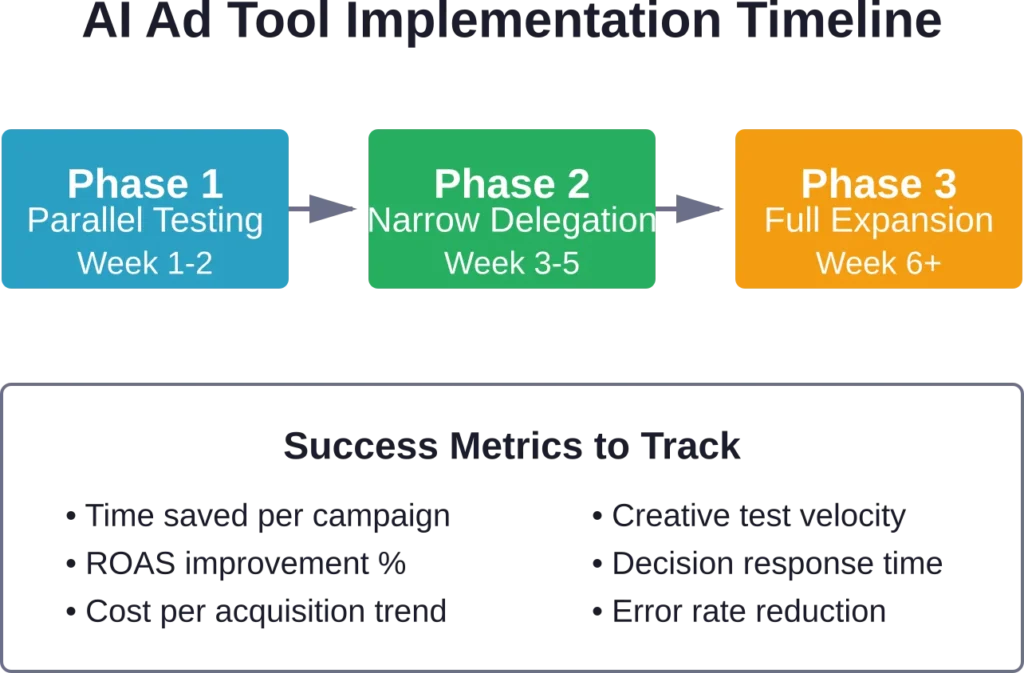
Adopting AI advertising tools works best as a phased process rather than an immediate wholesale switch.
Phase 1: Parallel Testing
Run the AI tool alongside existing processes for at least two weeks. Don’t disable current workflows or hand over full control immediately.
Set up campaigns in the new platform mirroring successful existing campaigns. Compare performance across identical audiences and creative to establish baseline capability before expanding.
This conservative approach costs extra time initially but prevents expensive mistakes from premature trust in unfamiliar systems.
Phase 2: Narrow Delegation
Choose one specific function to delegate fully—maybe creative variation generation or bid management—while maintaining manual control over other aspects.
That focused delegation reveals where AI genuinely saves time versus where it introduces friction or quality concerns. Learning these boundaries with limited risk beats discovering them after handing over entire account management.
Phase 3: Expansion and Optimization
Once comfortable with the tool’s decision-making in one area, gradually expand automation to additional functions. Monitor closely during each expansion phase.
Many platforms improve performance over time as they accumulate account-specific data. Don’t judge final capability by week-one results, but do watch for consistent improvement trajectories.
Common Pitfalls When Using AI for Instagram Ads
AI tools create new failure modes alongside the problems they solve. Awareness helps avoid expensive learning experiences.
Over-Trusting Early Results
AI platforms often show impressive initial performance improvements, partly because they’re compared against unoptimized baseline campaigns. That honeymoon period doesn’t always sustain.
Statistical significance takes time. A few days of strong ROAS might reflect random variance rather than genuine algorithmic superiority. Evaluate over weeks, not days.
Ignoring Creative Fatigue
Automation handles optimization but doesn’t inherently solve creative exhaustion. Instagram users see the same advertiser repeatedly, and even perfectly targeted ads lose effectiveness through overexposure.
AI tools can rotate existing creative and test variations, but they can’t manufacture fundamentally new concepts without human creative input. Budget for ongoing creative development even when using advanced automation.
Neglecting Strategic Direction
AI optimizes toward specified goals—maximize conversions, minimize cost per click, hit target ROAS. It won’t question whether those goals align with business strategy.
An AI might correctly optimize for immediate purchases while inadvertently cannibalizing long-term brand building. Strategic oversight remains human work.
Forgetting Platform Limitations
Instagram advertising runs on Meta’s infrastructure, which means platform policy changes, algorithm updates, and API restrictions affect all tools equally. AI can’t bypass Meta’s rules.
When performance drops across all campaigns, the issue often lives at the platform level rather than tool level. Blaming the AI wastes time that should go toward strategic adaptation.
The Future of AI in Instagram Advertising
Current AI tools represent early iterations of technology that’s developing rapidly. Several trends will likely reshape the landscape over the next few years.
Deeper Creative Generation
Image and video generation capabilities continue improving. Expect tools that produce fully custom video ads from text prompts, complete with product placement, scene composition, and even AI-generated voiceovers.
That evolution will democratize high-quality video advertising, currently gated behind production costs that favor large brands over small businesses.
Predictive Audience Modeling
Machine learning models will get better at predicting which audience segments will respond to specific offers before spending budget on testing. Early signals from pixel data and engagement patterns will inform targeting decisions faster.
This predictive capability compresses the learning phase that currently makes new campaign launches expensive.
Cross-Platform Intelligence
AI tools increasingly aggregate data across advertising platforms, email marketing, website behavior, and offline conversions. That unified view enables optimization based on complete customer journeys rather than channel-specific metrics.
Instagram ad decisions will incorporate what the AI learned from Google Ads performance, email open rates, and in-store purchase patterns.
Transparent Algorithmic Decision-Making
As AI systems make more autonomous decisions, explainability becomes critical for maintaining advertiser trust and meeting regulatory requirements. Expect tools to provide clearer reasoning for why specific changes were implemented.
That transparency will help advertisers learn from AI recommendations rather than just accepting them blindly.
Frequently Asked Questions
Both, but the proportion varies by tool. Platforms like AdAmigo and Madgicx demonstrate measurable ROAS improvements through faster optimization cycles and pattern recognition humans miss. Community discussions commonly report better KPI achievement alongside time savings. However, tools focused on content creation like Canva primarily save time without necessarily improving campaign performance—the strategic decisions still come from advertisers. The strongest performance gains come from tools that test more variations faster than manual processes allow, then scale winners immediately.
Entry-level tools like Predis.ai and Canva start at $0-15 monthly with limited features. Mid-tier automation platforms like AdAmigo begin around $99 monthly. Enterprise solutions like Madgicx and HubSpot require custom pricing, typically starting at several hundred dollars monthly. A practical rule: tool cost should represent 5-10% of monthly ad spend for the ROI to justify itself. Spending $100 monthly on tools makes sense when running $1,000-2,000 in ads; below that threshold, simpler solutions or manual management often provide better value.
Not entirely, though they significantly change the role. AI handles repetitive optimization, budget allocation, and creative testing that previously consumed hours daily. However, humans still need to set strategy, provide creative direction, interpret performance in business context, and handle platform policy issues. Small businesses may find AI tools eliminate the need for junior media buying help, while experienced advertisers become more productive. Think of AI as removing grunt work rather than replacing strategic expertise—the shift is from execution to oversight.
Predis.ai offers the most comprehensive feature set at accessible pricing for small budgets, with plans from $0-49 monthly. Canva Magic Studio provides strong creative tools starting free. Buffer works well for businesses prioritizing organic social alongside minimal paid advertising. At very small spend levels, automation ROI is harder to justify—manually managing a few campaigns remains feasible. Consider starting with free tiers of multiple tools to identify which capabilities provide the most value before committing to paid plans.
Initial setup typically takes 1-2 hours for straightforward tools like Buffer or Predis.ai, while more complex platforms like Madgicx might require 4-8 hours including training. Performance improvements usually become apparent within 2-3 weeks as the AI accumulates account-specific data. However, the first week often shows minimal change or even temporary performance dips as the system learns. Most platforms demonstrate their full capability after 4-6 weeks of continuous operation. Don’t judge success based on day-three results—AI optimization requires sufficient data volume to identify meaningful patterns.
Most AI ad tools were built primarily for direct-response e-commerce with clear conversion tracking. However, several work effectively for B2B advertisers. HubSpot Marketing Hub excels at integrating Instagram ads with longer B2B sales cycles through CRM connectivity. AdAmigo and Revealbot handle lead generation campaigns alongside e-commerce. The key difference: B2B advertisers need tools that optimize for leads and pipeline metrics rather than immediate purchases. Creative generation tools like Canva work equally well regardless of business model since visual content principles apply broadly.
Campaign performance typically reverts toward previous baseline levels, though knowledge gained during the AI period can inform better manual management. Automated optimizations—bid adjustments, budget reallocations, audience expansions—stop happening when the tool disconnects. Campaigns won’t crash, but they’ll stop improving at the pace automation enabled. Creative assets generated by AI tools remain usable after canceling subscriptions. The dependency risk is lowest with tools used primarily for content creation and highest with fully autonomous platforms managing all optimization. Many advertisers keep campaigns running through AI tools indefinitely rather than transitioning back to manual management.
Making Your Decision
Instagram advertising complexity continues increasing. Algorithm changes, new ad formats, and audience expectation shifts create moving targets that manual optimization struggles to track.
AI tools won’t make strategic decisions, understand brand nuance, or replace creative thinking. But they will execute repetitive optimization tasks faster and more consistently than human teams can manually.
The question isn’t whether to use AI for Instagram ads—industry adoption data makes the direction clear. The question is which tools match specific needs, budgets, and control preferences.
Start with the problem, not the technology. If creative production bottlenecks growth, prioritize tools like Predis.ai or Canva. If campaign optimization consumes excessive time, autonomous platforms like AdAmigo make sense. If maintaining strategic control matters most, rule-based systems like Revealbot preserve decision authority.
Most importantly, test before committing. Nearly every platform offers trials or free tiers. Use them. Run parallel campaigns. Measure actual performance differences rather than trusting marketing claims.
The best AI tool for Instagram ads is whichever one demonstrably improves the metrics that matter to the business—and that answer varies by advertiser.
Ready to test AI advertising tools? Start with free tiers from two platforms in different categories and compare results over three weeks. Track time saved alongside performance metrics. The data will clarify which investment makes sense.