

Quick Summary: AI avatar tools transform Facebook ad creation by generating professional spokesperson videos in minutes without hiring actors or production crews. The best platforms—Extuitive, D-ID, Synthesia, HeyGen, and Creatify—offer realistic avatars, multilingual support, and batch testing workflows that cut production time by 90% while lowering cost-per-acquisition by up to 28%.
Facebook advertising has shifted hard toward video. Carousel posts and static images still convert, but talking-head videos consistently pull higher engagement and click-through rates across most verticals.
The problem? Traditional video production drains budgets fast. Hiring actors, booking studios, and managing post-production for a single ad can run thousands of dollars and take weeks. And that’s before testing variations.
AI avatar generators solve this bottleneck. These platforms turn text scripts into polished spokesperson videos featuring realistic digital avatars—no cameras, no crew, no endless revisions with talent agencies.
Real talk: not every tool fits every campaign. Some platforms excel at batch testing dozens of variants for performance marketing. Others focus on ultra-realistic avatars for brand campaigns. The workflow, avatar library, customization depth, and pricing structure vary dramatically.
This guide breaks down the best AI avatar tools for Facebook ads in 2026, comparing features, pricing, and real-world use cases to help marketing teams pick the right platform.
Why AI Avatars Work for Facebook Ads
Meta’s algorithm prioritizes native video content. Ads with human faces—especially talking directly to the camera—trigger higher watch times and engagement signals that lower delivery costs.
According to Meta’s internal research, AI-based campaign management can reduce cost per action by up to 28%. That efficiency comes partly from creative velocity: teams can test 10–20 avatar variations in the time it takes to shoot one traditional video.
Avatar generators also eliminate common production headaches. Talent availability, location scouting, lighting inconsistencies, and reshoots vanish. Scripts can be tweaked and regenerated in minutes, not days.
The Creative Testing Advantage
Performance marketers live in testing cycles. A single winning ad creative can drive an entire quarter’s revenue, but finding it requires iterating fast.
Traditional video limits iteration speed. Booking talent for multiple takes of slightly different scripts burns time and money. AI avatars let teams generate 50 script variants overnight, launch them all, and identify winners by morning.
This workflow particularly benefits direct-response advertisers in e-commerce, SaaS, and lead generation where conversion lift from the right hook or offer framing can swing ROI by double digits.
Cost Structure Reality Check
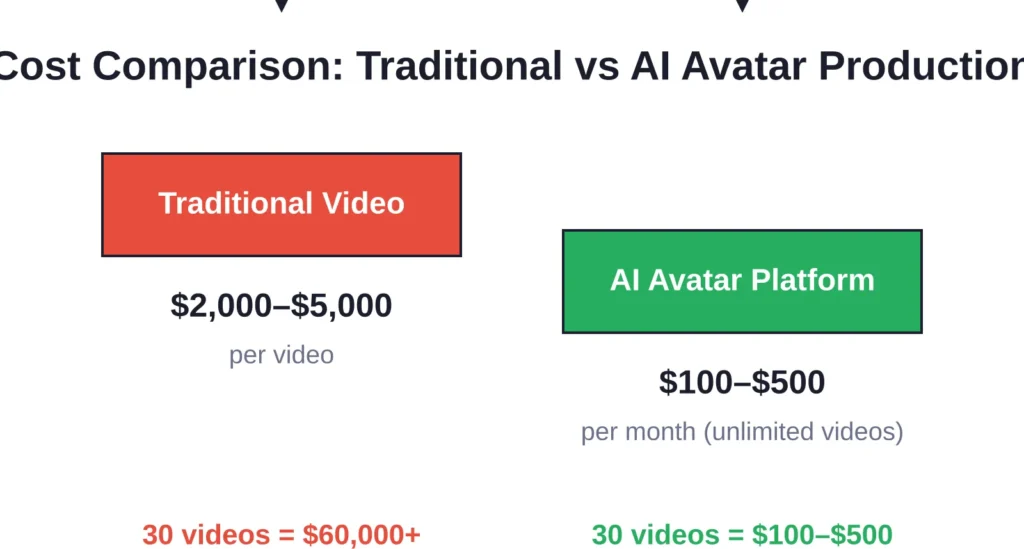
Budget matters. Traditional video production for Facebook ads typically costs $2,000–$5,000 per finished video when factoring in actors, crew, editing, and revisions. High-end productions run higher.
AI avatar platforms charge subscription fees—ranging from $15/month for basic tiers to $200+/month for enterprise features. Even at the high end, teams break even after producing 2–3 videos compared to traditional shoots.
The math shifts further when testing volume increases. A brand testing 30 creative variants per month would spend $60,000–$150,000 on traditional production. The same output through an AI platform costs $100–$500/month depending on the tool and tier.
Top AI Avatar Tools for Facebook Ads in 2026
The landscape split into distinct categories this year. Some platforms optimize for performance marketers who need batch testing and rapid iteration. Others focus on enterprise training and brand storytelling with premium customization.
Here’s the breakdown of the best tools, organized by use case and workflow strength.
1. Extuitive – Best for Predictive AI Ad Creation & Validation (UGC + Avatar Videos)
Extuitive is an AI platform built specifically for e-commerce (especially Shopify) that goes beyond just generating videos — it predicts their performance in Facebook Ads before you spend a single dollar. It creates UGC-style videos, talking-head avatar content, and full ad creatives, then tests them on 150,000+ AI consumer agents that simulate real buyer behavior.
For Facebook Ads, Extuitive stands out by delivering predictive scores (High/Medium/Low), estimated CTR, ROAS, and purchase intent. This dramatically reduces wasted ad spend and helps you launch only the strongest avatar and UGC videos.
Key Features:
- UGC-style video and AI avatar generation with product storytelling
- Predictive testing on 150k+ AI consumer agents before running real ads
- Automatic Shopify store analysis + full creative generation (copy, images, video)
- Performance forecasting (CTR, ROAS, purchase intent)
- Direct Meta Ads integration and bulk variation creation
Pricing: Starter — $1,000/month ($10k/year), Professional — $2,500/month. Custom enterprise plans available. Demo required.
Best For: Shopify brands and e-commerce teams that want to create and validate AI avatar / UGC videos for Facebook Ads with data-backed confidence, minimizing test budget and maximizing ROAS. Excellent complement to pure avatar tools like D-ID or Synthesia.
Contact Information:
- Website: extuitive.com
- Email: [email protected]
- LinkedIn: www.linkedin.com/company/extuitive
- Twitter: x.com/Extuitive_Inc
- Instagram: www.instagram.com/extuitiveinc
2. D-ID – Best for Interactive and Real-Time Conversational Avatars
D-ID pioneered interactive AI video and remains the leader in real-time conversational avatars. The platform generates both scripted videos and live interactive experiences where avatars respond to user input with sub-second latency.
For Facebook ads, D-ID’s strength lies in hyper-realistic facial expressions and emotional nuance. The avatars handle natural pauses, micro-expressions, and gaze shifts that make the delivery feel human rather than robotic.
The platform supports 100+ languages with extensive customization options. Teams can create custom avatars from photos or select from the stock library, then fine-tune voice tone, pacing, and delivery style.
Key Features:
- Real-time interactive avatars with sub-second response times
- Retrieval-augmented generation for context-aware responses
- Expressive avatars with natural emotional nuance
- 100+ language support with voice cloning
- API access for custom integrations
Pricing: Free 14-day trial available; tiered plans start at $5.90/month.
Best For: Brands testing interactive ad experiences, agencies managing multilingual campaigns, teams requiring premium avatar realism.
3. Synthesia – Best for Presentation-Style Business Videos

Synthesia built its reputation on corporate training videos and has expanded aggressively into marketing use cases. The platform offers 200+ AI avatars and a polished editor optimized for slide-style presentations.
The workflow centers on script-to-video conversion with minimal friction. Users paste scripts, select avatars and backgrounds, then export. The platform handles voiceover generation, lip-sync, and basic animations automatically.
Synthesia works particularly well for explainer-style ads—product demos, feature announcements, or educational content where clear delivery matters more than emotional range.
The platform is trusted by 90% of Fortune 100 companies, as noted on its official website, which speaks to reliability and enterprise-grade infrastructure. However, avatar expressions skew toward neutral professionalism rather than dynamic emotion.
Key Features:
- 140+ languages supported
- Slide-based editor with templates
- Screen recording integration for product demos
- Team collaboration tools and LMS integrations
- Brand kit customization
Pricing: Check the official website for current pricing; tiered plans available based on video volume and team size.
Best For: B2B advertisers, SaaS companies running educational ads, teams producing high volumes of scripted content.
4. HeyGen – Best for Marketing Videos at Scale
HeyGen dominates the performance marketing space with a workflow built for speed. The platform offers 175+ avatars, with multilingual support for 40+ languages, and batch generation tools that let teams create dozens of variants simultaneously.
The avatar library skews toward diverse, contemporary faces—think Instagram influencer aesthetic rather than corporate spokesperson. This makes HeyGen particularly effective for e-commerce and DTC brands targeting younger demographics on Facebook and Instagram.
Voice cloning quality stands out. Users upload a short voice sample, and HeyGen generates scripts in that voice with impressive consistency. This feature enables brand continuity when scaling creative across markets.
Key Features:
- 175+ diverse avatar library
- Multilingual support for 40+ languages
- Voice cloning from short samples
- URL-to-video for product demos
- Batch video generation
Pricing: Plans vary by video volume and features; check the official site for current tiers.
Best For: E-commerce brands, performance marketers running high-volume creative tests, DTC companies scaling internationally.
5. Creatify – Best for URL-to-Video and Product Ads

Creatify offers its Aurora model for enhanced avatar realism in product video generation. The platform’s standout feature: paste a product URL, and it auto-generates a complete video ad with avatar spokesperson, B-roll footage, captions, and music.
The workflow targets media buyers who need to test 20–50 creative variants weekly. Users input a product link, customize the hook and script, select an avatar, and export. The platform pulls product images, handles editing, and even suggests high-performing ad structures based on vertical and offer type.
Avatar realism improved significantly with the Aurora release. Faces now handle dynamic expressions, natural head movements, and realistic gaze shifts that earlier versions lacked.
Key Features:
- URL-to-video auto-generation from product pages
- Aurora model for enhanced realism
- Built-in B-roll library and music tracks
- Batch testing with script variants
- 75+ languages supported
Pricing: Tiered subscriptions available; free trial available.
Best For: E-commerce advertisers, Shopify store owners, affiliate marketers, dropshippers testing products rapidly.
6. Colossyan – Best for Structured Training and Educational Content

Colossyan focuses on learning and development with features that translate directly to educational ad content. The platform offers scenario-based templates, knowledge checks, and interactive elements that work well for lead magnets and mid-funnel content.
The avatar library includes professional, diverse faces suited to corporate and educational contexts. Customization depth exceeds most competitors—users can adjust avatar clothing, backgrounds, and even simulate conversations between multiple avatars in one video.
For Facebook ads, Colossyan shines in B2B campaigns where the goal is educating prospects rather than direct response. Think webinar teasers, course previews, or thought leadership content.
Key Features:
- 100+ languages with auto-translation
- Multi-avatar conversations
- Interactive elements and branching scenarios
- LMS integrations
- Extensive customization (clothing, backgrounds, gestures)
Pricing: Tiered packages available; see official website for current rates.
Best For: B2B advertisers, educational institutions, coaches and consultants, SaaS companies with complex products.
7. DeepBrain AI – Best for High-Volume Production

DeepBrain AI targets enterprise teams producing hundreds of videos monthly. The platform offers 150+ avatars and emphasizes speed in video rendering.
The editor includes templates optimized for common ad formats: testimonials, product demos, announcements, and how-to guides. Teams can save custom templates with brand colors, fonts, and preferred avatars for one-click reuse.
DeepBrain’s strength lies in workflow automation. The platform integrates with Google Sheets and Zapier, enabling bulk video generation from spreadsheet data. A single CSV with 50 rows of script variants generates 50 unique videos automatically.
Key Features:
- 150+ avatars with diverse demographics
- Template library for common ad formats
- Bulk generation from spreadsheets
- Fast rendering capabilities
- API access for custom workflows
Pricing: Enterprise-focused pricing; contact for quotes based on volume.
Best For: Agencies managing multiple clients, large e-commerce catalogs, teams producing localized content at scale.
8. Elai – Best for Document-to-Video Automation

Elai automates video creation from existing content. Upload a blog post, PDF, or presentation deck, and the platform generates a scripted avatar video with relevant visuals and transitions.
This workflow suits content marketers repurposing written assets into video ads. A product guide becomes a Facebook ad. A case study turns into a testimonial-style video. The automation handles script extraction, scene transitions, and visual selection.
The platform supports 75+ avatars and 75 languages with automated translations. Voice cloning capabilities enable consistent brand voice in international campaigns.
Key Features:
- Document-to-video automation (PDF, PPT, blog posts)
- 75+ avatars
- 75 languages with auto-translation
- Voice cloning capabilities
- Content repurposing from existing assets
Pricing: Subscription tiers based on video volume and automation features.
Best For: Content marketers, agencies repurposing client content, publishers monetizing articles through video.
How to Choose the Right AI Avatar Tool for Your Facebook Ads
The platform that works depends on campaign goals, creative workflow, and team structure. Here’s how to narrow options.
Match Tool to Campaign Objective
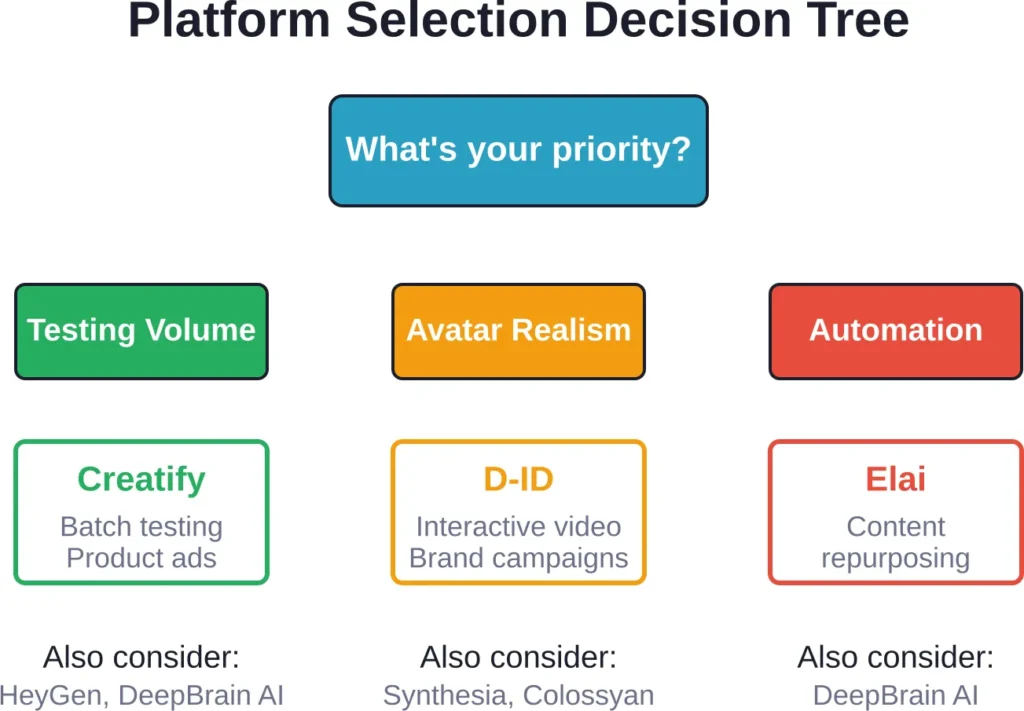
Direct-response campaigns prioritize testing velocity. Platforms like Creatify, HeyGen, and DeepBrain AI optimize for batch generation and rapid iteration. These tools sacrifice some customization depth for speed.
Brand campaigns require premium realism and emotional range. D-ID, Synthesia, and Colossyan offer deeper avatar customization, better facial expressions, and higher production polish. Rendering takes longer, but output quality justifies the tradeoff.
Educational or lead-magnet content benefits from tools with interactive elements and scenario branching. Colossyan and D-ID support multi-avatar conversations and branching logic that traditional avatar generators lack.
Evaluate Avatar Library and Customization
The default avatar library matters more than teams initially expect. If stock avatars don’t match brand aesthetic or target demographic, custom avatar creation becomes mandatory.
Some platforms charge extra for custom avatars. Others include it in base tiers. Review avatar ethnicity, age range, style (corporate vs. casual), and clothing options before committing.
Custom avatar quality varies significantly. D-ID and HeyGen produce the most realistic custom avatars from photos. Budget tools often generate uncanny-valley results that hurt ad performance.
Language and Localization Needs
Running international campaigns? Verify the platform supports target languages with native voice quality, not just machine translation.
Synthesia leads in language count (140+) but some languages rely on robotic text-to-speech. HeyGen and D-ID offer fewer languages but prioritize natural-sounding voices. Test before scaling.
Voice cloning across languages deserves special attention. Maintaining consistent brand voice in 10+ markets typically requires this feature. HeyGen and Elai handle multilingual voice cloning best as of mid-2026.
Workflow Integration and Team Collaboration
Agencies and larger teams need collaboration features: shared asset libraries, brand kits, approval workflows, and role-based permissions. Synthesia, Colossyan, and DeepBrain AI offer robust team features.
Solo advertisers and small teams benefit from simpler platforms with faster learning curves. Creatify and Elai prioritize single-user efficiency over collaboration complexity.
API access and bulk generation matter for technical teams. DeepBrain AI and D-ID provide APIs that enable custom integrations with ad platforms, analytics tools, and content management systems.
Best Practices for Using AI Avatars in Facebook Ads
Technology solves production bottlenecks, but creative strategy still determines ad performance. Here’s how to maximize results with avatar-generated videos.
Script for the First Three Seconds
Facebook users scroll fast. The first three seconds determine whether viewers stop or keep scrolling. AI avatars don’t fix weak hooks.
Open with a question, bold claim, or pattern interrupt that forces a pause. The avatar should deliver the hook with energy and eye contact. Neutral, slow delivery kills retention immediately.
Test multiple hooks aggressively. Generate 10 versions of the same ad with different opening lines. Let performance data identify winners rather than guessing which hook resonates.
Match Avatar to Audience Demographics
Avatar selection impacts trust and conversion rates more than most advertisers expect. An avatar’s age, ethnicity, style, and demeanor signal who the product serves.
Audience research should guide avatar choice. A skincare brand targeting Gen Z women should avoid corporate-styled avatars in suits. A B2B SaaS company selling to CFOs should skip influencer-aesthetic avatars.
When targeting multiple demographics, create separate ad sets with different avatars rather than using one generic face. Personalization extends beyond copy into visual representation.
Keep Videos Short and Focused
Optimal Facebook ad video length sits between 15–30 seconds for most direct-response campaigns. Brand awareness can stretch to 60 seconds, but retention drops sharply after that.
AI avatars enable rapid generation, which tempts teams to create longer scripts. Resist. Longer videos rarely convert better unless the product requires education.
Structure videos around one core message. Multiple CTAs, feature lists, or explanations dilute focus. Save complexity for landing pages.
Add Captions and Visual Elements
Most Facebook video views happen with sound off. Captions aren’t optional—they’re mandatory for performance.
The best platforms auto-generate captions, but review them for accuracy. Typos and mistimed text destroy credibility faster than poor avatar quality.
Layer in visual elements beyond the talking avatar. Product shots, text overlays highlighting benefits, and simple motion graphics maintain visual interest. Pure talking-head videos feel static after five seconds.
Test Avatar Styles Against Each Other
Not all avatars convert equally. A friendly, casual avatar might outperform a professional one for certain products, or vice versa.
Run split tests comparing avatar styles: energetic vs. calm, young vs. mature, corporate vs. casual. Creative differences often drive bigger performance swings than copy changes.
Batch generation tools like Creatify and HeyGen make this testing trivial. Generate the same script with five different avatars, launch all five, and allocate budget toward winners after 24–48 hours.
Common Mistakes to Avoid
AI avatar tools lower barriers to video production, but they don’t eliminate the need for creative discipline. These mistakes kill ad performance regardless of technology.
Overusing the Same Avatar
Ad fatigue hits faster when audiences see the same face repeatedly. Rotating avatars extends creative lifespan and keeps ads feeling fresh.
Some advertisers pick one avatar and use it across every campaign. This creates association—audiences start recognizing and ignoring the face. Variety prevents fatigue.
Establish a rotation schedule. Use 3–5 different avatars across active campaigns, and swap in new faces every 2–3 weeks even if performance remains strong.
Ignoring Voice Quality
Robotic, monotone AI voices destroy credibility. The avatar can look realistic, but if the voice sounds synthetic, viewers tune out.
Prioritize platforms with high-quality text-to-speech or voice cloning. D-ID, HeyGen, and Synthesia deliver natural-sounding voices. Budget tools often lag in vocal realism.
Test voice pacing and emphasis. Many platforms let users adjust speech speed, add pauses, and emphasize specific words. These adjustments separate robotic delivery from natural conversation.
Skipping Brand Consistency
Avatar videos still represent the brand. Inconsistent backgrounds, lighting, and avatar styling create disjointed brand perception.
Establish visual guidelines: approved avatars, background styles, color schemes, and logo placement. Most platforms support brand kits that enforce consistency automatically.
This matters especially for agencies managing multiple clients. Mixing client assets accidentally or using generic backgrounds for premium brands damages credibility.
Neglecting Mobile Optimization
Most Facebook ad views happen on mobile devices. Avatars that look great on desktop can appear too small or poorly framed on phones.
Preview all videos on mobile before launching. Check avatar size, caption readability, and visual element visibility. Tight framing and large text perform better on small screens.
Vertical or square video formats often outperform horizontal for mobile placements. Most avatar platforms support custom aspect ratios—use them.
Emerging Trends in AI Avatar Technology for 2026
The technology evolved rapidly over the past 18 months. Several trends are reshaping how advertisers use avatar tools.
Real-Time Interactive Avatars
D-ID pioneered this category, and competitors are following. Interactive avatars respond to user input in real time, creating conversational ad experiences rather than one-way broadcasts.
Early tests show higher engagement and qualification rates for lead generation campaigns. Users ask questions, avatars respond contextually, and conversations feel personalized despite automation.
Adoption remains limited due to technical complexity, but expect wider rollout as platforms simplify implementation.
Hyper-Personalization at Scale
Some platforms now generate unique avatar videos for each viewer based on demographic data, browsing history, or CRM attributes.
An e-commerce brand could show different product recommendations delivered by different avatars depending on viewer age, location, or past purchases. This level of personalization was impossible with traditional video.
Privacy regulations limit data usage, but first-party data from email lists and CRM systems enables significant personalization within compliance boundaries.
Integration with Meta’s AI Tools
Meta continues investing in native AI creative tools within Ads Manager. The eventual integration between external avatar platforms and Meta’s native features will streamline workflows further.
Currently, teams export videos from avatar platforms and upload to Ads Manager manually. API integrations are emerging that automate this handoff, enabling fully automated creative testing loops.
FAQ
Performance depends on execution, not just technology. Well-produced AI avatar ads often match or exceed real actor videos in CTR and conversion rates, particularly for direct-response campaigns where the message and hook matter more than production polish. Brand campaigns requiring high emotional resonance may still benefit from real actors, but the gap narrows as avatar realism improves.
Most platforms require 30–60 minutes to learn basic functionality. Users paste scripts, select avatars, and export videos with minimal training. Advanced features—custom avatars, voice cloning, batch generation—take a few hours of exploration. Teams producing their first video typically spend 1–2 hours; subsequent videos take 10–20 minutes.
Yes. Most premium platforms support custom avatar creation from photos. D-ID, HeyGen, and Synthesia produce the most realistic results. The process typically requires 3–5 high-quality photos of the person. Quality varies—some platforms generate uncanny results while others achieve near-photorealism. Always test before committing to custom avatars for major campaigns.
HeyGen, D-ID, Elai, and Synthesia offer voice cloning. Quality and language support vary. HeyGen handles multilingual voice cloning best as of mid-2026, supporting consistent voice across 40+ languages. Most platforms require 1–2 minutes of clear audio to train voice models. Review licensing terms—some platforms restrict commercial use of cloned voices without explicit consent.
AI-generated content must follow the same policies as traditional ads. Disclose AI use when relevant, especially for health, finance, or political ads. Avoid misleading claims about avatar identity—don’t imply the avatar is a real person endorsing the product unless legally permitted. Most AI avatar ads run without issues if the underlying product and claims comply with standard Facebook policies.
Direct-response ads perform best at 15–30 seconds. Brand awareness campaigns can extend to 45–60 seconds. Longer videos rarely justify the retention drop unless the product requires education. Test different lengths—some audiences engage with 10-second hooks, others need 20 seconds to understand the offer. Let performance data guide length rather than assumptions.
Direct native integration remains limited as of mid-2026. Most platforms require manual export and upload to Ads Manager. However, APIs from DeepBrain AI, D-ID, and Synthesia enable custom integrations for technical teams. Some third-party tools are building bridges between avatar platforms and Meta’s API to automate creative upload and testing workflows.
Conclusion
AI avatar tools fundamentally changed Facebook ad production economics. What once required thousands of dollars and weeks of lead time now takes minutes and costs a monthly subscription.
The best platform depends on specific needs. Performance marketers testing high volumes should explore Creatify, HeyGen, and DeepBrain AI. Brands prioritizing realism and emotional nuance will prefer D-ID, Synthesia, or Colossyan. Content marketers repurposing existing assets benefit from Elai’s automation.
The technology continues improving rapidly. Avatar realism, voice quality, and workflow automation all advanced significantly in 2026. Early adopters gain competitive advantages before competitors catch up.
Start with free trials from 2–3 platforms. Test the same script across different tools and launch the results as Facebook ads. Real performance data beats feature comparisons when choosing the right tool.
The barrier to professional video ads just dropped to near-zero. The question isn’t whether to use AI avatars—it’s which platform fits your workflow and how fast you can start testing.