

Quick Summary: AI marketing automation software combines artificial intelligence with workflow automation to help marketing teams personalize campaigns, optimize performance, and scale operations. The best platforms in 2026 include Extuitive, HubSpot Marketing Hub, ActiveCampaign, Customer.io, Gumloop, and Braze — each offering unique AI capabilities for email marketing, customer engagement, lead scoring, and multi-channel orchestration. Choosing the right tool depends on team size, technical expertise, integration requirements, and whether you prioritize no-code simplicity or advanced customization.
Marketing teams face a serious challenge: personalize experiences for thousands of customers, optimize campaigns across multiple channels, prove ROI on every dollar spent — and somehow do it all faster than last quarter.
The old playbook of throwing more hours or hiring more people isn’t sustainable. That’s where AI marketing automation software enters the picture.
But here’s the thing — not all automation platforms are created equal. Some slap “AI” on legacy features and call it innovation. Others build genuinely transformative capabilities that fundamentally change how teams work.
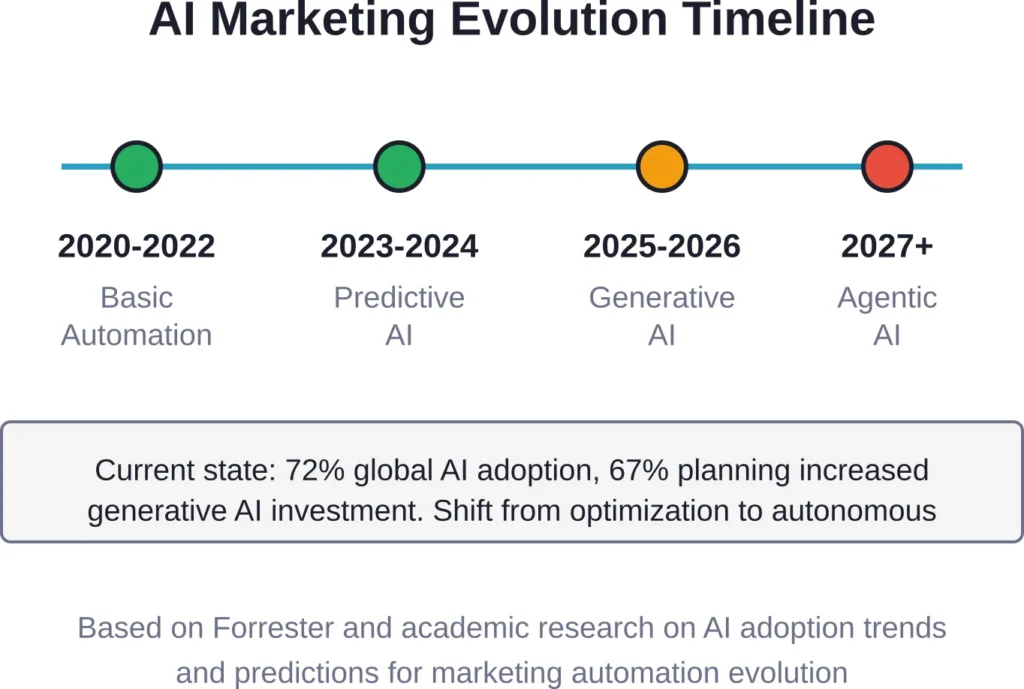
According to Forrester research, 67% of AI decision-makers plan to increase investment in generative AI within the next year. The market has spoken: AI-powered marketing isn’t a nice-to-have anymore. It’s table stakes.
This guide cuts through the noise. After analyzing user ratings, testing platform capabilities, and reviewing documentation from dozens of tools, here’s the definitive list of AI marketing automation software that actually delivers results in 2026.
Why AI Marketing Automation Matters in 2026
The competitive landscape has shifted. Display ad budgets are predicted to drop 30% in 2026 according to Forrester predictions, forcing marketers to find more efficient ways to reach audiences. Consumers are leaving the open web for walled gardens and private communities.
AI automation solves three critical problems:
Scale without proportional headcount. A five-person marketing team can execute campaigns that would have required twenty people just three years ago. The AI handles segmentation, personalization, optimization, and reporting — tasks that used to consume 60-70% of a marketer’s week.
Personalization that actually converts. Generic batch-and-blast emails don’t work anymore. Customers expect relevant content based on their behavior, preferences, and lifecycle stage. AI analyzes signals humans can’t process at scale — browsing patterns, engagement timing, content preferences, purchase history — and tailors messaging accordingly.
Optimization speed. Manual A/B testing takes weeks. AI-powered platforms test dozens of variations simultaneously, identify winning combinations in hours or days, and automatically shift traffic to top performers. The feedback loop accelerates from quarterly to daily.
But — and this is important — according to Forrester research, trust is cited as a significant barrier to generative AI adoption. The platforms that win in 2026 aren’t just the most feature-rich. They’re the ones that balance capability with transparency, control, and reliability.
Top AI Marketing Automation Software for 2026
After reviewing G2 ratings, testing platform capabilities, and analyzing user feedback, these platforms stand out for their AI capabilities, reliability, and real-world performance.
1. Extuitive
Extuitive is an AI-powered predictive advertising platform that forecasts campaign performance before launch. The platform analyzes creatives, predicts CTR, ROAS, and conversions using models trained on real campaigns and 150,000+ AI consumer agents.
The AI capabilities include pre-launch performance scoring, creative validation through simulated audiences, automated ad generation, and smart recommendations for winning variations. Extuitive acts as an intelligent pre-flight layer for Meta, Google, and other ad platforms.
What sets Extuitive apart is its ability to eliminate money-losing tests by predicting outcomes with high accuracy, dramatically reducing wasted ad spend and speeding up the creative iteration cycle from weeks to minutes.
G2 rating: — (newer platform). The platform offers multiple pricing tiers. Check Extuitive’s official website for current pricing and feature availability.
Best for: D2C and Shopify brands that want to optimize ad performance and creative testing with AI before spending on live campaigns.
Contact Information:
- Website: extuitive.com
- Email: [email protected]
- LinkedIn: www.linkedin.com/company/extuitive
- Twitter: x.com/Extuitive_Inc
- Instagram: www.instagram.com/extuitiveinc
2. HubSpot Marketing Hub
HubSpot remains the most popular all-in-one marketing platform, and for good reason. The Marketing Hub combines CRM, email marketing, landing pages, analytics, and increasingly sophisticated AI features into a unified system.
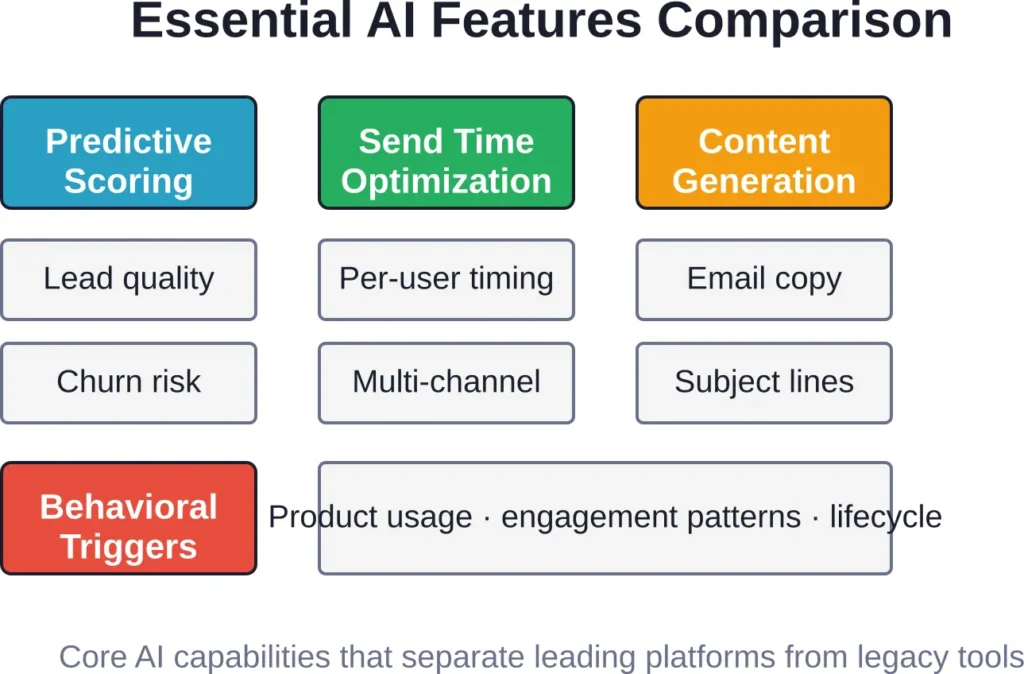
The AI capabilities include content generation, email subject line optimization, send time optimization, lead scoring predictions, and conversational chatbots. HubSpot’s AI assistant can draft blog posts, generate campaign copy, and suggest optimal content topics based on SEO data.
What sets HubSpot apart is the breadth of integration. Marketing automation doesn’t exist in isolation — it connects to sales pipelines, customer service tickets, and deal stages. The AI can trigger marketing actions based on sales activities and vice versa, creating genuinely unified customer journeys.
G2 rating: 4.4/5. The platform offers multiple pricing tiers. Check HubSpot’s official website for current pricing and feature availability.
Best for: Mid-market companies that want an all-in-one solution with strong AI features and don’t need highly specialized capabilities.
3. ActiveCampaign

ActiveCampaign built its reputation on email marketing and evolved into a powerful automation platform with sophisticated AI capabilities. The platform excels at predictive sending, automated segmentation, and behavioral trigger mapping.
The AI features include predictive sending (determining optimal send times per contact), win probability scoring (calculating deal close likelihood), automated split testing, and content recommendations. The conditional logic builder lets teams create complex, branching automation workflows that adapt based on customer behavior.
ActiveCampaign’s machine learning algorithms analyze engagement patterns to automatically move contacts between segments, pause communications when engagement drops, and re-engage dormant contacts with targeted win-back sequences.
G2 rating: 4.5/5. The platform offers multiple pricing tiers based on contact volume and features. Visit the official site for current pricing structures.
Best for: E-commerce and B2C companies that prioritize email marketing sophistication and need deep integration with shopping platforms.
4. Customer.io

Customer.io is an AI-powered customer engagement platform built specifically for product-led and data-driven companies. The platform focuses on behavioral automation — triggering campaigns based on actual product usage rather than just email opens or clicks.
The AI capabilities include intelligent send time optimization, frequency optimization (preventing over-messaging), predictive churn scoring, and automated segment discovery. Customer.io’s machine learning models analyze product usage patterns to identify at-risk users before they churn and automatically trigger intervention campaigns.
What makes Customer.io distinctive is the data flexibility. Teams can send any event data — page views, feature usage, transaction details, custom attributes — and build automation rules around those signals. The AI learns which behavioral patterns correlate with conversion, retention, or expansion and surfaces those insights to marketers.
The platform integrates deeply with data warehouses, CDPs, and analytics tools, making it ideal for companies with sophisticated data infrastructure. Check the official website for current pricing and plan details.
Best for: SaaS companies and product-led growth teams that want behavior-driven automation based on product usage data.
5. Gumloop

Gumloop represents a newer approach: no-code AI workflow automation that goes beyond traditional marketing tasks. The platform lets teams build custom automation workflows using a visual interface — no coding required.
The AI capabilities include automated web scraping, data enrichment, content generation, research automation, and custom workflow creation. Teams can chain together different AI models, APIs, and data sources to build marketing workflows tailored to their specific needs.
Here’s where Gumloop shines: unconventional automation. Need to monitor competitor websites and summarize changes weekly? Build a workflow. Want to scrape industry news, filter for relevant topics, and draft social posts automatically? Build a workflow. Looking to enrich lead data from multiple sources and score based on custom criteria? Build a workflow.
The platform offers a free tier with credits monthly, then paid plans starting at $37/month. The flexibility trades off some ease-of-use compared to purpose-built marketing tools, but the customization potential is unmatched.
Best for: Technical marketing teams that need custom automation beyond what standard platforms offer, or companies with unique workflow requirements.
6. Braze

Braze is an enterprise-grade customer engagement platform focused on multi-channel orchestration. The platform handles email, push notifications, in-app messages, SMS, WhatsApp, and content cards through a unified interface.
The AI capabilities include Intelligent Timing (predicting optimal send times per channel and user), Intelligent Selection (automatically choosing the best message variant for each user), and predictive churn and purchase likelihood models. Braze’s machine learning continuously optimizes which channels, messages, and timing combinations drive the best results for each customer segment.
Braze excels at coordinating campaigns across channels. The AI doesn’t just optimize email send times — it determines whether a specific user is more responsive to push notifications versus email, then automatically adjusts the channel mix to maximize engagement.
G2 rating: 4.5/5. Braze targets enterprise customers with complex, high-volume use cases. Contact their sales team for pricing specific to volume and feature requirements.
Best for: Enterprise companies with mobile apps that need sophisticated multi-channel orchestration and can invest in platform implementation.
7. Klaviyo

Klaviyo built a powerful position in e-commerce marketing automation, particularly for Shopify stores. The platform combines email and SMS marketing with deep e-commerce integrations and increasingly sophisticated AI features.
The AI capabilities include predictive analytics for customer lifetime value and churn risk, automated product recommendations, smart send time optimization, and AI-powered subject line suggestions. Klaviyo’s models analyze purchase history, browsing behavior, and engagement patterns to predict which products individual customers are most likely to buy next.
The platform’s strength is e-commerce specificity. Pre-built automation flows for cart abandonment, browse abandonment, post-purchase sequences, and win-back campaigns include AI optimization out of the box. The system learns which products to recommend, how long to wait between touchpoints, and when to offer discounts versus education.
Klaviyo offers a free tier for small lists, with pricing scaling based on contact volume. Check the official website for current tier structures and feature availability.
Best for: E-commerce brands, especially those on Shopify, that want powerful email and SMS automation with AI-driven product recommendations.
8. Intuit Mailchimp

Mailchimp evolved from an email marketing tool into a broader marketing automation platform. While not as AI-forward as some competitors, the platform offers accessible automation features with growing AI capabilities suitable for small businesses.
The AI features include send time optimization, subject line helper, content optimizer, and predictive demographic segmentation. Mailchimp’s AI analyzes campaign performance across millions of users to suggest improvements and predict which content variations will perform best.
G2 rating: 4.4/5. The platform offers a free tier for basic email marketing, with paid plans adding automation features. Visit the official site for current pricing and plan comparisons.
Best for: Small businesses and startups that need straightforward email automation with basic AI features at an accessible price point.
9. Insider

Insider is a growth management platform that combines marketing automation with AI-powered personalization across web, mobile, email, and messaging channels. The platform focuses on real-time personalization and cross-channel orchestration.
The AI capabilities include IndiGO (their AI engine for personalization), predictive segmentation, automated journey orchestration, and real-time product recommendations. Insider’s machine learning analyzes customer behavior across channels to create unified profiles and deliver consistent, personalized experiences.
G2 rating: 4.8/5. The platform targets mid-market and enterprise customers. Contact Insider directly for pricing specific to use case and volume.
Best for: Retail, e-commerce, and travel companies that need sophisticated cross-channel personalization with strong AI capabilities.
10. Zapier

Zapier isn’t strictly a marketing automation platform — it’s an integration and workflow tool. But it deserves inclusion because it connects thousands of apps and increasingly incorporates AI features into those workflows.
The AI capabilities include Zapier Central (an AI assistant that can build automations based on natural language instructions), AI-powered data formatting and transformation, and integration with AI tools like ChatGPT, DALL-E, and Claude for content generation and image creation.
Teams use Zapier to build custom marketing automation by connecting their existing tools. Lead capture forms can trigger enrichment services, update CRM records, send to email platforms, create tasks, and notify team members — all without custom code. Adding AI tools into these workflows enables automated content generation, image creation, and data analysis.
Zapier offers a free tier for basic automation, with paid plans adding advanced features and higher task volumes. Check the official website for current pricing tiers.
Best for: Teams that need to connect disparate tools and want flexibility to incorporate AI capabilities into existing workflows without switching platforms.
11. CleverTap

CleverTap is a customer engagement and retention platform focused on mobile-first companies. The platform combines analytics, segmentation, and multi-channel messaging with AI-powered optimization.
The AI capabilities include predictive segmentation, churn prediction, intelligent channel selection, and automated journey optimization. CleverTap’s machine learning identifies user segments most likely to convert or churn, then automatically adjusts campaign targeting and messaging to maximize retention and revenue.
G2 rating: 4.6/5. CleverTap targets app-based businesses with substantial user volumes. Contact their sales team for pricing specific to MAU (monthly active users) and features.
Best for: Mobile-first companies and apps that need sophisticated user engagement and retention automation with strong analytics integration.
Key Features to Look for in AI Marketing Automation Software
Not all AI features are created equal. Some are genuinely transformative. Others are marketing fluff. Here’s what actually matters when evaluating platforms.
Behavioral Triggers Beyond Email Opens
Traditional automation triggers on email opens, clicks, and form submissions. AI-powered platforms should trigger on deeper behavioral signals — product usage, page scroll depth, time spent on specific content, feature adoption, purchase frequency changes, and engagement patterns across channels.
The best platforms let teams define custom events and build automation rules around them. If a user views pricing three times in a week but doesn’t start a trial, that’s a signal. If someone uses a feature daily for two weeks then stops, that’s a signal. AI automation should act on these signals automatically.
Predictive Scoring and Segmentation
Manual lead scoring assigns arbitrary point values to activities. AI predictive scoring analyzes thousands of data points to calculate actual conversion probability based on historical patterns.
Look for platforms that offer predictive models for lead scoring, churn risk, customer lifetime value, and purchase propensity. These models should update automatically as new data arrives, and the platform should surface insights about which factors most strongly predict each outcome.
Automated Optimization at Scale
The platform should continuously test variations and automatically optimize without manual intervention. This includes send time optimization, subject line testing, content variation testing, channel selection, and frequency optimization.
The key word is “automated.” If teams need to manually review test results and implement winning variations, that’s not AI automation — that’s just A/B testing with extra steps.
Multi-Channel Orchestration
Customers don’t exist in single channels. The best AI automation platforms coordinate experiences across email, SMS, push notifications, in-app messages, web personalization, and paid channels.
The AI should determine not just what message to send, but which channel to use for each customer based on their historical engagement patterns. Some customers respond better to SMS. Others prefer email. The platform should learn these preferences and adapt automatically.
Integration Depth
Marketing automation doesn’t exist in isolation. The platform needs to connect with CRM systems, analytics tools, e-commerce platforms, data warehouses, advertising platforms, and product databases.
Evaluate both the breadth of integrations (how many tools connect) and the depth (how much data flows bidirectionally). Surface-level integrations that only sync basic contact info don’t enable sophisticated AI. Deep integrations that share behavioral events, transaction data, and engagement signals unlock the full potential.
Transparency and Control
AI that operates as a black box creates problems. Teams need visibility into why the AI made specific decisions — why this segment was created, why this send time was chosen, why this content variation won.
Look for platforms that balance automation with transparency. The AI should make recommendations and implement optimizations, but teams should be able to review the reasoning, override decisions when necessary, and understand model performance.
How to Choose the Right Platform for Your Team
The “best” platform depends entirely on context. A solo entrepreneur has different needs than a 50-person marketing team at a SaaS company. Here’s how to narrow the options.
Start with Use Case, Not Features
Define the specific problems that need solving. “We need AI marketing automation” is too vague. Better questions:
- Are we primarily doing email marketing, or do we need multi-channel coordination?
- Do we have product usage data to trigger campaigns on, or are we working with traditional engagement signals?
- Is our primary goal lead generation, customer retention, or revenue expansion?
- Do we need deep e-commerce integration, or are we selling services?
- Will non-technical marketers build automations, or do we have technical resources?
The answers point toward specific platforms. E-commerce teams gravitate toward Klaviyo. Product-led SaaS companies choose Customer.io or Braze. Small businesses often start with Mailchimp or HubSpot.
Consider Team Size and Technical Capability
Some platforms require technical setup and ongoing maintenance. Others are designed for non-technical users.
Gumloop and Zapier offer tremendous flexibility but expect teams to build custom workflows. HubSpot and ActiveCampaign provide pre-built automation templates and visual builders that don’t require coding. Enterprise platforms like Braze assume dedicated resources for implementation and optimization.
Match platform complexity to team capability. A powerful tool that nobody can use effectively is worse than a simpler tool that gets implemented fully.
Evaluate Integration Requirements
List every tool in the current stack — CRM, analytics, e-commerce platform, data warehouse, advertising platforms, support desk, billing system. Check whether candidate platforms integrate with each one.
Pay attention to integration depth. Some platforms offer “native” integrations built by their team, which tend to be more reliable and feature-rich. Others rely on third-party connectors through Zapier or similar services, which add complexity and potential failure points.
For companies with data warehouses or CDPs, look for platforms that support reverse ETL or warehouse integrations. This enables using the full breadth of customer data without rebuilding integrations.
Test with Real Campaigns
Most platforms offer free trials or free tiers. Use them. Build an actual campaign that mirrors real use cases — not just a test message to yourself.
Import a sample of the contact database. Set up realistic segments. Build an automation workflow. Connect necessary integrations. Review the reporting interface. Evaluate how long setup took and whether the team could work independently or needed constant documentation reference.
The platform that looks best in a demo might be frustrating in daily use. Testing reveals those gaps.
Calculate Total Cost of Ownership
Platform pricing varies wildly based on contact volume, email sends, features, and user seats. A platform that costs $100/month at 5,000 contacts might cost $1,500/month at 50,000 contacts.
Factor in implementation costs, training time, ongoing management effort, and integration expenses. A free tier that requires 20 hours of technical setup isn’t free. A $500/month platform that includes onboarding and support might be cheaper in total cost.
Request pricing calculators or detailed tier breakdowns. Most vendors publish general ranges but require contacting sales for specific quotes based on volume and features.
| Platform | Best For | Starting Price | G2 Rating |
|---|---|---|---|
| HubSpot Marketing Hub | All-in-one solution, mid-market | Contact for pricing | 4.4/5 |
| ActiveCampaign | Email-focused, e-commerce | Contact for pricing | 4.5/5 |
| Customer.io | Product-led growth, SaaS | Contact for pricing | Check official site |
| Gumloop | Custom workflows, technical teams | $37/month (Free tier available) | Check official site |
| Braze | Enterprise, multi-channel | Contact for pricing | 4.5/5 |
| Klaviyo | E-commerce, Shopify | Free tier, scales with volume | Check official site |
Common Implementation Mistakes to Avoid
Even the best platform fails if implemented poorly. These mistakes derail AI marketing automation projects repeatedly.
Automating Broken Processes
Automation makes processes faster. It doesn’t fix broken processes — it just breaks them faster at scale.
Before automating, map current workflows on paper. Identify inefficiencies, unclear hand-offs, and steps that don’t add value. Fix those problems manually first, then automate the optimized process.
Teams that automate dysfunctional workflows end up with automated dysfunction. The AI will dutifully execute the broken process thousands of times before anyone notices.
Insufficient Data Quality
AI marketing automation depends on clean, structured data. If contact records are duplicated, fields are inconsistent, and events aren’t tracked properly, the AI can’t function effectively.
Invest in data hygiene before implementation. Deduplicate contacts. Standardize field formatting. Define event taxonomies. Set up proper tracking on website and product.
Forrester research indicates that trust represents a significant barrier to AI adoption. Poor data quality destroys trust fast — the AI makes obviously wrong decisions, teams lose confidence, and the platform gets abandoned.
Over-Automation Too Quickly
The temptation is to automate everything immediately. Resist that urge.
Start with one or two high-impact, low-risk workflows. Get those running smoothly, measure results, learn from mistakes. Then expand gradually to more complex automation.
Teams that try to automate twenty workflows simultaneously spread attention too thin, miss configuration errors, and create a tangled mess that’s difficult to debug.
Ignoring the AI’s Recommendations
Some teams implement AI platforms then ignore what the AI suggests. If the system recommends different send times but teams override it with their preferences, the AI never improves.
Trust takes time to build. Run parallel tests — let the AI optimize one segment while manual approaches handle another. Compare results. When the AI demonstrates better performance, give it more control.
The point of AI automation is to let the machine handle optimization so humans can focus on strategy. That requires actually letting the machine optimize.
No Measurement Framework
Define success metrics before implementation. What outcomes should improve? By how much? Over what timeframe?
Common metrics include email engagement rates, conversion rates by segment, time saved on manual tasks, lead-to-customer conversion rates, customer retention rates, and revenue attributed to automated campaigns.
Without baseline measurements and clear goals, it’s impossible to know whether the AI automation is working. Teams end up arguing about subjective impressions instead of reviewing objective data.
The Future of AI Marketing Automation
The technology continues evolving rapidly. Several trends are reshaping what’s possible.
Agentic AI for Marketing
Current AI automation executes predefined workflows with AI-powered optimization. Agentic AI takes this further — autonomous systems that plan, decide, and act without predefined workflows.
Forrester research highlights that businesses are moving beyond traditional AI agents toward agentic AI systems that can plan, decide, and act autonomously, orchestrating complex workflows without human intervention.
For marketing, this means AI that doesn’t just optimize send times but independently designs campaign strategies, identifies new audience segments, creates content variations, tests hypotheses, and adjusts tactics based on results — all without explicit programming.
The platforms building toward this vision are creating AI “agents” that handle specific marketing functions autonomously. We’re still early, but the trajectory is clear.
Integration of Generative AI
Current platforms use AI primarily for optimization and prediction. The next wave incorporates generative AI for content creation, design, and creative strategy.
Platforms are embedding capabilities to generate email copy, create image variations, draft social posts, write product descriptions, and design landing pages directly within the automation workflow. The AI doesn’t just determine when to send — it creates what to send.
Harvard research emphasizes that AI presents marketers with unprecedented opportunities to personalize customer experiences. Generative AI makes that personalization possible at scale — unique content variations for thousands of micro-segments, generated automatically based on audience characteristics and performance data.
Deeper Cross-Channel Intelligence
Marketing channels are converging. The distinction between “email marketing” and “mobile marketing” and “web personalization” is dissolving into unified customer engagement.
Next-generation platforms treat all channels as a coordinated system. The AI determines not just message content and timing, but which channel mix will drive outcomes for each customer. It learns that some users respond to email but ignore push notifications, while others are the opposite.
This requires platforms to break down internal silos. The email team, push notification team, and web team can’t operate independently. The AI needs unified data and cross-channel orchestration capabilities.
Privacy-First Personalization
Regulatory pressure and consumer expectations are pushing toward privacy-first approaches. Third-party cookies are disappearing. Data collection faces increasing restrictions.
AI automation will increasingly rely on first-party data — information customers explicitly provide or behaviors within owned properties. Platforms are building capabilities to personalize effectively with less data, using techniques like federated learning and on-device processing.
The platforms that win long-term will balance personalization with privacy, delivering relevant experiences without creepy surveillance.
Real-World Results: What Teams Are Achieving
The proof lives in outcomes. Companies implementing AI marketing automation effectively report significant improvements across multiple metrics.
Community discussions and case studies reveal common patterns. Teams typically see email engagement rates increase 20-40% after implementing send time optimization and personalization. Conversion rates from automated nurture sequences often double compared to manual campaigns.
Time savings matter just as much. Marketing teams report spending 50-70% less time on campaign execution and reporting after implementing AI automation, redirecting that capacity toward strategy, creative development, and testing.
Financial services leaders are increasingly planning to expand AI investments.
But results depend entirely on implementation quality. The same platform produces wildly different outcomes depending on data quality, workflow design, and team execution. Technology is an accelerant, not a substitute for strategy.
Getting Started: First Steps
For teams ready to implement AI marketing automation, here’s a practical starting roadmap.
Audit Current State
Document existing marketing processes, tools, and data sources. Map customer journeys from awareness through purchase and retention. Identify bottlenecks, manual tasks, and areas where personalization could improve outcomes.
This audit reveals where AI automation creates the most value. Some teams need help with lead nurturing. Others struggle with customer retention. The problems determine which platform capabilities matter most.
Define Success Criteria
Establish baseline metrics before implementation. Current email engagement rates, conversion rates by segment, time spent on campaign execution, customer retention rates, revenue per customer.
Set realistic improvement targets. A 25% increase in email engagement is achievable. A 500% increase probably isn’t. The targets should be ambitious but grounded in reality.
Start Small, Prove Value
Choose one or two high-impact, low-complexity automation workflows for initial implementation. Welcome sequences for new subscribers, cart abandonment campaigns, or re-engagement campaigns work well as starting points.
Get those workflows running successfully. Measure results against baselines. Document lessons learned. Use early wins to build organizational confidence and secure resources for broader implementation.
Invest in Training
Even the most intuitive platform requires learning. Budget time for team training — not just initial onboarding, but ongoing skill development.
Encourage experimentation in test environments. Give team members permission to try things, make mistakes, and learn. The teams that excel at AI automation invest continuously in capability building.
Iterate Based on Data
Review performance weekly at first, then monthly once workflows stabilize. Look at engagement metrics, conversion rates, and AI-specific metrics like how often the AI’s recommendations differed from what teams would have done manually.
Use data to inform iteration. Which segments respond best to AI-optimized campaigns? Which automation workflows drive the most value? Where does manual intervention still outperform AI? The answers guide expansion priorities.
Frequently Asked Questions
Traditional marketing automation executes predefined workflows — if someone subscribes, send email A; if they click, send email B. AI marketing automation adds intelligence to those workflows. The system learns optimal send times for each individual, predicts which content variations will perform best, automatically segments audiences based on behavioral patterns, and continuously optimizes performance without manual intervention. The difference is between a scheduled system and a learning system.
Pricing varies dramatically based on platform, contact volume, features, and company size. Entry-level options like Mailchimp start with free tiers for small lists, scaling to hundreds per month as volume grows. Mid-market platforms like HubSpot Marketing Hub start at accessible price points with basic features, reaching thousands monthly for advanced AI capabilities and larger contact databases. Enterprise platforms like Braze require custom quotes typically starting at several thousand dollars monthly. Most platforms price based on contact count or email volume, so costs scale with growth.
Absolutely. Small teams actually benefit disproportionately because AI automation multiplies limited resources. A two-person marketing team can execute campaigns that would require a much larger team manually. Platforms like Mailchimp, ActiveCampaign, and HubSpot offer accessible entry points with AI features suitable for small businesses. The key is starting with focused use cases — email automation, basic segmentation, simple behavioral triggers — rather than trying to implement every feature immediately. Many platforms offer free tiers or low-cost plans specifically designed for small business needs.
Three prerequisites indicate readiness. First, established baseline marketing processes — even if manual, the team should have defined customer journeys and campaign workflows. AI automates and optimizes processes; it doesn’t create strategy from nothing. Second, decent data quality — contact databases should be reasonably clean, with consistent formatting and minimal duplication. Third, clear success metrics and willingness to test. Teams ready for AI automation have defined goals and are comfortable running experiments. If these three elements exist, the team is ready to start with basic AI automation and expand from there.
Data quality consistently ranks as the top challenge. AI depends on clean, structured data — incomplete contact records, inconsistent field formatting, and poor event tracking undermine AI effectiveness. Change management creates the second major challenge; teams accustomed to manual control sometimes resist letting AI make decisions. Technical integration complexity can slow implementation, especially for companies with legacy systems or custom platforms. Finally, unrealistic expectations cause problems — some teams expect AI to immediately transform results without adequate implementation time or process optimization. Forrester research indicates that trust represents a significant barrier, highlighting how important transparency and proven results are for successful adoption.
The answer depends on team size, technical capability, and complexity needs. All-in-one platforms like HubSpot offer convenience — everything lives in one system, data flows automatically between modules, teams learn one interface. This works well for small to mid-size companies that want simplicity and can accept some feature limitations. Best-of-breed approaches — combining specialized tools like Customer.io for engagement, Segment for data routing, and dedicated analytics platforms — offer more flexibility and power but require integration work and create multiple systems to manage. Technical teams at larger companies often prefer best-of-breed for customization. Growing companies sometimes start all-in-one, then migrate to specialized tools as needs evolve. Neither approach is universally better; alignment with team capability and requirements determines the right choice.
Timeline varies by use case and implementation quality. Basic automation workflows like welcome sequences or cart abandonment campaigns can show positive results within 2-4 weeks of launch — these are well-understood patterns with predictable performance. AI optimization features like send time optimization and predictive scoring require more time; the algorithms need 6-12 weeks of data to learn patterns and demonstrate improvement over baseline performance. Substantial organizational impact — measurable increases in revenue, retention, or efficiency — typically emerges after 3-6 months once multiple workflows are optimized and teams have refined their approach based on initial learnings. Quick wins prove value early, but transformative results require sustained implementation over quarters, not weeks.
Conclusion
AI marketing automation has moved from experimental technology to essential infrastructure. The data confirms this: 72% global AI adoption, 67% of decision-makers planning increased generative AI investment, strong expansion of AI budgets across sectors.
But technology alone doesn’t create outcomes. The platforms covered in this guide — HubSpot, ActiveCampaign, Customer.io, Gumloop, Braze, and others — provide powerful capabilities. Whether those capabilities translate into results depends entirely on strategy, implementation, and ongoing optimization.
The best platform for one company isn’t necessarily the best for another. E-commerce teams have different needs than B2B SaaS companies. Small businesses need different capabilities than enterprises. Technical teams want customization; non-technical teams prioritize ease of use.
Start by defining specific problems that need solving. Evaluate platforms based on how well they address those problems, not based on feature checklists. Test with real campaigns before committing. Implement gradually, prove value with early wins, then expand.
The competitive advantage doesn’t come from having AI marketing automation. Nearly everyone will have it soon. The advantage comes from implementing it effectively — clean data, optimized workflows, measurement frameworks, continuous iteration.
Marketing teams that master AI automation can personalize at scale, optimize continuously, and execute campaigns that would have required 3-5x more resources manually. That efficiency creates space for the strategic work that truly differentiates brands: understanding customers deeply, crafting compelling positioning, developing creative that resonates.
The technology handles execution and optimization. Humans handle strategy and creativity. That division of labor is where AI marketing automation creates the most value.
Ready to transform how your marketing team operates? Choose a platform from this list, start with one high-impact workflow, and prove the value with measurable results. The sooner teams start learning how to work effectively with AI automation, the stronger the competitive position they’ll build for the years ahead.