
Quick Summary: The best React web development companies in 2026 combine deep technical expertise in React, Next.js, and TypeScript with proven delivery track records across MVP to enterprise projects. Leading agencies like Brocoders, Xmartlabs, Toptal, and BairesDev offer full-stack capabilities, rigorous vetting processes, and specialized domain knowledge in SaaS, fintech, and e-commerce. When selecting a partner, prioritize verifiable client reviews, direct developer access, and transparent project processes over pricing alone.
React continues to dominate modern web development in 2026, powering everything from lean startup MVPs to complex enterprise platforms. According to industry analyses, 39.5% of developers prefer React as of 2024, and that number has held steady into 2026.
But here’s the thing: choosing a React development partner isn’t just about finding someone who knows JSX and hooks. The right agency brings architectural thinking, state management expertise, and the ability to connect React front ends to scalable backend services. They understand server-side rendering with Next.js, TypeScript for type safety, and modern tooling that keeps codebases maintainable as products scale.
This guide breaks down the top 15 React development companies operating in 2026, based on verified client reviews, technical depth, and proven project delivery. No fluff, no invented metrics—just agencies that consistently ship production-grade React applications.
What Makes a Great React Development Company in 2026
The React ecosystem has matured significantly. Framework knowledge alone doesn’t cut it anymore.
Top-tier React agencies demonstrate mastery across several technical dimensions. They architect applications with Next.js for server-side rendering and static site generation, which directly impacts SEO and initial load performance. They implement proper state management—whether through Redux, Zustand, or React Query—based on project complexity rather than default choices.
TypeScript has become table stakes. The best teams write type-safe code from day one, catching errors during development rather than production. They understand build optimization, code splitting, and lazy loading patterns that keep bundle sizes reasonable even as features multiply.
Real talk: technical chops matter, but so does process. High-performing React companies provide direct access to the developers who’ll actually write the code. They run transparent sprint planning, conduct regular code reviews, and maintain clear communication channels. When a developer leaves mid-project, they have a documented handoff process rather than leaving clients scrambling.
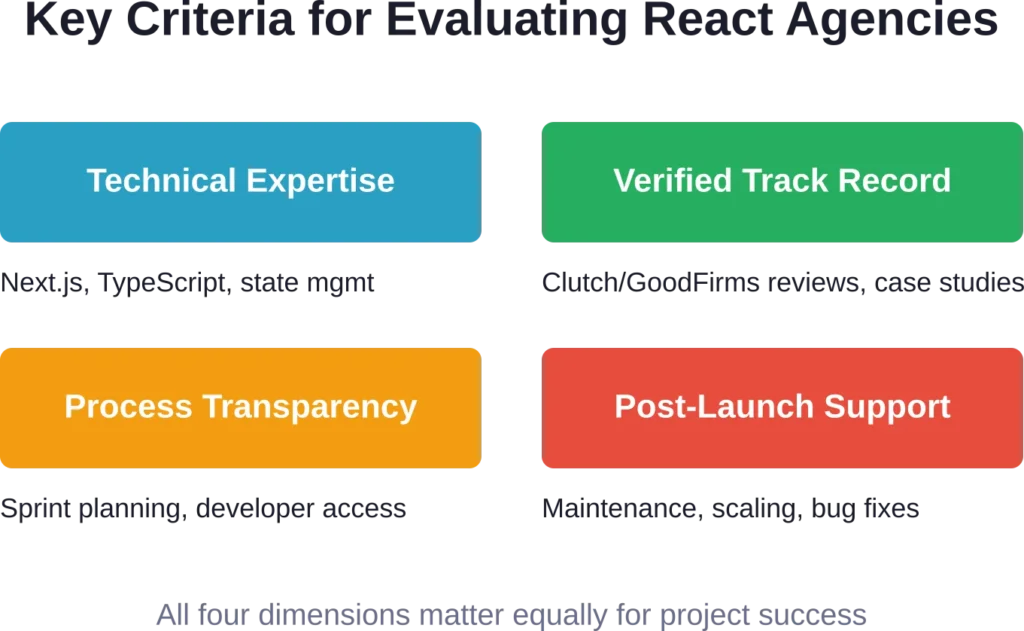
Client reviews offer the most reliable signal. Look for specific feedback about code quality, deadline adherence, and post-launch support. Generic praise means nothing. Comments like “delivered on-time sprint delivery 100% of the time” or “refactored our legacy codebase without breaking features” indicate real competence.
Domain expertise also separates specialists from generalists. An agency that’s built multiple fintech platforms understands regulatory compliance, security patterns, and payment integration challenges. One that’s shipped several SaaS products knows how to architect for multi-tenancy, role-based permissions, and usage metering.
Top 15 React Development Companies to Consider in 2026
The agencies below represent the strongest React development partners operating in 2026, evaluated on technical capability, client feedback, and project delivery consistency. Each brings specific strengths to different project types and business contexts.
1. A-listware

A-listware delivers reliable React development through dedicated teams and team augmentation for enterprises, SMBs, and startups. They focus on building secure, responsive, and scalable digital solutions that integrate seamlessly with existing systems.
What sets A-listware apart is their ability to rapidly assemble and manage professional development teams that act as a natural extension of the client’s organization. They excel at React-based web applications, legacy modernization, cloud solutions, and complex enterprise platforms while maintaining high code quality and clear communication throughout the project.
Clients choose them for custom software development, UI/UX implementation, and long-term React architectures that support sustainable business growth across multiple industries.
Contact Information:
- Website: a-listware.com
- Phone: +1 (888) 337 93 73
- Email: [email protected]
- Address: North Bergen, NJ 07047, USA
- LinkedIn: www.linkedin.com/company/a-listware
- Facebook: www.facebook.com/alistware
2. Oski
Oski delivers high-quality React development as part of their full-cycle software engineering for tech-forward enterprises and ambitious startups. Their team excels at building modern, scalable frontends that integrate seamlessly with complex backend systems and cloud infrastructure.
What sets Oski.site apart is their AI-accelerated engineering approach combined with deep frontend expertise. They don’t just code interfaces — they create performant, maintainable React architectures using React, Next.js, React Native, and modern tooling that support both web and mobile experiences. Their solutions emphasize clean code, intuitive UI/UX, and rapid development cycles while maintaining enterprise-grade quality.
Clients value their ability to deliver flexible frontend solutions that adapt to evolving business needs across industries like fintech, e-commerce, logistics, and education.
Contact Information:
- Website: oski.site
- Phone: +48571282759
- Email: [email protected]
- Address: Kaupmehe tn 7, 10114 Tallinn, Estonia
- LinkedIn: www.linkedin.com/company/oski-solutions
3. Gilzor

Gilzor specializes in custom web and mobile development with a strong focus on React-powered digital products. They help startups validate ideas and scale businesses through thoughtfully built applications that drive real user engagement and business growth.
What distinguishes Gilzor is their product-oriented process — from idea validation and UI/UX design to full React development, QA, and go-to-market support. They build secure, high-performance web applications with React that prioritize conversion, scalability, and long-term maintainability. Their teams deliver clean architecture and user-centric interfaces that help products stand out in competitive markets.
Clients particularly appreciate their ability to create both web platforms and cross-platform mobile solutions, with many becoming recurring partners due to consistent delivery quality.
Contact Information:
- Website: www.gilzor.com
- Email: [email protected]
- Address: Poland, Warsaw, Office 58, street Adama Mickiewicza 37, 01-625
- LinkedIn: www.linkedin.com/company/gilzor-softwaredevelopment
4. Mobian

Mobian builds dedicated engineering teams focused on production-ready React and full-stack development for companies in IT, healthcare, fintech, and logistics. They operate through outsourcing and outstaffing models to deliver fast, reliable software without hiring overhead.
What sets Mobian apart is their emphasis on senior-level execution and scalable architecture. They design React-based systems (along with mobile and backend layers) that handle growth from hundreds to hundreds of thousands of users. Every project receives clean, documented code and thoughtful architecture decisions that prevent future technical debt.
Their strength lies in end-to-end delivery — from UI/UX through React development to cloud deployment and post-launch support — while maintaining excellent English communication.
Contact Information:
- Website: mobian.studio
- Phone: [email protected]
- Address: Harju maakond, Tallinn, Kesklinnalinnaosa, Masina tn 22, 10113
- LinkedIn: www.linkedin.com/company/mobian-studio
5. Lengreo
Lengreo acts as a complete marketing and tech partner, offering professional website and web application development with React expertise. They combine technical development with B2B growth strategies to deliver platforms that not only look great but also drive measurable business results.
What sets Lengreo apart is their holistic approach — they handle discovery, prototyping, React development, optimization, and ongoing support while aligning technical solutions with marketing and lead-generation goals. Their web development services focus on high-converting, SEO-friendly interfaces built with modern React practices.
Clients highlight the team’s initiative, dedication, and ability to deliver high-quality work that supports both technical excellence and business development.
Contact Information:
- Website: Lengreo.com
- Phone: +31 686 147 566
- Email: [email protected]
- Address: Vrijstraat 9 C/D, 5611 AT Eindhoven, Netherlands
- LinkedIn: Lengreo
- Twitter: @Lengreo
- Instagram: @lengreo
6. Lemon.io

Lemon.io follows a curated marketplace model similar to Toptal but with faster matching timelines and a focus on startups and mid-market companies rather than enterprises.
Their React developer vetting emphasizes practical project experience over algorithmic puzzles. Developers in the Lemon.io network have shipped production React applications, not just passed whiteboard interviews. That practical orientation means less ramp-up time—developers understand real-world constraints like deadline pressure, shifting requirements, and technical debt.
The platform works well for companies that need one or two strong React developers to augment an existing team rather than building an entire dedicated squad. Fast matching, straightforward contracts, and developers who’ve built similar products before add up to quick value delivery.
7. Brainhub

Brainhub specializes in React development for startups moving from MVP to scale. They understand the specific technical challenges that emerge when an application that worked fine for 100 users suddenly needs to support 10,000.
Their refactoring capabilities stand out. Multiple case studies describe taking early-stage React codebases built quickly for validation and systematically rebuilding them for performance, maintainability, and feature extensibility. They know which shortcuts to leave in place and which create critical technical debt.
Performance optimization is a particular strength. Brainhub developers dig into bundle analysis, implement proper code splitting, optimize re-renders, and refine API data fetching patterns. For startups hitting scale problems after initial traction, Brainhub offers the expertise to stabilize and accelerate.
8. Visuality

Visuality brings deep React expertise combined with strong UI/UX design capabilities. Their projects consistently showcase polished interfaces with smooth interactions and thoughtful micro-animations.
The design-development integration here goes beyond surface aesthetics. Visuality’s React developers understand design systems, component libraries, and the architecture needed to maintain visual consistency across large applications. They build reusable component structures that make it easy for future developers to create new features that feel native to the application.
Their expertise covers complex technical requirements across various application types. If the product’s visual and interaction design is a competitive differentiator, Visuality delivers both the design vision and the React implementation to match.
9. Chudovo

Chudovo offers React development with particularly strong backend integration capabilities. They architect full-stack solutions where the React front end is just one layer in a larger technical system.
Their teams include backend engineers, DevOps specialists, and QA professionals alongside React developers. This full-stack composition means they can own entire technical implementations rather than requiring client coordination across multiple vendors. Projects ship faster when one team handles everything from database schema design through front-end state management.
Security and scalability receive serious attention. Chudovo developers implement proper authentication, authorization, data validation, and error handling from the start rather than treating them as afterthoughts. For regulated industries or applications handling sensitive data, this security-first mindset matters enormously.
10. Neoteric
Neoteric focuses on React development for complex business applications—the internal tools, dashboards, and workflow systems that power operations rather than consumer-facing products.
These applications demand different skills than consumer apps. They need flexible data visualization, complex form handling, sophisticated permission systems, and integration with existing enterprise systems. Neoteric’s React developers specialize in these less glamorous but critically important use cases.
Their approach emphasizes maintainability and documentation. Business applications often live for years, maintained by internal teams long after the initial development agency departs. Neoteric structures code for that handoff, creating clear component hierarchies, comprehensive documentation, and test coverage that makes future modifications safer.
11. Brocoders

Brocoders has built a reputation for full-cycle React development, handling everything from initial prototyping through production deployment and ongoing maintenance. Their Polish-based team focuses heavily on media, entertainment, and SaaS verticals.
What sets Brocoders apart is their architectural approach to connecting React front ends with scalable backend services. They don’t just build interfaces—they design the entire data flow, API layer, and infrastructure needed for products that need to handle growth. Their Clutch profile shows 4.9 stars from 53 reviews, with clients consistently highlighting code quality and communication.
Their team demonstrates fluency with Next.js for SEO-critical applications and React Native for cross-platform mobile development when projects require both web and app presence.
12. Xmartlabs

Xmartlabs brings serious engineering discipline to React development. Their Clutch profile carries 45 reviews with particularly strong marks for on-time sprint delivery—100% according to multiple client testimonials.
The technical fluency here runs deep. Xmartlabs architects full-stack applications with React and TypeScript on the front end, connected to robust backend services. They understand the product lifecycle from concept through scale, which means their initial architecture decisions account for future growth rather than creating technical debt.
Client reviews highlight the team’s ability to maintain velocity while working with React and TypeScript. That balance—speed without sloppiness—defines their approach. They’re particularly strong for teams that need enterprise-grade code quality but can’t afford slow delivery.
13. Toptal
Toptal operates on a different model: instead of a traditional agency structure, they maintain a vetted network of freelance React developers with rigorous vetting processes.
The vetting process includes multiple technical screenings and test projects. Once a developer passes, Toptal matches them to client projects, often within 48 hours for urgent needs. This model works exceptionally well for companies that need specific React expertise quickly or want to scale teams up and down based on project phases.
The trade-off? Less team cohesion than a dedicated agency, since developers work independently. But for organizations with strong internal technical leadership who just need additional React development capacity, Toptal’s model delivers high-caliber individual contributors fast.
14. BairesDev
BairesDev handles React development at enterprise scale. They serve large organizations requiring complex platform development.
They’ve developed systematic approaches to code quality, security, and technical modernization. Clients report the agency’s ability to work with complex codebases. That capability suggests deep architectural understanding and strong project management.
BairesDev brings extensive experience in modern JavaScript framework evolution. That long-term perspective shows in their technology choices—they adopt new tools when they solve real problems, not just because they’re trendy. For organizations tackling large-scale digital transformation with React at the center, BairesDev brings the structure and experience to execute.
15. Thoughtbot

Thoughtbot combines React development with strong product design thinking. They don’t just implement features—they question requirements, suggest alternatives, and push back when specifications don’t serve user needs.
This product-first approach makes them particularly valuable during the early stages of application development, when core decisions about information architecture, user flows, and feature prioritization have outsized impact. Their React developers work closely with designers, creating interfaces that feel cohesive rather than bolted together.
Clients frequently mention Thoughtbot’s consulting value beyond code. They help define MVP scope, validate assumptions through prototyping, and establish development processes that internal teams can maintain after engagement ends. The premium here isn’t just React expertise—it’s strategic product thinking.
How to Choose the Right React Development Partner
Selecting among these agencies requires matching their strengths to specific project needs. Here’s what actually matters.
Evaluate Technical Depth Beyond React Basics
Any competent developer can build a React component. The differentiator is architectural thinking.
During evaluation, ask agencies to walk through their approach to state management for a complex application. Listen for nuanced answers that mention trade-offs between different solutions. A team that suggests Redux for everything hasn’t thought deeply. One that asks about data fetching patterns, update frequency, and shared state requirements before recommending a solution demonstrates real expertise.
Next.js capabilities matter significantly now. Applications benefit from server-side rendering for SEO, static generation for performance, and API routes for backend logic. Agencies should articulate when to use each rendering strategy and how to architect hybrid applications that combine them.
TypeScript adoption signals code quality priorities. Teams writing type-safe code catch bugs during development rather than production. Ask to review code samples—strong TypeScript usage includes proper interface definitions, generic types, and utility types, not just slapping any everywhere to satisfy the compiler.
Verify Track Record With Specific Project Examples
Generic portfolio pages prove nothing. Request detailed case studies for projects similar in scope and technical complexity.
Good agencies provide specific metrics: initial load time improvements, performance optimization results, user growth handled post-launch. They explain technical challenges encountered and how they resolved them. One revealing question: “What went wrong on this project, and how did you handle it?” Agencies that claim perfect execution on every project either lie or lack self-awareness.
Client references carry enormous weight. Speak directly with previous clients, preferably those whose projects finished at least six months ago so post-launch support quality is evident. Ask about communication responsiveness, developer skill consistency across the team, and how the agency handled unexpected complications.
Assess Process Transparency and Communication
Process determines project outcomes as much as technical skill.
Demand direct access to developers who’ll write code. Some agencies keep clients isolated from their technical team, routing all communication through account managers. That creates a telephone game where requirements get distorted and technical nuances lost. The best partnerships involve regular developer standups, shared Slack channels, and direct technical discussions.
Sprint planning processes reveal organizational maturity. Agencies should describe their approach to backlog management, story estimation, sprint retrospectives, and deployment cadences. Mature teams have established rhythms. Immature ones wing it and miss deadlines.
Code review practices matter for long-term quality. Ask how agencies ensure consistency across developers, maintain coding standards, and prevent technical debt accumulation. Teams without formal review processes ship inconsistent code that becomes unmaintainable.
Understand Team Composition and Stability
Developer turnover destroys project momentum.
Ask agencies about team stability and what happens when developers leave mid-project. Strong teams have documented handoff procedures, maintain architectural decision records, and ensure at least two developers understand each codebase area. Weak teams rely on individual heroes whose departure creates crises.
Team composition should match project needs. A complex fintech application requires senior developers with regulatory compliance experience, not junior developers learning on the job. Ask about specific developer backgrounds and how the agency assigns talent to projects.
Bench strength indicates capacity to handle scope changes. If the project needs to scale up quickly, can the agency add qualified React developers within a week? Or does expansion require a lengthy hiring process that delays delivery?
Plan for Post-Launch Support
Launching is just the beginning. Applications need ongoing maintenance, bug fixes, and feature additions.
Clarify post-launch support models before signing contracts. Some agencies offer maintenance retainers with guaranteed response times. Others operate on ad-hoc billing that can lead to slow responses during critical outages. For production applications, defined support SLAs matter.
Knowledge transfer processes determine internal team capabilities. If the plan includes eventually transitioning maintenance to in-house developers, the agency should provide documentation, training sessions, and gradual handoff periods rather than abrupt departures.
| Evaluation Criteria | What to Ask | Red Flags |
|---|---|---|
| Technical Architecture | “How do you approach state management for applications with real-time data sync?” | Generic answers, one-size-fits-all solutions |
| Team Access | “Can I attend daily standups with the actual developers?” | Account manager gatekeeping, no developer contact |
| Code Quality | “Show me your TypeScript usage in a recent project.” | Heavy use of ‘any’ type, missing interfaces |
| Delivery Process | “What’s your sprint length and deployment cadence?” | No defined process, irregular deployments |
| Support Model | “What happens when a production bug appears on Saturday?” | Vague answers, no defined SLAs |
Understanding React Development Project Costs
Project costs vary significantly based on scope and complexity, ranging from simple MVPs to enterprise-scale platforms.
React developer rates typically range from $25–$99 per hour based on various factors, though rates alone tell an incomplete story.
Project scope determines total investment far more than hourly rates. Project costs vary significantly based on scope and complexity, ranging from simple MVPs to enterprise-scale platforms.
What drives costs up? Technical complexity like real-time features, complex state management, or heavy data visualization. Integration requirements with legacy systems or multiple third-party APIs. Compliance needs for regulated industries. Team composition—senior developers cost more but deliver faster with fewer mistakes.
What keeps costs reasonable? Clear requirements that minimize mid-project changes. Reusable component libraries that accelerate development. Phased delivery that validates assumptions before building everything. Strong client-side technical leadership that reduces back-and-forth.
But here’s the thing: optimizing for lowest cost often backfires. Cheap developers create technical debt that costs multiples to fix later. Rushed timelines produce buggy code. The agencies commanding premium rates typically deliver cleaner code, better architecture, and fewer post-launch surprises that justify the difference.
React Development Trends Shaping 2026
The React ecosystem continues evolving rapidly. Several trends are reshaping how leading agencies approach development.
Server Components and Streaming SSR
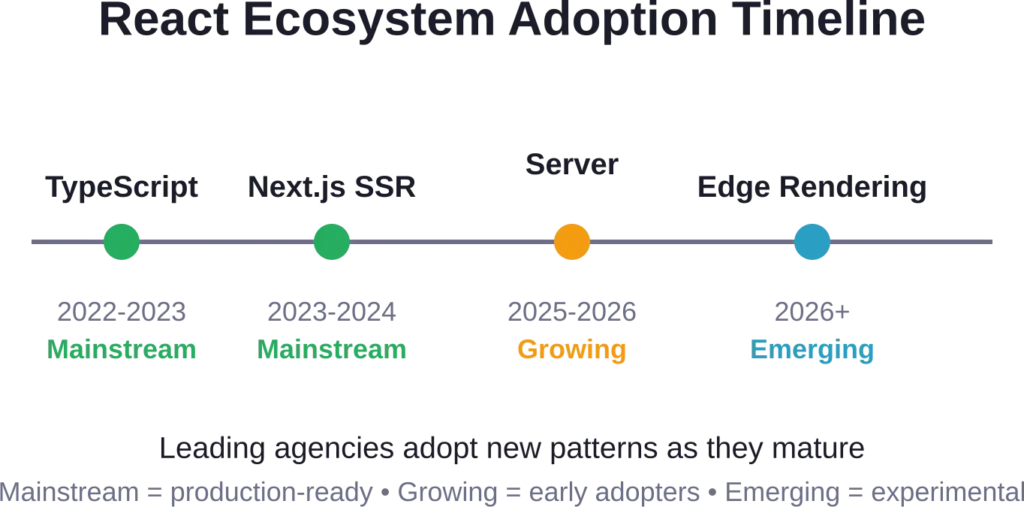
React Server Components, increasingly mature in recent Next.js versions, fundamentally change the performance equation. Components that don’t need client-side interactivity render entirely on the server, dramatically reducing JavaScript bundle sizes.
Top agencies leverage this for significantly faster initial page loads. Marketing pages, content-heavy sections, and mostly-static interfaces now ship minimal JavaScript to the browser. Only interactive components hydrate client-side. The result: faster perceived performance and better Core Web Vitals scores.
Streaming server-side rendering takes this further, sending HTML progressively as it’s generated rather than waiting for the entire response. Users see content faster even on slow connections. Leading React teams architect applications to maximize streaming benefits.
TypeScript Everywhere
TypeScript adoption has reached near-universal status among professional React teams. The type safety benefits—catching errors during development, enabling confident refactoring, improving IDE autocomplete—justify the additional complexity.
Modern React codebases use TypeScript not just for type checking but for documentation. Well-typed interfaces communicate component APIs better than comments. Generic types enable reusable utility functions. Discriminated unions model complex state machines precisely.
Agencies not offering TypeScript-first React development are falling behind professional standards.
Monorepo Architectures
Large React applications increasingly adopt monorepo structures using tools like Turborepo or Nx. Multiple related applications—web app, mobile app, admin dashboard—live in a single repository sharing common components and business logic.
This solves the code duplication and version synchronization problems that plague multi-repo setups. Shared component libraries, utility functions, and type definitions stay consistent across platforms. Updates propagate everywhere simultaneously. Build tools handle complex dependency graphs automatically.
The organizational discipline required for successful monorepos separates mature teams from struggling ones.
Edge Computing and Distributed Rendering
React applications increasingly leverage edge computing platforms like Vercel Edge Functions or Cloudflare Workers. Business logic runs physically close to users worldwide rather than in centralized data centers.
This geographical distribution reduces latency dramatically. API calls that previously took 200ms now complete in 20ms when executed from edge nodes near users. The cumulative effect across an application makes interfaces feel noticeably snappier.
Leading agencies architect React applications with edge-first thinking, determining which logic benefits from edge execution and which still requires centralized processing.
Common Mistakes When Hiring React Development Companies
Several recurring errors derail React development partnerships. Avoiding them dramatically improves project outcomes.
Optimizing for Lowest Cost
The cheapest agency rarely delivers the best value. Low rates correlate with junior developers, offshore teams requiring heavy oversight, or agencies desperate for work because they can’t maintain clients.
Budget constraints are real, but technical debt from poor initial development costs far more to fix than paying appropriate rates upfront. A $40,000 budget spent on competent developers beats a $25,000 budget on cheap ones who create unfixable architectural problems.
Skipping Technical Due Diligence
Evaluating agencies based solely on marketing materials and sales pitches invites disaster. Actual code quality, architectural decisions, and technical practices determine project success.
Request code samples. Conduct technical interviews with proposed developers. Review actual projects, not just polished case studies. Ask hard questions about failures and how they were handled. Agencies that won’t provide this transparency should raise red flags.
Unclear Requirements and Scope
Vague project definitions guarantee scope creep, budget overruns, and mutual frustration. “Build us an e-commerce platform” provides insufficient direction. Which features specifically? What scale? What integrations?
Invest time upfront defining requirements clearly. Create wireframes. Document user flows. Specify technical constraints. The clarity pays dividends in accurate estimates and aligned expectations. Good agencies will help refine requirements, but starting from total ambiguity wastes time.
No Success Metrics
How will success be measured? “The application works” sets too low a bar. Define specific performance targets, quality standards, and business outcomes.
Measurable goals might include: initial load time under 2 seconds, Lighthouse performance score above 90, zero critical bugs in first month post-launch, handling 10,000 concurrent users. These concrete targets align agency incentives with business needs.
Ignoring Cultural Fit
Technical capability matters enormously, but so does working relationship quality. An agency that delivers great code but creates constant friction through poor communication or misaligned values makes projects miserable.
Evaluate communication style, responsiveness, and collaboration approach during initial conversations. Teams that listen carefully, ask clarifying questions, and communicate proactively tend to maintain those behaviors through projects. Those that oversell, dismiss concerns, or dodge difficult questions will likely continue doing so when problems emerge.
Frequently Asked Questions
Project timelines vary dramatically based on scope and complexity. A simple MVP with core features typically requires 8-12 weeks with a focused team. Mid-scale applications with custom features, integrations, and mobile responsiveness often take 3-6 months. Complex enterprise platforms requiring extensive backend development, third-party integrations, and rigorous testing can extend to 6-12 months or longer.
Timeline depends on requirements clarity, team size, decision-making speed, and how many iterations occur during development. Projects with clear specifications and responsive stakeholders move faster than those with evolving requirements and slow feedback cycles.
The right choice depends on project needs. React specialists make sense when the backend already exists or another team handles it. Their deep front-end expertise delivers sophisticated interfaces and optimal performance.
Full-stack agencies work better when building complete products from scratch. They architect the entire technical stack—database, API layer, front end, infrastructure—as a cohesive system. This integration typically produces better results than coordinating multiple specialized vendors.
For projects requiring both deep React expertise and backend development, look for agencies with demonstrable strength in both areas rather than those that specialize in one and dabble in the other.
React builds web applications that run in browsers. React Native creates mobile applications that run natively on iOS and Android devices. While both use similar component-based architecture and JavaScript, they target fundamentally different platforms.
React Native allows sharing business logic and some components between iOS and Android versions, reducing duplication compared to building separate native apps. However, it still requires platform-specific code for native features, optimal performance, and platform-specific design patterns.
Some agencies specialize in React for web only. Others handle both React and React Native for projects needing web and mobile presence with maximum code reuse. Clarify which platforms the project requires before selecting an agency.
Request code samples from recent React projects and review them directly or have a technical advisor examine them. Look for TypeScript usage, proper component structure, appropriate state management, and clean code patterns.
Conduct technical interviews with proposed developers. Ask them to explain architectural decisions on past projects, discuss trade-offs between different approaches, and walk through how they’d handle specific scenarios relevant to the project.
Speak with previous clients about actual technical delivery. Were promised developers the ones who actually worked on the project? Did code quality hold up under scrutiny? How did the team handle complex technical challenges?
Developer turnover during projects is inevitable at some scale. Strong agencies mitigate this through documentation, code reviews, and knowledge sharing practices that prevent individual developers from becoming irreplaceable.
Ask agencies directly about their turnover rates and replacement processes. Good answers include: documented architectural decision records, pair programming practices, mandatory code reviews, and bench strength to assign replacement developers quickly. Poor answers include vague assurances that turnover won’t happen.
Contract terms should address this scenario explicitly, specifying transition timelines and knowledge transfer requirements when developers change
React excels at complex, interactive user interfaces with significant client-side state management. Applications like dashboards, real-time collaboration tools, social platforms, and dynamic content feeds play to React’s strengths.
For simpler content-focused websites, lighter alternatives might suffice. Static site generators can deliver excellent performance for blogs, marketing sites, and documentation. Traditional server-rendered frameworks work well for form-heavy applications without complex client-side interactions.
That said, React’s ecosystem maturity, developer availability, and tooling make it a safe default choice. The question isn’t whether React can handle the project—it almost certainly can—but whether simpler alternatives would deliver equal results with less complexity.
Next.js has become the dominant framework for production React applications, particularly those with SEO requirements or performance constraints. Its server-side rendering, static generation, and API route capabilities solve common challenges React developers otherwise handle manually.
For marketing sites, e-commerce platforms, or content-heavy applications where search engine visibility matters, Next.js expertise is essentially mandatory. The framework’s built-in optimizations for performance, SEO, and developer experience make it the standard choice.
For internal tools, dashboards, or applications behind authentication where SEO doesn’t matter, plain React might suffice. But even there, Next.js provides enough quality-of-life improvements that most professional teams prefer it.
Making the Final Decision
Selecting a React development partner ultimately requires balancing technical capability, process maturity, cultural fit, and practical constraints like budget and timeline.
The agencies profiled here represent the strongest options operating in 2026, each with specific strengths aligned to different project contexts. Brocoders and Xmartlabs excel at full-stack product development. Toptal and Lemon.io provide rapid access to individual developers. BairesDev handles enterprise-scale implementations. Thoughtbot and Visuality combine development with design thinking. Brainhub specializes in scaling startups beyond MVP stage.
No single agency fits every project. Match their core competencies to specific needs. A fintech startup building a regulated trading platform requires different expertise than a media company creating a content streaming service.
The evaluation process matters as much as the final choice. Conduct thorough technical due diligence. Speak with multiple references. Review actual code samples. Test communication responsiveness and clarity during the sales process—it predicts working relationship quality.
Start with clear requirements, even if they’re preliminary. Document what’s known, what’s uncertain, and what success looks like. Good agencies help refine requirements, but starting from complete ambiguity wastes everyone’s time.
Define success metrics upfront. Performance targets, quality standards, business outcomes—concrete goals align incentives and provide objective evaluation criteria when deliverables arrive.
Remember that development partnerships extend beyond initial delivery. Post-launch support, maintenance, and future feature development matter. Choose agencies positioned to support the product through its entire lifecycle, not just the first release.
The React ecosystem continues maturing rapidly. Leading development partners stay current with emerging patterns like Server Components, edge rendering, and advanced TypeScript usage. They adopt new capabilities when they solve real problems, not just chase trends.
Ready to start your React development project? Evaluate agencies systematically using the criteria outlined here. Request detailed proposals. Conduct technical interviews. Check references thoroughly. The upfront diligence pays enormous dividends in project success, code quality, and long-term maintainability.