
Quick Summary: This comprehensive guide examines the top 15 enterprise web development companies in 2026, featuring agencies that specialize in building scalable, high-performance web solutions for large organizations. Each company is evaluated based on their enterprise expertise, technical capabilities, client portfolios, and proven track record in delivering complex web applications and platforms without discussing pricing structures.
Finding the right enterprise web development partner can make or break your digital transformation initiative. The stakes are high when building complex web applications, customer portals, or integrated platforms that need to serve thousands of users while connecting with legacy systems.
Enterprise web development differs fundamentally from standard website creation. These projects demand specialized expertise in scalability, security protocols, system integrations, and regulatory compliance. The wrong choice can lead to budget overruns, missed deadlines, and technical debt that haunts your organization for years.
This guide cuts through the noise. We’ve analyzed dozens of agencies to identify 15 companies that consistently deliver enterprise-grade web solutions. Each has demonstrated expertise in handling complex requirements, managing large-scale projects, and building applications that stand the test of time.
What Makes Enterprise Web Development Different
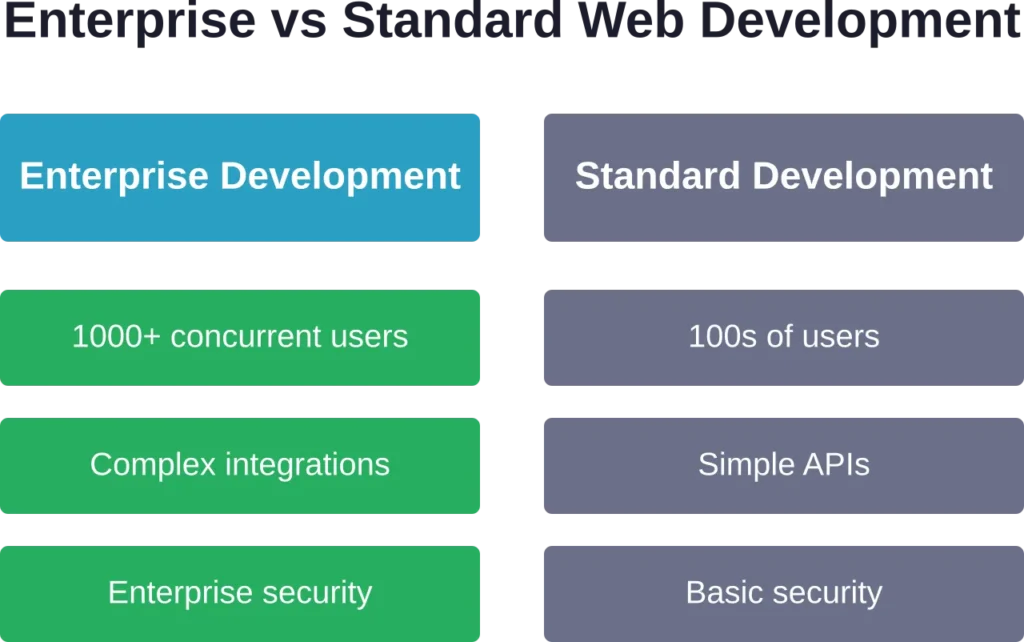
Enterprise web development operates on a different scale than typical website projects. These initiatives involve building robust web applications and platforms designed to handle significant user loads, complex business logic, and integration with multiple systems.
The technical requirements alone set these projects apart. Enterprise applications must support thousands of concurrent users without performance degradation. They integrate with existing enterprise resource planning systems, customer relationship management platforms, and legacy databases that can’t simply be replaced.
Security becomes paramount when dealing with sensitive business data and customer information. Enterprise web development companies implement multiple layers of security controls, conduct regular vulnerability assessments, and ensure compliance with industry regulations like GDPR, HIPAA, or SOC 2.
But here’s the thing though—technical capability is just the starting point. Enterprise projects involve multiple stakeholders, lengthy approval processes, and organizational politics that can derail even technically sound initiatives. The best agencies understand this reality and bring project management expertise to navigate these challenges.
Top 15 Enterprise Web Development Companies
1. Mobian Studio
Mobian Studio delivers dedicated engineering teams that build production-ready enterprise web applications on time and within budget. They specialize in creating robust digital solutions for companies in healthcare, fintech, logistics, and IT sectors where technology decisions directly impact business performance.
Their delivery model emphasizes either full outsourcing with end-to-end ownership or outstaffing where senior engineers integrate directly into client teams. This flexibility allows enterprises to scale development capacity without the risks and overhead of traditional hiring while maintaining strict control over project direction and quality.
Technical capabilities cover full-stack web development including modern frontend frameworks, scalable backend architectures, cloud infrastructure, and seamless legacy system integrations. They excel at building systems that connect new web platforms with existing enterprise environments while ensuring clean architecture and comprehensive documentation.
The company has delivered web and mobile solutions for clients in regulated industries requiring high security, compliance, and performance standards. Their work includes platforms with complex workflows, real-time data processing, and enterprise-grade integrations that support critical business operations.
What distinguishes Mobian Studio is their focus on long-term partnership after launch. They provide ongoing support, bug warranties, and scaling assistance with teams already familiar with the codebase, enabling enterprises to move faster without rebuilding context.
Contact Information:
- Website: mobian.studio
- Phone: [email protected]
- Address: Harju maakond, Tallinn, Kesklinnalinnaosa, Masina tn 22, 10113
- LinkedIn: www.linkedin.com/company/mobian-studio
2. Lengreo

Lengreo serves as a complete marketing and technology partner, building enterprise web platforms that drive measurable business growth through combined digital strategy and technical execution. They transform client requirements into functional websites, portals, and lead-generation systems that deliver tangible ROI.
Their approach combines deep business analysis and discovery with prototyping, design, and iterative development. Teams work closely with stakeholders to align technical solutions with marketing objectives, ensuring every web application supports lead generation, conversion optimization, and customer acquisition goals.
Technical expertise includes full-cycle website and web application development, e-commerce platforms, landing pages, and integrated marketing technology solutions. They implement SEO-optimized architectures, conversion-focused designs, and systems that connect seamlessly with CRM, analytics, and automation tools.
Client projects span software development companies, architecture firms, event technology providers, and sports tech organizations. They build B2B web platforms and customer portals that improve lead quality, reduce acquisition costs, and boost conversion rates in competitive enterprise markets.
Lengreo stands apart through their results-driven methodology that merges web development with hyper-personalized outreach, LinkedIn campaigns, and demand generation strategies, creating web solutions that actively contribute to revenue growth rather than serving as passive digital presences.
Contact Information:
- Website: Lengreo.com
- Phone: +31 686 147 566
- Email: [email protected]
- Address: Vrijstraat 9 C/D, 5611 AT Eindhoven, Netherlands
- LinkedIn: Lengreo
- Twitter: @Lengreo
- Instagram: @lengreo
3. Gilzor

Gilzor specializes in custom web and mobile application development for enterprises and product companies seeking scalable digital solutions. They focus on building robust web platforms that solve complex business challenges while delivering exceptional user experiences.
Their process begins with idea validation, business analysis, and thorough discovery phases before moving into design, development, and quality assurance. This structured approach minimizes rework and ensures web applications precisely match enterprise requirements and user needs.
The technical foundation includes full-stack web development services with strong capabilities in scalable architectures, secure systems, and high-performance applications. They handle everything from frontend interfaces to backend logic, cloud deployments, and ongoing maintenance.
Projects include web platforms for airlines, e-commerce grocery solutions, and various enterprise tools across multiple industries. Their work often involves process automation, complex data handling, and systems designed to support growth from startups to established businesses.
Gilzor differentiates itself with an exceptionally high rate of recurring clients and a disciplined quality assurance process that catches issues early. Their commitment to post-launch support and continuous optimization ensures enterprise web applications remain effective and reliable over time.
Contact Information:
- Website: www.gilzor.com
- Email: [email protected]
- Address: Poland, Warsaw, Office 58, street Adama Mickiewicza 37, 01-625
- LinkedIn: www.linkedin.com/company/gilzor-softwaredevelopment
4. Oski
Oski builds smart, well-engineered web solutions for tech-forward enterprises and ambitious startups. With deep expertise across cloud architectures and modern development practices, they help organizations reimagine business operations through powerful digital platforms.
They combine strategic consulting with hands-on development, offering rapid team deployment and AI-accelerated engineering processes. Projects move quickly from initial requirements to operational systems while maintaining enterprise standards for security, scalability, and performance.
Technical strengths span cloud and serverless solutions, modern frontend frameworks, AI integrations, and robust CMS implementations. Their teams deliver web applications using contemporary stacks that ensure flexibility, security, and seamless integration with existing enterprise systems.
The company serves clients in travel, logistics, e-commerce, education, fintech, and insurance industries. Their web platforms support critical functions including booking systems, supply chain management, personalized customer experiences, and secure financial operations.
Oski stands out through their ability to deliver 3× faster development cycles while maintaining high engineering standards. They focus on creating maintainable, scalable architectures that grow with the business and adapt to evolving enterprise needs.
Contact Information:
- Website: oski.site
- Phone: +48571282759
- Email: [email protected]
- Address: Kaupmehe tn 7, 10114 Tallinn, Estonia
- LinkedIn: www.linkedin.com/company/oski-solutions
5. A-listware
A-listware provides software development and consulting services with a strong emphasis on enterprise web applications and dedicated development teams. They act as a reliable extension of client organizations, delivering high-quality, secure, and responsive web solutions.
Their engagement models include team augmentation, software development outsourcing, and full project delivery. This flexibility allows enterprises to quickly scale web development capacity while ensuring seamless integration with internal processes and teams.
Technical expertise covers custom web development, cloud application development, legacy modernization, enterprise software solutions, and supporting services including UX/UI design, testing, and infrastructure management. They handle complex integrations and deliver systems built for long-term reliability.
Clients range from enterprises to small and medium businesses across various sectors. They build ERP, CRM, HR systems, and other internal and customer-facing web platforms that streamline operations and enable digital transformation.
What sets A-listware apart is their focus on managed development teams and end-to-end IT ecosystem support. They provide round-the-clock expertise, smooth collaboration, and comprehensive services that extend beyond initial development to ongoing optimization and infrastructure management.
Contact Information:
- Website: a-listware.com
- Phone: +1 (888) 337 93 73
- Email: [email protected]
- Address: North Bergen, NJ 07047, USA
- LinkedIn: www.linkedin.com/company/a-listware
- Facebook: www.facebook.com/alistware
6. Icreon

Icreon positions itself at the premium end of enterprise web development, serving Fortune 500 companies and large organizations that need sophisticated digital platforms. They’ve built particularly strong expertise in content management systems and digital experience platforms.
The company takes a consultative approach to enterprise engagements. Their teams begin with digital strategy workshops that align web development initiatives with broader business objectives. This strategic framing helps enterprises prioritize features and make informed tradeoff decisions when constraints emerge.
Technical expertise spans multiple enterprise platforms including Adobe Experience Manager, Sitecore, and Drupal. These content management systems power many large corporate websites and intranets. Icreon’s deep platform knowledge enables them to implement complex publishing workflows and personalization engines.
Custom web application development represents another major practice area. They’ve built customer portals, partner platforms, and internal tools for enterprise clients. These applications typically integrate with multiple backend systems and handle sophisticated business rules.
With offices in North America and development centers in Asia, Icreon can scale teams substantially when projects require rapid expansion. They maintain consistent development processes across locations through rigorous documentation and regular knowledge-sharing sessions.
7. Codal

Codal combines user experience design with technical implementation, bringing both disciplines to bear on enterprise web projects. This dual capability proves valuable when building applications where user adoption depends equally on functionality and usability.
The agency’s UX practice conducts extensive research before design begins. For enterprise projects, this means interviewing actual users, observing workflows, and identifying pain points in existing systems. These insights shape applications that fit naturally into how people actually work rather than how process documents claim they work.
Development capabilities cover modern JavaScript frameworks including React, Angular, and Vue.js on the frontend. Backend work typically involves Node.js or .NET depending on client environment and integration requirements. Codal’s architects make technology choices based on project needs rather than pushing a single preferred stack.
Enterprise clients in healthcare, financial services, and higher education have engaged Codal for web platform development. Their projects often involve regulated industries where security, compliance, and audit trails aren’t optional extras but fundamental requirements woven throughout the application architecture.
The company brings significant enterprise integration expertise. They’ve connected web applications to Salesforce, SAP, Oracle databases, and numerous industry-specific platforms. These integrations enable new web applications to access data and functionality from existing enterprise systems.
8. 10Clouds
10Clouds specializes in building web and mobile products with a strong technical foundation. Their enterprise practice focuses on companies that need scalable, high-performance web applications rather than traditional corporate websites.
Technical depth defines the 10Clouds approach. Their development teams include senior engineers with expertise in system architecture, performance optimization, and security. This technical maturity shows in applications that maintain responsiveness under heavy load and handle edge cases gracefully.
The company works extensively with React and Node.js, building isomorphic JavaScript applications that share code between frontend and backend. This approach accelerates development while ensuring consistent behavior across application layers. Their teams stay current with evolving JavaScript standards and tooling.
Cloud-native architecture represents a core competency. 10Clouds designs applications specifically for cloud environments, leveraging managed services, auto-scaling, and geographic distribution. These architectural choices enable applications to grow smoothly as user bases expand without expensive infrastructure overhauls.
Quality assurance practices include automated testing, code reviews, and continuous integration. Every code change triggers automated test suites that verify functionality across browsers and devices. This quality discipline reduces bugs in production and gives enterprise clients confidence in application stability.
9. Sidebench
Sidebench brings Los Angeles-based design sensibility to enterprise web development. They’ve carved out a niche building customer-facing web applications where user experience directly impacts business metrics like conversion rates and customer lifetime value.
The agency’s methodology combines rapid prototyping with iterative refinement. Rather than spending months on detailed specifications, they build working prototypes quickly and test them with actual users. This experimentation uncovers usability issues and validates assumptions before significant development investment.
Enterprise retail and consumer brands represent a significant portion of Sidebench’s client base. They’ve built e-commerce platforms, customer portals, and marketing websites for major brands. These projects balance aesthetic appeal with technical performance and security requirements.
Technical implementation leverages modern JavaScript frameworks and headless CMS architectures. This decoupled approach separates content management from presentation, enabling marketing teams to update content while developers maintain the application layer independently.
Sidebench also provides ongoing optimization services after launch. They monitor application performance, conduct A/B testing, and make data-driven improvements. For enterprises viewing web platforms as long-term investments rather than one-time projects, this continued partnership proves valuable.
10. Fingent

Fingent focuses exclusively on custom software development for enterprise clients, with web applications representing a major service line. Since 2003, they’ve built expertise in translating complex business requirements into functional software.
The company’s project methodology emphasizes thorough requirements gathering and documentation. Their business analysts work closely with stakeholders to capture detailed functional specifications before development begins. This traditional approach suits enterprises with established processes and clear requirements.
Industry expertise spans healthcare, logistics, finance, and manufacturing. Fingent’s teams understand industry-specific regulations, workflows, and integration requirements. This domain knowledge reduces miscommunication and accelerates delivery by eliminating basic learning curves.
Technical capabilities include .NET, Java, Python, and PHP backends combined with modern JavaScript frontends. Fingent’s architects select technology stacks based on client environment, internal team capabilities, and long-term maintainability rather than chasing trends.
The company maintains a significant presence in India alongside US offices, enabling competitive engagement models for enterprise clients seeking high-quality development at scale. They’ve refined processes for distributed collaboration across timezones through years of practice.
11. Thoughtbot

Thoughtbot brings a product development mindset to enterprise web projects. Founded in 2003, this agency has built a reputation for turning complex business requirements into elegant, functional web applications.
The company employs a distinctive development approach combining rapid prototyping with rigorous testing. Their teams work in weekly sprints, delivering working software incrementally rather than disappearing for months before unveiling a finished product. This methodology proves particularly valuable for enterprise clients who need to adjust requirements as market conditions evolve.
Technical expertise spans the full modern web development stack. Thoughtbot’s developers work extensively with Ruby on Rails, React, and Node.js, but they’re equally comfortable integrating with enterprise platforms like Salesforce or building APIs that connect to mainframe systems.
The client roster includes major enterprises across healthcare, financial services, and technology sectors. Their work for athenahealth involved building physician-facing applications handling sensitive patient data while maintaining strict HIPAA compliance—exactly the kind of regulated environment where enterprise expertise matters.
What sets Thoughtbot apart is their commitment to knowledge sharing. They’ve open-sourced numerous tools and frameworks that other developers use daily, demonstrating technical depth that extends beyond client work. This culture of continuous learning keeps their team current with evolving technologies.
12. Cognizant Softvision
Cognizant Softvision operates at the intersection of strategic consulting and hands-on development. With over 4,000 professionals globally, they bring the scale required for large enterprise initiatives while maintaining specialized expertise in web technologies.
Their approach emphasizes digital product engineering rather than traditional IT services. Instead of simply coding to specifications, Softvision teams work collaboratively with enterprise clients to define product strategy, design user experiences, and architect scalable technical solutions.
The company’s enterprise credentials are impeccable. They’ve delivered web platforms for Fortune 500 companies across industries including automotive, retail, and telecommunications. A representative project involved building a customer portal for a major automotive manufacturer that integrated with dealer management systems across multiple countries.
Technical capabilities cover the entire cloud-native stack. Their teams architect solutions on AWS, Azure, and Google Cloud Platform, implementing microservices architectures that enable independent scaling of application components. This proves essential for enterprise applications where different modules face vastly different load patterns.
Cognizant Softvision also brings mature DevOps practices to enterprise engagements. They establish continuous integration and deployment pipelines that enable rapid, safe releases even in environments with strict change control requirements. This operational excellence often proves as valuable as development skills.
13. Intellectsoft

Intellectsoft specializes in custom enterprise software with a particular strength in building web platforms that unify complex business processes. Since 2007, they’ve focused exclusively on enterprise clients, developing deep expertise in the unique challenges these organizations face.
The agency’s project approach prioritizes thorough discovery and planning phases. Before writing code, their teams invest significant time understanding existing systems, business workflows, and stakeholder requirements. This upfront investment pays dividends by reducing costly mid-project changes.
Industry specialization gives Intellectsoft an edge in certain verticals. Their healthcare practice has delivered numerous patient portals and clinical applications. Their logistics expertise has produced transportation management systems handling millions of shipments. This domain knowledge accelerates projects by reducing the learning curve.
Technical architecture capabilities shine in their integration work. Enterprise clients rarely build greenfield applications—they need new web platforms to communicate with existing systems. Intellectsoft’s teams excel at designing integration layers that connect modern web applications to legacy databases, ERP systems, and third-party services.
The company maintains development centers in multiple countries, enabling them to scale teams quickly when projects accelerate. This geographic distribution also provides timezone coverage valuable for global enterprises needing round-the-clock development support.
14. Netguru

Netguru has evolved from a web development shop into a full-service digital product agency serving enterprise clients. With more than 800 employees, they combine boutique agency creativity with the capacity to handle large-scale implementations.
Product design receives equal emphasis with development at Netguru. Their teams include UX researchers who conduct user testing and validate design decisions with real data. For enterprise applications where user adoption determines ROI, this design-first approach prevents building technically sound platforms that employees refuse to use.
The company’s agile methodology is battle-tested across hundreds of projects. They deliver working software in two-week sprints, with stakeholder demos and feedback sessions built into every cycle. This cadence keeps enterprise stakeholders engaged and reduces the risk of misalignment that plagues waterfall projects.
Netguru brings strong React and Node.js expertise to enterprise engagements. They’ve built numerous single-page applications that provide desktop-like experiences in the browser while maintaining the accessibility and security enterprises require. Their developers stay current with rapidly evolving JavaScript ecosystem best practices.
Cloud infrastructure and DevOps capabilities complement their development skills. Netguru teams set up containerized deployments using Docker and Kubernetes, enabling applications to scale horizontally as demand grows. They implement monitoring and alerting systems that catch performance issues before users notice.
15. Tivix
Tivix describes itself as a full-stack innovation partner, and that breadth shows in their enterprise web development work. The company handles everything from initial product strategy through deployment and ongoing optimization.
Their technical foundation rests heavily on Python and Django for backend development, combined with React for frontend experiences. This stack has proven remarkably effective for enterprise applications requiring complex business logic and data processing. Django’s built-in admin interfaces also accelerate development of internal-facing tools.
Enterprise clients appreciate Tivix’s willingness to augment existing teams rather than insisting on full project ownership. They provide senior developers who embed with client technology teams, transferring knowledge while accelerating delivery. This staff augmentation model works well for enterprises with strong internal capabilities who need specialized expertise.
The agency has delivered web platforms for enterprises in education, media, and technology sectors. Their work tends toward sophisticated applications with intricate user permissions, complex workflows, and significant data processing requirements rather than marketing-focused websites.
Quality assurance practices at Tivix include automated testing, security audits, and performance optimization. They write test suites that verify application behavior, then run these tests automatically on every code change. This discipline catches bugs early when they’re cheap to fix rather than after deployment.
Key Capabilities to Look For
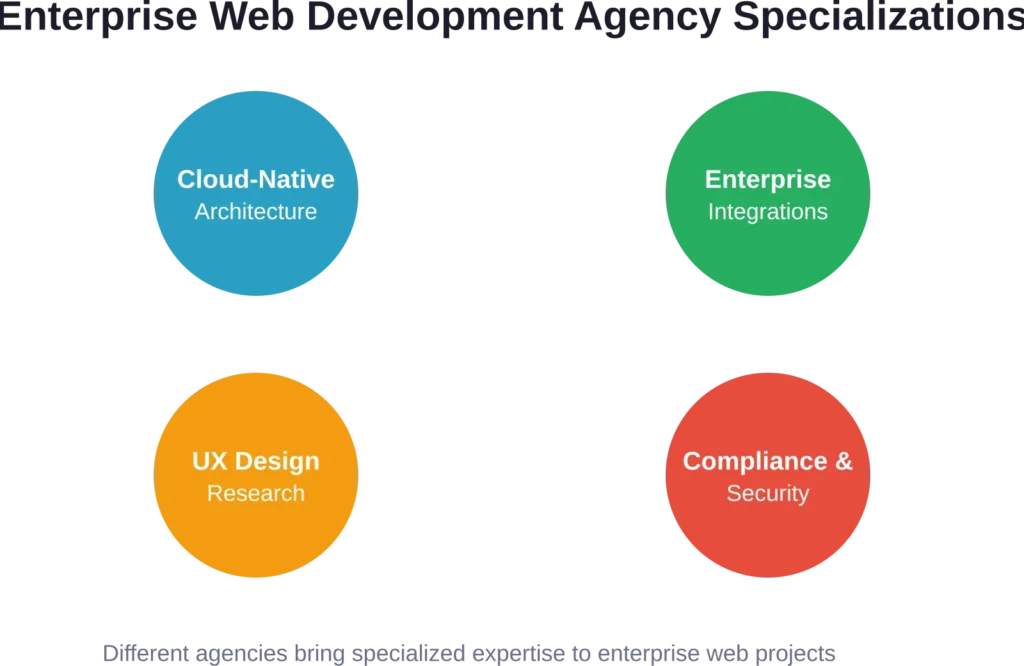
Evaluating enterprise web development companies requires looking beyond flashy portfolios and marketing claims. Certain capabilities separate agencies that consistently deliver from those that struggle with complex enterprise requirements.
Enterprise Architecture Expertise
The best companies employ solution architects who can design systems that scale. These professionals understand distributed systems, caching strategies, database optimization, and load balancing. They make architectural decisions at the project outset that prevent performance bottlenecks later.
Architecture expertise also means knowing when to build custom solutions versus leveraging existing platforms. Sometimes enterprises need bespoke applications. Other times, configuring an established platform like Salesforce or Adobe Experience Manager delivers better outcomes faster.
Integration Capabilities
Enterprise web applications rarely exist in isolation. They need to authenticate users against Active Directory, pull customer data from Salesforce, process payments through existing merchant accounts, and sync with ERP systems.
Strong integration capabilities include experience with enterprise service buses, API gateways, and middleware platforms. The best agencies have tackled integration challenges repeatedly and developed patterns that work reliably even with legacy systems that lack modern APIs.
Security and Compliance Knowledge
Security isn’t something to bolt on after development. Enterprise web development companies must implement security throughout the development lifecycle—from secure coding practices to vulnerability testing to deployment hardening.
Compliance requirements vary by industry. Healthcare applications must meet HIPAA requirements. Financial services need SOC 2 compliance. European operations demand GDPR adherence. The right agency understands these frameworks and builds compliant applications from the ground up.
DevOps and Cloud Infrastructure
Modern enterprise web development extends beyond writing application code. The best companies establish deployment pipelines, monitoring systems, and infrastructure-as-code that enable reliable operations at scale.
Cloud expertise has become essential. Whether deploying on AWS, Azure, or Google Cloud Platform, agencies need hands-on experience architecting cloud infrastructure, optimizing costs, and implementing disaster recovery strategies. This operational excellence ensures applications remain available and performant.
| Capability Area | Why It Matters | Red Flags |
|---|---|---|
| Solution Architecture | Prevents scalability issues and technical debt | No dedicated architects on the team |
| System Integration | Enables connection to existing enterprise systems | Limited experience with enterprise platforms |
| Security Practices | Protects sensitive data and ensures compliance | Security treated as separate testing phase |
| Cloud Infrastructure | Provides scalability and operational reliability | Only local deployment experience |
| Project Management | Keeps complex initiatives on track | No dedicated PM, developer handles coordination |
Common Enterprise Web Development Challenges
Enterprise web projects face predictable challenges regardless of industry or specific requirements. Understanding these obstacles helps in selecting partners equipped to navigate them.
Legacy System Integration
Most enterprises run critical operations on systems built decades ago. These legacy platforms may lack APIs, use outdated protocols, or run on proprietary databases. Integrating modern web applications with these systems requires specialized knowledge and creative problem-solving.
The challenge extends beyond technical integration. Legacy systems often contain business logic that isn’t documented anywhere except in the code itself. Developers must reverse-engineer this logic to ensure new applications maintain consistency with existing processes.
Organizational Complexity
Enterprise projects involve multiple stakeholders with competing priorities. IT wants maintainability. Marketing wants flexibility. Security insists on controls. Legal demands audit trails. Balancing these requirements while maintaining project momentum requires skilled navigation.
Decision-making processes in large organizations move slowly. Approvals require multiple layers of review. Change requests follow formal procedures. The best development partners understand this reality and structure engagements to work within organizational constraints rather than fighting against them.
Scalability Requirements
Enterprise applications must handle growth gracefully. A web portal that works fine with 100 users might collapse under the load of 10,000. Architectural decisions made early determine whether applications can scale or require expensive rebuilds.
Scalability isn’t just about user volume. Data growth matters too. Applications that perform well with thousands of records may slow dramatically with millions. Experienced enterprise developers anticipate these growth patterns and design accordingly.
Security and Compliance Constraints
Enterprise security requirements often seem restrictive to developers accustomed to startup environments. Firewall rules limit connectivity. Corporate policies prohibit certain technologies. Data residency requirements dictate where information can be stored.
Compliance frameworks add layers of mandatory controls. Applications must log certain activities, implement specific authentication mechanisms, and undergo regular audits. These requirements affect architecture, development practices, and deployment processes.
Questions to Ask Potential Partners
Selecting an enterprise web development company demands thorough vetting. These questions help evaluate whether agencies possess the capabilities your project requires.
About Their Experience
Ask about similar projects they’ve completed. Look for specifics about project scope, technologies used, and challenges overcome. Generic answers suggest limited relevant experience. Detailed responses with concrete examples demonstrate genuine expertise.
Request references from enterprise clients in similar industries. Actually call these references and ask about communication, problem-solving, and whether projects delivered promised outcomes. Reference calls reveal information that never appears in proposals.
About Their Process
Understanding how agencies approach projects reveals whether they’ll be good partners. Ask about discovery processes, how they handle changing requirements, and their approach to testing and quality assurance.
Question their project management methodology. How do they track progress? How often do stakeholders receive updates? What happens when projects encounter obstacles? The answers indicate whether they bring structure and discipline to complex initiatives.
About Their Team
Who will actually work on the project? Will senior architects involved in the sales process remain engaged during implementation, or do they disappear after contracts are signed? Understanding team composition prevents unpleasant surprises.
Ask about team stability and experience levels. High turnover disrupts projects as new team members get up to speed. Junior-heavy teams may lack the expertise to handle enterprise complexity. The best agencies assign balanced teams with appropriate seniority.
About Technical Approaches
Discuss technology stack preferences and how they make architecture decisions. Be wary of agencies that push a single technology for every project. The right approach varies based on requirements, existing systems, and internal team capabilities.
Ask about their experience with specific integration challenges relevant to your environment. How have they handled similar legacy system connections? What patterns do they use for real-time data synchronization? Specific examples demonstrate genuine expertise versus theoretical knowledge.

Build vs Buy Considerations
Before engaging any development company, enterprises should evaluate whether building custom applications makes sense. Sometimes purchasing and configuring existing software delivers better outcomes.
When Custom Development Makes Sense
Custom web development proves worthwhile when competitive advantage depends on unique capabilities. If the web application embodies proprietary business processes or provides differentiation in the market, building custom makes strategic sense.
Complex integration requirements also favor custom development. When applications must connect deeply with multiple internal systems and orchestrate complex workflows, the flexibility of custom code often exceeds what configurable platforms provide.
Unusual scalability or performance requirements may necessitate custom solutions. Off-the-shelf products optimize for common use cases. When requirements fall outside typical patterns, custom development enables architectural choices specifically targeting those requirements.
When Existing Platforms Work Better
Commodity functionality doesn’t require custom development. If building a customer portal with standard features like account management, document sharing, and support ticketing, existing platforms handle these requirements well at lower cost and risk.
Time-to-market pressure favors existing solutions. Custom development takes months or years. Configuring an established platform can deliver working systems in weeks. When speed matters more than perfect fit, existing platforms win.
Limited internal technical resources make custom development risky. Custom applications require ongoing maintenance, updates, and enhancement. Organizations without strong technical teams struggle to maintain custom systems over time. Vendor-supported platforms shift this burden.
Emerging Technologies in Enterprise Web Development
Enterprise web development continues evolving as new technologies mature. Understanding these trends helps enterprises make informed decisions about which innovations warrant adoption versus which remain too immature.
Progressive Web Applications
Progressive web apps blur the line between websites and native applications. They work offline, send push notifications, and install to home screens while remaining web-based. For enterprise applications, PWAs eliminate deployment friction associated with native apps while providing app-like experiences.
The technology has matured significantly. Major browsers support PWA capabilities, and enterprises are deploying them for field service applications, sales tools, and employee portals. PWAs prove particularly valuable for applications serving users on various devices including tablets and smartphones.
Headless CMS Architectures
Traditional content management systems couple content storage with presentation. Headless CMS separates these concerns, storing content in one system while multiple applications consume it via APIs. This architecture enables consistent content across web applications, mobile apps, and digital displays.
Enterprise adoption has accelerated as organizations recognize benefits. Marketing teams manage content independently while developers control presentation. Content becomes reusable across channels. Updates happen in one place rather than maintaining separate content in multiple systems.
Microservices and Containerization
Monolithic applications give way to microservices architectures where applications split into independently deployable services. Each service handles specific functionality and communicates with others via APIs. This approach enables teams to develop and deploy different application components independently.
Containerization technologies like Docker and orchestration platforms like Kubernetes make microservices practical. Containers package applications with all dependencies, ensuring consistent behavior across development, testing, and production environments. Orchestration platforms manage deployment, scaling, and networking automatically.
AI and Machine Learning Integration
AI capabilities are moving from experimental to practical in enterprise web applications. Chatbots handle routine customer service inquiries. Recommendation engines personalize content and product suggestions. Predictive models forecast demand and optimize inventory.
According to research on AI implementations, successful deployments share common characteristics including clear business objectives, high-quality training data, and realistic expectations. Enterprises achieve better outcomes when augmenting human capabilities rather than attempting full automation.
The best development companies bring pragmatic AI expertise. They understand which problems suit AI solutions and which require traditional programming. They know how to prepare data, train models, and integrate predictions into application workflows.
Maintaining Enterprise Web Applications
Launching an enterprise web application marks the beginning, not the end, of its lifecycle. Ongoing maintenance determines whether applications remain valuable assets or become liabilities.
Regular Updates and Security Patches
Web applications depend on frameworks, libraries, and platforms that receive regular updates. These updates often include security patches addressing newly discovered vulnerabilities. Enterprises must apply updates promptly to maintain security posture.
The best development partners establish processes for ongoing maintenance. They monitor security bulletins, test updates in staging environments, and schedule regular maintenance windows. This proactive approach prevents security incidents and ensures applications remain compatible with evolving browser standards.
Performance Optimization
Application performance degrades over time as data volumes grow and usage patterns evolve. Queries that once returned instantly start timing out. Pages that loaded quickly become sluggish. Regular performance monitoring identifies issues before users complain.
Optimization involves database tuning, caching improvements, and code refactoring. Experienced developers use profiling tools to identify bottlenecks, then apply targeted improvements. This ongoing optimization keeps applications responsive as they scale.
Feature Enhancement
User needs evolve. Competitive pressures emerge. Regulatory requirements change. Successful enterprise web applications adapt through regular enhancements. Organizations that treat applications as static products find them becoming obsolete.
Planning for ongoing development requires budgeting for continuing engagement with development partners or building internal capabilities. The most successful enterprises establish dedicated product teams that continuously improve applications based on user feedback and business needs.
Frequently Asked Questions
Enterprise web development involves building large-scale web applications and platforms for organizations serving significant user bases. These projects typically include complex business logic, integration with multiple systems, stringent security requirements, and the need to scale to thousands of concurrent users. Enterprise applications often support critical business processes like customer service, sales operations, or internal workflows.
Most enterprise web development projects require six to twelve months from initial discovery through launch. Complex projects with extensive integrations or regulatory requirements may extend beyond a year. The timeline depends on project scope, technical complexity, integration requirements, and organizational decision-making processes. Projects with clear requirements and engaged stakeholders progress faster than those with ambiguous goals or changing priorities.
Enterprise web development represents a significant investment that varies widely based on project complexity, team composition, and duration. Projects can range from modest initiatives to substantial multi-year engagements. The total investment includes discovery and planning, design, development, testing, deployment, and ongoing maintenance. Organizations should budget for continuing enhancement and support beyond initial launch.
No single technology stack works best for all enterprise projects. Popular choices include React or Angular for frontends combined with Node.js, .NET, Java, or Python backends. Cloud platforms like AWS, Azure, and Google Cloud provide scalable infrastructure. The optimal technology selection depends on existing systems, internal team skills, integration requirements, performance needs, and long-term maintainability considerations rather than current technology trends.
The build-versus-buy decision depends on whether the application provides competitive differentiation, how well existing products fit requirements, time-to-market pressure, and available technical resources for ongoing maintenance. Custom development makes sense when proprietary business processes require unique capabilities or when complex integration needs exceed what configurable platforms provide. Existing platforms work better for commodity functionality where speed and lower risk matter more than perfect fit.
Mobile compatibility has become essential for most enterprise web applications as employees and customers increasingly access systems from smartphones and tablets. Modern web applications should provide responsive designs that adapt to different screen sizes or implement progressive web app capabilities for app-like mobile experiences. The specific mobile requirements depend on user roles—field service applications may need offline functionality while internal admin tools might work fine with basic responsive design.
Enterprise web applications require multiple layers of security including secure authentication and authorization, encrypted data transmission via HTTPS, protection against common vulnerabilities like SQL injection and cross-site scripting, regular security updates, activity logging, and secure session management. Applications handling sensitive data need additional controls like data encryption at rest, role-based access controls, and audit trails. Compliance requirements vary by industry with healthcare needing HIPAA controls and financial services requiring SOC 2 compliance.
Choosing the Right Partner for Your Organization
Selecting an enterprise web development company ultimately comes down to fit. The right partner brings technical capabilities, relevant experience, and cultural alignment that enables productive collaboration through inevitable challenges.
Start by clearly defining project objectives and constraints. What business outcomes must the application deliver? What systems require integration? What security and compliance requirements apply? Which stakeholders need involvement in decision-making? This clarity enables productive conversations with potential partners.
Evaluate multiple companies rather than selecting the first option. Request detailed proposals that demonstrate understanding of requirements. Ask probing questions about their approach. Check references thoroughly. The evaluation process reveals how companies think and whether they truly understand enterprise challenges.
Look beyond technical skills to assess communication style and project management capabilities. Technical excellence matters little if teams can’t navigate organizational complexity or keep stakeholders aligned. The best technical solution delivered late or misaligned with business needs fails just as completely as poor code.
Consider long-term partnership potential. Enterprise web applications evolve continuously. Selecting a development partner capable of supporting ongoing enhancement and maintenance provides continuity that benefits application quality and reduces knowledge transfer costs.
Trust remains foundational. Complex projects encounter unexpected obstacles. Requirements change. Technologies evolve. The right partner navigates these challenges collaboratively rather than rigidly adhering to initial contracts or disappearing when difficulties emerge.
Conclusion
Enterprise web development demands specialized expertise that combines technical depth with understanding of organizational complexity. The 15 companies profiled here have demonstrated consistent ability to deliver sophisticated web applications that serve large user bases, integrate with existing systems, and meet stringent security requirements.
No single agency proves optimal for every organization or project. The right choice depends on specific requirements, industry focus, technical environment, and cultural fit. Thoughtful evaluation of capabilities, relevant experience, and partnership approach leads to better outcomes than selecting based solely on portfolio appeal or cost.
The investment in enterprise web development extends beyond initial launch. Applications require ongoing maintenance, security updates, performance optimization, and enhancement. Planning for this continuing engagement—whether through retained partnerships with external developers or building internal capabilities—determines whether applications remain valuable assets delivering sustained business value.
Ready to begin your enterprise web development initiative? Start by documenting clear objectives, understanding integration requirements, and evaluating potential partners against the criteria outlined in this guide. The right agency partnership transforms complex requirements into functional applications that advance business goals while providing experiences users actually want to use.