

Quick Summary: Sellerboard is a popular profit analytics tool for Amazon sellers, but alternatives like WisePPC, Profit Cyclops, Nova, and SellerLabs offer faster real-time data, deeper PPC insights, and better integrations. This guide compares 12 alternatives across pricing, features, and use cases to help you find the best fit for your business in 2026.
Sellerboard has earned a loyal following among Amazon FBA sellers for one reason: it delivers accurate, SKU-level profit tracking at a price point that doesn’t sting. Starting at $15 per month, it’s built for sellers who need real-time financial visibility without wrestling with spreadsheets.
But here’s the thing—Sellerboard isn’t the only option anymore.
As Amazon’s fee structure grows more complex and advertising costs climb (sellers in forums are reporting 600% bid increases in some niches), the need for specialized tools has exploded. Some sellers need lightning-fast data refresh. Others want advanced PPC analytics or seamless accounting integrations. A few are hunting for market intelligence that Sellerboard simply doesn’t provide.
This guide breaks down 12 Sellerboard alternatives across three categories: PPC and advertising optimization, profit and financial analytics, and market intelligence. Each tool is evaluated honestly, with verified pricing, feature comparisons, and real use cases.
No fluff. No affiliate-stuffed listicles. Just the data needed to pick the right stack for how business actually runs in 2026.
Why Sellers Look Beyond Sellerboard
Sellerboard does profit tracking well. Real-time P&L, automatic cost of goods sold (COGS) tracking, and one-click reimbursement requests make it a solid foundation tool. According to the official website, the Money Back feature alone has helped sellers recover funds—According to the official sellerboard website, one user reported $60 in reimbursements from the Money Back feature, noting that it covered nearly two months of subscription costs.
But as businesses scale, gaps appear.
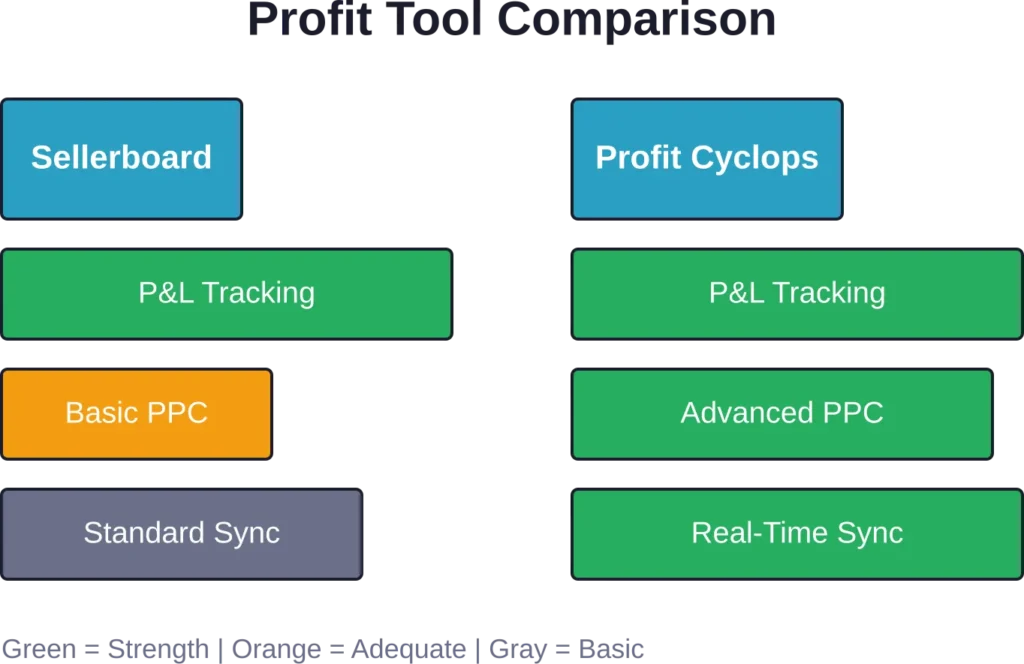
First, data refresh speed. Sellerboard syncs at standard periodic intervals. For high-volume sellers running aggressive promotions or managing rapid inventory turns, that lag can obscure what’s happening right now. Tools like Profit Cyclops and Nova advertise high-frequency, near real-time syncing—critical when decisions hinge on today’s numbers, not yesterday’s snapshot.
Second, PPC depth. Sellerboard offers basic advertising cost tracking and recently added manual entry for external ad spend. Great for simple setups. Less useful for sellers managing dozens of campaigns across multiple marketplaces who need bid automation, keyword-level ROI analysis, or dayparting controls.
Third, accounting workflows. Sellerboard generates reports, but sellers using QuickBooks, Xero, or Sage often end up manually reconciling data. Purpose-built accounting bridges like A2X or Link My Books automate settlement matching and tax-ready exports—saving hours every month.
Finally, market intelligence. Sellerboard tells what’s profitable. It doesn’t tell what competitors are doing, which niches are growing, or where the next product opportunity hides. For that, sellers turn to SmartScout, Helium 10, or Jungle Scout.
None of this makes Sellerboard bad. It just means the right tool depends on what the business needs most.
How to Pick the Right Alternative
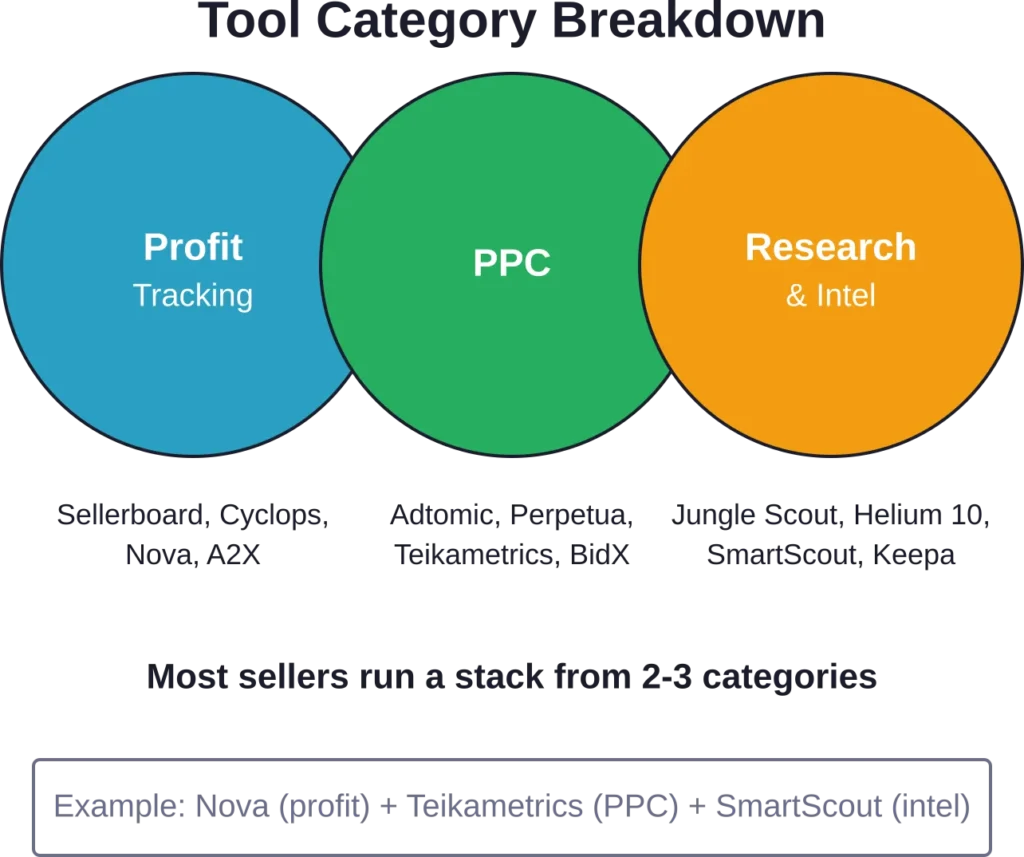
Before diving into specific tools, it helps to map business priorities. Based on market analysis, most Amazon sellers fall into one of three camps:
Profit trackers: Need accurate, real-time financial analytics to understand which SKUs make money after all fees, refunds, and ad costs. Priority is speed, accuracy, and clean P&L reporting.
PPC optimizers: Advertising spend is significant (often $20,000+ monthly). The goal is reducing wasted spend, automating bid adjustments, and improving ACoS without surrendering control to an agency charging 8-15% of ad spend (annual fees of $19,200-$54,000 depending on the percentage rate (8-15%), with brands spending $20,000 monthly facing $19,200-$36,000 annually and those spending $30,000 monthly facing $28,800-$54,000 annually, according to Helium 10 data from 2026).
Product researchers: Growth comes from launching new products or expanding into adjacent niches. Need tools that surface demand trends, keyword gaps, and competitor blind spots.
Most sellers end up running a stack—one tool for profit, another for PPC, maybe a third for research. The trick is avoiding overlap (paying twice for the same data) and ensuring tools integrate cleanly.
Here’s what to evaluate:
- Data refresh frequency: Real-time vs. hourly vs. daily. Matters most for high-volume accounts.
- Marketplace coverage: US-only vs. multi-region support (UK, DE, JP, etc.).
- Integrations: Does it push data to QuickBooks, Xero, Shopify, Google Sheets?
- Learning curve: Some tools are plug-and-play. Others require training.
- Pricing model: Flat monthly fee vs. percentage of sales/ad spend vs. tiered by SKU count.
With that framework, let’s break down the alternatives.
Best PPC and Advertising Optimization Alternatives
Amazon advertising is a different beast. Ad costs have climbed dramatically—sellers in competitive categories report bid increases that make profitability a daily puzzle. Managing PPC manually or with basic tools leaves money on the table.
These alternatives offer automation, bid optimization, and analytics that go far beyond Sellerboard’s basic ad cost tracking.
1. WisePPC

WisePPC is a powerful Amazon PPC optimization tool focused on deep analytics, bulk management, and long-term data insights. Unlike Amazon’s limited 60–90 day history, WisePPC stores years of campaign, keyword, and placement data, giving sellers a much clearer view of long-term performance.
The platform excels at handling thousands of campaigns and keywords at once. With advanced filters, inline editing, gradient heatmaps, and the ability to compare up to 6 KPIs on one chart, users can quickly identify underperforming elements and scale optimizations efficiently. WisePPC also combines advertising data with sales metrics for accurate ACoS, TACoS, and organic impact analysis.
It offers strong placement performance breakdowns and granular hourly insights. Bulk rules already provide solid automation, with full AI-powered bidding coming in upcoming updates. Multi-channel support (Amazon + Shopify) makes it especially useful for sellers operating across platforms.
Best for: Mid-sized and growing Amazon sellers and agencies who need powerful analytics, long-term data history, and fast bulk operations without enterprise-level pricing.
Pricing: Usage-based with lifetime deals available. Currently in advanced beta with very competitive pricing (significantly lower than most enterprise PPC tools).
Pros:
- Extremely long historical data storage (years instead of months)
- Powerful bulk actions and advanced filtering system
- Excellent multi-metric visualization and heatmaps
- Unified sales + advertising dashboard
- Strong value for money compared to enterprise alternatives
Cons:
- Still building full AI bidding automation (in progress)
- Interface may feel overwhelming for complete beginners
- Fewer managed services than some enterprise platforms
Contact Information:
- Website: wiseppc.com
- Facebook: www.facebook.com/people/Wise-PPC/61573154427547
- LinkedIn: www.linkedin.com/company/wiseppc
- Instagram: www.instagram.com/wiseppc
2. Helium 10 Adtomic

Helium 10 is best known for keyword research, but Adtomic (its PPC module) has evolved into a serious advertising platform. The tool uses AI to automate bid adjustments, pause underperforming keywords, and shift budget toward high-ROI campaigns.
Adtomic integrates directly with the rest of Helium 10’s suite, so sellers can tie keyword research (from Cerebro or Magnet) directly into campaign creation. That workflow—research, launch, optimize—happens inside one ecosystem.
The analytics dashboard breaks down ACoS, TACoS, and profitability by campaign, ad group, and keyword. For sellers who want control without manual daily bid tweaks, the automation rules are powerful. Set thresholds (pause keywords above 35% ACoS, boost bids on keywords converting below $1 CPC) and let the system execute.
Best for: Sellers already using Helium 10 for product research who want integrated PPC management.
Pricing: Included in higher Helium 10 tiers; standalone Adtomic pricing available—check the official site. According to authoritative sources, Helium 10 starts from $39 per month.
Pros:
- Integrated with Helium 10’s keyword and product research tools
- AI-powered bid automation
- Deep campaign analytics (ACoS, TACoS, keyword-level ROI)
- Multi-marketplace support
Cons:
- Requires Helium 10 subscription—not a standalone PPC tool
- Learning curve for sellers new to the platform
3. Perpetua
Perpetua is built for brands and agencies managing serious advertising budgets. The platform uses machine learning to optimize bids across Sponsored Products, Brands, and Display campaigns.
What sets Perpetua apart is goal-based optimization. Instead of manually setting bids, sellers define business goals (maximize profit, hit a target ACoS, increase market share) and Perpetua’s algorithms adjust bids to meet those objectives. The system monitors competitor activity, seasonal trends, and inventory levels to make smarter decisions than static rules allow.
Reporting is enterprise-grade. Custom dashboards, automated alerts, and API integrations make Perpetua a fit for brands spending $50K+ monthly on ads or agencies managing multiple clients.
Best for: Brands and agencies with large ad budgets who want AI-driven optimization and enterprise reporting.
Pricing: Custom pricing based on ad spend—contact Perpetua directly.
Pros:
- Advanced AI optimization with goal-based bidding
- Enterprise-level reporting and dashboards
- Supports all Amazon ad types (Sponsored Products, Brands, Display)
- Strong customer support and onboarding
Cons:
- Expensive—typically viable only for high-spend accounts
- Overkill for small sellers or those with simple PPC setups
4. Teikametrics

Teikametrics (formerly Flywheel) combines PPC optimization with inventory forecasting and market intelligence. The platform’s Flywheel 2.0 AI adjusts bids dynamically based on profitability, not just ACoS—a critical distinction.
Here’s why that matters: a keyword might have a 25% ACoS (looks great), but if the product’s margin is thin, that campaign could still lose money. Teikametrics factors in COGS, FBA fees, and other costs to optimize for actual profit, not vanity metrics.
The inventory integration is another standout. The system automatically reduces ad spend when stock runs low (preventing expensive clicks on out-of-stock items) and ramps up when inventory replenishes. For sellers managing tight inventory windows, that automation prevents wasted spend.
Best for: Sellers who need profit-aware PPC optimization and inventory-linked ad management.
Pricing: Percentage of ad spend or flat monthly fee depending on account size—check the official website.
Pros:
- Profit-based optimization (not just ACoS)
- Inventory-aware bid adjustments
- Combines PPC, inventory forecasting, and market intelligence
- Strong analytics and reporting
Cons:
- Higher cost than basic PPC tools
- Complex setup—best for intermediate-to-advanced sellers
5. BidX

BidX is a dedicated Amazon PPC automation tool focused on algorithmic bid management. The platform uses machine learning to analyze campaign performance and adjust bids in near real-time—far faster than manual updates or rule-based repricers.
The interface is simpler than Perpetua or Teikametrics, making BidX approachable for sellers who want automation without enterprise complexity. The tool supports Sponsored Products, Brands, and Display, with features like negative keyword harvesting, dayparting (time-of-day bid adjustments), and portfolio-level budgeting.
According to available data, BidX pricing starts around $99 per month with a 14-day free trial, making it more accessible than premium platforms.
Best for: Mid-sized sellers who want serious PPC automation without enterprise pricing.
Pricing: Starts around $99/month; 14-day free trial available—verify current pricing on the official site.
Pros:
- Strong algorithmic bid optimization
- Dayparting and negative keyword automation
- Simpler than enterprise platforms
- 14-day free trial
Cons:
- Less integration with profit tracking or inventory tools
- Not as feature-rich as Perpetua or Teikametrics
Best Profit and Financial Analytics Alternatives
These tools do one job exceptionally well: show true profit after every fee, refund, and expense Amazon throws at sellers.
1. Profit Cyclops

Profit Cyclops positions itself as the speed king. Where Sellerboard syncs periodically, Profit Cyclops delivers high-frequency, near real-time data—critical for sellers running flash deals, managing rapid inventory turns, or needing instant visibility into campaign performance.
The interface layers advanced PPC analytics on top of standard P&L tracking. Instead of just seeing total ad spend, sellers get keyword-level ROI breakdowns, campaign performance over time, and KPI tracking that ties advertising directly to profitability. For brands spending heavily on PPC, that depth matters.
Another edge: reporting. Profit Cyclops offers intuitive dashboards that let sellers drill from account-level summaries down to individual SKU performance without wrestling with nested menus or exporting to Excel.
Best for: Mid-to-large sellers ($50K+ monthly revenue) who need faster data and deeper PPC insights than Sellerboard provides.
Pricing: Check the official website for current plans—pricing typically scales with sales volume.
Pros:
- Near real-time data refresh
- Advanced PPC analytics and KPI tracking
- Clean, intuitive reporting interface
- Multi-marketplace support
Cons:
- Higher price point than Sellerboard
- May be overkill for sellers with simple PPC setups
2. Nova

Nova markets itself as “lightspeed fast.” The platform is built for sellers, agencies, and brands who need instant access to financial data without the lag that plagues older analytics tools.
The standout feature is speed. Nova’s data pipeline is optimized for high-frequency updates, meaning P&L numbers reflect current reality—not a snapshot from hours ago. For agencies managing multiple client accounts, that speed translates to faster reporting cycles and more responsive decision-making.
Nova also emphasizes user experience. The interface is modern, with customizable dashboards, one-click filtering by marketplace or date range, and visual charts that make it easy to spot trends at a glance.
Best for: Agencies, brand aggregators, and high-volume sellers who prioritize speed and clean UX.
Pricing: Visit the official website for up-to-date pricing—typically structured around account size and marketplace count.
Pros:
- Extremely fast data refresh
- Modern, enjoyable interface
- Built for multi-account management
- Strong support for agencies
Cons:
- Less focus on PPC-specific features compared to Profit Cyclops
- May require onboarding for teams used to older tools
3. A2X

A2X isn’t a profit tracker in the traditional sense—it’s an accounting bridge. But for sellers who’ve ever wrestled with Amazon settlement reconciliation in QuickBooks or Xero, A2X is a game-changer.
The tool automatically pulls Amazon settlement data, breaks it into clean transactions (sales, fees, refunds, ad spend), and pushes it into accounting software. No more manual CSV uploads. No more mismatched line items. Just accurate, tax-ready books.
A2X supports multiple marketplaces, handles FBA and FBM transactions, and integrates with major accounting platforms including QuickBooks Online, Xero, and Sage. For sellers working with accountants or preparing for tax season, the time savings are substantial.
Best for: Sellers who need seamless accounting integration and hate manual reconciliation.
Pricing: Check the official site—pricing typically tiers by monthly order volume.
Pros:
- Automates settlement reconciliation
- Direct integration with QuickBooks, Xero, Sage
- Multi-marketplace support
- Tax-ready transaction summaries
Cons:
- Not a full profit analytics platform—needs to pair with another tool for real-time P&L
- Cost adds up for high-volume accounts
4. Link My Books

Link My Books is A2X’s closest competitor—another accounting automation tool designed to eliminate manual reconciliation. The setup is similar: connect Amazon Seller Central, link accounting software, and let the tool handle settlement matching.
The main differentiator is pricing and simplicity. Link My Books often comes in slightly cheaper for smaller sellers, and the interface is deliberately stripped-down—fewer bells and whistles, but faster onboarding.
Like A2X, this isn’t a replacement for Sellerboard’s profit tracking. It’s a complement. Use it to keep books clean and taxes simple, then layer a dedicated analytics tool on top.
Best for: Small-to-mid sellers who need accounting automation on a tighter budget.
Pricing: Visit the official website for current plans—often lower entry pricing than A2X.
Pros:
- Simple, fast setup
- Lower cost for smaller accounts
- Clean QuickBooks and Xero integration
Cons:
- Fewer advanced features than A2X
- Not a standalone profit tracker
Best Market Intelligence and Product Research Alternatives
Sellerboard tells what’s profitable. These tools tell what to sell next, where demand is growing, and what competitors are missing.
1. Jungle Scout

Jungle Scout is the most established product research platform for Amazon sellers. The core tool—Product Database—lets sellers filter millions of products by category, sales volume, price, review count, and competition level to surface niche opportunities.
The Chrome extension (active on Amazon product pages) shows real-time sales estimates, revenue, review velocity, and historical trends. For validating product ideas, it’s fast and reliable.
Jungle Scout also includes keyword research (Keyword Scout), supplier sourcing, and listing optimization tools. It’s a full product launch suite, not just a research tool.
According to authoritative sources from 2026, Jungle Scout pricing starts at $49 per month, with higher tiers unlocking advanced features and increased search limits.
Best for: Sellers focused on launching new products or expanding into new niches.
Pricing: From $49/month—check the official site for current plans and feature limits.
Pros:
- Strongest product discovery and validation tools
- Accurate sales estimates via Chrome extension
- Integrated keyword research and supplier database
- Large user community and training resources
Cons:
- No profit tracking or PPC optimization
- Higher tiers get expensive quickly
2. Helium 10 (Black Box, Cerebro, Magnet)
Helium 10’s research suite is broader than Jungle Scout, covering product discovery (Black Box), reverse ASIN lookup (Cerebro), and keyword generation (Magnet). The depth of keyword data is exceptional—Helium 10 pulls from a larger dataset than most competitors.
Black Box works like Jungle Scout’s Product Database: filter by category, revenue, review count, and competition to find product opportunities. Cerebro reveals which keywords competitors rank for, making it easy to spot gaps in their strategy. Magnet generates thousands of related keywords from a seed term, perfect for building out PPC campaigns or optimizing listings.
Helium 10 also includes listing optimization (Scribbles), inventory management (Inventory Protector), and the Adtomic PPC tool covered earlier. It’s a complete Amazon seller toolkit.
Starting pricing is $39 per month according to authoritative data from 2026, with higher tiers unlocking more searches and advanced features.
Best for: Sellers who want keyword research, product discovery, and PPC in one platform.
Pricing: From $39/month—verify current plans on the official Helium 10 site.
Pros:
- Deepest Amazon keyword database
- Comprehensive suite (research, listing, PPC, inventory)
- Powerful reverse ASIN lookup (Cerebro)
- Free plan available (limited features)
Cons:
- Steep learning curve—lots of tools to master
- Can be expensive at higher tiers
3. SmartScout

SmartScout takes a different angle: market intelligence and brand mapping. Instead of focusing on individual products, SmartScout shows revenue by brand, category share, traffic sources, and geographic distribution.
The tool’s TrafficGraph feature reveals where a brand’s Amazon traffic originates (organic search, ads, external sources), helping sellers understand which marketing channels competitors lean on. SellerMap visualizes brand presence across categories, making it easy to spot underserved niches or emerging competitors.
For sellers considering acquisitions, wholesale partnerships, or private label expansions, SmartScout provides strategic data that product-level tools miss.
Pricing starts at $29 per month according to authoritative sources from January 2026, with a 7-day free trial.
Best for: Strategic sellers, aggregators, and agencies who need brand-level market intelligence.
Pricing: From $29/month; 7-day free trial—check the official site for current plans.
Pros:
- Brand revenue and market share analysis
- Traffic source insights (TrafficGraph)
- Category and niche mapping
- Lower entry price than Jungle Scout or Helium 10
Cons:
- Not a product discovery tool—different focus
- Less useful for individual product validation
4. Keepa

Keepa is a price tracking and historical data tool. The browser extension (available for Chrome, Firefox, Edge) overlays price history, sales rank, and Buy Box trends directly on Amazon product pages.
For resellers and arbitrage sellers, Keepa is essential—it reveals price drops, seasonal patterns, and restocking cycles. For private label sellers, it’s useful for competitive pricing analysis and monitoring how competitors adjust pricing over time.
Keepa also offers product search and alerts (get notified when a product drops below a target price). The data API is robust, making Keepa a backend data source for many other tools.
Pricing is extremely affordable compared to full research suites—typically under $20 per month for full access.
Best for: Resellers, arbitrage sellers, and anyone needing historical price and rank data.
Pricing: Under $20/month for premium features—check Keepa’s official site.
Pros:
- Best-in-class historical price and sales rank data
- Affordable pricing
- Browser extension integrates directly into Amazon pages
- API available for custom integrations
Cons:
- Not a full product research suite
- Interface is utilitarian—focused on data over UX
Price and Feature Comparison Table
Here’s a side-by-side look at pricing and core capabilities for the 12 alternatives covered. Prices reflect starting tiers as of 2026—always verify current pricing on official websites.
| Tool | Category | Starting Price | Key Strength |
|---|---|---|---|
| Sellerboard | Profit Tracking | $15/mo | Affordable SKU-level P&L |
| Profit Cyclops | Profit Tracking | Custom | Real-time data, advanced PPC analytics |
| Nova | Profit Tracking | Custom | Lightspeed fast, modern UX |
| A2X | Accounting | Tiered by volume | QuickBooks/Xero automation |
| Link My Books | Accounting | Lower than A2X | Simple, affordable accounting bridge |
| Helium 10 Adtomic | PPC | $39/mo (suite) | Integrated keyword research + PPC |
| Perpetua | PPC | Custom (% spend) | Goal-based AI, enterprise reporting |
| Teikametrics | PPC | Custom | Profit optimization, inventory integration |
| BidX | PPC | ~$99/mo | Algorithmic bidding, dayparting |
| Jungle Scout | Research | $49/mo | Product discovery, sales validation |
| Helium 10 | Research | $39/mo | Deepest keyword data, full suite |
| SmartScout | Market Intel | $29/mo | Brand revenue, market share analysis |
| Keepa | Price Tracking | <$20/mo | Historical price and rank data |
Building the Right Stack for Different Seller Types
Most sellers don’t pick one tool—they build a stack. The right combination depends on business model, sales volume, and growth priorities.
For Bootstrapped Beginners (Under $10K Monthly Sales)
Budget is tight. The goal is validating products and understanding baseline profitability without bleeding cash on software.
Recommended stack:
- Profit tracking: Sellerboard ($15/mo) or stick with Seller Central’s basic reports temporarily
- Research: Helium 10 Free Plan (limited searches) or Keepa (<$20/mo)
- PPC: Manual campaign management via Seller Central (no extra cost)
Total monthly cost: $15-$35. As revenue grows, upgrade to paid research tools and consider PPC automation.
For Scaling Sellers ($20K-$100K Monthly Sales)
Revenue is growing. Advertising spend is increasing. Manually tracking profit and tweaking bids every day is no longer sustainable.
Recommended stack:
- Profit tracking: Profit Cyclops or Nova (real-time data matters at this scale)
- PPC: Helium 10 Adtomic or BidX (automation frees up time, improves ACoS)
- Research: Jungle Scout or Helium 10 paid tier (for launching new products)
- Accounting: A2X or Link My Books (clean books save headaches at tax time)
Total monthly cost: $150-$300. The ROI comes from time saved and smarter ad spend allocation.
For Established Brands ($100K+ Monthly Sales)
Operations are complex. Multiple marketplaces, SKU counts in the hundreds, significant ad budgets. The focus shifts to margin protection, strategic growth, and staying ahead of competitors.
Recommended stack:
- Profit tracking: Profit Cyclops or Nova (enterprise-level reporting, real-time visibility)
- PPC: Perpetua or Teikametrics (AI optimization for large budgets)
- Research & Intel: Helium 10 + SmartScout (deep keyword data + brand-level market intelligence)
- Accounting: A2X with direct CPA integration
Total monthly cost: $500-$1,500+. At this scale, software is a tiny fraction of revenue, and the right stack directly impacts profitability.
For Agencies Managing Multiple Clients
Speed, multi-account support, and client reporting are non-negotiable. Tools need to scale across dozens of accounts without ballooning costs.
Recommended stack:
- Profit tracking: Nova (built for agencies, handles multi-account dashboards cleanly)
- PPC: Perpetua or Teikametrics (client-level reporting, white-label options)
- Research: Helium 10 or SmartScout (depending on client focus—product launch vs. market positioning)
Pricing typically negotiated at agency rates. The emphasis is on tools that reduce client onboarding time and generate impressive reports with minimal manual work.
Common Mistakes When Switching Tools
Switching from Sellerboard to an alternative seems straightforward—cancel one subscription, start another. In practice, sellers trip over a few predictable pitfalls.
Not exporting historical data first. Sellerboard stores months or years of P&L history. Before canceling, export CSV reports for key periods (year-end, tax quarters, product launch windows). Most tools don’t import historical data from competitors, so once the account closes, that data is gone.
Overlapping subscriptions without testing. Sign up for free trials or run tools in parallel for at least a week before canceling the old one. Compare P&L numbers, check data accuracy, and make sure integrations work. Discovering discrepancies after Sellerboard is canceled creates unnecessary stress.
Ignoring integration requirements. If the new tool needs API permissions, accounting software setup, or multi-marketplace connections, handle that during the trial period. Waiting until go-live day invites delays.
Choosing based on features instead of workflow. A tool loaded with features sounds great—until realizing those features require daily configuration tweaks or a steep learning curve. The best tool is the one that fits how the business actually operates, not the one with the longest feature list.
Underestimating onboarding time. Enterprise tools like Perpetua or Teikametrics often include onboarding calls, training sessions, and account setup support. Budget time for that. Smaller tools may be self-serve, but still expect a few hours to configure settings, connect accounts, and customize dashboards.
Frequently Asked Questions
Yes, especially for sellers who prioritize affordability and straightforward profit tracking. Sellerboard delivers accurate SKU-level P&L at a price point ($15/mo starting) that’s hard to beat. The Money Back reimbursement feature and one-month free trial add value. But sellers needing real-time data, advanced PPC analytics, or deep accounting integrations will outgrow it and benefit from alternatives like Profit Cyclops, Nova, or dedicated PPC platforms.
Profit Cyclops and Nova both emphasize high-frequency, near real-time data syncing. Standard analytics tools (including Sellerboard) sync periodically—hourly or every few hours. For sellers running flash promotions, managing rapid inventory turns, or needing instant campaign feedback, the speed difference is significant. Check each tool’s official documentation for specific refresh intervals, as these can vary by marketplace and account size.
It depends on business complexity. Tools like Helium 10 combine profit analytics, keyword research, and PPC automation in one suite—convenient for mid-sized sellers. But specialized tools often perform individual tasks better. Profit Cyclops offers deeper PPC analytics than general suites, while Perpetua and Teikametrics focus exclusively on advertising optimization with AI-driven strategies that all-in-one platforms can’t match. Most established sellers run a stack: one profit tracker, one PPC tool, maybe a research platform. The overlap isn’t wasteful if each tool excels at its job.
Budget scales with revenue. Beginners under $10K monthly sales can operate on $15-$50/month (basic profit tracking + free research tools). Sellers doing $20K-$100K monthly typically spend $150-$300/month on a stack that includes profit analytics, PPC automation, product research, and accounting integration. Established brands above $100K monthly often allocate $500-$1,500+ for enterprise tools, advanced PPC platforms, and market intelligence. At high revenue levels, software costs become a tiny percentage of sales—the ROI from time saved and margin improvements justifies the expense.
Not as a replacement—they serve different functions. A2X and Link My Books are accounting automation tools that reconcile Amazon settlements with QuickBooks, Xero, or Sage. They don’t provide real-time profit tracking, SKU-level analytics, or advertising insights. Think of them as complements: use A2X or Link My Books to keep books clean and tax-ready, then pair with Sellerboard, Profit Cyclops, or Nova for P&L visibility and business intelligence.
Nova is purpose-built for agencies, with multi-account dashboards, fast data refresh, and a modern interface that simplifies client reporting. For PPC-focused agencies, Perpetua and Teikametrics offer white-label reporting options and client-level performance analytics. Helium 10 also supports multiple accounts under one login, making it viable for agencies handling both research and PPC. The key is choosing tools that scale without multiplying per-account costs and that generate impressive client reports with minimal manual effort.
Switch when the current tool becomes a bottleneck, not based on the calendar. Waiting until January to fix a data lag problem or inefficient PPC spend means losing months of potential profit. That said, avoid switching during peak seasons (Q4, Prime Day lead-up) when operations are maxed out. The ideal window is a slower period—post-holiday lull, early spring—when there’s bandwidth to onboard a new tool, export historical data, and run parallel tests without disrupting daily workflows.

Final Thoughts: Pick Tools That Fit the Business, Not the Hype
Sellerboard is solid. It does what it promises—accurate profit tracking at an affordable price. But Amazon selling in 2026 is more complex than it was when Sellerboard launched. Fees climb. Ad costs surge. Competitors automate faster.
The best Sellerboard alternative isn’t the one with the longest feature list or the flashiest marketing. It’s the one that solves the specific bottleneck choking growth right now.
Need faster data? Profit Cyclops or Nova.
Burning cash on PPC? Teikametrics, Perpetua, or Helium 10 Adtomic.
Launching new products? Jungle Scout or Helium 10’s research suite.
Drowning in accounting reconciliation? A2X or Link My Books.
Most successful sellers don’t pick one tool—they build a stack. A profit tracker. A PPC optimizer. Maybe a research platform. The goal isn’t coverage for coverage’s sake. It’s creating a system where data flows cleanly, decisions happen faster, and margins improve without adding manual work.
Start with the biggest pain point. Fix that first. Then layer in tools that integrate cleanly and deliver measurable ROI. The right stack evolves as the business scales—what works at $20K monthly won’t cut it at $200K.
Take advantage of free trials. Export historical data before canceling old subscriptions. Test tools in parallel before committing. And remember: the best software is the one that gets out of the way and lets focus stay on what actually grows the business—better products, smarter pricing, and customers who come back.