

Quick Summary: AI marketing analytics tools enable marketers to automate data collection, uncover insights through machine learning, and make faster decisions across campaigns. The top platforms in 2026 include specialized solutions like Extuitive, Whatagraph for cross-channel reporting, AgencyAnalytics for client dashboards, and emerging AI agents that autonomously monitor metrics and trigger optimization workflows. According to California Management Review research, 71% of marketers now use generative AI weekly or more, with 85% reporting significantly increased productivity.
Marketing analytics has changed dramatically over the past few years. What used to take hours of manual spreadsheet work now happens in minutes, thanks to AI-powered platforms that can ingest data from dozens of channels and surface the insights that actually matter.
The shift isn’t just about speed. It’s about capability. AI marketing analytics tools today can predict customer behavior, identify hidden patterns across campaigns, and even autonomously adjust strategies based on real-time performance data.
The market reflects this transformation. The AI market grew from $15.84 billion in 2022 to $20.4 billion in 2024, according to George Mason University research. By 2030, experts project it will reach $107.5 billion.
But here’s the challenge: with hundreds of tools claiming AI capabilities, how do you separate genuinely intelligent platforms from glorified dashboard builders with an AI label slapped on?
This guide cuts through the noise. We’ll examine the AI marketing analytics tools that marketers actually rely on in 2026, from specialized reporting platforms to emerging agentic AI systems that continuously monitor and optimize campaigns.
What Makes AI Marketing Analytics Different
Traditional marketing analytics tools pull data and build dashboards. That’s it. They’re essentially fancy visualization layers on top of your data sources.
AI marketing analytics tools do something fundamentally different. They apply machine learning algorithms to spot patterns humans would miss, predict outcomes before they happen, and recommend (or execute) optimizations autonomously.
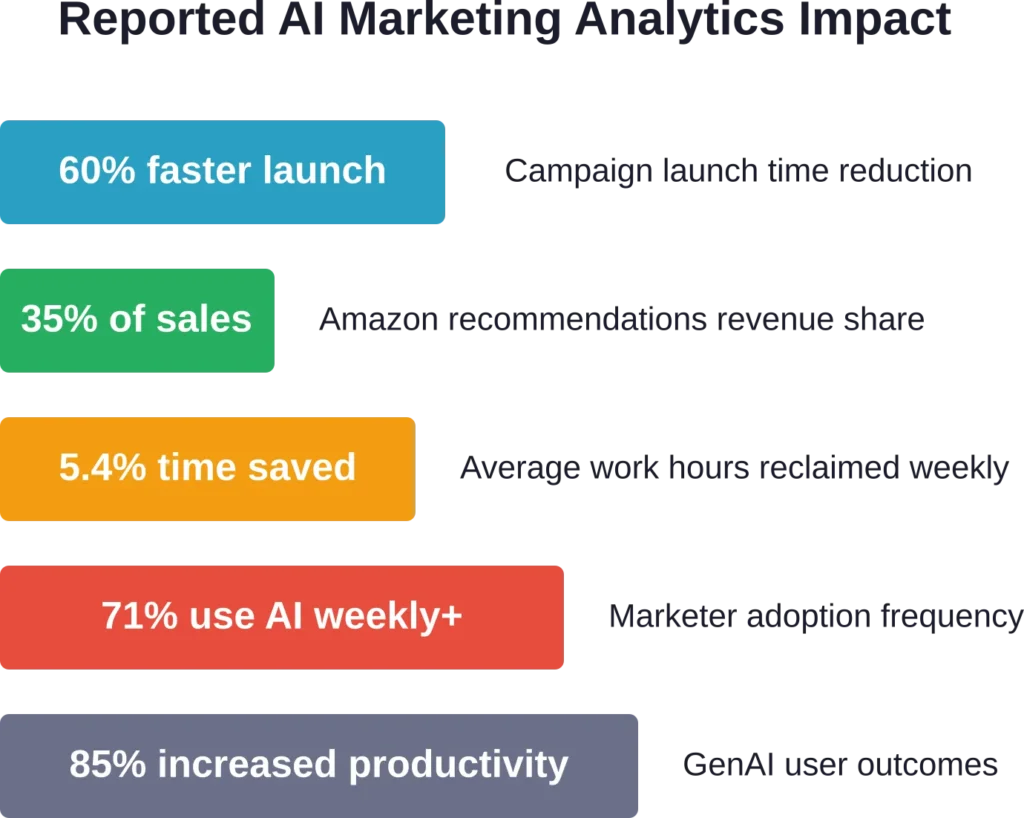
The distinction matters. According to Northwestern University research, According to Northwestern University research, marketing teams report a 60% reduction in campaign launch time using AI-powered tools. That’s not incremental improvement—it’s transformational.
Real AI analytics platforms exhibit these characteristics:
- Automated anomaly detection that flags performance outliers without manual monitoring
- Predictive modeling that forecasts campaign outcomes based on historical patterns
- Natural language querying so teams can ask questions conversationally instead of building complex reports
- Cross-channel attribution that traces customer journeys across multiple touchpoints
- Autonomous optimization workflows that adjust bids, budgets, or targeting without human intervention
The last point represents the newest evolution. Berkeley’s California Management Review notes that modern AI analytics tools are moving beyond one-off queries toward agentic workflows where multiple specialized AI agents collaborate continuously.
For example, one agent might monitor campaign metrics and notice a 15% drop in sign-ups. It could then autonomously trigger additional agents to investigate: one segments the data by traffic source, another by geography, a third by device type. Together, they identify that the decline stems specifically from mobile users in Europe, enabling focused fixes rather than broad guesswork.
Categories of AI Marketing Analytics Tools
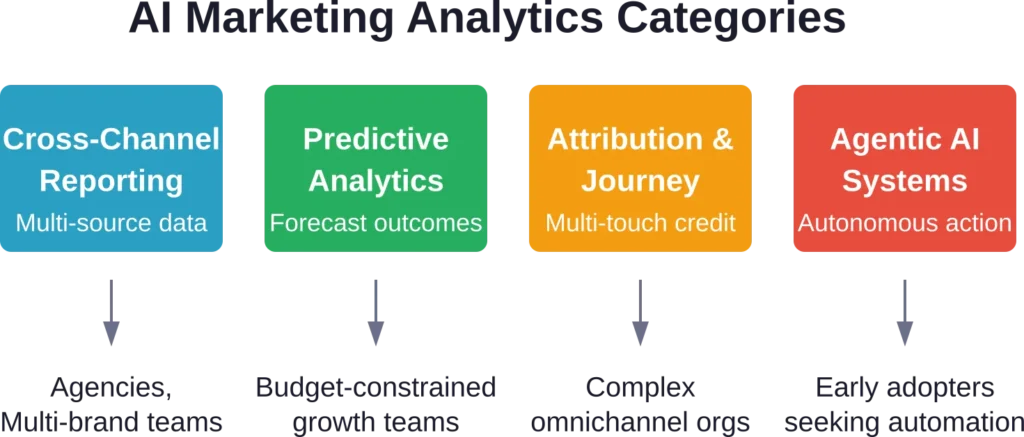
The landscape divides into several distinct categories, each solving different problems.
Cross-Channel Reporting Platforms
These tools aggregate data from multiple marketing channels—Google Ads, Facebook, email platforms, CRM systems—into unified dashboards. The AI layer automates data cleaning, normalizes metrics across platforms, and surfaces insights through conversational interfaces.
Most valuable for agencies managing multiple client accounts or brands running complex omnichannel campaigns.
Predictive Analytics Engines
Built for forecasting rather than historical reporting. They apply machine learning to predict which leads will convert, which customers will churn, and which campaigns will deliver the best ROI before you spend the budget.
Critical for teams with limited budgets who need to allocate resources with precision.
Attribution and Journey Analytics
These platforms track how customers interact with multiple touchpoints before converting. The AI determines which channels deserve credit for conversions, replacing simplistic last-click models with probabilistic attribution that reflects actual influence.
Essential for organizations running sophisticated multi-touch campaigns across paid, owned, and earned media.
Agentic AI Systems
The newest category. These platforms deploy multiple AI agents that continuously monitor metrics, investigate anomalies, and execute optimizations autonomously. Instead of generating reports for humans to act on, they take action directly—adjusting bids, reallocating budget, modifying targeting parameters.
Still emerging, but early adopters report significant efficiency gains.
Top AI Marketing Analytics Tools in 2026
Now let’s examine specific platforms marketers are actually using. This isn’t an exhaustive catalog—it’s a curated list of tools that demonstrate genuine AI capabilities and have proven track records.
Extuitive
Extuitive positions itself in the pre-launch predictive analytics category for advertising. It helps brands — especially Shopify merchants — forecast real-world ad performance (CTR, ROAS, purchase intent) before spending any media budget by combining brand historical data with large-scale consumer simulations.
The AI layer uses 150,000+ AI consumer agents modeled on real behavioral patterns (Polyintelligence engine). It analyzes products from a connected Shopify store, generates or optimizes ad copy, images, videos, and pricing, then validates concepts through simulated consumer responses. This creates a full cycle: idea generation → predictive scoring → refinement before launch.
Particularly strong for DTC brands and Shopify stores running frequent paid campaigns on Meta, TikTok, etc. It dramatically reduces wasted spend on weak creatives and shortens the creative testing cycle from weeks to minutes. Ideal for teams that want data-driven decisions early, rather than post-launch reporting.
According to current pricing information, the Starter plan is $1,000/month (or $10k/year) for brands spending >$10K/month on ads and includes 500 ads scored per month. Professional plan is $2,500/month for higher volumes. Enterprise is custom.
Contact Information:
- Website: extuitive.com
- Email: [email protected]
- LinkedIn: www.linkedin.com/company/extuitive
- Twitter: x.com/Extuitive_Inc
- Instagram: www.instagram.com/extuitiveinc
Whatagraph

Whatagraph positions itself squarely in the cross-channel reporting category. It connects to over 45 marketing data sources and automates the creation of unified dashboards and client reports.
The AI layer handles data normalization across platforms with different naming conventions and metric definitions. Teams can query performance using natural language—ask “which campaign delivered the best ROAS last month” and get an answer without building custom reports.
Particularly strong for agencies juggling multiple client accounts. The platform maintains separate workspaces for each client while allowing agency-level performance comparisons.
According to Whatagraph pricing information, the Start plan is $229/month (billed annually) and includes 20 source credits and essential integrations. A forever-free plan with limited credits is also available for teams testing the platform.
AgencyAnalytics

Built specifically for marketing agencies, AgencyAnalytics emphasizes white-label reporting and client communication. The platform aggregates data from SEO tools, PPC platforms, social media channels, and analytics systems into customizable dashboards.
Its AI features focus on automated insights—the system flags significant changes in client metrics and generates narrative explanations of performance shifts that can be included in reports without manual analysis.
Strong template library allows agencies to standardize reporting across clients while customizing branding and metrics to match each client’s priorities.
Klipfolio

Klipfolio takes a more technical approach, targeting teams comfortable with data modeling. The platform offers powerful data transformation capabilities alongside AI-assisted dashboard building.
The AI component suggests relevant visualizations based on data structure and helps debug data integration issues. Less emphasis on automated insights, more on empowering technical users to build sophisticated custom analytics.
Best fit for organizations with data-savvy marketing operations teams who need flexibility over simplicity.
Databox

Databox balances ease of use with analytical depth. The platform connects to common marketing tools and offers both pre-built dashboards for quick setup and customization options for specific needs.
AI features include anomaly detection that alerts teams when metrics deviate from expected ranges and goal tracking that compares actual performance against targets with predictive forecasting.
The mobile app is particularly polished, making it popular with executives and consultants who monitor performance on the go.
NinjaCat

NinjaCat serves larger agencies and enterprises with complex reporting requirements. The platform handles data from hundreds of sources and supports sophisticated data transformations.
AI capabilities focus on automating repetitive reporting tasks—scheduled report generation, automated client emails when performance crosses thresholds, and intelligent data refresh scheduling that prioritizes high-value sources.
Pricing reflects the enterprise focus—this isn’t a tool for small teams or individual consultants.
Julius AI

Julius AI takes a different approach entirely. Instead of pre-built dashboards, teams upload datasets and query them conversationally. The AI generates data visualizations on the fly based on natural language requests.
For instance, upload campaign performance data and ask “show me conversion rate trends by channel over the last six months” and the system generates an appropriate chart automatically.
Powerful for ad hoc analysis but lacks the ongoing monitoring and alerting capabilities of dedicated marketing analytics platforms.
Metabase

Metabase is open-source, which makes it appealing for organizations with technical resources who want full control. The platform connects to databases and allows teams to build SQL queries visually or through code.
AI features assist with SQL query debugging and suggest optimizations for slow-running queries. The visual query builder uses AI to recommend joins and filters based on schema analysis.
Requires more setup than commercial alternatives but offers unlimited customization for teams with database expertise.
Improvado

Improvado targets enterprise marketing operations teams managing massive data volumes across numerous sources. The platform emphasizes ETL (extract, transform, load) automation with AI-powered data mapping.
When connecting new data sources, the AI suggests how to map fields to the company’s standardized data model, dramatically reducing integration time.
Also offers emerging agentic AI features through Improvado Agent, which can autonomously investigate performance issues by segmenting data across multiple dimensions until root causes surface.
| Tool | Primary Use Case | AI Strengths | Best For |
|---|---|---|---|
| Whatagraph | Cross-channel reporting | Data normalization, NL queries | Agencies with multiple clients |
| AgencyAnalytics | White-label client reports | Automated narrative insights | Agencies needing branded reporting |
| Klipfolio | Custom dashboard building | Assisted visualization selection | Technical marketing ops teams |
| Databox | Balanced ease and depth | Anomaly detection, forecasting | Growing teams, mobile users |
| NinjaCat | Enterprise agency reporting | Workflow automation | Large agencies, enterprises |
| Julius AI | Ad hoc data analysis | Conversational visualization | Teams needing flexible exploration |
| Metabase | Database analytics | SQL assistance | Technical teams with databases |
| Improvado | Enterprise ETL and analysis | Data mapping, agentic investigation | Large orgs with complex data |
How AI is Transforming Marketing Analytics Workflows
The tools matter, but the real story is how they’re changing what marketers actually do day to day.
From Reactive to Predictive
Traditional analytics looks backward. Campaigns run, data accumulates, reports get generated. Teams review what happened and try to apply lessons to future efforts.
AI flips this. Predictive models analyze historical patterns to forecast outcomes before campaigns launch. Which audience segment will convert best? Which creative will drive engagement? Which budget allocation will maximize ROI?
Teams move from “let’s run this and see what happens” to “the model predicts X, so we’ll allocate resources accordingly.”
From Manual Investigation to Autonomous Monitoring
When campaign performance dips, someone has to dig through data to understand why. Is it seasonal? Traffic quality? Landing page issues? Creative fatigue?
That investigation process is where AI shines. Instead of a marketer spending hours slicing data by different dimensions, AI agents do it autonomously and surface the actual driver.
Berkeley research provides a concrete example: when sign-ups dropped 10%, traditional analysis might have stopped at “conversion rate decreased.” The AI segmented by region and discovered Europe specifically showed a 15% conversion decline alongside a 25% drop in organic search traffic, pointing to a likely SEO issue in European markets rather than a universal campaign problem.
From Periodic Reports to Continuous Optimization
The weekly or monthly reporting cycle made sense when humans had to compile data manually. It makes zero sense when AI can monitor performance continuously.
Modern agentic systems watch metrics in real time and adjust tactics immediately. Bid too high on underperforming keywords? The AI lowers bids. Conversion rate spiking from a particular traffic source? The AI reallocates budget to capitalize on momentum.
Northwestern University research found that 28% of employed adults in the U.S. used ChatGPT to get work done as of March 2025. But conversational AI for general tasks is just the beginning. Specialized AI agents that understand marketing metrics and can execute changes autonomously represent the next leap.
The Role of Generative AI in Marketing Analytics
ChatGPT and similar large language models deserve special attention because they’ve become the Swiss Army knife of marketing work.
According to California Management Review, 71% of marketers now use generative AI weekly or more, with 85% reporting significantly increased productivity. But how specifically do these tools fit into analytics workflows?
Natural Language Data Querying
Instead of learning SQL or building reports through complex interfaces, marketers can ask questions conversationally. “Show me the top five traffic sources by conversion value last quarter” generates the relevant chart automatically.
This democratizes data access. Junior team members and non-technical stakeholders can explore data without depending on analysts or engineers.
Automated Report Narrative
Numbers tell part of the story. Context and interpretation complete it. Generative AI can examine performance data and write the narrative section of reports—explaining what changed, why it likely changed, and what it means for strategy.
Does it replace human judgment? No. But it eliminates the tedious work of describing obvious patterns, freeing analysts to focus on strategic implications.
Insight Summarization
Large dashboards with dozens of metrics overwhelm decision-makers. Generative AI can digest the full dataset and produce executive summaries: “Three key takeaways from last month’s campaign performance…”
This proves particularly valuable for agencies managing multiple clients or brands running many simultaneous campaigns.
Data Quality Assistance
Messy data undermines analysis. Generative AI can identify inconsistencies, suggest cleaning approaches, and even automate standardization of fields with irregular formatting.
For example, if customer records have mixed formats for phone numbers or addresses, the AI can detect the pattern variations and propose normalization rules.
Real-World Applications and Results
Theory and capabilities mean little without evidence of actual impact. Here’s what organizations are seeing when they implement AI marketing analytics.
Campaign Launch Speed
As noted earlier, marketing teams report a 60% reduction in campaign launch time using AI-powered tools. That compression comes from automating data collection, audience creation, and performance monitoring setup that previously required manual configuration.
Personalization at Scale
According to research, recommendation engines can drive significant revenue share; Amazon’s recommendation engine is frequently cited as generating substantial sales impact. That level of personalization would be impossible without AI analyzing millions of customer interactions to predict preferences.
Smaller organizations are now accessing similar capabilities through marketing analytics platforms that incorporate predictive models for content recommendations, email personalization, and dynamic website experiences.
Resource Allocation Optimization
Marketing budgets remain constrained—According to Gartner’s 2025 CMO Spend Survey of 402 CMOs, marketing budgets have flatlined at 7.7% of overall company revenue. Within those limitations, AI-driven attribution helps ensure dollars flow to the highest-impact channels.
Teams using predictive analytics to guide budget allocation report measurably better ROI compared to intuition-based approaches, though specific improvements vary widely based on starting sophistication and campaign complexity.
Time Reclaimed
Generative AI tools for marketing save users an average of 5.4% of their work hours, according to Northwestern research. That translates to more than two hours per week for full-time professionals.
Those hours previously spent on report generation, data compilation, and manual analysis can shift to strategy, creative development, and relationship building—work that still requires human judgment and creativity.
Choosing the Right AI Marketing Analytics Tool
With dozens of options claiming AI capabilities, how should teams actually evaluate and select platforms?
Define Your Primary Use Case
Start with the problem, not the technology. Are you primarily trying to automate client reporting? Predict customer churn? Optimize ad spend allocation? Understand multi-touch attribution?
Different tools excel at different jobs. A platform perfect for agency reporting might be overkill (or inadequate) for predictive lead scoring.
Assess Actual AI Capabilities
Marketing vendors slap “AI-powered” on everything. Dig deeper. Ask specifically:
- What machine learning models does the platform use?
- Can it predict outcomes or only report historical data?
- Does it autonomously surface insights or just visualize data you query?
- How does it handle data quality issues and anomalies?
- Can it take action (adjust bids, reallocate budget) or only recommend actions?
Real AI platforms will have clear, specific answers. Vague responses like “we use advanced algorithms” are red flags.
Evaluate Integration Ecosystem
An analytics platform is only as good as the data it can access. Check whether the tool natively integrates with your existing marketing stack—advertising platforms, CRM, email systems, analytics tools.
Lack of native integrations isn’t necessarily a dealbreaker if the platform offers flexible API connections or works with automation tools like Zapier, but it does add implementation complexity.
Consider Team Technical Sophistication
Some platforms assume database knowledge and SQL skills. Others prioritize no-code interfaces and visual configuration. Match the tool’s complexity to your team’s capabilities.
If nobody on the marketing team knows SQL, choosing a platform that requires writing queries will lead to underutilization and frustration.
Test with Real Data
Most platforms offer trials. Use them with your actual data, not demo datasets. The differences between platforms become clear when you’re working with your real campaigns, your specific metrics, and your unique analysis needs.
Pay attention to how much manual setup and configuration the platform requires before it delivers value.
Calculate Total Cost of Ownership
Subscription price is one component. Also factor in:
- Implementation time and any professional services fees
- Training requirements for your team
- Ongoing maintenance and data pipeline management
- Integration costs if you need custom connections
A platform with a higher subscription price but faster time-to-value and lower maintenance burden often costs less overall than a cheap tool that consumes engineering resources.
Common Pitfalls When Implementing AI Analytics
Even good tools can fail to deliver value if implementation goes wrong. Watch out for these common mistakes.
Data Quality Neglect
AI models amplify whatever data you feed them. Garbage in, garbage out remains true. Before implementing sophisticated analytics, audit data quality across sources.
Are conversion tracking pixels firing correctly? Is CRM data standardized? Do different platforms use consistent naming conventions for campaigns?
Teams that skip this step end up with beautiful dashboards showing inaccurate insights.
Overcomplexity Out of the Gate
The temptation to connect every data source and build comprehensive cross-channel attribution models immediately is strong. Resist it.
Start with a narrow use case—maybe just paid search performance or email campaign analysis. Get that working reliably, prove value, then expand.
Trying to boil the ocean on day one leads to overwhelmed teams and stalled projects.
Ignoring Change Management
New analytics platforms change workflows. Team members who spent hours manually building reports might resist tools that automate their work, fearing obsolescence.
Address this proactively. Position AI analytics as eliminating tedious work so people can focus on strategy and creativity—which is accurate. Involve the team in tool selection and implementation so they feel ownership rather than displacement.
Trusting AI Outputs Without Validation
AI can be confidently wrong. Predictive models make mistakes. Automated insights sometimes misinterpret correlation as causation.
Especially in early implementation stages, validate AI recommendations against human judgment and actual campaign results. Use the AI as a powerful assistant, not an infallible oracle.
Underinvesting in Training
Powerful platforms have learning curves. Budget time for team training—not just on how to use the interface, but on how to interpret AI outputs and incorporate insights into decision-making.
Without proper training, teams either underutilize capabilities or misuse features in ways that produce misleading results.
The Future of AI Marketing Analytics
Current tools already deliver significant value, but the technology continues evolving rapidly. What’s on the horizon?
More Autonomous Agents
The shift from reporting tools to autonomous agents will accelerate. Future platforms won’t just identify that European mobile conversion rates dropped—they’ll automatically adjust mobile landing pages, modify targeting parameters, or reallocate budget across regions without human intervention.
Marketers will shift from executing tactics to defining objectives and guardrails within which AI agents operate.
Tighter Integration of Analytics and Execution
Currently, analytics platforms identify opportunities and humans implement changes in separate execution platforms (ad managers, email tools, CMS systems). That boundary is dissolving.
Future analytics tools will directly control execution systems, implementing optimizations the moment insights emerge.
Improved Natural Language Interfaces
Conversational querying exists now but often requires precise phrasing. Advances in language models will make it genuinely conversational—able to handle ambiguous questions, maintain context across multi-turn discussions, and proactively suggest related analyses.
“Show me campaign performance” might trigger clarifying questions: “Which campaigns—all active, or specific ones? What time period? Which metrics matter most to you right now?”
Privacy-Preserving Analytics
Regulatory pressure and consumer expectations continue pushing toward greater data privacy. AI analytics will adapt with techniques like federated learning that extract insights without centralizing raw personal data.
Models will train on aggregated, anonymized patterns rather than individual-level data, maintaining analytical power while respecting privacy.
Multimodal Analysis
Current analytics focus on structured data—clicks, conversions, revenue. Future systems will incorporate unstructured data: what customers say in support chats, how they engage with video content, sentiment in social media mentions.
AI will synthesize quantitative performance metrics with qualitative signals to build richer understanding of customer behavior and campaign impact.
Frequently Asked Questions
Traditional analytics platforms collect data and build dashboards, but require humans to analyze patterns and make decisions. AI marketing analytics tools apply machine learning to automatically detect anomalies, predict outcomes, recommend optimizations, and in some cases execute changes autonomously. The key difference is moving from descriptive reporting to predictive insights and automated action.
It depends on the platform. Tools like Julius AI, Whatagraph, and Databox emphasize no-code interfaces and natural language querying that non-technical marketers can use effectively. Others like Metabase and Klipfolio assume SQL knowledge and database expertise. When evaluating tools, match their technical requirements to your team’s actual capabilities rather than aspirational skill levels.
Pricing varies dramatically based on capabilities and target market. Entry-level plans for small teams start around $229 per month for platforms like Whatagraph. Enterprise solutions targeting large agencies and corporations can run into thousands per month. Many platforms offer free trials or limited free tiers—for instance, Whatagraph provides a forever-free plan with limited source credits. Check official websites for current pricing, as costs and plan structures change frequently.
No. AI excels at processing large datasets, identifying patterns, and automating repetitive tasks, but it lacks the strategic judgment, creativity, and contextual understanding humans bring. The technology is better viewed as augmentation rather than replacement. Research from Northwestern shows AI saves marketers an average of 5.4% of work hours—freeing time for strategy and creative work rather than eliminating the need for marketing professionals.
Most platforms integrate with common marketing tools including Google Ads, Facebook Ads, LinkedIn, email platforms like Mailchimp, CRM systems like Salesforce and HubSpot, Google Analytics, and e-commerce platforms like Shopify. The specific integrations vary by platform—Whatagraph offers 45+ native connections, while others focus on database connections and require more custom setup. Always verify that a tool integrates with your critical data sources before committing.
Look for specific capabilities rather than marketing claims. True AI platforms can predict future outcomes (not just report past results), automatically detect statistical anomalies without manual configuration, provide natural language querying that understands context, and explain reasoning behind recommendations. Ask vendors directly: what machine learning models power the platform? Can it show examples of predictions it’s made? Does it surface insights proactively or only when queried? Vague answers suggest shallow AI implementation.
It depends on data complexity and growth trajectory. If campaigns run across multiple channels and manual reporting consumes significant time, AI analytics can deliver value even for small teams. Many platforms offer affordable entry tiers or free plans that small businesses can test without major investment. However, if marketing is primarily organic social media and simple email, sophisticated AI analytics might be overkill. Start with clear use cases and specific pain points rather than adopting technology for its own sake.
Conclusion
AI marketing analytics has moved from experimental to essential. The technology no longer just promises efficiency gains—it delivers them, with teams reporting 60% faster campaign launches and 85% productivity increases.
The tools examined in this guide represent different approaches to the same core problem: extracting actionable insights from marketing data faster and more accurately than humans can manage alone. Cross-channel reporting platforms like Whatagraph automate data aggregation. Predictive engines forecast outcomes before budgets are spent. Agentic systems autonomously investigate performance issues and execute optimizations.
But tools alone don’t create results. Implementation matters. Data quality matters. Change management matters. Teams that treat AI analytics as a magic solution will be disappointed. Those that view it as a powerful capability requiring thoughtful deployment, proper training, and continuous refinement will gain sustainable competitive advantages.
The trajectory is clear. According to California Management Review research, 71% of marketers already use generative AI weekly or more. Adoption will only accelerate as platforms mature and capabilities expand. The question isn’t whether to embrace AI marketing analytics—it’s when and how.
Start with a specific use case. Evaluate tools against real requirements rather than feature checklists. Test with actual data. Validate outputs against business results. Then expand gradually as capabilities prove themselves.
The marketing teams that master AI analytics in 2026 won’t just be more efficient—they’ll make fundamentally better decisions, backed by insights impossible to extract manually. That’s not hype. That’s the demonstrated reality of where marketing analytics has already arrived.