

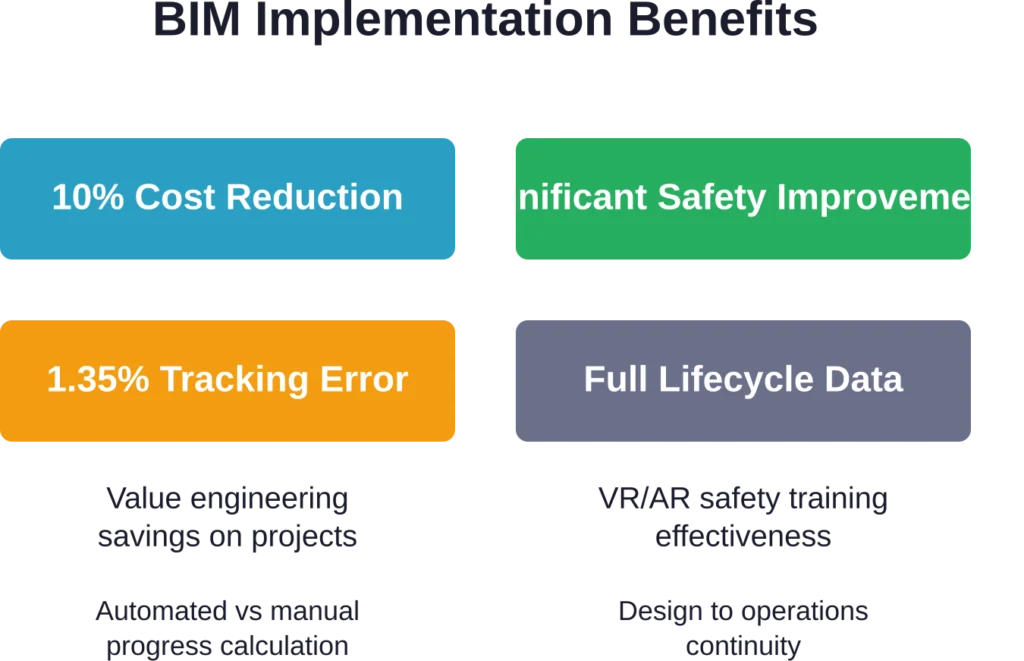
Quick Summary: The UK’s leading BIM companies combine technical expertise with comprehensive Building Information Modelling services to drive digital transformation across construction and architecture projects. From clash detection to 4D simulation, these agencies deliver collaborative solutions that reduce project costs by up to 10% while enhancing safety and delivery outcomes.
Building Information Modelling has fundamentally reshaped how construction projects are designed, coordinated, and delivered. What started as advanced 3D modelling has evolved into a data-driven collaborative process that spans the entire lifecycle of built assets.
The UK construction industry faces mounting pressure to improve efficiency, reduce waste, and enhance safety. Research from the Scientific Research Publishing organization demonstrates that BIM implementation in value engineering projects typically delivers cost and time savings of 10%. That’s not marginal improvement—it’s transformation.
But here’s the challenge: not all BIM providers deliver the same quality, expertise, or range of services. Some excel at scan to BIM conversions. Others specialize in multidisciplinary coordination or Level 2 compliance for government projects.
This guide examines ten leading BIM companies operating in the UK market, breaking down their core capabilities, service offerings, and what makes each agency stand out in an increasingly competitive digital construction landscape.
Understanding BIM Services and Their Impact
Building Information Modelling isn’t just software. It’s a collaborative approach that creates digital representations of physical and functional characteristics throughout a project’s lifecycle.
The technology enables architects, engineers, and contractors to work within a unified digital environment where changes propagate automatically, clashes are detected before construction begins, and data flows seamlessly between disciplines.
According to research published by Frontiers in Built Environment, 58% of individuals in the demographic studied have 11–20 years of experience in BIM. This represents a mature market where expertise has deepened considerably.
Real talk: research suggests BIM-enhanced safety training using VR and AR platforms can significantly reduce serious accidents.
What Separates Elite BIM Companies
Not every firm claiming BIM expertise deserves the label. Elite agencies demonstrate specific characteristics that separate them from general CAD services or basic modelling shops.
Technical depth matters. Top firms employ professionals certified in Revit, Navisworks, AutoCAD, and specialized scan to BIM software. They understand IFC standards, COBie data requirements, and PAS 1192 protocols.
Multidisciplinary coordination capability is non-negotiable. Architecture, structural engineering, and MEP systems must integrate seamlessly. Clash detection identifies conflicts between disciplines before they become expensive site problems.
Many UK projects now require specific BIM levels. Government contracts over certain thresholds mandate Level 2 compliance. Companies that understand these regulatory requirements and deliver compliant models save clients significant compliance headaches.
Service breadth distinguishes full-service agencies from niche providers. The best companies handle everything from initial laser scanning through model creation, coordination, 4D simulation, quantity takeoff, and facilities management handover.
Top 11 BIM Companies in the UK
The following agencies represent the strongest BIM service providers currently operating in the UK market. Each brings distinct capabilities and proven project experience.

1. Powerkh
Powerkh is a UK-based BIM and VDC consultancy providing BIM modelling, coordination, and digital construction support for architects, engineers, contractors, and consultants. The company works on commercial, residential, and industrial projects, supporting teams during design, coordination, and construction stages. Their services include BIM modelling from LOD 100 to LOD 500, Scan to BIM, clash detection, constructability review, and as-built verification.
Powerkh uses Autodesk Revit, Navisworks, and point cloud-based workflows to coordinate architectural, structural, and MEP systems across different project phases. The company also provides structural detailing, shop drawings, Revit family creation, and BIM support for fabrication and renovation projects. Their approach focuses on maintaining design continuity, improving coordination between disciplines, and helping teams manage project information more accurately during construction workflows.
Contact Information:
- Website: www.powerkh.com
- Email: [email protected]
- Facebook: www.facebook.com/100064039650167
- LinkedIn: www.linkedin.com/company/powerkh
- Instagram: www.instagram.com/powerkh_com
- Address: 3, Lavinia Walk, Taw Hill, Swindon SN25 1AP
- Phone: +44 7490 426678

2. Survey2Plan
Survey2Plan specializes in scan to BIM services, converting point cloud data from laser scanning into accurate, intelligent building information models. The company focuses on existing buildings and infrastructure where precise as-built documentation is essential.
Their core services include 3D laser scanning, point cloud processing, architectural modelling from scan data, MEP modelling, and structural documentation. Survey2Plan handles projects across commercial, residential, heritage, and infrastructure sectors.
What makes them stand out? Deep expertise in dealing with complex existing structures where traditional measurement methods fall short. They’ve built a reputation for accuracy and fast turnaround on scan to BIM conversions.

3. Plowman Craven
Plowman Craven combines surveying heritage with cutting-edge digital technology. Operating since 1959, they’ve evolved from traditional land surveying into a comprehensive geospatial and BIM solutions provider.
The agency delivers measured building surveys, 3D laser scanning, aerial surveying using drones, BIM modelling, and digital engineering services. Their geographic information system integration capabilities allow them to connect BIM models with broader spatial data.
Their strength lies in project scale and complexity. Plowman Craven handles major infrastructure projects, rail networks, airports, and large commercial developments where precision surveying feeds directly into BIM workflows.
4. Cresire Consulting
Cresire Consulting positions itself as a specialized BIM service provider for architecture, engineering, and construction professionals throughout the UK. The company emphasizes cost reduction and efficiency improvements.
Services span architectural BIM modelling, structural BIM, MEP coordination, clash detection, 4D construction sequencing, and quantity takeoff. Cresire works with both design firms needing additional capacity and contractors requiring coordination expertise.
They’ve built their reputation on delivering accurate models and technical drawings while claiming to reduce project costs significantly. Their focus on the complete UK AEC market gives them broad sector experience.

5. BIM Technologies
BIM Technologies operates as a consultancy and implementation specialist, helping organizations adopt and optimize Building Information Modelling processes across their project portfolios.
The company provides BIM strategy development, Level 2 compliance consulting, training and upskilling programs, model auditing and validation, COBie data management, and technology implementation support.
What sets them apart is process focus rather than just deliverables. BIM Technologies helps construction companies and design firms transform how they work, not just produce individual models. That strategic approach builds long-term capability.

6. Cadline
Cadline functions as both a software reseller and a professional services provider, offering Autodesk solutions alongside BIM implementation, training, and support services.
Their offerings include software licensing and support, BIM implementation consulting, customization and automation development, training programs for Revit and other platforms, and technical support services.
The dual model creates advantages. Cadline understands software capabilities deeply because they support the platforms directly. That technical knowledge translates into practical implementation advice and customization that optimizes workflows.

7. Armada
Armada specializes in digital engineering for the built environment, with particular strength in infrastructure, rail, highways, and utilities sectors. They work extensively on public sector projects requiring stringent compliance.
Services include civil engineering BIM, infrastructure modelling, utilities coordination, construction sequencing, asset information management, and digital handover preparation for operations teams.
Their infrastructure focus distinguishes them. While many BIM firms concentrate on buildings, Armada excels at linear infrastructure, underground utilities, and complex civil engineering works where coordination between multiple authorities and stakeholders is critical.

8. Arup
Arup operates as a global engineering consultancy with substantial BIM capabilities integrated throughout their design and engineering services. Their UK offices serve as BIM innovation centers.
The firm delivers integrated design using BIM across architecture, structural engineering, MEP systems, civil engineering, and specialist disciplines. They also develop custom tools, automation scripts, and digital design optimization solutions.
Scale and integration define Arup’s approach. BIM isn’t a separate service—it’s embedded in how they design. That creates seamless workflows on complex projects where multiple engineering disciplines must coordinate from concept through construction.

9. Mott MacDonald
Mott MacDonald brings BIM expertise to major infrastructure, transportation, and built environment projects worldwide, with strong UK operations across multiple offices.
Their BIM services support tunneling and underground construction, bridges and structures, water infrastructure, energy facilities, and urban development. They emphasize digital engineering that integrates analysis, simulation, and modelling.
Deep engineering knowledge combined with BIM proficiency creates their competitive advantage. Complex infrastructure projects require more than visual models—they need structural analysis, hydraulic simulation, and performance optimization integrated within the BIM environment.

10. Ramboll
Ramboll operates as a multidisciplinary consultancy delivering architecture, engineering, and environmental services with sophisticated BIM integration throughout project delivery.
The company provides architectural BIM, structural engineering models, building services coordination, sustainability analysis through BIM, energy performance simulation, and facilities management preparation.
Their holistic approach stands out. Ramboll connects BIM with sustainability objectives, using models not just for coordination but for environmental performance optimization, daylighting analysis, and lifecycle assessment.

11. Bond Bryan Digital
Bond Bryan Digital emerged from Bond Bryan Architects as a specialized digital practice focused exclusively on BIM, visualization, and digital design services.
Services include architectural BIM modelling, interior design visualization, virtual reality experiences, augmented reality applications, computational design, and parametric modelling for complex geometries.
Their architectural roots and visualization strength create a unique position. Bond Bryan Digital excels at models that serve both technical coordination and client communication, with photorealistic rendering and immersive experiences that help stakeholders understand designs.
Core BIM Services to Expect
Professional BIM companies typically offer a range of interconnected services that support different project phases and client needs.
3D Modelling and Documentation
Creating accurate three-dimensional models forms the foundation. This includes architectural geometry, structural elements, MEP systems, site context, and interior fit-out. Models serve as the single source of truth for design intent.
Documentation flows directly from models. Plans, sections, elevations, details, and schedules extract automatically, maintaining coordination as designs evolve. That eliminates traditional drawing coordination headaches.
Scan to BIM Conversion
Existing buildings rarely have accurate digital documentation. Laser scanning captures millions of points representing actual conditions. BIM specialists convert that point cloud data into intelligent models.
This service proves essential for renovation projects, heritage buildings, retrofits, and infrastructure upgrades where as-built accuracy determines feasibility and cost.
Clash Detection and Coordination
Multidisciplinary coordination identifies conflicts before construction begins. Structural beams intersecting ductwork, plumbing colliding with electrical conduit, architectural features blocking equipment access—these problems surface digitally rather than on site.
Leading firms run regular coordination cycles, resolve clashes with design teams, and produce coordinated construction documentation. That process alone justifies BIM adoption on complex projects.
4D Construction Sequencing
Time becomes the fourth dimension. BIM models link to construction schedules, visualizing how projects build over time. Contractors identify sequencing conflicts, optimize logistics, and communicate plans to subcontractors.
Visual schedules prove particularly valuable for phased projects, occupied renovations, and complex infrastructure where construction sequencing drives feasibility.
5D Cost Estimation
Quantity takeoff extracts directly from BIM models. Materials, areas, volumes, and counts feed into cost estimates. As designs change, quantities update automatically rather than requiring manual remeasurement.
Some firms integrate cost databases, delivering preliminary estimates during design development. That enables real-time value engineering rather than discovering budget problems at tender stage.
Asset Information Management
BIM value extends beyond construction into operations. Models capture equipment specifications, warranty information, maintenance requirements, and operational parameters.
COBie (Construction Operations Building information exchange) structured data allows facilities managers to import asset information directly into maintenance management systems. That handover transforms how buildings are operated.
BIM Levels and Compliance Requirements
The UK construction industry uses a maturity model defining BIM levels from 0 to 3, though Level 2 currently dominates regulatory requirements.
| Level | Description | Collaboration | UK Status |
|---|---|---|---|
| Level 0 | 2D CAD drafting with paper or electronic prints | Minimal digital sharing | Legacy projects |
| Level 1 | 2D/3D CAD with standard file formats | Basic electronic sharing | Declining use |
| Level 2 | Collaborative working with separate discipline models | Common data environment | Government mandate |
| Level 3 | Fully integrated models in single shared environment | Real-time collaboration | Emerging adoption |
Government construction projects reaching certain value thresholds require Level 2 BIM. That means discipline-specific models coordinated through a common data environment, with standardized information exchanges.
Companies working on public sector projects must demonstrate Level 2 capability. Many of the agencies listed above have built expertise specifically around government compliance requirements.
Choosing the Right BIM Partner
Selecting a BIM company requires evaluating several factors beyond basic capability claims.
Technical certification matters. Look for professionals certified in relevant software platforms—Revit Architecture, Structure, and MEP; Navisworks for coordination; AutoCAD for documentation. Certifications demonstrate verified competency.
Project portfolio reveals actual experience. Review completed projects in similar sectors, scales, and complexity levels. A firm experienced in residential developments may lack the expertise for industrial facilities or transportation infrastructure.
Process maturity separates sophisticated providers from basic modelling services. Ask about quality assurance procedures, model checking protocols, information management workflows, and collaboration platforms.
Communication capability often determines project success. Technical accuracy matters little if teams struggle to explain issues, respond to queries, or coordinate with other project stakeholders. Evaluate responsiveness and clarity during initial consultations.
Capacity and scalability become critical on larger projects. Can the provider scale resources to meet peak demands? Do they maintain sufficient depth to handle multiple concurrent projects without quality degradation?
The BIM Professional Workforce
Understanding who works in BIM companies provides insight into the expertise driving project delivery.
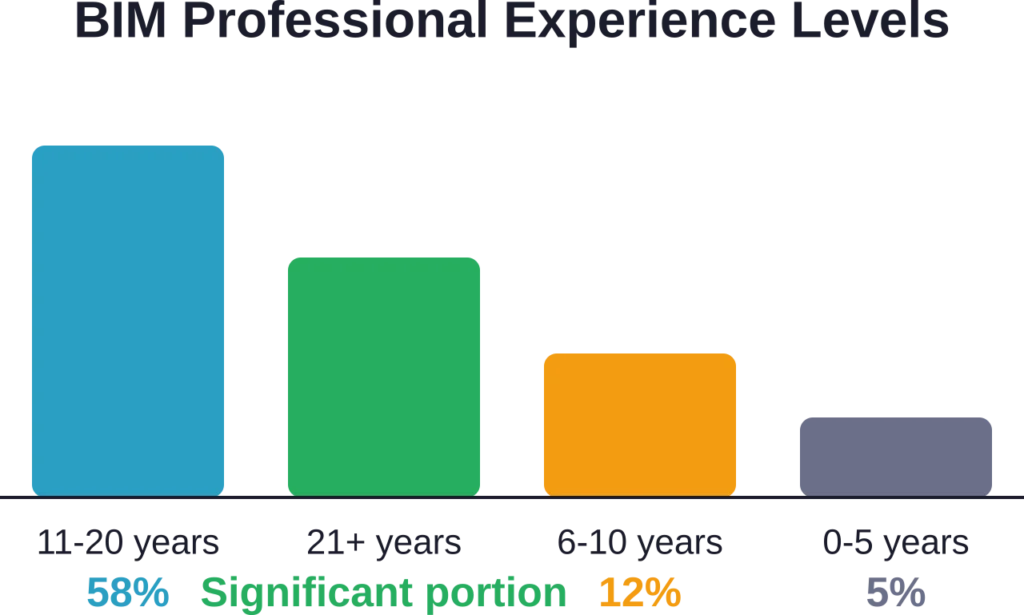
According to research analyzing BIM professionals, 58% possess between 11 and 20 years of industry experience. That substantial middle represents seasoned experts who’ve witnessed BIM evolution from early adoption through current maturity.
A significant portion bring more than 21 years of experience. These veterans often bridge traditional construction knowledge with digital transformation, understanding both legacy processes and modern collaborative workflows.
The data reveals a mature professional workforce. Unlike emerging technologies dominated by recent graduates, BIM attracts experienced construction professionals who’ve retrained and adapted.
Technology Stack and Software Platforms
Professional BIM companies work across multiple software platforms, each serving specific functions within the digital design and construction workflow.
Autodesk Revit dominates architectural, structural, and MEP modelling. Its parametric approach and extensive component libraries make it the industry standard for building projects across the UK.
Navisworks handles coordination and clash detection. Teams combine models from different disciplines, run interference checks, and manage coordination workflows. The software also supports 4D scheduling visualization.
AutoCAD remains essential for 2D documentation, civil engineering plans, and situations where traditional drafting better serves project needs.
Point cloud processing requires specialized tools. ReCap, CloudCompare, and similar platforms clean and register scan data before BIM conversion begins.
Solibri and similar model checking software validates compliance with standards, checks for modelling errors, and enforces information requirements.
Common data environments—platforms like BIM 360, Viewpoint, or Aconex—provide the collaboration infrastructure where teams share models, coordinate changes, and manage project information.
Sector-Specific BIM Applications
Different construction sectors place distinct demands on BIM capabilities and emphasize particular service aspects.
Commercial and Residential Buildings
Building projects emphasize architectural coordination, MEP clash detection, interior fit-out detailing, and facilities management handover. Visualization often plays a significant role in client communication and marketing.
Infrastructure and Civil Engineering
Roads, rail, utilities, and civil works require linear modelling capabilities, integration with civil engineering analysis software, geographic information system coordination, and utilities clash detection.
These projects often involve more stakeholders and regulatory authorities than building projects, placing additional emphasis on information management and compliance documentation.
Heritage and Conservation
Historic buildings demand exceptional scan to BIM accuracy, careful documentation of existing conditions, and sensitivity to conservation principles. Models support heritage impact assessments and guide careful intervention planning.
Industrial and Process Facilities
Manufacturing plants, refineries, and industrial facilities involve dense MEP systems, specialized equipment integration, maintenance access planning, and operational simulation. These projects push coordination complexity to the highest levels.
Future Directions in UK BIM
The Building Information Modelling landscape continues evolving as technology advances and industry adoption deepens.
Level 3 BIM represents the next maturity stage—fully integrated models in single shared environments with real-time collaboration. Research from academic institutions examines decision support systems for Level 3 implementation, though widespread adoption remains future-focused.
Artificial intelligence and machine learning are beginning to augment BIM workflows. Automated clash detection prioritization, design optimization algorithms, and predictive maintenance systems represent emerging applications.
Digital twins extend BIM beyond construction into operations. These dynamic models update with real-time sensor data, enabling predictive maintenance, energy optimization, and space management.
Prefabrication and modular construction lean heavily on BIM. Detailed models drive manufacturing processes, with components fabricated off-site based directly on digital information. That approach reduces site labor, improves quality, and accelerates schedules.
Sustainability analysis increasingly integrates with BIM workflows. Energy modelling, daylighting simulation, embodied carbon calculation, and lifecycle assessment use BIM data to evaluate environmental performance during design rather than after construction.
Common Challenges and How Top Firms Address Them
Even with mature technology and experienced professionals, BIM implementation faces recurring obstacles.
Software interoperability has long challenged the industry. According to a National Institute of Standards and Technology report from August 2004, inadequate interoperability cost the U.S. capital facilities industry an estimated $15.8 billion annually. While standards have improved, file exchange between platforms remains imperfect.
Leading firms address this through rigorous file format testing, standardized exchange protocols, and coordination procedures that catch translation errors early.
Information overload can overwhelm teams. BIM models contain vastly more data than traditional drawings. Without clear information requirements and structured delivery, projects drown in unnecessary detail.
Sophisticated providers implement Level of Development specifications, defining exactly what information is required at each project stage. That discipline focuses effort and prevents wasted modelling.
Skill gaps persist despite growing BIM education. Traditional construction professionals may lack digital literacy, while recent graduates may lack construction knowledge.
Top companies invest in training programs, mentorship structures, and knowledge transfer between experienced construction professionals and digital specialists.
Frequently Asked Questions
Building Information Modelling is a collaborative process creating digital representations of physical and functional building characteristics. It matters because it enables teams to coordinate complex projects digitally, identify problems before construction, reduce waste, improve safety, and deliver better outcomes. Research shows BIM implementation in value engineering delivers cost and time savings of 10%.
Evaluate technical certifications in relevant software platforms, review project portfolios for similar work, assess process maturity and quality procedures, test communication responsiveness, and verify capacity to handle the project scale. Sector experience matters significantly—firms specializing in buildings may lack infrastructure expertise and vice versa.
BIM Level 2 involves collaborative working with discipline-specific models coordinated through a common data environment, using standardized information exchanges. UK government construction projects above certain value thresholds require Level 2 compliance. Private sector projects benefit from the coordination and efficiency but aren’t legally required to implement it.
Scan to BIM converts laser scan point cloud data of existing buildings into intelligent BIM models. It’s essential for renovation projects, heritage buildings, retrofits, and infrastructure upgrades where accurate as-built documentation is required. Traditional measurement methods cannot capture complex existing conditions with sufficient accuracy and detail for modern renovation design.
BIM requires higher upfront investment in modelling and coordination but delivers substantial savings through reduced changes, fewer construction errors, and optimized designs. Studies demonstrate 10% cost and time savings on projects implementing BIM in value engineering. The return on investment typically justifies the initial expense on projects of moderate complexity and above.
Small projects can benefit from BIM but the return on investment depends on complexity rather than just size. A small but geometrically complex building with multiple systems benefits more than a large but simple warehouse. Projects involving renovation of existing structures, tight site constraints, or complex coordination needs justify BIM regardless of overall budget.
Properly structured BIM models transition to facilities management, containing asset information, maintenance schedules, equipment specifications, and operational parameters. Facilities managers use this data for maintenance planning, space management, energy optimization, and future renovation planning. This operational value extends BIM benefits throughout the building lifecycle.
Making the Right Decision
The UK BIM landscape offers sophisticated options across service categories, technical specializations, and sector expertise. The best choice depends entirely on specific project requirements.
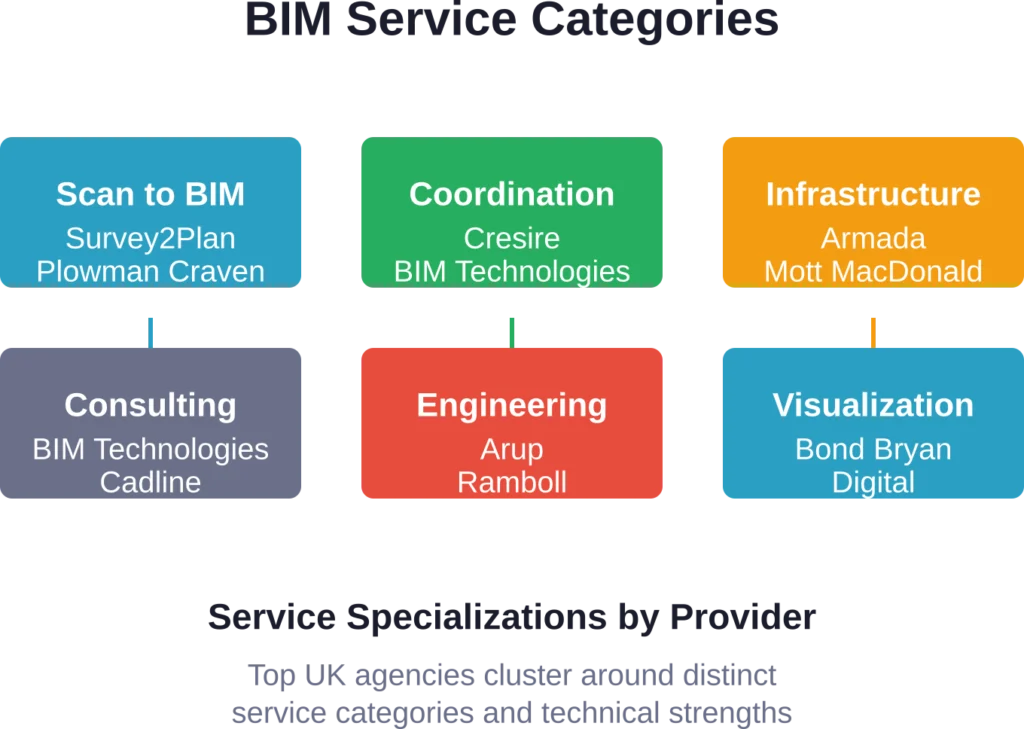
Scan to BIM needs point toward specialists like Survey2Plan and Plowman Craven. Infrastructure projects benefit from civil engineering depth at Armada or Mott MacDonald. Firms seeking strategic implementation support rather than just deliverables should examine BIM Technologies or Cadline.
Research demonstrates meaningful project improvements from BIM adoption. Cost savings of 10% and coordination accuracy within 1.35% of manual calculations represent real performance gains, not marketing claims.
But technology alone doesn’t deliver those results. Experienced professionals implementing disciplined processes within collaborative workflows create the value. That’s why selecting a BIM partner based on expertise, process maturity, and proven capability matters more than software selection or superficial capability claims.
The construction industry’s digital transformation continues accelerating. Projects without BIM increasingly struggle to compete on efficiency, coordination quality, and client expectations. Partnering with capable BIM specialists has shifted from competitive advantage to competitive necessity.
Start by defining specific project needs—services required, sector expertise, scale and complexity, compliance requirements, and collaboration expectations. Then evaluate providers against those criteria rather than generic capability statements.
The best BIM companies don’t just create models. They enable better decision-making, reduce risk, improve coordination, and deliver projects that perform as designed. That’s the standard to seek when selecting a Building Information Modelling partner.