

Quick Summary: BIM services meaning refers to professional consulting, modeling, coordination, and management solutions built around Building Information Modeling—a digital process that creates intelligent 3D representations of buildings and infrastructure. These services help architects, engineers, and contractors collaborate more effectively, reduce costly errors, and improve project delivery throughout the entire lifecycle of a building.
The construction industry has undergone a massive digital transformation over the past two decades. At the center of this shift sits Building Information Modeling, commonly known as BIM.
But what exactly does “BIM services” mean when contractors, architects, and project managers talk about it?
Here’s the thing though—BIM isn’t just software. It’s an entire approach to how buildings get planned, designed, built, and managed. And BIM services represent the professional expertise that makes this approach actually work in real-world projects.
What Is BIM (Building Information Modeling)?
Building Information Modeling is an intelligent, model-based process for planning, designing, building, and managing buildings and infrastructure. Unlike traditional 2D drawings, BIM creates digital representations that contain rich data about every component in a structure.
Think of it as a virtual building that exists before the physical one does. This digital model includes geometry, spatial relationships, geographic information, quantities and properties of building components—everything from HVAC systems to plumbing fixtures.
According to buildingSMART International, the worldwide industry body driving digital transformation in the built asset industry, BIM enables seamless data sharing and collaboration across platforms and stakeholders while maintaining full flexibility in defining workflows.
How BIM Differs from Traditional CAD
| Aspect | CAD | BIM |
|---|---|---|
| Focus | 2D drawing and drafting | 3D modeling with data-rich information |
| Collaboration | File-based, limited | Cloud-based, real-time team collaboration |
| Data | Geometric information only | Geometry plus material, cost, timeline data |
| Changes | Manual updates across drawings | Automatic updates throughout model |
| Lifecycle | Primarily design phase | Entire building lifecycle |
Poor software interoperability has long been regarded as an obstacle to industry efficiency. A 2004 US National Institute of Standards and Technology (NIST) report conservatively estimated that $15.8 billion was lost annually by the U.S. capital facilities industry due to inadequate interoperability.
That’s precisely why standards like Industry Foundation Classes (IFC) exist—to ensure different software solutions can talk to each other.
BIM Services Meaning: What Do They Actually Include?
When firms talk about offering “BIM services,” they’re referring to specialized professional services that leverage Building Information Modeling technology and methodology.
These services range from basic 3D modeling to sophisticated coordination, analysis, and facility management support.
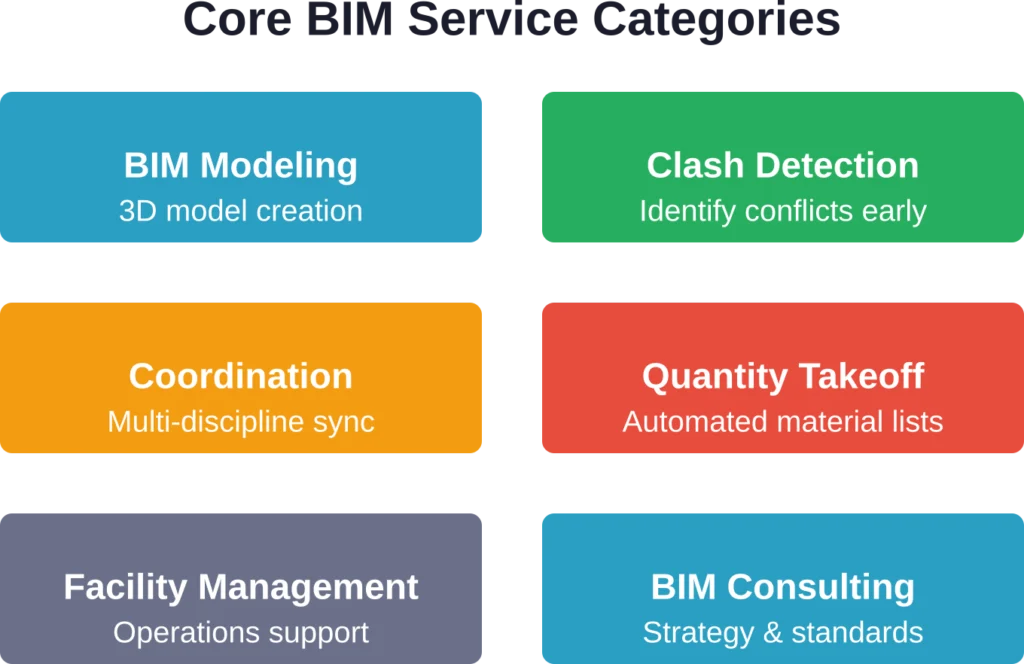
BIM Modeling Services
This is the foundation. BIM modeling services create the actual 3D digital representations of buildings. Specialists develop models for architectural, structural, and MEP (mechanical, electrical, plumbing) systems.
Each element in the model carries data—material specifications, manufacturer information, cost, maintenance schedules, energy performance characteristics.
Clash Detection and Coordination Services
Before construction even begins, coordination services identify conflicts between different building systems. Maybe the HVAC duct runs right through where a structural beam needs to go. Or the plumbing conflicts with electrical conduits.
Clash detection services catch these problems in the digital model, where fixes cost hours instead of thousands of dollars. Real talk: catching these clashes early is one of the biggest reasons contractors adopt BIM services.
BIM Management and Consulting
Larger projects need someone to oversee the entire BIM process. BIM management services establish standards, coordinate between disciplines, manage model versions, and ensure everyone follows the execution plan.
Consulting services help organizations develop BIM strategies, select appropriate software, train teams, and establish workflows that align with industry standards like ISO 19650.
Quantity Takeoff and Estimation Services
BIM models contain detailed information about every component, which means they can automatically generate material quantities and cost estimates. This eliminates manual counting and measurement from 2D drawings—a notoriously error-prone process.
Facility Management Services
BIM doesn’t stop when construction ends. The digital model becomes a valuable asset for building operations, containing equipment specifications, maintenance schedules, warranty information, and operational manuals.
Support Project Delivery with BIM Services
Powerkh works with project teams that need BIM support during design, coordination, and construction. Its services include BIM modelling, coordination, detailing, Scan to BIM, and technical documentation for live construction projects.
Need BIM Support for a Project?
Talk with Powerkh to:
- develop BIM models for design and coordination
- support structural and MEP project delivery
- prepare drawings and technical documentation
- improve coordination between design and site teams
Contact Powerkh for a project review and consultation.
Who Uses BIM Services and Why?
Architects and Design Firms
Architects use BIM services to create detailed design models, explore design alternatives, generate construction documentation, and coordinate with engineers. The intelligent model helps visualize spatial relationships and test design concepts before committing to them.
Engineers (Structural, MEP, Civil)
Engineering disciplines rely heavily on BIM coordination services. Structural engineers model the building’s skeleton. MEP engineers design the systems that make buildings functional. Civil engineers plan site work and infrastructure.
All these models need to work together without conflicts—that’s where BIM coordination becomes essential.
Contractors and Construction Teams
General contractors and subcontractors use BIM services for construction planning, scheduling, cost estimation, and on-site coordination. The model helps them understand exactly what needs to be built before breaking ground.
Prefabrication and modular construction heavily depend on accurate BIM models to manufacture components off-site.
Building Owners and Facility Managers
Owners increasingly require BIM deliverables because the models provide value long after construction. Facility managers use them for maintenance planning, space management, energy optimization, and future renovation projects.
The UK Government and major contractors mandate BIM on public projects, recognizing its ability to improve project delivery and reduce lifecycle costs.
Key Standards Behind BIM Services
Industry Foundation Classes (IFC)
IFC is a standardized, digital description of the built asset industry, officially designated as ISO 16739. It’s an open file format that allows BIM models to be shared between different software platforms without losing data.
Think of IFC as the universal language of BIM. When a project uses Revit, ArchiCAD, and Tekla simultaneously, IFC ensures they can all read each other’s models.
buildingSMART Data Dictionary (bSDD)
According to buildingSMART, the bSDD is an online service hosting classes (terms) and properties, allowed values, units, translations, and relations. It provides a standardized workflow to guarantee data quality, information consistency, and interoperability.
BIM modelers use the bSDD for easy access to standards to enrich their models. BIM managers reference it in Information Delivery Specifications to define exactly what data needs to be included.
Information Delivery Specification (IDS)
IDS is a buildingSMART standard for defining information requirements in a computer-interpretable form. It allows automatic compliance checking of IFC models, which increases quality control and data fidelity.
As of June 1, 2024, IDS v1.0 was approved as a Final Standard. Over 30 software solutions now support the IDS standard for information validation.
York Tang from buildingSMART notes: “By adhering to openBIM standards, like IDS, we can show that standardization enhances project efficiency and quality. This helps improve automation that streamlines compliance checking and validation processes, saving time and boosting productivity.”
ISO 19650 Standards
The ISO 19650 series provides the international framework for managing information throughout the lifecycle of a built asset using Building Information Modeling. Part 1 covers concepts and principles, while subsequent parts address specific aspects like health and safety information (ISO 19650-6:2025).

Benefits of BIM Services for Construction Projects
Reduced Errors and Rework
Clash detection alone can save massive amounts of money. Finding conflicts in the digital model before construction means avoiding expensive field changes, material waste, and schedule delays.
Catching clashes early can reduce rework costs compared to traditional coordination methods.
Improved Collaboration
BIM services create a common language and shared model that all project stakeholders can reference. Architects, engineers, contractors, and owners work from the same data source, reducing miscommunication.
Cloud-based collaboration platforms mean team members can access current model information anywhere, anytime.
Better Project Visualization
Clients and stakeholders who struggle to read 2D drawings can instantly understand 3D BIM models. This improves decision-making and reduces misunderstandings about design intent.
Virtual walkthroughs let owners experience spaces before construction, making it easier to request changes when they’re still cheap to implement.
More Accurate Cost Estimation
Automated quantity extraction from BIM models eliminates counting errors and provides more reliable cost estimates. Changes to the model automatically update quantities, keeping estimates current throughout design development.
Enhanced Facility Management
The digital twin created during design and construction becomes an invaluable operations tool. Facility managers can quickly locate equipment, access maintenance manuals, track warranty periods, and plan renovations with accurate as-built information.
Common BIM Software Platforms
BIM services rely on specialized software platforms. While the services matter more than the specific tools, understanding the major platforms helps contextualize how BIM services work.
| Software | Primary Use | Discipline Focus |
|---|---|---|
| Autodesk Revit | Architecture, MEP, Structure | Multi-discipline |
| ArchiCAD | Architectural design | Architecture |
| Navisworks | Coordination, clash detection | Multi-discipline |
| Tekla Structures | Structural engineering, steel detailing | Structural |
| BricsCAD BIM | Architecture and engineering | Multi-discipline |
BIM Maturity Levels
BIM adoption happens in stages, often described as maturity levels. Understanding these levels helps contextualize what different BIM services can deliver.
Level 0: Traditional CAD
No collaboration. Teams work with 2D drawings, sharing information through printed or digital paper-based formats.
Level 1: Managed CAD
Some 3D modeling exists, but collaboration is limited. 2D drawings remain the primary deliverable, with basic file sharing but no integrated models.
Level 2: Collaborative BIM
Each discipline creates its own 3D model, and these models are coordinated through a central platform. This is the level mandated for UK public sector projects and represents current best practice for most BIM services.
Level 3: Integrated BIM (openBIM)
All disciplines work in a single shared model or fully integrated separate models using cloud-based collaboration. This represents the future of BIM services and is enabled by standards like IFC, bSDD, and IDS.
The openBIM approach, championed by buildingSMART, enables seamless data sharing and collaboration across platforms and stakeholders.
Getting Started with BIM Services
Assess Current Capabilities
Start by evaluating current project delivery methods, identifying pain points, and defining what BIM services could address. Not every organization needs the full spectrum immediately.
Establish Standards and Protocols
Successful BIM implementation requires clear standards. Define naming conventions, file organization, level of detail requirements, and exchange protocols. Reference industry standards like ISO 19650 rather than inventing everything from scratch.
Invest in Training
Software is useless without skilled people. Either train existing staff or partner with experienced BIM service providers. Many firms start with outsourced BIM services while building internal capabilities.
Start with Pilot Projects
Test BIM services on smaller, less complex projects first. Learn the workflows, refine standards, and build confidence before tackling mission-critical work.
Common Challenges
Interoperability Issues
Despite standards like IFC, data exchange between different software platforms can still be problematic. Information gets lost or corrupted in translation, requiring manual fixes.
That’s why buildingSMART’s work on standards like IDS matters—better validation and standardization reduce these friction points.
Initial Investment and Learning Curve
BIM software, training, and process changes require significant upfront investment. Teams need time to become proficient, which can temporarily slow productivity.
Resistance to Change
Professionals comfortable with traditional methods often resist BIM adoption. Change management becomes as important as technical implementation.
Legal and Contractual Considerations
BIM raises questions about intellectual property, data ownership, liability for model accuracy, and insurance. Academic research highlights that legal frameworks haven’t always kept pace with BIM technology, creating ambiguity about rights and responsibilities.
The Future of BIM Services
Integration with Digital Twins
The BIM model is increasingly becoming a living digital twin that updates throughout the building’s operational life. Sensors feed real-time data into the model, enabling predictive maintenance and performance optimization.
Artificial Intelligence and Automation
AI is beginning to automate routine BIM tasks—generating code-compliant designs, optimizing layouts, and identifying clashes more intelligently. This will make BIM services more efficient and accessible.
Cloud and Mobile Access
Cloud-based BIM platforms enable real-time collaboration from anywhere. Field teams access model information on tablets, closing the loop between office and construction site.
Sustainability Analysis
BIM services increasingly include energy analysis, carbon footprint calculation, and sustainability certification support. The model becomes the foundation for environmental performance optimization.
Conclusion
BIM services meaning extends far beyond 3D modeling. These services represent a fundamental shift in how the built environment industry collaborates, makes decisions, and delivers projects.
From architects visualizing designs to contractors coordinating installations to facility managers maintaining buildings, BIM services touch every phase of a structure’s lifecycle. The intelligent data within BIM models drives better decisions, reduces waste, improves quality, and creates lasting value.
Understanding what BIM services actually are—and what they can deliver—helps organizations make informed decisions about adoption. The initial investment is real, but the benefits compound over time as teams become proficient and processes mature.
Ready to explore how BIM services can improve projects? Start by assessing current workflows, identifying specific pain points, and connecting with experienced BIM service providers who can guide implementation.
Frequently Asked Questions
BIM services are professional consulting, modeling, coordination, and management solutions that use Building Information Modeling technology. They help create intelligent 3D digital representations of buildings and infrastructure that contain detailed data about every component, enabling better collaboration and decision-making throughout a project’s lifecycle.
BIM service costs vary widely based on project complexity, scope, and deliverables. Pricing might be hourly, per-project, or based on building square footage. For current pricing on specific services, contact BIM service providers directly as rates depend on individual project requirements and regional market conditions.
Traditional drafting creates 2D drawings with limited data, while BIM services produce intelligent 3D models containing geometry plus rich information about materials, costs, schedules, and performance characteristics. BIM enables automatic coordination between disciplines, clash detection, and data that supports the entire building lifecycle—not just design and construction.
If hiring BIM service providers, they’ll use their own software platforms like Revit, ArchiCAD, or Tekla. If developing internal BIM capabilities, appropriate software and training are necessary. However, viewing and reviewing BIM models often requires only free viewer software, making collaboration accessible without full software licenses.
Absolutely. BIM services can create as-built models of existing structures through laser scanning and photogrammetry. These models support renovation planning, facility management, and operations. Many building owners are retrofitting BIM models to older buildings to improve maintenance efficiency and plan future upgrades.
Implementation timelines vary based on organization size, existing capabilities, and adoption scope. Basic BIM modeling capability might develop in 3-6 months with proper training. Comprehensive BIM maturity across an organization typically takes 1-3 years of gradual implementation, pilot projects, standard development, and process refinement.
Requirements vary by location and project type. The UK Government mandates BIM Level 2 for public sector projects. Some countries and large private clients require BIM deliverables. Even when not legally required, many projects specify BIM in contracts because of the efficiency and quality benefits it provides.