

Quick Summary: The best healthcare web development companies combine HIPAA compliance expertise with modern patient-centric design, delivering accessible, secure digital solutions. Top agencies specialize in EHR integration, ADA accessibility, and mobile-first development tailored to medical practices, hospitals, and healthcare organizations. Leaders include firms with proven healthcare portfolios, regulatory knowledge, and experience building trust-driven platforms that convert visitors into patients.
Healthcare organizations face a unique digital challenge. A website isn’t just a marketing tool—it’s often the first clinical touchpoint, the place where patients decide whether to trust their health to your care.
That decision happens fast. And if the site feels outdated, confusing, or insecure, potential patients leave. They won’t call. They won’t book.
Finding the right healthcare web development company requires more than browsing portfolios. It demands understanding compliance requirements, patient experience principles, and technical architecture that protects sensitive health data. According to healthit.gov, 193 different developers of certified health IT were reported by clinicians in 2023 (as documented in the Certified Health IT Developers report), demonstrating the complexity and specialization required in healthcare technology development.
This guide evaluates the top healthcare web development companies operating in 2026, examining their specializations, compliance credentials, and proven results with medical organizations.
What Makes Healthcare Web Development Different
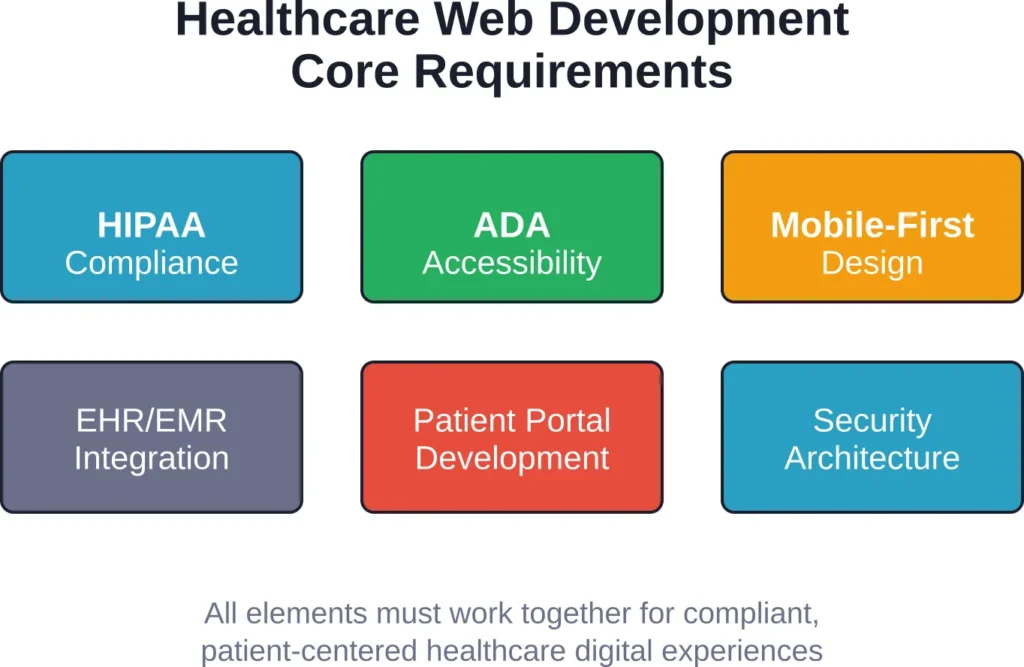
Healthcare web development operates under constraints that don’t exist in most industries. Regulatory frameworks dictate data handling, accessibility standards mandate inclusive design, and patient safety concerns shape every interaction.
Standard web agencies often underestimate these requirements. They build beautiful sites that fail HIPAA audits or create patient portals that exclude users with disabilities.
Compliance as Foundation, Not Feature
HIPAA compliance isn’t a checkbox—it’s an architecture. Every form submission, every patient portal login, every appointment request needs encryption, audit logging, and access controls that meet federal standards.
The Office of the National Coordinator for Health IT notes that 96% of U.S. non-federal acute care hospitals engaged in electronically sending care records. Healthcare websites increasingly serve as integration points for these exchanges, requiring developers who understand health information standards like HL7 FHIR.
Recent enforcement underscores the stakes. Research from Claremont Graduate University documents a July 2025 HIPAA settlement with a New York surgery center for $250,000, highlighting the critical nature of proper data protection in healthcare digital platforms.
Accessibility Means Everyone Can Access Care
ADA compliance in healthcare extends beyond legal obligation—it’s a care delivery issue. When patients with visual impairments can’t navigate appointment scheduling or those with motor disabilities can’t complete intake forms, the website becomes a barrier to treatment.
Healthcare web development companies must build to WCAG 2.1 AA standards minimum, ensuring screen reader compatibility, keyboard navigation, color contrast ratios, and alternative text for all functional elements.
Mobile-First Is No Longer Optional
Industry analyses indicate that over 70% of healthcare searches happen on mobile devices. Patients research symptoms, find specialists, and book appointments from mobile devices—often in moments of stress or urgency.
Responsive design in healthcare requires more than scaling layouts. Touch targets need sizing for accessibility, forms need simplification for small screens, and page speed becomes critical when users have limited connectivity or patience.
Top 15 Healthcare Web Development Companies in 2026
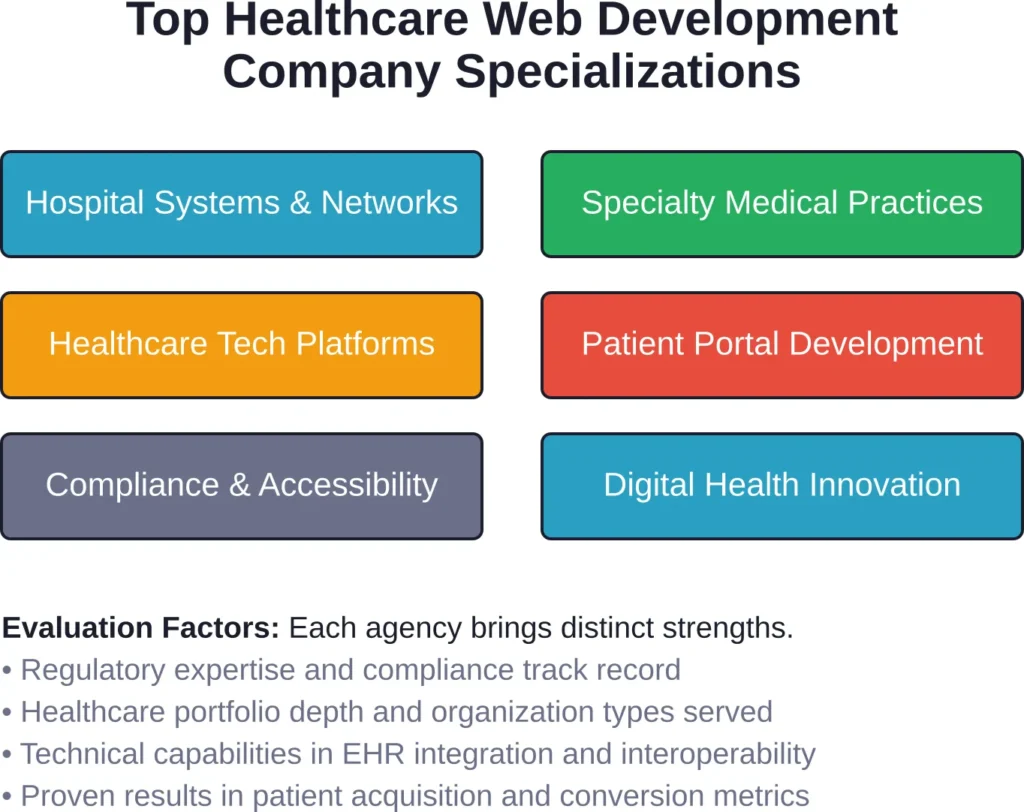
The agencies below represent leaders in healthcare-specific web development, evaluated on regulatory expertise, portfolio depth, technical capabilities, and client results in medical sector projects.
1. Mobian Studio
Mobian Studio specializes in building dedicated engineering teams for healthcare web and mobile development, serving organizations in the healthcare, fintech, and logistics sectors that demand high-stakes digital solutions. The agency operates through outsourcing and outstaffing models, delivering production-ready patient portals, clinical platforms, and AI-enhanced healthcare applications.
Their approach emphasizes clean architecture, regulatory compliance, and seamless integration with existing healthcare systems. Mobian focuses on end-to-end product development, including HL7/FHIR integrations, secure patient data handling, and scalable architectures that support both small clinics and larger health networks.
The team delivers full-stack solutions with particular strength in mobile health applications, AI-powered clinical workflows, and legacy system modernization for healthcare providers.
Contact Information:
- Website: mobian.studio
- Phone: [email protected]
- Address: Harju maakond, Tallinn, Kesklinnalinnaosa, Masina tn 22, 10113
- LinkedIn: www.linkedin.com/company/mobian-studio
2. Lengreo

Lengreo acts as a complete marketing and technology partner for healthcare organizations, combining strategic digital marketing with custom website development. The agency focuses on delivering HIPAA-aware digital experiences that drive patient acquisition and appointment bookings while maintaining full regulatory compliance.
Their development process includes thorough discovery, business analysis, and conversion-focused website builds tailored for medical practices, clinics, and health tech companies. Lengreo excels at creating patient-friendly interfaces, optimized lead generation flows, and integrated marketing campaigns that balance user experience with data security requirements.
Notable results include significant increases in qualified leads for software-enabled healthcare services, reduced cost per lead for medical technology providers, and improved conversion rates for patient-facing digital platforms.
Contact Information:
- Website: Lengreo.com
- Phone: +31 686 147 566
- Email: [email protected]
- Address: Vrijstraat 9 C/D, 5611 AT Eindhoven, Netherlands
- LinkedIn: Lengreo
- Twitter: @Lengreo
- Instagram: @lengreo
3. Gilzor

Gilzor delivers custom software development and web solutions specifically tailored for healthcare startups, medical practices, and digital health companies. The agency helps clients validate ideas, design user-centric interfaces, and build secure, high-performance web and mobile platforms that improve patient engagement and operational efficiency.
Their development process covers full-cycle web development, UI/UX design focused on healthcare usability, quality assurance, and go-to-market strategies for medical products. Gilzor creates solutions such as patient management systems, telemedicine platforms, and e-commerce solutions for healthcare services.
The agency is known for building functional and attractive digital products that connect healthcare providers with their audiences while maintaining strict security and compliance standards.
Contact Information:
- Website: www.gilzor.com
- Email: [email protected]
- Address: Poland, Warsaw, Office 58, street Adama Mickiewicza 37, 01-625
- LinkedIn: www.linkedin.com/company/gilzor-softwaredevelopment
4. Oski

Oski builds smart, scalable web solutions for tech-forward healthcare enterprises and innovative medical startups. With deep expertise in cloud architecture, modern frontend frameworks, and AI integration, the agency develops sophisticated digital platforms that enhance patient experiences and streamline clinical operations.
Their healthcare-focused services include secure patient portals, complex web applications, CMS solutions for medical content management, and AI-powered features for personalized patient journeys. Oski emphasizes accessibility, performance, and seamless integration with healthcare ecosystems.
The agency delivers solutions across multiple healthcare verticals, including digital tools for hospitals, specialty clinics, insurance providers, and medical education platforms.
Contact Information:
- Website: oski.site
- Phone: +48571282759
- Email: [email protected]
- Address: Kaupmehe tn 7, 10114 Tallinn, Estonia
- LinkedIn: www.linkedin.com/company/oski-solutions
5. A-Listware

A-Listware is a software development and consulting company that provides dedicated teams and custom web solutions for healthcare organizations. The agency specializes in building secure, compliant digital platforms for medical practices, health systems, and digital health innovators.
Their healthcare web development offerings include custom software solutions, application services, UX/UI design focused on medical usability, and legacy system modernization. A-Listware excels at creating enterprise-grade patient-facing websites, internal clinical tools, and integrated healthcare platforms.
The company delivers end-to-end development with strong emphasis on security, scalability, and seamless integration with existing healthcare infrastructure and compliance requirements.
Contact Information:
- Website: a-listware.com
- Phone: +1 (888) 337 93 73
- Email: [email protected]
- Address: North Bergen, NJ 07047, USA
- LinkedIn: www.linkedin.com/company/a-listware
- Facebook: www.facebook.com/alistware
6. Design de Plume

Design de Plume focuses on specialty practices and boutique medical services, creating distinctive brand experiences that differentiate providers in competitive markets. Their design-forward approach suits practices where patient experience and brand perception drive referrals.
The agency excels at aesthetic medical practices, dental specialists, and concierge medicine—sectors where website design directly influences perceived quality of care. Their development balances visual sophistication with the compliance requirements that govern all healthcare digital properties.
Design de Plume’s projects often include photography direction, brand development, and content strategy alongside technical development, providing turnkey solutions for practices launching or repositioning their market presence.
7. WebFX

WebFX brings scale and technology infrastructure to healthcare web development, leveraging proprietary marketing platforms and analytics tools. Their data-driven approach suits healthcare organizations focused on measurable ROI from digital investments.
The agency’s healthcare division handles projects ranging from individual practices to multi-state hospital networks. Their development integrates with MarketingCloudFX, a proprietary platform tracking patient journeys, revenue attribution, and competitive intelligence.
WebFX’s technical capabilities include complex API integrations, patient portal development, and custom web applications for healthcare organizations with unique workflow requirements. Their scale enables competitive engagement timelines and comprehensive service offerings.
8. Modular DS

Modular DS specializes in healthcare technology platforms and digital health startups, bringing product development expertise to medical web projects. Their background in health tech SaaS shapes their architectural approach and scalability focus.
The agency excels at projects requiring interoperability—systems that exchange data with EHRs, integrate with telehealth platforms, or connect to wearable devices. Their development team includes engineers with health IT certification and FHIR implementation experience.
Modular DS suits healthcare organizations building patient-facing applications, developing member portals, or creating digital health products beyond traditional marketing websites. Their agile methodology accommodates the iterative development common in health tech innovation.
9. Spinutech

Spinutech operates as a regional agency with healthcare sector specialization, serving hospitals, health systems, and medical practices primarily in the Midwest. Their understanding of regional healthcare markets informs strategy and positioning.
The agency’s development work emphasizes community connection and local search optimization—critical factors for healthcare organizations competing in specific geographic markets. Their projects integrate physician directories, location finders, and service line marketing.
Spinutech provides ongoing website management and optimization, functioning as an extension of internal marketing teams. Their retained service model suits healthcare organizations lacking in-house digital expertise.
10. Vital Design

Vital Design focuses exclusively on healthcare and wellness brands, building expertise in the unique challenges of medical digital marketing. Their niche focus means every team member understands healthcare compliance, medical terminology, and patient psychology.
The agency’s development process incorporates patient experience research, usability testing with target demographics, and accessibility evaluation with users who have disabilities. This human-centered approach produces interfaces optimized for diverse patient populations.
Vital Design’s portfolio includes innovative work in telehealth interfaces, patient education platforms, and wellness program portals. They suit healthcare organizations pursuing digital transformation beyond traditional website presence.
11. Cardinal Digital Marketing

Cardinal specializes exclusively in healthcare and medical organizations, bringing deep regulatory knowledge to every project. The agency handles everything from small practice websites to enterprise hospital systems.
Their development process begins with compliance audits, ensuring HIPAA requirements integrate into architecture from day one rather than bolted on afterward. Cardinal’s team includes certified health IT specialists who understand the interoperability standards governing modern healthcare systems.
Notable work includes patient portal development, EHR integration projects, and accessibility remediation for health systems facing ADA compliance issues. Their conversion-focused approach balances regulatory requirements with user experience that drives appointment bookings.
12. Forefrontweb

Forefrontweb positions itself as a compliance-first agency, building HIPAA-compliant infrastructure as the foundation for patient-facing digital experiences. Their development methodology emphasizes security architecture, encrypted data transmission, and audit-ready documentation.
The agency’s front-end development creates responsive, mobile-first interfaces tested across devices and assistive technologies. Their CMS implementations focus on empowering healthcare marketing teams to update content without compromising security or compliance.
Forefrontweb’s portfolio spans multi-location medical practices, specialty clinics, and regional health networks. They excel at projects requiring complex form logic, patient intake workflows, and integration with practice management systems.
13. Kanopi Studios

Kanopi takes a high-touch, mission-driven approach to healthcare web development, partnering primarily with university medical departments, health foundations, and specialized networks. Their focus on education-oriented healthcare organizations shapes their content-first development philosophy.
The agency excels at information architecture for complex medical content, creating navigation systems that help patients find specialized services, research information, and provider directories. Kanopi’s accessibility work goes beyond baseline compliance, incorporating user testing with people who rely on assistive technologies.
Their technical stack emphasizes open-source platforms, particularly Drupal, which offers robust security, granular permissions, and the scalability required by large healthcare institutions. Kanopi’s development includes ongoing support and training, ensuring medical organizations can maintain compliant sites long-term.
14. Blend
Operating across the UK and USA, Blend brings a business-growth focus to healthcare web development. The agency combines strategic consulting with technical execution, aligning website projects to measurable organizational goals.
Blend’s healthcare portfolio demonstrates sophistication in balancing technical requirements with visual excellence. Their work for DrDoctor showcases strategic website design that reflects healthcare sector credibility while driving user action. The Viedoc project achieved a 100% increase in conversion rate through user experience optimization.
The agency’s development process integrates analytics and conversion tracking from launch, enabling healthcare organizations to measure patient acquisition, appointment bookings, and content engagement. Typical client results include improvements in qualified inquiries and reductions in patient acquisition costs.
15. Thrive Agency
Thrive operates as a full-service digital marketing agency with a dedicated healthcare division, combining web development with SEO, PPC, and content marketing services. This integrated approach appeals to medical organizations seeking comprehensive digital growth strategies.
Their development work emphasizes lead generation architecture—forms optimized for conversion, call tracking integration, and patient journey mapping that guides prospects from initial search through appointment booking. Thrive’s healthcare team understands the longer consideration cycles in medical decision-making.
The agency manages ongoing digital marketing campaigns post-launch, providing healthcare organizations with a single partner for development, optimization, and patient acquisition efforts. Their reporting dashboards track website performance alongside marketing channel attribution.
Key Considerations When Choosing a Healthcare Web Development Partner
Selecting the right agency requires evaluating factors beyond design portfolios and technology stacks. Healthcare projects succeed or fail based on regulatory understanding, patient experience expertise, and post-launch support.
Proven Healthcare Industry Experience
Generic web agencies can learn healthcare requirements, but the learning curve happens on your project timeline and budget. Agencies with established healthcare practices bring pattern recognition—they’ve solved similar compliance challenges, optimized comparable patient journeys, and understand the terminology without translation.
Review case studies specifically from healthcare clients. Look for projects matching the scale and complexity of what’s needed. A portfolio heavy with small practice sites may not translate to hospital system requirements.
Ask about team composition. Do developers hold health IT certifications? Has the team implemented FHIR integrations? What’s their experience with accessibility remediation?
Compliance Documentation and Processes
HIPAA compliance requires documented processes, not just secure infrastructure. The right agency provides Business Associate Agreements, maintains security policies, trains staff on healthcare data handling, and conducts regular security assessments.
Request their compliance documentation. Established healthcare agencies have standardized BAAs and can explain their security posture clearly. Hesitation or vague answers signal risk.
The Trusted Exchange Framework and Common Agreement promotes nationwide health information exchange as of 2025. Agencies developing patient portals or systems exchanging health data need familiarity with these frameworks.
Accessibility Commitment Beyond Baseline Compliance
Minimum accessibility compliance prevents lawsuits. Excellent accessibility expands patient reach and improves experience for everyone. The best healthcare web development companies conduct user testing with people who have disabilities, not just automated scans.
Ask about accessibility testing methodology. Do they test with screen readers? Conduct keyboard-only navigation? Evaluate color contrast in context? Review with users who have cognitive disabilities?
HealthIT.gov data shows that 65% of individuals nationally offered and accessed online medical records or patient portals. These tools must serve all patients, regardless of ability, making accessibility testing a clinical necessity.
Integration Capabilities and Technical Architecture
Modern healthcare websites rarely operate in isolation. They integrate with practice management systems, EHRs, patient portals, billing platforms, and telehealth tools. The technical complexity exceeds typical content management system deployments.
Among all clinician participants, 62% reported at least one certified health IT product from Epic Systems Corporation, with Cerner, athenahealth, and eClinicalWorks serving other significant portions of clinicians. Healthcare web development companies need experience integrating with whichever systems the organization uses.
Evaluate the agency’s API development experience, authentication security implementation, and understanding of healthcare interoperability standards like HL7 FHIR. These technical foundations determine whether integrations succeed or become ongoing maintenance headaches.
Post-Launch Support and Optimization
Website launch represents the beginning, not the end, of the relationship. Healthcare organizations need ongoing security patches, compliance updates as regulations evolve, and optimization based on patient behavior data.
Clarify support models before engagement. What’s included in maintenance? How quickly do emergency security issues get addressed? What’s the process for compliance updates when regulations change?
The best agencies provide performance reporting, conduct regular accessibility audits, and recommend optimizations based on analytics data. This ongoing partnership approach drives continuous improvement in patient acquisition and experience.
| Evaluation Criteria | Why It Matters | Red Flags to Avoid |
|---|---|---|
| Healthcare Portfolio | Proven experience solving similar challenges for medical organizations | Generic web portfolio with one or two healthcare projects |
| HIPAA Compliance | Protects patient data, avoids regulatory penalties | Vague answers about security, no standard BAA |
| ADA Accessibility | Ensures all patients can access care information and tools | Reliance solely on automated testing, no user testing |
| Integration Experience | Connects website to EHR, practice management, telehealth systems | No API development experience or interoperability knowledge |
| Ongoing Support | Maintains security, compliance, and performance post-launch | Launch-and-leave model with no maintenance offering |
Healthcare Web Development Trends Shaping 2026
Healthcare digital experiences continue evolving, driven by regulatory changes, patient expectations, and technological capabilities. Understanding current trends helps organizations make future-ready platform decisions.
AI Integration and Regulatory Compliance
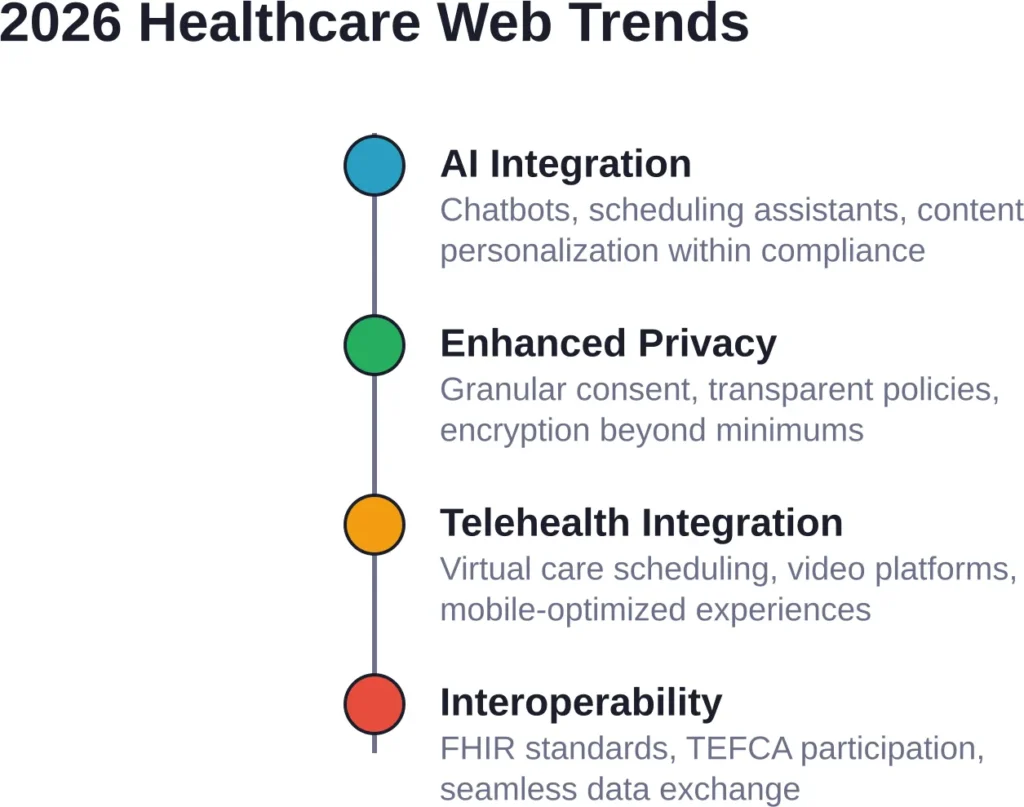
Artificial intelligence tools are reshaping healthcare websites through chatbots providing preliminary symptom guidance, scheduling assistants automating appointment bookings, and content personalization adapting information to patient needs.
But healthcare AI faces unique regulatory scrutiny. HL7 International launched an Artificial Intelligence Office, with Dr. Daniel Vreeman (DPT) appointed as its first Chief AI Officer to establish foundational standards for safe, trustworthy AI in healthcare. Organizations implementing AI features need development partners who understand these emerging frameworks.
Academic research highlights evolving compliance challenges. Vanderbilt Law School analysis published in October 2025 examined AI integration and regulatory compliance in healthcare, noting that healthcare systems implementing AI and machine learning technologies require careful navigation of existing regulations while anticipating new frameworks.
Leading healthcare web development companies are incorporating AI responsibly—within compliance guardrails, with appropriate disclaimers, and never replacing clinical judgment with automated recommendations.
Enhanced Patient Data Privacy Measures
Patient privacy concerns intensify as data breaches increase and AI capabilities expand. Healthcare organizations face pressure to demonstrate data protection commitments through transparent privacy policies and secure technical implementations.
Claremont Graduate University research published in July 2025 examined HIPAA compliance in the age of AI, emphasizing that if participatory research is to thrive, HIPAA must function not as mere regulation but as a framework for patient privacy, equity, and mutual respect. This philosophy extends to patient-facing websites.
Educational institutions are implementing stricter controls. Weill Cornell Medicine disabled web search in Microsoft 365 Copilot effective July 1, 2025 to support responsible AI use with protected health information. Similar caution shapes healthcare website development.
Development trends include explicit consent mechanisms for data collection, granular privacy controls allowing patients to manage information sharing, and encryption extending beyond HIPAA minimums. Organizations differentiate through privacy commitments, not just compliance.
Telehealth and Virtual Care Integration
Telehealth transformed from emergency pandemic response to standard care delivery option. Healthcare websites now serve as gateways to virtual care, requiring seamless integration between scheduling, video conferencing, and clinical documentation systems.
Development requirements include video platform integration, virtual waiting room experiences, digital intake form completion, and secure messaging between appointments. The technical architecture mirrors in-person visit workflows while addressing unique virtual care challenges.
User experience design distinguishes strong telehealth implementations. Clear instructions for first-time users, technical requirement checks before appointments, and mobile-optimized interfaces for patients joining from phones determine whether virtual care expands access or creates new barriers.
Interoperability and Data Exchange Standards
Healthcare data exists in silos—different systems that don’t communicate. Federal initiatives push toward seamless data exchange, affecting how healthcare websites integrate with broader health IT ecosystems.
TEFCA experienced significant adoption growth in the past year. The Trusted Exchange Framework and Common Agreement (TEFCA) brings disparate, disconnected networks of information together in a coordinated way to better enable care and secure patient access to their own data.
HL7 International’s FAST Accelerator, Da Vinci Project, and collaboration with Sequoia Project unify scalable FHIR infrastructure, governance, and real-world use cases. As reported by HL7 in February 2026, these initiatives build a secure, trusted, nationwide interoperability framework that empowers individuals, reduces burden, and strengthens care delivery.
Healthcare web development companies implementing patient portals or data access tools need FHIR expertise. The standard enables real-time data exchange between providers and payers, required under several CMS interoperability rules with adoption growing across public programs and commercial health plans.
Common Healthcare Web Development Challenges and Solutions
Even with the right agency partner, healthcare web projects face predictable challenges. Understanding these obstacles and proven mitigation strategies prevents delays and cost overruns.
Balancing Security with User Experience
Healthcare security requirements often conflict with frictionless user experiences. Multi-factor authentication protects accounts but adds login steps. Encryption secures data but increases page load time. Session timeouts prevent unauthorized access but frustrate users completing long forms.
The solution lies in thoughtful implementation rather than choosing security over experience or vice versa. Smart authentication remembers trusted devices while requiring verification on new ones. Performance optimization compensates for encryption overhead. Form autosave prevents data loss from security timeouts.
Leading agencies conduct user testing of security implementations, identifying friction points and refining approaches until both security and experience goals meet.
Content Migration from Legacy Systems
Healthcare organizations accumulate years of content across outdated platforms, static HTML pages, and file-based storage. Migrating this content to modern systems while maintaining SEO value, fixing broken links, and improving information architecture represents major project scope.
Successful migrations require content audits identifying what to keep, consolidate, or retire. Redirect mapping preserves search engine rankings. Taxonomy development improves findability. And phased migration approaches prevent overwhelming staff with change.
Agencies experienced in healthcare migrations bring efficiency through proven processes, automated tools, and realistic timeline expectations that account for clinical staff availability.
Stakeholder Alignment Across Clinical and Administrative Teams
Hospital websites serve diverse stakeholders—patients, physicians, administrative staff, researchers, donors, and community members. Each group has different needs, perspectives, and definitions of success.
Projects stall when internal consensus doesn’t exist. Physicians want clinical accuracy over marketing language. Administrators need compliance documentation. Marketing teams focus on conversion optimization. IT departments prioritize security and maintainability.
Experienced agencies facilitate stakeholder alignment through discovery workshops, user research that builds empathy for patient needs, and governance frameworks defining decision authority. The right process design prevents one department from blocking progress for the entire organization.
Regulatory Changes Requiring Platform Updates
Healthcare regulations evolve constantly. CMS interoperability rules, state privacy laws, accessibility standards, and security requirements all shift over time, requiring platform updates to maintain compliance.
Organizations need development partners who monitor regulatory changes, assess impact on existing implementations, and proactively recommend updates before compliance gaps create legal exposure.
HL7 reporting from January 2026 notes that the first phase of the CMS-0057-F Interoperability Final Rule implementation continues, with healthcare organizations moving from planning to active implementation of standardized data exchange. Staying current requires agencies embedded in these regulatory developments.
| Challenge | Impact | Solution Approach |
|---|---|---|
| Security vs. Experience | Strong security creates user friction | Smart authentication, performance optimization, user testing of security flows |
| Content Migration | Years of legacy content across old systems | Content audits, redirect mapping, phased migration, taxonomy development |
| Stakeholder Alignment | Conflicting priorities across departments | Discovery workshops, user research, governance frameworks, clear decision authority |
| Regulatory Changes | Compliance requirements evolve constantly | Regulatory monitoring, proactive updates, embedded regulatory expertise |
Questions Healthcare Organizations Should Ask Potential Agencies
The vetting process determines project success. These questions reveal whether an agency truly understands healthcare development or just claims healthcare experience in their marketing.
What percentage of your portfolio is healthcare projects? Agencies with dedicated healthcare practices should derive meaningful revenue from medical clients—ideally 40% or more. Lower percentages suggest healthcare is a side offering rather than core competency.
Which health IT standards and frameworks do your developers have experience implementing? Listen for specific answers: HL7 FHIR, SMART on FHIR, HL7 CDA, DIRECT secure messaging, TEFCA participation. Vague responses about “following best practices” signal limited technical depth.
How do you approach accessibility testing beyond automated scans? Strong agencies describe screen reader testing, keyboard navigation evaluation, user testing with people who have disabilities, and manual review processes. Reliance solely on automated tools misses most accessibility barriers.
What’s your process when HIPAA requirements conflict with desired features? This reveals problem-solving approach. Experienced agencies offer alternative implementations that achieve business goals within compliance constraints rather than simply saying no or ignoring requirements.
Can you walk through a recent healthcare project that faced unexpected challenges? How agencies handle obstacles matters more than whether obstacles occur. Look for honest problem acknowledgment, creative solutions, and lessons learned—not perfect-project narratives.
What’s included in ongoing maintenance and support? Clarify security patch deployment, compliance update processes, performance monitoring, analytics reporting, accessibility audits, and emergency response procedures. Assumptions about included services create post-launch conflicts.
How do you stay current with healthcare regulatory changes? Listen for specific resources: ONC policy briefs, HL7 working group participation, healthcare IT conferences, compliance training programs, or advisory board relationships. Continuing education separates current expertise from outdated knowledge.
Frequently Asked Questions
Healthcare web development operates under strict regulatory frameworks including HIPAA for data protection, ADA for accessibility, and industry-specific standards for interoperability. According to healthit.gov, 193 different developers of certified health IT were reported by clinicians in 2023, demonstrating the specialization required. Healthcare sites must integrate with EHR systems, protect patient data through encryption and access controls, maintain audit trails, and serve diverse patient populations including those with disabilities. Standard web development rarely faces these combined technical, legal, and ethical requirements.
Healthcare website investment varies dramatically based on scope, complexity, and customization level. Typical ranges depend on organization size and requirements. Small practice informational sites with basic functionality may start around $5,000 for template-based solutions, while fully custom hospital system websites with patient portals, EHR integration, and complex functionality typically start at $25,000 and can exceed $100,000 for enterprise implementations. Ongoing maintenance, security updates, and compliance reviews add annual costs. Organizations should prioritize compliance and security over initial cost, as regulatory penalties for violations far exceed development savings.
HIPAA violations carry severe financial and reputational consequences. Research from Claremont Graduate University documented a July 2025 HIPAA settlement with a New York surgery center for $250,000. Beyond legal penalties, data breaches destroy patient trust—the foundation of healthcare relationships. HIPAA compliance protects electronic protected health information through technical safeguards like encryption, administrative controls including staff training, and physical security measures. Websites collecting patient data through contact forms, appointment requests, or patient portals must implement Business Associate Agreements, maintain audit logs, and follow strict data handling protocols.
Healthcare websites must comply with ADA requirements, typically interpreted as WCAG 2.1 Level AA standards minimum. This ensures patients with visual, hearing, motor, or cognitive disabilities can access health information and services. Requirements include screen reader compatibility, keyboard navigation functionality, sufficient color contrast ratios, alternative text for images, captions for videos, and logical heading structure. HealthIT.gov reports that 65% of individuals nationally offered and accessed online medical records or patient portals. Accessibility failures don’t just risk legal action—they exclude patients from care access, creating health equity issues.
Healthcare website timelines depend on project scope, complexity, compliance requirements, and stakeholder alignment. Simple informational sites for small practices might complete in 6-8 weeks. Mid-size projects with custom design, content migration, and basic patient tools typically require 3-4 months. Enterprise hospital systems with patient portals, EHR integration, multiple stakeholder groups, and complex functionality often need 6-12 months. Healthcare projects generally take longer than comparable commercial sites due to compliance documentation, accessibility testing, security implementation, and the coordination required across clinical and administrative teams.
Healthcare websites need continuous attention beyond standard CMS updates. Security patches must deploy immediately to prevent vulnerabilities that expose patient data. Compliance updates respond to evolving regulations—HL7 reported in January 2026 that CMS interoperability rule implementation continues progressing, requiring ongoing platform adjustments. Accessibility audits should occur quarterly or after significant content additions. Performance monitoring identifies speed issues affecting patient experience. Analytics review guides content and conversion optimization. Most healthcare organizations benefit from retained agency relationships providing proactive monitoring, regular security assessments, compliance reviews, and strategic optimization recommendations.
Modern healthcare websites can integrate with most major EHR and practice management platforms, though complexity varies by system. Among all clinician participants, 62% reported at least one certified health IT product from Epic Systems Corporation, with Cerner, athenahealth, and eClinicalWorks serving other significant portions of clinicians as of 2023. Most major platforms offer APIs enabling appointment scheduling, patient portal access, provider directories, and basic data exchange. Integration scope depends on both the EHR vendor’s capabilities and the development agency’s technical expertise with specific systems. Organizations should verify agency experience with their particular EHR platform before engagement, as implementation approaches differ significantly across vendors.
Making the Right Healthcare Web Development Decision
Choosing a healthcare web development company represents a strategic decision affecting patient acquisition, care delivery, and regulatory compliance for years. The right partner brings specialized expertise that generic agencies can’t replicate.
Look beyond portfolios to evaluate regulatory knowledge, technical capabilities with healthcare-specific systems, accessibility commitment, and post-launch support models. The agencies profiled here represent leaders in distinct healthcare niches—from hospital systems to specialty practices to digital health innovation.
But the best agency for one organization may not suit another. Match agency specialization to specific needs. Consider whether the priority is regulatory compliance remediation, patient experience optimization, complex system integration, or digital transformation.
Healthcare organizations that invest time in thorough agency evaluation, ask probing questions about compliance processes and accessibility testing, and clarify support expectations before engagement set projects up for success. Those that rush selection based on cost or aesthetics alone often face mid-project scope challenges, compliance gaps, or post-launch maintenance struggles.
The healthcare digital landscape continues evolving—TEFCA adoption expands, AI capabilities advance, patient expectations for seamless digital experiences increase. Organizations need development partners who stay current with regulatory frameworks, understand emerging standards like HL7 FHIR, and bring innovation within compliance guardrails.
Start the selection process by defining clear objectives. What specific problems does the new website need to solve? Which patient populations does it serve? What systems must it integrate with? How will success be measured?
Then evaluate potential agencies against those requirements, prioritizing healthcare expertise and compliance rigor over design trends or technology buzzwords. The right partnership produces not just a beautiful website, but a compliant, accessible, patient-centered platform that advances organizational mission and improves community health outcomes.