
Quick Summary: Facebook ads automation tools handle repetitive campaign management tasks like bid adjustments, budget allocation, creative testing, and audience targeting. The best platforms for 2026 include Synter (AI agent starting at $199/month), Revealbot (rule-based automation from $99/month), Madgicx (creative intelligence), and Meta’s native Advantage+ suite. Automation saves 10–15 hours per week and addresses rising CPM costs that make manual optimization financially unviable.
Managing Facebook ad campaigns manually in 2026 means watching competitors scale while someone’s stuck adjusting bids at midnight. The platform’s complexity has exploded—dynamic creative, Advantage+ targeting, multiple campaign objectives—and the old approach of babysitting campaigns simply doesn’t work anymore.
Automation has shifted from “nice to have” to absolutely essential. The average Facebook advertiser spends 23% of their time on routine optimization tasks (according to platform data from www.get-ryze.ai). That’s nearly a quarter of the workweek consumed by bid adjustments, budget tweaks, and creative swaps.
The right automation tool saves 10–15 hours per week. But which tool? The market’s crowded with platforms claiming to automate everything from audience discovery to creative production.
This guide evaluates the leading Facebook ads automation platforms for 2026, covering AI agents, rule-based engines, and Meta’s native tools. The comparison focuses on what these platforms actually automate, how much control advertisers retain, and what they cost.
Predict Winning Ads Before Spending a Dollar
Extuitive provides an AI-native platform designed to validate Facebook and Instagram ad creatives before they go live. By utilizing proprietary behavioral models and over 150,000 simulated consumer profiles, the system predicts which ads will convert, reducing the need for expensive post-launch A/B testing. It is particularly effective for Shopify brands looking to scale performance through data-driven creative insights.
Key capabilities include:
- Pre-launch performance forecasting to identify high-performing ad variations.
- Automated generation of ad copy, images, and video assets based on brand data.
- Simulated consumer testing to predict purchase intent and market fit.
- Audience targeting analysis to align products with high-intent buyer segments.
- Direct Shopify integration for automated product and creative analysis.
To see how these simulations can improve your ROAS, you can book a demo with Extuitive.
Why Facebook Ads Automation Matters in 2026
Meta’s advertising ecosystem reaches 3.3 billion monthly users across Facebook, Instagram, Messenger, and the Audience Network. That reach comes with complexity.
A single Facebook ad account can contain hundreds of campaigns, thousands of ad sets, and tens of thousands of individual ads. Each requires monitoring, testing, and optimization. Manual management doesn’t scale.
The financial pressure is real. Average Facebook CPM in 2026 was $11.54. Advertisers can’t absorb rising costs through budget increases alone—they need efficiency gains.
Manual optimization also introduces delays. Most advertisers check campaigns once or twice daily. That 24–72 hours of manual optimization response time means money wasted on underperforming ads and missed opportunities on winning creative.
Automation tools monitor campaigns continuously and execute changes in minutes, not days. The best platforms make hundreds of micro-adjustments weekly that compound into significant performance improvements.
What Automation Tools Actually Do
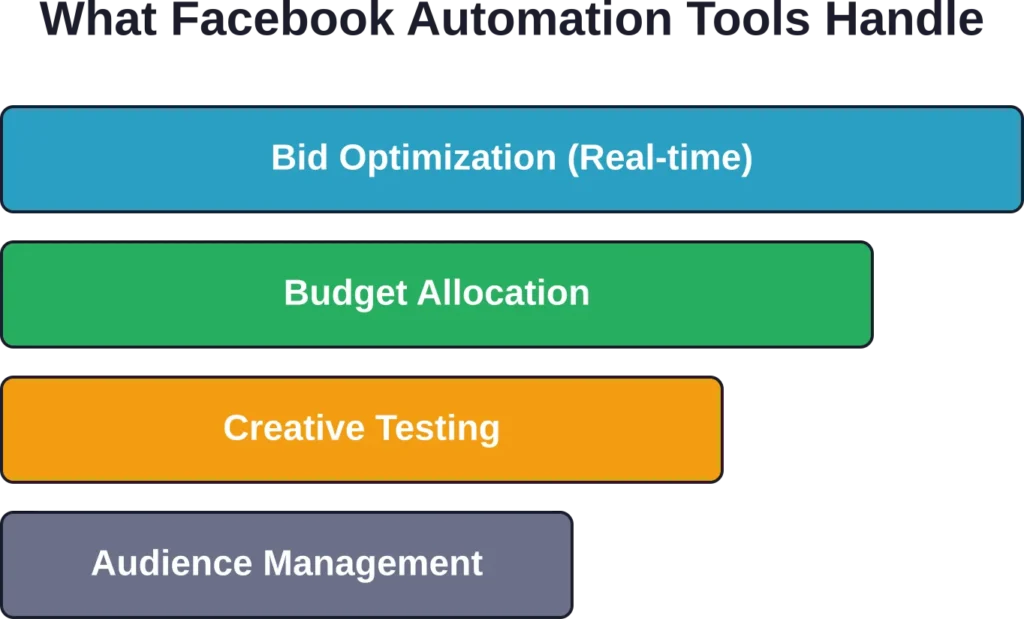
Facebook ads automation platforms handle five core tasks:
- Bid optimization — Automatically adjust bids based on performance data, time of day, audience segment, and conversion likelihood
- Budget allocation — Shift spend from underperforming campaigns to winners, respecting daily and monthly caps
- Creative testing — Launch new ad variations, measure performance, pause losers, and scale winners
- Audience management — Test new segments, consolidate underperforming ad sets, and manage overlap between audiences
- Performance reporting — Generate dashboards, send alerts when metrics cross thresholds, and consolidate data from multiple ad accounts
The sophistication varies dramatically. Some tools execute simple threshold rules (pause if CPA exceeds $50). Others use machine learning models to predict which creative will perform best with which audience segment at which time of day.
Types of Facebook Ads Automation Platforms
Automation tools fall into three categories, each with different philosophies about control and autonomy.
AI Agents (Autonomous Systems)
AI agents run campaigns with minimal human intervention. Advertisers set high-level goals—target CPA, monthly budget, audience constraints—and the AI makes tactical decisions.
These platforms use machine learning models trained on millions of ad campaigns. They predict which combinations of creative, audience, bid, and placement will hit target metrics.
The advantage: hands-off operation. An AI agent can manage 50 campaigns as easily as five. The disadvantage: less granular control. Advertisers who want to manually tweak bid caps or audience exclusions find AI agents restrictive.
Rule-Based Automation Engines
Rule engines let advertisers build “if this, then that” logic chains. The platform monitors campaigns and executes predefined actions when conditions are met.
Example rule: “If CPA exceeds $50 for 3 hours and ROAS drops below 2.0, then decrease budget by 20% and send Slack notification.”
Rule engines give advertisers more control than AI agents. They’re also more labor-intensive to set up and maintain. Each campaign objective needs custom rules, and those rules need adjustment as market conditions change.
Meta’s Native Automation Tools
Meta offers built-in automation through Advantage+ campaigns and automated rules in Ads Manager. These tools are free and deeply integrated with the platform.
Advantage+ shopping campaigns and app campaigns automate targeting, creative, and placement decisions. Advertisers provide creative assets and a budget; Meta handles the rest.
The limitation: Advantage+ works best for established accounts with substantial conversion data. New advertisers and those with complex attribution requirements often need third-party tools for more control.
Top Facebook Ads Automation Tools for 2026
The following platforms represent the current market leaders across different automation approaches and price points.
Synter – Cross-Platform AI Agent

Synter operates as an autonomous AI agent across 10+ advertising platforms including Meta, Google, Microsoft, LinkedIn, Reddit, X, TikTok, Amazon, Spotify, and DSP networks.
The platform starts at $199/month and uses natural language instructions. Advertisers describe goals in plain English—”keep CPA under $30 and spend $80/day on Facebook prospecting campaigns”—and the AI builds campaign structures and optimization rules accordingly.
Best for: Agencies and brands running coordinated campaigns across multiple platforms who want unified reporting and budget allocation.
Key strength: Cross-platform intelligence. Synter can shift budget from Facebook to Google if conversion rates improve there, something single-platform tools can’t do.
Limitation: Less granular control over Facebook-specific features like placement optimization and catalog setup. Advertisers who live exclusively in Meta’s ecosystem might find specialized tools more powerful.
Revealbot – Sophisticated Rule Engine

Revealbot excels at “if this, then that” automation. Advertisers can create complex rule chains with AND/OR operators, custom metrics, timeframes, and rank-based comparisons.
Pricing starts from $99/month. The platform supports Meta, Google, TikTok, and Snapchat campaigns from a single dashboard.
The bulk management features let advertisers execute changes across hundreds of campaigns simultaneously. Conditional logic is genuinely sophisticated—advertisers can create rules that reference other rules or compare performance across time periods.
Best for: Performance marketers who want precise control over optimization logic and don’t mind investing time in rule setup.
Key strength: Granular control. Advertisers can automate nearly any task they previously did manually, using exactly the logic they prefer.
Limitation: Requires ongoing maintenance. Rules that work well in Q4 might underperform in Q1. Advertisers need to audit and update rule sets regularly.
Madgicx – Creative Intelligence Platform
Madgicx focuses on creative automation and audience discovery. The platform analyzes ad creative to identify winning elements (colors, messaging, formats) and suggests new variations.
The audience launcher tests multiple cold audiences simultaneously and consolidates winners. The platform handles Meta and Google campaigns.
Best for: Direct-to-consumer brands and ecommerce advertisers who run continuous creative testing programs.
Key strength: Creative analysis at scale. Madgicx can identify that ads with blue backgrounds outperform red backgrounds for a specific audience segment—insights buried in data that manual analysis would miss.
Limitation: Meta-focused. Advertisers running significant spend on other platforms need additional tools.
AdEspresso – Split Testing Specialist
AdEspresso offers split testing and optimization tools for Facebook and Google campaigns. The platform lets advertisers test multiple variables simultaneously—headlines, images, audiences, placements—and automatically identifies winning combinations.
The interface is designed for small business owners and marketers new to paid social.
Best for: Small businesses and solo marketers who want structured testing without complex setup.
Key strength: User-friendly interface. AdEspresso abstracts away Facebook’s complexity, making campaign creation feel simple.
Limitation: Less sophisticated than enterprise platforms. Advertisers managing six-figure monthly budgets will outgrow the feature set.
Qwaya – Campaign Structure Automation
Qwaya focuses on campaign structure automation with pricing available upon request. The platform makes it easy to build complex campaign architectures with hundreds of ad sets organized by audience, placement, and objective.
The bulk creation tools let advertisers launch campaigns at scale without repetitive manual work.
Best for: Advertisers running seasonal campaigns or product launches that require dozens of variations deployed simultaneously.
Key strength: Template system for campaign creation. Advertisers can save proven structures and duplicate them with new creative in minutes.
Limitation: Meta-only. No cross-platform support.
| Platform | Type | Starting Price | Supported Platforms | Best For |
|---|---|---|---|---|
| Synter | AI Agent | $199/month | 10+ (Meta, Google, LinkedIn, TikTok, etc.) | Cross-platform campaigns |
| Revealbot | Rule Engine | $99/month | 4 (Meta, Google, TikTok, Snapchat) | Granular control |
| Madgicx | Creative Intelligence | Custom pricing | 2 (Meta, Google) | Creative testing |
| AdEspresso | Split Testing | Starting from ~$49/month | 2 (Meta, Google) | Small businesses |
| Qwaya | Campaign Structure | Available upon request | 1 (Meta only) | Bulk campaign creation |
| Meta Advantage+ | Native AI | Free | 1 (Meta only) | Established accounts with conversion data |
Choosing the Right Automation Tool
The best platform depends on budget, technical sophistication, and how much control the advertiser wants to retain.
Budget Considerations
Automation platforms typically charge monthly subscriptions based on ad spend managed. Pricing structures vary:
- Flat monthly fee — Fixed cost regardless of spend (common for tools under $200/month)
- Percentage of spend — Tool takes 2–5% of monthly ad spend (common for enterprise platforms)
- Tiered pricing — Different feature sets at different price points
For accounts spending over $5K monthly on Meta ads, the cost of automation typically ranges from $200–2,000 per month. Tools like Synter start at $199/month and the time savings alone — typically 10–15 hours per week — justify the investment for accounts spending $5K+ monthly.
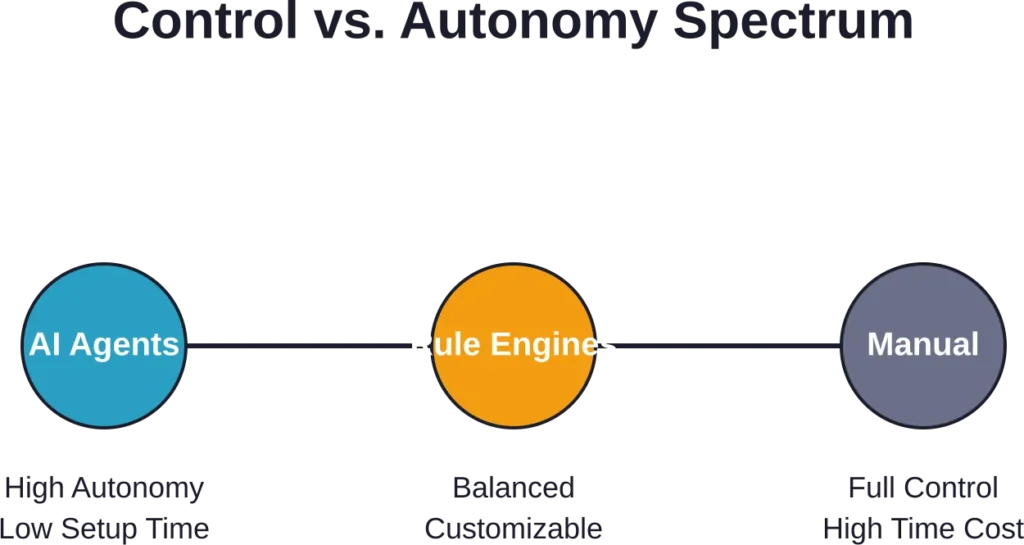
Control vs. Autonomy Trade-Off
Different advertisers want different levels of control. Some want simple threshold rules (pause if CPA exceeds $50). Others want complex conditional logic with custom metrics and multi-step workflows.
AI agents offer autonomy but less control. Rule engines offer control but require more setup time. The right choice depends on team structure and expertise.
Small teams benefit from AI agents that require minimal configuration. Large performance marketing teams with dedicated media buyers often prefer rule engines that let them implement proprietary optimization strategies.
Platform Coverage Needs
Advertisers running campaigns exclusively on Meta can choose from the full range of tools. Those running multi-platform campaigns need tools that support Google, TikTok, LinkedIn, and other networks.
Cross-platform tools cost more but provide unified reporting and budget allocation. Single-platform tools typically offer deeper feature sets for their specific network.
What Good Automation Platforms Must Do
Not all automation tools deliver on their promises. The best platforms share four characteristics.
Intelligent Budget Allocation
Monthly budgets that overspend or underspend by 20% are common with manual management. Good automation tools stay within tolerance while maximizing results.
The best platforms reallocate budget dynamically based on performance. If conversion rates spike on weekday mornings, the tool shifts spend toward those hours. If a specific ad set hits diminishing returns, budget flows to better opportunities.
Look for tools that respect hard caps (never exceed daily budget) while optimizing within constraints.
Audience Overlap Management
Facebook penalizes advertisers whose campaigns compete against themselves in auctions. Audience overlap causes this—when multiple ad sets target the same people, Facebook enters them into an internal auction that drives up costs.
Good automation tools manage audience overlap, test new segments systematically, and consolidate underperforming ad sets. Look for tools that handle Advantage+ audience expansion with guardrails advertisers control.
Creative Fatigue Detection
Showing the same creative too often kills performance. Declining click-through rates and rising cost per 1,000 impressions signal fatigue.
The best automation platforms detect fatigue early and automatically rotate in fresh creative. Some tools even generate new variations by remixing existing assets—swapping headlines, testing different image crops, or reordering video clips.
Transparent Reporting
Automation shouldn’t be a black box. Advertisers need to understand what the tool did and why.
Look for platforms that log every action—budget changes, bid adjustments, creative swaps—with timestamps and explanations. Good reporting shows what the automation improved versus the manual baseline.
Getting Started with Facebook Ads Automation
Implementation typically follows a six-month evaluation period. Rushing into full automation before understanding how the tool works leads to problems.
Month 1: Setup and Baseline
Connect the automation tool to existing ad accounts but don’t enable automation yet. Spend the first month letting the platform collect data and learn campaign structures.
Document current performance: average CPA, ROAS, CPM, daily spend, time spent on manual optimization. These baseline metrics will measure whether automation delivers results.
Months 2-3: Limited Automation
Start with simple rules on low-risk campaigns. Common starting points:
- Pause ads when CPA exceeds 150% of target for 6+ hours
- Increase budgets 10% on ad sets with ROAS above target for 24 hours
- Send alerts when daily spend hits 80% of cap
Monitor results closely. Automation should improve performance, not just replicate what manual management already achieved.
Months 4-5: Expanded Automation
Add more sophisticated automation: creative rotation, audience testing, cross-campaign budget allocation.
This phase reveals whether the platform handles complexity well. Can it manage multiple objectives simultaneously? Does it optimize for long-term performance or just immediate metrics?
Month 6: Full Implementation
By month six, automation should handle most routine tasks. Human oversight shifts from tactical execution (adjusting bids) to strategic direction (setting targets, approving creative, analyzing trends).
The time savings should be measurable—10–15 hours per week is typical. Performance should improve or at minimum hold steady while freeing up time for higher-value work.
Common Mistakes to Avoid
Automation can backfire when implemented poorly. These mistakes are common and avoidable.
Over-Automation Too Quickly
Letting an AI agent take over 50 campaigns on day one is asking for trouble. Start small, measure results, expand gradually.
The platforms that work best are those that let advertisers dial automation up incrementally—from simple alerts to partial automation to full autonomy over time.
Ignoring Data Quality
Automation is only as good as the data it learns from. If conversion tracking is broken, the AI will optimize toward the wrong goal.
Before implementing automation, audit tracking: Are all conversions being captured? Is the attribution window correct? Are offline conversions being imported?
Setting Unrealistic Targets
Telling an AI agent to achieve $30 CPA when the account has never delivered below $45 CPA won’t work. The tool will either fail to spend budget or deliver poor-quality conversions.
Automation works best when targets are aggressive but achievable based on historical performance. A good rule: set targets 10–20% better than the current baseline.
Neglecting Creative Refresh
No automation tool can fix stale creative. If ads haven’t been updated in six months, performance will decline regardless of bid optimization.
Automation handles the tactical work—bidding, budgeting, placement—but creative strategy still requires human judgment. Plan to refresh creative monthly at minimum.
Meta’s Native Automation vs. Third-Party Tools
Meta offers free automation through Advantage+ campaigns and automated rules in Ads Manager. When should advertisers use native tools versus paying for third-party platforms?
When Native Automation Works
Advantage+ shopping campaigns and app campaigns work well for established accounts with substantial conversion data. Meta’s algorithm learns from past performance and optimizes toward similar results.
Advertisers with simple objectives—maximize purchases, drive app installs—often get good results from native automation without additional tools.
The limitations appear when campaigns need complex customization. Advantage+ doesn’t support custom audience exclusions, placement controls, or bid caps in the same granular way manual campaigns do.
When Third-Party Tools Add Value
Third-party platforms shine in several scenarios:
- Multi-platform campaigns — Meta’s tools don’t optimize across Google, TikTok, and LinkedIn
- Custom attribution — Advertisers using server-side tracking or multi-touch attribution need more control than Advantage+ provides
- Complex business rules — Budget caps per product category, geographic restrictions, or dayparting require custom logic
- Advanced reporting — Native reporting is basic; third-party tools offer custom dashboards and deeper analysis
The sweet spot: use native automation for straightforward campaigns and third-party tools for complex scenarios requiring customization or cross-platform coordination.

Future of Facebook Ads Automation
The automation landscape continues evolving rapidly. Three trends are shaping where the market goes next.
Generative AI for Creative Production
Current automation tools handle creative testing—launching variations, measuring performance, scaling winners. The next generation will create the variations themselves.
Generative AI can produce dozens of ad variations from a single brief: different headlines, visual styles, calls to action. The automation tool tests everything and identifies what works.
This shifts creative strategy from “make five ads” to “define the parameters and let AI generate 50 variations to test.”
Cross-Platform Budget Optimization
Most advertisers run campaigns on multiple platforms but optimize each in isolation. The next wave of automation tools will allocate budgets across platforms based on marginal return.
If the next $100 delivers better ROAS on Google than Facebook, the budget shifts there automatically. This requires unified tracking and sophisticated modeling—capabilities only enterprise platforms currently offer but that will become more accessible.
Predictive Performance Modeling
Current automation is reactive—it responds to performance changes after they happen. Predictive modeling anticipates changes before they occur.
Machine learning models can predict that CPMs will spike next week based on seasonal patterns and competitor activity. The automation preemptively adjusts bids and budgets to maintain target metrics through the volatility.
This moves from “respond to problems” to “prevent problems before they happen.”
Frequently Asked Questions
Pricing varies by platform and ad spend managed. Entry-level tools start around $44–49/month for basic split testing and scheduling. Mid-tier rule engines like Revealbot start at $99/month. AI agents and enterprise platforms range from $199–500+/month or charge a percentage of ad spend (typically 2–5%). Meta’s native Advantage+ automation is free. The right price point depends on monthly ad spend and complexity—accounts spending $5K+ monthly typically find $200–500/month automation costs easily justified by time savings.
Poorly configured automation can damage performance. Common issues include setting unrealistic targets that cause the tool to pause all campaigns, over-optimizing toward short-term metrics at the expense of long-term growth, and ignoring data quality issues that cause the AI to optimize toward the wrong goal. The risk is minimized by starting with limited automation on low-risk campaigns, monitoring results closely during the first 6 months, and maintaining human oversight of strategic decisions. Automation should handle tactical execution while humans set direction.
Automation changes what media buyers do, not whether they’re needed. Tactical tasks—bid adjustments, budget tweaks, pausing underperformers—get automated. Strategic work becomes more important: setting campaign objectives, defining target audiences, approving creative direction, analyzing competitive trends, and adjusting automation rules based on business goals. Experienced media buyers add the most value by configuring automation intelligently and identifying opportunities the AI misses. Teams typically save 10–15 hours per week on routine tasks and reinvest that time in higher-value analysis.
Initial setup typically takes 2–4 weeks as the platform connects to ad accounts and learns campaign structures. Performance improvements usually appear within 30–60 days as the automation accumulates enough data to make confident optimizations. Significant results—measurably better ROAS, lower CPA, or substantial time savings—typically emerge after 3–6 months of optimization. The timeline depends on ad spend volume (higher spend generates more data for faster learning), campaign complexity, and how well the automation is configured. Starting with simple rules on established campaigns produces faster results than complex logic on new accounts.
Rule-based tools execute predefined logic that advertisers create: “if CPA exceeds $50, then reduce budget by 20%.” The advertiser defines every condition and action. AI agents use machine learning to make autonomous decisions based on goals, not explicit rules. Advertisers set targets (keep CPA under $30) and the AI determines how to achieve them. Rule engines offer more control and transparency but require time to configure and maintain. AI agents are more hands-off but give advertisers less visibility into tactical decisions. The right choice depends on team sophistication and how much control the advertiser wants to retain.
Most third-party automation tools can monitor Advantage+ campaigns and adjust budgets, but they can’t modify the internal optimization that Meta’s AI handles. Advantage+ campaigns automate targeting, creative, and placement decisions within Meta’s algorithm, while third-party tools focus on budget allocation, performance alerting, and cross-campaign analysis. Many advertisers run a hybrid approach: use Advantage+ for creative testing and audience discovery, then use third-party tools to manage budgets across multiple Advantage+ campaigns and coordinate with non-Meta platforms. The tools complement each other rather than overlap.
The right optimization target depends on business goals. Ecommerce advertisers typically optimize toward ROAS (return on ad spend) or CPA (cost per acquisition). Lead generation campaigns optimize toward cost per qualified lead. Brand awareness campaigns optimize toward reach and frequency. The critical detail: optimize toward business outcomes, not vanity metrics. Clicks and impressions don’t matter if they don’t drive revenue. Most automation platforms support custom conversion events, so advertisers can optimize toward high-value actions like purchases over $100 or leads from specific industries rather than all conversions equally.
Final Recommendations
The best Facebook ads automation tool depends on specific needs, but general guidance holds across most scenarios.
Small businesses and solo marketers (under $10K monthly spend): Start with AdEspresso for simple split testing or Meta’s native Advantage+ campaigns. Both offer meaningful automation without complex setup.
Mid-market advertisers ($10K–100K monthly spend): Revealbot provides the best balance of control and automation. The rule engine handles most optimization tasks while giving advertisers granular control over logic.
Agencies and multi-platform advertisers (over $100K monthly spend): Synter’s cross-platform AI agent or similar enterprise tools deliver unified optimization across Meta, Google, and other networks. The higher price is justified by consolidated reporting and intelligent budget allocation.
Ecommerce brands focused on creative testing: Madgicx offers specialized features for identifying winning creative elements and scaling successful ads.
The manual approach doesn’t compete in 2026. Rising costs mean advertisers can’t absorb increasing CPMs through budget increases alone. Efficiency gains from automation are no longer optional.
Start with limited automation, measure results rigorously, and expand as confidence builds. The 10–15 hours saved weekly and the performance improvements from faster optimization response times justify the investment for any account spending more than $5K monthly.
Check each platform’s current pricing and feature availability on their official websites—automation tools update frequently and what’s accurate in May 2026 may change by next quarter.