
Quick Summary: The best creative web design agencies in 2026 combine technical excellence with artistic vision to deliver websites that drive conversions. This guide profiles 15 leading agencies—from ThunderClap and Digital Silk to Excited and Clay—each bringing unique strengths in UX research, brand strategy, and innovative design. Choosing the right partner depends on project scope, industry focus, and design philosophy.
Finding a web design agency that can translate brand vision into digital reality isn’t easy. Browse enough portfolios and the distinctions blur. Beautiful hero sections? Check. Smooth animations? Everywhere. Bold typography? Standard issue.
But here’s the thing—creative web design goes deeper than aesthetics. It’s the strategic thinking that makes a homepage convert. The UX research that guides navigation structure. The technical execution that turns concept sketches into responsive, accessible interfaces.
The agencies profiled here have earned recognition not just for visual polish, but for solving complex design problems. Some specialize in SaaS products that need to simplify dense feature sets. Others build e-commerce experiences that drive measurable revenue growth. A few focus exclusively on brand-first digital experiences for enterprise clients.
This list cuts through the noise. No fluff, no invented metrics—just 15 agencies with verified portfolios, real client results, and distinct creative approaches.
What Makes a Web Design Agency “Creative”?
The term “creative agency” gets thrown around freely. In practice, it signals a few specific capabilities that separate strategic design studios from template-driven dev shops.
Creative agencies typically lead with design thinking. They invest time in discovery—researching user behavior, mapping customer journeys, defining brand positioning before touching design tools. That upfront work shapes everything downstream.
They also tend to maintain in-house multidisciplinary teams. Art directors, UX researchers, motion designers, brand strategists, and front-end developers collaborate under one roof. This integration produces more cohesive work than the typical handoff model where design and development operate in silos.
Core Services Creative Agencies Provide
Most creative web design agencies offer an overlapping set of services, though emphasis varies by shop:
- UI/UX Design: Interface design grounded in user research, wireframing, prototyping, and usability testing
- Brand Identity: Logo design, typography systems, color palettes, brand guidelines, and visual language development
- Web Development: Front-end engineering, CMS integration, responsive implementation, and performance optimization
- Motion Design: Micro-interactions, scroll animations, transitions, and branded motion systems
- Content Strategy: Information architecture, messaging frameworks, and editorial planning
The best agencies don’t just execute in these areas—they connect them. Brand identity informs interface design. Motion design reinforces interaction patterns. Content strategy shapes page structure.
How to Choose the Right Creative Agency
Selecting an agency starts with honest assessment of project needs and internal capabilities. A startup launching an MVP has different requirements than an enterprise brand refreshing a 200-page website.
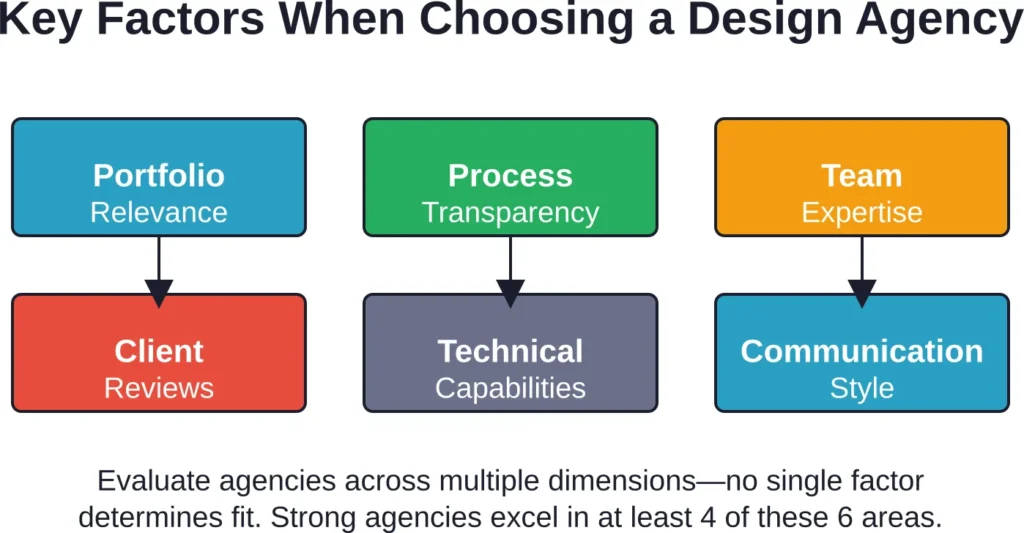
Portfolio quality matters, but relevance matters more. Look for work in similar industries or with comparable complexity. An agency that designs beautifully for B2C e-commerce might struggle with B2B SaaS product interfaces—different users, different goals, different constraints.
Process transparency is another key indicator. Strong agencies document their methods: how they conduct research, structure design sprints, handle revisions, and measure success. Vague promises about “collaboration” and “innovation” should raise flags.
Questions to Ask During Agency Selection
Initial conversations reveal a lot about how an agency operates. Some questions worth asking:
- What does the typical project timeline look like from kickoff to launch?
- How are revisions structured—unlimited rounds or defined stages?
- Who owns the design files and code after project completion?
- What happens if the project scope changes midway through?
- Can the agency provide references from clients with similar project types?
Agencies that answer these clearly and specifically tend to run tighter projects. Vague responses often signal operational immaturity or past client conflicts.
Top 15 Creative Web Design Agencies in 2026
The agencies below represent diverse approaches to creative web design. Some focus on product design for SaaS companies. Others specialize in brand-driven experiences for enterprise clients. A few bridge both worlds.
What they share: proven ability to execute complex projects, portfolios recognized by industry organizations like Awwwards, and business models built on strategic design rather than commodity execution.
1. Mobian Studio
Mobian Studio builds dedicated engineering teams that deliver production-ready digital products with excellent design execution. The agency specializes in mobile and web solutions for IT, fintech, healthcare, and logistics companies that demand both speed and quality.
Their approach centers on end-to-end product development, scalable architecture, and thoughtful interfaces that enhance user engagement. Mobian creates clean, modern digital experiences from concept to launch, with particular strength in mobile applications and AI-enhanced interfaces.
The studio excels at turning complex product requirements into intuitive, well-designed solutions.
What Mobian Studio Does Best:
- End-to-end creative product design and development
- Mobile-first web and application experiences
- AI-powered interfaces and user-centered digital solutions
- Scalable architecture with polished interaction design
Mobian delivers production-ready digital products that combine strong engineering with creative, user-focused design.
Contact Information:
- Website: mobian.studio
- Phone: [email protected]
- Address: Harju maakond, Tallinn, Kesklinnalinnaosa, Masina tn 22, 10113
- LinkedIn: www.linkedin.com/company/mobian-studio
2. Lengreo
Lengreo positions itself as a complete marketing and tech partner that delivers high-converting digital experiences for B2B companies. The agency specializes in combining strategic digital marketing with professional website development to drive measurable business growth.
Their work focuses on lead generation and conversion optimization through tailored digital solutions. Clients have seen significant improvements, including 400% growth in annually acquired clients for a US software development company, over 6X reduction in cost per lead for a Dutch event technology company, and a 53.6% boost in conversion rates for a Ukrainian IT company.
Lengreo’s process integrates deep business analysis with creative website development, resulting in platforms that effectively attract and convert high-value prospects.
What Lengreo Does Best:
- B2B website development and landing pages with strong conversion focus
- Integrated digital marketing strategies and lead generation systems
- Hyper-personalized outreach and demand generation campaigns
- SEO-optimized websites that improve search visibility and performance
The agency excels at creating cohesive digital presences that support business development goals for tech and service companies.
Contact Information:
- Website: lengreo.com
- Phone: +31 686 147 566
- Email: [email protected]
- Address: Vrijstraat 9 C/D, 5611 AT Eindhoven, Netherlands
- LinkedIn: www.linkedin.com/company/lengreo
- Instagram: www.instagram.com/lengreo.agency
- Twitter: x.com/Lengreo
3. A-Listware

A-Listware is a software development and consulting partner that creates custom digital solutions with strong attention to user experience and interface design. The agency supports businesses with tailored web applications, UX/UI design, and complete digital transformations.
They specialize in building enterprise applications, custom software, and user-friendly platforms that streamline operations while maintaining visual appeal and usability. Their work covers everything from cloud applications to modern web solutions designed for scalability and engagement.
A-Listware focuses on delivering polished, functional digital experiences that align with business objectives.
What A-Listware Does Best:
- Custom software and web application development with creative design
- UX/UI design for enterprise and business platforms
- Cloud-based digital solutions with strong user interfaces
- Legacy modernization with improved user experience focus
The agency serves as a reliable partner for companies seeking high-quality digital products that balance creativity and technical performance.
Contact Information:
- Website: a-listware.com
- Phone: +1 (888) 337 93 73
- Email: [email protected]
- Address: North Bergen, NJ 07047, USA
- LinkedIn: www.linkedin.com/company/a-listware
- Facebook: www.facebook.com/alistware
4. Gilzor
Gilzor creates custom digital products with a strong emphasis on user-centered design and seamless experiences. The studio helps startups and growing businesses launch and scale through thoughtful web and mobile solutions that prioritize both aesthetics and performance.
Their approach combines UI/UX design, product validation, and full-cycle development to deliver solutions that resonate with users and drive business results. Projects include e-commerce platforms, mobile applications, and specialized tools that enhance user engagement and operational efficiency.
Gilzor focuses on building attractive, functional digital products that connect brands with their audiences through clean design and intuitive interfaces.
What Gilzor Does Best:
- Custom web and mobile application design with user-centric focus
- UI/UX design that improves conversion rates and user satisfaction
- Product idea validation and go-to-market digital strategies
- Full-cycle development of engaging digital experiences
The studio delivers creative digital solutions that help businesses stand out through quality design and technical excellence.
Contact Information:
- Website: www.gilzor.com
- Email: [email protected]
- Address: Poland, Warsaw, Office 58, street Adama Mickiewicza 37, 01-625
- LinkedIn: www.linkedin.com/company/gilzor-softwaredevelopment
5. Oski
Oski builds smart, well-engineered digital solutions for forward-thinking enterprises and ambitious startups. With deep expertise in modern web technologies, the agency creates scalable digital experiences that combine creative design with robust functionality.
Their portfolio covers cloud solutions, frontend development, and AI-powered interfaces that deliver exceptional user experiences. Oski emphasizes innovative design, seamless integration, and performance-driven development across multiple industries including fintech, e-commerce, and logistics.
The agency’s strength lies in transforming complex requirements into intuitive, visually compelling digital platforms.
What Oski Does Best:
- Creative frontend and UI/UX design for complex web applications
- Scalable web solutions with modern cloud architecture
- AI-enhanced digital experiences and interfaces
- Custom CMS and e-commerce platform development
Oski delivers high-quality digital products that help businesses operate more effectively through thoughtful design and technology.
Contact Information:
- Website: oski.site
- Phone: +48571282759
- Email: [email protected]
- Address: Kaupmehe tn 7, 10114 Tallinn, Estonia
- LinkedIn: www.linkedin.com/company/oski-solutions
6. Instrument

Instrument positions itself at the intersection of brand, product, and business strategy. The Portland-based agency has worked with clients like Google, Levi’s, and Nike, building digital experiences that balance creative expression with commercial objectives.
The studio’s process begins with strategic discovery—understanding market positioning, competitive landscape, and user needs before moving into design. This foundation shapes everything downstream, ensuring creative decisions support business goals rather than existing independently of them.
Instrument’s portfolio demonstrates particular strength in creating brand systems that work across touchpoints. Visual languages, interaction patterns, and content strategies remain consistent whether users encounter the brand on web, mobile, or physical retail environments.
What Instrument Does Best:
- Brand strategy and positioning for consumer brands
- Multi-platform design systems
- Product design for consumer-facing applications
- Content strategy and digital storytelling
Consumer brands looking to elevate their digital presence while maintaining brand consistency will find Instrument’s integrated approach valuable.
7. Fantasy
Fantasy builds digital experiences for entertainment, sports, and cultural brands. The New York studio has created websites for the NBA, Netflix shows, musicians, and major sporting events. Their work emphasizes storytelling, immersive visuals, and scroll-driven narratives.
The agency’s portfolio features ambitious technical execution—parallax effects, video integration, WebGL animations, and custom interactive elements. Projects often push the boundaries of what’s possible in the browser, prioritizing impact over conservative best practices.
This approach works brilliantly for launch campaigns, artist sites, and event promotion where the website itself becomes an experience. It’s less appropriate for utility-focused applications where performance and accessibility trump visual spectacle.
What Fantasy Does Best:
- Entertainment and cultural brand experiences
- Event and product launch microsites
- Scroll-driven storytelling and narrative design
- Advanced front-end animation and interaction
Brands that need their website to generate buzz and media coverage will appreciate Fantasy’s cinematic approach. Product companies focused on conversion metrics might find the aesthetic overblown.
8. Locomotive
Montreal-based Locomotive has earned multiple Awwwards and recognition for technical innovation in web development. The studio specializes in creating smooth, performant animation systems that enhance rather than distract from content.
Locomotive’s signature contribution to the web design community is their open-source scroll library, used by developers worldwide to create sophisticated scroll-based animations. This technical depth informs all their client work—projects run smoothly even with complex interactions.
The agency serves a mix of cultural institutions, lifestyle brands, and tech companies. Projects balance aesthetic ambition with technical constraints, resulting in sites that look impressive while maintaining fast load times and accessibility standards.
What Locomotive Does Best:
- Performance-optimized animation systems
- Custom scroll interactions and transitions
- Creative development for cultural institutions
- Technical innovation in front-end engineering
Brands that want cutting-edge interactions without sacrificing performance will find Locomotive’s engineering-forward approach valuable.
9. Ueno
Ueno maintains its identity as a design-focused studio creating brand-driven digital products. The agency’s portfolio spans startups and enterprises, with work for companies like Google, Medium, and Uber.
Ueno’s process emphasizes tight collaboration with product teams. Rather than delivering static designs for developers to interpret, Ueno designers often work directly in code, prototyping interactions and refining details through iteration. This approach produces more polished final products.
The studio’s visual style tends toward bold typography, generous white space, and thoughtful micro-interactions. Projects feel modern without chasing trends, focusing on clarity and usability alongside aesthetic appeal.
What Ueno Does Best:
- Product design for consumer and B2B applications
- Brand identity and visual language development
- Design-development collaboration and prototyping
- Interface design with attention to detail
Product teams looking for design partners that understand engineering constraints and work collaboratively will benefit from Ueno’s integrated approach.
10. Design Monks
Design Monks operates as a global design agency with expertise in web design, branding, and digital marketing. The studio has worked with clients across industries, from startups to established brands, delivering projects that balance creative vision with commercial objectives.
The agency’s service offering spans the full spectrum of digital needs—brand strategy, UI/UX design, web development, SEO optimization, and ongoing maintenance. This comprehensive approach appeals to clients who prefer a single partner managing their digital presence rather than coordinating multiple specialists.
Design Monks has built a reputation for responsive communication and iterative processes. Client feedback gets incorporated quickly, and projects move forward through regular check-ins rather than long silences followed by big reveals.
What Design Monks Does Best:
- Full-service web design and branding
- Responsive design and mobile optimization
- SEO-integrated web design
- Ongoing website maintenance and updates
Small to mid-size businesses looking for an accessible, responsive design partner without enterprise agency overhead will find Design Monks’ approach practical and effective.
11. ThunderClap
ThunderClap positions itself as a conversion-focused design agency for B2B SaaS and fintech companies. The studio has managed over 70 B2B SaaS and fintech clients, accumulating deep expertise in lead generation and product marketing sites.
The agency’s approach emphasizes measurable outcomes. According to their published case data, clients report a 50% increase in lead generation. For SaaS companies where website performance directly impacts pipeline, those metrics matter.
ThunderClap’s process centers on what they call “structured design systems”—reusable component libraries that maintain consistency across pages while enabling rapid iteration. This methodology works particularly well for product companies that need to launch quickly and test messaging variations.
What ThunderClap Does Best:
- High-converting landing pages for B2B SaaS products
- Conversion rate optimization through design iteration
- Fast turnaround on marketing site updates and A/B test variations
- Design systems that scale with product growth
The studio maintains a tight focus on B2B tech. Companies outside that sector might find better fit elsewhere, but for SaaS startups and fintech platforms, ThunderClap’s specialized expertise delivers.
12. Digital Silk
Forbes named Digital Silk as the best Web Design Company for eCommerce in 2024, and the agency has continued that momentum into 2026. With a large team of designers and developers, Digital Silk operates at enterprise scale while maintaining creative standards.
Their portfolio demonstrates particular strength in e-commerce redesigns that drive revenue growth. One published case study for Absolute Dogs, a Shopify-based pet training site, generated a 5.9% increase in new users, a 32.4% rise in organic search sessions, and a 77.88% boost in add-to-cart actions. Another project for Rollink, a luggage brand, delivered 500% revenue growth.
Digital Silk’s service offering extends beyond design into branding, digital marketing, and custom development. This full-service model appeals to brands that want a single partner for their entire digital presence rather than coordinating multiple vendors.
What Digital Silk Does Best:
- E-commerce platform redesigns with conversion focus
- Enterprise-scale branding and digital transformation projects
- Integrated marketing and SEO alongside design
- Custom development for complex technical requirements
The agency’s size enables them to handle large, complex projects that smaller studios can’t resource. Brands undergoing major digital overhauls benefit from that capacity.
13. Excited Agency
Excited Agency takes a product-first approach to web design, focusing on clarity, structure, and conversion rather than purely decorative aesthetics. Based in Ukraine, the studio has built a portfolio centered on SaaS products and digital platforms.
The agency’s methodology combines UX research, web design, branding, and motion design into cohesive systems that scale with product evolution. Rather than delivering a static website, Excited creates design frameworks that accommodate feature additions and messaging pivots without requiring full redesigns.
Excited Agency has received positive reviews for its product design approach, with particular praise for their ability to translate complex product requirements into intuitive user interfaces. The studio works well with technical founders who need design partners that understand product development cycles.
What Excited Agency Does Best:
- Product-focused web design for SaaS platforms
- UX research and user testing integration
- Design systems that evolve with product roadmaps
- Motion design that reinforces interaction patterns
Companies looking for surface-level redesigns won’t find it here. Excited’s strength lies in strategic product design that addresses underlying UX problems.
14. Clay
Clay operates at the high end of the web design market, working with brands like Coca-Cola, Slack, and Snapchat. The San Francisco-based agency combines brand strategy, UI/UX design, and technical development with an emphasis on craft and attention to detail.
The studio’s portfolio showcases work that balances business objectives with creative ambition. Projects often feature custom illustrations, sophisticated animation systems, and thoughtful micro-interactions. This level of polish requires time and budget—Clay typically works on projects with significant scope.
What sets Clay apart is their integration of brand thinking into every interface decision. Color palettes, typography, layout systems, and interaction patterns all reinforce brand positioning. For companies where digital presence is a core brand expression, that strategic layer matters.
What Clay Does Best:
- Brand-driven digital experiences for enterprise clients
- Custom illustration and visual storytelling
- Sophisticated animation and interaction design
- Strategic positioning and messaging development
Clay’s client roster skews toward established brands with mature marketing organizations. Early-stage startups will likely find better budget alignment elsewhere.
15. Code and Theory
Code and Theory operates as a full-service digital agency across multiple offices. The New York-based firm handles everything from brand strategy and creative campaigns to product design and enterprise software development.
The agency’s scale enables them to take on massive digital transformation projects. They’ve built platforms for major media companies, redesigned e-commerce experiences for global retailers, and created digital products for Fortune 500 clients. Projects often involve complex technical requirements alongside creative work.
Code and Theory’s approach emphasizes “making things that make things better”—using design and technology to solve business problems rather than pursuing creativity for its own sake. This pragmatic philosophy resonates with enterprise clients focused on measurable outcomes.
What Code and Theory Does Best:
- Digital transformation for large organizations
- Complex web applications and platforms
- Integrated campaigns across digital channels
- Enterprise software interface design
Small projects aren’t a fit. Code and Theory’s infrastructure and process overhead make sense for substantial engagements with multi-phase timelines.
Creative Web Design Trends Shaping 2026
Design trends emerge from technological capabilities, cultural shifts, and evolving user expectations. A few patterns have gained traction across the creative web design community in 2026.
AI-Assisted Design Tools
Generative AI has moved from experimental to production use in design workflows. Agencies now use AI tools for rapid wireframe generation, design variation exploration, and content placeholder creation. This accelerates early-stage ideation without replacing human design judgment.
The technology hasn’t eliminated the need for skilled designers—it’s shifted their focus toward strategic decisions, critique, and refinement rather than manual execution of repetitive tasks. Agencies that have integrated AI thoughtfully report faster project timelines without quality compromise.
Micro-Interactions and Delight
Subtle animations and interaction feedback continue to mature. The best implementations feel almost invisible—hover states that provide just enough visual response, transitions that guide attention without demanding it, loading indicators that reduce perceived wait time.
These details accumulate into an overall impression of polish and care. Users might not consciously notice individual micro-interactions, but they perceive the resulting experience as more refined than sites lacking them.
Performance as a Design Constraint
With Core Web Vitals influencing search rankings and users abandoning slow sites, performance has become a design deliverable rather than just an engineering problem. Leading agencies now optimize for speed during the design phase—choosing image formats, limiting animation complexity, and planning component architecture with load time in mind.
This shift requires designers to understand technical constraints. The agencies doing it well have broken down traditional design-development silos, enabling earlier collaboration on performance tradeoffs.
Inclusive Design and Accessibility
Accessibility is moving from compliance checkbox to fundamental design principle. Agencies now consider color contrast, keyboard navigation, screen reader compatibility, and cognitive load during initial design rather than retrofitting accessibility after development.
This approach produces better outcomes for everyone—designs that work for users with disabilities typically work better for all users. Clear hierarchy, readable typography, and logical navigation benefit everyone, not just those using assistive technology.
| Design Trend | Key Benefit | Implementation Challenge |
|---|---|---|
| AI-Assisted Design | Faster ideation and iteration | Maintaining creative quality control |
| Micro-Interactions | Enhanced perceived quality | Performance optimization |
| Performance Focus | Better SEO and user retention | Balancing aesthetics with speed |
| Inclusive Design | Broader audience reach | Testing across diverse scenarios |
| Component Systems | Consistency and scalability | Initial setup investment |
What to Expect During a Web Design Project
Understanding typical project phases helps set realistic expectations. While specific agencies vary in their process, most creative web design projects follow a similar arc.
Discovery and Strategy
Projects typically begin with research and planning. The agency gathers information about business goals, target users, competitive landscape, and technical constraints. This phase might include stakeholder interviews, user research, content audits, and analytics review.
Strong discovery produces clear design direction. Without it, projects tend to drift as stakeholders debate subjective preferences rather than evaluating designs against defined criteria.
Concept Development
Once strategy is defined, designers explore visual directions. This phase typically yields multiple design concepts showing different approaches to layout, typography, color, and overall aesthetic. Concepts often focus on key templates—homepage, product page, article page—rather than designing every possible page upfront.
Effective concept presentations explain the thinking behind design decisions. Why this color palette? How does the layout hierarchy support user goals? What does the visual style communicate about the brand?
Design Refinement
After selecting a direction, designers flesh out the full site. This includes designing additional templates, defining interaction patterns, creating component libraries, and establishing responsive behavior. Revision rounds address feedback and refine details.
The number of revision rounds varies by engagement. Some agencies offer unlimited revisions within defined project phases. Others structure specific feedback stages. Clarify this upfront to avoid late-project conflicts.
Development and Launch
With designs approved, developers translate mockups into functional code. Quality agencies test across devices and browsers, optimize performance, implement analytics tracking, and handle deployment logistics. Post-launch support addresses bugs and minor adjustments discovered after the site goes live.
Communication cadence matters during development. Regular progress check-ins prevent last-minute surprises and allow course correction if technical constraints require design adjustments.
Measuring Web Design Success
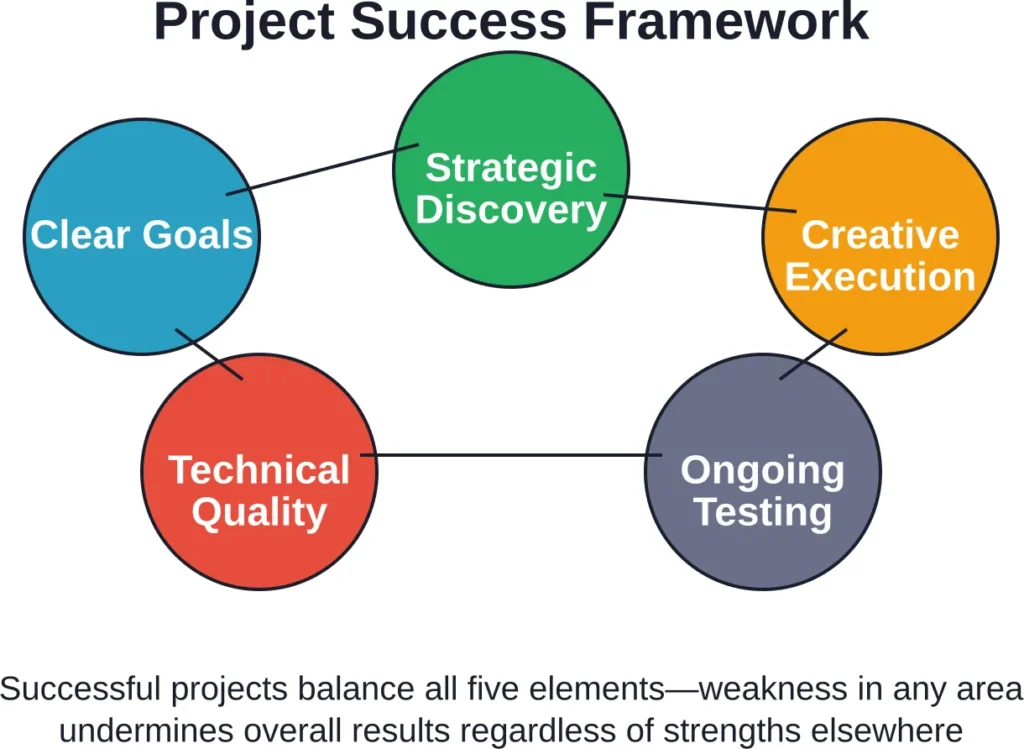
Beautiful design means nothing if it doesn’t support business objectives. The best agencies define success metrics upfront and track them post-launch.
Conversion Metrics
For commercial sites, conversion rates provide the clearest success indicator. Are more visitors completing desired actions—signing up, making purchases, requesting demos, downloading resources? A/B testing different design variations can isolate which elements drive performance.
Context matters when evaluating conversion data. A 2% conversion rate might be excellent for high-ticket B2B sales but terrible for e-commerce. Compare against industry benchmarks and baseline performance rather than arbitrary targets.
Engagement Signals
Time on site, pages per session, scroll depth, and video completion rates indicate whether content holds attention. Low engagement might signal unclear value proposition, poor information architecture, or content that doesn’t match visitor intent.
These metrics work best in combination. High time on site could mean users are engaged—or that they can’t find what they need. Cross-reference engagement data with conversion rates and user feedback for accurate interpretation.
User Feedback
Qualitative input complements quantitative metrics. User testing sessions, support ticket analysis, and feedback surveys reveal friction points that analytics alone might miss. Users can tell you when something confuses them—data just shows them leaving.
The most valuable feedback comes from actual users rather than internal stakeholders. Everyone has design opinions, but only users’ opinions impact business outcomes.
Common Web Design Project Pitfalls
Even with experienced agencies, certain problems recur. Awareness helps avoid them.
Scope Creep
Projects expand as new ideas emerge. “While we’re at it, let’s also redesign the blog. And add a customer portal. And build a mobile app.” Each addition delays launch and strains budget. Define scope clearly upfront and address changes through formal change orders rather than informal additions.
Design by Committee
When too many stakeholders have approval authority, projects bog down in conflicting feedback. Establish a clear decision-maker and limit the number of voices in design reviews. Everyone can provide input, but one person needs final say.
Ignoring Content Until the End
Design and content development should happen in parallel. Placeholder text and designs that assume ideal content length fall apart when real copy arrives. Involve copywriters early and design with actual content whenever possible.
Inadequate Testing
Designs that work beautifully on a designer’s 27-inch monitor might break on mobile devices or older browsers. Comprehensive testing across devices, browsers, and connection speeds catches problems before users encounter them. Budget time for this—it’s not optional.
Building Long-Term Agency Relationships
The best client-agency relationships extend beyond individual projects. Agencies that understand business context, brand history, and team dynamics deliver better work over time.
Consider retainer arrangements for ongoing design needs—landing page updates, campaign creative, A/B test variations, and continuous optimization. Monthly retainers typically cost less than project-based work while providing consistent access to design resources.
Strong relationships require clear communication from both sides. Share business context, market changes, and strategic shifts so the agency can anticipate needs. Agencies should proactively bring ideas rather than waiting for assignments.
Industry Recognition and Awards
Design awards from organizations like Awwwards provide useful signals about agency capabilities. Awwwards evaluates sites based on design, usability, creativity, and content—recognizing work that pushes boundaries while remaining functional.
Multiple agencies on this list have earned Awwwards recognition. Clou received Site of the Day recognition on Sep 5, 2025. Mad Creative Agency earned an Honorable Mention on Apr 19, 2026. These accolades validate technical and creative execution against industry standards.
That said, awards shouldn’t be the only evaluation criteria. An agency with a shelf full of trophies but no relevant portfolio work in your industry might deliver less value than a specialized boutique with fewer awards but deep sector expertise.
Look at awarded projects in context. Does the work solve real business problems, or is it purely experimental? Some award-winning sites sacrifice usability for visual impact—impressive to look at but frustrating to use. The best work balances both.
Frequently Asked Questions
Web design agencies focus on user experience, visual design, brand expression, and strategic planning. Development companies emphasize technical implementation, infrastructure, security, and back-end systems. Many agencies offer both services under one roof, but specialization varies. Creative agencies typically lead with design thinking and bring in development capabilities to execute the vision, while development-focused firms start with technical requirements and add design support.
Project duration depends on scope and complexity. A straightforward marketing site might take 8-12 weeks from kickoff to launch. Complex e-commerce platforms or web applications often require 4-6 months or longer. Enterprise projects with extensive requirements and stakeholder coordination can extend to a year or more. Agencies should provide timeline estimates during initial conversations based on specific project parameters.
Geographic proximity matters less than it once did. Remote collaboration tools enable effective partnerships regardless of location. That said, some clients prefer local agencies for easier in-person meetings, especially during discovery and strategy phases. Consider time zone alignment—working with an agency eight hours ahead or behind can slow communication. Evaluate agencies based on portfolio fit, process, and communication style rather than location alone.
Review portfolio work for aesthetic alignment, but look deeper than surface style. Strong agencies adapt their approach to each client’s needs rather than stamping every project with a house style. During initial conversations, ask how they approach brand expression and customization. Agencies should demonstrate ability to translate brand strategy into visual design rather than imposing predetermined aesthetics.
Typical deliverables include design files (Figma, Sketch, or Adobe XD), front-end code (HTML, CSS, JavaScript), content management system integration, style guides documenting design patterns, and documentation covering site architecture and functionality. Clarify ownership and usage rights upfront—some agencies retain design file ownership while providing clients with full code and content access. Ensure contracts specify exactly what you’ll receive and in what formats.
Most agencies offer post-launch support through retainer agreements or hourly arrangements. Services typically include content updates, security patches, performance monitoring, A/B testing, and iterative improvements based on user data. Scope and cost vary widely—some agencies provide comprehensive managed services while others focus purely on design and development work. Discuss ongoing needs during initial conversations to ensure the agency can support long-term requirements.
Budgets vary enormously based on scope, complexity, and agency positioning. Small business marketing sites might start around a few thousand dollars with freelancers or smaller studios. Mid-market projects with custom design and development typically fall in a broader range. Enterprise projects with the top agencies often reach into six figures. Rather than starting with a fixed number, define project requirements and goals, then get quotes from agencies that fit the profile. Many agencies can adjust scope to align with budget constraints.
Conclusion
Selecting a creative web design agency isn’t about finding the “best” studio in absolute terms. It’s about matching capabilities to specific needs, aligning process with internal culture, and choosing partners whose work demonstrates understanding of the industry and users.
The agencies profiled here represent diverse approaches—from conversion-focused SaaS specialists like ThunderClap to brand-driven creative studios like Clay and Instrument. Some excel at e-commerce optimization, others at enterprise digital transformation, still others at culturally ambitious brand experiences.
Start by defining what success looks like for the project. Clear goals enable evaluation of agency portfolios against relevant criteria rather than subjective aesthetic preferences. A studio that creates stunning work for entertainment brands might struggle with B2B SaaS interfaces—and vice versa.
Look for demonstrated expertise in similar projects. Review case studies for process transparency, problem-solving approach, and measurable outcomes. Ask questions about revision policies, communication cadence, and post-launch support. Strong agencies answer these clearly and specifically.
Remember that great design isn’t purely visual. It’s strategic thinking translated into interface decisions. User research informing navigation structure. Brand positioning expressed through color, typography, and tone. Technical execution that makes interactions feel effortless.
The right agency becomes a long-term partner, not just a vendor. They learn business context, anticipate needs, and proactively suggest improvements. Building that relationship starts with choosing an agency whose values, process, and expertise align with project requirements and company culture.
Ready to start the search? Review portfolios from the agencies listed here. Reach out to those whose work resonates and whose specializations match project needs. Schedule discovery calls. Ask tough questions. The investment in finding the right partner pays dividends in project outcomes and working relationship quality.