

Quick Summary: The best custom web design and development companies combine strategic thinking, technical excellence, and creative innovation to deliver websites that drive business results. This curated list features 15 leading agencies—from boutique studios to enterprise-level firms—each bringing unique strengths in custom development, user experience design, and digital transformation.
Finding the right web design company can make or break an online presence. The difference between a generic template and a custom-built website is starkly visible in performance, user engagement, and conversion metrics.
But here’s the thing—not all agencies calling themselves “custom” actually deliver bespoke solutions. Some rely heavily on pre-built frameworks. Others excel at design but falter on technical implementation.
This guide cuts through the noise. The 15 agencies featured here have demonstrated consistent excellence in custom web design and development across multiple projects and client types. No fluff, no fabricated rankings—just agencies that have proven their capabilities through real-world work.
What Makes a Web Design Company Truly Custom
Custom web design goes far beyond selecting a premium WordPress theme. Real custom work means building from the ground up—tailored architecture, bespoke functionality, and unique user experiences that align precisely with business objectives.
The term “custom” gets thrown around liberally in the web design industry. Many companies that advertise custom services actually deliver semi-custom solutions: modified templates with personalized branding. Nothing inherently wrong with that approach for certain projects, but it’s not the same as true custom development.
Genuine custom agencies typically offer several distinguishing characteristics. They conduct extensive discovery phases, mapping business processes and user journeys before touching design tools. Their development teams work with modern frameworks and can build any functionality from scratch. They think strategically about scalability, integration capabilities, and long-term maintenance.
According to industry analyses, custom-built websites require significantly higher investment than template-based solutions. But they deliver measurably better results for businesses with specific needs, complex requirements, or competitive markets where differentiation matters.
How This List Was Compiled
These 15 companies weren’t selected randomly. The evaluation process considered multiple factors: portfolio quality, technical capabilities, client reviews across platforms like Clutch, project complexity, industry recognition, and design innovation.
Each agency featured has completed multiple custom projects—not just one or two showcase pieces. They maintain consistent quality standards. Their client testimonials reflect satisfaction with both process and outcomes.
The list intentionally includes different agency types. Some specialize in enterprise-level transformations. Others focus on mid-market businesses or specific industries. This variety ensures readers can find agencies matching their project scope and budget range.
What’s deliberately excluded: pricing and hourly rates. These vary dramatically based on project scope, timeline, and specific requirements. More importantly, focusing on cost alone typically leads to poor hiring decisions. The right agency delivers value that far exceeds their fees.
The Top 15 Custom Web Design and Development Companies
1. Gilzor
Gilzor specializes in turning ambitious product ideas into polished digital realities through custom software development with a strong emphasis on web and mobile solutions. This global team creates tailored digital products that combine thoughtful design with robust technical implementation.
Their process begins with thorough idea validation and business analysis, followed by user-centric UI/UX design, development, and quality assurance. This integrated approach ensures every solution is built with both user needs and business objectives in mind, resulting in products that perform exceptionally well in real-world conditions.
The team excels at full-cycle web development, building scalable web applications, e-commerce platforms, and complex interactive systems. They work with modern technologies and maintain a keen focus on clean architecture, performance, and seamless user experiences across all projects.
Gilzor has delivered successful web and mobile solutions for clients in aviation, retail, healthtech, and various startups. Their portfolio includes systems that optimize operational processes, create new revenue channels, and deliver delightful user interfaces that drive engagement and growth.
This studio is an ideal partner for startups and small-to-medium businesses that need custom web solutions built with care and precision. Organizations that value both technical excellence and user-focused design appreciate Gilzor’s ability to deliver functional, attractive products that connect effectively with their audiences.
Contact Information:
- Website: www.gilzor.com
- Email: [email protected]
- Address: Poland, Warsaw, Office 58, street Adama Mickiewicza 37, 01-625
- LinkedIn: www.linkedin.com/company/gilzor-softwaredevelopment
2. Lengreo
Lengreo acts as a complete marketing and technology partner, delivering custom web development as part of comprehensive digital growth strategies. The agency creates purposeful websites and digital platforms designed to drive measurable business results for B2B companies.
Their approach combines deep business analysis and discovery with strategic prototyping, design development, and professional implementation. Rather than offering template solutions, Lengreo listens carefully to client needs and crafts tailored digital experiences that support specific marketing and sales objectives.
The team provides complete website development services including eCommerce platforms, business websites, portfolio sites, and high-converting landing pages. They focus on clean, functional design paired with strong technical foundations to ensure websites perform well for both users and search engines.
Lengreo has helped software development companies, architecture firms, event technology providers, and IT services businesses strengthen their online presence through custom web solutions that generate qualified leads and improve conversion rates.
The agency works best with growth-oriented B2B organizations that understand the importance of a custom-built website as a core business asset. Companies seeking a partner that combines strategic marketing thinking with professional web development find Lengreo’s integrated expertise particularly valuable.
Contact Information:
- Website: lengreo.com
- Phone: +31 686 147 566
- Email: [email protected]
- Address: Vrijstraat 9 C/D, 5611 AT Eindhoven, Netherlands
- LinkedIn: www.linkedin.com/company/lengreo
- Instagram: www.instagram.com/lengreo.agency
- Twitter: x.com/Lengreo
3. Mobian
Mobian builds dedicated engineering teams that deliver production-ready custom digital products with a focus on mobile and web solutions. The studio partners with companies in IT, healthcare, fintech, and logistics that require reliable, scalable technology.
Their delivery model emphasizes focused, dedicated teams working on single projects with full accountability for outcomes. From initial scoping through architecture, development, and post-launch support, Mobian maintains high standards in code quality, documentation, and clear communication throughout every engagement.
The team handles end-to-end product development, including complex web applications, modern interfaces, scalable backend systems, and seamless integrations. They excel at creating clean architecture that supports both current needs and future growth without requiring complete rebuilds.
Mobian has successfully delivered critical digital solutions for companies where technology execution directly impacts business performance. Their projects range from customer-facing web platforms to internal tools and specialized industry applications.
This partner suits organizations that need dependable custom web and digital product development without the overhead and risk of building large in-house teams. Companies that prioritize on-time delivery, technical quality, and long-term maintainability choose Mobian for their engineering excellence and practical approach.
Contact Information:
- Website: mobian.studio
- Phone: [email protected]
- Address: Harju maakond, Tallinn, Kesklinnalinnaosa, Masina tn 22, 10113
- LinkedIn: www.linkedin.com/company/mobian-studio
4. Oski
Oski designs, develops, and maintains well-engineered custom software solutions for forward-thinking enterprises and ambitious startups. With deep expertise in modern web technologies, they create digital experiences that combine sophisticated functionality with exceptional user interfaces.
Their process leverages experienced teams and AI-accelerated development practices to deliver high-quality solutions efficiently. Projects typically include thorough discovery, thoughtful design, robust development, and ongoing support to ensure long-term success and adaptability.
The agency offers strong capabilities in frontend development using React, Vue, Angular, and other contemporary frameworks, alongside backend systems, cloud architecture, and CMS implementations. They create scalable web applications, digital platforms, and complex interactive solutions tailored to specific business requirements.
Oski serves clients across multiple industries including travel, logistics, e-commerce, education, fintech, and insurance. Their work focuses on building digital solutions that enhance customer experiences, streamline operations, and support business growth objectives.
This company is particularly well-suited for tech-forward enterprises and startups that demand quality custom web development paired with modern design sensibilities. Organizations looking for reliable technical partners who understand both cutting-edge technologies and practical business needs find strong alignment with Oski’s capabilities.
Contact Information:
- Website: oski.site
- Phone: +48571282759
- Email: [email protected]
- Address: Kaupmehe tn 7, 10114 Tallinn, Estonia
- LinkedIn: www.linkedin.com/company/oski-solutions
5. A-listware

A-listware is a software development and consulting company that provides custom digital solutions and dedicated development teams for enterprises, small and medium businesses, and startups. They focus on delivering secure, responsive, and high-quality web and software applications.
The agency offers comprehensive services including software development, UX/UI design, team augmentation, and full project delivery. Their flexible engagement models allow them to function as an extension of the client’s team while maintaining rigorous standards in architecture and execution.
With expertise across cloud solutions, data analytics, modern interfaces, and enterprise systems, A-listware builds custom web applications, ERP/CRM platforms, and specialized industry solutions. They emphasize clean code, scalability, and seamless integration with existing business processes.
The company has supported clients in various sectors with tailored digital transformation initiatives and custom software projects. Their solutions help organizations improve operational efficiency and create better digital experiences for both internal teams and customers.
A-listware serves best organizations seeking trustworthy, high-quality custom development partnerships. Companies that value professional software engineering practices, dedicated attention to their projects, and solutions built to last appreciate A-listware’s methodical and client-focused approach.
Contact Information:
- Website: a-listware.com
- Phone: +1 (888) 337 93 73
- Email: [email protected]
- Address: North Bergen, NJ 07047, USA
- LinkedIn: www.linkedin.com/company/a-listware
- Facebook: www.facebook.com/alistware
6. Basic Agency
Now part of DEPT, Basic Agency has maintained its identity as a shop that creates sophisticated digital experiences. Based in San Diego, they work with consumer brands, technology companies, and businesses that see their website as a primary customer touchpoint.
The agency approaches web design through a product lens, treating websites as evolving platforms rather than static deliverables. This mindset influences both design decisions and technical architecture—they build for flexibility and future enhancement rather than just initial launch.
Basic’s process includes substantial UX research and strategic planning before visual design begins. They map user journeys, identify conversion opportunities, and establish clear success metrics. The resulting websites reflect this strategic foundation, with design and functionality choices tied to documented objectives.
Their technical work spans custom front-end development, headless CMS implementations, e-commerce platform customization, and web application development. They’re comfortable working with various technology stacks, selecting tools based on project requirements rather than forcing every client into a standardized approach.
The agency works well for mid-size to large companies that need websites balancing aesthetic quality with conversion optimization. Their combined focus on design craft and business results appeals to marketing leaders who must deliver both brand impact and measurable outcomes.
7. Locomotive
Based in Montreal, Locomotive creates websites that often feature impressive technical execution and creative interactions. They’re known for pushing boundaries with animation, scroll-based effects, and interactive elements that elevate standard web experiences.
The agency’s technical capabilities are particularly strong. Their development team experiments with emerging web technologies and techniques, often implementing features that feel ahead of typical web standards. This technical ambition shows in portfolio pieces featuring sophisticated animations, WebGL implementations, and creative uses of modern browser capabilities.
Despite the technical showmanship, Locomotive maintains focus on usability and performance. Their websites work across devices and browsers. Loading times remain reasonable despite rich interactions. The technical flourishes serve design concepts rather than existing for their own sake.
Project types include corporate websites, campaign microsites, brand launch platforms, and digital experiences for cultural events. Across these varied applications, a consistent emphasis on craft and innovation emerges.
Organizations seeking websites that stand out through innovative interactions and technical excellence find Locomotive’s capabilities aligned with their objectives. The agency suits brands willing to invest in distinctive digital experiences that may require more development time than conventional approaches.
8. Code and Theory
Code and Theory operates as a digital-first agency working with major brands across industries. With significant team size and multiple office locations, they handle substantial web projects requiring coordinated efforts across disciplines.
The agency’s methodology combines strategic consulting, experience design, content strategy, and technology implementation. For web projects, this comprehensive approach means addressing business strategy, brand positioning, user experience, content development, and technical architecture as interconnected elements.
Their technical capabilities support enterprise-level requirements. They build custom platforms, integrate with complex back-end systems, create scalable content management solutions, and develop web applications with sophisticated functionality. The development teams work with modern frameworks and can handle both front-end and back-end development.
Code and Theory has created work for financial services companies, retail brands, entertainment properties, technology firms, and cultural institutions. Projects often involve multiple phases, starting with strategy and planning, then moving through design and development, and continuing with optimization and enhancement.
The agency fits best with large organizations that need comprehensive digital capabilities and can invest substantially in web initiatives. Their process includes thorough documentation, stakeholder management, and quality assurance appropriate for complex projects with multiple requirements and constraints.
9. Build in Amsterdam
This Netherlands-based agency has built a portfolio of visually striking websites with strong creative concepts. They work internationally, serving clients across Europe and North America who seek distinctive digital experiences.
Build in Amsterdam’s approach emphasizes big creative ideas executed through meticulous design craft. Their websites often feature bold visual treatments, custom illustrations or photography, innovative layouts, and interactions that surprise and engage without sacrificing usability.
The team includes art directors, designers, developers, and strategists who collaborate closely throughout projects. This integrated working style enables them to develop concepts that push creative boundaries while remaining technically feasible and functionally sound.
Technically, they handle custom development across the stack. Projects span various platforms and architectures depending on specific requirements. They’re experienced with modern development frameworks, headless CMS systems, and custom back-end solutions when needed.
Their client list includes fashion brands, cultural organizations, technology companies, and consumer products. The connecting thread across these varied industries is a willingness to embrace bold creative approaches and invest in websites that function as primary brand expressions.
Organizations seeking creative distinction and willing to collaborate on innovative concepts find Build in Amsterdam’s approach energizing. The agency works best with clients who view their website as an opportunity for creative expression, not just information architecture.
10. Area 17

Area 17 specializes in creating websites for cultural institutions, publishers, and content-rich organizations. Based in New York and Paris, they’ve developed deep expertise in handling complex content requirements, editorial workflows, and digital publishing challenges.
The agency’s approach balances design quality with content functionality. Their websites look refined and contemporary while providing robust tools for content management, publication workflows, and user engagement. This dual focus on aesthetics and content infrastructure serves organizations that publish regularly and need systems supporting editorial teams.
Technically, Area 17 has developed their own content management system called Twill, built on Laravel. This platform reflects their philosophy: giving content creators and editors powerful, flexible tools without overwhelming complexity. They also work with other platforms when project requirements dictate different approaches.
Their portfolio includes museums, universities, cultural centers, media companies, and foundations. These projects typically involve substantial content migration, custom content types, sophisticated taxonomy systems, and editorial tools tailored to specific organizational workflows.
Organizations with significant content needs—particularly those in cultural, educational, or media sectors—find Area 17’s specialized expertise valuable. The agency understands the unique challenges of digital publishing and builds systems that work for content teams long-term, not just at launch.
11. Clay
Clay has built a reputation for creating digital experiences that feel less like websites and more like carefully crafted products. This San Francisco-based agency works primarily with established companies and well-funded startups that need sophisticated web solutions.
Their approach centers on understanding business models deeply before proposing solutions. Clay’s team includes strategists, designers, and developers who collaborate throughout projects rather than working in sequential phases. This integrated methodology shows in the final products—websites that look exceptional but also function intelligently.
The agency has worked with recognizable brands across technology, finance, and consumer sectors. Their portfolio demonstrates range: complex web applications, content-rich publishing platforms, e-commerce systems with custom functionality, and brand-focused marketing sites.
What sets Clay apart is their refusal to force-fit clients into standardized solutions. Each project receives genuinely custom treatment, from information architecture through front-end interactions and back-end systems. They’re equally comfortable building on headless CMS architectures or creating entirely custom platforms.
Clay works best for organizations that understand the value of design as a business driver, not just aesthetic polish. Their clients typically have complex requirements that template solutions can’t address.
12. Instrument

Based in Portland, Instrument operates at the intersection of brand strategy, digital product design, and technical development. They’ve worked with some of the world’s most recognizable brands, helping them translate brand identities into digital experiences that feel both premium and functional.
The agency’s process starts with brand and strategy work before moving into design and development. This ensures websites align with broader business positioning and marketing objectives. Their strategic foundation shows in portfolios that maintain strong brand consistency while delivering excellent user experiences.
Instrument’s technical capabilities span custom web development, application building, and complex integrations. They work with modern JavaScript frameworks, headless architectures, and custom-built content management systems when projects demand them.
Their client list includes major technology companies, consumer brands, and cultural institutions. Projects range from corporate websites with extensive content requirements to interactive brand experiences and custom web applications.
The agency excels when brand considerations matter as much as functionality. Organizations seeking to elevate their digital presence while maintaining strict brand standards find Instrument’s combined branding and development expertise particularly valuable.
13. Fantasy
Fantasy brings an editorial sensibility to digital design. This New York and San Francisco agency creates websites that feel more like curated experiences than typical corporate properties. Their work emphasizes storytelling, visual richness, and interaction design that engages without overwhelming.
The team includes art directors, motion designers, copywriters, and developers—a composition that enables them to craft holistic digital experiences. This multidisciplinary approach produces websites where visual design, content, animation, and functionality work in concert.
Fantasy has created notable work for cultural organizations, lifestyle brands, technology companies, and entertainment properties. Their projects often feature custom illustrations, sophisticated animation, and innovative navigation patterns that break from conventional web conventions while remaining usable.
Technically, they handle both front-end and back-end development, building on established platforms when appropriate or creating custom solutions for unique requirements. Their development work supports ambitious design concepts without compromising performance or accessibility.
This agency suits organizations that view their website as a primary brand expression rather than just an information delivery system. Clients who appreciate design craft and are willing to invest in distinctive digital experiences find Fantasy’s approach aligned with their values.
14. Huge

Huge operates at enterprise scale, with offices across North America, Europe, and South America. They work with Fortune 500 companies, major retailers, financial services firms, and global technology brands on digital transformation initiatives that often include significant web components.
The agency combines strategy consulting, experience design, and technology implementation. For web projects, this means starting with business objectives and user research, then designing and building solutions that address documented needs rather than assumed requirements.
Huge’s technical capabilities are comprehensive. They handle complex integrations with enterprise systems, build custom e-commerce platforms, create content management solutions for organizations with sophisticated publishing needs, and develop web applications with advanced functionality.
Their project teams typically include business strategists, user researchers, UX designers, visual designers, content strategists, front-end developers, back-end developers, and quality assurance specialists. This full-stack capability means they can handle every aspect of large web initiatives internally.
The agency works best for established organizations with complex requirements, multiple stakeholder groups, and substantial budgets. Their process includes extensive documentation, testing, and refinement—appropriate for projects where risks must be carefully managed.
15. Ueno
Ueno has cultivated a reputation for creating websites and digital products that feel polished and delightful. Based in San Francisco with additional locations internationally, they work with both startups and established companies across various industries.
The agency’s design philosophy emphasizes clarity and refinement. Their websites avoid unnecessary complexity, focusing instead on clean layouts, thoughtful typography, purposeful interactions, and careful attention to detail throughout. This design restraint actually makes their work distinctive in a landscape often cluttered with excessive effects.
Technically, Ueno builds with modern frameworks and approaches. They’re experienced with React, Vue, and other contemporary tools. Their development teams create custom solutions while maintaining clean, maintainable codebases that clients can work with long-term.
Portfolio projects span marketing websites, web applications, e-commerce platforms, and content publishing systems. Across these varied project types, a consistent design sensibility emerges: refined aesthetics, smooth interactions, and user experiences that feel considered rather than cobbled together.
Companies that value design quality and user experience but prefer understated elegance over bold experimentation often find Ueno’s approach appealing. Their work suits brands that want to appear polished and professional without feeling corporate or stiff.
Choosing the Right Custom Web Design Partner
So how does an organization actually select from these capable agencies? The right choice depends less on objective rankings and more on alignment between agency strengths and project requirements.
Start by clarifying what matters most for the specific project. Is brand differentiation the primary goal? Technical innovation? Conversion optimization? Content management capabilities? Different agencies excel in different areas.
Portfolio review matters, but look beyond surface aesthetics. Examine whether featured projects align with the complexity and type of work needed. An agency creating beautiful brand sites may not be the best choice for a complex web application, and vice versa.
Consider process and culture fit. Some agencies work best with clients who provide creative freedom and trust the agency’s judgment. Others excel at collaborative processes with heavy client involvement. Neither approach is inherently better—what matters is matching working styles.
Team composition provides clues about capabilities. Agencies with in-house strategists likely emphasize discovery and planning. Those with strong motion design teams will create more animated experiences. Development-heavy agencies can handle more complex technical requirements.
Questions to Ask During Agency Evaluation
When speaking with potential agencies, certain questions help reveal true capabilities and working approaches beyond marketing materials:
Ask about their discovery process. How do they gather requirements? What research methods do they employ? How do they validate assumptions before design begins? Agencies with mature processes will describe specific methodologies, not vague generalities.
Inquire about technical architecture decisions. What factors influence platform selection? How do they approach scalability? What’s their philosophy on custom versus off-the-shelf solutions? Strong technical teams can articulate trade-offs and explain recommendations in business terms, not just technical jargon.
Understand project team structure. Who will actually work on the project day-to-day? How much senior talent involvement occurs throughout versus just at the beginning? What’s the agency’s employee turnover rate? These operational details significantly impact project experience.
Discuss post-launch support. How do they handle the transition to client teams? What training and documentation do they provide? Do they offer ongoing optimization services? Custom websites require ongoing refinement—agencies should have clear plans for life after launch.
Custom Web Design Investment Considerations
While specific rates aren’t included here, understanding investment ranges helps set realistic expectations. Custom web design and development requires substantial resources compared to template-based alternatives.
Based on industry analyses, custom projects typically require minimum investments starting around tens of thousands of dollars for relatively straightforward custom sites from smaller agencies. More complex projects from established agencies often reach six figures. Enterprise-level initiatives with the largest agencies can extend into seven figures.
These ranges vary dramatically based on scope, timeline, technical complexity, content volume, integration requirements, and agency positioning. Geographic location also influences costs, though many agencies now work remotely with clients nationwide or globally.
What drives costs in custom web projects? Discovery and strategy work represents significant early investment. Custom design for multiple page types and responsive breakpoints requires substantial design time. Bespoke development takes longer than implementing templates. Quality assurance, testing, and refinement add further costs. Post-launch support and optimization continue expenses beyond initial launch.
The key question isn’t whether custom development costs more—it definitively does. The relevant question is whether that additional investment delivers proportional business value. For organizations where their website drives significant revenue, supports complex user journeys, or serves as primary brand expression, custom work typically justifies the investment through better performance.
Key Capabilities to Evaluate in Custom Agencies
Beyond portfolio aesthetics, certain technical and strategic capabilities distinguish truly capable custom agencies from those primarily working with templates and themes.
Technical Architecture and Development
Strong custom agencies can articulate clear technical architecture strategies. They understand modern web development frameworks, can build headless or decoupled architectures when appropriate, and make platform recommendations based on actual requirements rather than standardized preferences.
Development teams should demonstrate proficiency with contemporary tools and approaches. This might include React, Vue, Next.js, or other modern frameworks on the front end. Back-end capabilities might span Node.js, PHP/Laravel, Ruby on Rails, Python/Django, or other established platforms depending on agency focus.
Custom agencies typically maintain flexibility in technology selection. They’re not locked into a single CMS or platform. Instead, they evaluate project requirements and recommend appropriate solutions—whether that’s WordPress with extensive custom development, a headless CMS like Contentful or Sanity, a custom-built system, or something else entirely.
UX Research and Strategy
Design decisions in custom projects should flow from research and strategy, not just aesthetic preferences. Quality agencies invest in understanding users, mapping journeys, identifying pain points, and validating solutions through testing.
Research methodologies might include user interviews, usability testing, analytics analysis, competitive audits, stakeholder workshops, and various other techniques. The specific methods matter less than the agency’s commitment to evidence-based design decisions.
Strategic capabilities extend beyond UX into business strategy. The best agencies connect design decisions to business objectives, think about how websites support broader marketing and sales funnels, and consider organizational capabilities and constraints in their recommendations.
Content Strategy and Information Architecture
Custom websites often involve substantial content—product catalogs, blog articles, case studies, documentation, media libraries, and more. Organizing this content intelligently requires dedicated expertise.
Strong agencies include content strategists who think about content models, taxonomy systems, editorial workflows, governance processes, and how content gets created, published, and maintained over time. They design systems supporting content teams, not just launch day content.
Information architecture skills ensure content gets organized logically and users can find what they need. This involves navigation design, search functionality, filtering and sorting systems, and the underlying structural decisions that make complex websites usable.
| Capability Area | Why It Matters | Red Flags |
|---|---|---|
| Technical Architecture | Determines scalability, performance, and maintenance requirements | Agency only works with one platform regardless of project needs |
| UX Research | Ensures design decisions address actual user needs and pain points | Design begins immediately without discovery or research phase |
| Strategy Integration | Connects website functionality to business objectives and KPIs | Agency focuses exclusively on aesthetics without business discussion |
| Content Systems | Supports ongoing content operations and editorial workflows | No discussion of post-launch content management or governance |
| Quality Assurance | Prevents bugs, ensures cross-browser compatibility, validates functionality | Testing appears minimal or rushed at project end |
The Custom Web Design Process
While specific processes vary by agency, most custom web projects follow a general progression through distinct phases. Understanding this typical flow helps set appropriate expectations and prepare for participation requirements.
Discovery and Strategy Phase
Quality custom projects begin with extensive discovery work before any design begins. This phase typically lasts several weeks and involves stakeholder interviews, user research, competitive analysis, technical audits, and requirements gathering.
The agency is learning about the business, its objectives, target audiences, competitive landscape, technical constraints, and success criteria. They’re also establishing shared understanding with the client team about project scope, priorities, and approach.
Deliverables from this phase might include research findings, strategic recommendations, user personas, journey maps, content audits, technical architecture proposals, and project roadmaps. These foundational documents guide all subsequent work.
Design Phase
With strategy established, designers begin creating the visual and interaction design. This typically starts with wireframes—low-fidelity layouts focusing on structure and functionality without visual polish.
After wireframe approval, designers develop high-fidelity mockups showing actual visual design: typography, color, imagery, spacing, and detailed interface elements. These mockups typically cover key page templates rather than every individual page.
For custom projects, the design phase often includes interaction design specifications, animation concepts, responsive design for multiple breakpoints, and detailed design systems or style guides documenting reusable components and patterns.
Development Phase
With approved designs in hand, developers build the actual website. This involves front-end development (the HTML, CSS, and JavaScript that runs in browsers), back-end development (server-side logic, databases, APIs), and system integration.
Custom development typically takes longer than template implementation because everything gets built from scratch. Developers are writing code for layouts, interactions, functionality, content management, and any special features rather than configuring existing tools.
Quality agencies build in staging environments where clients can review work-in-progress, provide feedback, and test functionality before public launch. Iterative refinement during development ensures the final product matches expectations.
Testing and Launch
Before launch, thorough testing catches bugs and ensures everything works across browsers, devices, and screen sizes. Testing includes functional testing (does everything work?), usability testing (is it easy to use?), performance testing (is it fast?), and accessibility testing (can everyone access it?).
Content migration or population often occurs during this phase if the new site requires moving content from an existing site or populating with new content. This process can be surprisingly time-consuming for content-rich sites.
Launch planning addresses technical details like DNS configuration, redirects from old URLs, analytics setup, and monitoring. The actual launch might happen all at once or through a phased rollout depending on project complexity and risk tolerance.
Post-Launch Optimization
Launch isn’t the finish line. The best agencies include post-launch support and optimization. This might involve monitoring performance, gathering user feedback, analyzing usage data, fixing any issues that emerge with real-world traffic, and making refinements based on actual user behavior.
Some agencies offer ongoing optimization services, continuously improving the website based on data and evolving business needs. Others transition completely to client teams after an initial support period. Clear expectations about post-launch involvement should be established early in the relationship.
Common Pitfalls in Agency Selection
Even with a solid understanding of requirements and capabilities, organizations frequently stumble into predictable traps when hiring web design agencies.
Choosing Based on Portfolio Alone
Beautiful portfolio pieces prove design capability but reveal little about process quality, project management, communication, or ability to meet deadlines and budgets. An impressive portfolio from difficult collaboration experiences benefits no one.
Look beyond surface aesthetics. Investigate the projects: What was the scope? What problems did they solve? What results did they achieve? How did the agency approach challenges? Reference checks with past clients provide insights portfolios can’t.
Underestimating Timeline Requirements
Custom web development takes time. Rushing processes leads to shortcuts, compromised quality, and frustration on all sides. Organizations sometimes underestimate how long quality work requires, then pressure agencies for unrealistic timelines.
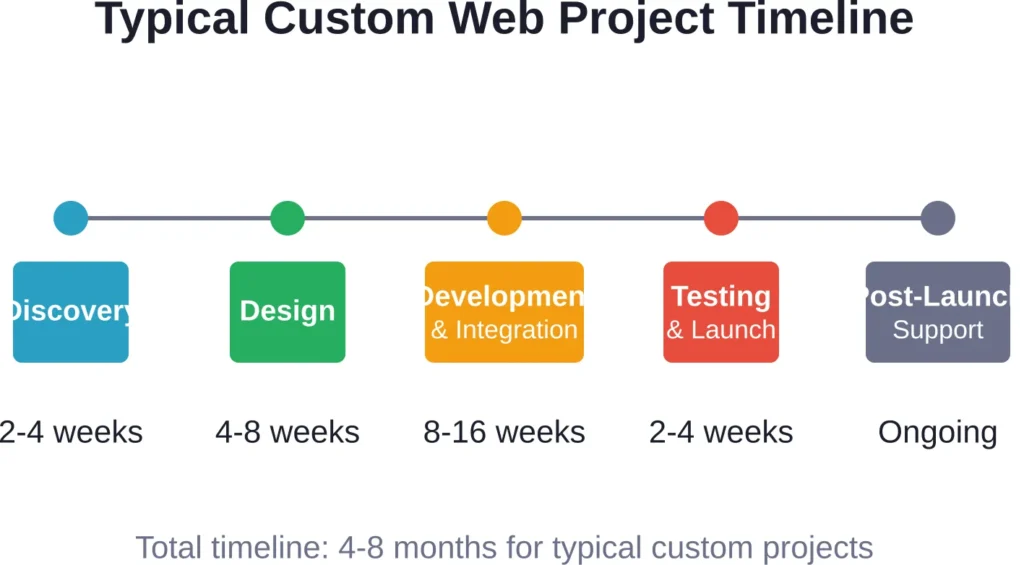
A typical custom website requires several months from kickoff to launch. Complex projects extend further. Factor in client review and approval cycles, which add weeks to timelines. Starting earlier than initially comfortable usually proves wise.
Inadequate Internal Resources
Successful projects require substantial client participation. Someone must provide business context, make decisions, gather content, review deliverables, coordinate stakeholders, and provide timely feedback. Agencies can’t work in a vacuum.
Organizations sometimes hire agencies without allocating adequate internal resources to support the project. The agency then waits for feedback, decisions stall, and timelines slip. Clear identification of client team members and their time commitments should happen before engagement.
Scope Creep Without Timeline Adjustment
Requirements evolve during projects. That’s natural and sometimes necessary. But adding features or expanding scope without adjusting timeline and budget expectations creates unrealistic pressures and disappoints everyone.
Good agencies track changes and communicate impacts. Good clients recognize that additional work requires additional resources. Clear change management processes established early prevent misunderstandings later.
Trends Shaping Custom Web Design in 2026
The web design landscape continues evolving. Several current trends influence how leading agencies approach custom work today.
Performance as Design Principle
Page speed and performance have moved from technical concern to design priority. Users abandon slow sites quickly. Search engines factor speed into rankings. Progressive agencies now treat performance as a design constraint from the beginning, not an afterthought.
This means designers consider image optimization, animation performance impacts, and loading strategies during design phases. Developers optimize code, implement lazy loading, and carefully manage third-party scripts. The result: beautiful sites that also load quickly.
Component-Based Design Systems
Rather than designing individual pages, many agencies now design component systems—reusable building blocks that can be combined into various page layouts. This approach provides consistency while enabling flexibility.
Design systems also ease long-term maintenance. When a button style changes, updating the component updates it everywhere. Adding new pages becomes faster when components already exist. This systematic approach suits organizations planning ongoing site evolution.
Headless and Decoupled Architectures
Traditional content management systems couple the content editing interface with the public website. Headless architectures separate these: content lives in one system, while the public site pulls content via APIs.
This separation provides flexibility. The same content can feed a website, mobile app, and other channels. Developers can use modern frameworks for the front end while content editors use familiar CMS tools. Many custom projects now employ this architecture.
Accessibility as Requirement
Web accessibility—ensuring sites work for people with disabilities—has moved from nice-to-have to essential. Legal requirements in many jurisdictions mandate accessible websites. Beyond compliance, accessibility represents good business: more people can use accessible sites.
Quality agencies now integrate accessibility into design and development processes from the beginning. This includes proper semantic HTML, keyboard navigation, screen reader compatibility, color contrast, and many other technical considerations.
AI-Enhanced Experiences
Artificial intelligence is increasingly integrated into web experiences. This might include personalized content recommendations, intelligent search functionality, chatbots for customer service, automated content generation, or predictive user interfaces.
Leading agencies are experimenting with AI applications that genuinely enhance user experiences rather than implementing technology for its own sake. The focus remains on solving real problems and meeting user needs, with AI as a tool rather than the objective.
Preparing for Agency Partnership Success
Organizations can take specific steps before engaging an agency to set projects up for success.
Document Clear Objectives
What should the new website accomplish? Increase leads? Improve brand perception? Support sales processes? Enable customer self-service? Clear objectives guide every subsequent decision and provide criteria for measuring success.
Good agencies will probe these objectives during discovery, but starting with documented goals accelerates the process. Objectives should connect to broader business strategy, not just exist as isolated web goals.
Audit Existing Content and Assets
Many projects involve migrating or reimagining existing content. Understanding what currently exists—the volume, quality, organization, and ownership—helps scope work accurately and identify content gaps or opportunities.
Similarly, auditing existing brand assets (logos, fonts, colors, photography, guidelines) clarifies what the agency can use versus what needs creation. This prevents surprises about asset availability mid-project.
Identify Stakeholders and Decision-Makers
Who needs to approve designs? Who makes final decisions when disagreements occur? Who provides content? Who handles technical details? Mapping stakeholders and their roles prevents confusion and ensures the right people participate at appropriate times.
Too many stakeholders slow projects through review cycles and conflicting feedback. Too few mean important perspectives get missed. Finding the right balance and clarifying decision authority streamlines processes.
Establish Realistic Budgets
Custom web design requires substantial investment. Organizations should research typical costs for projects of their scope and establish budgets that reflect reality rather than wishful thinking.
Underfunding projects leads to either compromised scope or disappointed expectations. Being transparent about budget parameters helps agencies propose solutions that fit, rather than wasting time on approaches that aren’t feasible.
Allocate Internal Time
Key team members will spend significant time on the project: attending meetings, reviewing deliverables, providing feedback, coordinating stakeholders, and making decisions. This time commitment should be acknowledged and protected.
Projects stall when client team members are too busy with other responsibilities to participate adequately. Treating the web project as priority work, not something squeezed between other tasks, dramatically improves outcomes.
| Preparation Step | Why It Matters | Typical Time Investment |
|---|---|---|
| Objective Documentation | Aligns team and provides success criteria | 1-2 weeks of stakeholder discussions |
| Content Audit | Reveals scope and identifies gaps or opportunities | 2-3 weeks depending on volume |
| Stakeholder Mapping | Streamlines decision-making and prevents bottlenecks | Several days of organizational planning |
| Budget Research | Sets realistic expectations and guides agency selection | 1-2 weeks of market research and planning |
| Resource Allocation | Ensures adequate internal participation throughout project | Ongoing throughout project duration |
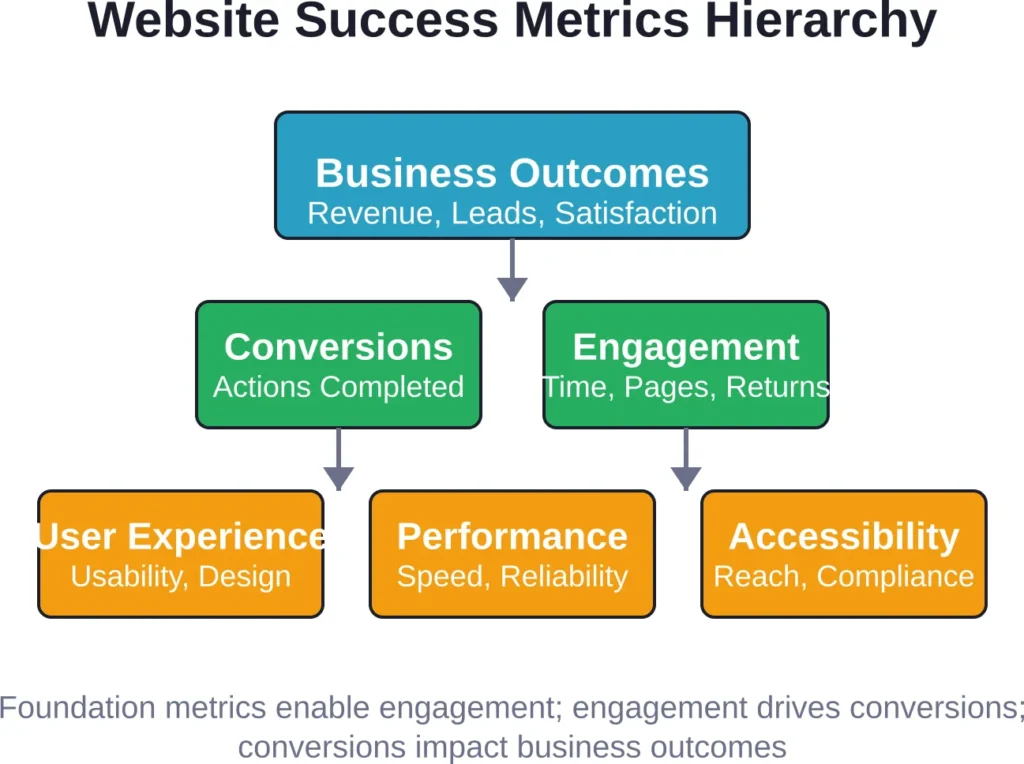
Measuring Custom Website Success
How do organizations know whether their custom website investment delivered value? Success measurement should align with the objectives established at project outset.
Performance Metrics
Technical performance matters for user experience and business outcomes. Key metrics include page load time, time to interactive, mobile performance scores, and core web vitals. These measurements reflect whether the site works well technically.
Performance impacts both user satisfaction and search engine rankings. Slow sites frustrate users and rank lower in search results. Quality agencies deliver sites that perform well across these technical measures.
User Engagement
Analytics reveal how users interact with the site. Metrics like time on site, pages per session, bounce rate, and return visitor percentage indicate whether the site engages its audience effectively.
For specific goals, more targeted metrics matter: form completions for lead generation sites, product views and add-to-cart rates for e-commerce, video plays for media sites, or documentation searches for support sites.
Conversion Achievement
Most websites exist to drive specific actions: purchases, lead submissions, content downloads, appointment bookings, or other conversions. Conversion rate—the percentage of visitors completing desired actions—directly measures website effectiveness.
Comparing conversion performance before and after website redesign reveals impact. Quality custom work typically improves conversion rates through better user experience, clearer value communication, and reduced friction in conversion paths.
Business Impact
Ultimately, websites should impact business results. Depending on business model, this might mean increased revenue, more qualified leads, reduced support costs, improved customer satisfaction, or other business-level outcomes.
Connecting website metrics to business impact sometimes requires analysis beyond simple analytics. But establishing these connections demonstrates website value in terms leadership cares about: business performance, not just digital metrics.
When to Consider Custom vs. Template Solutions
Custom web design isn’t always the right choice. Template-based solutions work well for many situations and cost significantly less. Understanding when custom work justifies the investment helps make smart decisions.
Custom Makes Sense When…
Organizations have unique requirements that templates can’t accommodate. This might include complex data visualization, specialized e-commerce workflows, custom user portals, sophisticated content relationships, or industry-specific functionality.
Brand differentiation matters significantly. Companies in competitive markets where visual distinction provides advantage benefit from custom design that sets them apart rather than using templates competitors might also employ.
Scalability and growth are priorities. Custom systems can be architected for specific growth plans, handling increasing traffic, expanding content, additional functionality, and evolving requirements more gracefully than template constraints allow.
Integration needs are complex. Custom development enables seamless integration with CRM systems, marketing automation, inventory management, custom databases, or proprietary internal tools that templates might not support.
Templates Work Well When…
Requirements are straightforward and well-served by existing solutions. Many small business websites, blogs, portfolios, and basic marketing sites work perfectly well with quality templates requiring minimal customization.
Speed to market is critical. Template-based projects launch much faster than custom development. When time matters more than uniqueness, templates provide quicker paths to functioning websites.
Budgets are limited. Template solutions cost a fraction of custom development. For organizations with tight budgets or where websites aren’t primary business drivers, templates offer acceptable quality at accessible prices.
Technical resources are minimal. Templates typically come with documentation, support communities, and established update processes. Organizations without technical staff find templates easier to maintain than custom solutions.
Frequently Asked Questions
Custom web projects generally require four to eight months from initial kickoff to public launch. Simpler custom sites might complete in three months, while complex platforms with extensive functionality can extend to a year or more. Timeline factors include project scope, design complexity, custom functionality requirements, content volume, number of stakeholders involved in approvals, and client responsiveness during review cycles. The timeline breaks down roughly into discovery and strategy (2-4 weeks), design (4-8 weeks), development (8-16 weeks), testing and launch preparation (2-4 weeks), plus ongoing post-launch support.
Custom web design means building a website from scratch, creating unique layouts, designing bespoke functionality, and writing original code tailored to specific requirements. Templates provide pre-built designs and functionality that get customized through configuration, content updates, and limited modification. Custom work offers complete flexibility, unique visual identity, and functionality built precisely for needs, but requires substantially more time and investment. Templates provide faster, more affordable solutions but with design and functionality constraints. The right choice depends on budget, timeline, uniqueness requirements, and functional complexity.
Look beyond surface aesthetics to understand the actual work involved. Investigate project scope, problems solved, and results achieved. Consider whether featured projects match the complexity needed. Evaluate whether the design style aligns with preferences—agencies often have signature approaches that appear across their work. Check for diversity in industries served or repeated work in a specific sector indicating specialization. Read case studies to understand their process and problem-solving approach. Contact references to learn about working relationships, communication quality, meeting deadlines, and handling challenges. A beautiful portfolio from difficult collaboration benefits no one.
Comprehensive project scopes define deliverables, responsibilities, timelines, and success criteria. Key elements include project objectives and success metrics, specific deliverables (design files, developed website, documentation, training), number of page templates and unique layouts, specific functionality and features, content migration or creation responsibilities, integration requirements with other systems, number of revision rounds during design phases, browser and device support specifications, accessibility requirements, post-launch support duration, training for client teams, and hosting setup if included. Clear scopes prevent misunderstandings and scope creep that derails timelines and budgets.
WordPress handles many custom projects successfully when extended with custom themes and plugins. It offers familiar editing interfaces, extensive documentation, large developer communities, and established hosting options. True custom CMS solutions make sense when workflows don’t fit WordPress’s publishing model, when specific content relationships and structures exceed what WordPress handles elegantly, when integration requirements are complex, or when performance at massive scale matters. Many agencies build custom front-ends while using headless WordPress or other headless CMS platforms for content management, combining custom flexibility with established content tools. The decision should be based on specific requirements rather than assumptions.
Custom projects require substantial client participation throughout. During discovery, teams provide business context, participate in strategy discussions, and help establish requirements. Design phases need timely feedback on concepts and mockups, content and asset provision, and coordination with stakeholders for approvals. Development involves reviewing work-in-progress, testing functionality, identifying issues, and making decisions about trade-offs or adjustments. Launch requires coordinating timing, communications, and technical details. Plan for key team members to dedicate several hours weekly to project activities, with heavier involvement during specific phases like discovery and design reviews. Projects stall when client teams can’t participate adequately.
Quality agencies provide post-launch support during an initial period, monitoring performance, fixing any issues that emerge with real traffic, and making minor adjustments. This support period varies but typically lasts 30-90 days. After initial support, ongoing maintenance becomes necessary: applying security updates, fixing bugs, optimizing performance, adding content, and making incremental improvements. Some agencies offer ongoing optimization services, continuously refining the website based on usage data and evolving needs. Others transition completely to client teams or other maintenance providers. Establishing clear expectations about post-launch support and ongoing maintenance should happen before engagement, not after launch when issues arise.
Making the Final Decision
Selecting from capable agencies ultimately comes down to alignment. Technical capabilities matter, but so do working styles, communication approaches, and shared understanding of objectives.
Trust instincts about cultural fit. The agency relationship spans months and requires close collaboration, frequent communication, and mutual respect. If initial interactions feel difficult or communication seems unclear, those patterns typically continue throughout projects.
Verify that the agency genuinely understands the business and its challenges. Generic responses or solutions that could apply to any company suggest superficial engagement. Quality agencies ask specific questions, demonstrate curiosity about the business model, and offer insights reflecting genuine understanding.
Ensure the proposed team—not just senior people in sales meetings—actually matches project needs. Ask to meet the team members who’ll do the daily work. Their capabilities and communication styles matter more than agency reputation alone.
Look for agencies that challenge assumptions constructively. Yes-men agencies that agree with everything might seem appealing initially but provide little value. The best agencies bring expertise and perspectives that improve outcomes, which sometimes means respectfully disagreeing with initial ideas.
Finally, recognize that perfect agencies don’t exist. Every shop has strengths and limitations. The goal isn’t finding perfection but finding the right match between agency capabilities and project requirements at this moment for this organization.
Conclusion
Custom web design and development represents a significant investment, but the right agency partnership delivers websites that genuinely drive business results. The 15 companies featured here have demonstrated consistent excellence across different project types, industries, and client sizes.
The selection process matters as much as the final choice. Organizations that invest time in clarifying objectives, evaluating capabilities beyond portfolios, checking references, and ensuring cultural alignment typically experience smoother projects and better outcomes.
Custom websites provide flexibility, uniqueness, and functionality that template solutions can’t match. For organizations where their website serves as a critical business tool, competitive differentiator, or primary customer touchpoint, custom work typically justifies its higher investment through superior performance.
The web continues evolving. New technologies, design approaches, and user expectations emerge constantly. Working with agencies that stay current with these changes while maintaining focus on timeless principles—clear strategy, user-centered design, quality execution—positions websites for success both at launch and as the digital landscape shifts.
Start the search with clear objectives. Evaluate thoroughly. Choose thoughtfully. Then commit to genuine partnership throughout the project. That approach, combined with a capable agency from this list, sets the foundation for a custom website that serves business needs effectively for years to come.