

Quick Summary: Choosing the right Django development agency is critical for building secure, scalable web applications. This comprehensive guide profiles the top 15 Django development companies of 2026, covering their expertise, tech stacks, and ideal project types—without listing pricing or hourly rates. From startups seeking MVPs to enterprises requiring complex integrations, these agencies deliver Python/Django solutions backed by proven track records.
Django has evolved into one of the most trusted web frameworks for building robust, production-ready applications. Its batteries-included philosophy, security-first architecture, and Python foundation make it the go-to choice for fintech platforms, healthcare systems, e-learning portals, and logistics management tools.
But here’s the thing—not all Django development companies are created equal.
Some excel at rapid MVP delivery. Others specialize in complex API integrations or legacy modernization. A few bring deep domain expertise in regulated industries like finance or healthcare. The challenge? Matching your project requirements with the right agency’s strengths.
This guide cuts through the noise. Below, discover 15 Django development agencies that consistently deliver quality solutions in 2026, along with what makes each stand out and which projects they’re best suited for.
Why Django Remains a Top Framework Choice in 2026
Django continues dominating the Python web development landscape for good reasons. The framework ships with built-in admin panels, ORM systems, authentication scaffolding, and security features that prevent common vulnerabilities like SQL injection and cross-site scripting right out of the box.
Real talk: Django’s “don’t repeat yourself” principle accelerates development timelines significantly. Teams spend less time reinventing wheels and more time solving actual business problems.
The framework’s scalability credentials speak for themselves. Platforms handling millions of users—from content management systems to real-time booking engines—run on Django infrastructure. Its asynchronous capabilities, introduced in recent versions, further expand performance potential for concurrent-heavy applications.
And the ecosystem? Thousands of vetted third-party packages extend Django’s functionality without compromising stability. Whether building RESTful APIs with Django REST Framework, implementing GraphQL endpoints, or integrating machine learning pipelines, the tooling exists and it’s mature.
For businesses, this translates to faster time-to-market, lower maintenance overhead, and easier talent acquisition—Python developers remain abundant compared to niche-framework specialists.
What Separates Great Django Agencies from Average Ones
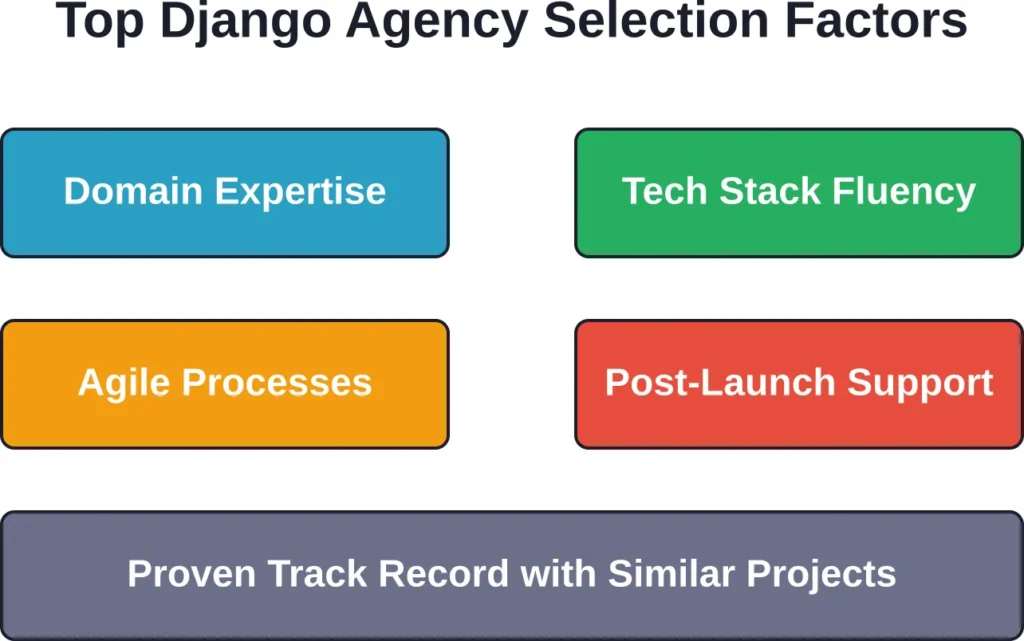
Experience with the framework itself matters, but it’s not the whole story. The best Django development companies demonstrate several distinguishing characteristics:
Domain expertise. Agencies that have shipped fintech applications understand regulatory compliance, audit trails, and transaction integrity at an architectural level. Those with healthcare portfolios grasp HIPAA requirements and data privacy constraints. Generic web shops can’t replicate this contextual knowledge quickly.
Agile and discovery-driven processes. Top firms invest in understanding business requirements before writing code. They run discovery workshops, create technical specifications, and validate assumptions through prototyping. This front-loaded investment prevents costly pivots mid-development.
Modern tech stack fluency. Django doesn’t exist in isolation. Leading agencies pair it with React or Vue.js frontends, PostgreSQL or MongoDB databases, Redis caching layers, Docker containerization, and AWS or Azure infrastructure. They architect for scalability from day one.
Post-launch support commitment. Software delivery isn’t a one-time event. The strongest partnerships include maintenance agreements, performance monitoring, security patching, and feature evolution roadmaps.
Now, which agencies actually deliver on these fronts?
The 15 Best Django Development Companies for 2026
Each company profiled below brings distinct strengths to Django projects. The list spans agencies of different sizes, geographic footprints, and specializations—because the “best” agency depends entirely on project context.
1. Mobian Studio
Mobian Studio specializes in building dedicated engineering teams that deliver production-ready Django-based software on time and within scope. They focus on mobile, AI, and backend solutions for companies in healthcare, fintech, logistics, and IT.
Their projects range from full end-to-end product development to complex integrations and scalable architectures. They have experience connecting new Django systems with existing infrastructure without disruption.
What stands out: Mobian emphasizes clean architecture, comprehensive documentation, and post-launch partnership. They work in both dedicated team and outstaffing models, ensuring senior-level Django expertise and smooth collaboration.
Best for: Companies in fintech, healthcare, and logistics needing robust Django backends with mobile or AI components, organizations scaling existing products, and teams looking for reliable long-term development partners.
Contact Information:
- Website: mobian.studio
- Phone: [email protected]
- Address: Harju maakond, Tallinn, Kesklinnalinnaosa, Masina tn 22, 10113
- LinkedIn: www.linkedin.com/company/mobian-studio
2. Oski
Oski delivers smart, well-engineered software solutions with deep expertise in Django development for tech-forward enterprises and ambitious startups. They combine strong backend architecture with modern frontend and cloud capabilities.
Notable work includes complex solutions across travel, logistics, e-commerce, education, fintech, and insurance industries. Their projects often involve scalable platforms, real-time features, and seamless integrations with existing systems.
What stands out: Oski applies AI-accelerated engineering practices while maintaining solid Django foundations. They focus on cloud-native development, serverless architectures, and clean separation of concerns, enabling faster delivery without compromising quality or maintainability.
Best for: Enterprises modernizing their digital infrastructure with Django, companies building scalable marketplaces or SaaS products, and organizations in regulated industries needing secure and compliant web applications.
Contact Information:
- Website: oski.site
- Phone: +48571282759
- Email: [email protected]
- Address: Kaupmehe tn 7, 10114 Tallinn, Estonia
- LinkedIn: www.linkedin.com/company/oski-solutions
3. Lengreo
Lengreo acts as a complete marketing and tech partner with strong Django development capabilities. They build high-performance websites, e-commerce platforms, and lead-generation systems that are optimized for both user experience and search visibility.
Their track record includes boosting client acquisition for software companies, generating qualified opportunities for service providers, and improving conversion rates through technically sound digital platforms.
What stands out: Lengreo seamlessly integrates Django backend development with advanced digital marketing services. They create solutions where technical architecture directly supports lead generation, SEO performance, and conversion optimization from day one.
Best for: B2B companies needing Django-powered lead generation and marketing platforms, service businesses requiring SEO-optimized websites with strong backend functionality, and organizations looking for a single partner that combines development with customer acquisition strategies.
Contact Information:
- Website: Lengreo.com
- Phone: +31 686 147 566
- Email: [email protected]
- Address: Vrijstraat 9 C/D, 5611 AT Eindhoven, Netherlands
- LinkedIn: Lengreo
- Twitter: @Lengreo
- Instagram: @lengreo
4. A-Listware

A-Listware is a software development and consulting company with proven Django expertise for building custom enterprise solutions and augmenting existing teams. They deliver secure, scalable, and responsive digital products tailored to client needs.
They have delivered projects for enterprise clients in various sectors, including ERP/CRM systems, custom software, cloud applications, and legacy modernization initiatives using Django as a reliable foundation.
What stands out: A-Listware excels at dedicated development teams and full project outsourcing with end-to-end management. Their approach ensures seamless integration with client processes while maintaining high standards in architecture, security, and code quality.
Best for: Enterprises requiring dedicated Django development teams or team augmentation, businesses modernizing legacy systems, and companies building complex internal tools or customer-facing platforms.
Contact Information:
- Website: a-listware.com
- Phone: +1 (888) 337 93 73
- Email: [email protected]
- Address: North Bergen, NJ 07047, USA
- LinkedIn: www.linkedin.com/company/a-listware
- Facebook: www.facebook.com/alistware
5. Gilzor

Gilzor is a custom software development partner focused on building robust digital products with Django as a core backend framework. They specialize in turning ideas into scalable web and mobile solutions while maintaining clean, maintainable architecture.
Their portfolio features an airline passenger boarding system, an eco-friendly grocery e-commerce platform aggregating hundreds of stores, and a brain-training mobile app with backend services. These projects showcase strong capabilities in logistics, marketplaces, and consumer apps.
What stands out: Gilzor follows a full-cycle approach that includes idea validation, business analysis, and go-to-market strategy alongside development. They emphasize clean architecture, high code quality, and user-centric design from the very beginning.
Best for: Startups looking to validate and launch Django-based MVPs, small and medium businesses needing custom web platforms, and product companies seeking reliable backend solutions with long-term support.
Contact Information:
- Website: www.gilzor.com
- Email: [email protected]
- Address: Poland, Warsaw, Office 58, street Adama Mickiewicza 37, 01-625
- LinkedIn: www.linkedin.com/company/gilzor-softwaredevelopment
6. Techtimize
Techtimize positions itself as transforming ideas into code, with a team of 51 professionals specializing in custom software solutions. Their service scope includes web and mobile app development, UI/UX design, and cutting-edge technologies like AI and machine learning.
The agency’s LinkedIn presence highlights their ability to integrate Django backends with AI/ML capabilities—think recommendation engines, natural language processing features, or predictive analytics dashboards built atop Django data layers.
Mobile app development capability matters for projects requiring companion apps. Techtimize architects systems where Django powers the API layer, serving both web frontends and iOS/Android mobile clients through unified backend logic.
Their emphasis on overcoming challenges and delivering results suggests a problem-solving mentality. When off-the-shelf solutions don’t exist, they build custom implementations.
Best for: Startups building AI-enhanced products, businesses requiring synchronized web and mobile experiences, and projects combining Django with machine learning workflows.
7. DeepCodeX
DeepCodeX operates as both a software solutions hub and IT training institute. The dual focus on development and training suggests the organization stays current with Django best practices while building client projects.
The agency specializes in custom web and mobile application development for startups and enterprises. Their training programs cover full-stack development, data science, Python/Django, React development, and real-time project training—indicating hands-on, practical skill building.
This training dimension offers an interesting advantage: clients benefit from developers who teach the framework. Teaching requires deep conceptual understanding, not just implementation ability. Instructors must anticipate edge cases, explain architectural trade-offs, and communicate complex ideas clearly.
DeepCodeX’s mission explicitly includes building powerful software, training skilled developers, and creating career opportunities—suggesting a holistic view of the development ecosystem.
Best for: Startups seeking cost-effective Django development with access to emerging talent, businesses open to team augmentation models, and projects where knowledge transfer matters alongside delivery.
8. Devyard
Devyard specializes in comprehensive IT consulting and development services, including AI solutions tailored to business needs. Operating with a team of seven professionals, they function as a focused boutique firm.
Their expertise spans custom software development, system integration, cloud solutions, AI-powered innovations, and technology strategy. This breadth suggests they consult on technology decisions first, then implement—rather than immediately proposing Django for every problem.
System integration capability matters for enterprises with existing software ecosystems. Devyard connects Django applications to ERP systems, CRM platforms, legacy databases, and third-party APIs without creating data silos.
The cloud solutions focus indicates infrastructure expertise beyond application code. They architect for AWS, Azure, or Google Cloud environments, implementing CI/CD pipelines, infrastructure-as-code, and scalable deployment strategies.
Best for: Enterprises requiring Django applications that integrate with existing systems, businesses needing strategic technology consulting alongside implementation, and organizations prioritizing cloud-native architecture.
9. EchoGlobal
EchoGlobal operates as an ISO 27001 certified tech talent provider focusing on Eastern Europe and LATAM regions. Their Upwork profile shows top-rated status with 100% job success rating and over 16,000 delivery hours.
The ISO 27001 certification signals serious information security management. For clients in regulated industries or handling sensitive data, this certification provides assurance around development practices, data handling, and security protocols.
EchoGlobal’s geographic focus in Eastern Europe and Latin America offers cost advantages without sacrificing quality. Time zone overlap with North American and European clients facilitates real-time collaboration.
Their integrated approach connects strategy, delivery, and growth—meaning they don’t just build software and walk away. They consider product-market fit, user acquisition, and ongoing value creation as part of their engagement model.
Net Promoter Score of 9.8/10 and Clutch rating of 4.9/5 indicate strong client satisfaction and willingness to recommend.
Best for: Startups and scale-ups seeking cost-effective Django development without compromising security standards, businesses requiring flexible team augmentation, and projects benefiting from nearshore collaboration.
10. Emvigo Tech

Emvigo Tech maintains a presence ranking top Django development agencies in the US. Their focus on the American market suggests familiarity with US business practices, communication norms, and regulatory contexts.
While specific portfolio details weren’t available in the source material, their appearance in multiple “top Django agencies” rankings indicates consistent performance and visibility within the Django community.
Agencies that rank well across multiple independent evaluations typically demonstrate several common traits: transparent communication, reliable delivery timelines, quality code standards, and post-launch support responsiveness.
The US market focus means easier coordination for American businesses—working hours align, cultural context matches, and legal frameworks simplify contracts and intellectual property agreements.
Best for: US-based businesses preferring domestic Django development partners, projects requiring real-time collaboration during American business hours, and companies prioritizing cultural and communication alignment.
11. DjangoStars

Founded in 2008, DjangoStars has built a reputation centered entirely on Python and Django expertise. The team ranges from 100 to 249 professionals, allowing them to handle everything from startup MVPs to enterprise-scale platforms.
Their portfolio includes the digital mortgage platform for MoneyPark, the PADI Travel booking system, and the Molo Finance MVP that processes substantial transaction volumes. These projects demonstrate capability across fintech, travel, and marketplace verticals.
What stands out: DjangoStars follows discovery-driven development processes. They don’t jump straight into coding. Instead, workshops and technical specifications precede implementation, reducing scope creep and aligning technical decisions with business objectives.
The agency’s agile methodology ensures regular stakeholder feedback loops. Sprints deliver incremental value, making projects adaptable to changing requirements without complete reworks.
Best for: Fintech platforms requiring regulatory compliance, travel booking systems with complex inventory management, and e-learning portals needing scalable architecture.
12. Merixstudio
Since 1999, Merixstudio has evolved into a full-service digital product agency with notable Django credentials. Their team size falls in the 50-249 range, supporting both product development and team augmentation engagements.
Client names like Volkswagen and Toshiba appear in their portfolio, alongside fintech projects like Repositax and the EatClub transportation management system. This range demonstrates versatility across B2C and B2B contexts.
Merixstudio combines Django backend development with modern frontend frameworks—React and Angular feature prominently in their stack. They also leverage Node.js for real-time features, AWS for cloud infrastructure, PostgreSQL for relational data, and Docker for containerized deployments.
The agency emphasizes UX/UI design integration. Rather than treating design and development as separate phases, their process interweaves both disciplines from the start.
Best for: Enterprises seeking end-to-end digital product development, including design, development, and infrastructure management under one roof.
13. Imaginary Landscape

Operating since 1995, Imaginary Landscape brings nearly three decades of web development experience to Django projects. Their team size ranges from 10 to 49 professionals, positioning them as a specialized boutique.
High-profile clients include Airbnb, the United Nations, and the American Medical Association. These partnerships highlight the agency’s capability with mission-critical applications requiring custom API integrations and complex data workflows.
Imaginary Landscape excels at legacy modernization—taking aging systems and rebuilding them on modern Django architecture without disrupting ongoing operations. Their experience with large organizations means they navigate bureaucratic procurement processes and compliance requirements smoothly.
The firm’s approach emphasizes long-term partnerships over one-off projects. Many clients return for iterative enhancements, treating Imaginary Landscape as an extended technology team.
Best for: Established organizations modernizing legacy systems, nonprofits requiring robust content management, and institutions needing WCAG-compliant accessible web applications.
14. Django Web Studio
Django Web Studio operates as a specialized Django development firm offering full-service internet productions. According to their LinkedIn profile, the agency explicitly positions itself as Django framework experts, focusing on complete projects from concept through design, development, implementation, hosting, and ongoing support.
They tackle complicated problems—custom payment integrations, API development, web services, and data visualizations.
This specialization means deep technical knowledge. When Django-specific challenges arise—optimizing ORM queries, implementing custom middleware, or architecting multi-tenant systems—Django Web Studio brings pattern-tested solutions rather than trial-and-error approaches.
The “full service” model appeals to clients who prefer single-vendor accountability. Rather than coordinating between separate design, development, and hosting providers, clients get unified project management.
Best for: Mid-market companies seeking specialized Django expertise with end-to-end project ownership, particularly those with complex backend requirements like custom payment processing or API ecosystems.
15. Webence
Webence describes itself as specializing in modern, scalable, user-centric web solutions with deep focus on Django development, UI/UX design, and SEO optimization. Based in Tehran, the agency serves both regional and international clients.
Their service portfolio spans simple landing pages to complex e-commerce platforms. The emphasis on UI/UX design alongside Django development suggests a product-thinking approach—not just implementing features, but ensuring those features deliver intuitive user experiences.
SEO optimization as a core service differentiates Webence from pure-development shops. They architect Django applications with search engine visibility baked in from the start—proper semantic HTML, server-side rendering where appropriate, structured data markup, and performance optimization.
The combination of Django backend strength and frontend polish makes Webence particularly relevant for businesses where user acquisition depends on organic search visibility.
Best for: E-commerce platforms requiring SEO-optimized architecture, content-heavy sites needing both performance and discoverability, and businesses prioritizing design alongside development.
How to Choose the Right Django Development Company for Your Project
Matching project requirements to agency strengths determines success more than any other factor. A firm perfect for one project might completely miss the mark for another.
Start by clarifying project type. MVP development for a startup requires different capabilities than enterprise legacy modernization. Agencies specializing in rapid prototyping excel at the former but may lack the patience for gradual, risk-averse migrations the latter demands.
Evaluate Domain Experience
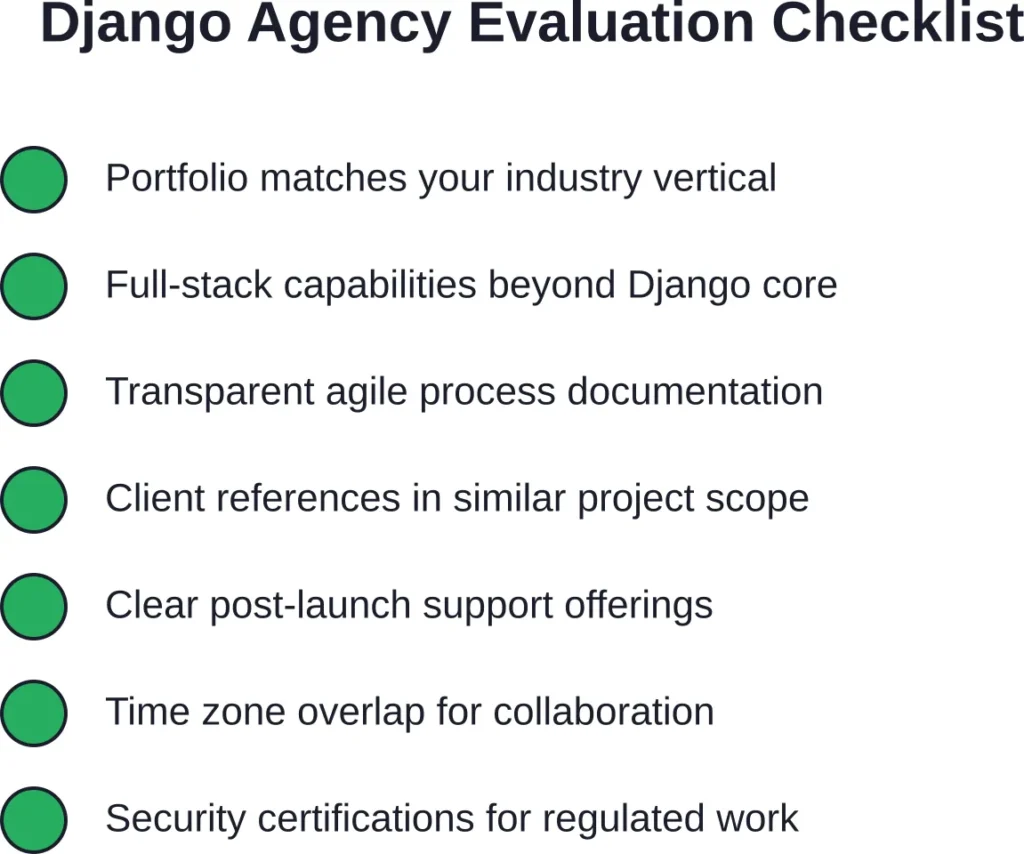
Has the agency shipped applications in your industry? Fintech projects involve regulatory compliance, audit trails, and transaction integrity requirements that generic web development doesn’t address. Healthcare applications must navigate HIPAA, data privacy, and interoperability standards.
Review portfolio case studies critically. Look beyond surface-level descriptions. What specific technical challenges did they solve? How did they handle scalability? What was the performance outcome?
Request references from clients with similar project profiles. Ask those references about communication cadence, problem-solving approaches when issues arose, and whether the agency proactively identified risks.
Assess Technical Capabilities Beyond Django
Django is the backend framework, but modern applications require full-stack competency. What frontend frameworks does the agency work with? React, Vue.js, and Angular each bring different strengths—agencies should articulate why they’d recommend one over another for your use case.
Database expertise matters enormously. PostgreSQL? MongoDB? Redis for caching? The right choice depends on data structure, query patterns, and scalability requirements. Strong agencies make these recommendations based on technical analysis, not just familiarity.
Infrastructure and DevOps capability separates agencies that deploy to production successfully from those that hand off half-baked code. Ask about CI/CD pipelines, monitoring strategies, backup procedures, and scaling approaches.
Examine Development Process and Communication
Agile doesn’t mean the same thing to everyone. Some agencies run tight two-week sprints with daily standups and end-of-sprint demos. Others take a looser interpretation. Which style matches your involvement preference?
Communication transparency prevents nasty surprises. How often will you receive updates? Through what channels? Who’s the primary point of contact? How are scope changes handled?
Discovery phase investment signals quality orientation. Agencies that jump straight into development without requirements analysis, technical specifications, or prototyping often deliver software that technically works but misses business objectives.
Consider Geography and Time Zones
Distributed teams work beautifully when managed well, but time zone overlap facilitates collaboration. Four hours of overlap enables real-time problem-solving. Zero overlap forces asynchronous communication that slows iteration cycles.
Cultural and communication alignment matters more than geographic proximity. An Eastern European team with strong English skills and experience working with American clients often collaborates more smoothly than a domestic team with poor communication practices.
Verify Post-Launch Support Models
Software delivery isn’t the finish line—it’s the starting line. Bugs emerge in production. Performance bottlenecks appear under real load. Feature requests pile up as users engage with the product.
What does the agency offer post-launch? Warranty periods covering bug fixes? Maintenance retainers? On-call support for critical issues? Feature development roadmaps?
The strongest partnerships treat software as an evolving product, not a one-time deliverable. Agencies that stick around for the long haul understand your codebase intimately, making future enhancements faster and more reliable.
Key Technologies Django Agencies Should Master
Django doesn’t operate in isolation. Modern web applications combine multiple technologies into cohesive architectures. The strongest Django agencies demonstrate competency across complementary tools and frameworks.
Frontend Frameworks
React dominates the Django-paired frontend landscape. Its component-based architecture, robust ecosystem, and widespread talent pool make it the default choice for interactive single-page applications. Agencies should demonstrate clean REST API design patterns that serve React frontends efficiently.
Vue.js offers a gentler learning curve and excellent documentation, making it ideal for projects where frontend complexity remains moderate. Django + Vue.js stacks work beautifully for content-heavy applications requiring some interactivity without React’s overhead.
Angular appears in enterprise contexts where TypeScript’s strong typing and opinionated structure provide guardrails for large teams. Agencies targeting enterprise clients should show Angular competency.
Databases and Data Layers
PostgreSQL pairs naturally with Django. Its robust feature set, ACID compliance, and advanced data types (JSONB, arrays, full-text search) handle most application requirements elegantly. Strong agencies optimize PostgreSQL specifically—query planning, indexing strategies, connection pooling.
MongoDB serves use cases with evolving schemas or document-centric data models. Django’s MongoEngine and Djongo libraries enable MongoDB integration, though agencies should articulate when NoSQL actually provides advantages over PostgreSQL’s JSONB capabilities.
Redis appears in virtually every production Django stack—as a cache layer, session store, task queue backend, or real-time pub/sub mechanism. Agencies should implement Redis strategically, not just because “everyone uses it.”
API Development Tools
Django REST Framework (DRF) has become the de facto standard for building RESTful APIs atop Django. Experienced agencies leverage DRF’s serializers, viewsets, authentication classes, and permission systems to create clean, well-documented APIs rapidly.
GraphQL through Graphene-Django offers an alternative for clients preferring strongly-typed, flexible query interfaces. Agencies should explain trade-offs between REST and GraphQL based on client consumption patterns, not trends.
Infrastructure and Deployment
Docker containerization is table stakes. Agencies should deliver Dockerized applications with docker-compose configurations for local development and production-ready images for deployment.
AWS expertise appears frequently—EC2 for compute, RDS for managed databases, S3 for object storage, CloudFront for CDN, Lambda for serverless functions. Agencies targeting enterprise clients should hold AWS certifications.
Azure and Google Cloud Platform serve clients already invested in those ecosystems. Multi-cloud competency demonstrates architectural flexibility rather than vendor lock-in.
CI/CD pipeline implementation through GitHub Actions, GitLab CI, or Jenkins ensures reliable deployments. Every code commit should trigger automated testing, and production deployments should happen through controlled, repeatable processes.
| Technology Category | Primary Options | When to Use |
|---|---|---|
| Frontend Framework | React, Vue.js, Angular | React for SPAs, Vue.js for moderate interactivity, Angular for enterprise |
| Database | PostgreSQL, MongoDB, MySQL | PostgreSQL default, MongoDB for document models, MySQL for legacy compatibility |
| Caching | Redis, Memcached | Redis for versatility, Memcached for pure caching |
| API Style | REST (DRF), GraphQL (Graphene) | REST for simplicity, GraphQL for flexible querying |
| Cloud Platform | AWS, Azure, Google Cloud | AWS for breadth, Azure for Microsoft integration, GCP for data/ML |
| Containerization | Docker, Kubernetes | Docker always, Kubernetes for complex orchestration |
Common Django Project Types and Ideal Agency Profiles
Different project types demand different agency strengths. Matching these correctly saves headaches down the road.
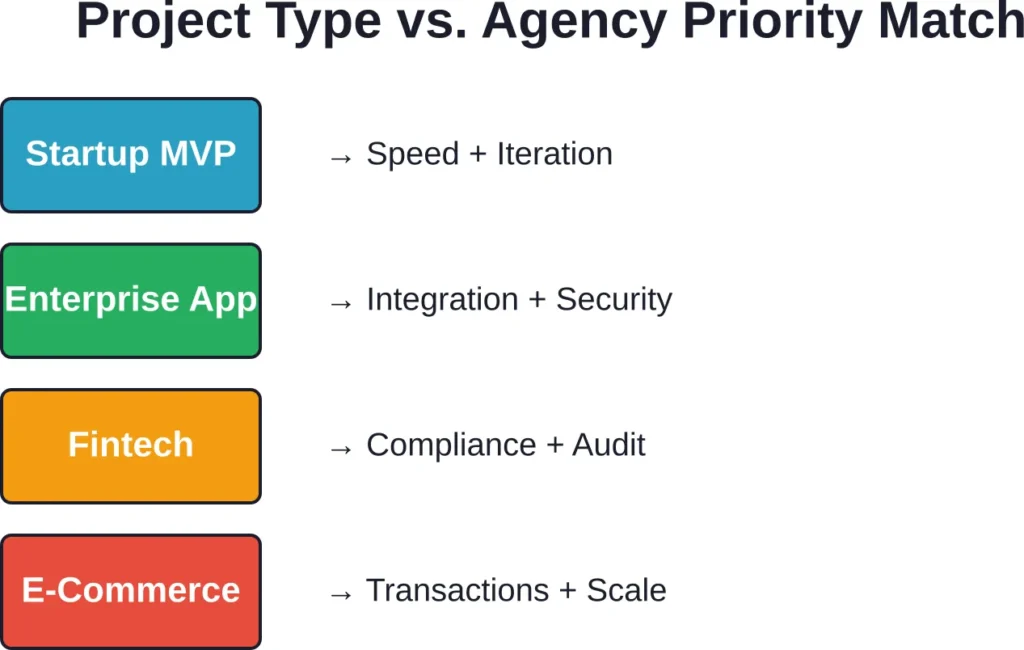
Startup MVPs
Speed matters most. Startups need to validate product-market fit before capital runs out. Agencies serving this market excel at rapid development cycles, prioritization frameworks that identify true MVP scope, and iterative launches that get software in users’ hands quickly.
Look for agencies with startup portfolio depth. They understand the “build-measure-learn” cycle and won’t over-engineer solutions. They’re comfortable with ambiguity and changing requirements as market feedback arrives.
DjangoStars, DeepCodeX, and EchoGlobal fit this profile—startups appear prominently in their positioning and case studies.
Enterprise Applications
Compliance, security, and integration complexity define enterprise projects. Agencies need experience navigating procurement processes, security reviews, and multi-stakeholder approval chains.
Technical requirements often include SSO integration, role-based access control, audit logging, and connections to existing ERP or CRM systems. The pace moves slower but stakes run higher—production failures affect thousands of users and carry financial consequences.
Imaginary Landscape, Devyard, and Merixstudio demonstrate enterprise credibility through client names, security certifications, and integration case studies.
Fintech Platforms
Regulatory compliance isn’t optional. Agencies building fintech applications must understand PCI DSS for payment processing, banking API integration standards, transaction integrity requirements, and financial audit trails.
Security takes center stage—penetration testing, encryption at rest and in transit, secure credential management, and incident response planning. One breach destroys trust permanently.
DjangoStars and Merixstudio highlight fintech projects explicitly, suggesting deep domain knowledge in this vertical.
Content Platforms and Publishing
Django’s origins lie in newsroom content management, and it still excels here. Content-heavy applications need robust admin interfaces, workflow management, media handling, SEO optimization, and performance under high traffic.
Agencies should demonstrate content modeling sophistication—taxonomy design, versioning systems, multi-language support, and editorial workflows that match publishing processes.
Webence’s explicit SEO optimization focus makes them relevant for content platforms where organic discovery drives growth.
E-Commerce Systems
Transaction handling, inventory management, payment gateway integration, shipping calculations, and tax compliance create complexity beyond typical CRUD applications. Django e-commerce frameworks like Django Oscar and Saleor provide foundations, but customization always emerges.
Agencies need experience with payment processor APIs (Stripe, PayPal, Authorize.net), PCI compliance requirements, cart abandonment recovery, and performance optimization for product catalogs.
Webence specifically mentions e-commerce platform capability, positioning them for this project type.
Red Flags When Evaluating Django Development Agencies
Certain warning signs indicate trouble ahead. Recognizing these early prevents painful project experiences.
Vague or Missing Portfolio Details
Agencies should provide concrete case studies with measurable outcomes. “Built an e-commerce platform” tells you nothing. “Built a Django e-commerce platform processing 50,000 monthly transactions with 99.9% uptime and sub-200ms API response times” demonstrates actual capability.
Missing portfolios entirely? That’s an immediate red flag. Even new agencies can showcase side projects, open-source contributions, or detailed technical blog posts demonstrating expertise.
Over-Promising Timelines
Complex applications take time. Agencies promising three-month delivery for inherently six-month projects either don’t understand the scope or plan to cut corners.
Realistic timeline estimates account for discovery, design, development, testing, deployment, and iteration. Be skeptical of agencies that jump straight to development estimates without scoping.
Generic Technical Proposals
Strong agencies ask probing questions about requirements before proposing technical approaches. Generic proposals suggesting Django + React + PostgreSQL + AWS for every project indicate template-driven thinking, not contextual analysis.
Technical decisions should flow from requirements. Why React over Vue.js for this specific use case? Why PostgreSQL over MongoDB given this data model? Agencies should articulate these trade-offs clearly.
Poor Communication During Sales
If communication feels difficult during the sales process when they’re trying to win your business, it’ll only get worse during delivery when they’re juggling multiple clients.
Slow responses, unclear answers, or difficulty scheduling calls signal organizational dysfunction or bandwidth constraints.
No Post-Launch Support Discussion
Agencies that focus exclusively on initial delivery and avoid post-launch support conversations plan to disappear once the contract ends. Software needs ongoing maintenance—agencies confident in their code quality offer it.
The Django Ecosystem in 2026: What’s Changed
Django continues evolving. Understanding recent changes helps evaluate whether agencies stay current or rely on outdated patterns.
Asynchronous support matured significantly. Django’s async views, middleware, and database access enable handling thousands of concurrent connections efficiently. Modern agencies leverage these capabilities for real-time features, WebSocket implementations, and high-concurrency APIs.
Type hints and static analysis became standard practice. Tools like mypy catch errors before runtime, reducing bugs and improving code maintainability. Agencies following current best practices annotate function signatures and use static type checking in CI pipelines.
Security enhancements continue. Django’s track record on security remains stellar, but staying current matters. Agencies should run recent Django versions and demonstrate familiarity with the security release cycle.
The community keeps growing. The Django community job board shows active postings for Senior Python Developers and Django specialists. This talent availability benefits clients—agencies can hire skilled developers without multi-month searches.
Budget Considerations Without Discussing Rates
While this guide excludes specific pricing, understanding cost drivers helps planning.
Team location significantly impacts costs. Agencies in Eastern Europe and Latin America typically offer lower rates than North American or Western European firms. But lower rates don’t automatically mean lower quality—many offshore teams deliver exceptional work.
Project complexity matters more than feature count.
Team composition affects budgets. Senior developers cost more but often deliver faster and write more maintainable code. Junior-heavy teams might show lower hourly rates but require more hours for the same outcome.
Minimum project sizes vary by agency. Boutiques might accept smaller engagements while enterprise-focused firms set higher minimums to justify their sales and management overhead.
Ongoing costs deserve attention. Hosting, monitoring, SSL certificates, API subscriptions, and maintenance retainers add up. Factor these into total cost of ownership, not just initial development.
Making Your Final Decision
Armed with agency profiles, evaluation criteria, and red flags, how do you actually choose?
Start by shortlisting three to five agencies whose portfolios align with your project type. Geographic preferences, team size comfort levels, and domain expertise narrow the field quickly.
Request detailed proposals. Share comprehensive requirements documents and ask agencies to respond with technical approaches, timelines, team compositions, and engagement models. Compare how deeply they engage with your specific context versus generic responses.
Check references thoroughly. Don’t just ask if the agency delivered on time and on budget. Ask about communication quality, problem-solving when issues arose, code quality and documentation, and whether the reference would hire them again.
Conduct technical interviews. If you have technical stakeholders, have them discuss architecture, deployment strategies, and technology trade-offs with the agency’s lead developers. Surface-level sales knowledge differs from deep technical expertise.
Start small if possible. A fixed-scope proof-of-concept or discovery phase engagement tests the relationship before committing to full development. You’ll learn more about working dynamics from a four-week pilot than from any amount of sales conversations.
Trust your gut on cultural fit. Technical skills matter enormously, but so does working relationship quality. If communication feels off during sales, trust that instinct.
Frequently Asked Questions
Django’s “batteries included” philosophy ships with authentication, admin panels, ORM, form handling, and security features built in. This accelerates development compared to minimal frameworks requiring manual assembly of these components. The framework’s maturity—first released in 2005—means battle-tested stability and comprehensive documentation. Django’s security-first design prevents common vulnerabilities like SQL injection, cross-site scripting, and CSRF attacks by default. For businesses, this translates to faster delivery timelines and lower security risk.
Timeline depends entirely on scope and complexity. Simple MVPs with standard features might complete in 8-12 weeks. Mid-complexity applications with custom workflows, third-party integrations, and moderate data models typically require 3-6 months. Enterprise applications with complex business logic, multiple integrations, and compliance requirements often span 6-12 months or more. Discovery and design phases add 2-4 weeks before development. Agencies should provide timeline estimates only after understanding detailed requirements—immediate estimates without scoping signal template-driven thinking rather than contextual analysis.
Absolutely. Instagram, Pinterest, and Mozilla run on Django infrastructure, handling millions of concurrent users. Django itself scales horizontally—adding more application servers behind load balancers increases capacity linearly. Database optimization, caching strategies with Redis or Memcached, CDN implementation for static assets, and asynchronous task processing with Celery address performance bottlenecks. The framework doesn’t impose scaling limitations; architecture and infrastructure decisions determine capacity. Experienced Django agencies design for scale from the start, implementing caching layers, database query optimization, and infrastructure elasticity.
Fintech companies leverage Django’s security features and transaction integrity capabilities. Healthcare organizations benefit from Django’s data privacy controls and audit trail functionality for HIPAA compliance. E-learning platforms use Django’s content management strengths and scalable architecture. Logistics companies build complex workflow systems atop Django’s ORM and background task processing. Publishing and media companies utilize Django’s origins in newsroom content management. Essentially, any industry requiring secure, data-driven web applications with complex business logic benefits from Django’s strengths. The framework’s versatility serves B2B SaaS, e-commerce, marketplaces, and internal enterprise tools equally well.
Django specialists bring deep framework expertise—they’ve encountered and solved edge cases general agencies haven’t faced. They optimize Django-specific performance, leverage lesser-known packages effectively, and follow current best practices religiously. Full-service agencies offer broader technology coverage, potentially handling mobile apps, infrastructure, and design under one contract. For Django-centric projects where the framework is the core technology, specialists often deliver superior results. For multi-technology products where Django is one component among many, full-service agencies simplify coordination. Evaluate based on where your project’s complexity lies—if Django expertise is the critical success factor, choose specialists.
Domain expertise significantly reduces risk for regulated industries like finance, healthcare, or government. These sectors carry compliance requirements, security standards, and workflow patterns that generic web development doesn’t address. An agency that has shipped fintech applications understands PCI DSS, banking API integrations, and transaction audit requirements intimately. For less-regulated industries, domain experience provides helpful context but matters less than core technical capability. A strong Django agency can learn e-commerce or logistics domain knowledge more easily than a domain expert can learn sophisticated Django development. Prioritize industry experience for regulated sectors; prioritize technical excellence for others.
Ask for detailed case studies matching your project type with measurable outcomes. Request client references and actually call them—ask about communication quality and problem-solving when issues emerged. Inquire about their development process: sprint length, stakeholder involvement, testing strategies, deployment procedures. Understand team composition: who specifically works on your project, their experience levels, and availability. Discuss post-launch support: warranty periods, maintenance offerings, bug fix processes. Ask about technology trade-offs: why they’d recommend specific databases, frontend frameworks, or infrastructure for your context. Request their approach to security, performance optimization, and scaling. Strong agencies answer these questions with specifics, not generic marketing speak.
Conclusion: Partnering for Django Success
Choosing the right Django development company determines project outcomes more than any other factor. The 15 agencies profiled here—DjangoStars, Merixstudio, Imaginary Landscape, Django Web Studio, Webence, Techtimize, DeepCodeX, Devyard, EchoGlobal, and Emvigo Tech—each bring distinct strengths to different project contexts.
MVP development demands speed and iteration. Enterprise applications require integration expertise and security rigor. Fintech platforms need regulatory compliance knowledge. E-commerce systems must handle transactions flawlessly. Match your project type to agency specialization.
Look beyond marketing claims to portfolio substance. Verify domain expertise through case studies and references. Assess technical breadth across frontend frameworks, databases, infrastructure, and DevOps practices. Evaluate communication quality and cultural fit through proposal processes and pilot projects.
Django’s maturity, security, and scalability make it a solid foundation for web applications across industries. The right agency partner transforms that foundation into production software that drives business value.
Ready to move forward? Shortlist agencies whose portfolios align with your needs. Request detailed proposals that demonstrate contextual understanding of your requirements. Check references thoroughly. Start with a pilot engagement to validate the partnership before committing to full development.
The perfect Django agency for your project exists—this guide provides the framework to identify them systematically rather than hoping for the best.