

Quick Summary: Residential design in Europe combines rich architectural heritage with modern sustainability requirements, from French chateaus and Italian villas to English cottages. With 85% of EU buildings constructed before 2000 and 75% having poor energy performance, European residential design now prioritizes energy efficiency alongside timeless style. The EU’s Renovation Wave aims to renovate 35 million buildings by 2030, driving contemporary home design toward zero-emission standards while preserving the continent’s distinctive regional aesthetics.
European residential design stands at a fascinating crossroads. On one hand, centuries of architectural tradition—from Tuscan farmhouses to Parisian apartments—continue to shape how homes look and feel across the continent. On the other, aggressive energy efficiency mandates are transforming what it means to build or renovate a European home in 2026.
The numbers tell a compelling story. According to the European Commission, buildings consume around 40% of all energy used in the EU, with around 50% of the EU’s gas consumption attributable to buildings. Roughly 80% of energy used in EU homes goes toward heating, cooling, and hot water alone.
But here’s the thing: this massive energy footprint isn’t distributed evenly. About 85% of buildings in the EU were built before 2000, and 75% have poor energy performance. That’s created both a challenge and an opportunity for residential design.
The Architectural Heritage That Defines European Homes
European residential design doesn’t follow a single aesthetic. The continent’s geography, climate, and cultural history produced remarkably diverse regional styles that still influence new construction and renovation projects today.
French Country and Chateau Styles
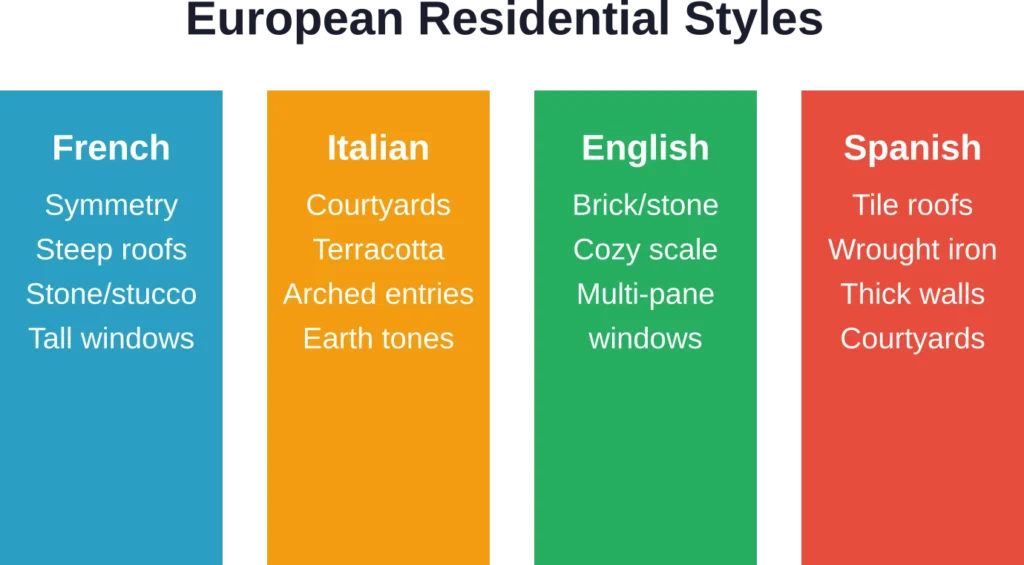
French residential architecture emphasizes symmetry, tall windows, and steep hip roofs. Stone and stucco exteriors dominate, often with decorative shutters and detailed millwork around doors and windows. These homes prioritize natural light and formal room arrangements, with public spaces designed for entertaining.
In modern interpretations, designers maintain the steep rooflines and exterior materials while opening up interior floor plans. The result? Homes that photograph like historic chateaus but function for contemporary family life.
Tuscan and Italian Villa Influences
Italian-inspired residential design brings warmth through earthy color palettes—ochre, terracotta, burnt sienna—and textured stucco walls. Low-pitched terracotta tile roofs, arched doorways, and iron balconies create that unmistakable Mediterranean character.
Courtyards and outdoor living spaces aren’t optional decorative elements in Italian villa design. They’re central organizing features that blur the boundary between inside and outside, particularly in southern European climates where outdoor rooms extend the usable living area for much of the year.
English Cottage and Manor Traditions
English residential architecture ranges from modest cottages with stone or brick facades to grand manor houses. Common elements include multi-pane windows, prominent chimneys, and a mix of building materials that create visual texture.
What’s particularly appealing about English design? The scale feels human. Rooms are cozy rather than cavernous, ceilings aren’t unnecessarily tall, and there’s an emphasis on nooks and intimate spaces that larger continental styles sometimes lack.
Spanish and Mediterranean Approaches
Spanish residential design shares some DNA with Italian styles but develops its own character through Moorish influences—geometric tile work, interior courtyards, and thick walls that provide thermal mass for temperature regulation.
Wrought iron details, wooden beams exposed in ceilings, and tile roofs define the exterior aesthetic. Inside, tile floors, plaster walls, and an emphasis on natural cooling through strategic window placement and cross-ventilation reflect centuries of climate-responsive building.
The Energy Efficiency Revolution Reshaping European Homes
Now for the part that’s fundamentally changing residential design across Europe: energy performance requirements.
The European Commission launched the Renovation Wave Strategy in 2020 with an ambitious goal—renovate 35 million buildings by 2030. That’s at least doubling the annual renovation rate across the continent. This renovation push represents massive economic opportunity alongside climate benefits.
New Performance Standards for Residential Buildings
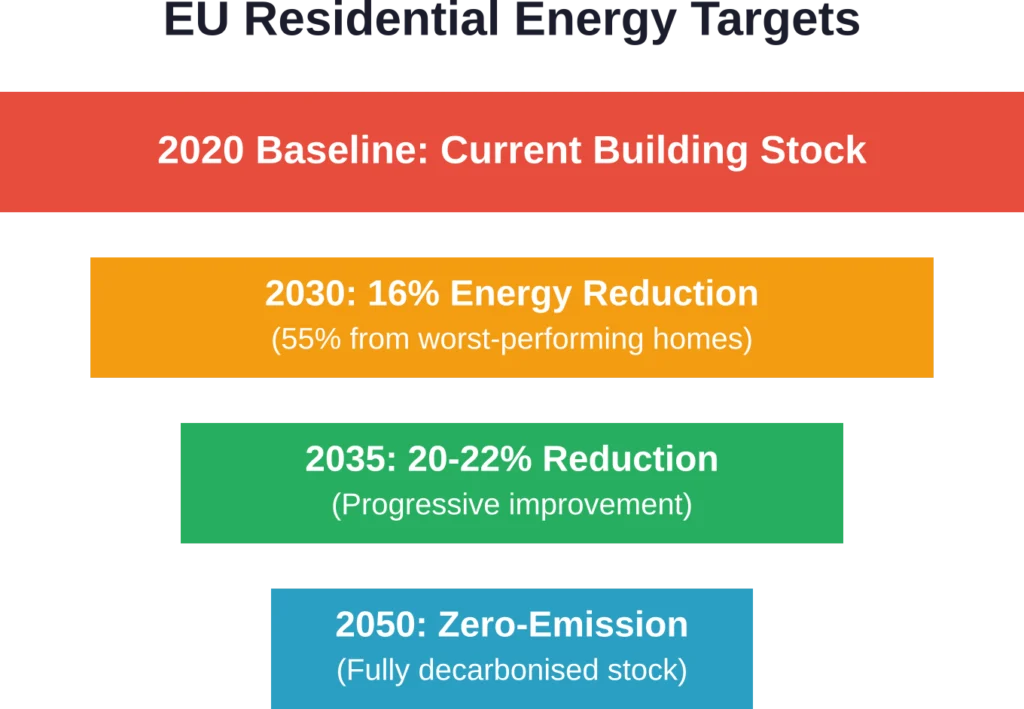
The Energy Performance of Buildings Directive sets specific targets that directly impact residential design. Member states must adopt national trajectories to cut average energy use in homes—for example, 16% reduction by 2030 and 20-22% by 2035, compared with 2020 levels.
Here’s where it gets interesting: Member States are required to adopt minimum energy performance standards (MEPS) targeting the worst-performing buildings, with at least 55% of reductions coming from the worst-performing dwellings.
What does this mean for residential design? Architects and builders can’t just make incremental improvements to already-efficient homes. The regulatory pressure focuses on transforming the building stock that consumes the most energy—exactly the pre-2000 housing that dominates the European landscape.
Zero-Energy Building Design Principles
The push toward zero-emission buildings by 2050 drives specific design choices that are becoming standard in new European residential construction:
- High-performance insulation in walls, roofs, and foundations that dramatically reduces heating and cooling loads
- Triple-glazed windows with low-emissivity coatings and insulated frames
- Air-tight construction with controlled mechanical ventilation and heat recovery systems
- Solar orientation and passive design strategies that maximize natural heating in winter and minimize it in summer
- Heat pumps replacing traditional gas or oil boilers for space heating and hot water
- Rooftop photovoltaic systems that offset electrical consumption
These aren’t aspirational features anymore. They’re becoming baseline requirements for new residential construction across much of Europe.
Balancing Heritage Aesthetics With Modern Performance
So how do architects and designers square this circle? How does a home look like a centuries-old French manor while meeting 2026 energy standards?
The answer lies in separating what homeowners see from what makes the building perform. Modern European residential design increasingly treats the visible aesthetic—materials, proportions, details—as a skin applied over a high-performance core.
Exterior Materials and Detailing
Stone facades, timber framing, and traditional stucco finishes remain popular across Europe, but the wall assemblies behind them have transformed. Where a traditional stone cottage might have had solid masonry walls 18 inches thick, contemporary construction uses engineered insulation systems with stone veneer that captures the aesthetic while dramatically outperforming the original in thermal efficiency.
Roof design presents similar opportunities. Those steep French country rooflines aren’t just decorative—they shed water effectively and create attic space that, when properly insulated and ventilated, contributes to the building’s thermal performance. Modern materials let builders maintain traditional profiles while incorporating continuous insulation that old construction methods couldn’t achieve.
Window Technology Meets Traditional Proportions
Windows represent one of the biggest thermal weak points in residential buildings, yet European architectural styles often feature generous glazing. Triple-pane windows with low-E coatings and insulated frames now deliver thermal performance that was impossible even a decade ago.
Manufacturers produce windows that match traditional divided-light patterns, narrow sightlines, and period-appropriate colors while incorporating modern glazing technology. The visual effect preserves historic character; the performance prevents heat loss.
Interior Layouts for Contemporary Living
Traditional European homes often featured many smaller, single-purpose rooms—formal dining rooms, parlors, libraries—that don’t match how most families actually live. Modern European residential design maintains exterior architectural character while reimagining interior spaces.
Open-concept great rooms that combine kitchen, dining, and living areas appear even in homes that externally look like historic villas or manor houses. Primary bedroom suites with ensuite bathrooms and walk-in closets—thoroughly modern amenities—fit within traditional building forms.
The key? Thoughtful space planning that respects the proportions and rhythm of traditional architecture while accommodating contemporary functionality.
Regional Variations in Contemporary European Design
Climate and culture still drive significant regional differences in how European residential design evolves.
Northern Europe: Scandinavian Minimalism Meets Efficiency
Scandinavian countries have long prioritized energy efficiency by necessity—heating loads in Nordic climates don’t forgive poor building performance. The design aesthetic that emerged emphasizes clean lines, natural materials, and exceptional build quality.
Light matters enormously in northern latitudes. Large windows, light-colored interiors, and open floor plans maximize daylight during short winter days. But those windows are specified for brutal thermal performance, and mechanical systems incorporate heat recovery ventilation as standard.
Mediterranean: Passive Cooling and Outdoor Integration
Southern European residential design historically relied on thermal mass, natural ventilation, and strategic shading to maintain comfort without mechanical cooling. Those strategies remain relevant as designers work to minimize cooling energy in warming climates.
Thick walls, shutters that close during peak heat, pergolas and overhangs that shade south-facing walls—these traditional elements now combine with improved insulation, reflective roofing, and efficient heat pumps to deliver comfort with minimal energy input.
Outdoor living spaces aren’t optional in Mediterranean residential design. Courtyards, terraces, and covered outdoor rooms extend the home’s functional area and connect inhabitants to climate and landscape in ways that purely indoor-focused northern designs don’t.
Central Europe: Traditional Forms, Contemporary Systems
German, Austrian, and Swiss residential design often represents the most rigorous application of building science in Europe. Passivhaus standards originated in Germany, and the emphasis on measured, verified performance drives design decisions.
Exteriors might reference vernacular alpine architecture or traditional half-timbered construction, but the buildings themselves are engineered systems where every component’s thermal and moisture performance is calculated and tested.
| Region | Design Priority | Key Features | Climate Strategy |
|---|---|---|---|
| Scandinavia | Light and warmth | Large windows, light interiors, wood materials | Maximum insulation, heat recovery |
| Mediterranean | Passive cooling | Thick walls, courtyards, shutters, terraces | Thermal mass, shading, ventilation |
| Central Europe | Measured performance | Engineered systems, traditional forms | Rigorous air-tightness, verified efficiency |
| Western Europe | Historic adaptation | Period details, modern amenities | Retrofit technology, heritage preservation |
The Economics of European Residential Design
Building to contemporary European standards costs more upfront than traditional construction. But here’s what changes the calculation: energy prices in Europe are typically much higher than in North America, making the payback period for efficiency investments shorter.
Financing mechanisms across Europe increasingly tie mortgage terms to building energy performance. Properties with better energy ratings command premium prices and rent more quickly. The market is beginning to penalize poor-performing buildings, not just reward good ones.
Renovation incentives vary by country but often include direct grants, tax credits, or subsidized loans for energy improvements. These programs specifically target the existing building stock where performance gains are largest.
Design for Disassembly and Adaptability
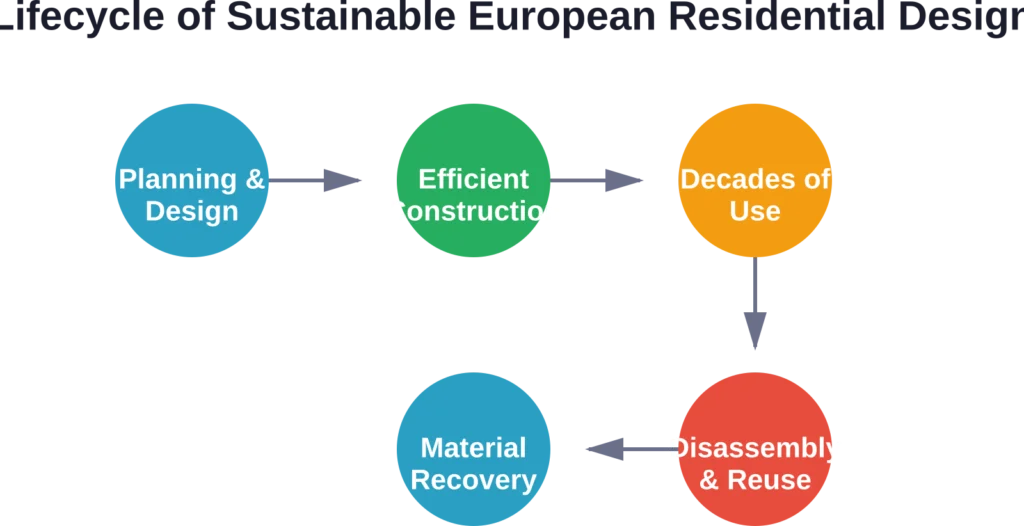
Forward-thinking European residential design now considers end-of-life scenarios. Design for disassembly principles—where building components can be separated, reused, or recycled rather than landfilled—influence material selection and assembly methods.
Adaptability matters too. Residential spaces designed to accommodate changing household needs over decades reduce the pressure to demolish and rebuild. That might mean floor plans that support home offices or multi-generational living, or structural systems that allow interior walls to be moved without major renovation.
These aren’t radical ideas. They’re pragmatic responses to the reality that buildings constructed in 2026 need to remain functional and efficient for 50, 75, even 100 years.
Get BIM Support for Residential Design Projects in Europe
Powerkh works with architects, developers, and consultants on residential design projects across Europe. Its services include BIM modelling, coordination, technical documentation, and existing conditions support for multi-disciplinary project delivery.
Need Support with Residential Design Delivery?
Talk with Powerkh to:
- develop BIM models for residential projects
- support coordination across design disciplines
- prepare technical drawings and documentation
- improve project delivery from design through construction
Discuss your residential design and BIM delivery requirements with Powerkh.
Modern European House Plan Features
When architects design new European-style homes today—whether in Europe or elsewhere—certain plan features appear consistently:
Open Living Areas
The kitchen-dining-family room combination creates flexible space for daily living and entertaining. Even homes with traditional exteriors typically feature this layout, which improves sightlines, natural light distribution, and family interaction.
Primary Suite Luxury
First-floor primary suites with spa-like bathrooms, generous closets, and sometimes private outdoor access represent thoroughly modern programming within traditional architectural envelopes.
Multi-Purpose Spaces
Rooms designed to serve multiple functions—home office, guest bedroom, study—accommodate changing needs without requiring renovation. Flexibility in residential design extends the useful life of the home.
Outdoor Connections
Covered terraces, loggias, and porches extend living space beyond the conditioned envelope. These semi-outdoor areas mediate between fully interior and exterior environments, particularly valuable in moderate climates.
Garage and Service Integration
Modern homes require space for vehicles, equipment, and storage that historic designs never anticipated. Contemporary European residential design tucks garages and service areas into lower levels or side wings where they don’t compromise the architectural composition.
Technology Integration in European Homes
Smart home technology appears in European residential design, though perhaps more subtly than in some markets. The emphasis leans toward systems that optimize energy use rather than pure convenience features.
Building automation that adjusts heating, cooling, and ventilation based on occupancy and weather conditions delivers measurable energy savings. Solar systems paired with battery storage and intelligent load management let homes maximize self-consumption of renewable energy.
But the technology stays largely invisible. European design sensibility tends to hide rather than celebrate technical systems, keeping focus on architecture and lived experience rather than gadgetry.
Frequently Asked Questions
European residential design encompasses multiple regional traditions including French country, Tuscan, English cottage, and Spanish styles. Common elements include steep roofs, stone or stucco exteriors, arched openings, multi-pane windows, and attention to exterior architectural detail. Modern European design maintains these aesthetic elements while incorporating contemporary floor plans and energy-efficient building systems.
The EU requires member states to reduce average home energy use by 16% by 2030 and 20-22% by 2035 compared with 2020 levels. This drives specific design choices including high-performance insulation, triple-glazed windows, air-tight construction, heat pumps, and solar panels. The goal is a zero-emission, fully decarbonised building stock by 2050.
Yes, and that’s exactly what the EU’s Renovation Wave Strategy targets—renovating 35 million buildings by 2030. About 85% of EU buildings were built before 2000 and 75% have poor energy performance. Renovation focuses on adding insulation, upgrading windows, improving air-tightness, and replacing heating systems while often preserving exterior historic character.
French residential design emphasizes symmetry, steep hip roofs, tall windows, and formal room arrangements using stone and stucco exteriors. Italian villa design features lower-pitched terracotta tile roofs, arched doorways, earth-tone color palettes, and central courtyard organization. Both share European elegance but express different regional climate responses and cultural traditions.
Construction costs vary significantly by region, materials, and performance standards. Meeting contemporary European energy efficiency requirements adds upfront costs for insulation, windows, and mechanical systems, but delivers lower operating costs through reduced energy consumption. High-performance homes qualify for various financing incentives and command premium resale values that offset initial investment.
Generally yes, though this varies. European residential design tends toward more compact, efficiently planned homes with less dedicated single-purpose space. Rooms serve multiple functions, and outdoor living areas extend usable space in moderate climates. The design philosophy prioritizes quality over quantity—better materials and details in somewhat smaller footprints.
French country, Tuscan villa, and modern European (contemporary interpretations of traditional styles) remain consistently popular. Spanish and English cottage styles have strong regional followings. Modern European designs that combine clean contemporary lines with traditional materials and proportions appeal to buyers wanting Old-World character with updated aesthetics.
Conclusion: The Evolution Continues
European residential design stands at a moment of necessary evolution. The architectural heritage remains deeply valued—those regional styles developed over centuries contain real wisdom about creating beautiful, durable, human-scale homes.
But the climate crisis and energy security concerns demand transformation. Buildings consume 40% of Europe’s energy, with 50% of gas consumption attributable to the built environment. That can’t continue.
What’s emerging is a hybrid approach: homes that honor traditional aesthetics and proportions while incorporating building science that would have seemed impossible even twenty years ago. Thick walls that look like stone but contain engineered insulation systems. Windows with historic profiles and triple-pane thermal performance. Rooflines that echo centuries-old precedents while supporting photovoltaic arrays.
The next decade will determine whether Europe can actually renovate 35 million buildings and bring them to contemporary performance standards. That’s the real test of whether architectural tradition and environmental necessity can coexist.
For anyone building or renovating in Europe—or drawing inspiration from European residential design anywhere—the message is clear: the best contemporary work respects what came before while refusing to be limited by it. That’s how architectural traditions stay alive rather than becoming museum pieces.
Ready to explore European-inspired residential design for your own project? Look for architects who understand both the aesthetic language of European architecture and the building science required to make it perform for the next century. The two aren’t in conflict—they’re the foundation of residential design that actually lasts.