
Quick Summary: Point cloud services cost between $1,000 for single rooms to $100,000+ for large industrial facilities, with most commercial projects ranging from $3,000 to $15,000. Per-square-foot rates typically fall between $0.20-$0.70, while software subscriptions start at €99/month for professional tools. Pricing depends on project size, complexity, deliverable formats, accuracy requirements, and turnaround time.
The point cloud market has exploded over the past few years. With the global LiDAR market reaching USD 2.74 billion in 2024 and projected to hit USD 4.71 billion by 2030 (a 9.5% CAGR), more businesses are adopting these technologies than ever before.
But here’s the thing—pricing for point cloud services remains frustratingly opaque. Ask five providers for quotes and you’ll get five wildly different numbers.
This guide breaks down exactly what point cloud services cost in 2026, from field scanning through final deliverables. Real numbers, real projects, real pricing structures.
What Are Point Cloud Services?
Point cloud services capture physical spaces using laser scanning or LiDAR technology, creating dense collections of XYZ coordinate data points. Each point represents a precise location in three-dimensional space.
These services typically include three phases: field data capture using 3D laser scanners, point cloud processing and registration to align multiple scans, and deliverable creation such as CAD drawings, Revit models, or as-built documentation.
The output—a point cloud—contains millions or billions of individual measurements. A single mobile LiDAR sensor can capture 600,000 points per second with sub-centimeter accuracy. That’s massive data volume requiring specialized processing.
Point Cloud Services Cost by Project Type
Pricing varies dramatically based on what’s being scanned. Here’s what professional services actually cost across different project categories.
| Project Type | Cost Range | Per Sqft Rate | Typical Timeline |
|---|---|---|---|
| Single Room | $1,000–$2,000 | N/A (min project) | 1–2 hours |
| Residential (Full Home) | $2,000–$6,000 | $0.40–$0.70/sqft | 1 day |
| Small Commercial | $3,000–$8,000 | $0.30–$0.50/sqft | 1–2 days |
| Medium Commercial | $5,000–$15,000 | $0.25–$0.40/sqft | 2–3 days |
| Large Industrial | $15,000–$100,000+ | $0.20–$0.35/sqft | 1–2 weeks |
Most providers enforce minimum project fees between $1,000-$2,000 regardless of size. That covers mobilization costs, equipment transport, and baseline processing time.
For medium-sized commercial projects, expect total costs between $5,000 and $15,000. A simple 20,000-square-foot warehouse might cost significantly less to scan than a complex hospital with extensive MEP systems at the same square footage.
Per-Square-Foot Pricing Reality
The cost of 3D laser scanning services typically ranges from $1.00 to $10.00 per square foot when you factor in complexity adjustments. But that’s misleading.
Real-world per-square-foot rates cluster between $0.20-$0.70 for straightforward commercial spaces. The higher end of that range applies to residential work or highly detailed documentation requirements.
Per-square-foot pricing makes sense for bidding purposes, but savvy buyers look at total project cost instead. A 5,000-square-foot mechanical room packed with piping costs more per square foot than a 50,000-square-foot empty warehouse.
Point Cloud Processing and Software Costs
Field scanning represents only part of total project cost. Processing raw scan data into usable deliverables often equals or exceeds field time expenses.
Software licensing adds recurring costs that many buyers overlook during initial budgeting.
Professional Point Cloud Software Pricing
Dedicated point cloud classification and processing tools charge monthly or annual subscriptions. Professional-grade software with unlimited project size starts around €99 per month for basic tiers.
Enterprise solutions scale significantly higher—hundreds or thousands per month depending on feature sets, user seats, and processing capacity.
| Software Category | Typical Pricing | Best For |
|---|---|---|
| Entry-Level Processing | €99–€200/month | Small teams, occasional projects |
| Professional Classification | €300–€600/month | Regular scanning workflows |
| Enterprise Platforms | €1,000+/month | Large organizations, continuous processing |
| Cloud Processing Services | Pay-per-project | Variable workloads, no capex |
Cloud-based processing has emerged as an alternative to perpetual software licenses. Instead of monthly subscriptions, some platforms charge per-project based on data volume processed. That works well for firms with inconsistent project flow.
Processing Time and Labor Costs
Processing labor typically matches or exceeds field capture time. A four-hour field scan might require 6-10 hours of office processing depending on deliverable complexity.
Registration—aligning multiple scan positions into a single coordinate system—takes 1-3 hours per average project. Classification and feature extraction for Scan-to-BIM deliverables adds substantially more time.
When evaluating service provider quotes, ask specifically about included processing. Some quotes cover only raw scan data delivery. Others include full as-built CAD drawings or Revit models. That difference explains massive price variation between seemingly comparable bids.
Cost Factors That Actually Matter
Several variables drive point cloud service pricing beyond simple square footage. Understanding these helps evaluate quotes and control costs.
Building Complexity
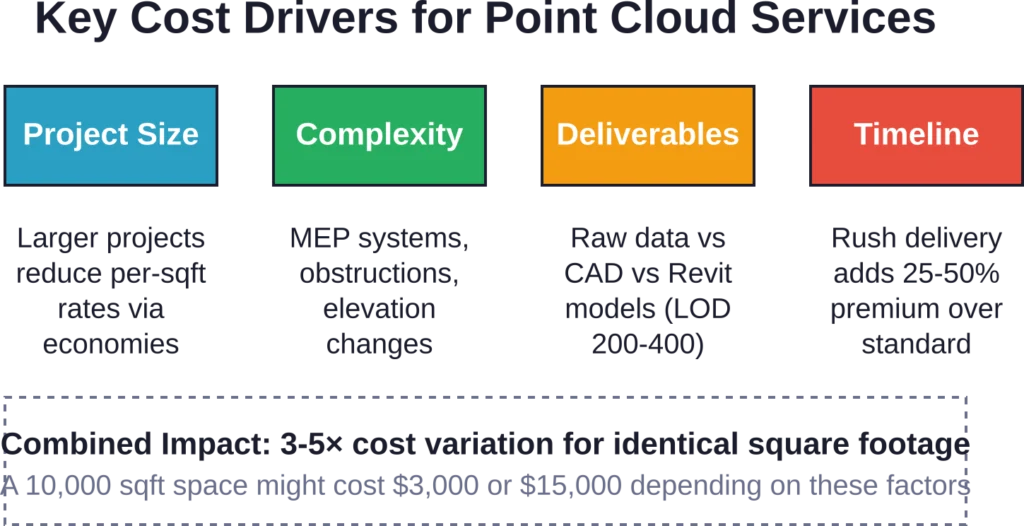
Complexity trumps size for pricing impact. An empty 50,000-square-foot warehouse scans quickly with minimal setup positions. A 10,000-square-foot hospital with dense mechanical systems, multiple floors, and cluttered spaces requires far more scan positions and processing time.
Specific complexity factors include ceiling height variations, mechanical/electrical/plumbing density, furniture and equipment obstructions, multi-floor layouts, and exterior envelope documentation needs.
Accuracy and Deliverable Requirements
Standard commercial scanning delivers ±2mm accuracy, sufficient for most as-built documentation and renovation planning. Higher precision requirements increase both field time and processing costs.
Deliverable format dramatically impacts pricing. Raw point cloud data (.LAS, .LAZ, .E57, .RCP formats) costs least—essentially field capture plus basic registration. CAD drawings extracted from point clouds add 30-50% to baseline costs. Full Revit BIM models at LOD 300-400 specifications can double or triple raw scan pricing.
The cost of 3D laser scanning services jumps when clients request multiple deliverable formats. Requesting point clouds plus 2D CAD plans plus Revit models costs more than choosing one primary format.
Timeline and Rush Fees
Standard delivery runs 2-4 weeks from field capture through final deliverables. Need rush delivery within one week? Expect a 25-50% premium over standard pricing.
That premium isn’t arbitrary—it reflects overtime labor, expedited processing, and displaced work from other projects. Some providers can’t accommodate rush requests at all during busy seasons.
Point Cloud Deliverable Formats and Pricing
What you actually receive for your money varies significantly. Understanding deliverable options prevents costly surprises.
Raw Point Cloud Data
Baseline deliverables include registered point cloud files in standard formats. LAS and LAZ files carry XYZ coordinates, intensity values, RGB color, and classification attributes. LAZ represents the compressed variant—identical data at 10-15% of uncompressed file size.
E57 and RCP formats serve similar purposes with slightly different use cases. E57 works across multiple platforms as an open standard. RCP integrates directly with Autodesk products.
Raw data alone costs least but requires recipient teams to have appropriate software and expertise for extraction.
CAD and As-Built Documentation
CAD deliverables extract 2D plans, elevations, sections, and details from point cloud data. This represents traditional construction documentation in AutoCAD or similar formats.
Pricing for CAD extraction depends on detail level and number of drawing sheets. Simple floor plans cost less than fully dimensioned construction documents with detailed call-outs.
Scan-to-BIM and Revit Models
Scan-to-BIM services convert point clouds into intelligent 3D Revit models. Professional point cloud modeling services typically deliver LOD 200 through LOD 400 specifications depending on project needs.
LOD (Level of Development) determines model detail and cost. LOD 200 provides schematic massing. LOD 300 includes specific assemblies and accurate geometry. LOD 400 adds fabrication-level detail.
Scan-to-BIM costs run 2-3× raw point cloud pricing for LOD 300 models. LOD 400 increases that further. A $5,000 scanning project might generate $12,000-$15,000 in total costs when including LOD 300 Revit models for architectural, structural, and MEP systems.
Get Point Cloud Processing and Scan to BIM Support
Powerkh works with design and construction teams that need accurate existing conditions data for BIM and coordination workflows. Its services include laser scanning support, point cloud processing, and existing conditions modelling.
Need Point Cloud Support for a Project?
Talk with Powerkh to:
- process point cloud data for BIM workflows
- create accurate existing conditions models
- support renovation and retrofit projects
- align scan data with project coordinates
Talk with Powerkh about Scan to BIM and point cloud processing support.
Hidden Costs and Budget Considerations
Several costs catch buyers off-guard if not addressed during initial scoping.
Site access and coordination time can add expenses. If scanning requires after-hours access, weekend work, or extensive coordination with building operations, expect premium rates or additional fees.
Multi-visit projects cost more than single-session capture. Some construction documentation requires scanning at multiple project phases—pre-construction, rough-in, and final conditions. Each visit incurs mobilization costs.
Data storage and management costs accrue over time. Point cloud files consume massive storage—often 1-10 GB per project. Cloud storage for long-term archival adds recurring costs that exceed initial project fees over multi-year periods.
Software licensing for end users matters too. Receiving a Revit model doesn’t help if your team lacks Revit licenses. Budget accordingly for tools needed to actually use deliverables.
Point Cloud Services Pricing Models
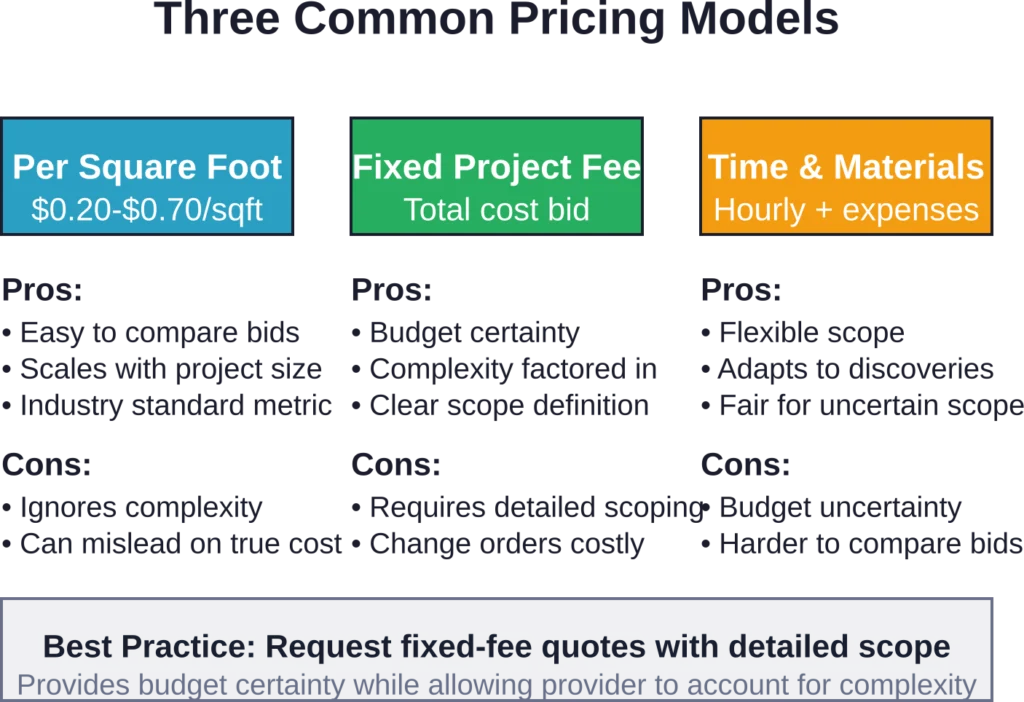
Providers structure pricing three primary ways, each with distinct advantages and limitations.
Per-Square-Foot Pricing
Most providers quote initial estimates based on square footage. This provides easy comparison between competing bids and aligns with how construction projects typically budget.
The limitation? Square footage alone doesn’t capture project reality. Two 15,000-square-foot buildings might differ 3× in scanning cost based on complexity factors.
Fixed Project Fees
Fixed-fee proposals provide budget certainty. The provider assesses project scope—including complexity, deliverables, and timeline—then quotes a total price.
This works well when scope is clearly defined upfront. Changes during execution typically trigger change orders at premium rates.
Time and Materials
Hourly billing with material pass-throughs suits projects with uncertain scope or ongoing scanning needs. Construction documentation across multiple phases often works best on T&M basis.
Hourly rates for professional scanning services range from $150-$300 per hour depending on equipment sophistication and expertise level. Processing and modeling work bills separately, typically $75-$150 per hour.
Cost Optimization Strategies
Several tactics reduce point cloud service costs without sacrificing quality.
Bundle multiple areas or phases into single projects. Providers offer better per-unit rates for larger engagements because mobilization costs spread across more billable work.
Choose appropriate deliverable detail levels. Do you truly need LOD 400 Revit models, or would LOD 300 suffice? Each LOD step up adds significant cost. Match deliverable detail to actual project requirements rather than requesting maximum detail by default.
Provide clear site access and minimize coordination friction. Every hour a scanning crew spends waiting for access or coordinating with building operations adds direct costs. Streamlined logistics reduce billable time.
Consider raw data delivery with in-house processing if your team has appropriate software expertise. This cuts costs significantly but requires internal capability.
Industry-Specific Cost Patterns
Different industries show distinct cost patterns for point cloud services based on typical project characteristics.
Construction and renovation projects focus on as-built documentation, typically requiring CAD or Revit deliverables. These projects represent the volume market for point cloud services and fall into standard pricing ranges.
Industrial and manufacturing facilities involve complex piping, equipment, and process systems. Higher complexity and precision requirements push costs toward the upper end of typical ranges.
Mining and infrastructure projects deal with massive scale and outdoor environments. The mining sector in particular has driven rapid adoption, with compliance monitoring and site analysis becoming routine.
Historic preservation requires exceptional detail and non-invasive capture methods. These specialized projects often exceed standard commercial rates due to precision requirements and careful handling protocols.
Evaluating Service Provider Quotes
When comparing quotes, look beyond the bottom-line number. Several factors indicate whether a bid represents good value or potential problems.
Detailed scope documentation separates professional providers from low-ball competitors. Quality quotes specify exact deliverable formats, coordinate systems, accuracy standards, delivery timeline, and what’s explicitly excluded from scope.
Ask about included revisions and review cycles. Does the quote include one round of revisions or unlimited adjustments? Revision policies dramatically impact final costs when changes arise.
Verify insurance and professional liability coverage. Point cloud data errors can cause expensive downstream problems. Adequate provider insurance protects against measurement errors or deliverable defects.
Check equipment and technology capabilities. Providers using current-generation scanners and proven processing workflows deliver better results than those running outdated equipment.
Request sample deliverables from similar past projects. This reveals actual quality standards and deliverable formats better than any written specification.
Future Cost Trends
Several trends are reshaping point cloud service economics for 2026 and beyond.
Cloud processing platforms are reducing software capital costs while enabling more flexible project-based billing. Rather than maintaining expensive software licenses year-round, firms increasingly access processing tools on-demand.
Automation and AI-driven feature extraction are compressing processing timelines and reducing labor costs.
The falling cost of scanning hardware continues driving market expansion. Equipment that cost $100,000+ five years ago now has capable alternatives under $30,000, expanding the provider market and increasing competition.
Integration with AWS, Azure, and other cloud platforms enables massive-scale processing. A single mobile LiDAR sensor generating 600,000 points per second creates data volumes requiring cloud-scale infrastructure.
These trends generally push costs downward for commodity scanning while enabling more sophisticated analysis at comparable price points.
Frequently Asked Questions
Professional point cloud services typically cost $0.20-$0.70 per square foot for commercial projects, with residential work at the higher end ($0.40-$0.70/sqft) and large industrial facilities at the lower end ($0.20-$0.35/sqft). Total project cost depends heavily on complexity beyond just square footage—a mechanically dense space costs significantly more per square foot than an empty warehouse.
Standard quotes include field data capture, point cloud registration (aligning multiple scan positions), and delivery of registered point cloud files in specified formats (.LAS, .LAZ, .E57, or .RCP). Additional deliverables like CAD drawings or Revit models cost extra—often 50-200% above baseline scanning fees depending on detail level required. Always verify exactly what deliverables are included before comparing quotes.
Standard turnaround runs 2-4 weeks from field capture through final deliverables. Raw point cloud registration typically completes within a few days. CAD extraction or Revit modeling adds 1-3 weeks depending on project size and detail level. Rush delivery within one week is possible but adds 25-50% premium over standard pricing.
Yes, if your team has appropriate software and expertise. Purchasing raw registered point cloud data costs least—essentially just field capture and basic registration. Processing software subscriptions start around €99/month for professional tools. However, extracting accurate CAD or BIM models requires significant skill and time investment. Most organizations find full-service providers more cost-effective unless they maintain regular in-house scanning workflows.
Equipment quality, processing capabilities, deliverable detail levels, and provider experience all create cost variation. A provider using professional-grade scanners with proven processing workflows delivers different value than one using consumer equipment. Scope differences also explain variation—one quote might include only raw point clouds while another includes full Revit models. Always compare scope and deliverables carefully, not just bottom-line pricing.
Potentially yes. Point cloud files require significant storage space (1-10 GB per typical project), so long-term archival creates recurring costs if using cloud storage. Software licenses are needed to view and use deliverables—Revit models require Revit licenses, specialized point cloud formats need viewing software. Budget for these post-delivery requirements in addition to initial service costs.
Professional commercial scanning delivers ±2mm accuracy as standard, sufficient for most as-built documentation and renovation planning. Higher precision (sub-millimeter) increases field time and processing costs but is rarely necessary outside specialized industrial applications.
Making Smart Point Cloud Investment Decisions
Point cloud services represent significant project investment, but the value delivered through accurate documentation and reduced construction risk justifies costs when scoped appropriately.
Focus on matching deliverable detail to actual project needs. Not every project requires LOD 400 Revit models. Many design and construction workflows function perfectly well with point cloud data plus basic CAD extraction.
Build relationships with qualified providers rather than always chasing the lowest bid. Established providers with demonstrated quality and reliability prevent costly errors and project delays that wipe out any upfront savings from cut-rate scanning.
Start with clearly defined scope and deliverable specifications. Ambiguity creates change orders and cost overruns. Invest time upfront detailing exactly what coordinate systems, file formats, accuracy standards, and deliverable content the project requires.
The point cloud services market continues maturing rapidly. With the LiDAR market growing at 9.5% annually through 2030, competitive pressure generally favors buyers through improved capabilities at stable or declining costs.
For organizations adopting point cloud technology for the first time, start with a pilot project of manageable scope. This builds internal familiarity with deliverables and workflows before committing to large-scale deployment.
Understanding true point cloud services cost—beyond simple per-square-foot rates—enables smarter procurement decisions and better project outcomes. The technology delivers measurable value when matched appropriately to project requirements and budgeted realistically.