

Quick Summary: Structural shop drawings typically cost between $500 and $5,000+ depending on project complexity, with simple steel connections starting around $500-$1,500, medium-complexity projects ranging $2,000-$4,000, and large custom fabrications exceeding $5,000. Pricing varies by trade (structural steel, precast, rebar), project size, detail level, and turnaround time, with most firms charging either hourly rates ($40-$150/hour) or flat project fees.
If you’re planning a construction project that involves structural components—steel beams, precast concrete, reinforcing bars, or custom fabrications—you’ll need shop drawings. And you’ll need to budget for them.
But here’s the thing: shop drawing costs aren’t advertised like retail prices. There’s no standard rate card. What you pay depends on dozens of variables, from the type of structure you’re building to how fast you need the drawings delivered.
This guide breaks down exactly what structural shop drawings cost in 2026, what drives those prices, and how to estimate your budget accurately.
What Are Structural Shop Drawings?
Before diving into costs, it’s worth clarifying what you’re actually paying for.
Structural shop drawings are highly detailed fabrication and installation drawings created by contractors, subcontractors, or specialized drafting firms. They translate the architect’s construction drawings into precise, fabrication-ready documents that show exactly how each structural component will be manufactured, assembled, and installed.
Unlike architectural construction drawings—which show overall design intent—shop drawings include dimensions, materials, connection details, weld specifications, bolt patterns, and coordination with other building systems. These drawings are essential for avoiding costly rework and ensuring that fabricated components fit perfectly on site.
Common types of structural shop drawings include:
- Structural steel shop drawings (beams, columns, connections)
- Rebar detailing and placement drawings
- Precast concrete panel drawings
- Metal deck and joist drawings
- Miscellaneous steel (stairs, railings, platforms)
Each type requires different levels of detail and expertise, which directly impacts cost.
Typical Cost Ranges for Structural Shop Drawings
So what do these drawings actually cost?
Based on current market data from CAD drafting service providers and construction firms, here’s what you can expect to pay:
| Project Complexity | Typical Cost Range | Example Projects |
|---|---|---|
| Simple/Small | $500 – $1,500 | Basic steel beam connections, small residential steel work, simple rebar schedules |
| Medium | $2,000 – $4,000 | Commercial building steel frame, moderate precast panels, multi-level structures |
| Complex/Large | $5,000 – $15,000+ | Custom fabrications, large industrial facilities, stadiums, bridges, high-rise buildings |
These ranges align with broader construction drawing costs. For context, a complete set of construction drawings for an average single-family home often ranges between $3,000 and $8,000 USD (2,800 to 7,500 EUR), with basic floor plans starting at $500 to $1,500 USD (450 to 1,400 EUR).
The structural shop drawings represent just one subset of that total package—but for projects with significant structural components, they can account for a substantial portion of the budget.
Get Structural Shop Drawings Prepared for Construction
Structural shop drawing costs can depend on project scale, structural complexity, detailing scope, and fabrication requirements. Powerkh supports structural workflows with shop drawings, BIM coordination, and technical documentation services for construction teams.
Need Structural Shop Drawing Support?
Talk with Powerkh to:
- prepare coordinated structural shop drawings
- support reinforcement and steel detailing workflows
- improve documentation before fabrication starts
- support structural coordination during delivery
Talk with Powerkh about structural shop drawing support for your project.
Hourly Rates vs. Flat Project Fees
Structural shop drawing services typically price their work in one of two ways: hourly rates or flat project fees.
Hourly Rate Pricing
Many drafting professionals and smaller firms charge by the hour. Current market rates vary significantly based on experience level and location:
| Provider Type | Typical Hourly Rate | Notes |
|---|---|---|
| Freelance CAD draftsman (beginner) | $20 – $40/hour | Entry-level or overseas professionals |
| Experienced freelancer / mid-level | $40 – $75/hour | 5-10 years experience, domestic providers |
| Specialized structural drafting firm | $75 – $150/hour | Licensed engineers, complex projects, coordination services |
Hourly billing works well for projects where scope isn’t fully defined upfront or when revisions are expected. But it can make budgeting tricky.
Flat Project Fee Pricing
For well-defined projects, many firms prefer flat fees. This gives contractors certainty for bidding and budgeting purposes.
Flat fees are typically calculated based on the firm’s estimated hours multiplied by their hourly rate, then adjusted for project risk and complexity. A project that might take 20 hours at $60/hour would be quoted around $1,200 as a flat fee, potentially with adjustments for rush delivery or extensive revisions.
Homeowners or small contractors commissioning residential drawings usually pay a flat project rate, since it’s easier to budget that way.
Key Factors That Affect Shop Drawing Costs
Why such wide price ranges? Because shop drawing costs aren’t determined by square footage alone. Here are the main drivers:
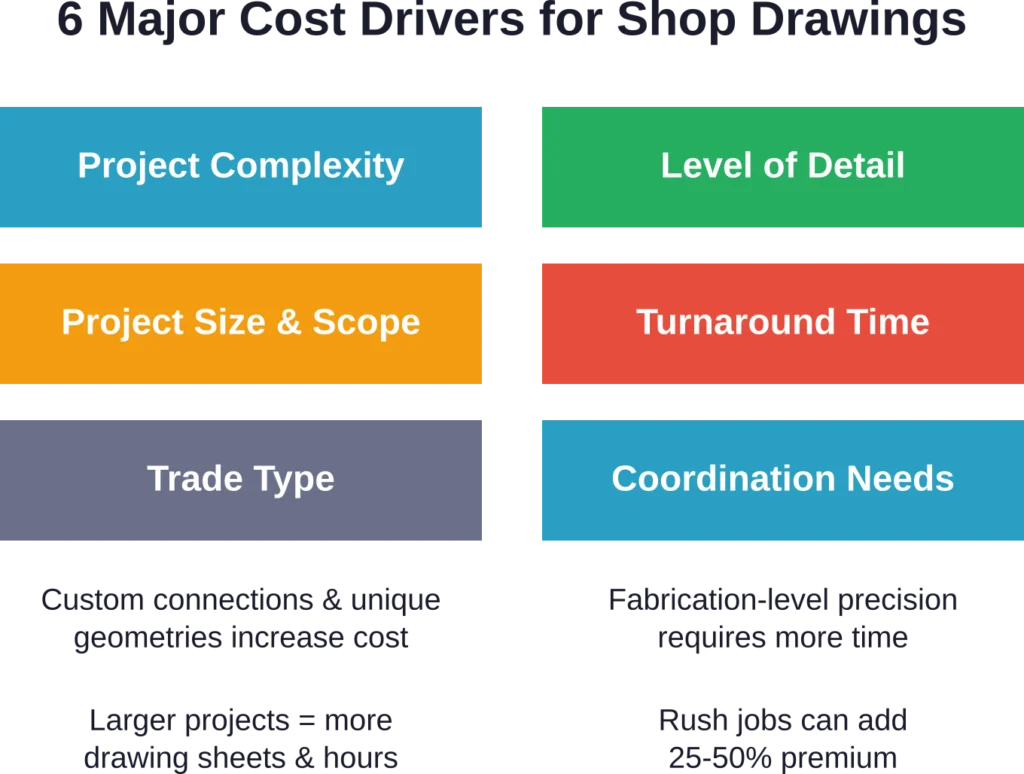
1. Project Complexity
A simple steel beam connection with standard bolted details? That’s straightforward. A custom curved steel staircase with complex welded nodes and glass infill panels? That’s going to cost significantly more.
Complexity includes unusual geometries, custom fabrications, tight tolerances, and non-standard materials or connections. Each complication adds drafting time and requires higher expertise.
2. Level of Detail Required
Shop drawings for fabrication require far more detail than preliminary design drawings. Every weld symbol, bolt grade, material specification, and surface finish must be precisely documented.
Some projects also require coordination drawings that show how structural elements interface with mechanical, electrical, and plumbing systems. This level of coordination adds substantial cost but prevents expensive conflicts during construction.
3. Project Size and Scope
This one’s obvious: more square footage, more structural members, more drawing sheets, more cost.
A 5,000-square-foot commercial building will have far fewer structural elements to document than a 50,000-square-foot warehouse or a multi-story office tower.
4. Turnaround Time
Need drawings in two weeks instead of six? Expect to pay a premium.
Rush jobs require drafters to prioritize your project over others, often working overtime or bringing in additional resources. Many firms add 25-50% to their standard rates for expedited delivery.
5. Trade Type
Different structural trades have different pricing norms:
- Structural steel shop drawings tend to be the most expensive per ton of material due to connection complexity and precision requirements
- Rebar detailing can be labor-intensive for complex foundations or heavily reinforced elements but may be less costly for standard slabs and walls
- Precast concrete requires precise dimensions and embed details, often falling in the mid-range
- Miscellaneous steel (stairs, railings, ladders) varies widely based on custom design elements
6. Coordination and BIM Requirements
If your project requires Building Information Modeling (BIM) coordination—where structural shop drawings must be modeled in 3D and checked for clashes with other trades—costs increase substantially.
BIM-based shop drawings provide enormous value by catching conflicts before fabrication, but they require specialized software expertise and more time to produce. Some firms charge 20-40% more for BIM-coordinated shop drawings compared to traditional 2D drawings.
Shop Drawings vs. Construction Drawings: Understanding the Difference
It’s worth clarifying this distinction because mixing up the two can lead to budget confusion.
Construction drawings (also called architectural drawings or contract documents) are created by architects and engineers during the design phase. They show design intent, overall dimensions, performance specifications, and regulatory compliance. They’re what you submit for building permits.
Shop drawings are created later, during the construction phase, by contractors or fabricators. They show exactly how each component will be made and installed, including manufacturing processes, connection methods, and field assembly sequences.
| Aspect | Construction Drawings | Shop Drawings |
|---|---|---|
| Created by | Architects and engineers | Contractors, fabricators, specialty firms |
| Purpose | Design intent, permits, bidding | Fabrication, installation, coordination |
| Detail level | Moderate (shows what to build) | High (shows how to build it) |
| When created | Design phase | Construction phase |
| Typical cost | $3,000-$8,000 for full residential set | $500-$15,000+ depending on scope |
Both are essential, but they serve different purposes and come from different sources in your project timeline. When budgeting, make sure you’re accounting for both separately.
Who Provides Structural Shop Drawing Services?
You have several options when sourcing shop drawings, each with different cost profiles:
In-House Fabricator Drafting
Many steel fabricators and precast manufacturers include shop drawing production as part of their fabrication contract. The cost is typically bundled into the overall fabrication price rather than itemized separately.
This can be the most seamless option since the people making the drawings are the same people fabricating the components. But it doesn’t give you much flexibility in sourcing or price comparison.
Specialty Shop Drawing Firms
Dedicated shop drawing companies focus exclusively on producing detailed fabrication drawings across multiple trades. They’re experienced, efficient, and can often deliver faster than in-house teams.
These firms typically charge by the hour or project fee, with rates in the $60-$120/hour range for experienced structural drafters.
Freelance CAD Drafters
Independent drafters offer the most flexible pricing, especially for smaller projects. Rates vary widely based on location and experience—from $20-$40/hour for entry-level or overseas professionals to $75+/hour for highly experienced domestic drafters.
The trade-off is variable quality and availability. A skilled freelancer can deliver excellent work at competitive rates, but vetting and communication require more effort on your part.
Engineering or Architectural Firms
Some structural engineering firms offer shop drawing services, particularly for complex projects requiring licensed engineer review and stamping.
This is typically the most expensive option—often $100-$150+/hour—but provides the highest level of technical expertise and professional liability coverage.
How to Estimate Shop Drawing Costs for Your Project
Ready to budget? Here’s a practical approach:

Step 1: Define Your Structural Scope
List every structural element that will require shop drawings: steel beams and columns, connection types, precast panels, rebar assemblies, joists, metal deck, miscellaneous steel, etc.
Work from your structural engineer’s construction drawings. If the engineer has provided preliminary member sizes and quantities, use those as a starting point.
Step 2: Assess Complexity
For each element, determine whether it’s standard or custom:
- Standard wide-flange beams with typical bolted connections? Lower complexity.
- Custom built-up members with complex welds and non-orthogonal angles? Higher complexity.
- Repetitive floor-to-floor framing? Economies of scale reduce per-unit cost.
- Unique conditions at every level? Each requires individual detailing.
Step 3: Request Quotes from Multiple Providers
Don’t rely on a single estimate. Reach out to at least three providers—fabricators, specialty firms, and possibly freelancers—with the same scope description.
Make sure quotes specify what’s included: number of drawing sheets, number of revisions allowed, file formats delivered, and whether engineer review or coordination is part of the scope.
Step 4: Add Contingency
Shop drawings almost always require revisions. Design changes happen. Coordination issues emerge. Budget an extra 15-20% beyond the initial quote to cover these inevitable adjustments.
Common Shop Drawing Types and Their Cost Impact
Not all shop drawings are created equal. Understanding the specific requirements of different trades helps refine your budget.
Structural Steel Shop Drawings
These are among the most detailed and expensive shop drawings. Every connection must show bolt locations, hole sizes, weld types, plate thicknesses, and edge distances. Complex moment connections or seismic detailing increase costs substantially.
Expect to budget at the higher end of the range for steel—especially if the project includes architectural exposed steel where aesthetics matter as much as structure.
Rebar Detailing
Reinforcing bar shop drawings show bar sizes, spacing, lap lengths, development lengths, and placement sequences. They’re essential for concrete pours but can become extremely time-consuming for heavily reinforced elements like transfer beams, shear walls, or seismic frames.
Standard slabs and footings are relatively inexpensive to detail. Complex post-tensioned slabs or congested column-beam joints push costs higher.
Precast Concrete Shop Drawings
Precast panels, beams, and columns require dimensional precision and coordination with embeds, inserts, connection hardware, and architectural finishes. The level of detail is comparable to structural steel.
Pricing typically falls in the mid-to-high range, especially for architectural precast with intricate form liners or reveals.
Miscellaneous Steel
Stairs, railings, platforms, ladders, and supports often fall under “miscellaneous steel.” These can range from simple prefabricated components (lower cost) to one-off custom designs (higher cost).
A standard OSHA-compliant industrial stair might cost $800-$1,500 to detail. A monumental curved staircase in a corporate lobby could easily exceed $5,000.
How to Reduce Shop Drawing Costs Without Sacrificing Quality
Looking to stretch your budget? A few strategies can help:
Standardize Where Possible
Repetitive elements are cheaper to detail. If your structural design uses the same beam size and connection type across multiple locations, the drafter can reuse details with minor modifications rather than starting from scratch each time.
Work with your structural engineer during design to maximize repetition and minimize one-off conditions.
Provide Clear, Complete Information
The more complete and clear your construction drawings, the less time drafters spend asking questions and waiting for clarifications. Ambiguity and missing information drive up costs through delays and rework.
Make sure your structural engineer provides thorough notes, specifications, and connection details. This reduces interpretation time.
Allow Adequate Time
Rush charges are real and significant. If your schedule permits, request standard delivery rather than expedited turnaround. The same set of drawings might cost 30% less with an extra two weeks of lead time.
Bundle Work with One Provider
If you have multiple structural trades requiring shop drawings (steel, precast, rebar), consider sourcing them all from a single full-service firm. Many providers offer volume discounts or package pricing when you consolidate work.
Review and Approve Efficiently
Every revision cycle costs time and money. Establish a clear review and approval process with your architect and structural engineer so shop drawings get thorough review the first time, minimizing back-and-forth.
Some contracts specify a limited number of included revisions, with additional rounds billed separately. Efficient review saves money.
The Role of BIM and Technology in Shop Drawing Costs
Technology is reshaping how shop drawings are produced—and what they cost.
Building Information Modeling (BIM) has become standard on larger projects. Instead of 2D CAD drawings, structural components are modeled in 3D using software like Revit, Tekla, or SDS/2. These models can automatically generate 2D shop drawings, perform clash detection with other trades, and export directly to CNC fabrication equipment.
BIM-based shop drawings cost more upfront—often 20-40% higher than traditional 2D drawings—but they can save far more on the back end by catching coordination conflicts before they reach the field. In practice, many project teams find the investment pays for itself through reduced RFIs, change orders, and rework.
For smaller projects where BIM isn’t required, traditional 2D CAD drafting remains cost-effective and entirely adequate.
Real-World Budget Examples
Let’s put these ranges into context with a few realistic scenarios:
Example 1: Small Residential Addition
A homeowner is adding a 400-square-foot second-story addition that requires a few steel beams and column supports. The structural engineer has specified standard wide-flange sections with bolted connections.
Estimated shop drawing cost: $600-$1,200
Simple scope, standard details, minimal complexity. A local fabricator includes this in their overall fabrication quote, or a freelance drafter handles it for $30-40/hour over 15-30 hours.
Example 2: Mid-Size Commercial Building
A 12,000-square-foot, two-story office building with structural steel framing, metal deck, and open-web joists. Moderate complexity with some architectural features requiring exposed steel.
Estimated shop drawing cost: $3,500-$6,000
Includes full structural steel shop drawings for beams, columns, connections, and joist coordination. A specialty shop drawing firm quotes $5,200 for a complete set with two rounds of revisions.
Example 3: Large Industrial Facility
A 60,000-square-foot warehouse with heavy structural steel, crane support systems, precast wall panels, and complex foundation details. High load conditions and custom connections throughout.
Estimated shop drawing cost: $15,000-$25,000
Multiple trades, high complexity, BIM coordination required. Steel shop drawings alone might run $12,000-$18,000, with additional costs for precast and rebar detailing. Some of this cost is absorbed by fabricators, but coordination and review add substantial engineering hours.
Questions to Ask Your Shop Drawing Provider
Before committing to a provider, clarify these key points:
- What’s included in your quote? Number of sheets, revisions, file formats, coordination services?
- What’s your typical turnaround time? And what does expedited delivery cost?
- Do you provide 2D CAD, 3D BIM, or both? Which does the project require?
- Will drawings be sealed by a licensed engineer if required? Some jurisdictions require professional stamps.
- How do you handle changes and revisions? Are a certain number included, or is each billed separately?
- What file formats will you deliver? PDF? DWG? IFC? Native model files?
- Do you carry professional liability insurance? Important for larger projects.
Clear communication upfront prevents expensive misunderstandings later.
Frequently Asked Questions
Structural shop drawings focus on load-bearing components—steel, concrete, rebar—and show fabrication and connection details. Architectural shop drawings cover non-structural elements like millwork, casework, curtain walls, and finishes. Both are detailed fabrication documents, but they address different building systems and are typically produced by different trades.
Not always. Small, simple projects using standard materials and methods may not need formal shop drawings. But any project involving fabricated structural steel, precast concrete, complex rebar assemblies, or custom components will require them. Building officials don’t review shop drawings for permits, but contractors and fabricators need them to build accurately and efficiently.
Typically, the cost is borne by the contractor or subcontractor and built into their bid price, which is ultimately paid by the owner as part of the overall construction cost. In some contracts, shop drawing costs are explicitly broken out; in others, they’re bundled into fabrication or installation line items. The key is ensuring someone budgets for them—overlooking shop drawings is a common source of change orders.
Timelines vary widely. A simple steel connection set might be ready in a week. A complete building’s structural steel shop drawings for a mid-size commercial project typically take 4-8 weeks, including review and revision cycles. Complex projects with extensive coordination can stretch to 12 weeks or more. Rush delivery is possible but comes with premium pricing and may sacrifice thoroughness.
Some construction estimating databases, including industry tools like RSMeans Data, provide cost benchmarks for various drafting and engineering services. These can give you ballpark figures based on project type and size. However, shop drawing costs are highly project-specific, so actual quotes from providers are always more accurate than software estimates. Use estimating tools for preliminary budgeting, then verify with real bids.
Requirements vary by jurisdiction and project type. In many cases, shop drawings are prepared by experienced CAD drafters or detailers without a professional engineering license, but they must be reviewed and approved by the project’s licensed structural engineer (the Engineer of Record). Some jurisdictions require that certain shop drawings be sealed by a licensed professional engineer, particularly for high-risk structures or public buildings. Check local building codes and contract documents.
Errors in shop drawings can lead to fabrication mistakes, field conflicts, construction delays, and expensive rework. Responsibility depends on contract terms, but generally the fabricator or shop drawing provider is liable for errors in their work, while the Engineer of Record is responsible for reviewing and catching issues before fabrication begins. This is why thorough review and coordination are critical—and why quality shop drawing services are worth the investment.
Final Thoughts: Budgeting Wisely for Shop Drawings
Structural shop drawings aren’t the most glamorous part of a construction budget. They don’t show up in architectural renderings. Nobody tours a building admiring the quality of the fabrication documents.
But they’re absolutely essential. Skimp here, and you pay for it later in field conflicts, fabrication errors, schedule delays, and change orders that dwarf the original shop drawing cost.
The best approach? Budget realistically from the start. Use the ranges in this guide as a starting point, then get detailed quotes from qualified providers based on your actual project scope. Build in contingency for the inevitable revisions and coordination.
And remember: the lowest bid isn’t always the best value. Experience, accuracy, and responsiveness matter. A provider who charges $1,000 more but delivers clean, coordinated drawings on time can save you $10,000 in avoided rework.
Shop drawings are an investment in getting the structure built right the first time. Budget for them wisely, and they’ll pay for themselves many times over.