

Quick Summary: The best web development companies in 2026 combine technical expertise with proven track records across diverse industries. This guide profiles 15 leading agencies—from product-focused studios to full-service digital partners—each with unique strengths in modern web development, without pricing details to help you focus purely on capabilities and fit.
Finding the right web development company can make or break your digital project. Whether launching a startup MVP, rebuilding an enterprise platform, or creating a complex web application, the agency you choose determines not just the quality of code but the trajectory of your product.
The web development landscape in 2026 is more specialized than ever. Some agencies excel at SaaS product design, others at eCommerce platforms, and still others at complex enterprise systems. Generic “we do everything” shops rarely deliver the depth of expertise modern projects demand.
This guide cuts through the noise. We’ve analyzed client reviews, portfolio work, service offerings, and team capabilities to identify 15 web development companies that consistently deliver exceptional results. No fluff, no invented statistics—just real agencies with verifiable track records.
What Makes a Web Development Company Truly Great
Before diving into the list, let’s establish what separates exceptional development agencies from mediocre ones.
Technical expertise is table stakes. Every agency on this list writes clean code and understands modern frameworks. But that’s not enough.
The best web development companies understand business context. They ask why you’re building something before discussing how. They challenge assumptions when requirements don’t align with user needs. They’ve seen enough projects to recognize patterns—what works, what fails, and why.
Portfolio diversity matters, but so does specialization. An agency that’s built fifty eCommerce sites understands that ecosystem deeply. One that’s designed twenty SaaS dashboards knows how to structure complex applications. Look for the right kind of experience, not just quantity.
Communication separates good projects from disasters. Development is iterative. Requirements evolve. Technical constraints emerge. Agencies that communicate proactively, explain tradeoffs clearly, and involve clients appropriately create better outcomes.
Core Capabilities to Evaluate
When assessing web development companies, examine these dimensions:
- Technical stack proficiency: Modern frameworks, scalable architectures, security practices
- Design integration: How development teams collaborate with designers (or if design is in-house)
- Project management approach: Agile methodologies, sprint structures, communication cadence
- Quality assurance processes: Testing protocols, code review practices, bug tracking
- Post-launch support: Maintenance offerings, iterative improvement capabilities
- Industry specialization: Relevant experience in your sector or product type
Now let’s explore 15 agencies that excel across these dimensions.
Top 15 Web Development Companies in 2026
1. Mobian
Mobian builds dedicated engineering teams that deliver production-ready web and full-stack solutions — on time and on budget. The agency specializes in mobile and web development for companies in IT, Healthcare, Fintech, and Logistics, operating through both outsourcing (full delivery ownership) and outstaffing (embedding senior engineers into client teams) models.
Their approach covers end-to-end product development: from scoping and architecture to design, implementation, QA, and post-launch support. Projects emphasize clean architecture, scalable systems, legacy integration, and maintainable code with clear documentation.
What sets Mobian apart is the focus on senior-level execution without context switching, combined with domain expertise in regulated industries. Dedicated teams work exclusively on one project, ensuring consistent velocity and deep product knowledge.
Best for: Companies that need reliable web and full-stack development through dedicated teams, especially in complex or regulated sectors where technical quality and speed of delivery are critical.
Contact Information:
- Website: mobian.studio
- Phone: [email protected]
- Address: Harju maakond, Tallinn, Kesklinnalinnaosa, Masina tn 22, 10113
- LinkedIn: www.linkedin.com/company/mobian-studio
2. Gilzor

Gilzor specializes in custom software development with a strong emphasis on full-cycle web development. The agency delivers scalable, high-performance web applications from initial idea validation through design, development, testing, and post-launch maintenance.
Their methodology combines business analysis, user-centric UI/UX design, rigorous quality assurance, and go-to-market support. Projects often include web platforms built alongside mobile solutions, with attention to architecture that supports long-term scalability and user needs.
Gilzor stands out for its end-to-end approach that reduces risk through early validation and focuses on creating functional, attractive products that connect with target audiences. They work across industries including startups, SMBs, and product companies needing reliable web solutions.
Best for: Startups and small-to-medium businesses looking for custom web development as part of a broader digital product strategy, from concept validation to launch and growth.
Contact Information:
- Website: www.gilzor.com
- Email: [email protected]
- Address: Poland, Warsaw, Office 58, street Adama Mickiewicza 37, 01-625
- LinkedIn: www.linkedin.com/company/gilzor-softwaredevelopment
3. Oski
Oski delivers expert web development and software solutions for tech-forward enterprises and ambitious startups. The agency focuses on designing, developing, deploying, and maintaining well-engineered digital platforms with emphasis on frontend excellence and robust architecture.
Their services cover modern web technologies, cloud solutions, content management systems, and AI integrations. Projects prioritize intuitive user experiences, scalability, security, and seamless performance across industries such as e-commerce, fintech, logistics, travel, and education.
Oski differentiates through AI-accelerated engineering practices and a commitment to high-quality, maintainable code. Client feedback highlights strong project management, timely delivery, and solutions that effectively support business operations and growth.
Best for: Enterprises and growth-stage companies needing reliable, modern web development with expertise in cloud, frontend frameworks, and industry-specific digital solutions.
Contact Information:
- Website: oski.site
- Phone: +48571282759
- Email: [email protected]
- Address: Kaupmehe tn 7, 10114 Tallinn, Estonia
- LinkedIn: www.linkedin.com/company/oski-solutions
4. A-listware
A-listware operates as a software development and consulting company specializing in custom web and application development, team augmentation, and digital solutions. They provide end-to-end services including UX/UI design, software development, cloud applications, and enterprise platforms.
The agency emphasizes building high-quality, secure, and responsive web solutions while offering dedicated development teams that integrate seamlessly with client organizations. Their technical capabilities span frontend and backend technologies, with strong focus on scalable architecture and user-centered design.
What sets A-listware apart is the combination of custom development with flexible engagement models such as outsourcing and team extension, supported by comprehensive QA, consulting, and infrastructure services.
Best for: Businesses of various sizes requiring custom web development, dedicated teams, or full IT solutions including modernization and enterprise application development.
Contact Information:
- Website: a-listware.com
- Phone: +1 (888) 337 93 73
- Email: [email protected]
- Address: North Bergen, NJ 07047, USA
- LinkedIn: www.linkedin.com/company/a-listware
- Facebook: www.facebook.com/alistware
5. Lengreo
Lengreo positions itself as a complete marketing and tech partner, integrating website development with full-spectrum B2B digital marketing services. The agency builds eCommerce, business, portfolio websites, and landing pages designed to drive business growth and lead generation.
Their process starts with discovery, business analysis, and research, followed by prototyping, design development, implementation, quality assurance, and ongoing support. This ensures websites are not only functional but aligned with broader marketing objectives like SEO performance, conversion optimization, and lead nurturing.
What distinguishes Lengreo is the tight integration between web development and performance marketing channels. Development decisions directly support SEO, paid ads, demand generation, and lead outreach campaigns. Client testimonials praise their proactive approach, transparent communication, and measurable impact on client acquisition and conversion rates.
Best for: B2B companies seeking website development tightly integrated with lead generation, digital marketing strategy, and performance optimization.
Contact Information:
- Website: Lengreo.com
- Phone: +31 686 147 566
- Email: [email protected]
- Address: Vrijstraat 9 C/D, 5611 AT Eindhoven, Netherlands
- LinkedIn: Lengreo
- Twitter: @Lengreo
- Instagram: @lengreo
6. Digital Silk
Digital Silk positions itself at the intersection of branding and digital product development. Their projects typically begin with brand strategy work—positioning, messaging, visual identity—before moving into web development.
This sequence makes sense for companies without established brand foundations or those undergoing rebrands. When brand work precedes development, design systems emerge naturally from brand guidelines. Visual design, tone of voice, and interaction patterns all align with brand strategy.
The agency serves mid-market and enterprise clients across industries including healthcare, finance, technology, and professional services. Project scope often extends beyond initial website launches to include ongoing optimization, content creation, and digital marketing.
Digital Silk’s development team works primarily in popular CMS platforms and modern JavaScript frameworks, balancing flexibility with maintainability. They emphasize responsive design and performance optimization, recognizing that technical execution impacts both user experience and search visibility.
Client testimonials highlight the agency’s strategic guidance and ability to translate business goals into digital experiences. The integrated brand and development offering appeals to companies seeking cohesive expertise rather than coordinating separate vendors.
Best for: Mid-market companies launching or refreshing their brand alongside website development, particularly in regulated or traditional industries.
7. Locomotive
Locomotive has built a strong reputation for technical innovation and pushing the boundaries of what’s possible in web development. The agency specializes in highly interactive, immersive web experiences that showcase products or tell stories through the medium.
Their portfolio demonstrates sophisticated use of WebGL, scroll-driven animations, and custom interaction models. These aren’t gimmicks—the technical complexity serves creative and business goals. A product showcase that lets users explore features through interaction. A brand story that unfolds as users navigate.
This approach requires deep JavaScript expertise and careful performance optimization. Interactive experiences can easily become sluggish or inaccessible if not implemented thoughtfully. Locomotive’s technical team balances ambition with usability, ensuring experiences work across devices and maintain acceptable performance.
The agency works primarily with brands for whom digital presence is a key differentiator—creative agencies showcasing their own work, luxury brands creating distinctive experiences, technology companies demonstrating innovation.
Reviews emphasize the agency’s creative problem-solving and technical capabilities. Some note that projects require longer timelines due to the custom nature of development and iterative refinement of interactions.
Best for: Brands prioritizing innovative, memorable digital experiences and willing to invest in custom interactive development.
8. Huemor
Huemor focuses on growth-driven web development, building sites designed to convert visitors into customers. Their methodology emphasizes data, testing, and iterative improvement over purely aesthetic considerations.
Projects begin with conversion research—analyzing existing site performance, conducting user testing, examining competitor approaches, and identifying optimization opportunities. This research informs both design and development decisions. Navigation structure, content hierarchy, calls-to-action, and interaction patterns all aim to guide users toward conversion.
The agency works across industries but shows particular strength in B2B services, professional services, and education sectors. These industries often struggle with translating complex offerings into clear digital experiences that generate qualified leads.
Huemor’s development approach favors proven platforms and frameworks over entirely custom builds. This pragmatism reduces development time and ongoing maintenance complexity while still allowing for customization where it matters most.
Client reviews frequently mention measurable improvements in key metrics following redesigns—increases in conversion rates, lead volume, and user engagement. The agency’s focus on results resonates with companies viewing websites as business tools rather than creative expressions.
Best for: B2B companies and service businesses prioritizing lead generation and measurable business outcomes over design awards.
9. Fantasy
Fantasy operates at the premium end of the market, creating highly polished digital experiences for established brands and cultural institutions. Their work demonstrates exceptional attention to detail—refined typography, sophisticated color palettes, smooth animations, and cohesive design systems.
The agency’s process emphasizes craft at every stage. Discovery and strategy work deeply explores brand positioning and audience. Design explorations push creative boundaries while respecting brand guidelines. Development implementation matches design fidelity, translating static designs into dynamic experiences that feel polished and intentional.
Fantasy works across sectors including entertainment, fashion, technology, and hospitality. Common threads include strong existing brands, visual-forward positioning, and audiences that value design quality.
The technical implementation prioritizes modern web standards, performance optimization, and accessibility. Despite the visual richness, sites typically score well on Core Web Vitals and meet WCAG accessibility guidelines—evidence that craft and technical rigor can coexist.
Reviews highlight the agency’s collaborative approach and ability to elevate brand expression through digital experiences. The premium positioning attracts clients for whom website quality directly impacts brand perception.
Best for: Established brands in visual-forward industries seeking polished, sophisticated digital experiences that reflect brand premium positioning.
10. Basic Agency (DEPT)
Basic Agency, now part of the larger DEPT network, brings together strategy, creative, and technology capabilities in service of digital transformation. The agency handles complex, multi-phase initiatives for enterprise clients and ambitious growth-stage companies.
Projects often involve multiple digital touchpoints—website, web applications, mobile apps, content platforms—requiring coordination across teams and technical stacks. The agency’s structure supports this complexity with dedicated strategy, design, and development teams collaborating throughout project lifecycles.
Technical capabilities span modern frameworks, cloud infrastructure, API development, and system integrations. This breadth allows the agency to tackle projects requiring custom platforms rather than adapting existing tools.
As part of DEPT, Basic can draw on specialized expertise across the network—from data science to marketing automation to e-commerce platforms. This access provides flexibility for projects with diverse requirements.
Client work spans industries including retail, financial services, healthcare, and technology. Common themes include digital product launches, platform modernization, and omnichannel experience development.
Reviews emphasize the agency’s strategic thinking and ability to execute on ambitious technical requirements. The enterprise focus means structured processes and formal project management—appropriate for organizations with established procurement and vendor management practices.
Best for: Enterprise organizations and well-funded growth companies undertaking significant digital initiatives requiring strategic and technical depth.
11. Excited Agency
Excited approaches web development through a product-first lens, focusing on clarity, structure, and conversion rather than surface-level aesthetics. Based in the United States, this agency combines UX research, web design, branding, and motion design to create websites that scale with the product and support long-term growth.
Their methodology emphasizes understanding user behavior before writing a single line of code. Projects begin with discovery phases that map user journeys, identify friction points, and establish conversion goals. This foundation informs both design decisions and technical architecture.
The agency maintains a medium-sized team, large enough to handle complex projects but small enough to provide personalized attention. Client reviews on Clutch give Excited high ratings, with particular praise for communication quality and strategic thinking.
What sets Excited apart is the integration of motion design into development. Animations aren’t decorative afterthoughts—they’re functional elements that guide attention, provide feedback, and enhance usability. This requires close collaboration between designers and developers throughout the build process.
Best for: Mid-market companies launching new digital products or rebuilding existing platforms with conversion optimization as a primary goal.
12. Clay
Clay has built a reputation as one of the most design-forward development agencies in the industry. Their work is immediately recognizable—bold visual treatments, sophisticated interactions, and meticulous attention to craft.
But Clay isn’t just about aesthetics. The agency combines branding, UI/UX design, and web development into cohesive digital experiences. Their process begins with brand strategy, ensuring visual and interaction design align with positioning and messaging.
The technical implementation matches the design ambition. Clay’s development team builds custom solutions rather than relying on templates or page builders. This approach provides flexibility for unique interactions but requires longer timelines and larger budgets.
Clay works primarily with established brands and well-funded startups. Their portfolio includes recognizable names across technology, finance, and consumer sectors. Projects typically involve complete digital presence rebuilds—new branding, new website, new design system.
Reviews highlight the agency’s collaborative approach and willingness to push creative boundaries. Some clients note that Clay’s strong creative vision requires trust and alignment on aesthetic direction.
Best for: Brands prioritizing design excellence and willing to invest in custom development to achieve distinctive digital presence.
13. Code and Theory
Code and Theory operates at enterprise scale with a large team serving Fortune 500 clients and major institutions. This agency handles the kind of complex, high-stakes projects that require deep technical capabilities and robust project management.
The company’s name reflects its dual focus: rigorous technical implementation (code) combined with strategic thinking (theory). Projects often involve digital transformation initiatives—modernizing legacy systems, consolidating fragmented digital properties, or building new platforms to support business model changes.
Code and Theory’s team structure supports large, multi-disciplinary projects. Strategy, design, and development teams work in integrated pods, with dedicated project managers coordinating across workstreams. This organizational approach works well for complex initiatives with many stakeholders.
Industry reports suggest their work commands premium positioning in the market, reflecting both the scale of projects and the depth of expertise required. The agency has offices in multiple cities and serves clients globally.
Client testimonials emphasize the agency’s ability to navigate organizational complexity, manage stakeholder alignment, and deliver on ambitious technical requirements. The tradeoff is process overhead—expect thorough documentation, structured communication, and formal methodologies.
Best for: Enterprise organizations undertaking major digital transformation projects with substantial budgets and complex requirements.
14. Eleken
An established SaaS-focused design agency, Eleken has carved out a distinctive position by specializing exclusively in SaaS product design and development. The team has grown to a distributed team of 100+ designers and SaaS product experts, all focused on making complex web applications feel simple, fast, and usable.
This specialization creates deep domain expertise. The team understands SaaS-specific challenges: onboarding flows that reduce time-to-value, dashboard designs that surface the right data, settings architectures that accommodate complexity without overwhelming users.
Eleken operates with a distributed team model, allowing them to tap talent globally while maintaining consistent processes and quality standards. Their methodology emphasizes rapid iteration—getting functional prototypes in front of users quickly, gathering feedback, and refining.
The agency has directly contributed to client success, with their designs supporting significant venture rounds. Datawisp raised $3.6M, Floret secured $2.3M, and Aampe raised $18M. While correlation isn’t causation, these outcomes suggest strong product-market fit enabled partly by effective design and development.
Client reviews highlight responsiveness and willingness to work within startup constraints. The agency understands early-stage dynamics—limited budgets, changing requirements, and the need to ship quickly.
Best for: SaaS startups and scale-ups building or rebuilding product interfaces, particularly those in technical or data-intensive domains.
15. Thrive Internet Marketing Agency
Thrive differentiates itself by integrating web development with comprehensive digital marketing services. While many agencies build sites and hand off marketing separately, Thrive handles both under one roof.
This integration matters because development decisions impact marketing performance. Site architecture affects SEO. Page load speed influences conversion rates. CMS capabilities determine content marketing scalability. When development and marketing teams work together from project inception, these considerations shape technical decisions early.
Thrive has demonstrated strong capabilities in AI-driven marketing, achieving substantial growth in referral traffic from generative AI platforms. From January to October of 2025, total traffic from all AI platforms grew by a staggering +4,302%. This expertise in emerging channels positions them well for the evolving search and discovery landscape.
The agency maintains offices across the United States and serves businesses of all sizes, from local companies to national brands. Services span web design and development, SEO, PPC advertising, social media marketing, and content creation.
Reviews frequently mention the agency’s data-driven approach and transparent reporting. Clients receive detailed analytics showing how development and marketing initiatives impact business metrics.
Best for: Businesses seeking integrated development and marketing services, particularly those prioritizing lead generation and measurable ROI.
How to Choose the Right Web Development Company
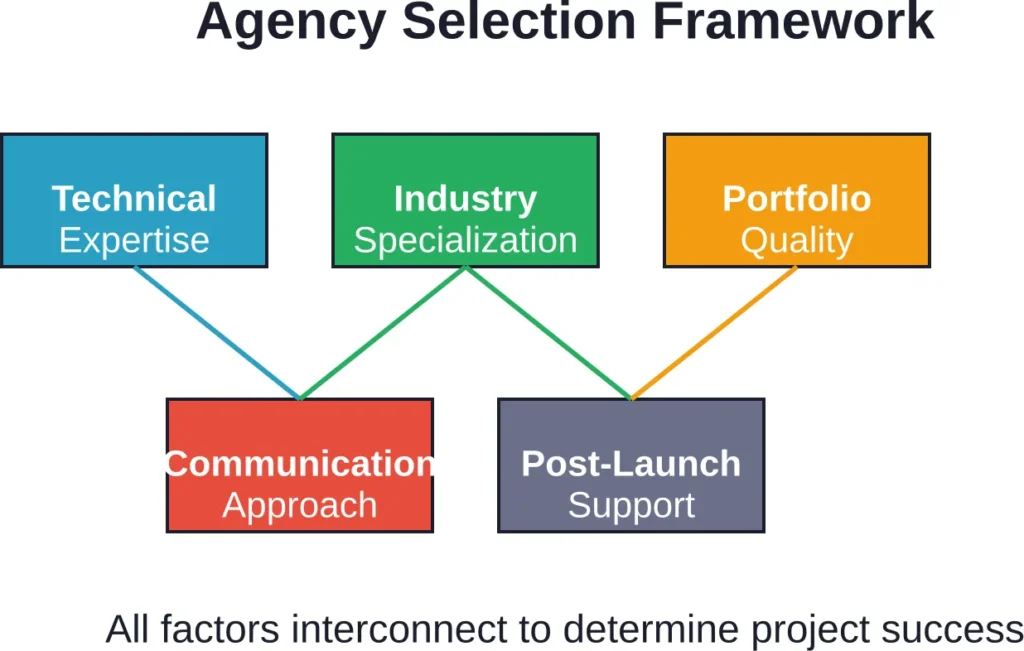
With 15 strong options, how do you narrow down to the right partner for your specific project? Here’s a practical framework.
Start With Specialization Alignment
Generic capabilities matter less than relevant expertise. An agency that’s built twenty SaaS products understands that domain better than one that’s built two SaaS products and eighteen brochure sites.
Look for portfolio examples similar to your project. Not identical—good agencies apply learning across projects—but similar enough that they understand the problem space. eCommerce agencies know checkout flows. SaaS agencies understand onboarding. Enterprise agencies navigate stakeholder complexity.
Ask about relevant experience directly. How many projects have they completed in your industry or product category? What did they learn? What would they do differently?
Evaluate Portfolio Quality Over Quantity
Don’t count projects. Assess outcomes.
Strong portfolio pieces show clear business context. What problem was the client solving? What approach did the agency take? What results did they achieve? Vague case studies with just pretty screenshots suggest limited strategic involvement.
Look for variety within specialization. An eCommerce agency should show different approaches for different brands, not the same solution repeated. Adaptability within expertise demonstrates real understanding rather than rote application of templates.
Examine technical sophistication appropriate to your needs. If you’re building a complex application, portfolio examples should demonstrate handling of similar technical challenges. If you’re creating a marketing site, excessive technical complexity might indicate poor product-channel fit.
Assess Communication and Process Fit
Process alignment prevents friction. Some agencies work best with minimal client involvement, others thrive on collaboration. Neither is wrong, but misalignment creates frustration.
Ask about communication cadence. How often do they update clients? Through what channels? Who’s the main point of contact? How are decisions made?
Understand their project management methodology. Agile approaches involve clients in sprint reviews and prioritization. Waterfall methods define scope upfront with less flexibility. Hybrid approaches balance structure and adaptability.
Consider your organization’s capacity for involvement. Collaborative processes produce better outcomes but require time investment. If internal stakeholders can’t commit to regular reviews and quick feedback turnaround, agencies with more autonomous processes might fit better.
Verify Technical Capabilities
Not all development expertise is equal. Agencies might claim proficiency in technologies they’ve used once or twice.
Ask specific technical questions relevant to your project. If you need a React application, how many React projects have they built? What state management approaches do they favor? How do they handle testing? What’s their deployment process?
For complex projects, request a technical architecture discussion. Good agencies can explain their proposed approach, articulate tradeoffs, and justify technology choices. Vague answers or reliance on buzzwords suggest superficial expertise.
Check whether they maintain technical blog content or contribute to open source. These activities indicate deep technical engagement rather than surface-level capability.
Understand Post-Launch Support
Websites require ongoing attention. Platforms need updates. Bugs emerge. Requirements evolve. Content changes. Clarify support arrangements upfront.
Some agencies include post-launch support in project scopes. Others offer retainer arrangements. Still others hand off to clients or third-party maintenance providers. None of these models is inherently better, but you need clarity before launch.
Ask about typical support arrangements. What’s included? What costs extra? What response times can clients expect? How are updates prioritized?
For platforms or applications, discuss long-term partnership possibilities. Can the agency scale support up or down based on needs? Will you work with the same team members? How do they handle knowledge transfer if the relationship ends?
Red Flags to Watch For
Certain warning signs suggest potential problems. Here’s what to watch for during agency evaluation.
Overemphasis on Awards and Accolades
Design awards recognize creative work, which is fine. But agencies that lead with awards over client outcomes might prioritize work that wins competitions over work that achieves business goals.
Look for case studies focused on results. Traffic increases. Conversion improvements. User satisfaction metrics. Revenue impact. These demonstrate business value rather than just aesthetic achievement.
Vague Timelines and Process Descriptions
Professional agencies articulate clear processes. They can describe typical project phases, duration ranges, and key milestones. Vagueness suggests either inexperience or intentional obscurity.
Ask for example project timelines. What happens in each phase? What deliverables do clients receive? Where do dependencies typically emerge? Clear answers indicate structured approach and realistic expectations.
Portfolio Showing Only Visual Design
Pretty screenshots don’t demonstrate development capabilities. Strong portfolios show interaction design, explain technical architecture, discuss performance optimization, and address accessibility considerations.
For development-focused evaluation, ask to see live projects or request technical case studies that go deeper than visual design. How did they solve specific technical challenges? What performance benchmarks did they achieve? How did they approach scalability?
Pressure Tactics or Urgency Creation
Good agencies don’t need to pressure prospects. They have enough work and recognize that projects work best with strong client-agency fit.
Artificial urgency—”we only have one slot available,” “this price is only good until Friday”—suggests either desperate need for work or manipulative sales practices. Neither builds confidence.
Lack of Strategic Questions
Agencies that jump straight to solutions without understanding context signal shallow thinking. Initial conversations should involve more questions than answers.
What are you trying to achieve? Who are your users? What constraints do you face? What have you tried before? What does success look like? Agencies asking these questions demonstrate strategic thinking beyond execution.
Making the Final Decision
Narrow to two or three finalists based on specialization alignment, portfolio quality, and technical capabilities. Then make the final decision based on relationship factors.
Request Proposals or Audition Projects
Detailed proposals reveal how agencies think. Good proposals don’t just outline deliverables—they demonstrate understanding of your business context, articulate strategic approach, and explain why specific methods fit your needs.
Some organizations use paid audition projects for final evaluation. Small, real projects demonstrate working style, communication patterns, and output quality better than proposals or presentations.
If budget allows, consider audition projects for projects where relationship fit matters most. The investment provides clarity worth many times the cost if it prevents a mismatched engagement.
Check References Thoughtfully
Don’t just ask for references—agencies provide clients who’ll speak positively. Ask specific questions that reveal working relationship quality.
How did the agency handle unexpected challenges? How responsive were they to feedback? What would you change about the process? Would you work with them again? Why or why not?
Listen for hesitation or qualified enthusiasm. “They did good work but…” statements reveal friction points. Understand whether those friction points would matter for your project.
Trust Your Gut on Culture Fit
Data and process matter, but so does interpersonal chemistry. You’ll spend months working closely with this team. Communication style, personality, and values alignment affect project experience significantly.
If interactions feel difficult during sales process—slow responses, communication mismatches, personality clashes—these patterns typically intensify during project work. Trust discomfort as signal.
Conversely, easy communication and natural rapport suggest smoother collaboration. When agencies understand you quickly and you understand them, less energy goes to coordination overhead and more to creative problem-solving.
Common Web Development Project Challenges
Understanding typical challenges helps set realistic expectations and evaluate how agencies handle difficulties.
Scope Creep and Timeline Extensions
Projects expand. New requirements emerge. Stakeholders request additions. Technical constraints appear.
Good agencies manage scope actively. They document requirements clearly. They use change request processes. They communicate tradeoffs when scope increases—timeline impact, budget implications, or feature prioritization.
Ask agencies how they handle scope changes. What’s their change request process? How do they communicate impact? How do they help prioritize when everything seems important?
Design-Development Handoff Issues
Friction between design and development teams creates problems. Designs that ignore technical constraints. Implementations that don’t match design vision. Both scenarios frustrate everyone.
Agencies with integrated teams—where designers and developers work together throughout—avoid these handoff problems. Technical feasibility informs design decisions. Designer intent guides implementation choices.
For agencies with separate design and development functions, ask about collaboration processes. When do developers review designs? How are technical constraints communicated? How are implementation questions resolved?
Browser and Device Compatibility
Websites must work across browsers, operating systems, and device sizes. Testing takes time. Edge cases emerge late in projects.
Professional agencies build responsive design into initial development, not as an afterthought. They test across devices and browsers throughout development. They establish browser support targets upfront based on audience analytics.
Ask about testing processes and supported browsers. What devices do they test on? How do they handle older browser versions? What accessibility standards do they target?
Performance and Page Speed
Slow sites frustrate users and hurt search rankings. Performance optimization requires technical expertise and discipline throughout development.
Good agencies treat performance as a feature, not an afterthought. They establish performance budgets. They optimize assets. They minimize dependencies. They test on realistic connection speeds, not just office wifi.
Ask about performance approach. What tools do they use? What metrics do they target? How do they optimize images, code, and assets? How do they balance design ambition with performance constraints?
The Future of Web Development Agencies
The web development landscape continues evolving. Understanding emerging trends helps evaluate whether agencies will remain relevant partners as technology and practices change.
AI-Assisted Development
AI tools increasingly assist with code generation, testing, and optimization. Agencies adopting these tools thoughtfully gain efficiency without sacrificing quality. Those resisting adaptation may fall behind.
But AI doesn’t replace expertise—it amplifies it. Good agencies use AI to handle repetitive tasks, freeing senior developers to focus on architecture, problem-solving, and optimization. The strategic and creative dimensions remain human.
Performance and Core Web Vitals
Search engines increasingly weight site performance and user experience metrics. Core Web Vitals—loading speed, interactivity, and visual stability—now directly impact search rankings.
Agencies prioritizing performance throughout development deliver sites that rank better and convert higher. Those treating performance as optional create technical debt that hurts both user experience and discoverability.
Accessibility as Standard Practice
Web accessibility is both ethical imperative and legal requirement. Regulations in many jurisdictions mandate accessible digital experiences. Beyond compliance, accessible sites reach broader audiences and often perform better for everyone.
Progressive agencies build accessibility into standard practice, not as expensive add-on. They understand WCAG guidelines. They test with assistive technologies. They design and develop inclusively from project start.
Composable Architecture and Headless CMS
Traditional monolithic CMS platforms give way to composable architectures—content managed separately from presentation layer, with APIs connecting components.
This approach provides flexibility, performance benefits, and future-proofing. Content lives in specialized systems. Frontend developers use modern frameworks. Teams choose best tools for each function rather than forcing everything into one platform.
Agencies with expertise in headless CMS and API-driven development can build more flexible, performant solutions than those locked into traditional platform thinking.
Questions to Ask During Agency Consultations
These questions reveal agency capabilities, approach, and fit:
- How many projects similar to ours have you completed in the past year?
- Can you walk us through a recent project that faced significant challenges? How did you handle them?
- What’s your typical project process from kickoff to launch?
- How do you handle scope changes or new requirements that emerge mid-project?
- What communication cadence should we expect? Through what channels?
- Who will be our day-to-day contact? Will we interact directly with designers and developers?
- What happens if we’re unhappy with initial designs or development work?
- How do you approach performance optimization and accessibility?
- What happens after launch? What support do you provide?
- Can you provide references from recent clients with similar projects?
- What technologies would you recommend for our project, and why?
- How do you handle browser and device testing?
Listen not just to answers but to how agencies answer. Do they ask clarifying questions? Do they explain tradeoffs? Do they acknowledge what they don’t know? These patterns indicate thinking depth and intellectual honesty.
Frequently Asked Questions
Web development costs vary dramatically based on project complexity, agency expertise, and scope. Industry reports suggest simple marketing sites might start around a few thousand dollars with smaller agencies or freelancers, while custom web applications from established agencies can reach well into six figures. Complex enterprise platforms with Code and Theory or similar firms often command substantial investments. Rather than focusing solely on cost, evaluate value relative to your business goals and expected return. The cheapest option rarely delivers the best outcome.
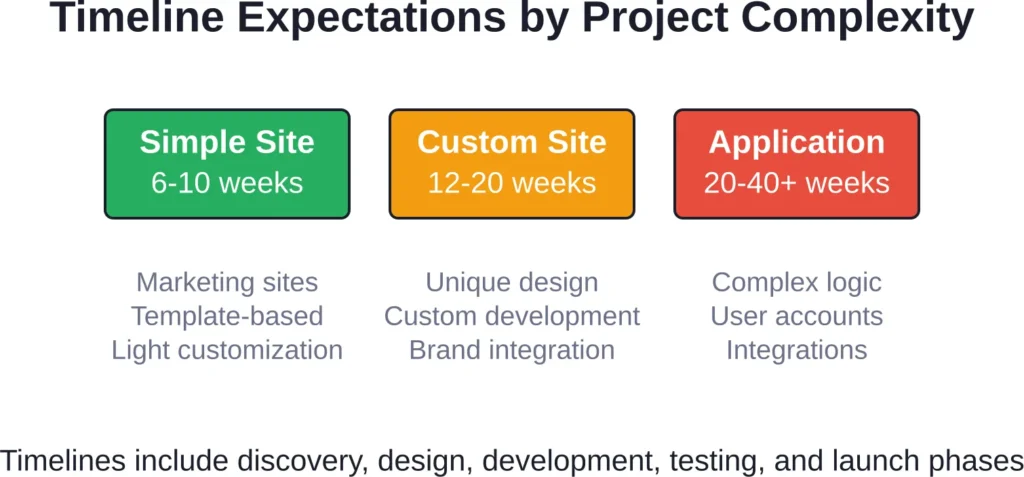
Project timelines depend on complexity and scope. A simple marketing site might take 6-10 weeks from kickoff to launch, including discovery, design, development, and testing phases. Custom websites with unique design and functionality typically require 12-20 weeks. Complex web applications or platforms often span 20-40 weeks or longer, especially when involving multiple integrations, user authentication, complex business logic, or iterative feature development. Agencies rushing timelines often sacrifice quality or overwhelm clients with compressed feedback cycles.
Location matters less than it once did. Many successful client-agency relationships happen entirely remotely, with video calls replacing in-person meetings. Remote work can expand options, letting you engage agencies with specific expertise regardless of geography. However, some organizations prefer local agencies for time zone alignment, occasional face-to-face meetings, or supporting local businesses. Evaluate communication capabilities rather than location—an unresponsive local agency is worse than a highly communicative remote one.
Look beyond visual appeal to business context and results. Strong portfolio case studies explain the client’s challenge, the agency’s strategic approach, key decisions and tradeoffs, and measurable outcomes. Examine whether portfolio examples demonstrate relevant expertise for your project type. Check if designs show thoughtful user experience, not just surface aesthetics. For development evaluation, request to see live sites or technical case studies that explain architectural decisions and performance optimization. Variety within specialization demonstrates adaptability while maintaining expertise.
Web design agencies focus primarily on visual design, user experience, and interface creation. They determine how sites look and how users interact with content. Web development agencies focus on technical implementation—writing code, building functionality, connecting systems, and optimizing performance. Many agencies offer both services with integrated teams, while others specialize in one area and partner with specialists for the other. For most projects, agencies with both capabilities in-house create more cohesive outcomes with fewer handoff issues.
Websites require ongoing attention even after launch. Software platforms need security updates. Content changes. Performance optimization continues. User feedback reveals improvement opportunities. Some agencies include post-launch support periods in project scope, others offer ongoing retainers, and some hand off to clients for self-management. Clarify support arrangements before launch. For complex platforms or if internal technical resources are limited, ongoing agency partnership often makes sense. For simpler sites with technical staff available, self-management may work well.
Client involvement levels vary by agency and project approach. Collaborative agencies involve clients in regular sprint reviews, design feedback sessions, and prioritization decisions—expect several hours per week throughout the project. More autonomous agencies work with less frequent check-ins, requiring involvement primarily at key milestones. Neither approach is inherently better, but alignment matters. Under-involvement leads to outcomes missing the mark; over-involvement when agencies don’t expect it disrupts workflow. Discuss involvement expectations upfront and ensure internal stakeholders can commit the necessary time.
Taking the Next Step
Choosing a web development company is one of the most important decisions in your digital strategy. The right partner doesn’t just build a website—they become a collaborator in achieving business goals, a strategic advisor navigating technical decisions, and an extension of your team.
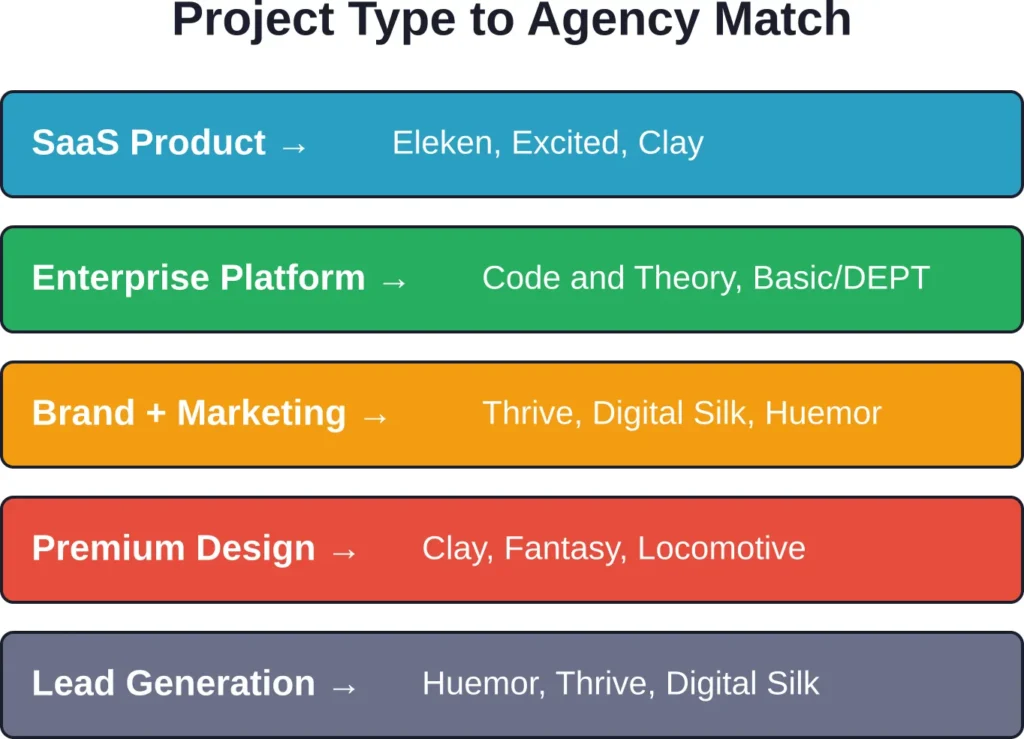
The 15 agencies profiled here represent different approaches, specializations, and strengths. There’s no universally “best” agency—only the best fit for your specific project, organization, and goals.
Start by clarifying what you need. What type of project are you undertaking? What outcomes define success? What constraints do you face? Clear answers to these questions guide agency selection more effectively than any ranking.
Then match your needs to agency specialization. Look for relevant portfolio examples. Evaluate technical capabilities for your specific requirements. Assess communication fit and process alignment.
Request consultations with your top choices. Ask the questions that matter for your project. Listen to how agencies think, not just what they say. Check references thoughtfully, asking specific questions about working relationship quality.
Trust both data and instincts. Evaluate capabilities objectively while recognizing that relationship factors—communication style, cultural fit, collaborative chemistry—significantly impact project success.
The digital landscape grows more complex every year. Technology evolves. User expectations rise. Competition intensifies. The right agency partner helps navigate this complexity, applying expertise to create digital experiences that drive real business results.
Don’t settle for good enough. Don’t choose based solely on cost. Invest in finding the agency that brings the right combination of technical capabilities, relevant experience, strategic thinking, and collaborative approach for your specific needs.
Your website or application represents your brand, serves your users, and drives your business forward. Make the agency selection decision with the care and rigor it deserves. The investment in finding the right partner pays dividends throughout the project and beyond.